
The Covenants: A Follow-up to Andy’s Post on Protective Custody; What is the New Birth? Were Old Covenant Saints Born Again?
 This ministry feels pretty good about what we teach on New Testament Justification. It’s theological math that adds up. In opposition to authentic Protestant orthodoxy, we teach that the believer is righteous and holy as a state of being. We reject the Protestant notion that Christ supplies an ongoing substitution for the penalty of sin and a substitutional righteousness that can only be obtained by church membership.
We also understand that confused Protestants of various stripes; Baptist, Methodist, even Presbyterian, will protest this assertion but they are simply misinformed and confused. The accusations we level at the church are based on Protestant documentation. What’s wrong with church? Answer: a false gospel that denies a biblical definition of new birth.
Now, the new birth from a New Testament perspective is easy to nail down; the theological math adds up perfectly, but when you try to figure in Old Testament believers it can get really challenging. If you’re a Protestant theologian it’s simple: the penalty for sin is an ongoing substitution and so is righteousness; the Old Testament looked towards its culmination and the New Testament looks back. The only difference between the two Covenants is time. “Believers” remain totally depraved and keep themselves saved by believing they can do no good work and they need ongoing salvation by revisiting the same gospel that saved them every day which can only be obtained through church membership. Then, at the final judgment, everyone finds out if they lived by faith alone in what Jesus supplies as an ongoing substitution well enough to get into heaven.
It’s really works salvation by doing nothing with intentionality other than revisiting the gospel every day and rejoicing in how evil you are as set against God’s holiness. Viz, your “gratitude” saves you and nothing else. Paul David Tripp calls this a “lifestyle of repentance” and “resting and feeding on Christ.” At the final judgment, you are judged according to how well you rested in your Christian life. This is John Calvin’s Sabbath rest sanctification that he articulated in his Institutes. I have written on this extensively and will not belabor it here.
For sure, it would be easy enough for Andy and me to rest on what we have figured out thus far and say, “Hey, we know what the deal is presently, so who cares about the Old Testament?” But, it is a funny thing about truly loving the Scriptures and God’s truth; you want to know everything about it that you can, so here we are.
So far, we are up to three posts on this issue here, here, and here. Take note of the comments here that are furthering the discussion. As I have stated before, the collective efforts of God’s laity will figure all of this out, not the 500-year-plus regurgitation of Protestant progressive justification overseen by the authority of men and not Christ. Hopefully, the discussion between Andy and I have our readers searching the Scriptures for themselves and with their own mind.
Andy’s thesis fits together well regarding the idea that the Spirit baptism and the new birth are the same thing…if I am understanding him properly. And, if I am understanding him properly, what makes his thesis fit together well is the idea that the covering or taking away of sin makes one righteous. I struggle with that. A declaration of righteousness based on the removal of sin doesn’t change the heart; a changed heart is what makes a person righteous. Somehow, the Old Testament believers received a transformed heart and mind. In other words, I am adamant that the Old Covenant transformation was twofold just like New Covenant transformation is twofold. I lean towards the idea that there is a transformed heart in both while sin was covered in the former and ended in the latter. BUT, again, taking care of sin one way or the other does not make one righteous; it’s merely a sinner who is not going to hang on the gallows.
I do believe we make this more difficult than it is because we fail to use my favorite hermeneutical assumption; the problem with God’s word is—its too simple. Seriously, Susan and I do a lot of counseling which has become more repetitious than anything. After showing people the problem clearly stated in Scripture, they will continually come back to us with other possible scenarios. What the Bible states about the problem is often just too simple.
Not to say that everything is simple, I can’t deny that this issue seems to be fairly complex from our Western perception. But in all of this we must not forget the hermeneutic of simplicity; what is plainly stated in Scripture about the issue? Get that down, and then build on it. So, let me throw out another element for consideration. How it fits into the overall discussion will take more study.
How were the hearts of the Old Testament believers transformed, and does that necessarily qualify as the new birth? Not necessarily. However, there is something objective we can park on; the book of Hebrews demands the same thing for New Covenant believers that Old Covenant believers had: “faith.” In fact, the Old Covenant believers are held up as the example for such. Are we overlooking the gravity of this one word? I think we are. This is another very important hermeneutical principle: pay attention to single words and ask yourself what they really mean. Let me give you an example. I have struggled for some time in regard to the significance of the word “grace” and how it should be perceived in biblical contexts. Try this: whenever you see that word in Scripture, insert the word “love” in its place and see how it works. Is the “grace” spoken of in the verse speak to something that God’s love does? See how it works for you.
At any rate, let’s get back to “faith.” Consider:
Romans 10:17 – So then faith cometh by hearing, and hearing by the word of God (KJV).
Now consider the father of our “faith,” Abraham:
Genesis 15:6 – and he believed the LORD, and he counted it to him as righteousness.
We don’t want to miss the following: faith is synonymous with righteousness and faith is something that is alive. Faith comes when one hears the word of God (which is commonly referred to in the Bible as a “seed”) and believes what is heard. When one believes the word of God, faith is the result, and faith is not only synonymous with righteousness but is something that is alive resulting in actions characteristic of it. Is this the new birth? I wouldn’t be dogmatic about it at this point, but if I wanted to I would probably use 1Peter 1:23…
since you have been born again, not of perishable seed but of imperishable, through the living and abiding word of God;
The biblical concept of God’s word as a seed (see Matthew, chapter 13) that is in us is woefully neglected as a piece of the justification puzzle. Here, it could be argued that Peter is saying that the new birth comes through the word of God. However, we must ask, “New birth in what context?” In the Old Testament, as far as I can tell, believers are not yet God’s literal family and Jews and Gentiles have not been baptized into one body. This may be a valid demarcation. Nevertheless, “faith” is a living transformation that took place within the Old Testament believer and resulted in different behaviors characterized by faith. Because of faith, the Old Covenant believer was literally righteous as a state of being while sin was imputed to the law. This is more than a mere legal declaration.
This necessarily brings us to the accounting like words used to refer to Abraham’s righteousness. Let’s go to Romans for this:
Romans 4:1 – What then shall we say was gained by Abraham, our forefather according to the flesh? 2 For if Abraham was justified by works, he has something to boast about, but not before God. 3 For what does the Scripture say? “Abraham believed God, and it was counted to him as righteousness.”
In both the Hebrew (Gen 15:6) and the Greek here, instead of the idea that something was credited to Abraham’s account, the words are really closer to the idea of an objective assessment or judgment. Abraham believed God, so it was determined that he was righteous; not something credited to his account as a promissory note because sin was dealt with by imputation to the law. With that said, there is seemingly, some biblical merit to righteousness being the absence of sin’s condemnation:
Romans 4:4 – Now to the one who works, his wages are not counted as a gift but as his due. 5 And to the one who does not work but believes in him who justifies the ungodly, his faith is counted as righteousness, 6 just as David also speaks of the blessing of the one to whom God counts righteousness apart from works:
7 “Blessed are those whose lawless deeds are forgiven, and whose sins are covered; 8 blessed is the man against whom the Lord will not count his sin.”
However, I think it is better stated that the two go hand in hand while coming from different angles. This brings us to yet another very important hermeneutic: other than the specific definition of a word, how is it used or defined elsewhere in Scripture? Instead of the idea of Abraham’s righteousness being something like a legal declaration accredited to his account as a promissory note, James describes his faith as something alive that produced works that showed him righteous:
James 2:14 – What good is it, my brothers, if someone says he has faith but does not have works? Can that faith save him? 15 If a brother or sister is poorly clothed and lacking in daily food, 16 and one of you says to them, “Go in peace, be warmed and filled,” without giving them the things needed for the body, what good is that? 17 So also faith by itself, if it does not have works, is dead.
18 But someone will say, “You have faith and I have works.” Show me your faith apart from your works, and I will show you my faith by my works. 19 You believe that God is one; you do well. Even the demons believe—and shudder! 20 Do you want to be shown, you foolish person, that faith apart from works is useless? 21 Was not Abraham our father justified by works when he offered up his son Isaac on the altar? 22 You see that faith was active along with his works, and faith was completed by his works; 23 and the Scripture was fulfilled that says, “Abraham believed God, and it was counted to him as righteousness”—and he was called a friend of God. 24 You see that a person is justified by works and not by faith alone. 25 And in the same way was not also Rahab the prostitute justified by works when she received the messengers and sent them out by another way? 26 For as the body apart from the spirit is dead, so also faith apart from works is dead.
Faith is something that is alive that works because it is living; you don’t work to get righteousness, but righteous faith works because it is living. In this way, saints of old were justified by works because their works demonstrated their living faith as a result of believing God and His word. A dead corps doesn’t work because it’s dead.
Now, the New Testament frames all of these things differently. In the New Testament, faith works through love. How does circumcision, the one new man (Jew and Gentile), the family of God versus the “friend of God,” the times of the Gentiles, the body of Christ, and all other elements fit together? Is the ending of sin the full consummation of the new birth? It will take more study.
paul
The Philosophy of the Reformation and Its Historical Impact, by John Immel – Part 2
Taken from John Immel’s second session at the 2012 Conference on Gospel Discernment and Spiritual Tyranny
Published with permission
~ Edited by Andy Young
Click here to read Part 1
Click here to read Part 3
Click here to read Part 4
People hear “philosophy” and they tend to think of academics talking about useless ideas. This perception has everything to do with the collapse of philosophy as a science. In the middle 1700s, Immanuel Kant took hold of “reason” and wrote a book called The Critique of Pure Reason. His goal with to reduce reason to ash. He wanted to destroy man’s competence and reason so that the Christian religion could regain its monopoly on faith.
If you tell people long enough that thinking is irrelevant, then eventually everyone thinks thinking is irrelevant and the average fifteen-year-old sitting in math class says, “Why do I need to know this?” Or the average eighteen-year-old sitting in advanced history class says, “Well, why do I need to know this? Why isn’t it okay that I’m stupid?”
Now they don’t say that out loud because they feel entitled to what they do know, their mastery of the latest X-Box game or their knowledge of whatever is in pop culture, for example. But they see no causal relationship between their given body of thought and their given body of action. No one has ever explained to them that the content of their thinking is in fact a cohesive whole.
Everybody has individual stray thoughts, but those don’t amount to much. On the other hand, full philosophical statements have enormous power. For example, the statement, “Give it over to the universe,” is a philosophical statement. It is a tenet from the book The Secret written by Rhonda Byrne in 2006. This philosophical statement summarizes the elements of quantum physics and the mystical assumption that the universe is a conscious creature that is aware of your needs.
Another example is, “No one can know anything for sure.” This philosophical statement presupposes that there is no objective truth. It is a summation of Friedrich Hegel and Immanuel Kant’s full philosophic conclusions. When somebody insists to you that you cannot know anything, that there is no absolute in life, they are citing a deep philosophical tradition that goes back to the mid 1700s.
Here is another example. “Jesus died for our sins,” is often believed to be a “Biblical” statement. While it is true that Paul makes this statement in 1 Corinthians 15:3, the traditional “orthodox” interpretation of that statement is rooted in the doctrines of “original sin”, federal guilt, atonement, and the ratification of a new covenant. And further notice that doctrine of “original sin” first recorded by Irenaeus, who lived from AD c125-c202, differs from Saint Augustine’s theology of “original sin.” Irenaeus taught that God saw sin as a necessary step for the education of mankind rather than some obstacle that God must continually overcome (source: http://www.lifeissues.net/writers/zim/ev/ev_01evolution_sin13.html). Notice that Augustine’s variation of Original sin necessitated the concept of federal guilt: the presumption that Adam ultimately is responsible for the simple destruction of the whole race. And then notice that to solve the problem of “salvation” that these doctrines advance requires a specific understanding of “atonement.” All of these doctrines emerge almost 400 years after the gospels were written and are the requisite foundation for the throwaway line “Jesus died for our sins,” to be understood.

Can’t we all just get along?
In each statement discussed above there are layers upon layers upon layers in understanding. The conceptual layers are philosophy. It is the progression from the assumptions all the way through to the final summation that ultimately ends up on a bumper sticker. When you see a bumper sticker such as the popular one now that says “coexist” written out in formula or symbols representing all the various spiritual faiths and beliefs. But the bumper sticker means to ask the question: “Can’t we just all get along?” And the bumper sticker presumes that all religions are created equal. If one does not know the content of each religion, then it seems “logical” that people of faith should all be able to coexist.
This is the ultimate power of philosophy, taking ideas, very big, very large ideas and ultimately rolling them down so that you and I can grasp ideas in the simplest terms.
The Gospel According to John Immel, chapter 3:1-3
1. All people act logically from their assumptions.
2. It does not matter how inconsistent the ideas or insane the rationale. They will act until that logic is fulfilled.
3. Therefore, when you see masses of people taking the same destructive actions, if you find the assumptions, you will find the cause.
Humans are the sum of their collective ideas. Humans are built to think and to use our minds to engage the world in which we live. The command from the beginning, “be fruitful and multiply,” rule and subdue the earth, presupposes a mastery of the earth. It presupposes the ability to master the earth, and it specifically presupposes that you are charged with the responsibility to master the earth. The one thing that sets man apart above all else is that man is not specifically designed to live in any given environment. He must alter his environment to live in it, which means he must think. He must manipulate his environment to his advantage. Every other creature, every other animal is specifically built to function within its environment. Man is not. Man is utterly separated from all the rest of creation, set at its pinnacle as a master of that creation by virtue of his rational mind. This means by necessity we must understand the difference between good and bad ideas.
Disciplines of Philosophy
– Metaphysics
– Epistemology
– Ethics
– Politics
So when I talk about philosophy, I’m not talking about vain concepts, “vain philosophies,” or intellectual beach balls batted around in ivory towers. I am specifically referring to how we know what we know. The nature of existence is called metaphysics. How we know what we know is called epistemology. How we value what we know is called ethics. And how we interact with people is called politics.
Our metaphysical assumptions about the nature of existence is the beginning of the path down to mass of action. They are the concepts that are above the physical realm that we must come to understand and are in fact transcendent specifically of the here and now. Once we understand this, then we understand epistemology. Man understands how he knows what he knows. Once he understands his existence, he then understands how he interacts with that existence. That ultimately produces his values.
Here is an example. How do you know you should drink water? What is the value of water? You value water because it is necessary to keep you alive. Your specific metaphysical truth that your body needs water to survive makes water good. Those are your ethics. Now let us ask this question. Once we have our ethics, how do we know how to interact with human beings? That is the study of politics. This is the driving force of human existence, from the most rudimentary, to how man understands, to how man derives his specific set of values, to ultimately how man interacts with the rest of the world, the other individuals in the world.
What does this have to do with Calvinism, Reformed theology, and spiritual tyranny?
Absolutely everything.
The existing fight over Neo Calvinism and the Neo Reformed movement in the United States is specifically built upon philosophical issues. They portray the nature of human existence as a moral evil. Man’s very being IS the problem. It is this metaphysical premise that has undergird man’s trend towards destruction. This is a bold statement, but you will understand shortly.
I want you understand a specific principle. The major metaphysical premises, which are your foundational assumptions, determine your epistemological qualification. This speaks to the idea of competence. When we discuss epistemological qualification, we are talking about where we decide who is qualified to do what. Epistemological qualification defines ethical standard. Once you decide how competent you are, that determines what your ethics are. From there, ethical standards prescribe political culture.
This is high-level stuff but let me try to break this down a little more. Foundational assumptions (metaphysics) determine how effective man is to understand his world, defines moral value, and prescribes government force.
Plato was one of the first man to author a full comprehensive philosophical statement. There were others prior to him, but Plato has dominated the vast percentage of western history, which is ultimately the heritage of the United States. Here is Plato’s premise:
“This world is a mere reflection of other worldly forms.”
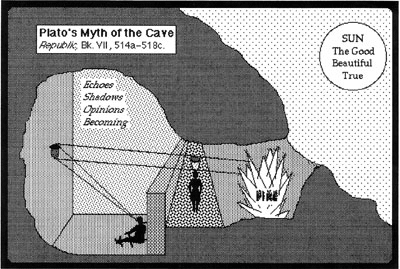 In other words, if I were to hold up a bottle of water for you to consider, that bottle of water does not really exist. There is actually a pure and true bottle of water in some other place. The bottle that I hold in my hand is imperfect. It is a form of something else. This assumption therefore determines that man cannot know truth because he experiences the imperfect shadow world. The metaphor Plato uses is that man stands in a cave. There is a fire in the cave that ultimately casts a shadow on the wall. All man sees is in fact that shadow. That’s all man truly understands about the nature of the world. In Plato’s philosophy, only select men of the highest character and a longstanding study can achieve enlightenment.
When you make these first three assumptions about reality, the resulting conclusion is that “philosopher kings” should govern the great unwashed.
Do you see the progression?
The moment you accept as true that man is incompetent, the moment you decide that truth is beyond his capacity, that is the moment you accept that only a select few are somehow able to know the truth, and they are the only ones uniquely qualified to force the rest of us to their enlightened understanding.
Here is another example.
Karl Marx said that history is a community fight over resources. That was his metaphysical premise. The community is first and the community creates truth. Therefore, all members of the community must work for the common good, and the common good is synonymous with the collective will. This means that government is right to force each person to provide according to his ability and to be given only according to his need. Notice that the metaphysical premise ultimately turns part of a culture into slaves.
Here is another example.
Augustine said “original sin” means the “fall of man.” That is the metaphysical premise. This means that man qua man is fully and entirely disqualified. His very existence is a moral affront. The nature of sin so fully corrupted who and what he is that ultimately man cannot know any good. In other words, you cannot know that water is good for you. The nature of your depravity so corrupts what you are that you cannot define good. The conclusions that arise from this assumption are of vicious nature. Primarily, man has no ethical standard because he has no good. He can never act with good on his own. It then follows that:
God must enforce moral standards, and the doctrine insists that the Holy Mother Church is responsible to use that force against depraved humanity.
Anybody who has an inch of knowledge about Catholic church history knows this is where the disaster of the Dark Ages comes from: the massive tide of human destruction and the warfare. The warfare and destruction is no accident; it follows from the metaphysical premise. When you presume that the masses of humanity are functionally incompetent, you can arrive at no other conclusion than that man must be compelled by force.
This is my contribution to the discussion of philosophy in the world.
Universal Guilt + Mass Incompetence = Dictated Good
The first three elements of every cause of tyranny follow exactly this way. All tyranny is derived from two primary presumptions. I call them universal guilt and mass incompetence. Universal guilt basically says that because man is pervasively guilty of some primary moral inferiority, he has no redeeming quality in and of himself. These ideas combine to a government model for dictated good.
This philosophical equation is the source of all tyranny!
Every time you hear a despot, a tyrant, an autocrat speak, if you listen to him long enough you will hear him tell you how incompetent you are and how guilty you are. The primary example in our current culture is the environmentalist propaganda campaign to “Go Green.” Notice the political forces in our culture saying that man is polluting the world and destroying it. Man, is incompetent to do anything else. We must therefore revert to a primitive state where the world is somehow saved. Notice then the themes within the propaganda: man, is universally guilty of destroying the world and he is collectively incompetent to fix the world. The political conclusion is: government must destroy anything that is modern – get rid of cars, get rid of oil, get rid of power, get rid of coal.
Universal guilt equals the metaphysical premise. Mass incompetence equals man’s epistemological determination. In other words, man can’t get the point. He is incompetent at his root. The only thing that’s left is dictating good, and this prescribes the function of government.
Now notice that this is the central premise of John Calvin. Pervasive depravity has wholly corrupted human existence. This determines that all good is the product of God’s specific sovereign action. Notice the vast gap that this places between good and man. Notice how far this removes man from his very environment. This defines man’s life as predetermined in action and in outcome. Lastly, this prescribes an elect few who are divinely appointed to shepherd the flock in God’s behalf.
Americans live with ontological certainty of religious freedom. That big word, ontological, means we are positive that we should be entitled to our own faith. We have never suffered a religious war in the United States. Churches tend to fracture and divide long before it becomes a fight, long before it comes to blows, long before it becomes bloodshed. 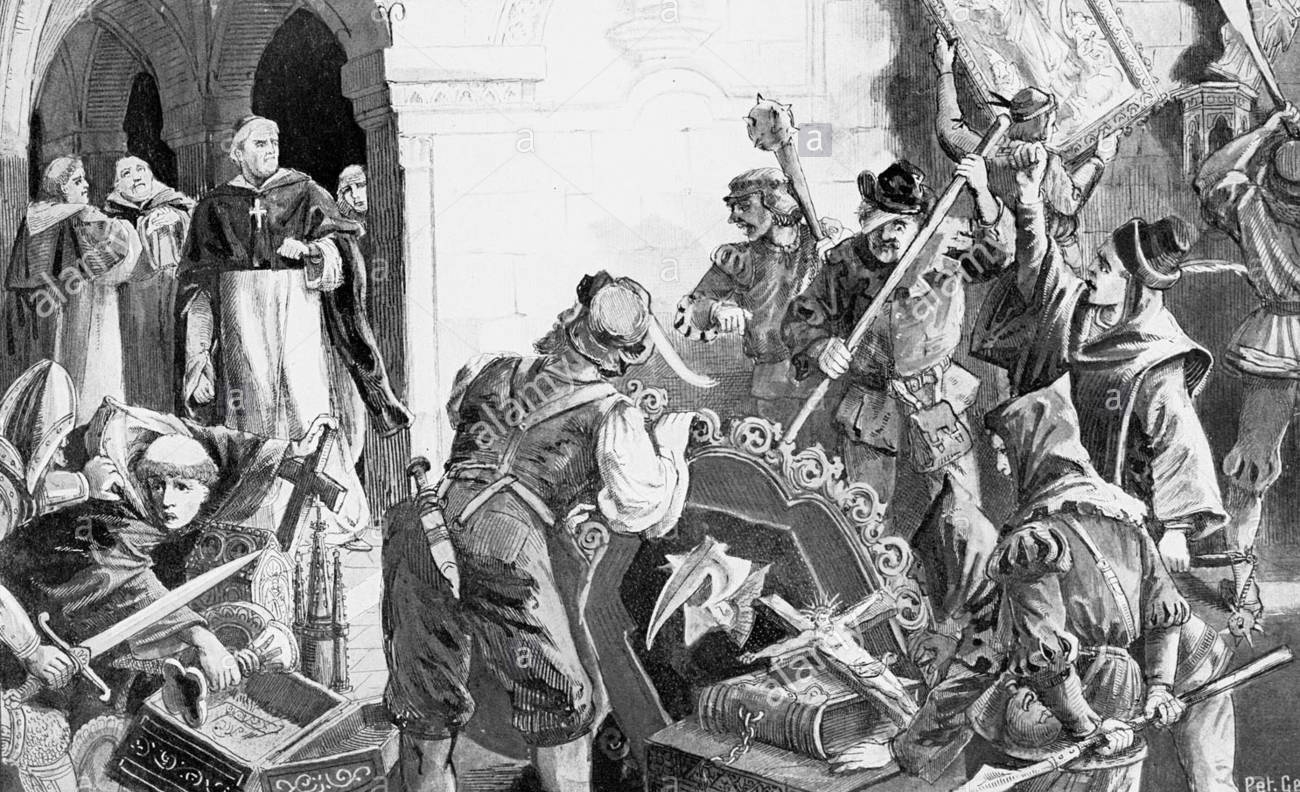 But Calvinism validates violence— or civil force.
To John Calvin, total depravity equals mass incompetence. The irresistible grace of the T.U.L.I.P. acronym equals universal guilt. Irresistible grace implies that the prevailing manifestation of humanity is in fact incompetence, so he must be given a specific grace, but only a select few that will get there. Those select few, those who have experienced limited atonement, are the ones that get to dictate the good. They are the ones that get to wield the force to compel a given body of outcome.
Take each of the doctrines of T.U.L.I.P. and pull them apart – the total depravity, the unconditional election, the irresistible grace, the perseverance of the saints – begin to pull those doctrines apart and notice how they fit into the logical progression that I’ve discussed.
Now you can grasp where our current Christian malaise comes from. It is no accident. The doctrines lead to the exact same result. Every time this body of doctrine has risen its ugly head in the world it has led to bloodshed and destruction. It leads to political force. It leads to civil force. This is where it ends.
And now you understand where tyranny comes from.
~ John Immel

 Paul's Passing Thoughts
1 comment