
About the Gospel

Dear Christians: Don’t You Get It? Calvinists Think You Are Going to Hell
Originally Published February 27, 2013
 I think I have taken my last trip to SBC Today .com and SBC Voices .com. I have been referred over there a number of times to observe truth tone deafness on steroids. A heretic is running our flagship seminary, but the big news is that Tim Tebow cancelled his speaking engagement at FBCD. The big hero this time in the ongoing drama of SBC folklore (in our own pitiful minds) is Dr. Jeffress, who like all other SBC notables has never called out another leader for the same scandalous filth that is going on in most denominations. He will call out homosexuals, but the rape cover-ups in the SBC are a taboo subject. We call out the sins of the world, but to call out our own sin is “gossip.” All of these guys just really make me want to puke. Because they are sorry excuses for leadership—we are a joke in the eyes of the world and rightfully so.
Other articles posit the supposed strength of Calvinists and non-Calvinists working together in the SBC. So, the likes of David Platt will gladly play along while believing that synergistic sanctification is a false gospel and works salvation. This is a simple thing, Jerry Vines needs to call Al Mohler on the phone and ask him if synergistic sanctification is works salvation. I think the answer would surprise him if Mohler has a rare moment of truth telling. Of course, if Vines decides to do something about it, he then has to explain how he missed this all along and focused on symptoms rather than the issue of Calvin’s false gospel. I have been a lay pastor since 1986, and I missed it. Why? Because I was clueless, that’s why. More studied than a lot of Christians, I had a very poor understanding of justification, sanctification, and covenants, and still have a lot to learn. What’s so hard about that? Just admit it! What’s the big deal?
All of this conversation in the SBC about getting along with Calvinists could just as well include the Jehovah Witnesses or the Moonies. There is no difference; a false gospel is a false gospel and a cult is a cult. Calvinism was the epitome of a cult in Calvin’s Geneva and still is. You could slip a playing card in-between Calvin’s Geneva and Jonestown save the fact that Jonestown wanted to go out with a bang. But more to the point let’s talk about Calvin’s false gospel—the gospel that SBC yesomites say we should work together with.
In today’s church words don’t mean things because if they did we would have to do something about it. And we are mostly business as usual loving spiritual slugs. That’s what we need more than anything in the church today: leaders who take words seriously and will act accordingly. They will be easy to spot. When the sun is out during the day they will be walking around rather than sunning themselves on flat rocks like the majority. So, let’s talk about words.
“We must preach the gospel to ourselves every day.” Really? Does this raise any red flags? No. It is so, so indicative of how mindless Christians are in our day. “Wow, that sounds pretty cool. More fish anybody?” Come now, let’s be honest; do we really believe that we have been appointed stewards of God’s life-giving word? Is that how we function? A name that has come up in this ministry a lot this week is Miles McKee. He states a lot of things on his Facebook page that brings hearty kudos from many because their eyes immediately gravitate to the word, “gospel” in the sentence. “Oh there it is! The word gospel! Amen brother!” But let’s

GOSPEL GOODIES! Yum, Yum!
look at his statements more closely. Here is the subline of his Facebook page:
“Preaching Christ crucified to the saved and lost alike. The goal is to pack this web site with rich gospel goodies.”
Yes, and that is exactly what Christian children in adult bodies seek in our day, “rich gospel goodies.” Yum, yum, yum. We can’t take the word of God and help people in real trouble; we are too busy feeding on our gospel goodies. Note the picture at right—that’s us. It is also how the world sees us, and rightfully so.
But note that we are supposed to be preaching Christ crucified to Christians. This doesn’t raise any red flags. Note that the same message preached to unbelievers is also fundamental to the message Christians still need to hear daily. Still no red flags. Particularly alarming should be the idea that Christ’s crucifixion is perpetual in the Christian life. That’s what Calvin believed. He believed the atonement is perpetual. He believed Christ’s death is continually reapplied to the Christian’s life by faith alone until we reach heaven. We are then judged according to whether or not we continually appropriated Christ’s death in our life by faith alone until that day. It’s keeping our salvation by staying at the foot of the cross. We are saved by faith alone, and at any given time that we are not living our Christian life by faith alone we lose our salvation (or they say we were not really saved to begin with). That’s why we preach the same gospel to the saved as well as the unsaved.
It would therefore seem that the new birth would have to be redefined, and you would be right about that. This doctrine necessitates the denial of the new birth. Hence, McKee also states the following:
“Contrary to much of today’s evangelical preaching, we must state that the message of New Birth is not the gospel.”
Regardless of the fact that Christ’s own gospel presentation to Nicodemus was, “You must be born again,” this doesn’t raise any red flags either. The mindlessness truly boggles the imagination. Graeme Goldsworthy, the foremost hermeneutical authority recognized by Calvinists in our day footnoted (with full agreement) an article written by Anglican Geoffrey Paxton entitled, “The False Gospel of the New Birth.” Yes, the gospel that SBC dimwits think they can colabor with denies the new birth in no uncertain terms. This isn’t rocket science: if the gospel that is good for the goose is also good for the gander; this assumes that no change takes place inside of the believer. And in case you haven’t read the papers lately that’s exactly what Christians are acting like.
Moreover, Calvinists think the evangelical new birth gospel is works salvation: “It would be better to die a heathen than to live a religious life and die without Christ” (McKee). And trust me, synergistic sanctification is the “religious life” being spoken of here.
The Calvinist gospel, the centrality of the objective gospel outside of us, is a perfect storm of deception that perfectly facilitates the confounding of salvific terms—I get that. But yet, I see a prevailing arrogance among Christians that since we are so smart, deception will always be evident to us. We are so good at doing Christianity we don’t need practice or diligent study. Our claim that faith is pure and simple is a cloak of arrogance that covers for our bankrupt spirituality and the brunt of jokes among the heathen. If there is a God, where is His representation upon the earth? “Well, we don’t attempt to be the gospel with our own works, we only preach the gospel.” And to that the heathen say,
“Amen.”
paul
“Trusting Jesus” In 2017 For Your Daily Re-Salvation
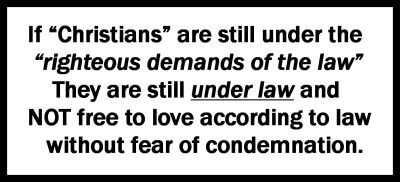
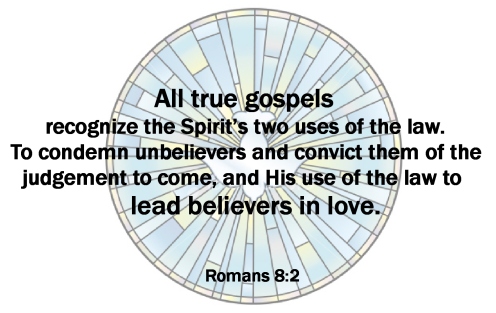
The institutional church has very little to offer people in the way of hope and assurance. Its orthodoxy takes away a believer’s means of showing love to God and others – obedience to the law. By making perfect law-keeping the standard for righteousness, its single perspective on law keeps believers “under law” and in a constant state of fear due to condemnation. But the Bible says that there is no fear in love because perfect (mature) love casts out fear.
We have before us today yet one more example of the orthodoxy of authentic Protestantism to consider. This example happens to come from my former church, Calvary Bible Church in Columbus, OH. One of the current members snapped this image of a power point slide presented during this past Sunday’s sermon.

This slide comes at the “application” part at the end of a sermon which used Hebrews 12:1-2 as a text.
“Wherefore seeing we also are compassed about with so great a cloud of witnesses, let us lay aside every weight, and the sin which doth so easily beset us, and let us run with patience the race that is set before us, looking unto Jesus the author and finisher of our faith; who for the joy that was set before him endured the cross, despising the shame, and is set down at the right hand of the throne of God.” ~ Hebrews 12:1-2
Here are the four points of application for consideration:
- Trusting Jesus keeps us from looking to self
- Trusting Jesus requires trust in all He is for us
- Trusting Jesus is needed most when others hurt us
- Trusting Jesus is key to not growing weary or losing heart in life
Before I even get into addressing the points of application, a brief exegesis and word study of the passage is required.
It is important to understand that the chapter divisions in our Bibles are not there in the original texts. They were added much later as a means to aid in finding certain passages. The unfortunate result is that sometimes the chapter divisions have a tendency to break up the context. Chapter 12 of Hebrews is the concluding application of chapter 11, sometimes known as the “Hall of Faith”. The “cloud of witnesses” mentioned in verse 1 is a reference to all the saints mentioned in chapter 11, some by name, some collectively.
I want to quickly call your attention to the verbs in verse 1. I have marked them in bold.
“Wherefore seeing we also are compassed about with so great a cloud of witnesses, let us lay aside every weight, and the sin which doth so easily beset us, and let us run with patience the race that is set before us,”
This is a very poorly translated verse in both the King James and all modern English translations. While there are five verb forms in this verse, only one verb is part of the main clause and shows the action. It is the word “run”. In the Greek the word is τρεχω (trek-oh). We get our English word “trek” from this, referring to a course or trip or voyage in which we may engage.
While this verb is in the present tense, it is also in the subjunctive mood, which normally indicates a hypothetical possibility. But in this case, since we are not dealing with a conditional statement, this implies a command. It is used as a means of exhorting others to join in on a particular course of action. With this in mind, there is only one main clause in verse 1:
“wherefore, …let us engage in our course of life”
This is the reasonable conclusion the writer of Hebrews draws from the testimony of all the saints mentioned in chapter 11.
The other four verb forms are actually used as participles. A participle is a verb that is used as an adjective or adverb. In English, participles most often end in “ing”. A participle can either describe how an action is performed or it further describes the state of a noun or subject. Knowing then that the other verbs in verse 1 are participles, the verse would better read this way (notice the participles are emphasized in bold).
“Wherefore, we, having this vast cloud of witnesses encompassing us, and having put off every impediment – the sin nemesis – let us then through endurance engage in our course of life lying before us.”
Some things should be obvious in this verse. Foremost is the implication that WE are the ones running our race of life. The command is to US to engage the undertaking of our lives, and we are exhorted to do it with endurance. But also, the grammatical structure gives us the “why”. It is because:
- We have a group of spectators “watching” us. These are the faithful saints who have gone on before us who have given us an example of how WE are then expected to conduct our lives.
- We have the ABILITY to run this race of life with certainty because we have already laid off everything that would hinder us. It is not something we need to do continuously. The aorist (past) tense of the verb indicates it is something that we have already done. Because of our new birth the law is ended, the old man is dead, and sin no longer has any power over us. Sin can no longer restrict us from running as fast as we want to.
Verse 2 gives us further instruction as to “how” or “what” we should do as we run our life race. It begins with the phrase “looking unto Jesus”, but that does not indicate that we “trust Jesus” to run the race for us or even to help us run. The word in the Greek is αφοραω (ah-for-AH-oh). It literally means to perceive from a distance, but the implication means to consider attentively.
Another expression that needs to be examined is “the author and finisher of our faith”. First off, the word “our” is not found in the Greek text, neither is it implied. “Author” is the Greek word αρχηγον (arch-AY-gon), and it means “chief leader”. Jesus is not the “author” of faith as if He was the originator of it. Consider the context of the passage. In the great cloud of witnesses just mentioned in chapter 11, among all of those in that great “hall of faith”, Jesus is the Chief Leader of faith. This means that Jesus is included among all of the saints listed in chapter 11. The author of Hebrews is exhorting us to consider Jesus’ own example of faith.
Furthermore, a close look at the grammar of verse 2 reveals that the verse is not saying that our faith originates and ends with Jesus. Instead, these are two separate aspects of who Jesus is with regard to faith itself. The word translated “finisher” is the word τελειωτης (tel-ee-oh-TACE). It comes from the word “teleos” which means “maturity” or “completeness”. Jesus is the one who made “faith” complete.
If you consider that the audience of Hebrews is Jews, this aspect of Jesus completing faith takes on considerable significance. Remember that God made the promise of a “seed” to Abraham. The apostle Paul also wrote in Galatians about the law being a guardian until “faith” came. With this in mind it is fairly easy to see that Jesus was the promised “seed” and the “faith” that came to end the law. I believe this is the reference the writer of Hebrews is making when he says that Jesus is the “completer” of faith, because Jesus was the promised seed of Abraham, the “faith” that came to end the law and make the new birth possible.
So in verse two, as we run our life race, we are to give attentive consideration to the Chief Faith Leader; the Faith Completer; Jesus! Not only is “faith” completed because Jesus is that promised seed, but we are to consider His example of faith. The rest of the verse cites Jesus’ own example of faith.
“…giving attentive consideration to the Chief Leader and Completer of faith – Jesus – who for the joy that was set before him endured the cross, despising the shame, and is set down at the right hand of the throne of God.”
So now that we understand the correct grammatical-historical context of the passage, let us once again consider the points of application suggested to us by the pastor of Calvary Bible Church.
- Trusting Jesus keeps us from looking to self
- Trusting Jesus requires trust in all He is for us
- Trusting Jesus is needed most when others hurt us
- Trusting Jesus is key to not growing weary or losing heart in life
Please notice that the passage in Hebrews has nothing to do whatsoever about trust or trusting Jesus. This should be blatantly obvious. How does one make the leap from a context having to do with great examples of faith for us to emulate to one of “trusting Jesus”? If one uses a redemptive-historical hermeneutic, it’s fairly easy. Every verse has to be taken in its proper “gospel context”.
Authentic Protestantism is a false gospel of progressive justification. Believers are merely declared righteous while remaining totally depraved and in a constant need of re-salvation and forgiveness for “present sin”. So then:
- A believer then must continually “trust Jesus” for daily salvation instead of looking to himself.
- A believer must “trust Jesus” to do good works through him rather than trying to do any good works himself.
- A believer must “trust Jesus” to be his righteousness for him since the believer is only declared righteous.
- A believer must “trust Jesus” by recognizing his own sinfulness, depravity, and need for constant forgiveness rather than dwell on how other people have wronged him.
- A believer must “trust Jesus” by continuing to live by “faith alone” and persevering in the off chance that maybe he is one of the elect who endures to final justification.
Of course, if at any time you fail to somehow keep “trusting Jesus,” your very salvation may be at stake.
Sure sounds like an encouraging New Year’s message to me. Good luck with that.
~ Andy
Cross Conference Wrap-up, Other Loose Ends, and Moving Forward into 2017
 Cross Conference Wrap-up, Other Loose Ends, and Moving Forward into 2017
Live Link: Today 1/1/2017 @ 6pm

 Paul's Passing Thoughts
1 comment