Why Are Democrats Acting Like This?
 Am I here right now? Did America really elect Donald Trump 45th President of the United States of America? And how could this guy beat the tremendous odds against him including himself? Especially himself.
People don’t like change and Trump represents a gamble never before undertaken by the American people. How did it happen? It happened because of Americanism. What is Americanism? It is a spirit of rugged individualism inspired by roughly 10,000 years of collectivism which is the antithesis of individualism.
Let’s set the table for answering the question posed by the title of this post.
This is simply a matter of two worldviews: self-actualization (Americanism) as opposed to self-worth being defined by one’s willingness to obey the top of the societal caste hierarchy. For the first time in history, men said “no” to the caste system.
What is the caste system? It is predicated on the idea that the masses are totally depraved and will destroy themselves unless ruled over by preselected mediators. The mediators serve a cosmic force or god of your choice. Caste has utterly dominated all of human history until the American Revolution. This is why the Protestant claim of historical uniqueness among religions is utterly laughable. Protestantism’s “inability of man” doctrine is the same old worn out historical song and dance with some modifications here and there. Martin Luther nor John Calvin were original thinkers and I seriously doubt God was much impressed with either of them.
Nevertheless, Protestant scholars insist that Luther and Calvin were God’s anointed. So, which church counsel was it when God attended and established such? Never happened. So, why should we take their word for it? Because they are God’s preselected representatives to save His people from self-destructive ignorance…and because they say so. And how do you become one of these rulers? You buy the privilege by attending a Protestant seminary.
Finally, men stood up and rejected this nonsense that licensed elitists to rule over other men. Furthermore, Americanism will never go away because humanity has tasted of it for over 200 years. For the most part, humanity will never go back to collectivism. The American experience connects with how man was created: free, and individually responsible for the sum and substance of their own lives before God.
Human experience is a tension between fears of failure leading to death and established self-confidence. It is a tension between the ability to be free and an inability to be free while believing the latter will lead to death and the destruction of mankind. Supposedly, mankind must be saved from itself by the elitists. Remember, elitism is defined by the belief that gods or cosmic powers preselect knowers to save mankind from its totally depraved self.
Only problem is, who are the real elitists? Who are the elitists who are best capable to usher in the utopia of Plato’s Republic? Throughout human history wars have supposedly settled that issue. But at any rate, America began as a run of the mill caste system church state. The Puritan version of such drove the colonials to demand liberty or death. America was NOT founded on Christianity, it was founded on the freedom of man and the ability of man to be free. The founders of Americanism were a mixed bag of people who agreed on the freedom of man. That’s the core factor that united them, not the because aspect; man is free because…. The founders of Americanism were not united on why man is free, but on the principle that man is indeed free. Some said that such was “self-evident” while others said God made it so. Religion was not the primary uniting issue.
Now let’s talk about crash and burn politics. Sometimes a system is so deeply entrenched in a society that the only hope for change is to destroy the system and hope something better comes out the ashes. To first destroy the present system is the only real hope for something better. What came over the pond and established colonial America has never gone away. After the American Revolution it moved South and eventually incited the American Civil War. A cursory observation of history will identify the South as the post-Revolution remnant of Puritan caste. Historically, the Democratic Party was founded on and came out of the Southern caste system which of course included slavery which is fundamentally driven by caste.
In our day, even though Protestants disagreed with President Obama on many issues, they saw him as the only hope in crashing Americanism with the hope that the same old song and dance would rise from the ashes. Remember, Protestantism was founded and chartered as a church-state and was the primary negative inspiration for Americanism’s separation of church and state. The present-day New Calvinist movement that has taken over the Protestant church and is returning it to its former tyrannical roots understands how this all works. Caste governments give those who control blocks of population a place at the tyrannical table. In their endeavor to return America to the glory days of Calvin’s Geneva, they must destroy Americanism at any cost and hope their control of a large block of people will give them bargaining power with the new government. That’s crash and burn politics.
But on the other side, we have the same thing. Americans who are of Americanism have sensed over the years that caste is taking over via both Parties. Like WWF wrestlers who fight in public and go out to drink beer together afterwards, Democrats and Republicans play golf. President Bush’s seemingly honorable refusal to criticize Obama is really based on his respect for fellow elitists. This is also why he gave Hillary Clinton a kiss-n-hug at Nancy Reagan’s funeral. Be sure of this; she rolled in her grave accordingly.
This is why Americanism elected Donald Trump; crash and burn politics, the present system has to go at any cost while hoping that the Donald will bring back Americanism out of the ashes. Ok, so, now you’re going to point out Trump’s tyrannical side but that’s not the point. The point follows: Trump is a better shot at a return to Americanism than Hillary Clinton; that’s how crash and burn politics work. It’s not either/or, it’s the best gamble. This alone is why Trump correctly stated that he could shoot somebody in Central Park and still rise in the polls. He gets it.
Now we get to why Democrats are acting like they are completely unhinged, because they are, over Trump’s victory. Answer: fear of self-dependence leading to the destruction of humanity, and the loss of power to control the masses by the political elite represented by two parties: Caste Light (Republican), and Caste Lager of the stout ale variety (Democrat). Whether scotch and water or straight up, Americanism is sick of both. For crying out loud, football and baseball are even being politicized; and that’s were red-blooded Colonial Revolutionaries will draw the line. Crash and burn time. In addition, remember that many Trumpers even threatened actual revolution if Hillary was elected.
Hence, anything Trump said or did was completely beside the point.
So, in conclusion, this is why Democrats are acting the way they are acting: fear of two things; freedom is supposedly like handing a toddler a loaded pistol, and loss of elitist power that satisfies the sin of control-lust.
paul
The Tragic Results of Puritan Ideology
The following is a transcript of Susan Dohse’s third session from the 2014 Conference on Gospel Discernement and Spiritual Tyranny, originally presented on June 22, 2014.
~ Edited by Andy Young
Click here for Part 1
Click here for Part 2
 The Puritans, who first settled the Massachusetts Bay Colony, believed three key ideas. First, They believed that every aspect of their life, both the personal and social was grounded in sacredness. Their very presence in the New World was posited on the assumption that God in His Providence had saved the discovery of the New World until after the reformation of His church. Second, the Puritans believed that they were called by God to settle in the New World and to establish,
“a due form of government, both civil and ecclesiastical.” ~ John Winthrop, Christian Charity
This government was to be grounded in the Scriptures of the Old and New Testaments. Third, they believed and affirmed that society existed only and through Divine Providence. They held to an intense commitment to a morality, a form of worship, and a civil society designed to conform to God’s commandments.
One of the most important values in the Puritan cultural system is covenants. Covenants were most basic and pervasive symbol in the Puritan society, and it touched every aspect of their life. Three covenants became the foundation of private, social, and civil life in the Puritan culture:
- The covenant of grace
- The church covenant
- The civil covenant
– Three distinct covenants, but in practice “Trinitarian”, three but one.
The covenant of grace is the individual church of saints by calling; the whole body of God’s elect. God only knows who were saints and who were not. The church covenant is the visible church, a visible political union of saints.
“It is the duty of every saint to join a church, for, As Thomas Hooker put it though the saints constitute the matter of Christ’ kingdom, its form is only by a mutual covenant…For purposes of Church Covenants, therefore, Saints were ‘such as have not only attained the knowledge of the principles of Religion, and are free from gross and open scandals, but also do together with the profession of their faith and repentance, walk in blameless obedience to the Word, so as that in charitable discretion they may be accounted Saints by calling (though perhaps some or more of them be unsound and hypocrites inwardly).’”
~ The Cambridge Platform
Those who remained outside of the church covenant, though they attended church regularly, were spoken of as unregenerate. Cotton Mather, Thomas Hooker, and Governor Bradford of Plymouth regarded the church covenant as a covenant of grace, so you can see how they flipped and merged these covenants together.
 The civil covenant kept a churches’ state distinct in theory but not in practice. The Puritans held to the practice that God set up ministers to declare his will and magistrates to execute his will. Ministers had authority to counsel, advice, and admonish, and magistrates had the authority to command, judge, and punish. The civil covenant was in reality the physical enforcement and public advancement of whatever the churches desired. The church was not just part of one’s social life. It was the end and aim of all life. Therefore, all institutions were subordinated to the church. The Cambridge Platform states,
“As it is unlawful for church officers to meddle with the sword of the magistrate, so it is unlawful for the magistrate to meddle with the work of the proper church officers. It is the duty of the magistrates to take care matters of religion and to improve his civil authority for the observing of the duties commanded in the second table. They are called gods. The end of the magistrate’s office is not only the quiet and peaceable life of the subject in matters of righteousness and honesty but also in matters of godliness, yea of all godliness.”
So though they stated it in the civil covenant that church affairs were separate from the civil affairs, they qualified it after they stated it by saying that the end of the magistrate’s office is not only the quiet and peaceable life of the subject but in all matters of righteousness and honesty and all matters of godliness.
The church covenant gave form to the covenant of grace, and the civil covenant gave power to the church covenant. With these three covenants, society in New England was organized into this Holy Commonwealth. The church members chose the magistrates, but the ministers knew who the godly were and greatly influenced whom the members elected. The covenant of grace they held to tenaciously, which included the doctrines of predestination and election. All events are foreknown and foreordained by God and God would save whom He chose to and damn those He chose to as well.
The question foremost in the mind of a Puritan was, “Am I saved?” Being endlessly reminded that they were born sinners and remained sinners unless redeemed by God, the Puritan heart was constantly in search of a sign from God that they might be one of the elect. Faith in God did not assure salvation, for even the faithful could be damned. It was taught by the Puritan preachers that the gift of salvation was given at birth. You were given one of the souls that was to be saved. Believing is salvation by “faith alone.” The Puritan hoped and prepared for an experience of conversion. So they believed that “faith alone” is what provides or gives us salvation, and once they desired salvation, they prepared for the experience of conversion.
Well, conversion defined by the Puritan mind was “the soul is touched by the Holy Spirit so that the heart is turned from sinfulness to holiness.” Conversion represented human consent to the reality of divine election. It was God’s will that man consent to the reality of his sinfulness and in the experience of that recognition of his total depravity, consent to the reality of divine forgiveness in Jesus Christ. Conversion was an intense, even mystical experience through which God revealed signs that you were one of the saved. This theme of consent runs throughout Puritan society. Man consents to God’s judgment and divine activities, so man’s consent is required at all the key points in human existence.
When one joined a congregation, one had to demonstrate the truth and validity of one’s consent to divine will. Upon acceptance by the congregation, one had to consent to join and abide by its rules. To be a member of the Puritan Church, you had to convince the elders that you had experienced conversion. In today’s modern church, you give a testimony of how you were saved.
 To be a member of the Puritan Church though, the word “convince” is very important. You had to convince the elders. An application was made and a conversion narrative written that provided evidence that you had received “divine grace.” Because human nature was depraved and self-deceived, even after conversion there was always doubt. How could you be sure your conversion was real and not self-deception? How does one distinguish the real thing from the counterfeit? For this reason, the Puritans fostered a culture of intense self-scrutiny. Self-discipline and introspection was stressed. These were spiritual strivings practiced to determine if they carried genuine marks of sainthood. Events of everyday life were to be examined constantly for signs of confirmation of one’s election. Conversion was a rejection of the worldliness of society and a strict adherence to Biblical principles.
While repression was evident in their actions, they were taught that God could forgive anything. While God could forgive anything, man could only forgive by seeing a change in behavior. Actions spoke louder than words, so actions had to be constantly controlled by the individual and by the laws of the community. In order to have faith, it was as important to cultivate good works and strive to become a more spiritual person. Works were to prepare an individual to receive grace, if he was so predestined. Many also argued that anyone who had received God’s grace would naturally be inclined to good works. The grace of God’s gift would inspire that soul to act in giving and loving ways toward others.
The experience of conversion did not happen suddenly. It proceeded in fits and starts, punctuated by doubt as the divine power worked its way on that fragile human material. Much of Puritan preaching was concerned with the experience of conversion–why not everyone will be converted; how conversion comes about, whether in a blinding flash as with Paul on the road to Damascus or following well-defined stages of preparation; how one can distinguish real conversion from the counterfeit. These were sermon topics frequently, and they heard it often.
Although assurance of salvation could never be obtained, the hope of being chosen by God fortified the Puritans to contend with the reckless abandon in society, faithfulness in the church, and to endure the hardships in trying to create a Christian Commonwealth in the New World.
The clergy advised their church members to pray, study the Bible, and hope to receive grace. He or she was quite aware of the powerful experience of grace and conversion, but they also had to accept that if an individual was not predestined to be saved, there was nothing he or she could do about it. Many may have lived virtuous lives, but if they did not experience grace and conversion, they would not be saved.
 Because many who did not experience grace became discouraged, the clergy tried to find ways to encourage good behavior, even if they knew that only the few were predestined for salvation. This is where we get a lot of the devotional step and those intense prayers that we read online, you know, that we should start emulating and praying, it was this daily self-introspection, searching the heart to get a clue or hint of actual conversion.
To make sure that the church leaders were not fooled into admitting hypocrites, they were required to give a personal narrative of their conversion experience before the congregation and answer questions. This was to weed out those who were genuinely converted from the hypocrites. So the clergy had a list of specific elements of narratives of conversion that they expected to hear. When the candidates’ narrative did not adhere to the model, they were denied membership.
“When a man or woman cometh to join unto the church so gathered, he or she cometh to the elders in private…And if they satisfy the elders and the private assembly… that they be true believers that they have been wounded in their hearts for their original sins and actual transgressions and can pitch upon some promise of free grace in Scripture for the ground of their faith and that they find their hearts drawn to believe in Christ Jesus for their justification and salvation and these in the ministry of the word reading or conference and that they know completely the sum of Christian faith. And sometimes though they be not come to a full assurance of their good estate in Christ. Then afterwards, in convenient time, in the public assembly of the church…the elder turneth his speech to the party to be admitted and requires him or sometimes asks of him, if he’d be willing to make known to the congregation the work of grace upon his soul; and biddeth him, as briefly and audibly, to as good hearing as he can, to do the same…
“Whereupon the party if it would be a man speaks himself; but if it would be a woman, her confession made before the elders in private is most usually read by the Pastor who registered the same. At Salem the women speak themselves for the most part in the church; but of late it is said they do this upon the weekdays, and there is nothing done on Sunday, but their entrance into the covenant.”
~ Thomas Letchford
So they have a separate meeting for women on weekday where she is interviewed in private without her husband present. She presents her narrative, and they judge her on the basis of what is written.
This ordeal was regarded as a sufficient barrier to all who were not saints, and it kept out of the church many who really were saints but who disliked these public professions and confessions. Those who remained outside of the church covenant, though they attended regularly, were called unregenerate so that for all practical purposes the elders and ministers could know who the invisible and the invisible church was. They could identify it by who were official members. You were a visible saint if you were accepted as a member of the church. And if you were not a member, either by personal choice or rejection, you were unregenerate.
Thomas Letchford, in questioning Cotton Mather, said, “What do you do about the visible saints who are really hypocrites, that they could write a good narrative, that they could give a good profession of faith, say the right things, what do you do about those?” Cotton Mather replied, “Better a hypocrite in the church than a man who is profane.” Mather goes on to explain that hypocrites are useful to God and the church. Well, everybody had to go to church or be fined, so even if you were a hypocrite, you were useful in the church. This goes hand in hand with Augustine and Calvin’s doctrine that salvation can be found in the church.
Sidebar: Here are some of the sad results of this Puritan dogma:
“August 1637: A women of Boston congregation, having been in much trouble of mind about her spiritual estate, at length grew into utter desperation and could not endure to hear of any comfort. So as one day she took her little infant and threw it into a well and then came into the house and said now she was sure that she should be damned, for she had drowned her child. But some stepping presently forth saved the child.”
“May 1642: A cooper’s wife, having been long in a sad melancholy distemper, near to frenzy and having poorly attempted to drown her child, but prevented by God’s gracious providence, did now again take an opportunity, being alone, to carry her child, age three, to a creek near her house. And stripping it of the clothes threw it into the water and mud. But the tide being low, the little child scrambled out. And taking up its clothes, came to its mother who had sat down not far off. She carried the child again and threw it so far as it could not get out. But then it please God that a young man coming that way saved it. She would give no other reason for it but that she did it to save her child from misery, and withal that she was assured she had sinned against the most Holy Ghost and that she could not repent of any sin.”
Preaching for the Puritan ministers was vital to the community, for they viewed it as the means to regeneration. From behind the pulpit, leaders in the new world sought to bring their community steadily closer to that Christian model. The “meeting house” was the place of instruction where the community learned its duties. It was the geographical and social center and a place to learn how to build their Zion in the wilderness. The Puritans refused to call their church a “church” so as to distinguish themselves from the Church of England.
The sermons were thoroughly theological and thoroughly practical based upon common acceptance of Calvin’s theology. It was left to the minister alone to discover the practical applications of it. There was hardly a public event in which a sermon was not featured. There were election day sermons, artillery sermons, fast day and thanksgiving day sermons where they would explain why God was humbling or rewarding them, execution sermons, funeral sermons, and dying men’s sermons. Puritan preachers were instructed to preach much about the misery of the state of nature. Arthur Dent’s instruction about the nature of man said that man was nothing but a gulf of grief, a sty of filthiness.
Puritan men and women of the upper and middle class became prolific writers. They kept diaries and wrote poetry and prayers. Puritan personal literature was devotional in nature, centering on the “contemplative” life. Everyone had to speak honestly of his own experience as they experienced a growing manifestation of a growing self-consciousness. Puritan writings yielded three things:
- self-examination
- self-hood
- self-identity
Self-examination was not to liberate the mind and heart, it was to constrict, confine, and control your mind and heart. Self-hood was a state to be overcome and obliterated. Self-identity was found only through the act of total submission to God. This contemplative life was a process. Puritan literature carried the single message of all Christians sharing the same plight, all Christians having the same calling, all Christians undertaking the same wayfaring pilgrimage.
“Nature of one makes many, but grace of many makes one. For the Holy Spirit, which is as a fire, melts all the faithful into one mass lump.” ~ William Dell
By much beholding the glory of the Lord in the glass of the gospel and acting out our perceptions, we are changed into the same image” ~ Richard Mathers
When they saw Christ, which they called the “mirror of reflection”, they were to see no reflection of themselves. They were to disappear. Using a faulty interpretation of 1 Corinthians 13:8, to the Puritans, sin disfigured that reflection. They spoke not of the stain of sin but of the dunghills, the lumps of lewdness, the slough and slime. When you looked into that “mirror” of self-reflection, you were to see yourself in this manner.
“[God] will have our hands actively in it, and in it not for one instance but for the whole course of a man’s life. We must be soaked and boiled in affliction if we would have some relish acceptable unto God.” (uncited author)
“First take a glass and see where it is dirty and labor to discern your very crime. Experimentally persuade yourself that you are the biggest sinner in the world. Plunge yourself into the foul waters of your heart till you know there is none worse than thyself.” ~ John Bunyan
The Puritans’ humanity was fulfilled as it was plunged and purged, “washed clean of the vomit in its cheeks,” its sullied flesh destroyed, its whole body of sin transformed, emptied, melted, rendered a pure and shining surface on which the individual in his daily thoughts and actions would reflect back an unstained image of his redeemer.

Richard Baxter
Self versus God becomes the motivating force of their activism. In their language of the day and in their writings and in their sermons they added many “self” compounds to their language: self-credit, self-fullness, self-honor, self-intended, self-practiced, self-safety, self-confident, self-sufficiency, self-trial, self-denial, self-acquaintance, self-abhorring, self-abasing, self-determinism. The redeemed are marked by self-emptiness and self-revenging. Man’s fall was his turning from God to himself, and his regeneration consists of his returning of himself to God. Hence, self-denial and the love of God is the same thing.
“Understand this, and you understand what original and actual sin is, and what grace and duty are. It is self that the scripture principally speaks against. The very names “self” and “own” should sound in the watchful Christian’s ears as very terrible awakening words that are next to the same name as “sin” and “Satan”.
~ Richard Baxter, “The Benefits of Self-Acquaintance”
What they unknowingly created was this force of “I” –ness in their violent vocabulary of self-abhorrence. The state of mind they reveal in their devotional writings might be described in modern terms as schizophrenic single-mindedness. The struggle between God and man entail the relentless psychic strain, and in Puritan New England, where Calvinistic theology insisted upon this, anxiety about election was not only normal but mandatory. Hysteria, breakdowns, and suicides were not uncommon.
Their meditative literary works, or “spiritual biography”, provided a guide for living up to the demands of dogma. But in the process of emphasizing “I” –ness, in the end all it did was minimize Christ rather than exalting him.
Two more sad results of Puritan dogma:
Increase Mather, leading Puritan minister, as he lay “feeble and sore-broken upon his deathbed”, faced his life’s end with desperate fear and trembling. He was tormented by the thought that he might be bound for hell.
John Tappin, who died in Boston in 1673 at the age of 18, suffered a bitter spiritual torment as well in the face of death. All the while he had been a godly youth, professing to be a believer, he bemoaned his hardness of heart and mildness of mind and feared he was headed for eternal damnation.
 From the earliest upbringing Puritans were taught to fear death. Ministers terrorized young children with graphic descriptions of hell and the horrors of eternal damnation. “At the last judgment, your own parents will testify against you.”
Fear of death was also reinforced by showing young children corpses and taking them to public hangings. Accordingly, young children were continually reminded that their probable destination was hell. Cotton Mather put the point bluntly.
“Go unto the burying place, children. You will see graves as short as yourselves. Yes, you may be at play one hour and dead, dead the next.”
Even their schoolbooks repeatedly reminded Puritan children about death and hell.
“’Tis not likely that you will all live to grow up. Learn the alphabet this way – ‘T’ is for ‘time.’ Time cuts down all both great and small.”
“Surely there is in all children, though children are not all alike, a stubbornness and stoutness of mind arising from natural pride which must be in the first place broken and beaten down so that the foundation of their education can be laid in humility and trapableness, and other virtues may in their time be built thereon.” ~ Reverend John Robinson.
Parents and other adults begin to break the child’s will beginning somewhere around the age of one or two years old. Also at this time, while the child is being weaned from his mother’s milk, the parents began to establish limits, all in the effort to break the child’s compulsive and assertive nature. The parents were very eager and very forceful to make the child walk, because they believed that if the child crawled on all fours he was too close to the animal kingdom.
To enforce this purity of doctrine the Puritans needed a network of schools throughout the colony to teach the younger generation the Puritan beliefs and Calvin’s doctrine. The first task was to establish a college to graduate suitable rigorous ministers and to train schoolmasters for lower education. The Puritans referred to such a school as a “School of the Prophets”. (It is no coincidence that the title “professor” is derived from the word “prophet”) One such school was called “New College” or “the college at New Towne.” It was a divinity school that grew into what is now known as Harvard University. The school was meant to superintend the lives of the colonists and prevent any further deviations from “proper” doctrine.
With Harvard established, they had the supporting structures in place. They implemented aspects of their Platonic paradigm of community child-rearing. One such structure was indentured servitude. In 1645, each town was compelled to provide a schoolmaster to teach a wide range of subjects. There was no point for government schools if there were no masses to be taught, so another law was established compelling every child in the colony to be educated – compulsory education. Parents ignoring the law were fined. Wherever the government officials judged the parents to be unfit, the government had the power to seize the children and apprentice them out to other families. Children were regarded as the absolute property of their parents, for if they were “property” then they could be confiscated.
A practice common among the English Puritans was called the ‘putting out” of children. This is where children were placed at an early age in other homes where they were treated as an apprentice. It was done by parental consent. This custom was practiced with the pretense of the parents’ desire to glorify God by avoiding the formation of strong emotional bonds with their children, bonds that might temper the strictness of the child’s discipline. In reality, the teaching was that if you loved your children too much you were sinning because you are taking away from glory that rightfully belonged to God. You were allowing your children to be an idol.
English poor laws of 1563 and 1601 stated”
“Permit the poor children to be taken out of the hands of their parents by the statutes for apprenticing poor children that are placed out by the public for the advantage of the commonwealth”
As a result of all this a controlling a punitive culture emerged. Laws were written and enforced that curtailed parental rights, creation of community schools, established Puritan precepts as a civil requirement, imposed community taxation, encouraged citizens to report on non-conforming relatives and neighbors. Informal snooping was considered to haphazard, so an “official snooper” was formed. These officers were called “tithing men”, because each one had supervision over the private affairs of his ten nearest neighbors. Of course the tithing men were appointed by the ministers of the churches who would then be sufficiently armed with enough material with which to derive a sermon for the following Sunday, preaching about the evils that were occurring within the community.
I will remind you once again of the gospel according to John Immel:
- All people act logically from their assumptions.
- It does not matter how inconsistent the ideas or insane the rationale. They will act until that logic is fulfilled.
- Therefore, when you see masses of people taking the same destructive actions, if you find the assumptions, you will find the cause.
If you want to understand why mental disorder, anxiety, depression, and suicide were epidemic in the Puritan community, you need only look to the environment of control, fear, and condemnation their Calvinist orthodoxy produced. It is no coincidence then that we see the same patterns of anxiety and depression occurring among the laity in today’s institutional church, particularly in those churches where authentic reformed Protestantism dominates or is making a resurgence. To borrow a phrase from James Carville in the early 1990’s, “It’s the theology, stupid.”
When we closely examine the real history of the Puritans, their lifestyle, and the necessary results of their theology, we must ask ourselves why any rational person would want to emulate them. I strongly urge you to consider once again the statement by George Santayana, which I cited in my previous session, “Those who do not remember the past are condemned to repeat it.”
~ Susan Dohse
Death is From Earth; Life is From Mars, and Lemonade from Heaven
 God is the God of freewill that intervenes and He is unlimited. Any god who writes a metaphysical narrative for its own glory is limited and must be in control of everything lest its sovereignty is overtaken. God is the creator of the unlimited which He has no need to fear because He is unlimited. Religion writes of “God’s attributes” because their god is limited.
No, no, that passage of Scripture couldn’t be saying that because God is ________ …fill in the blank with an attribute from men defining God.
Love must be freewill. At least the beast of the Dark Age, the Catholic Church, even knows that. Protestantism came along and ushered in a special kind of evil; God predetermined who will love Him because man is unable to love. Yes, God predetermined evil in order to better define His holiness. Apparently, God had a need for evil men to know How holy He is to prove a point, that is, men who would have never existed in the first place had He not created them.
Educated people actually fall for this stuff.
God only predetermines one thing: a happy ending, and total healing. In achieving this, He intervenes to keep things on schedule for the predetermined end. BUT, whatever side one wants to be on, in the end, is a matter of freewill choice.
Here is another thing God does: He takes evil perpetrated by men and turns it into something good. He is the cosmic maker of lemonade from lemons. Adam and Eve were created beings who were deceived by their own choice; God then, as a result, created a way to make mankind His literal family through the new birth.
Moses presented God as one who pushes every person to the precipice of eternal life and finally beseeches them to “choose life.”
Life. What must we say about it? In what way is it from Mars? We will get to that. But first, as a longtime Protestant cult member and leader; when events showed me a new path, I wanted to obtain a new career that would teach me about Christian living as opposed to Protestant progressive justification which makes everything about striving for a final salvation. Protestants can love bomb all they want to, but if the focus is your own eternal salvation you will throw babies out of the lifeboat to save yourself. You want examples? Really? Have you been on Mars all of your life?
I had no idea how much being a nurse’s aide would teach me about Christian living, but it has sure taught me a lot about the subject of life. Primarily…
Life has unlimited value in and of itself because of what it represents. Quality of life is a non-issue; all living things represent hope. My first RN mentor only said one thing I disagreed with: “There are worse things than dying.” That’s not true. As Steve Jobs once said, ““No one wants to die. Even people who want to go to heaven don’t want to die to get there.”
Quality of life is an earthly invention constantly contradicted by the earthlings themselves. Life is sometimes a dimly illumined ember that we try to nurse into a flame, but if we snuff out the ember all hope is lost. And don’t miss this: quality of life is an inevitable slippery slope that constantly asks the question: “How much?”
Indeed, the quality of every life is often defined by narrow human thinking and doesn’t ponder the lemonade that God is making. All life has a quality of value predicated on hope.
That’s why it is from Mars. Why would America invest trillions in a 48-year project to find life on Mars? Why has Congress looked the other way for years when these various projects run over-budget by billions? The answer? Hope. What if Earth loses its ability to support life? And how is quality of life judged on Mars? NASA researchers have a massive orgasmic reaction if a rock on Mars would suggest some kind of lifeform on Mars.
A rock…on Mars.
Quality is not the issue; hope is the issue, except on Earth.
Meanwhile, God is making capitalism lemonade from quality of life lemons here on Earth. Due to the fact that capitalism allows people to earn a right to care, especially in the United States, the hope of life is cultivated here on Earth. As a nurse’s aide, it is my job to fan the ember and draw as much quality of life out of it as possible. In this way, I serve hope, but hope is not the servant of quality of life; quality of life is the servant of hope.
By the way; Pope Francis has recently declared capitalism as inherent evil. Just sayin’.
God and His good news is hope; the Bible is clear, death is God’s enemy that will be defeated last. First, His Son defeated sin of the cross. Second, disease will be defeated in the Millennial Kingdom, and lastly, death.
 Some time ago, I received an unexpected phone call from a friend of this ministry that was in a quandary. The doctors were recommending a discontinuation of care because of a dim prognosis. The immediate two-word response that came out of my mouth even shocked me after the reply minus any forethought…
“Choose life.”
Where there is life, there is hope, and hope is where God makes His lemonade.
Choose life, and life eternally, offered from the God of love.
In His eternal love,
paul
An Examination of Colonial Puritan Collectivism
The following is a transcript of Susan Dohse’s second session from the 2014 Conference on Gospel Discernement and Spiritual Tyranny, originally presented on June 21, 2014.
~ Edited by Andy Young
Click here for Part 1
Click here for Part 3
George Santayana is credited with saying “Those who do not remember the past are condemned to repeat it.” The very popular phrase has taken on several variations. Many moons ago when I taught high school history and social studies, I would sometimes introduce the classes by saying my teacher variation of that quote. For example, on the first day of U.S. History I would begin with, “Welcome to U.S. History. It is important for you to do well in this class, for remember, those who do not learn history are doomed to repeat it.”
One particular year, this one poor guy in the back of the room put his head down on his desk and said, “I’m doomed! I’m doomed!” And his friend, faking compassion patted him on the back and said, “It’s okay, man. She always gives extra credit.” “But you don’t get it. I hate History, and Mrs. St. Dennis is the only history teacher in the school. I’m double doomed!” It was bad enough not only having to repeat history but also having to have me for two years. In the end he did pass the class, and I do believe he still dislikes history.
While the above phrase is impressive and common, it is difficult to disagree with. If it is true and if history is so ugly and objectionable, then this proverbial quote ought to be a guide to public and private policy. For example, couples who do not learn from their fights, break up. People who do not learn from their mistakes do not mature. Revolutions that give an individual absolute power inevitably end up as brutal dictatorships. After repeated wars between Germany and France, France made harsh demands on Germany and their terms of surrender after World War I, setting the groundwork for the Second World War. After Stalin’s brutal regime of secret police and leader worship, Cuban revolutionary has allowed their charismatic revolutionary leader to seize absolute power, and Castro still holds the seat of dictatorial power in Cuba today. History shows that indeed, those who do not learn from history are doomed to repeat it.
 What about those who do learn from history? Are they still doomed to repeat it? If the converse is true, then the saying has no power and adds nothing at all to the discussion. What adds power to that quote is the word “learn”, because with learning and with knowledge there is a hope of change. The question remains, will learning what history taught us provoke us to make the changes necessary to keep it from being repeated? Can it be that all the good and bad things about people and the way we organize ourselves simply creates patterns as we make history? Could it be that we are given to a certain irrationality that leads us down similar paths, some disastrous, again and again?
Consider a different approach. When you look back through history and you see man taking the exact same steps, coming to the exact same conclusions generation after generation, millennia after millennia, what were their root assumptions?
“It does not matter how inconsistent the ideas. It doesn’t matter how insane the rationale. They will act until the logic is fulfilled. Therefore, when you see masses of people taking the same destructive actions, find the assumptions and you will find the cause.”
~ The Gospel According to John Immel, chapter 3, verses 1-3
Knowing the cause should provoke us to take some kind of action, hopefully preventative action, proactive action, and proactive changes. It is one thing to know your ABCs, but what are you going to do with that knowledge? Will you take action and make meaning of the letters, connecting them with sounds and letter combinations that create words and words that build sentences and ideas? Will you take your ABCs to that ultimate conclusion and learn to read and write? Will we learn the lessons of the history past and use that knowledge to take action to stay off those irrational and destructive paths?
Are we like the Calvinists who believe and hold on so tenaciously to the doctrine that we are predestined to live in this time and space with no choice, no say in the direction we are to take and no say in how we stand, no chance for change? Are we to take up that clarion call, to become like the Puritans of old and all things will be set to right? Now why not consider the assumptions and logic and end results of the Puritans? Their patterns of irrationality, their faulty root assumptions, are leading the institutional church down the same disastrous paths once again.
What I have been reading from Christian homeschool blogs and from leaders in the homeschool movement is a desire to return to the Puritan way with the intention of putting our children on the road to better education. I’ve read that more than once. A Southern Baptist seminary professor wrote:
“We can learn from the old, namely the Puritans, for the doing of theology, for the life and health of the church today,”
~ Stephen J. Wellum, Editorial: “Learning from the Puritans,” Theology Professor at Southern Baptist Seminary, Louisville, Kentucky.
But without some understanding of Puritanism, there is no solid understanding of Dominionism, the patriarchy movement, and the downward spiral of our Christian institutions. Without understanding Puritanism, you only have a partial knowledge of New Calvinism. Without understanding Puritanism, there is no solid understanding of America either.
What were we taught in U.S. history?
- That the New England colonies were started under austere circumstances.
- That other colonies with more financial support from their mother country and more material resources suffered collapse.
- That the Puritans faced severe climate and a howling wilderness, yet they made themselves physically secure and began immediately to lay the foundations of government, education, thought, and literature that outdid the achievements of all the other colonies.
- That the Puritans made New England the intellectual leader of the nation at that time.
- That their belief in God’s sovereignty and of divine predestination provided a measure of comfort and stimulus to these early settlers.
Did this consciousness that they were not ultimately responsible but that they were being led by God, have anything to do with their success? Is it a shining example of human discipline and energy that in the face of circumstances would have discouraged and ruined most other adventurers? Could it be that holding fast to a doctrine that man is not free, that he is a not free agent, provided them with a more powerful stimulus to exert extreme effort and a more moral force than any doctrine of human freedom?
 Perhaps this is one of the ironies of history. If you compare American of the 18th and 19th century to the Puritans, one would have to say that the Puritans were theology-minded. I would say they were Calvin-minded. The doctrines of the fall of man, of sin, of salvation, predestination, election, and conversion were their meat and drink. But what distinguished them is that they were less interested in theology than in the application of Calvin’s theology to everyday life and especially to society. They became consumed with making the society in America embody the “truth” that they thought they already knew and less concerned with perfecting how they form truth. Puritan New England was nothing more than a grand and noble experiment in applied Calvinism.
Sidebar: The Puritans did not learn from history past. John Calvin tried this noble experiment Geneva of an enforced theocracy, a holy commonwealth, in Geneva. If you read any part of Calvin’s Geneva experience, they took Calvin’s faulty assumption, they applied a faulty logic and tried to enforce their theology of theocracy, a holy commonwealth, and the end result was the same.
New England offered a rare opportunity for the Puritans in the New World. The Calvinistic theology was their point of departure when they left England, and they did not waver from it. Life in this New World was life in the wilderness, away from the great university libraries and the higher institutions of learning of their motherland. Daily threatened by hardships and the perils of a savage America, elaborating a theology and disputing its finer points was not practical. It was not the writing of books that was impossible for New England. New England flowed with an abundance of sermons, textual commentaries, collections of providences, statutes and works of history, which were of themselves quite remarkable. Cotton Mather wrote 400 books. But with the exception of Roger Williams (who is not in the stream of New England orthodoxy) Massachusetts Bay did not produce a major figure in theology until Jonathan Edwards. And when Edwards arrived on the scene, by then the Massachusetts Bay Colony Puritanism was waning.
During the great days of the New England Puritanism, there was not a single important dispute that was primarily theological. There were arguments over who should rule New England, whether John Winthrop or Thomas Dudley or Harry Vane should be governor, whether the power representation of different classes in the community should be changed, whether the Child Petition Act should be accepted, penalties for crimes by fixed statutes, and whether outlying towns should have more representation in the general court. If they were theology-minded, what they argued about was institutions.
 Consider this comparison. At this time in history, the Puritans in England, the mother country, were discussing the fine points of their theory such as what was the true nature of liberty? When should a true Puritan resist a corrupt civil government? When should diversity be tolerated? The debates of these topics expanded the social classes in England, and it reveals how different the intellectual atmosphere in England was from that of New England. Soldiers and other men of action stopped to debate the theory of revolution and the philosophy of sovereignty. But let us remember this crucial difference: Puritanism in England was more complex than Puritanism in the Massachusetts Bay Colony. The Puritans in good old England had representatives from a wide range of doctrines–Presbyterians, Independents, Separatists, Levellers, Millenarians. So, naturally, Puritanism in England was a matter of dispute.
But consider this. In England, any community they built would have to find some space for the dozens of sects, from Quakers to Papists, because England was their home, too. Massachusetts Bay Colony did not possess this vigor. They possessed orthodoxy. It was organized and ran as a community of self-selected conformists.
In 1637, the general court of Massachusetts passed an order forbidding anyone from settling within the colony without first having his orthodoxy approved by the magistrates. These immigrants were required to be free from contamination. John Winthrop was bold and clear in defending this ruling. This community was formed by free consent of its members. Why should they not exclude dangerous men or men with dangerous thoughts? Take, for example, Reverend John Wheelwright. His brother-in-law’s wife was Anne Hutchinson. He and Anne accused the majority of the colony’s ministers and their magistrates of preaching a covenant of works. So, both he and Anne were banished from the colony. Governor John Winthrop said:
“If we conceive and find by sad experience that Wheelwright’s opinions are such, and by his own profession cannot stand with external peace, may we not provide for our peace by keeping off such as would strengthen him and infect others with such dangerous tenets?”
This was a peculiar opportunity for the Puritans of New England. Why not see what true orthodoxy could accomplish? In one unspoiled corner of the world, declare a truce on doubts and on theological debate. Here at last, man could devote their full energy to applying Christianity, not to clarifying doctrine, not to build Zion. Puritan Nathaniel Ward wrote,
“I dare take upon me to be the herald of New England so fair, as to proclaim to the world, in the name of our colony, that all Familists, Antinomians, Anabaptists, and other Enthusiasts shall have free liberty to keep away from us, and such as will come to be gone as fast as they can, the sooner the better.”
~ taken from the pamphlet, “Simple Cobbler”, 1647
A dissension in England would have created a new sect of Puritanism. In America, dissension simply produced another colony. In England, the Puritans had to find a way to live with dissenters. In New England, the Puritans found ways to live without them. What truly distinguished Massachusetts Bay was its refusal to develop a practice of toleration. Unlike England of the 17th century, the leaders of Massachusetts enjoyed their pure and simple orthodoxy; a conformity with established and accepted Calvinistic standards.
Let us consider another side of the coin. While intolerance was a source of strength for the New England Puritans, this was not a philosophical enterprise in which they were engaging. They were community builders. They were building the New Jerusalem. They were building Zion, a city upon a hill. Their counterparts in England were using all their energy to debate and war over compulsive and restrictive powers in religion and between matters essential and matters indifferent. These are still debated today by political science students. Instead, the American Puritans put all that energy to mark off the boundaries of their new towns, enforce criminal laws, and to fight the Indian menace. Theology and metaphysics were not going to distract them because they had no doubt and they had no dissent. Had they spent as much energy debating with each other as their English counterparts, would they have still had the single-mindedness to overcome the perils of the wilderness and build a nation? I contend that there were three things that held the Massachusetts Bay Colony together that made them successful initially.
No toleration
In England the various sects of Puritanism were daring each other to extend and clarify their doctrines, but there was little of this in America. In New England, the critics, the doubters, and dissenters were expelled from the community. (Roger Williams was expelled for confronting the leaders about separation of Church and State, not doctrinal issues. He agreed in doctrine point by point by point with Calvinistic doctrine, so the colony leaders did not have an issue with his doctrine. Their problem was his relentless preaching from the pulpit and talking to the magistrates and the civil leaders in public and in private that the Church had no business in civil government, that there had to be a separation. He was expelled for confronting the leaders about this issue. Later, he established the colony of Rhode Island.) In England the Puritans had to find ways to live together, which in turn helped to develop a theory of toleration. In New England they transcended theological preoccupation.
The idea that democracy was of the devil
The goal of creating a democracy in Massachusetts had never stirred the leadership except the opposition. The idea that authority and sovereignty came from below, from the governed as opposed to from above, from God was completely foreign. Winthrop believed that the magistrates, even though being elected by “freemen,” had their authority from God. A “freeman” was defined as one who was a member of the Puritan church. If you were not a member, you were not a freeman. Therefore, you could not vote. So, the freemen were an elite few who made the decisions for the entire colony.
“So shall your liberties be preserved in upholding the honor and power of authority among you.”
~ Governor John Winthrop
Winthrop declared democracy “the meanest and worst form of government.” He called it a breach of the Fifth Commandment and noted that history records it has always been of least continuance and fullest of troubles.
“Democracy, I do not conceive that God ever did ordain as a fit government, either for a church or commonwealth. If people be governors, who shall be the governed? As for monarchy and aristocracy, both of them clearly approved and directed by Scripture.” ~ John Cotton
An example of this lack of tolerance practice is witnessed in the life of Roger Williams. He claimed the people were sovereign. I infer that the sovereign origin and foundation of civil power lies in the people. These were hardy and rebellious ideas that ended in Williams being expelled from the community in the dead of winter during the blizzard. Had it not been for the Native Americans who rescued him, he would have perished, and he does pay them tribute for aiding him in his time. He spent the entire winter with them being nursed back to health.
 Community and unity over individual freedom
The Puritans were concerned with the organization of their New Jerusalem society with making their communities effective. Three problems worried them in New England:
- How to select their leaders and representatives. They had to decide who were the fit rulers and how should they be selected.
- The proper limit of power. John Cotton said, “It is therefore more wholesome for magistrates and officers in the church and commonwealth never to afflict more liberty and authority that will do them good and the people good. It is necessary therefore that all power that is on earth be limited.”
- And how power should be distributed between local and central organs.
Are not these same three problems addressed in the U.S. Constitution? While denying democracy as a valid way to address the community’s organizational needs, the Puritans unwittingly used democratic ideas to solve these worrisome problems. To the Puritans, the American destiny was inseparable from the mission of community building. It always sounds good to say we need to build a community. Hillary Clinton was famous for saying “it takes a village to raise a child.” Though Individualism threatened the delicate strings that held the community together, a main component of the emerging American ideology, from the Puritans through the Enlightenment, was focused on keeping the community united while trying to find some place for individualism.
There was the need for community involvement in the church- showing unswerving devotion to the church, performing good works, having unquestioned obedience to the church leaders. Good works and charitable acts would not lead a person to salvation but were necessary to show their natural grace to prove that they might be considered one of the elect.
The concept of unity as a community was communicated. It was sermonized aboard the Arabella on their way over crossing the Atlantic Ocean.
“We must knit together in this work as one man, mourn together, labor, suffer together, always having before our eyes our commission and community in the work, our community as members of the same body.” ~ John Winthrop
If one part of the community was ill, then the entire community would suffer. Each individual was responsible for their actions because it would affect the entire community. A person could not do simple things without harming the community.
Certainly, there are examples of this from the Bible. One example is when Achan took spoil from Jericho in disobedience, as recorded in the book of Joshua. God brought chastisement upon Israel when He declined to help them in the very next battle, and the results were devastating. Nevertheless, no person has ever been commanded to isolate themselves. And though no person in God’s word has been commanded to pursue total individualism, danger comes to a community when control becomes punitive, leadership turns into tyranny, and unity becomes total conformity.
The Puritans felt that conformity was essential to keeping the community together. The leaders not only demanded conformity and enforced it, but dissention and divisiveness were silenced. The community could not thrive if too many independent thinkers attempted to change the power structure of the community. Individual beliefs and liberties would have to be sacrificed in order to promote a strongly linked community. Individual beliefs and liberties would have to be sacrificed in order to promote a strongly linked community, according to the Puritans.
Eventually out of necessity, the role of the individual evolved and was seen as an asset and not a threat. It was not until the Enlightenment and revolutionary of the 1700s that individualism was recognized. The emphasis focused on individuals using their unique abilities to better the community. One of the Founding Fathers, James Madison, warned of absolute individualism in his federalist paper. In essence, he wrote that there was a delicate balance between expressing individuality and hurting another member of the community. But during the Puritan era, individualism was suppressed in order to keep that delicate community balance, and individualism was suppressed to assert the power of the church.
As the colonies grew and prospered, new ideas began to arise, and some individualistic thoughts and ideas were seen as important and necessary for the growth of the community. The puzzle the Puritans had to put together was how to balance individualistic expression and the welfare of the community. Intolerance grew the nation. Distaste of democracy organized their communities, but community building necessitated individualism.
~ Susan Dohse
Three Myths of Colonial Puritanism
The following is a transcript of Susan Dohse’s first session from the 2014 Conference on Gospel Discernement and Spiritual Tyranny, originally presented on June 20, 2014.
~ Edited by Andy Young
Click here for Part 2
Click here for Part 3
The television show, Myth Busters, a popular show at our house, was about a team of men whose goal was to disprove popular myths by using a scientific, investigative approach. Often they would take legend, superstition, or even a stunt that had been done on television to see if it could really happen without the effects of Hollywood. And they would break it up into a scientific investigative approach and determine if the myth was definitely a myth, could probably happen, or that it would occur all the time.
I would like to provoke you to take on the role of a myth buster rather than accept what’s in our textbooks or what you read on your online blog spots or what you hear from the pulpit; rather than accept those things as factual, biblical, or true. This is why we call TANC a discernment ministry. It is a ministry that encourages believers to become Bereans, searching the Scripture daily to verify what is taught from the authority of God’s word.
Using a historical research approach, I have selected three myths that I would like to try to bust. I want to plant a seed and hopefully provoke you to germinate that seed. Take my point of view, look at my references, and then you go and research for yourself and see if you come up with the same or similar conclusions that I have.
There is a plethora of myth surrounding the early history of America. Some is from secular humanist research, and much is from the Christian historians, so you have to be careful. You have to be careful when you elevate historical figures to the rank of hero and you begin hero-worshiping historical figures without knowledge. There is a risk when we hold a group of people in such high regard that we are encouraged to teach our children to emulate them. Therefore, it was important for me to frame any research that I did with dependable historical records, direct quotes from personal writings, sermons, and speeches.
Now when I say “dependable”, I glean that from James Deetz, a colonial historian who wrote the book The Times of Their Lives: The Life, Love, and Death in Plymouth Colony. Deetz said that if three or more historical documentations from firsthand accounts – court and church records, personal diaries, pamphlets and books – agree fully or mostly, then the assumption can be made that that source is probably reliable, or at least more reliable than not. So I try to do the same as Mr. Deetz in preparation for this talk. I looked at historical documents, church and court records, personal diaries, pamphlets, and books.
Today there is a resurgence of interest and emphasis on the Puritans – their beliefs and their practices. In our Christian schools, in our churches, and especially heavy in the homeschool movement there is a push to pattern how we study the Bible, theology, and how to contend for the truth after the Puritans in order to make significant changes that will reap eternal results. I quote from a professor at Southern Baptist Seminary:
“No greater tribute to them [the Puritans] could be made than to follow their example in this regard.”
Well, that emphasis is causing me to have some grave concerns, because there is a lack of foundation based on fact and true historical perspective. Myths are being presented as facts. The same criticism that is heaped upon secular humanists who want to shape America’s history by eliminating and covering its Christian roots need also to apply to those who try to shape America’s history by eliminating and covering its Calvinist roots.
Myth Number One:
“The Puritans came to the New World because of religious persecution and a desire for religious freedom.”
The Puritans immigrated to establish God’s commonwealth on earth, a community of visible saints following the Bible, and to found churches on a congregational model. The king gave permission for the migration in order for England to acquire new materials (particularly gold and silver), to check the power of Spain, to find a new route to the Orient, and to convert the Indians. It is very important to remember what was in the Massachusetts charter that was given to those colonial-minded people.
English history reports that the Puritans back in England wanted to “purify” the Church of England, which is how they got the nickname “Puritans.” The pilgrims, who were called separatists, chose to break away from the Church of England, and many even left England for Holland. The pilgrims of Plymouth are not the same as the Puritans of Massachusetts. Both were Calvinists, but they were not the same. The pilgrims of Plymouth were Puritans, seeking to reform their church, and the Puritans of Massachusetts were innocent pilgrims who moved to this land because of religious conviction, not persecution. The name “Puritan” was initially an insulting moniker, very much like when the believers in the New Testament were first called “Christians.” It was really not a praiseworthy title. It was to make fun of them.
The Puritans believed the reforms being made in the Church of England did not go far enough. The liturgy was still too Catholic, bishops lived like princes, ecclesiastical courts were corrupt, and the king was the head over both church and state. When the Puritans set out for America, they did not break with the Church of England. They sought to reform it and that reformation would happen in America. They couldn’t do it in England. They would come over to New England and reform the Church of England there. They would be a city upon a hill.
“The eyes of all people are upon us, so that if we shall deal falsely with our God in this work we have undertaken and so calls him to withdraw his presence from us, we shall be made a story in a byword through the world,”
~ John Winthrop sermon on board Arabella as they crossed the Atlantic Ocean.
They saw a simpler form of worship, a return to the virtues of primitive Christianity. These included the following:
- The Bible, not the Church hierarchy, was the ultimate authority.
- Membership by choice, and therefore, limited by some degree because of religious motivation.
- An active clergy who carried out teaching, as well as liturgical functions.
The 1620s were a time of political and religious turmoil in England. And during this time, official pressure was applied on religious dissenters, notably the separatists, affectionately called “The Pilgrims,” and pressure was applied on the Puritans. The protracted struggle for supremacy between the monarchy and parliament reached new heights in 1629 when Charles I disbanded parliament and ruled alone for eleven years under the auspices of the Divine Right of Kings.
Official pressure was now applied on these religious dissenters, and some of the Puritan ministers were imprisoned for their non-conformist views. We hear of John Bunyan writing in his book while in prison, and others lost lucrative official positions. There were Puritans in Parliament, and because of their Puritan theology they were dismissed from their official positions, and a financial pinch was made in their pocket book. The separatists who wanted to break away from the Church of England, moved to the Netherlands in search for freedom of worship.
(Having taught for fifteen years in a Christian school, and teaching everything from fifth grade to high school social studies, I had never heard any of this information- never read it, never studied it from secular texts or Christian textbooks. I thought the Pilgrims and the Puritans were the same group of people. I did not know that they were Calvinists. This was all an eye-opener for me.)
 In 1628, a group of distinguished Puritan businessmen formed a venture called “The Governor in company of Massachusetts Bay,” which was initially conceived as a profit-making endeavor in the New World. A land grant was received from the Council of New England, providing rights to the area between the Charles and Merrimack Rivers and westward to the Pacific Ocean. (Did you know that the Massachusetts Bay colony were given the land rights all the way to the Pacific Ocean? From sea to shining sea…) The preliminary voyages were made in 1628 and 1629, and it resulted in the establishment of a small colony on Cape Anne and another smaller colony called Salem. (That name does sound familiar, doesn’t it?)
Here’s a quote from the charter.
“All that part of America, lying and beneath in breadth from 40 degrees north latitude to 48 degrees of the said north latitude, inclusive and in-link of and within all breadth aforesaid, throughout the Main Lands from sea to shining sea.”
In other words, Oregon, along with Massachusetts. The charter also expressed an optimistic view of the prospects of finding gold and silver.
“Yielding and paying unto us our heirs and successors the one-fifth part of the ore, gold and silver, which shall, from time to time, and at all times hereafter, happen to be found, gotten and had and obtained in any of those said lands.”
While still in England, the company members signed an agreement called the “Cambridge Agreement” in which they said,
“We will undertake the rigors of the Atlantic voyage if full authority over the charter and colony will be vested in the members themselves only.”
So the stockholders who did not want to migrate to the New World sold their shares to the immigrants. The members who held the charter held the authority. The careful wealthy Puritan businessmen sought additional protection for their scheme by requesting and receiving a charter from the king, a king who had been misinformed about their religious views. The result was a charter that allowed them to go to the New World and establish a colony with whatever form of government they wanted.

John Winthrop
From this action, the new Massachusetts Bay venture was transformed from a trading company into an organization dominated by staunch Calvinist Puritans and their religious agenda. Political power in the new colony was limited to fellow believers and effectively created a theocracy, a government run by religious officials who would enforce religious principles. Later, they refer to it as a “holy commonwealth.” Beginning in 1630, Governor John Winthrop, with the company charter tightly in hand, guided the arrival of a thousand colonists to the new world. The initial settlers stopped first at Salem but soon established a permanent settlement in the Shawmut Peninsula in Massachusetts Bay, which was later called Boston.
Initially, circumstances were extremely difficult. Many died in that horrible first winter from starvation, cold, and disease. Over time, gradual improvements in living conditions led to an influx of new colonists, mainly English Puritans that totaled more than 20,000 over the next decade. The Puritans arrived in this land of promise. They would be eager to live godly lives. Within a decade of their arrival, they had accomplished a great deal. They controlled more land, they had defeated the nearby native neighbors, troublesome believers had been banished, and radical thinkers have been tamed.
But there was a price for this success. The “godly” saw their neighbor as savages, and evangelism virtually stopped. Radical thinkers were called “heretics” and excommunicated not only from the church but also from the colony itself. In the new land, the Puritan government was becoming more and more established, while a few believers changed its laws and actions. It would appear that becoming rigid and domineering was the only way for the Puritans to survive and prosper. The charter granted to John Winthrop and company through careful planning and engineering was seen as the King’s permission to establish a colony and organize it in any fashion desired by the shareholders listed on the charter, as long as the spirit of the charter was followed. In the background was the future threat of persecution by the king and the archbishop. In the forefront was an agenda to create a theocracy, a holy commonwealth according to the interpretation of Old Testament scripture.
Myth number two:
“God could make any people his chosen.”

Cotton Mather
That is a quote from Cotton Mather, one of the famous Puritan ministers. It is what Puritan ministers preached as a motivational speech to encourage the immigrants to never give up, never give in, and keep going on. This idea was based on their hermeneutic, their method of interpreting Scripture. The Puritans’ hermeneutic was a redemptive-historical one. Like Augustine, they used allegory and symbolism to sanction their existence, their decisions, and their doctrine. That is key. The ministers and leaders of Puritan Calvinism traveled the Atlantic Ocean to establish colonies under charters given to them by the English parliament. They taught the Bible as one story, a meta-narrative about the redemptive plan of God in which every part is organically related and finds its fulfillment in the person and work of Jesus Christ. This hermeneutic does not look at the context, the grammar, or the history of Scripture.
The Puritans took the intended meaning of God’s word and used allegory, symbolism, and typology to justify and gain approval of their cause. If God’s word was a narrative, just put yourself in the narrative. We have heard this from Neo-Calvinist preachers all the time. It is nothing new. It is the same old Calvinism that came over on the Arabella. This is what the Puritans believed and taught. Quoting from Cotton Mather:
“Become the actor in a divine drama. Play a determined role. Ultimately, all deeds are acts of God. A man is but an actor playing the part which has been assigned to him. He cannot miraculously escape the structure of the drama to which he belongs and act on his own freewill.”
Cotton Mather described the leaders of New England as actors in a divine drama. God had elected them from all eternity to play just this role, and none but a supernatural explanation could explain it. These Puritans experienced exuberance and wholehearted devotion in the beginning. If you read accounts of what they went through to establish that colony, you would find it grievous – the hard work, the labor, the sacrifice, children dying, starvation, problems with their neighbors, the Native Americans. Yet they just got into the play and played their part well. When tragedy reared its ugly head, they showed heroic intensity and pride. For you see, the Puritans believe they were God’s chosen people, the Israelites who had been led from Egypt to the Promise Land to build the new Jerusalem, Zion, a city upon a hill. They were the elect of God, selected to build the theocracy, a holy commonwealth.
One of the highly regarded preachers in England was John Cotton. Cotton came to South Compton when the Arabella was getting ready to cast sail across the Atlantic Ocean. He came to give them a “rah-rah” speech and to address the fears, that it’s going to be all right; it’s going to be okay. He charged them with this mission: if they were true to His path, God would aid and protect them. America was a Land of Promise, and Cotton found the proof. The Bible recounts the story of the Jews fleeing slavery in Egypt, wandering in the wilderness, and then finding their destined home in Israel. Cotton told them that under the tyranny of King Charles and Archbishop Laud, they were re-living the Jews’ oppression and bondage, which meant that in leaving the mother country, England (Egypt), they were surely following God’s plan. They were not cowards in leaving England; they were a chosen people on a divine mission.
 John Winthrop raised an interesting question. What of the people already living in America? He really struggled with taking away land that rightfully belonged to original inhabitants. Cotton’s answer and argument to that was:
“The Jews had been right in driving out the Canaanites, so the Puritans were free to do the same with the Indians. The godly deserve the land as long as they lived up to the promises of God.”
Winthrop’s image of this loving community required each person in a colony as a whole to strive endlessly toward perfection. A Puritan’s most basic belief is that no human could ever escape his or her sinful nature. They had to balance these two concepts: labor ceaselessly to live by God’s laws with the constant threat of his justified anger if they failed. Each second of every day as weak human beings, they were sure to fail and fail and fail again. They were told this. Presented with this painful and difficult challenge, it motivated these colonists to overcome every obstacle they faced.
For the New England clergy, the meaning of the continent was an issue of prophetic history. America’s name, they declared, America’s destiny, they declared, is seen to be fairly recorded in Scriptures. And they found that proof text in Isaiah, Zechariah, Daniel and, of course, the Book of Revelation. They believed in Scripture and they believed in history. And history was the fulfillment of Scripture.
For decades, English Protestants in general and Puritans in particular had no doubt that God had chosen England as his own land and themselves as God’s new chosen people. John Foxe in his Book of Martyrs had portrayed England as replacing ancient Israel as God’s chosen and had said that the English had a special covenant with God. The bishop of London said, “God is English.” God had proven his love for England by delivering her.
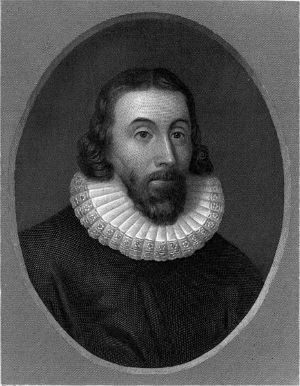
Thomas Hooker
Thomas Hooker, a leading Puritan minister who established the colony of Connecticut after he was asked to leave the Massachusetts Bay Colony, explained:
“Above all other deliverances, in ’88 the Spanish armada was a great deliverance because God worked through covenants. God expected England to abjure sin.”
Hooker preached from Deuteronomy 28 and Leviticus 26. If we, English, keep the law, he will bless us abundantly in all things. When the plague struck, the Puritans believed it was an explicit warning from God. Yet England did not come back to God. England escaped war, but the English hearts did not bow and did not break. The Crown and Parliament grew more corrupt, and attacks were now being made on the Puritan ministers. So Hooker warned them, when the sin of a nation comes to a full rightness and perfection, then the truth is the Lord will save and deliver them no more.
Side bar: We hear similar sermons like this, sometimes around the Fourth of July, sometimes around the time of the National Day of Prayer. God’s going to pull his favor from the nation of America as a judgment for the nation’s sinfulness. And we hear clarion calls for repentance, national repentance here in America. It is an issue to discuss and debate at a later time. But God does bless those who obey and He does judge those who disobey, be it an individual or a nation.
God had made Israel His chosen people, yet the Jews had broken their covenant. This it their logic. The Abrahamic covenant belonged to the Jews, the Jews broke their covenant with God, so God is going to give that Abrahamic covenant to someone more deserving. And they believed that was England.
Now when England went into corruption and sin and did not repent, the Puritans said God is going to judge England and give the Abrahamic covenant to another more deserving group. Hooker begged his audience to repent and rally around the covenant.
“…lest God go into Turkey and say unto them, ‘thou art my people and I will be your God’”
Hooker echoed another Puritan minister,
“God is packing up His gospel because none of you will buy his wares nor come to His price. O therefore, my brethren, lay hold on God. Let Him not go out of your coasts. Let not thy God depart, O England, Lay siege about Him by humble and hearty closing with Him. Suffer Him not to go far. Suffer Him not to say ‘farewell,’ or rather ‘fare ill,’ England.”
In Nehemiah’s time, Jerusalem was to the west of Babylon. New Jerusalem must be to the west of Rome. And what would be westward at this stage of redemptive history, but America? Or when the psalmist spoke of a new nation to be placed at the head of all others in Psalm 18, surely he was offering above all the hope of the Americas. So to the Puritans, the entire story of the New World from beginning to end was Christ’s “magnalia”: the glorious works of Christ.
In a sermon to the passengers aboard the Arabella who were preparing to leave in 1630, John Cotton proclaimed:
“America is the new promised land, reserved by God for His elect people on the actual site for a new heaven and a new earth.”
So as Israel traveled from bondage in Egypt, so these early Puritans followed the same paradigm on their trek to the promised land of North America. Millenniumarianism was a central motivating factor for moving from the old world to the new. England replaced Israel as the people of God. Now New England was replacing England as the people of God. They abandoned England and its acquiescence to the antichrist (Rome) and set off to build the millennial kingdom in North America, literally their “promised land.” It is significant that the imagination of many Puritans were captured by this hope of the new millennium.
Now upon this redemptive-historical hermeneutic of scripture, the Puritans placed themselves in this divine drama which they believed gave divine approval upon all that they did in the new world. From the private to the public church state and economy because why? They were the elect people of God. They were God’s new Israelites. His chosen people. Well I contend that Israel is still God’s chosen people, and the Abrahamic covenant is their covenant today, given to them in the past, fulfilled in the future, and the Gentiles will be blessed through that covenant. God did not take that covenant and give it to England or New England. It is still the covenant of Israel.
Care must be taken when we elevate these groups of people and individuals and then follow their doctrine and ways of life. The early church had the same problem. That was in the book of Acts- I am of Paul, I am of Apollos, I am of Cephas. What should we rather say? I am of Christ.
Myth number three:
“The Puritans had a Biblical worldview.”
A worldview is a framework from which one views reality and makes sense of life and makes sense of the world. A “Biblical” worldview is diligently learning and applying and trusting God’s truth in every area of our lives, because in the end, it is the decisions and actions that will reveal what one truly believes. However the Puritans had a worldview that was in fact NOT “Biblical”. They created a worldview using the Bible to “purify” it.
 One cannot deny that the Puritans did indeed hold God’s word in high regard. Most families were middle and upper class in Massachusetts Bay, and they owned a Geneva Bible, they read daily, and sometimes the Bible was the only book in the home. They wished to be guided by one rule: the word of God most high. That is honorable. However, the Puritans had a habit of calling their convictions “Biblical”, and often this became nothing more than a divine “rubber stamp.” If we can find a proof text, a typology, we can make it law in our commonwealth.
The Ten Commandments were easy. “Thou shalt not kill” was accepted without discussion, but what interested them more was the “how” and “why” an episode in the Bible was like one in their own lives. The great and terrible earthquake in June 1, 1638, and the one in January 14, 1639 reminded Captain Edward Johnson of how “the Lord, Himself roared from Zion as in the days of Amos.” They searched the scripture for texts relevant to their own particular needs, and because of their redemptive-historical interpretation of scripture, they liked finding a portion of scripture that showed similarities between themselves and the ancient Israelites. The Lord had “obviously” chosen them, just as He had chosen the Israelites, to carry out His plan for the redemption of the world.
If you recall the account in Exodus where the Israelites wandered for forty years in the wilderness, with the exception of Joshua and Caleb, that generation was denied entrance into the Promised Land. The Puritans believed that the chief difference between them and the ancient Hebrews was that God had called them to make a promised land out of the wilderness. The belief in their divine election to accomplish a great work in ushering in God’s kingdom ceased to be faith and came to be regarded as fact. Nothing seemed more evident to the minds of the Puritans than that God was taking a hand in establishing His kingdom on earth.
“The God of heaven had carried a nation into a wilderness upon the designs of a glorious reformation.” ~ Cotton Mather
Another example of using scripture to justify Puritan behavior is when John Cotton found a passage of scripture indicating that it was not the will of God that the Indians should be converted. Certain things had to take place first, and he used Revelation 15:8 as his proof text. What the Puritans had developed in New England was a practical, common-law orthodoxy. Their heavy reliance on the Bible was used to justify their preoccupation with platforms, programs, and schemes of confederation rather than using God’s word to shape a Biblical view of life and living.
There are five elements that could be said of developing a true Biblical worldview.
- Culture
- Education
- Religious Beliefs
- Emotions
- The Bible
Culture: the society with its traditions, traits, and ideas. Education: what you have been taught as truth. Religious beliefs: what one has been taught as matters of faith. Emotions: how you feel about others. The Bible: how one believes and adheres to its teachings.
The Puritans had:
- their English traditions
- their Calvinistic ideas
- they had been educated and taught through typology and allegory
- they believed that they had replaced Israel as God’s chosen people
- the covenant God had made with His people had been taken away and given to them
What did this create: an elitist mentality which tolerated no doubt and no dissention. They foisted their own philosophy into scripture. I contend that they developed a “Puritan” worldview rather than a “Biblical” worldview.
When I taught in high school, I encouraged my students to think and not to necessarily accept what the book said and not necessarily accept what I said. They needed to investigate for themselves and judge whether or not that textbook or that teacher was presenting the right view of life and history and God’s word. That is what I want to provoke you to do. After all of my own study, the Puritans are now off of my hero list.
~ Susan Dohse



10 comments