The History of Western Philosophy and Its Societal Impact on the Church – Part 5
The following is part five of an eight-part series.
Taken from John Immel’s second session at the 2013 Conference on Gospel Discernment and Spiritual Tyranny
~ Edited by Andy Young
| Click here for part one Click here for part two Click here for part three Click here for part four |
Click here for part six Click here for part seven Click here for part eight |
Plato
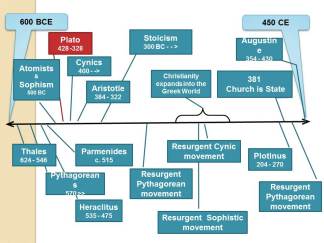 I think it is important for me to make this point at the outset. Plato was a genius virtually unparalleled by anyone in human history. His system dynamics, his creativity, his ability to integrate enormous amounts of information are rivaled only by Aristotle. Now of course they arrived at two very different conclusions, but Plato is not a villain as such. He was not deliberately trying to devise a bad system of thought. He was attempting to take the arguments of his day, all of the ideas from the various and sundry thinkers we have thus far discussed, and turn it into a system of thought that is useable.
Plato is the very first thinker to successfully develop a fully comprehensive system of thought from metaphysics to epistemology to ethics to politics. His metaphysical assumptions have an enormous impact on Western thought. Plato took Socrates’ grasp of universals and then proceeded to develop a metaphysical conclusion, and since everything that follows revolves around a metaphysical foundation, we need to start at the beginning.
Universals must be knowable. Without knowable universals man is little more than an animal and less moral than the Sophists. Parmenides told us that “thou canst know what is not.” In other words, if it doesn’t exist, you can’t know it. If universals are knowable then they must be real. If universals are real, then they must exist. Plato decided that the next two questions that must be answered are where do universals exist and how do universals exist. The question later became known as “The Problem of Universals.”
Plato’s answer to these questions is that there must be two worlds (once again we see this theme of dividing reality) because the universals and the particulars are not elements of the same thing, but fully different things. Plato is taking his influence by the Pythagoreans and developing it into a primary element of his metaphysics. Plato’s conclusion was that universals are one per category, particulars are many in any given instance.
 Now remember the background. The conflict is between Heraclitus and Parmenides. From the beginning, everyone was trying to solve the riddle of change and multiplicity. So the next question was how to deal with change and multiplicity and immutability? His solution was to say that universals must be eternal and indestructible. Without something that is unchanging, the world is fully unintelligible.
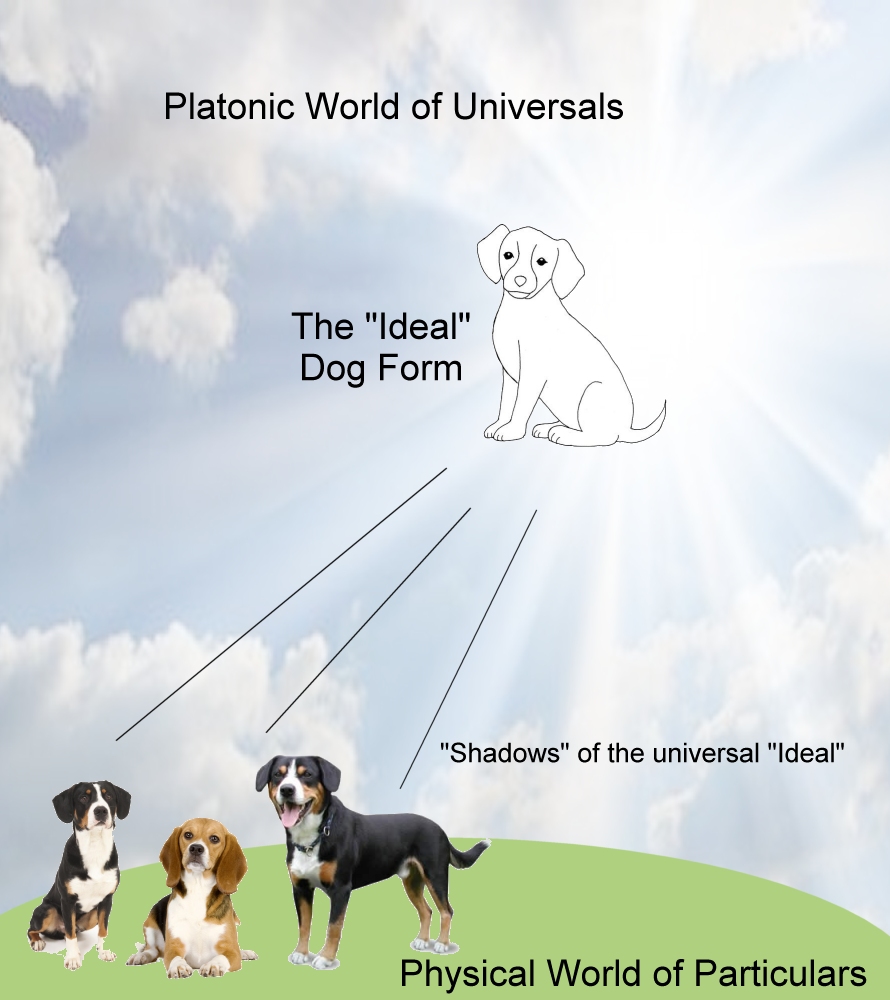
The logic goes like this. Think of the idea of “dog-ness”. We can say that the nature of dogs requires floppy ears, a bark, four paws, and so on. These are particulars, but there are many, many dogs with variations on those specifics, yet we understand that there is one concept of “dog-ness”. This must be an immutable law of “dog-ness”, because without immutability there would never be a law of “dog-ness”. Therefore, the universal of “dog-ness” must be eternal and indestructible.
His logic continues. Particulars are necessarily material and physical. Animals can see them, hear them, taste them, but do they grasp universals? Dogs can certainly see bones but do they see “bone-ness”? Does “dog-ness” see “bone-ness”? Plato concludes that “bone-ness” is somehow abstract and not part of the physical world, because it can’t be grasped by the physical senses. So particulars are physical, and universals are non-physical.
 And what followed from that premise was that particulars were understood by the means of the senses, and universals must be understood by the means of reason. With this conclusion, Plato completes his argument about two worlds. It is the obvious necessity based on the functions of human existence. Universals, defined by one group category, exist as immutable, unchanging, and non-material world and are known only to the mind. Particulars, defined by multiplicity and change, are physical and material and are grasped by the senses.
This conclusion, of course, begs the question. If universals are somewhere outside human perception and material existence, how does man ever access the knowledge? Plato’s answer was that man gets his understanding of universals before existence. So what we have really just introduced is the concept of innate ideas. If we possess knowledge at birth, man then must have what are called innate ideas that are the product of another world, and the soul is independent of the body. This concept is central to Pythagorean mysticism.
Notice what we have. A soul/body dichotomy where the soul is eternal that is somehow intimately involved with universal knowledge that is non-specifically a part of sensory apparatus. We have man utterly divided.
Plato made many other arguments for the existence of two realms, but many of you are familiar with one that is a very popular Christian proof. It is generally called the argument for perfection. Plato asks, where do we get the standards for perfection in any category? Where do we get the concept of a perfect circle, a perfect latte, a perfect Oreo cookie? All concepts of perfection cannot come from this material world because nothing in this world is perfect. This world is made up of particulars, and particulars are always changing. If you are changing, you cannot be perfect. Change implies some kind of deficiency. Perfection requires immutability. You can hear the echoes of Christian doctrine all over this.
The most obvious example is the perfect cow. What would it eat? It doesn’t lack food because it is perfect. It doesn’t lack knowledge because it is perfect. It doesn’t need to breathe because it doesn’t lack air. If nothing in this world can be perfect, where do we get our concept of perfect? The only conclusion is that man gets it from contemplating another world, a world that hold the perfect embodiment of everything in this world, a perfect archetype of universals.
And the reason this gets so much traction is because this is exactly how we prove the existence of God. This is what we say. We have a concept of God in our thinking. And where do we get that concept? Well, it must necessarily exist because we wouldn’t have it in our thinking if it didn’t exist.
 Now you know how Plato came up with the world of forms and the world of the senses. The realm of universals is the world of forms. Step by step, man is taken farther and farther away from life in this world. By incremental steps man has been taken down a path that says that he is absolutely not a part of this world. He is not able to understand it, he is not really able to interact with it, and in some instances he is not even really able to know it.
While Plato’s solution was an elegant response to the Sophists, he unwittingly sets man up for the tyranny that necessarily must follow from this progression of thought. Remember what I said: human life is defined by how ideas go together. This is the principle:
Foundational assumption (Metaphysical premise) determines…
-> Epistemological qualification, which in turn defines…
-> Ethical standards, which in turn prescribes…
-> Political culture (government force)
What you assume to be true about man determines what you think man can do. What you think man can do defines his ethical standard or his definition of value. And man’s definition of value dictates the government structure with which he surrounds himself.
How does this look when applied to Plato’s philosophy?
Foundational assumption – This world is a reflection of other-worldly forms. This determines…
Epistemological qualification – Man cannot know truth because he experiences the imperfect from a shadow world. That defines…
Ethical standards – Only select men of the highest character and longstanding study can achieve enlightenment. This prescribes…
Political force – A select few who have the right to rule over the masses.
 Now we’ve actually caught this theme repeatedly. It is always a select few that have the ability to understand this grand mystical truth. It is everybody else that cannot understand it for whatever disqualification they may possess. This two-world distinction ultimately creates a class society, the endless presumption that some are uniquely qualified, by virtue of some ethical achievement, to ultimately govern those who cannot arrive at that ethical achievement.
We have seen endless examples of this. Slavery was justified for this exact reason. The white man was superior because the black man was inferior, and so the white man must rule over the slave. Our treatment of the American Indians was the same way. This two-world concept always boils down to a class society that is determined, pre-destined to rule over a sub-class.
 The only reason to advocate determinism and pre-destination is to establish a class society, always. There is no logical, rational reason to advocate determinism otherwise. Because if everything is determined, then why is there any argument? What are you trying to persuade? By definition, I am who I am because I am determined to be that. There is no rational appeal to achieve any other end.
So if you are arguing with a determinist, the answer is, “why are you arguing?” At the end of the day the only reason he is arguing is because at some point he believes he should be in charge of your life. It is that stark, that ugly, and that bold. If you get this point, you can unravel 99% of all determinist’s arguments.
Are you starting to get the picture of how philosophy integrates ideas? Are you starting to see how what man believes affects the existence of what he knows? Are you starting to see how what man knows affects how he thinks he should act?
To be continued…
| Click here for part one Click here for part two Click here for part three Click here for part four |
Click here for part six Click here for part seven Click here for part eight |
Tweet, Tweet
Protestantism is no less irrational or superstitious than the rankest forms of Voodooism; it merely dresses itself in pseudo-intellectualism
— Paul M. Dohse (@PaulMDohse) February 9, 2017
Genesis Genealogical Trivia Tidbits
The genealogies recorded in Genesis and in various other places in the Bible are easy to regard as mundane in comparison to other passages of scripture. Reading through verse after verse of “so and so begat such and such” becomes tedious, and it isn’t all that unreasonable that most people simply skip over those verses in their Bible reading. Or when they do read them it is just a formality, and no careful consideration is really given to the words on the page.
I don’t remember what prompted me to do it, but as I was reading through the genealogies in Genesis 5 one day several years ago, it occurred to me that all these numbers and ages might be easier to follow if I organized them into a chart. So I created an Excel spreadsheet, and with the help of a few formulas I was able to easily come up with the following table.
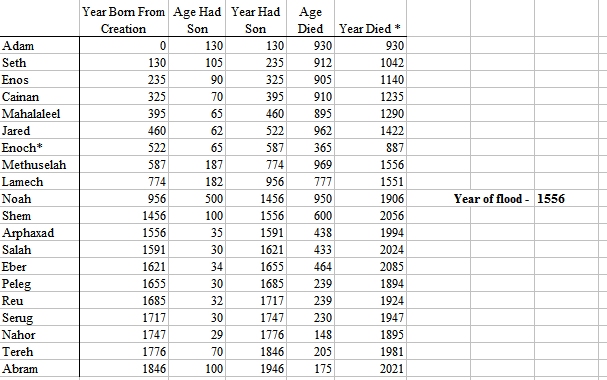
Let me point out that the Bible does not record the specific year in which these men were born and when they died. All it gives is the number of years they lived and how old they were when they “begat” their son for the next generation. But if we use Creation as our starting point, with the use of Excel formulas it is very easy to derive a number of years from Creation when a person was born and when he died.
As I was making this table, I began to see some interesting correlations and relationships that aren’t apparent when you’re just reading words. In order to help these relationships be more evident I created a graph to translate the lives of these men and their relationship to each other into a timeline of sorts.
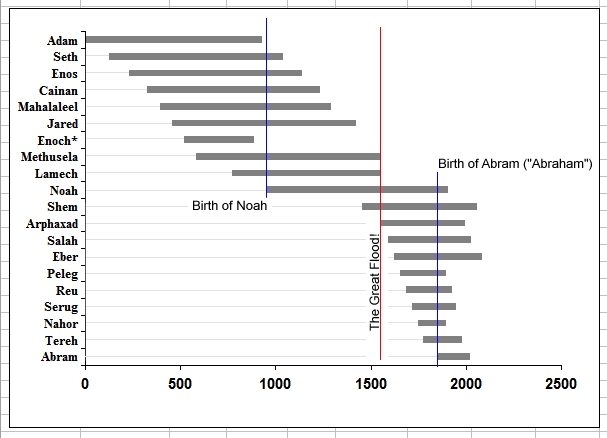
Here are some of the more interesting observations I have made looking at these two graphics.
- There are 8 generations who were living during Adam’s lifetime. If you consider the way that history was passed down from generation to generation in the oral tradition, this means that for 800 years, these 8 generations had direct access to an accurate oral account of Creation from the first human being to ever walk the earth! Think of the bedtime stories Adam could have told to his great, great, great, great, great, great grandchildren!!!
- Lamech, the son of Methusela, died 4 years before his father.
- We will easily recall Methusela as being the oldest man in history as a part of our genus of Bible trivia, but how many of us realize that he died in the same year as The Great Flood? Here are some other questions to ponder. Did he die just before the flood? Or was he one of the countless hundreds of thousands (millions?) to perish in unbelief? How truly tragic that would have been considering he probably knew Adam personally!
- Enoch was taken to heaven at the tender young age of 365. He has the shortest lifespan of any man prior to the Flood that is recorded in scripture.
- The Great Flood occurred 1,556 years after Creation.
- 1,556 years of history are recorded in a mere seven chapters of the Bible. Think about how much more there was that is not recorded. Think about how much God has preserved!
- Arphaxad, the son of Shem, would have been born in the same year as the flood. Since the Bible clearly states that 8 people were saved in the Ark, it is very likely that Arphaxad was born (and possibly even conceived) while Noah and his family were still on the Ark.
- If we exclude Enoch, the average lifespan of the men recorded who lived prior to the Flood was 912 years. Following the flood, the average lifespan of the next four is 483 years, and it drops to 206 after that. What factors contributed to this rapid drop in longevity? Were there certain environmental changes as a direct result of the Flood?
- Abram (Abraham) was born while Noah still lived, and he was about 60 when Noah died.
- Including Abram there are 10 generations who lived during Noah’s lifetime following the flood.
- Again, given the oral tradition and even considering the confounding of languages at Babel and the resulting dispersal of the world’s populace, these 10 generations would still have a very close and accurate account of the Flood.
What observation were you able to make?
~ Andy
Five Damning Facts About Calvinism
I. It’s daily re-salvation by preaching the gospel to yourself every day. II. Its progressive justification defines “Christians” as under law—the biblical definition of a lost person. III. Forgiven…
The History of Western Philosophy and Its Societal Impact on the Church – Part 4
The following is part four of an eight-part series.
Taken from John Immel’s second session at the 2013 Conference on Gospel Discernment and Spiritual Tyranny
~ Edited by Andy Young
| Click here for part one Click here for part two Click here for part three |
Click here for part five Click here for part six Click here for part seven Click here for part eight |
We continue in our discussion of the major contributors in the progression of Western thought. Many concepts and doctrines that we have traditionally come to think of as Biblical orthodoxy in reality have their roots in ancient philosophies. Here is a brief summary of the thinkers and their contributions that we have studied so far:
Thales – The first scientific approach to explaining reality as opposed to a pantheistic approah. The concept of one universal “stuff” and its various forms.
Heraclitus – Because everything is in a constant state of “flux”, man is unable understand the nature of reality. The first to introduce a division of reality. Two “realms”.
Parmenides – Precursor to Aristotle’s “Law’s of Identity” and existence. Existence is real, but change is not. Change is only apparent because of man’s faulty perception.
Zeno – The Dichotomy Paradox. Movement was an illusion and plurality and change was impossible.
The Pythagoreans – Orphic mystics. Introduction of the soul/body dichotomy.
The Atomists – Described a mechanical model for metaphysical concepts. Introduction of determinism.
This brings us to part four, and we will pick up where we left off.

Sophism
The modern disparaging term sophistry is used to describe someone offering a false argument for the express purpose of clouding the issue. The word’s origin comes from a professional class of philosophy and rhetoric teachers of the fifth century. The name became a criticism because of the way the Sophists conducted their teaching business. At the time their great sin was taking money for teaching philosophy to the aristocracy, and they engaged in open deception. And the reason they engaged in open deception you will understand shortly.
Their goal when teaching the nobles was to win the argument by whatever means. Persuasiveness was a desirous skill in Athens because it was a means to political power and wealth, and the Sophists focused their instruction on these skills. Since they didn’t believe in truth, they saw no moral failing in their methods, and this made them villains to most of their contemporaries.
Actually, they were villains for probably two reasons. Plato didn’t like them at all. And most of what we know about them is from Plato. He often used them as straw men for Socrates to knock down. But the second reason they were considered villains was that they are credited with starting was is called “egoism”. This is the “egoism” that everybody fears, the idea that the world is mine to conquer and your needs and rights don’t matter.
There were two main Sophists. One is Protagoras, considered to be the father of Sophism. The other is Gorgias.
Now I need to introduce you to another philosophical concept. This is called skepticism. Skepticism means there is no objective or certain knowledge. It is impossible to know anything absolutely. There is no absolute truth. If you hear somebody say that, they are a skeptic. Nothing can be known, and when I say nothing I do mean nothing. The Sophists where skeptics.
The Sophists said that there was no certainty to be had for any creature, and they sought to prove that every sense perception to any creature was necessarily invalid. Others had suggested that man’s senses were invalid, but the Sophists took this argument to new heights (or lows depending on how you look at it). They made an all-out attempt on the faculties of man to show that every sense perception is wrong, not just that man can be taken in by the occasional illusion or hallucination, but that man can never trust anything from his senses.
The Sophists taight that whenever we perceive, what we perceive depends on two factors. It depends on the object being perceived and the nature and condition of your sensory apparatus. For example, the colorblind man looks at a tree and says the tree is gray, but a man with normal vision looks at the same tree and says it is green. The same object, but different sensory outcomes. One man is sick, the other healthy. They both eat pie. One says it tastes sweet, the other says it tastes bitter. One man is in a hot tub and gets sprayed with water from the hose and says, “how cold!” Another man craws out of the Arctic Ocean and gets sprayed with water from the hose and says, “how warm!”
What was the conclusion the Sophists drew from this? The key factor in each instance was that the quality of the sensory apparatus determined the effectiveness of the experience, so that it appears that all sensory information is utterly subjective. How then can we ever know anything for sure? What is the right experiential knowledge? Who has it?
According to the Sophists, nobody. No one can perceive reality except as a subjective function of his specific senses. All we can ever know is that what you perceive right this second is what you perceive right this second. So the only certainty is, “it seems to me now,” because in a few minutes your senses will probably change. The inescapable conclusion then is that since the perceptions change from person to person and from time to time, each individual lives in his own private subjective little world.
According to the Sophists, there is no such thing as “truth”, there is only subjective experience.
 Now watch what happens to man when this happens.
If the senses are invalid then reality is unknowable. If reality is unknowable then reason is useless. If reason is useless then truth is unknowable. They have just reduced man to less than nothing.
Here is the main argument for these conclusions. Everybody disagrees about what is rational. Who is to say what is really true? Since everyone seems to disagree about everything, the whole question must be hopeless. If man had a way of arriving at the truth, they would agree. The fact of disagreement means that reason is incapable of arriving at truth.
There was a second argument best expressed by Gorgias who offered up three propositions.
- Nothing exists
- If anything existed you couldn’t know it
- Even if you could know it, you couldn’t communicate it.
This is the most succinct statement for absolute skepticism, and you can see now why skepticism descended into complete subjectivism and complete relativism. There are no absolutes, and there is no objective truth.
Has anyone ever heard this before? Think about an aristocrat in the Bible, a government official, maybe taught by the Sophists. Think Jesus. Think crucifixion. Think of the words of Pontias Pilate, “What is truth?”
This was a predominant way of thinking for centuries.
It is the single greatest attack on human senses ever constructed. It is foundational for Plato’s teaching and then subsequently applied to Christian teaching from Augustine and on. So this perspective effectively crippled epistemology, man’s qualification for discerning truth, for over one thousand years. And you wonder why there was ever a time called the “Dark Ages.” It was dark on principle. It was dark metaphysically, it was dark because the “church” said it was impossible to know.
You actually see some variation of this in the modern day. But you see it in more subtle forms in very reasonable conversations about the nature of truth. On a blog, one individual by the name of “Ben” asked me a series of questions and made the following comments:
“…also by definition, truth must be absolute. Said another way, truth cannot be relative. This is not to say that all human action has a case-specific absolute, but that eventually, at some hierarchical level absolutes must exist. Most secular ethics are relative. To say, for example, that some morality naturally selects itself is relative. Utilitarians are relative, and obviously so is majority rule in all its forms.
“It follows then that absolutes must be derived from a source outside the human sphere. Any configuration conceived by humans, even unintentionally through biological processes, always reduces to relativism.”
What is the fundamental assumption about the nature of human existence? That man cannot fully grasp the nature of truth. This is skepticism at its root. Ben’s assumptions are two-fold. Ethics are the providence of a supernatural source, and the reason is because man is incompetent to know the truth.
When you hear a preacher talking about your cramped little subjective lives, he is staking a claim to the roots of Sophism. He is seeking to condemn individual men for their inherent subjectivism. Any time you hear someone say, “it is true for you,” they are giving away their philosophical pedigree. The Calvinist doctrine is true for me even though you are an Armenian with a bad attitude.
One final note on the Sophists and their politics. Remember I said that from the beginning that a philosophical progression starts with metaphysics and ends with politics. Our ethics that arrive from our metaphysical assumptions produce our government action. If you remove reason and senses from human existence, how do you deal with another man? What happens when another man does not accept your version of truth? The only method left at your disposal is the use of force to compel another into your desired behavior. This is the source of all violence in the world. When you remove reason from man and you assume that he cannot know truth, the only thing left is to treat every other man as prey.
Since there is no truth and there is no reason, this of course affects public policy. Your government and public policy is always an expression of your philosophy. And once reason is no longer valid the only means to deal with other men is violence.
(Remember when I said that Sophism became the definition of egoism? This was why they were such villains. This kind of thing is utter anarchy, and it’s not livable. Any rational human being recognizes this. Liberty and anarchy are not the same creature. We are often told that liberty is really anarchy, but that is error because it removes from man his fundamental apparatus of reason. You have two ways to deal with men, by force of ideas or force of violence. The moment we are pointing a gun we are no longer discussing ideas, we are no longer reasoning. So an argument is by far the better course of action because that can be engaged freely, which is the very definition of liberty.)
The Sophists are the first people to pose the Nietzschian will to power as the ethical ideal, which means that man’s primary social purpose is domination. And now you can understand why the Caesars were constantly waging wars of domination. It naturally followed that the ethical premise produced the political outcome.

Socrates
There is some academic debate whether Socrates really ever existed or whether he was simply an alter ego created by Plato as a vehicle to deliver his own ideas. The debate doesn’t really matter though, because ultimately the development attributed to Socrates was crucial in the evolution of Western thought.
Socrates is the first philosopher to take up the task of grounding objective knowledge and objective morality into human existence. This is a huge undertaking considering the pervasiveness of Sophism to this point. Socrates’ focus was on the philosophical discipline of Ethics. He had a specific approach that was ultimately systematized into Plato and Aristotle.
This was the approach. Socrates said that the reason people are confused, so habitually in disagreement, so endlessly mired in subjectivism, the reason they despaired at ever knowing the truth was because their concepts were never defined. Now that seems obvious to most of us, the need to understand the commonalities of a particular argument. Socrates went on to say that people will fight over the question of is a man good or honorable or virtuous and never arrive at a conclusion. Identifying this problem, for Socrates and his contemporaries, was an evolution of thought. We will never come to agreement until we can first agree over the definitions of good, honorable, or virturous.
The question then is what are the characteristics of particulars so that we can arrive at a definition? What are the particulars of good? What are the particulars of honor? What are the particulars of virtuous? For example, when we discuss honor, what is the common denominator that is the class called “honor”? To define the concept you must generalize what is common to the whole group of a class. So when you think of “circles”, you don’t have to think of every circle you have ever seen. You can simply see what is common to all circles.
 Socrates identified what was the need and the essential nature of what is called universals. This concept is huge. It is the dividing line of every system of thought that comes after. Universals are the set of properties common to every member of a class, and it is the basis of its classification.
Every item that can be categorized into a specific class is called a particular. Man engages in this process constantly. This is his unique ability, to reduce down to commonalities, to universals, a class. He doesn’t need to remember every single instance of a particular in order to identify it. Using the concept of universals he is then able to see any given particular and identify it by instinctively categorizing it into a given class.
Man’s conceptual faculty is what gives him the ability to understand principles and laws which in turn gives him the ability to predict the future. This is important. If I can derive a principle by generalizing a particular, then I can look into the future and see the application of that principle to other instances and reasonably predict an outcome. If my reasoning is valid, and I can understand laws, suddenly the world is not such a scary, confusing, chaotic place.
This is the importance of the difference between conceptual versus perceptual knowledge. Conceptual knowledge is founded on the recognition of universals. Perceptual knowledge is founded on what man understands from reality’s interaction with his senses, and that varies from man to man. Socrates goal was that if we can validate universal knowledge, we can answer the skeptics’ rejection of truth. Man must rise from the merely perceptual stage to the conceptual stage, and this is what stops the fights. At the conceptual stage, man can grasp a universal standard and end all argument and all subjectivism.
To be continued…
| Click here for part one Click here for part two Click here for part three |
Click here for part five Click here for part six Click here for part seven Click here for part eight |



1 comment