Nothing is “Stupid” ALL Behavior Flows from Logic
 Has our culture completely lost its mind? Rush Limbaugh, Shawn Hannity, et al, make a living pointing out the absurdity and irrational logic of the “looney left.” I have all but ceased listening to a lot of these programs because they beat the mere symptoms of the real problem like a never-ending Whack-A-Mole game. The different colors and mole versions of the gaming machines all flow from moleism.
The core logic drives everything; i.e., presuppositions concerning mankind. Man is either able or unable. Man is created with an individual ability to discern reality or he isn’t. This is where people miss it: at the core of this question is whether man can discern reality itself; not practical truth. When reality is the question, practical commonsense observation is neither here nor there.
We have all screamed at the TV during a political speech proclaiming, “Do they think we are stupid?” Barack Obama continually states things that are glaringly opposite from what is happening with a straight face and without batting an eyelash. He doesn’t think you are stupid; he thinks you are unable to properly discern reality. What you think you perceive couldn’t be the truth because you are not an elitist, and how dare you question those destined to lead the great unwashed away from ignorant self-destruction?
Farfetched? Think about the things he has said. “You didn’t build that.” Really? Is this not a complete dismissal of individual ability? You only think you built that, but that’s not reality. You are completely full of yourself, and robbed others of their fair share to enrich yourself. But don’t miss the main point here: Obama is a microcosm of this core issue that transcends history, religion, and the future of mankind.
The Bible has much to say about this issue. Ever heard of the Tower of Babel? Ironically, religion has always been the standard-bearer of the following idea:
Man is totally depraved and unable to discern reality.
Therefore, elitists must guide the great unwashed away from self-annihilation.
If the great unwashed refuse to follow, they must be forced to obey against their will for their own good and the preservation of mankind.
Wars are the necessary result of competing elitists who fancy themselves as having the best wisdom for saving mankind. Of course, there will always be those who just want to conquer other nations to gain a spoil and use said philosophy for an excuse to do so.
In contrast, we read this in the 11th chapter of Genesis:
6 And the Lord said, “Behold, they are one people, and they have all one language, and this is only the beginning of what they will do. And nothing that they propose to do will now be impossible for them. 7 Come, let us go down and there confuse their language, so that they may not understand one another’s speech.” 8 So the Lord dispersed them from there over the face of all the earth, and they left off building the city. 9 Therefore its name was called Babel, because there the Lord confused the language of all the earth. And from there the Lord dispersed them over the face of all the earth.
Even though in this case man’s ability was being utilized for evil, the ability of mankind is plainly stated in this chapter. How can religion therefore get away with the Total Inability of Man doctrine despite the plain sense of biblical grammar? Again, it’s a case of truth being under the authority of elitists supposedly gifted (a source of your preference) with knowing reality. How dare you think for yourself and assume the text says what it plainly states oh arrogant one!
The primary tool for gaining control of the masses is condemnation. You are a totally depraved individual; therefore, you must put yourself under the authority of “godly/wise” elitists. It is interesting to note that biblically speaking the essence of sin itself is a lust/desire to control others. The best way to control someone is to rob them of self-esteem, self-confidence, and dignity. Being unworthy and shamed, they are now putty in the hands of tyranny. Do you see much condemnation in the present American political climate? That’s what it is all about; you are a fill in the blank-phobe and therefore should humbly put yourself under the submission of an elitists who doesn’t fear fill in the blank due to their infinite wisdom. It has been said that Obama was elected because of white guilt; I buy into that totally. Because we are all racist, we dare not oppose a black president and add to our shame. The same mode of operation was attempted in the past election regarding gender but the failed polices of Obama trumped what would have ordinarily worked. Also note that black conservatives are not really black. Even skin color has been redefined according to the collectivist worldview. If you really understood reality you would understand that black isn’t always black.
What compels the masses to buy into this? Probably fear of self-governing and finding comfort in the mommy-state. Behind all the absurd arguments is a fundamental fear that we will be without an elitist protector. It is interesting to note what the comedian Louis C.K. recently stated on the Conan O’Brien show. Speaking about Hillary Clinton and the past election:
I’d take her over anybody. To me, it’s really exciting to have the first mother in the White House. It’s not about the first woman, it’s about the first mom. Because a mother just does it. She feeds you and teaches you, protects you. She takes care of sh*t.
Don’t underestimate this mentality as a principle shared by those who fear individual ability. The question of individualism versus collectivism drives nearly everything we experience in history, religion, and politics.
paul
Overcoming the Blues
“The one thing life cannot take from you is the way you think; that is always a choice leading to either happiness or despair. I understand that life often requires the absence of joy, but even then, the peace of happiness is running in the background.”
Christ, yes, the Lord, but more importantly our big brother and the firstborn of God’s family, said, “To whom much is given much is expected.” Two major keys to overcoming the blues are found in this first sentence. As Christians, we must make who we really are a concrete realization in our living; God is our literal Father, not our judge and condemner. Jesus completed His part in redeeming mankind and is therefore not “ashamed to call us brothers.”
We are family members of God and Christ and the reality of that is reflected to a great degree in earthly family members. Good parents want you to be blessed, happy, and don’t want to control you; they want to see a good and fruitful life that flows from your own heart. After all, you are their offspring. Your happiness is their happiness and their reward. Most churches that supposedly represent God are more like parental failures who try to control their children through condemnation.
I mention this because the subject of condemnation is not far removed from any discussion on the blues or depression. Condemnation has little place in the realm of wellbeing where truth about people is the order of the day and any valid reason for condemnation is in the process of being corrected. Staying in a place of rightful condemnation is a personal choice. But, being in a place where untruthful condemnation rules the day is also a choice indicative of religion in general and Protestantism specifically. Therefore the institutional church is making a killing on counseling services; it is creating its own supply and demand.
Amidst the expectation introduced in the first paragraph is confidence, thankfulness, and happiness. After all, “what can separate us from the love of God?” Be sure of this: the blues and depression are almost always the result of a temporary or overall errant perspective of reality.
May I share what I have learned about this the hard way? Your journey to overall happiness does not have to be long like mine was. Yes, you may be happy, but not taking the blues seriously can change that in a hurry. At work (I am a nurse’s aide), I was recently greeted this way by a resident: “How are you today?” I answered this way: “I am absolutely wonderful; in fact, there isn’t a resident in this facility who wouldn’t trade places with me.” The resident paused, and replied, “Well, well, that is a very healthy perceptive.” More than that—it happens to be the truth…with some qualifications.
Those who are happy wouldn’t want to be me; they are happy with being themselves, they would just prefer my present resources. Why? Because they earned their present self-esteem by being all they could be while they were able while those exploiting all their present resources to be all they can be have little time to be sad. Unnecessary idleness is not only the Devil’s workshop, it is the workshop of stinking thinking. What is stinking thinking? It is a focus on untruth; overemphasis on the negatives in your life is NOT the truth. For example, consider worry. How often does something you worry about come true in your life? Worry is most often not the truth. Worry robs you of joy. Dwell on truth, and use your abilities to make your life a truth that you can feel good about. We were created to be productive and to receive a reward for it.
Got the blues? Stop. Do an inventory of your present resources. Are you exploiting them per the Father’s expectations? He has made you able to earn a truthful evaluation of yourself. Being satisfied with yourself is a good medicine against the blues. By the way, the occasional blues are a forerunner to serious forms of depression; take the blues seriously and practice preventative medicine.
Also, bring balance to your perspective on present reality. Whenever I get the blues, feel dread, or experience signs of depression, I have learned to stop and say to myself, “Ok, what’s going on here?” Time to evaluate my present thinking, what I am dwelling on, and my present perspective on reality. Recently, I began focusing on unfortunate politics going on at work, the basic difficulty of the job, and a warfare of personal agendas. And of course, working while sick didn’t help any of this, but that did lead to a doctor’s visit which sparked some rethinking.
When the nurse took my blood pressure she was shocked; 112 over 62. My blood pressure has been nowhere near that good for ten years despite my doctor’s best efforts. Yes, my job is hard, but it also entails walking about 20 miles a day in a large facility. I have been dieting for six years with little results so that was in place resulting in significant weight loss and good blood pressure. High blood pressure will mess up your health A-Z, and being overweight as well. This new development is an additional tool in the toolbox used to be all that the Father expects me to be based on what I have been given. Don’t get me wrong, it’s not that our Father is condemning if we don’t live up to what we have been given, the point is that we are most happy when we are doing just that. It is interesting to note that being happy is a biblical command; it is an imperative. And, believers who obey God are loving Him. So, is it fair to say that we love our Father by being happy? Absolutely if 2+2=4 and it does.
This blood pressure revelation led me to consider other areas to refocus on concerning my job and per the usual, my original joy regarding my career returned. This is simply how life works. Truthful thinking is foundational. The one thing life cannot take from you is the way you think; that is always a choice leading to either happiness or despair. I understand that life often requires the absence of joy, but even then, the peace of happiness is running in the background.
This brings us to hope. Happiness results in truthful evaluation of yourself leading to action and a truthful evaluation of reality. Hope is the stalwart against the trials and troubles of life. Hope denotes that the trial is only temporary, and that the Father has promised eternal happiness in the end. A happy life ebbs and flows between joy and peace amidst sorry; hope is the anchor for our souls. Your ship may be in a storm, but the Father’s anchor will hold.
Let me express an opinion about hope; I believe it is an acid test for truth. If something stated has no hope; it’s probably not the truth. Hence, predestination isn’t the truth. However, let’s not forget that religious predestination always states that faithfulness to the church means you are predestined for salvation. So, you can choose to be predestined for salvation by going to church, and yes, therefore, there is damn good money in religion. People will pay any price for hope.
But hope is free from our loving Father. Is it any wonder that Christ came preaching the good news of the kingdom which began with nine paragraphs on happiness? Also, be sure of this as well: those who are indifferent to being God’s children can be mentally healthy by practicing truthful thinking. Psychology rightfully defines good mental health as “an ability to cope with life.” But this has no insurance against everything that life can bring; only God can supply that hope.
Got the blues? Time to take inventory…a truthful one. Move the bigger packages on the shelf to make sure there is nothing you forgot about. If you have the blues, more than likely, a lot of your life is not being counted, and future shipments are not being considered. Furthermore, continue to educate yourself regarding hope and truth in general. Excessive sadness is the kissing cousin of ignorance.
In one of the few instances that made my stint in the institutional church worth it, I had a visitor in the 6th grade Sunday school class that I taught. The subject of the lesson was the biblical truth that trials are only temporary. Few things are more devastating to a female adolescent than divorce, especially when it is the mother who walks out on the marriage. The father came and shared with me what transpired after church. His daughter hurriedly approached him in an excitable fashion asking, “Daddy! Is it true? Trials are only temporary?” He, of course, affirmed that for God’s children trials are always temporary. He informed me of the resulting joy that he had not seen in his daughter for weeks. Why? The divorce was not ended. Answer: hope.
Right thinking, right remembering, a right course of action, and claiming the hope of our Father will overcome the blues. Happiness is not optional…
…this is how we love our Father.
paul
The History of Western Philosophy and Its Societal Impact on the Church – Part 5
The following is part five of an eight-part series.
Taken from John Immel’s second session at the 2013 Conference on Gospel Discernment and Spiritual Tyranny
~ Edited by Andy Young
| Click here for part one Click here for part two Click here for part three Click here for part four |
Click here for part six Click here for part seven Click here for part eight |
Plato
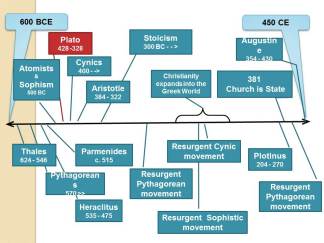 I think it is important for me to make this point at the outset. Plato was a genius virtually unparalleled by anyone in human history. His system dynamics, his creativity, his ability to integrate enormous amounts of information are rivaled only by Aristotle. Now of course they arrived at two very different conclusions, but Plato is not a villain as such. He was not deliberately trying to devise a bad system of thought. He was attempting to take the arguments of his day, all of the ideas from the various and sundry thinkers we have thus far discussed, and turn it into a system of thought that is useable.
Plato is the very first thinker to successfully develop a fully comprehensive system of thought from metaphysics to epistemology to ethics to politics. His metaphysical assumptions have an enormous impact on Western thought. Plato took Socrates’ grasp of universals and then proceeded to develop a metaphysical conclusion, and since everything that follows revolves around a metaphysical foundation, we need to start at the beginning.
Universals must be knowable. Without knowable universals man is little more than an animal and less moral than the Sophists. Parmenides told us that “thou canst know what is not.” In other words, if it doesn’t exist, you can’t know it. If universals are knowable then they must be real. If universals are real, then they must exist. Plato decided that the next two questions that must be answered are where do universals exist and how do universals exist. The question later became known as “The Problem of Universals.”
Plato’s answer to these questions is that there must be two worlds (once again we see this theme of dividing reality) because the universals and the particulars are not elements of the same thing, but fully different things. Plato is taking his influence by the Pythagoreans and developing it into a primary element of his metaphysics. Plato’s conclusion was that universals are one per category, particulars are many in any given instance.
 Now remember the background. The conflict is between Heraclitus and Parmenides. From the beginning, everyone was trying to solve the riddle of change and multiplicity. So the next question was how to deal with change and multiplicity and immutability? His solution was to say that universals must be eternal and indestructible. Without something that is unchanging, the world is fully unintelligible.
The logic goes like this. Think of the idea of “dog-ness”. We can say that the nature of dogs requires floppy ears, a bark, four paws, and so on. These are particulars, but there are many, many dogs with variations on those specifics, yet we understand that there is one concept of “dog-ness”. This must be an immutable law of “dog-ness”, because without immutability there would never be a law of “dog-ness”. Therefore, the universal of “dog-ness” must be eternal and indestructible.
His logic continues. Particulars are necessarily material and physical. Animals can see them, hear them, taste them, but do they grasp universals? Dogs can certainly see bones but do they see “bone-ness”? Does “dog-ness” see “bone-ness”? Plato concludes that “bone-ness” is somehow abstract and not part of the physical world, because it can’t be grasped by the physical senses. So particulars are physical, and universals are non-physical.
 And what followed from that premise was that particulars were understood by the means of the senses, and universals must be understood by the means of reason. With this conclusion, Plato completes his argument about two worlds. It is the obvious necessity based on the functions of human existence. Universals, defined by one group category, exist as immutable, unchanging, and non-material world and are known only to the mind. Particulars, defined by multiplicity and change, are physical and material and are grasped by the senses.
This conclusion, of course, begs the question. If universals are somewhere outside human perception and material existence, how does man ever access the knowledge? Plato’s answer was that man gets his understanding of universals before existence. So what we have really just introduced is the concept of innate ideas. If we possess knowledge at birth, man then must have what are called innate ideas that are the product of another world, and the soul is independent of the body. This concept is central to Pythagorean mysticism.
Notice what we have. A soul/body dichotomy where the soul is eternal that is somehow intimately involved with universal knowledge that is non-specifically a part of sensory apparatus. We have man utterly divided.
Plato made many other arguments for the existence of two realms, but many of you are familiar with one that is a very popular Christian proof. It is generally called the argument for perfection. Plato asks, where do we get the standards for perfection in any category? Where do we get the concept of a perfect circle, a perfect latte, a perfect Oreo cookie? All concepts of perfection cannot come from this material world because nothing in this world is perfect. This world is made up of particulars, and particulars are always changing. If you are changing, you cannot be perfect. Change implies some kind of deficiency. Perfection requires immutability. You can hear the echoes of Christian doctrine all over this.
The most obvious example is the perfect cow. What would it eat? It doesn’t lack food because it is perfect. It doesn’t lack knowledge because it is perfect. It doesn’t need to breathe because it doesn’t lack air. If nothing in this world can be perfect, where do we get our concept of perfect? The only conclusion is that man gets it from contemplating another world, a world that hold the perfect embodiment of everything in this world, a perfect archetype of universals.
And the reason this gets so much traction is because this is exactly how we prove the existence of God. This is what we say. We have a concept of God in our thinking. And where do we get that concept? Well, it must necessarily exist because we wouldn’t have it in our thinking if it didn’t exist.
 Now you know how Plato came up with the world of forms and the world of the senses. The realm of universals is the world of forms. Step by step, man is taken farther and farther away from life in this world. By incremental steps man has been taken down a path that says that he is absolutely not a part of this world. He is not able to understand it, he is not really able to interact with it, and in some instances he is not even really able to know it.
While Plato’s solution was an elegant response to the Sophists, he unwittingly sets man up for the tyranny that necessarily must follow from this progression of thought. Remember what I said: human life is defined by how ideas go together. This is the principle:
Foundational assumption (Metaphysical premise) determines…
-> Epistemological qualification, which in turn defines…
-> Ethical standards, which in turn prescribes…
-> Political culture (government force)
What you assume to be true about man determines what you think man can do. What you think man can do defines his ethical standard or his definition of value. And man’s definition of value dictates the government structure with which he surrounds himself.
How does this look when applied to Plato’s philosophy?
Foundational assumption – This world is a reflection of other-worldly forms. This determines…
Epistemological qualification – Man cannot know truth because he experiences the imperfect from a shadow world. That defines…
Ethical standards – Only select men of the highest character and longstanding study can achieve enlightenment. This prescribes…
Political force – A select few who have the right to rule over the masses.
 Now we’ve actually caught this theme repeatedly. It is always a select few that have the ability to understand this grand mystical truth. It is everybody else that cannot understand it for whatever disqualification they may possess. This two-world distinction ultimately creates a class society, the endless presumption that some are uniquely qualified, by virtue of some ethical achievement, to ultimately govern those who cannot arrive at that ethical achievement.
We have seen endless examples of this. Slavery was justified for this exact reason. The white man was superior because the black man was inferior, and so the white man must rule over the slave. Our treatment of the American Indians was the same way. This two-world concept always boils down to a class society that is determined, pre-destined to rule over a sub-class.
 The only reason to advocate determinism and pre-destination is to establish a class society, always. There is no logical, rational reason to advocate determinism otherwise. Because if everything is determined, then why is there any argument? What are you trying to persuade? By definition, I am who I am because I am determined to be that. There is no rational appeal to achieve any other end.
So if you are arguing with a determinist, the answer is, “why are you arguing?” At the end of the day the only reason he is arguing is because at some point he believes he should be in charge of your life. It is that stark, that ugly, and that bold. If you get this point, you can unravel 99% of all determinist’s arguments.
Are you starting to get the picture of how philosophy integrates ideas? Are you starting to see how what man believes affects the existence of what he knows? Are you starting to see how what man knows affects how he thinks he should act?
To be continued…
| Click here for part one Click here for part two Click here for part three Click here for part four |
Click here for part six Click here for part seven Click here for part eight |
Tweet, Tweet
Protestantism is no less irrational or superstitious than the rankest forms of Voodooism; it merely dresses itself in pseudo-intellectualism
— Paul M. Dohse (@PaulMDohse) February 9, 2017
Genesis Genealogical Trivia Tidbits
The genealogies recorded in Genesis and in various other places in the Bible are easy to regard as mundane in comparison to other passages of scripture. Reading through verse after verse of “so and so begat such and such” becomes tedious, and it isn’t all that unreasonable that most people simply skip over those verses in their Bible reading. Or when they do read them it is just a formality, and no careful consideration is really given to the words on the page.
I don’t remember what prompted me to do it, but as I was reading through the genealogies in Genesis 5 one day several years ago, it occurred to me that all these numbers and ages might be easier to follow if I organized them into a chart. So I created an Excel spreadsheet, and with the help of a few formulas I was able to easily come up with the following table.
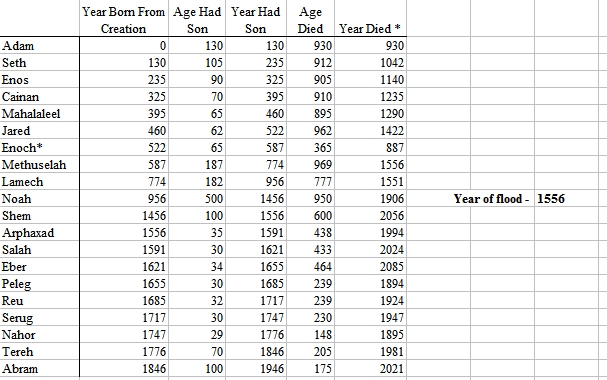
Let me point out that the Bible does not record the specific year in which these men were born and when they died. All it gives is the number of years they lived and how old they were when they “begat” their son for the next generation. But if we use Creation as our starting point, with the use of Excel formulas it is very easy to derive a number of years from Creation when a person was born and when he died.
As I was making this table, I began to see some interesting correlations and relationships that aren’t apparent when you’re just reading words. In order to help these relationships be more evident I created a graph to translate the lives of these men and their relationship to each other into a timeline of sorts.
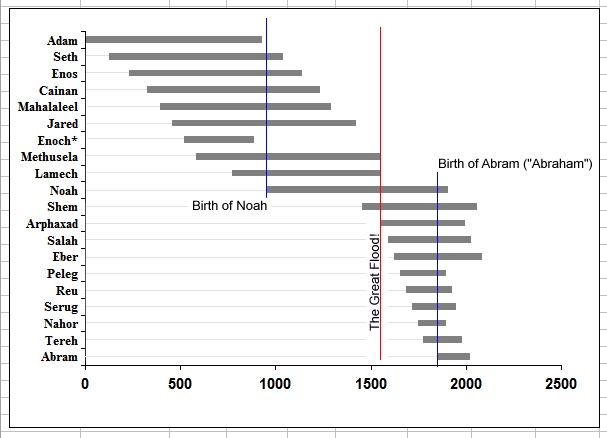
Here are some of the more interesting observations I have made looking at these two graphics.
- There are 8 generations who were living during Adam’s lifetime. If you consider the way that history was passed down from generation to generation in the oral tradition, this means that for 800 years, these 8 generations had direct access to an accurate oral account of Creation from the first human being to ever walk the earth! Think of the bedtime stories Adam could have told to his great, great, great, great, great, great grandchildren!!!
- Lamech, the son of Methusela, died 4 years before his father.
- We will easily recall Methusela as being the oldest man in history as a part of our genus of Bible trivia, but how many of us realize that he died in the same year as The Great Flood? Here are some other questions to ponder. Did he die just before the flood? Or was he one of the countless hundreds of thousands (millions?) to perish in unbelief? How truly tragic that would have been considering he probably knew Adam personally!
- Enoch was taken to heaven at the tender young age of 365. He has the shortest lifespan of any man prior to the Flood that is recorded in scripture.
- The Great Flood occurred 1,556 years after Creation.
- 1,556 years of history are recorded in a mere seven chapters of the Bible. Think about how much more there was that is not recorded. Think about how much God has preserved!
- Arphaxad, the son of Shem, would have been born in the same year as the flood. Since the Bible clearly states that 8 people were saved in the Ark, it is very likely that Arphaxad was born (and possibly even conceived) while Noah and his family were still on the Ark.
- If we exclude Enoch, the average lifespan of the men recorded who lived prior to the Flood was 912 years. Following the flood, the average lifespan of the next four is 483 years, and it drops to 206 after that. What factors contributed to this rapid drop in longevity? Were there certain environmental changes as a direct result of the Flood?
- Abram (Abraham) was born while Noah still lived, and he was about 60 when Noah died.
- Including Abram there are 10 generations who lived during Noah’s lifetime following the flood.
- Again, given the oral tradition and even considering the confounding of languages at Babel and the resulting dispersal of the world’s populace, these 10 generations would still have a very close and accurate account of the Flood.
What observation were you able to make?
~ Andy

 Paul's Passing Thoughts
3 comments