Paul’s Interaction with Thabiti Anyabwile at the 2016 Cross Conference
 This will be the subject of tonight’s radio show: “The Elementary Falsehood of the Protestant Gospel” LIVE LINK: Friday 2.17.2017 @ 7pm
During Breakout Session
[BEGIN TRANSCRIPT]
PAUL DOHSE: I’m just trying to connect the message that I’m hearing constantly about the problem with moralism versus the practical application that you just recommended for sins like pornography. The financial stuff I understand, that once you get to a mission field you gotta be able to feed yourself, whatever, raise support. But I guess where I’m hearing conflicting messages is between the whole problem with moralism and um…but yet the tension between the practical application that you just recommended for these kinds of sins
And lastly, when we go to a mission field, what’s the gospel that we’re really trying to put out there? It seems like if you have a lot of sins issues, that’s a contradiction to the gospel, but yet this seems to be a gospel that says that whether you’re a Christian or not a Christian you’re still totally depraved, so… (Note: the last emphasised part was edited out of the audio posted by the Cross Conference on their website. This interchange begins around the 1:09 mark of their audio.)
THABITI ANYABWILE: No, no no. Let me give you some clarification real quick. That’s a very good question. I’m glad you asked that. I hope everyone’s clear that in this conversation here I was just setting out to give you some practical, sort of, thoughts, and points to think through in some practical areas that sometimes inhibit your participation in the mission. This was not a sort of workshop on the gospel itself. Right? So moralism is entirely different gospel. That’s the idea that by your moral behavior you earn sort of right standing or acceptance with God. We would renounce that as pharisaical, in fact when you read your gospel that’s what you see. Think of, uh, um, the man who comes to Jesus and says what must I do to have eternal life? Right? Jesus says something along the lines of go sell your all, give it to your poor. First he starts with the law, you know? He cites a couple of commandments and the young man says this I’ve done since I was a youth. That’s moralism. And Jesus says, I tell you what, go sell you all, sell all you have, give to the poor, come follow me. That’s the call of the gospel. Rich young man goes away sad, doesn’t he? So he was moral, but he wasn’t accepted with Christ, he wasn’t justified with Christ.
So, let me give two or three sort of words here. Justification and sanctification. When we’re talking about the gospel, when we’re talking about justification we’re talking about how it is we are made right with God, reconciled to him, forgiven of our sins, declared righteous with God, that is solely by God’s grace alone, apart from any works we do, through faith alone, in Jesus Christ alone. Right? It’s the work that Christ has accomplished, in His obedience to God and His sacrifice on the cross and in the resurrection that is the sole and only grounds of our being right with God, and we receive that righteousness only by faith in Christ. That’s the gospel.
However, those who are so justified with God also, if they’re genuinely converted, in fits and starts and leaps and bounds and stumblings and sort of up and down like the stock market chart, begin a lifelong process of sanctification, of growing in Christ-likeness, in growing in obedience to Christ, in conformity to Christ. Right?
And so when we’re talking about some of these questions about sin issues that keep you off the mission field, we’re talking about that area of sanctification, not justification, and we’re talking about sort of an artistic question about, in some ways artistic, in some ways Biblically clear. So for example if we’re talking about someone who wants to be a pastor in a missions context or pastor locally, 1 Timothy 3 defines that really clearly. Right? Must be above reproach, the husband of one wife, can’t be a brawler, can’t be a drunkard. Here he’s naming these sin issues and these righteousness issues. The Bible speaks to that very clearly. I think we want a similar kind of maturity in mind when we think about the mission field. So we’re talking there about maturity, not justification. Yes sir?
PAUL: So in defining justification, is justification a mere legal declaration in which the righteousness of Christ is also substituted for us?
ANYABWILE: That’s exactly right, it’s imputed to us.
PAUL: Or are we righteous as a state of being, through the New Birth?
ANYABWILE: No, I would understand justification to be, um, an imputation, um, and I would understand that there is a kind of growing in righteousness that’s a part of our sanctification. But this is where the protestant church is different from Roman Catholicism for 500 years. Right? So Roman Catholicism say the protestant view of justification is a legal fiction. That’s the language that they have used historically. Actually that’s what the Bible teaches. Romans 1:16, 17 so many other places, Ephesians 2:8-10, uh, and we could continue to add texts. So our justification is a legal declaration. It is forensic, in which Christ’s righteousness is imputed to us by faith. Right? We’re not earning it. We’re not made righteous in that sense, uh, at the point of justification, but we do grow in righteousness. Now I’m gonna pause you cause I’m already past time and we can talk further, but let me see if there is maybe just one other question from the students in the room and we can talk further.
[END TRANSCRIPT]
Follow-up in Hallway
[BEGIN TRANSCRIPT]
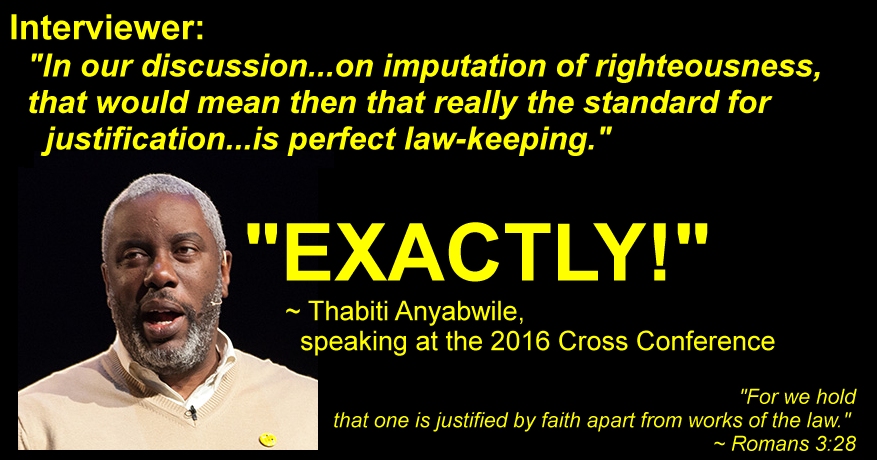
PAUL: Just one minute or so. In our discussion in there on imputation of righteousness, that would mean then that really the standard for justification , or the basis for justification, is perfect law-keeping.
ANYABWILE: Exactly
PAUL: Okay
ANYABWILE: Exactly, which Christ done. Matthew 5:17
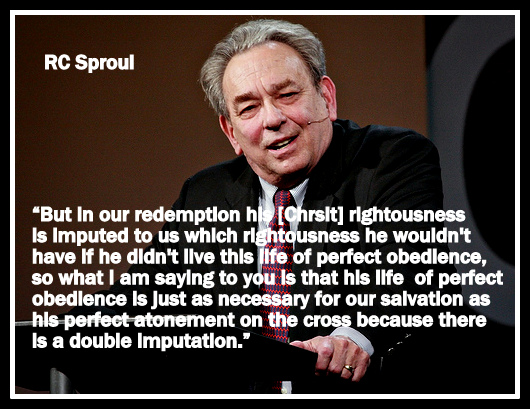
PAUL: Which Christ did. I mean RC Sproul says that Christ actually gained his righteous status by keeping the law perfectly. Would you agree with that?
ANYABWILE: Yeah I would agree with that. Matthew 5:17. You know Kevin was talking about that a little bit this morning, speaking about that, I’ve not come to abolish the law and the prophets but to fulfill it. Um, and when you read the record of the sermon on the mount, when he says fulfill it he doesn’t seem to mean merely keeping the letter of the law but also the whole spirit. Right? So to fulfill it in its fullest sense. Or as to say, 1 Corinthians 1:30 or 31 where Paul says there that God made Him to be wisdom for us, that is, our righteousness, sanctification, and holiness. Um, so Christ has become all the holiness we need for justification to be fulfilled, so He is the reality [sounds like] for our justification.
PAUL: Yeah. I guess, and I understand that angle on it and everything, but then basically, as far as the gospel is concerned and missionaries, I mean, we’re there but it’s not us that’s really righteous at all.
ANYABWILE: Well that’s right. That’s right.
PAUL: Right
ANYABWILE: There’s a message that hey there’s a righteousness apart from the law that’s by faith from first to last. We’re calling other people to that foreign righteousness that’s in Christ.
PAUL: Right. So basically in cleaning up our act and going to mission fields, I mean, that shouldn’t be the emphasis, right? I mean that’s what cultures are gonna be looking for. They’re gonna be looking for character in missionaries. Okay. But the gospel is really stating that the fact that character is not in us at all.
ANYABWILE: That Christ is producing it…it’s not in us for justification…
PAUL: Right…
ANYABWILE: …but it is in us as Christians as we grow with Christ by a particular…
PAUL: But it’s really the one…Christ is really the one that’s doing it. When you say grow, it’s just an increased manifestation of Christ’s work, not us.
ANYABWILE: By the ordinary means of grace. Another phrase Sproul would want to use. By the ordinary means of grace. What’s happening is, like what Paul says in Colossians, right, Christ in you the hope of glory…
PAUL: Right
ANYABWILE: …that Christ is manifesting Himself more and more. And the normal way that He does that, right, is by the word, by prayer, by fellowship, those ordinary means of grace.
PAUL: Right
SUSAN: My question is…
PAUL: This is my wife.
ANYABWILE: How are you? Pleased to, blessed to know you.
SUSAN: When you say that Christ fulfilled the law, so when He ascended up into heaven, all law was fulfilled. What about all those he didn’t that have not yet been fulfilled?
ANYABWILE: Are you thinking of the prophesies and [unintelligible] like that?
PAUL: Yeah.
ANYABWILE: Yeah. So when I use the phrase “He fulfilled the law”, I’m mean in terms of our justification. It doesn’t mean that all of the scripture is now fulfilled. There’s still some things….
SUSAN: Right, I just didn’t know if that was something you said before…
ANYABWILE: It’s a great question.
SUSAN: …Old Testament law (unintelligible)
ANYABWILE: Something great Paul says to them in Galatians, Christ is the end of the law for justification.
PAUL: Alright, thanks a lot. Alright. Bye Bye.
[END TRANSCRIPT]

Why We Do What We Do Here at TANC Ministries
Whenever you feel like you can’t possibly make a difference in this world, remember the starfish.
~ Andy
A young girl was walking along a beach upon which thousands of starfish had been washed up during a terrible storm. When she came to each starfish, she would pick it up, and throw it back into the ocean. People watched her with amusement.
She had been doing this for some time when a man approached her and said, “Little girl, why are you doing this? Look at this beach! You can’t save all these starfish. You can’t begin to make a difference!”
The girl seemed crushed, suddenly deflated. But after a few moments, she bent down, picked up another starfish, and hurled it as far as she could into the ocean. Then she looked up at the man and replied, “Well, I made a difference to that one!”
The old man looked at the girl inquisitively and thought about what she had done and said. Inspired, he joined the little girl in throwing starfish back into the sea. Soon others joined, and all the starfish were saved.
The History of Western Philosophy and Its Societal Impact on the Church – Part 8
The following is the final part of an eight-part series.
Taken from John Immel’s third session
at the 2013 Conference on Gospel Discernment and Spiritual Tyranny
~ Edited by Andy Young
| Click here for part one Click here for part two Click here for part three Click here for part four |
Click here for part five Click here for part six Click here for part seven |
 The Concept of the “Common Good”
The “common good” is a collectivist myth designed to achieve the outcome of subordinating the individual to the majority. The collective well-being is the supreme measure of ethics. The phrase implies that if the individual acts for the “good” of the group, the individual is taking moral action. Notice the equation; action for the group = morality. However, there are three primary problems with the concept of the “common good”
1. It is deception.
By definition, “common” is a synonym for a generalization, and by definition a generalization does not have a specific definition. So when a person speaks of the “common good”, they are appointing themselves the spokesman for some loosely defined group. In conversation, the “common good” is used to refer to the good of the public or the community or society or the tribe. However, each of these words is merely a poor label for the intangible sum of individual interaction. The point is, such “groups” do not really exist.
- “The public”: an adjective describing individual conduct exposed to general view.
- “The community”: little more that the interaction of individual people in close proximity.
- “Society”: The aggregate actions of many “sub-groups” within a geographic location.
- “The Tribe”: A “group” based on genetic similarities. A religious denomination is merely a tribal preoccupation shifted from genetic pedigree to doctrinal pedigree.
 So the thing that is “common” is not really common at all. There is no “thing” that is the direct recipient of good, because there is no specific object to receive the “good”. The work you do doesn’t benefit the good of the group, it benefits the good of individuals within the group.
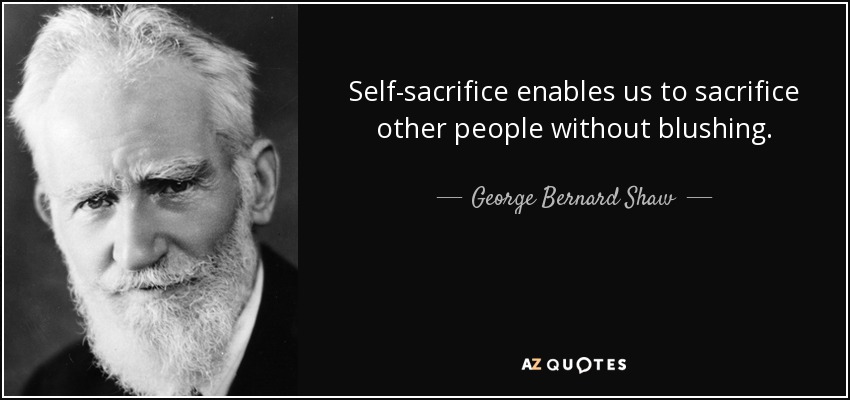
The purpose of the deception is to conceal the root presumption that the collective stands supreme to its individual members, for the “common good” is really the good of the group at the expense of the individual members. Or said another way, the individual is a sacrificial animal to the will of the collective. Any individual who is perceived as a threat to the survival of the group must be sacrificed.
Every time I hear somebody talk about altruism and the “common good”, the conceit in this means that if my life is to be sacrificed to you, the necessary presumption is that your life in turn should be sacrificed to me. I own your life by default, and you think that’s morality? You think that’s just and good? So we’re reduced to moral cannibalism?
2. It poses as morality
The “common good” is really a moral subterfuge because it is an indefinable, elastic concept that can be shaped to apply to any outcome for any political whim. Since the group is elastic based on momentary standards of inclusion, the definition of “good” constantly changes. There is really no constant “yardstick” of measurement but rather a thick syrup that clouds the eyes and ears of its victims and makes them abandon morality rather than cling to it.
The “common good” inspires people to lay down values in service to a select few who claim to be spokesmen for the majority. We see this in political conversation all the time. The outcome is that the spokesmen have a moral blank check that every individual is obligated to cash.
You wonder why you hear stories of molestation coming out of church groups and Christian universities and missionary organizations, where the leadership and authority specifically tried to conceal the crimes against the children and members and students. This is the moral blank check that parents are supposed to cash in behalf of the child who was molested. This is EVIL, fundamental evil!
3. It masquerades as good.
 If taken literally, the error within the expression “common good” itself becomes glaringly obvious. When people advocate for the “common good”, they think they are saying the “good” of all individuals admitted to the group. Or maybe if they paused to consider more deeply, they are saying the “good” of the majority. This doesn’t yet sound too scandalous because “good” is what is done numerically for the greatest amount of individuals. People do a loose moral calculus and decide that the greater the sum, the more moral the action.
But here is the result of that rationale: moral action is quantifiable by statistical outcome. If morality is nothing more than statistics then it is a trivial exercise to justify the Holocost. Stalin created a famine and killed 7 million people, but by the standard of the “common good” his actions are “moral” because the mathematical formula benefits 100 million faithful communists. The “common good” is used to justify taking enormous sums of money from individuals in order to pay for other people’s medical care, or whatever your favorite government program happens to be.
Having identified the three problems with the notion of “common” good, let us examine how this is all used at the root of tyranny.
We now know that the “common good” does not exist because the concepts of group do not exist, and they are never the recipient of any action. Only individuals receive good. Only individuals receive value. It is a false morality designed to subordinate all people to the collective, but who defines the collective?
At the root of all collectivist organizations there is usually only one person holding the yardstick of group inclusion. This person surrounds himself with a gang to defend against any interloper. He is the voice of the people, the voice of community, the voice of society, the voice of the tribe, the voice of the church.
 What people fail to grasp is the “good” of the people is really subterfuge to justify the violation of individual rights. The function of this expression is designed to violate individual rights, and when you violate individual rights you are really abolishing all rights. Groups do not have rights. When you tell me I must subordinate my rights to the group, the group does not gain them by proxy. They have been forfeited.
If there is no such thing as “rights”, the thug, surrounded by his gang, is free to use force (government) to achieve whatever outcome they fancy.The collectivist thug is at once empowered to force people to conform to the collective and shielded against all outcomes. It doesn’t matter what happens next.
This is why you have the brutal absurdity of Soviet Russia. The USSR was built in service to the “common good”, yet the only people who prospered were the tiny gang who surrounded the bloodiest despot in history, Joseph Stalin. The rest of the population lived in sub-human misery for almost three generations.
This is why you have the mystical tyranny of the medieval Catholic church. The Catholic church portrayed itself as the greatest proponent of human good on the planet, yet from effectively 600AD to almost 1500 AD the church leadership lived a comparatively lavish lifestyle, and the serfs existed generation after generation in squalor.
 In the modern age, think of any social program that is said and done for “the people,” for “the society,” for “the community”. Now define exactly what the program does; give money for college, pay for medicine, feed the hungry. If you look at the actual event, only a select number of individuals actually receive the benefit, and all of the authority (force) is invested in a bureaucrat whose sole function is to weed out those who never receive the “good”.
Some of you are squirming because I have placed “community” in the same pot of condemnation. You long for community. You conceptualize your local church as a community. You think this is a social ideal. You think that the community does good. And you like the fact that you vicariously participate in the moral reputation, the prestige, of the group. You want the prestige plus you long for an inter-personal connection, and you yearn to find friends and have “relationships.” You pine for an indescribable thing that is a cross between a Norman Rockwell painting and the television sitcom, “Cheers”, where everybody knows your name. For the life of you, you struggle to see how this is the same seedbed of evil that I have been talking about.
Unfortunately, I am about to tell you that Santa Clause does not exist.
Look closely at the real social dynamic of your community. The connectedness, the relationships that you seek is really the exchange of individual value on an inter-personal level. You long to live in Mayberry R.F.D., filled with “Aunt Beas” baking apple pies waiting on the porch, never once realizing that the safety and security and fraternity that you want cannot happen if the highest moral standard is sacrifice of personal desires and personal values for the “common good.”
 The price of admission to the community is the very self that you must surrender for public consumption. Think about that. To participate in community means that you must get rid of the very thing that makes you unique. This is why most communities (read “churches”) are petty, and gossipy, and back-stabbing, and cliquey. Everyone in the community is constantly vying for some piece of the “common good.” In the end, you realize that the mindless hoards sitting in the pews are there to graze over you like a buffet table.
Now let’s back up to the 10,000-foot view. Now you can see why metaphysics and epistemology are so important. Now you can see how everything revolves around a specific body of ideas that begins with Thales and evolves all the way down to the Cynics and the Stoics, formalized and systematized by Plato, and eventually shape Augustine, Calvin, and Luther. Inasmuch as you continue to accept their premises, you will continue to achieve the same outcome.
If you think the Neo Calvinists are ugly now, you wait and see what happens when you give them just an ounce of civil authority. There will be bloodshed. I know you think that’s scandalous, I get that. It may not even be the guys in the pulpits right this minute. But if you let this construct get hold of civil government, if you have the marriage of faith and force, they will make John Calvin look like a choir boy and Geneva look like a day at the beach. Make no mistake, at the root of this doctrine lie death and destruction.
When you separate man from his mind and his mind from reality, the only thing he has left to deal with another man is a club. The moment we have a club in our hands we are no longer offering an argument. And these guys don’t offer arguments. They have to bail on the conversation every single time they are pressed on the points of their doctrine. They must punt into the grand “mystery” of God. They don’t have a choice.
 Once they are finally confronted with the dead end of their logic, all they can do next is attack and posture and threaten. Inasmuch as you fear that retaliation and extortion, you will willingly shut your mouth. This is why you see such enormous fear coming out of the pews. The discernment blogs and survivor blogs start discussing how they were treated. Everybody online is anonymous, not because they are trying to be deceitful, but because they are terrified!
They have accepted the premise.
What made me specifically so dangerous to them is that I rejected the premise. And that will make you dangerous. When you reject the premise, they will become terrified of you. They do not have the power, and if they ever get close to civil government, resist them with all of your might!
All collectivist cultures are tyrannies.
The philosophy of collectivism claims that there is a mystical, supernatural, social organism that embodies the highest moral values. Of course, only a few elite people with special insight can fully grasp this truth. Somehow they have access to special source knowledge that transcends the average man’s mind. Average men are incompetent, helpless, mindless creatures, depraved and unworthy of social interactions. So they must be purified to serve the collective organism.
Men cannot deal with other men voluntarily because they have no peaceful means to settle disputes. They have no means to act as contractual beings because they are metaphysically incapable of doing good. Human salvation always boils down to an elite clique endowed with some mystical insight, and that insight qualifies them to rule men. They are dictators of an omnipotent, benevolent state, doing what is best for the “common good.”
 All collectivist ideologies hold the same political assumption. All collectivist doctrines seek the exact same end – subjugation of the individual. Man must be chained to the collective. Man is property of the state. Statism is always implemented by force.
The measure of social slavery is directly proportional to how much the slogan of “common good” is embraced. Conversely, the measure of civil liberty is directly proportional to how much the same slogan is overtly rejected. Our Founding Fathers rejected this notion of “common good”. They recognized that the legitimate role of government was specifically to defend the individual and his life, his liberty, and his pursuit of happiness. These are notions contrary to “common good.”
It is an easy slogan to reject because there is no such thing as a generalized good, because only individuals receive values. As soon as you realize it is a hoax it becomes a matter of course to refuse to pay homage to the fraud. Good is not being done. The reality is that people are enslaved to the fancies of others. No man has a moral obligation to subjugation to another man.
The Longing for Revival
We erroneously believe that a return to God will naturally be a return to morality. A return to morality is really a return to a belief in divine extortion. When morality is the product of divine command, the fight becomes about which divine we follow. What the Platonist/Augustian/Calvinsit version of Christianity has shown is that it has nothing to offer as a counter to militant ideologies.
Their first test was Islam. The eastern church showed itself impotent to stop the ideological tide of Islam. Christianity had so gutted the intellectual rigor of intellectual thought, that when confronted with a totally irrational ideology based on war, it could offer no counter.
Of course, Protestants like to push these things off as “those dastardly Catholics.” But Protestants have not fared any better. The Southern Presbyterian Church was in the forefront of slavery within the United States. Of course, Presbyterianism has a direct pedigree line with ties to the reformed tradition.
The reformed tradition’s next test would be National Socialist Germany. It failed miserably. Lutheran churches, with almost no exception, joined “the party” and remained committed to National Socialism until the collapse of the Third Reich.
Christianity has shown itself impotent to offer any intellectual defense against Marxism, National Socialism, and Islam, and that’s just in the modern day.
But they cannot lay claim to mere impotence. It isn’t “God’s will.” Christianity has with far too much consistency been connected to the tyranny. This is not a new observation.
 “7. Because experience witnesseth that ecclesiastical establishments, instead of maintaining the purity and efficacy of Religion, have had a contrary operation. During almost fifteen centuries has the legal establishment of Christianity been on trial. What have been its fruits? More or less in all places, pride and indolence in the Clergy, ignorance and servility in the laity, in both, superstition, bigotry and persecution.”
~ James Madison, “A Memorial in Remonstrance Against Religious Assessments”, 1786
“In every country and in every age, the priest has been hostile to liberty. He is always in alliance with the despot, abetting his abuses in return for protection of his own.”
 ~ Thomas Jefferson
“Millions of innocent men, women, and children, since the introduction of Christianity, have been burned, tortured, fined, and imprisoned, yet we have not advanced one inch towards uniformity. What has been the effect of coercion? To make one half the world fools, and the other half hypocrites; to support roguery and error all over the earth”
~ Thomas Jefferson
“I could never join Calvin in addressing his god. He was indeed an atheist, which I can never be, or rather his religion was demonism. If ever a man worshipped a false god!”
~ Thomas Jefferson, in a letter to John Adams, April 1823
 Here is the absolute conclusion of all we have studied in this series. For anyone with intellectual integrity, these things should be fully and entirely unacceptable. This should compel you to evaluate the content of Christianity for what it has said for the whole of its history. It is not an accident that the same tyranny abetted by the church has occurred over and over and over.
And now, having heard where all this is rooted, you are without excuse. Now you have seen where the core of Protestant doctrine comes from. The intellectual pedigree goes as far back as Heraclitus and the Pythagoreans. It finds its full philosophic formation in Plato, it is welded into Christian thinking by Augustine, and it is put into practice by Luther and Calvin – from Augustine to Luther to Calvin to the Synod of Dort to the Westminster Confessions to the Puritans to the local pastor pounding the pulpit.
The dots are all connected, and now it rests on you to resist the disaster.
~ John
| Click here for part one Click here for part two Click here for part three Click here for part four |
Click here for part five Click here for part six Click here for part seven |
The History of Western Philosophy and Its Societal Impact on the Church – Part 7
The following is part seven of an eight-part series.
Taken from John Immel’s thirsdsession at the 2013 Conference on Gospel Discernment and Spiritual Tyranny
~ Edited by Andy Young
| Click here for part one Click here for part two Click here for part three Click here for part four |
Click here for part five Click here for part six Click here for part eight |
 We have hammered pretty hard the notion of people being personally responsible for the intellectual content of their minds. As a man who has been pretty much talking to the air about this very subject for the last twenty years of his life because I couldn’t get anybody to pay attention, it is very easy to become cynical about how people respond to this information. I suspect some of the cynicism is warranted, because no matter how many times I start up this conversation I am usually confronted with the deer in the headlights look from people.
However, what I have learned is that mostly the reason is due to the fact that people have never been exposed to any counter-argument. They are usually more dumbfounded that someone actually has the audacity to suggest that there is something implicitly wrong with reformation doctrine- not that it is something of an aberration or that a few stray teachers didn’t seem to get it right, but that reformation doctrine is fundamentally wrong.
During these lectures I have had the opportunity to talk to some people who have traveled the same path and arrived at very similar intellectual conclusions. I find them to be endlessly engaged, and I find that to be enormously gratifying, to find others people who have begun to do similar work, have started to see the big picture and have arrived at the same conclusions. The piece of the puzzle that was lacking was actually the framework of the puzzle itself. It was a commitment to say no, these ideas are morally evil. There is a root problem with this doctrine that corrupts it without end.
This is a very longwinded way of saying I am encouraged at the potential that is out there. In discussing the notion of tyranny, it has always relied on men who fear resisting it. Tyranny can only persist when good men do nothing. But good demands of you to fundamentally believe in your moral virtue. If you cannot believe in your own virtue, then you can never ever fight what is evil. This is perhaps the motivation of tyranny to promote the willful self-destruction of man, to keep good men in a constant state of devaluing their own virtue so as to not have the motivation to resist.
This is why I advocate endlessly for your own rational motivation, your own specific commitment to your rational faculties. In all that TANC Ministries is trying to accomplish, I loathe the idea that it ends up becoming one more cult of personality. I recognize that people like Paul Dohse and myself are very strong personalities. And it would be very easy for people to trade my personality and the force of my ability as an individual with any of the popular teachers who currently dominate the scene of reformed orthodoxy. I would rather wreck my own reputation on your behalf than for you to follow me simply because you trust me specifically.
I want you to trust the conclusions of your own rational mind.
The ultimate goal is for you to carry the fight on your own.
 The beauty of Western culture is that it is ultimately the source of freedom and liberty. In the previous five articles I covered approximately 500 years worth of the evolution of Western thought. It is essentially a masters level course on philosophy crammed into a little more than 8,000 words.
The person I neglected to bring into the discussion is Aristotle. His ability to identify the laws of logic is the only thing that comes close to rivaling Plato. Inasmuch as Plato organized a collectivist ruling dictatorship, Aristotle is essential for the liberties of man. He is the first person to give a systematic presentation on why man specifically is qualified to operate successfully on the earth.
In part one we considered the following quote by Sun Tzu.
“All men can see the tactics whereby I conquer, but what they cannot see is the strategy out of which victory has evolved.” ~ Sun Tzu, The Art of War
He was making the observation that it was the underlying strategy that allowed him to win. Men could see the tactics, but they couldn’t understand the function whereby those tactics were employed. This is essentially what we are now being confronted with. The reason tyranny has been so successful at sweeping across the globe is because it has drilled down to the same fundamental elements.
Because man is a rational being in need of a way to integrate his ideas, it is how those ideas go together that defines how he organizes his political life. Political life is nothing more than how individuals interact. We tend to think of politics in terms of the elaborate game that happens in governments between parties and the endless quest for social power. Yet what happens in the grand halls of government is nothing more than the logical conclusions of ideas, and then those men decide that everyone else should live by those sets of ideas.
Here is the central fight of all political philosophy. The whole of human existence has focused around the question of who owns man. The leading consensus, the predominant assumption, the conclusion of the vast percentage of human intellectual content has been focused on man is the property of the state.
My job in this series was to discuss the societal impact of the development of Western thought. I have put off revealing to you the ultimate impact until now because I was more interested in laying the foundation of how we get to that resulting impact. Once we identify how we get to societal impact, it is actually very simple for individuals to start understanding what is actually happening in society.
So the question is then if man is property of the state, what is the moral justification for some to use force against others? What have we just studied? What were the root presumptions throughout history? Man is incompetent. His senses are invalid. There are a select few who have some form of enlightenment from some extra-worldly source. Such enlightenment then makes them alone qualified to use force over others.
The underlying question historically within Christianity has universally revolved around why “they”, whoever those leaders happen to be, are specifically authorized to define truth. Augustine justified this very end using the same exact assumptions I just mentioned. The sheep are stupid, the sheep are incompetent, the sheep cannot organize their own lives, and more importantly, they should be compelled to do what is good.
 I need to introduce you to yet one more philosophical concept. Any doctrine that services the notion that man is the property of the state is know as collectivism. The systems illustrated in the figure at the right are all manifestations of collectivism. In these systems, the dominant presumption is that your life is to be placed at the disposal of some collective. The collective will is the standard of moral value. The goal is always that man must be chained to the collective. And I do mean chained. Man is property of the state, to subordinate the individual to the collective will.
How do they do this?
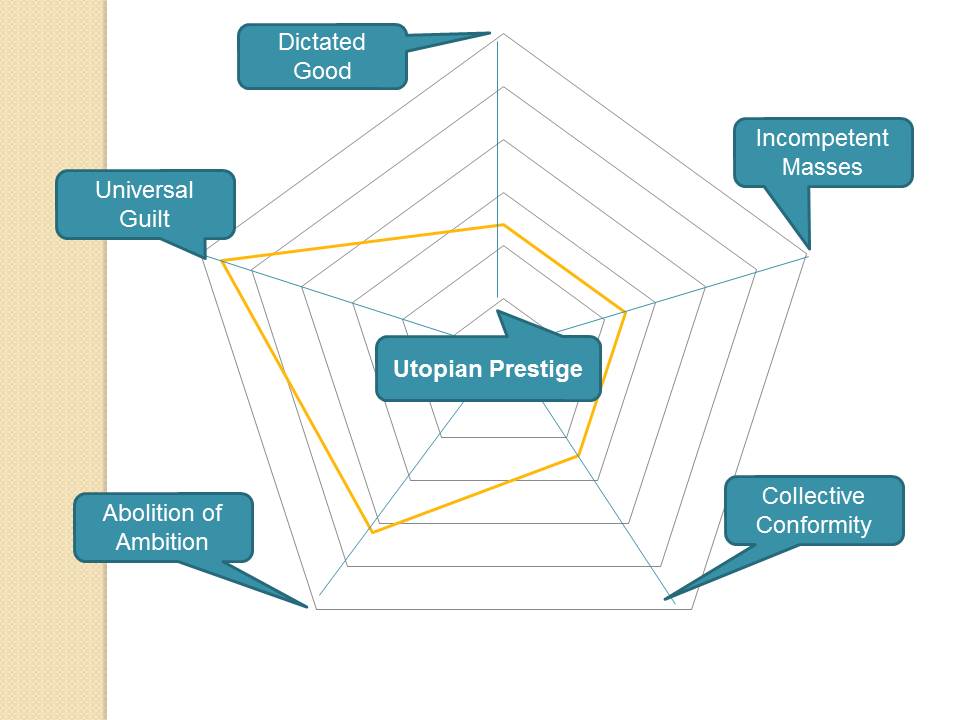 This is my contribution to philosophy. I have identified five fundamental elements of all collectivist doctrines that are designed to produce tyranny. The reason I have organized this as a web is because I want you to understand that this is not linear. All of these elements are interdependent and to not necessarily follow in a progression. There is a dynamic tension between all the arguments. Some arguments that you hear will have facets of each of these categories. Let’s look at each one of these more closely.
Incompetent Masses
The underlying conclusion throughout all the thinkers we have studied has been that man’s senses or his ability to reason were fundamentally flawed. Man could not understand the world in which he lived. This is the bedrock of incompetence. If you separate man from his mind, man from his body, and man from reality, there is no other place for man to live. So if you presume that man is incompetent then you set the groundwork for the next concept.
Universal Guilt
This is a tool designed to drive you to accept your own incompetence. All men are guilty of moral depravity so that no one can advocate a moral standard. If you will accept guilt, a universal guilt, a guilt for no crime whatsoever, a guilt for nothing more than for simply being an incompetent human, you will accept the standard that you are morally incapable of running your own life. This is the death knell of all individualism. If you cannot presume your own moral good then the only thing left is…
Dictated Good
Because man is guilty and incompetent to carry out the important actions, he necessarily needs someone to save him from himself. This is why there has always been a separation between the willing elite and the general masses. This is where the class society comes from. There has always been the presumption that the “true philosopher” had a special access to truth.
The only function of determinism in all of its forms has been to create a class society. If everything is determined, there is no intellectual argument. You cannot persuade me, because whoever I am is nothing more than the outcome of that determinism. Yet this is what sets up select men as the driving force of all political organization. The catch phrase these days among all various forms of Christianity is “God is Sovereign.” This is nothing more than another variation on determinism. If God is “sovereign”, then the very fact that certain men are in positions of authority is evidence of their right to run your life.
But the problem is, man is not a collective being.
He is a contractual being. This is how man successfully operates with other men. Look at all of your successful social interaction, and the quality that makes them successful is men freely engaging in a mutual exchange of value for value. This poses a problem for collectivism.
Abolition of Ambition
 Because man is by nature an individual and not a collective being, he must be talked out of individual action. He must be persuaded that any action done independent of group sanction is the height of moral failing. This is why, within all collectivist doctrines, ambition is synonymous with sin.
The true definition of ambition is to see a value and then organizing an effort to achieve that value. In every effort as a contractual being, man organizes a value that he has and persuades another that he wants that value.
Consider the scope of the charge that God gave to Adam. Be fruitful and multiply and subdue the earth! The scope of Adam’s existence was the earth, and we sit here and worry about how we are going to pay for new tires for the car. God has always been driving man towards his own individual best. So pursuing ambition is not sin. How we break contracts in the pursuit is how we get to sin. Covetousness is not sin because we want something. Ambition becomes covetousness when our means of obtaining value results in broken contracts in our mutual exchange of value with others.
Once you have been talked out of ambition you have arrived at…
Collective Conformity
This is the end game. This is where the full force of government is brought to bear for the sole purpose of creating a neutered humanity without complexion, or variation, or distinction. This outcome is held out as an ethical ideal and forced into existence at all costs.
 In collective conformity, the group is prime. The collective must then define what is authentic “groupness”. It defines the parameters for group inclusion. This is where you get concepts such as “tribalism”. Where we see this most dramatically in the modern age and current culture is the concept of “political correctness”. You are fundamentally immoral if you do not conduct your life in a certain way, if you do not speak a certain way, if you do not hold to a specific set of values.
In the church, this presents itself this way: “Who has the most correct doctrine”, and the yardstick of inclusion is some form of orthodoxy. They hold up that yardstick, and they must pass that yardstick over every individual.
But what happens when someone no longer measures up?
Consider, you attended a church for 15 years or more of your life, you committed enormous amounts of time and resources to that church where everybody hugged and kissed you and told you how wonderful you are. But then you had a conflict, and you got kicked out on your butt. Suddenly you looked around and said, “Where are all my friends?”
Here’s what happened. The whole time you were there, they were holding up that yardstick, and as long as you measured up you were one of them. But the moment they could hold up that yardstick and say, “you are no longer one of us,” they had no other choice but to exclude you from the group. Because everything was about the collective.
Utopian Presitge
All arguments are in service to the collective reputation. Notice what the outcome is at the center of the web of these five elements. How many times have you heard a preacher talk about the reputation of the church? The argument is that individual action will impact the prestige of his “local collective.” This is the presumption of Utopian Prestige.
I have always been a little confused how it is that if man is so morally corrupt how such a great God could ever be concerned that man’s actions would tarnish His reputation. There is no more spectacular conceit. Yet with stunning consistency, Neo Calvinists are obsessed with God’s reputation. In reality, the only way man’s actions could ever affect God’s reputation is if man is God’s equal!
Chew on that one for a while.
Collectivism always seeks some utopian ideal that is never achievable- the Marxist workers’ paradise, Hitler’s Third Reich, the Muslim perception of “Allah”. Every collectivist culture is always driving towards this idea that if we had this perfect thing, whatever that happens to be, and everybody focused all of their pursuits towards that one end, the prestige of that would be so enormously great that it would compel everyone else to fall down before it on their knees.
 Well, it compels everyone to fall to their knees, but with their hands behind their back and a bullet to the back of the head.
The National Socialists of Germany went to war on two fronts for the prestige of the “fatherland”. Alexander the Great conquered nations for his collectivist/statist will. Stalin killed 7 million people in his Workers’ Paradise due to man-made famines, all for the prestige of the Soviet Union.
And what do we hear now? How often in American parlance do you here people say, the world doesn’t like America; that there is something wrong with our reputation in the world? It is always about prestige.
What did the people in the land of Shinar say to themselves? “Let us make a name for ourselves.” What was the mark of that prestige? “We will build a tower to reach unto the heavens.” It was a collectivist ideal, and every resource of human ability was focused into the achievement of that ideal. But they could never get to the heavens. There was never any practical end to that outcome.
Once you know the elements of collectivism and the outcomes to which they are in service it becomes stunningly easier and easier to recognize it all around you. Have this chart in front of you the next time you listen to the news, I don’t care what source, it doesn’t matter, and in less than a half hour your will be sitting there in stunned amazement.
Watch any television drama, which is entertainment, which is nothing more than an artistic expression. These elements are even easier to see in art because art is the most condensed version of a society’s value statement. It is the result of a full philosophical statement boiled down into a picture. And without fail, the greatest villain in most television shows ends up being the one who is successful. This is the manifestation of the abolition of achievement.
These are all reflections of our cultural expectations. They are all designed to drive us towards some collective conformity. Any true individuality is always explained in terms of exploitation, and everything is about sacrifice to the collective.
…To be continued
| Click here for part one Click here for part two Click here for part three Click here for part four |
Click here for part five Click here for part six Click here for part eight |
The History of Western Philosophy and Its Societal Impact on the Church – Part 6
The following is part six of an eight-part series.
Taken from John Immel’s second session at the 2013 Conference on Gospel Discernment and Spiritual Tyranny
~ Edited by Andy Young
| Click here for part one Click here for part two Click here for part three Click here for part four |
Click here for part five Click here for part seven Click here for part eight |
We continue in our discussion of the major contributors in the progression of Western thought. Many concepts and doctrines that we have traditionally come to think of as Biblical orthodoxy in reality have their roots in ancient philosophies. Here is a brief summary of the thinkers and their contributions that we have studied so far:
Thales – The first scientific approach to explaining reality as opposed to a pantheistic approach. The concept of one universal “stuff” and its various forms.
Heraclitus – Because everything is in a constant state of “flux”, man is unable understand the nature of reality. The first to introduce a division of reality. Two “realms”.
Parmenides – Precursor to Aristotle’s “Law’s of Identity” and existence. Existence is real, but change is not. Change is only apparent because of man’s faulty perception.
Zeno – The Dichotomy Paradox. Movement was an illusion and plurality and change was impossible.
The Pythagoreans – Orphic mystics. Introduction of the soul/body dichotomy.
The Atomists – Described a mechanical model for metaphysical concepts. Introduction of determinism.
Sophism – Used deceptive arguments as a means of persuasion. “What is truth?” There is no objective knowledge. Man’s primary social purpose is domination.
Socrates – Introduced the concept of “universals”. Man’s ability to use reason to grasp universal concepts.
Plato – First successful comprehensive system of philosophy. Two world dichotomy, universals/particulars. Only philosopher kings have access to the realm of the “forms”.
This brings us to part six, and we will pick up where we left off.
 Cynicism
These guys could be considered the first “street preachers”. In Christian parlance they were “evangelists”. They considered themselves humanity’s watchdogs. Their favorite pastime was to publicly expose the pretense at the root of everyday conventions. The believed that is was their life task to convert the masses to what they called the declarative.
They rejected all wealth, power, sex, fame, because these pursuits were the stuff of a polluted mind with internal haze. Diogenes of Sinope, one of the founders of the Cynic movement, is reported to have lived in a tub. He refused to wear shoes in the winter, refused to bathe, ran around the streets without clothes, and wandered from street to street in the cities preaching Cynic doctrines. Those doctrines were specifically designed to save men from the bondage of their flesh. If man was liberated from the bondage of flesh they would be liberated from worldly suffering and uncertainty.
The summary of Cynic ideology follows:
- The goal of life is mental clarity or lucidity.
- Freedom from internal haze, which signified ignorance, mindlessness, folly, and conceit.
- Achieving freedom by living in harmony with nature.
- Mental haze, ignorance, mindlessness, et al, is caused by false judgment of values which causes negative heartache, anxiety, unnatural desires, and evil character.
- Man flourishes (he truly lives) by achieving what is called “self-sufficiency”.
Self-sufficiency in the case of the Cynics refers to an internal indifference to life’s hardships. One progresses towards this life and clarity of thought by ascetic practices that help one become free from the influences of the flesh. And since they had a great disdain for fame, they tended to act shamelessly in public in a direct effort to slight all social conventions.
Here is the point I want you to grasp. How does man achieve harmony with nature? By being indifferent to all hardship. The suggestion was that the way man obtained this harmony was by constant arduous training of the body. You see this theme in the apostle Paul’s comment when he says in 1 Corinthians 9:27, “But I keep under my body, and bring it into subjection…” Here he is using a reference that is influenced by the Cynics. (Editor’s note: While the expression might be familiar to his audience because of Cynic doctrine, Paul is using it in the context of a believer’s sanctification so as to not be disqualified from any heavenly reward he might receive at the Bema.)
Notice also how the Cynics have elevated the nature and importance of asceticism. Not only is the flesh bad, but the flesh must be defeated through specific violence towards it. This is crucial because it becomes a dominant theme later as we shall see.
 Stoicism
Stoicism finds its beginnings in a school founded by Zeno of Citium in the early 4th century BC. Zeno taught in the public square located on the north side of the Ancient Agora of Athens. The name “stoicism” is derived from this square which was named ποικίλη στοά (Poikile Stoa) which means “Painted Porch”. The Stoics taught that destructive emotions resulted from errors in judgment. Someone of moral and intellectual perfection would not suffer such emotion.
Stoics were concerned with the active relationship between cosmic determinism and human freedom and the belief that it is virtuous to maintain a will that is in accord with logos. Remember it was Heraclitus who was the first to use the term logos. Aristotle used it to mean reasoned discourse. However the Stoics were the first to use it in conjunction with god. They said the logos was the animating force of the universe. It was this conceptual and linguistic shift that made the introductory chapter to the gospel of John possible.
Of course, later Christianity condemned Stoicism, but that didn’t stop them from using Stoic concepts and advocating the primary themes of Stoic metaphysics and ethics: an inner freedom in spite of worldly hardships, the innate depravity of man called “persistent evil” by the Stoics, and the futility and temporal nature of worldly possessions and attachments.
Stoic religion emphasized prayer, self-examination, and praise. They described spiritual pursuits like this: God is best worshipped in the shrine of the heart, by the desire to know and obey Him. Where have we heard that theme before?
The four cardinal virtues of Stoic philosophy where:
- Wisdom
- Courage
- Justice
- Temperance
Virtue alone was sufficient for happiness. A sage was immune to misfortune because he is dispassionate about all things both good and evil. Epictetus is quoted as saying, “Sick and yet happy, in peril and yet happy, dying and yet happy, in exile and yet happy, in disgrace and yet happy”
A sage achieved freedom by studying and seeking “universal reason”, which was their logos concept, and through practicing asceticism. Notice, now we have the correlation. Not only is it necessary to study this higher mystical concept, but it is specifically essential that the flesh is purged in the process. The flesh is beaten, and the study continues. Those who practice these virtues are enlightened and can achieve freedom from the vicious materialism and emotionalism of this world.
Stoics were determinists. They said that everything is subject to the laws of fate. The logos acts in accord with its own nature and governs matter. Souls are emanations from the logos and are therefore subject to logos dictates.
They describe the wicked man like this: he is like a dog tied to a cart and compelled to go wherever it goes. For you history buffs, you will recognize this from the Christian deterministic traditions that describe man like this: man is on the back of a horse being led around by the devil. This is Reformed Theology 101.
I want to illustrate how the Pythagoreans’ soul/body dichotomy weaved its path from their own relative hedonism to the Stoic doctrines we see before us. How did we get to the point where man must use violence against his own body to achieve enlightenment? And just so you understand, when we start talking about asceticism, we are not talking about giving up a few McDonald’s apple pies or a doughnut for breakfast in the morning. The accepted expression of virtue involved the literal beating of flesh as an ethical ideal
From the late 3rd century to almost the 1100s, here is what these people did:
- They sat on stone pillars until their legs rotted away.
- They drank laundry water.
- They slept on beds of nails.
- They inflicted on themselves personal and/or public floggings for sins.
This is the corruption implicit to these ideas. When you so divide man from reality, when you so divide man from life, you can only worship death!
…And that’s exactly where these doctrines trend.
To be continued…
| Click here for part one Click here for part two Click here for part three Click here for part four |
Click here for part five Click here for part seven Click here for part eight |

 Paul's Passing Thoughts
6 comments