A Historical Survey of the First Century Christian Assembly – Part 1
The following is part one of a four-part series.
Taken from Andy Young’s first session at the 2017 Conference on Gospel Discernment and Spiritual Tyranny
Part Two • Part Three >
 Clearly there is a problem with the institutional church. But what is the alternative? I honestly don’t believe that Jesus ever had in mind what passes today for “the church”. Ironically what we see today in the beast that is institutionalized religion is frighteningly reminiscent of the religious and political climate in which Jesus found Himself during His ministry. And I daresay that He would be any less harsh with the likes of the John Pipers and the John MacArthurs and the Kevin DeYoungs of the world than He was with the scribes and Pharisees.
So what is the alternative? Does the Bible prescribe a model for us to follow. I will say outright, no there is no prescribed pattern. In other words there is no place in the NT where any of the apostles said this is how you meet and this is what you do. We can, however, come to a better understanding of just what God had in mind when He chose to make mankind His literal offspring. Let us begin by examining the forerunner of the 1st century assembly, the Jewish synagogue.
A History of the Synagogue
The word synagogue is from the Greek word συναγωγη (soon-a-go-gay). It is made up of the prefix “soon” meaning “together with” and the verb “a-go” meaning “to lead or bring”. Literally then it means “a bringing together.”
There is very little information regarding the origin of the synagogue. Most of what is assumed about the synagogue is due to tradition. This is because the synagogue is so closely associated with Jewish institutional religion. Most people simply assume the synagogue was a central fixture among Judaism going back as far as Moses.
However the origin of the synagogue is probably much more recent than that. Some historians believe that the synagogue evolved out of necessity during the time of Babylonian captivity. Since the captive Jews had no access to the temple in Jerusalem for worship and sacrifice, spontaneous assemblies of Jews would meet in their local communities for times of prayer and teaching. These captive Jews would gather at a location central to their community, perhaps someone’s home. In time, many would erect buildings for this select purpose. These buildings were called “Beth K’nesset”, or “House of Assembly”.
If the name alone doesn’t suggest that these buildings existed for a sole purpose, consider also that the configuration of these buildings had dedicated certain rooms for specific functions; one room for prayer, another for instruction, and so on. Some synagogues even had fully organized religious schools.
Excerpt http://scheinerman.net/judaism/Synagogue/history.html
“What happened to the Jewish people in Exile in Babylonia? We know that Exile lasted for 70 years, until Babylonia was conquered by the Persian Empire under King Cyrus, who gave the Jews permission to return to their land and rebuild their central sanctuary. During those 70 years in Babylonia, Jews settled and built homes, started businesses and raised families. They faced an unprecedented religious crisis: Exiled from their homeland and unable to offer sacrifices to God, since offering could only be made in the central sanctuary in Jerusalem, the Jews in Babylonia wrestled with whether their covenant with God was still operative. The prophet Ezekiel, who had preached before the Destruction and who had gone into Exile with them, assured them the covenant was eternal, and that God would some day return them to their Land. He shared with them a vision of valley of dry bones which God would bring back to life, covered with muscles, sinews, and flesh, a divine sign that the nation Israel would one day be resurrected from exile to live again as a nation in her own Land. In the meantime, to preserve their traditions, it seems that the Jews in Babylonia gathered together on market days (Mondays and Thursdays) and participated in some combination of worship and study. Some scholars believe that these gatherings gave rise to worship services, and that prayers were composed for use at this time which were eventually brought back to the Land of Israel when some of the Exiles returned, and incorporated into the cult worship when the Second Temple was eventually built.
“Most of the Jews in Babylonia, however, remained there even after King Cyrus permitted them to return to the Land of Israel. By then, most Jews had been born in Babylonia; some were even the children of Jews born in Babylonia. They had built homes, businesses, and lives in Babylonia. While sacrifices could be offered only from the altar in Jerusalem, prayers could be offered anywhere. The focal point was still Jerusalem, however, as we know from Daniel’s prayer — he faces Jerusalem when praying to God. In time, schools of study grew in Babylonia, especially in the aftermath of the Destruction of the Second Temple by the Romans in 69 C.E., where prayer and study were full-time activities for the learned class. By the first century, synagogues emerge as the central institution of Jewish life once the Temple is destroyed, a place where study, worship, meeting, celebration, and civic meetings take place. There were synagogues not only in Babylonia, but in Alexandria and throughout the Land of Israel, in places such as Dora, Caesarea, Nazareth and Capernaum”
Hang on to that idea “central institution” because I’m going to come back to that.
After the return to Israel following captivity, the synagogue remained a vital part of the Jewish community even after the reconstruction of the temple. In Jerusalem alone, at the time of its destruction in 70 AD it is estimated that there were between 390 and 480 synagogues.
Synagogues were the cultural center for the Jews. It was as if they were expected, because they were Jews, to gather at the synagogue on the Sabbath. But since the synagogue was also the place where teaching took place, I can conceive groups of Jews going to the synagogue at different times during the week for instruction or to attend community functions of some kind.
Synagogues were not restricted to specific locations. No uniform design or floor plan existed, and so each community of Jews was at liberty to build their synagogues as they saw fit to meet their own requirements. They could be located on the seashore, along riverbanks, in the center of town, or even in private dwellings.
As such, the synagogue was also often used as a place of lodging for travelers. Many private dwellings in this culture often contained fully furnished third floors for the express purpose of housing visiting out-of-town family members. Therefore, it is likely that purpose-built synagogues or private dwelling used for that purpose may have been constructed with the same third flood lodging space. Consider this, the term “inn” that is found in Luke 2 that was already occupied by the time Mary and Joseph arrived in Bethlehem is more properly translated as “guest chamber” and could refer to this upper room of a private dwelling. Indeed, this guest chamber, as well as the upper room where Jesus and the disciples held the “last supper”, the upper room where the 120 disciples in Acts 2 were filled with the Holy Spirit, and the third floor window out of which Eutychus fell when he fell asleep during Paul’s marathon teaching session in Acts 20 could have very well been in a synagogue.
Now you don’t have to be a Bible scholar to do this. Anybody with some kind of rudimentary Bible app with a search function can do this. You can quickly search your Bibles and you swill find no mention of synagogues in the OT. Now there might be one exception to that in Psalm 74, which I believe is a lamentation regarding Israel being led into captivity. There is one mention in verse 8 about the enemy burning up all the synagogues. But in that instance the Hebrew word translated synagogue is referring to fixed times and seasons or more specifically festivals and the places where those festivals were held and does not necessarily imply a synagogue in the sense we know it per se.
Furthermore, there is no commandment to be found anywhere in the OT instructing the Jews to build synagogues. However rabbinical Jews will suggest otherwise. Now this is organized, institutional religion we’re talking about here. We’re talking traditions, we’re talking orthodoxy. Look at what they do. They claim that that Torah mandates that Jews follow all properly instituted decrees accepted by the community at the time the decree was made.
That is to say this – here is the logic behind this: They claim the Torah commands that everyone follows the decrees of the religious leaders. So if the religious officials make a decree that says you must build a synagogue, then the command to build a synagogue is sanctioned by the Torah. This is how they conclude that synagogues are a Torah-mandated institution. And the scripture they use to back this claim is Deuteronomy 17:11.
“According to the sentence of the law which they shall teach thee, and according to the judgment which they shall tell thee, thou shalt do: thou shalt not decline from the sentence which they shall shew thee, to the right hand, nor to the left.”
~ Deuteronomy 17:11
Now looking at this verse, there is a huge problem here.
This verse is the conclusion of a larger context that is dealing with legal matters. You’ve got a dispute between two parties. Moses says if you cannot resolve the matter, you go to the place that God appointed for judgment. You go to the Levites and they will settle the dispute. And when the Levites render a judgment, you will do exactly as they say according to their verdict.
Notice this is very specific context to this verse. And what did the Jewish religious leaders do? They took a verse in scripture and applied it to an incorrect context. They took something that was talking about rendering a judgment in a legal matter and said, this verse means we are commanded to do whatever the leaders tell us to do. This is orthodoxy or tradition with Bible verses hung on it. In this case this is how they get to synagogues being a scriptural mandate. They have conflated religious orthodoxy with scripture.
And this is the thing I want you to get out of all of this. Synagogues today are still characteristic of ancient Jewish synagogues. But what I think has become obvious by now is that synagogues also share in common many characteristics of today’s institutional church.
Notice the progression. Let us accept the assumption that synagogues began as a means to fulfill a cultural void during Israel’s captivity. This happened spontaneously – of its own accord. It was local. It was within specific communities. This was the result of what happens when individuals get together and figure out a way to solve a problem. But look at what happened over time. Look at what happened when some authority got its hands on it. It became institutionalized. Synagogues today and synagogues in the 1st century drifted far from what they were originally intended to be.
Is this not a parallel to what happened with the church? First century believers met spontaneously in local assemblies. They probably began in these same synagogues, but I would imagine that due to being a follower of Christ being in conflict with the religious orthodoxy within the synagogues there in Jerusalem, many of these believer found themselves ousted from their local synagogue. There were no longer welcome there.
In John chapter 9 we have the account of a man who was blind from birth and Jesus came along and healed him. The Jewish leaders wanted to know who it was that healed him. In fact, they didn’t believe at first that this man was ever really blind. They went to his parents, his parents said, look he’s a grown man, he can speak for himself. You need to discuss this with him. And John says that the reason the parents said this was because they were afraid that they would be thrown out of the synagogue if they acknowledged that Jesus was the Messiah.
When they came back to this man who was healed they asked him again. And what’s funny about this is the man gets kind of testy with these guys. He says, you already asked me this question and I already told you. And then he says, why are you so interested in Jesus? Do you want to be His disciples too?
And then he becomes even more impertinent with them. He says, you guys say you are disciples of Moses but yet you cannot answer if Jesus is the Messiah or not. This man who healed me – not everyone can do that. Only someone from God could do that. And these religious leaders got really angry at this point and they say, how dare you instruct us! And at the end of this account we read that they threw him out of the synagogue.
So I’m sure this kind of thing happened over and over in Jerusalem with the early believers. So they began to assemble and fellowship among themselves out of necessity. And I’ll get into more of what that might have looked like in later lessons. But here you have believers meeting spontaneously, seeing a need and finding a way to solve a problem. They had need of fellowship, they had a way were they could exercise their spiritual gifts for the purpose of building each other up. They had a way of providing for those among them who were in need. And this goes on like this for the first 50, 60, 70 years or so.
And then what happens? Some authority steps in and decides to centralize all the fellowships under one umbrella. You have the institutionalization of the home fellowship into what becomes the institutional church.
So this is my point. You can see what happens here. There is this parallel between the synagogue and the institutional church.
Worship in the Synagogue
Now one other way in which we have a similarity between synagogues and the institutional church is with this notion of worship. In each of the sources I came across as I was researching the history of the synagogue, this idea of “worship” kept coming up. Every source was stuck on this notion of the synagogue being a center of worship. I saw this repeatedly. And I think in our modern culture, and as historians review this information from the past, history becomes colored with the current understanding of the meaning of words, and so this idea of “worship” somehow implies some kind of ritualistic observance; some kind of liturgy or progression of acts that one performs toward a deity, and this is called “worship.” It might be reciting a prayer, reading holy writings, listening to a sermon, giving offerings, some kind of sacrifice. This notion of worship then is applied to Christian worship and the institutional church.
One might ask the question, why do we go to church? I remember one time in particular when one of my own kids asked that question. Now, there are several fundamental fallacies with that question which I’ll get to, but lets take the question for what it is. The orthodox answer is we go to church to worship God. And that sounds like a reasonable answer.
Well, right off the bat, there is one glaring fallacy that should be obvious in the question itself. Why do we go to church? Stop right there. What are you assuming by asking that question? You are assuming that church is a place to which you go. So from the start the question is irrelevant because you should reject the premise of the question.
But assume you get past that faulty premise, the next thing you need to ask is what is the definition of worship? Worship is a modern English word that simply means to ascribe worth to something. Our understanding of the English word worship is not what the Greek and Hebrew words mean. We understand worship as this ritualistic experience that we somehow believe is required of us by whatever deity we happen follow.
And Christians are no different. If you don’t believe me, then ask yourself why you run yourself ragged every Sunday. Christians love to talk about a day of rest, but consider what you put yourself through every week. You get up at the crack of dawn, probably the same time you do for work during the week. You shower and primp and make sure you look your best, putting on your best clothes so that no one will think you’re not “fit for worship.” If you have kids, you run around the house trying to keep them corralled, getting them dressed and fed and washed and primped and then making sure they don’t get rumpled or dirty before you get to church. If you teach Sunday School, you have to get to church extra early to get things ready for your class. Oh wait, I have a committee meeting after the morning service; sorry honey, that roast you have in the oven at home is going to have to wait. And I’m sure there are any number of scenarios you could add to the mix.
You put it all together, and for a day that we are told is to be a day of rest, Sundays are probably the most stressful day of the week. To be quite honest, I came to point where I hated Sundays. And it wasn’t because of the doctrine I was going to hear. It was because of the hassle and just how exhausted I knew I would be at the end of the day.
All of this for some vague notion of worship.
But what did God have to say about worship?
Probably the best treatise on worship in the Bible is found in the gospel of John chapter 4. Now I will get there eventually, but I am going to set up some background first. A little more Jewish history. Many of you will probably already be familiar with this, but since most churches only view the OT in a redemptive context and have little to no interest in the historical context, I’m sure there a great number of people who will not comprehend the significance of just what is taking place in John chapter 4. This is why I am going to take the time to lay this groundwork.
So, Israel wanted a King. In the early history of Israel they were governed by judges, and then a little later God dealt with Israel directly through the prophets. So during the time of the prophet Samuel the people looked around at the other nations around them and saw their kings and their prestige, and they came to Samuel and said, hey, we want a king too. So God conceded to their desires and gave them Saul. Of course Saul ended up being a man who was rife with character flaws, so God unseated him and put David in Saul’s place, and you have this dynasty of kings that issues forth from David’s lineage. The next king following David was Solomon who is traditionally known as the wisest man who ever lived. Solomon too ended up having some character issues at the end of his life, and this ended up having direct bearing on what happened with his son, Rehoboam, who succeeded him. Because of the things Solomon did at the end of his life God said He would rend the kingdom from his son.
So there was a man named Jeroboam who had been a servant of Solomon. And one day a prophet came to Jeroboam and he told him that God would give to him ten tribes of Israel. So when Solomon heard this he wanted to kill Jeroboam. Jeroboam flees to Egypt, Solomon dies, and Rehoboam becomes king.
So now Jeroboam hears the Solomon is dead. He goes to Rehoboam and tries to make peace with him. Rehoboam doesn’t know what he should do. He calls in his advisors. The older, wise advisors say, yes make peace with him, give his what he asks for. The younger advisors who grew up with Rehoboam said, here’s what you say to Jeroboam. You think my father treated you harsh? Just wait!
“And the young men that were grown up with him spake unto him, saying, Thus shalt thou speak unto this people that spake unto thee, saying, Thy father made our yoke heavy, but make thou it lighter unto us; thus shalt thou say unto them, My little finger shall be thicker than my father’s loins. And now whereas my father did lade you with a heavy yoke, I will add to your yoke: my father hath chastised you with whips, but I will chastise you with scorpions.” ~ 1 Kings 12:10-11
So Jeroboam ends up leading a rebellion against Rehoboam. Jeroboam prevails, and the kingdom is divided. So you have the ten tribes of Israel to the north, also known in many OT scriptures as “Ephraim,” and you have the kingdom of Judah to the south.
Now here’s where it gets tricky. The temple is in Jerusalem. Jerusalem is part of the southern Kingdom of Judah. The Jews were required by the Moasic law to go to Jesursalem for all the major feasts, Day of Atonement, Passover, and so forth. They were supposed to bring gifts and offering to the priest in the temple at Jerusalem. Now that you have a divided kingdom you can imagine that for the people in the northern kingdom this would prove to be troublesome. I’m sure there were many devout who would still make the pilgrimage despite the tension between the two kingdoms, but for the most part, not many people are going to risk getting in the middle of this political powder keg.
Jeroboam realizes this, and being a shrewd leader he also realizes that if people keep going to Jerusalem they might eventually turn against him. And he says this in 1 Kings 12:
“Whereupon the king took counsel, and made two calves of gold, and said unto them, It is too much for you to go up to Jerusalem: behold thy gods, O Israel, which brought thee up out of the land of Egypt. And he set the one in Bethel, and the other put he in Dan. And this thing became a sin: for the people went to worship before the one, even unto Dan. And he made an house of high places, and made priests of the lowest of the people, which were not of the sons of Levi.”
~ 1 Kings 12:28-31
And of course you know then the northern kingdom was infamous for having all manner of idolatry, and you know what happened with King Ahab and Jezebel and so forth.
Now I set all that up to bring us here. When we get to John 4, Jesus is in Samaria – the region that was once the northern kingdom. So already we are in a region that according their history and religion forsook going to Jerusalem for worship.
Second, we have to take into account the time of captivity. After 70 years, you have Ezra who leads a remnant back to rebuild Jerusalem and the temple. But not all of those who return settle in Jerusalem. Some will go back to their homeland. And now they are accustomed to this practice of having a synagogue, assuming this was a practice that started in Babylon. Also by this time the synagogues have the beginnings of becoming institutionalized. So then for the next 400 years or so you have created a culture where it is perfectly acceptable to worship in a synagogue instead of making the trek to the temple in Jerusalem. These synagogues are going to be located wherever it is convenient, whatever a particular community needs. You are going to have all manner of “traditions” develop. And so when Jesus meets this woman at the well in John chapter 4, this is the background she’s coming from.
So now we will finally get to the text of John 4. This is a very familiar passage of scripture, and typically most teachers will focus on the first part of this account where Jesus offers this woman the “living water”. I want to focus on the second part of this interaction beginning with verse 19. So lets begin by reading there.
“19The woman saith unto him, ‘Sir, I perceive that thou art a prophet. 20Our fathers worshipped in this mountain; and ye say, that in Jerusalem is the place where men ought to worship.’”
Now before we go on I want to interject something here. The King James translates prophet with the indefinite article “a”. But in the Greek, the word prophet is preceded by the word “hoti” which is the demonstrative pronoun “that”. So what this woman is actually saying is, “Sir, I perceive that you are that prophet.”
Now just a few chapters earlier in John, we have all the people coming up to John the Baptist and asking him are you the Christ, are you Elijah, are you “that prophet”? So who exactly is the one identified as “that prophet”. This is actually a reference to Deuteronomy 18. Moses is talking to the children of Israel and he says this.
“The LORD thy God will raise up unto thee a Prophet from the midst of thee, of thy brethren, like unto me; unto him ye shall hearken;” ~ Deuteronomy 18:15
“I will raise them up a Prophet from among their brethren, like unto thee, and will put my words in his mouth; and he shall speak unto them all that I shall command him.” ~ Deuteronomy 18:18
So this tells us two things. First it tells us that the people in Israel at this time have been waiting for this prophet to come along that Moses talked about. But second, it tells us that this woman at the well had some knowledge of Mosaic Law. Not only was she aware of Moses speaking about “that prophet”, but she also knew enough to know that Mosaic Law required certain types of ceremonial observances to take place in Jerusalem at the temple.
Now this woman is a thinker. Clearly she has some cognitive dissonance going on in her mind because of this conflict she perceives between her understanding of Mosaic Law and the traditions and orthodoxy she grew up with. Remember this all this historical background we’ve just covered?
Furthermore, she senses something different about Jesus. She recognizes Him as more than just a teacher. He knows all about her and who she is and has made this offer of “living water” to her. She sees Him as more than just a teacher but as an authority who might be able to help her resolve this conflict she has in her mind.
Notice how Jesus answers her question. Verse 21
“21Jesus saith unto her, ‘Woman, believe me, the hour cometh, when ye shall neither in this mountain, nor yet at Jerusalem, worship the Father.’”
Understand that in the Old English, the word “ye” is a plural, collective form. So when Jesus says “ye”, He doesn’t mean her specifically, he means “all of you”, or “you” in a general sense. People in general. So what is Jesus point? He says, you’re really asking the wrong question. You are getting all hung up about a location, about WHERE worship happens because you have a wrong assumption about worship. How do we know this? Look at the next verse. 22
“ 22Ye worship ye know not what: we know what we worship: for salvation is of the Jews.”
Now let’s skip this phrase at the end, “salvation is of the Jews” because that can be a whole other study on its own, and if you want to discuss this later we can do that. But I want to stay focused on this idea of what is worship. Jesus says you are all preoccupied with “where” to worship you don’t even know “what” you are worshipping. “Ye know not what.” The Greek word is “iedo” and it means to perceive, or “to see”, in this sense “see” meaning “to understand”.
Jesus says we5* understand worship because we know what salvation means. Or perhaps Jesus is really saying, to understand salvation is to understand worship. Look at the next verse:
“23But the hour cometh, and now is, when the true worshippers shall worship the Father in spirit and in truth: for the Father seeketh such to worship Him. 24God is a Spirit: and they that worship Him must worship Him in spirit and in truth.”
~ John 4:19-24
So worship doesn’t happen at a place. It is not the fulfillment of some ritualistic requirement of your favorite deity. It doesn’t matter if you worship in this mountain or at Jerusalem. There is coming a time (in fact, it’s already here, it NOW IS) when true worshippers worship in spirit and in truth. Worship doesn’t happen at a place. Worship happens in spirit and in truth. Now what does that mean?
Well let’s consider this. What did Jesus come to do? He came to die on the cross to end the law. That OT covenant that was the last will and testament of Jesus Christ; that OT law that imprisoned sin. It acted as a guardian to all those who believed God. Their sins were imputed to that Law. There was a promise of a new birth. Jesus died, He ended that testament, and not only did He take away all sin with Him when he ended that testament, but the promises that were in that testament could now be realized. A will cannot be executed until the testator dies. What’s in a will? It’s a promise to the people mentioned in it that they will receive some benefit upon the death of the testator.
So now, all those OT saints who died under the old covenant, who are waiting in Sheol, who were under the protective custody of the Law, now the law is taken away, and the promise of the New Birth is realized. Anyone who understood the OT scriptures should have understood this. This is why Jesus was so incredulous at Nicodemus – he was a teacher of Israel and he had no clue what it meant to be born again.
The New Birth makes us God’s literal offspring. We are born of the spirit. And as such we are no longer under condemnation. Now we are free to go and live lives pleasing to our Father. We can aggressively pursue obedience to the Law and thus show love to God and to others. What did the apostle Paul have to say about that?
“I beseech you therefore, brethren, by the mercies of God, that ye present your bodies a living sacrifice, holy, acceptable unto God, which is your reasonable service.”
~ Romans 12:1
This is where Paul makes the transition from justification to sanctification. At the conference last year, John Immel spoke about sacrifice as the highest moral ideal and how this notion of sacrifice permeated everything in the culture, and still does as a matter of fact. In fact it’s gotten even more insidious. Now you take that cultural expectation of sacrifice, and you overlay it on top of what Paul is talking about in Romans, and what you see is that Paul loves to take jabs at current cultural norms.
Paul’s audience was familiar with the concept of sacrifice. Now he takes that concept and turns it on its head and talks about being a “living sacrifice”. What impression must that have made to the people in that time? Paul, sacrifice means death. How can you sacrifice yourself and still be alive? And the answer is you can’t, and that is the irony that Paul uses so effectively here. To them sacrifice was their idea of worship. Sacrifice was something that was expected of the gods. But you have to get rid of this notion that worship means you have to sacrifice something to your god – big “G” or little “G” god. That’s not worship.
Paul says that as a believer, to be a living sacrifice is your reasonable service. Now the word there for service is the word “latria”, and the root word is used to refer a hired menial servant. Not a “doulos,” that is a bond servant. This is a “latria,” a menial servant. In fact I would not be surprised if this is where we get the word “latrine.” They had public toilets in the Roman empire, so cleaning one of these public facilities would be considered a menial job.
What’s interesting is that this word can also imply worship. Guess what. When you go around and demonstrate love to God and to other through aggressive obedience to the law, you are being a living sacrifice. Every time you show love to God and others, you are worshipping. Paul said this is reasonable. The word there means logical. This is the logical conclusion of what it means to be a child of God. As God’s child the least you can do is be a living sacrifice. The least you can do is show love to God and others, and when you do that you are worshipping. That is what it means to worship in spirit and in truth. That is the kind of people that the Father seeks to worship Him.
Now before I conclude this lesson, let me make one other little side note here. If worship then is defined as the result of showing love to God and others, do you have to be a believer to worship God? Think about the answer to that and we can discuss that afterwards.
I think it should be obvious at this point, that worship is not something that happens at a place. Yet institutional religion tells us that we must go to a place to worship. Not only are they wrong about salvation, and justification, and a myriad of other doctrines, they don’t even understand the true meaning of worship. They are like this woman at the well to whom Jesus said, “You don’t even know who or what you worship.”
Notice how much today’s modern institutional church mirrors the culture of the 1st century Jewish synagogue. Jesus didn’t intend for His Body to be an institution that follows adherence to a strict religious code of conduct, feigning some obscure notion of worship and thinking that will somehow earn them points with the elder and keep the salvation train rolling along. He intended for His Body to operate as a family under the idea of love; fellowshipping together, encouraging each other, building each other up, using their gifts. This is the least we can do. This is being a living sacrifice. This is worship. This does not, this CANNOT happen in an institution.
In my next sessions, I am going to spend some time looking at what happened in a typical 1st century assembly, what they did, and contrast that with what’s going on today in institutional religion.
To be continued…
Part Two • Part Three >
Salvation By Church Membership
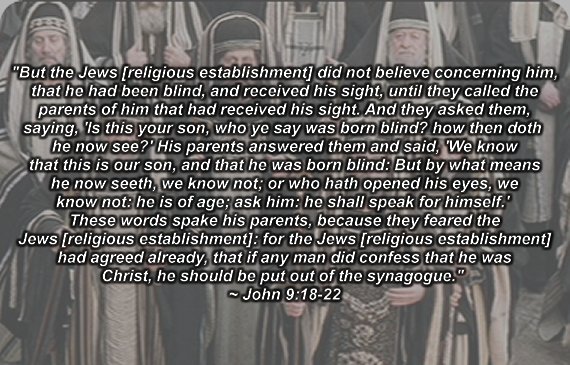
To be put out of the synagogue was to them the equivalent of being declared “unsaved”. According to their orthodoxy, salvation was tied with membership to the synagogue. Not much has changed today.
The Email Continues: Compass Bible Church is Not the Problem; Church is the Problem
Um, it’s been great corresponding with you, and thank you for your reply to my reply, but please let me lovingly challenge you on a few things. Your thinking is very indicative of present-day church attenders and my own for many years. So for the moment, let me include myself as a churchian. Everything is interpreted through a belief that the institutional church is the only game in town. Though we would deny it intellectually, we function as if we are progressively saved by church, and that is, in fact, stated Protestant orthodoxy.
So, what do we do? In order to condone staying in church, we make the church God’s only field, and we make the “red flags” the tares among the wheat. But trust me, the church is not God’s wheat field. Not even close. Compass Bible Church is not the problem, church is the problem. God’s family is a literal family, not a top-down authoritative institution. The phrase I just used is redundant because the essence of any institution is authority, and not the “body” illustration that describes Christ’s called out assembly. As a nurse aide presently perusing a medication certification, I have been awakened to the profundity of this illustration through the study of Physiology. There is no top-down authority in a body, a healthy body functions by mutual cooperation in accordance with each part fulfilling what it is created to perform. If the “head” makes good decisions, this edifies the living organisms of the body to fulfill their contributions to the overall health of the body. This is known as homeostasis. Different cells make up the body, and these cells are bodies in and of themselves with an intelligent mind of their own. The head cannot control these cells, but can only edify them (nourish them) through good decisions based on sound knowledge. It’s interdependence, not authority.
So God is “sovereign”? Very well, it is his sovereign choice for His body to operate in this way. And besides, doesn’t interdependence and edification reflect love and not authority? Authority circumvents the need for trust, edification, leadership, and interdependence. With authority, all of these are totally irrelevant. You merely do what the authority says to do; end of discussion, nothing else is needed. Hence, the sole purpose of the parishioner is to support the institution. Stop and think for a moment; is this not the pervasive mentality of church culture if you listen carefully to the primary themes in its sermons and songs? Furthermore, this is akin to the Platonist ideology that founded church to begin with circa 4th century. Why does present-day church look little like what we see in the book and Acts and the Gospels? Because its not the same thing. At times, I find the use of Scripture to supposedly articulate churchianity utterly ridiculous to the point of parody.
What you see at Compass is just their expression of the overall problem with church and its orthodoxy. Whether people want to call it “Calvinism,” “aggressive Calvinism,” “high controlling churches,” or whatever, it’s ALL, one, big, fat, lie.
Come out from among them and be separate. You are either with Christ, or the Pharisees.
paul
Email: What’s Wrong with John MacArthur and John Piper?
Answer:
It’s pretty simple; Catholicism and Protestantism, and the vast majority of other religions expressed in institutional church buildings hold to Progressive Justification. This is a soteriology that makes salvation a “process” and not a finished work. And, that process can only be completed through church membership. Most Protestants would deny this because they don’t know what Protestantism is. Few Protestants have read the documents of its orthodoxy for themselves, but rather rely on the doublespeak and nuance heard weekly at church and on “Christian radio.”
The motivation of edification alone would hardly support the massive infrastructure of the institutional church, but be assured, the motivation of ongoing salvation will keep the money rolling in.
This ministry has documented this charge extensively with book publications and hundreds of articles. John Piper has said several times that “Christians still need to be saved.” MacArthur and those who teach under him continually refer to salvation as a “process” and “atonement” (ie., a covering for condemning sin, not an ending of sin). Furthermore, the Calvinism aspect of Protestantism, though Calvinists deny it because many professing Calvinists don’t really know what Calvinism is, completely rejects assurance of salvation and promotes fear of eternal damnation as the primary motivator for sanctification. But basically, all Protestantism, at least its official orthodoxy, makes sanctification the progression of justification, or “justification in motion.”
What do we believe? We believe in a literal new birth into God’s family, and once you are born unto eternal life you cannot be unborn. We also believe that the literal new birth through the baptism of the Spirit changes our relationship to the law. We believe the two relationships are “the law of sin and death” versus “the law of the Spirit of life.” When we die with Christ, we die to the law of sin and death (under law) and are resurrected to the law of life (under grace). The law is no longer our condemner, but our rule for loving God and others. Per MacArthur et al, it is impossible for ANY individual to fulfil the “righteous demands of the law” (viz, perfect law-keeping) because they don’t understand how the new birth changes our relationship to the law. In other words, Protestantism holds to a single perspective on the law; “under grace” means that we are still under law but Jesus fulfilled/fulfills the law in our stead if we partake in the “means of grace.” According to what we believe, you are under one or the other law alone; you cannot be saved by being under both, and grace is not a progressive cure for remaining under law.
If one is under grace, love indeed fulfills the law; we are not still “sinners (a biblical designation for those still under law) saved (perpetually) by grace.” Technically, true Christians do not sin under the law of sin and death, but fail to love under grace. Moreover, the answer is a return to home fellowships which express the gospel of literal new birth into the literal family of God and the emphasis on individual gifts. Fellowship, not membership, and a cooperation of individual members of Christ’s body with Him being the only head, not the authority of mere men. A priesthood of believers offering living sacrifices from the temples of our body where the Spirit dwells, not an institutional building with top-down authority.
paul



4 comments