A Call to the Laity: The New Birth is the Infusion of God’s Word
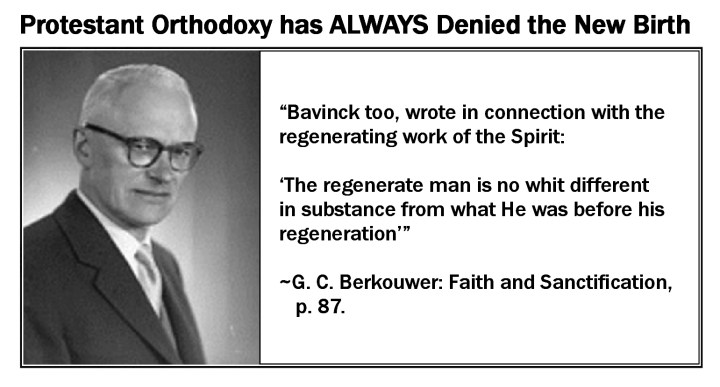
Other than the use of a few facts in the commission of first-degree premediated falsehood, the Protestant Reformation did not get one thing right. The Protestant Reformation is plenary falsehood. This post is about the Reformation’s most grievous falsehood; the denial of the new birth as defined by the Bible.
John Piper once stated that the Reformation’s cardinal argument with Rome was the issue of “infused grace.” He is absolutely correct in that self-condemnation. The Protestant Reformation, as constantly stated by the Neo-Calvinists of our day, was all about an objective gospel that remains completely outside of us. What they call the “Objective Gospel.” This is Martin Luther’s “alien righteousness.”
Fundamentally, the objection was grounded in Augustine’s Neo-Platonism that disallowed the fusion of goodness with evil matter, but this post is not about that aspect.
If there is ever an escape from the present Protestant Dark Age, it will be the result of the laity’s collective study of God’s word to the exclusion of Protestant caste scholarship. The laity must recognize that we are God’s elect, and once again seize our rightful calling in the prevention of losing full reward. Our present day represents the Corinthian problem once again in which philosopher kings subjugate the gifts assigned to God’s offspring.
After more than 500 years of making every verse in the Bible about justification, there is much work to be done for the glory of God and His truth. One place where study is much needed regards the word, “seed.” Before one is born again, the law (God’s word) judges and condemns, but the new birth makes the same word a living seed that is infused within the believer. This is what the Bible teaches.
Seed theology, so to speak if I may, is a deep and vast continuity throughout the Bible and an element of the new birth. There is a link between the one seed, Christ, and Him as “the word,” and how the truth of Scripture is life to the believer as opposed to death and condemnation.
James 1:21 – Therefore, get rid of all moral filth and the evil that is so prevalent and humbly accept the word planted in you, which can save you (NIV).
Got that? The word of God, also called a “seed” that is planted and gives life (see the parable of the sower etc.), is planted IN US. Is there a more glaring contradiction as set against the Reformation’s Objective Gospel? Also, in the Bible, “saved” doesn’t always mean the salvation of the soul. And, it NEVER means a progressive saving of the soul. In sanctification, the believer can still make life or death decisions by saying yes or no to proper or improper desires. There is also a saving of the body that saves us from the weakness of the flesh (redemption). At any rate, the point here is that the life giving word of God is In US via the new birth.
Jesus answered, “It is written: ‘Man shall not live on bread alone, but on every word that comes from the mouth of God.'” (NIV).
Like newborn babies, crave pure spiritual milk, so that by it you may grow up in your salvation, (NIV).
In these verses, growth/nourishment from the word of God refers to the putting on of the new man (Eph 4:24) who is already a new man. The new creature grows up in newness, not some striving to finally achieve a state of newness. This is a true progressive holiness that is already holy, not progressive justification posing as progressive sanctification. Sanctification does not flow from a “legal declaration,” it flows from a state of being defined by an infusion of God’s life-giving word.
Well, there you have it; the vast seed doctrine of the Bible. This post is meant to point you in that direction. Get busy and obey your calling and teach me a few things about it. That’s how this all works.
Strive for your full reward and be transformed by the renewing of your mind with God’s word. This is your “reasonable” (literally, “logical”) service.
paul
Train Wreck: John Piper’s Ability to Interpret Scripture
“The Hebrew writer is saying the justified are being continually set apart (via their obedient love) for God’s glory while Piper is using Hebrews 10:14 to say that ‘Christians’ are being progressively justified. And if one really knows true Protestant orthodoxy, it is really a process of perpetual re-justification in order to keep ourselves saved.”
“Christ is a substitution for our past sin, not our righteousness—He MADE us righteous through His death and resurrection (Rom 4:25).”
Though my time for writing posts is limited these days, the assurance of salvation issue is very near and dear to my heart. Hence, when I stumbled across this post by John Piper I was compelled to respond. Any Protestant who thinks OSAS (once saved always saved) is an orthodox distinction is a typical, confused Protestant.
Throughout the writings of Luther and Calvin, and Reformed writings in general, assurance is dissuaded. This is because, as written about much here at PPT, Protestantism redefines biblical new birth and in essence denies it. This is because orthodoxy defines the Protestant as still under law, and subsequently under condemnation making it necessary for perpetual re-justification.
The Reformed process for perpetual re-justification is the “vital union” which we will not be addressing here. But, again, as stated much here at PPT, the official Protestant doctrines of forensic justification, double imputation, mortification and vivification, alien righteousness, and the vital union all work together in denying the new birth. FEW Protestants even know what these doctrines are.
Let’s begin to work through Piper’s mini-treatise on assurance. First, let’s look at the title: “Complete Assurance for Incomplete People.” Notice that per the usual John Piper double speak and demonic nuance, Piper is not saying that people possess complete assurance. If you are looking for A, plus B, plus C, equals assurance, in this treatise, you will be disappointed.
Piper kind of says you can have assurance now, but if you carefully examine what he is saying, and per orthodoxy, complete assurance doesn’t come until what they call “final justification” occurs. While vehemently denying progressive justification, they admit justification has finality. This is because most Reformed scholars are habitual liars and the rest are confused.
Piper predicates the post on Hebrews 10:14,
By one offering He has perfected for all time those who are being sanctified. (Hebrews 10:14)
Two things here are mightily encouraging for us in our imperfect condition as saved sinners.
Here we must begin by drilling down on the Reformed plenary redefinition of Bible words. Here, Piper is interpreting “perfection” as perfect law-keeping, or perhaps more accurately, a sinless state. He has “perfection” wrong, and he also refers to “believers” as “saved sinners.”
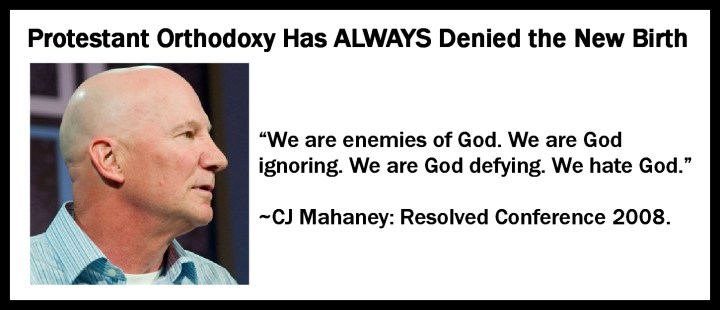
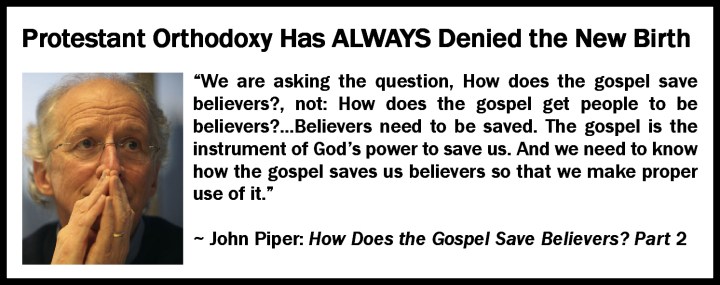
In the Bible, without any exception whatsoever, “sinner” refers to the unregenerate. In reality, Piper is referring to believers as saved lost people. And in fact, that’s Protestant orthodoxy; in essence, you remain unregenerate, and perpetually return to the same gospel that saved you in order to “keep yourselves in the love of Christ” (CJ Mahaney). Now look, John Piper has said this on many occasions outright. In a message titled, “How Does the Gospel Save believers” [did you know believers still need to be saved?], Piper states,
We are asking the question, How does the gospel save believers?, not: How does the gospel get people to be believers? When spoken in the power of the Holy Spirit, the gospel does have power to open people’s eyes and change their hearts and draw them to faith, and save them. That’s what is happening on Tuesday nights and Wednesday nights this summer. People are being drawn to Christ through the power and beauty of the gospel. But I am stressing what Paul says here in verses 16 and 17, namely, that “the gospel is the power of God for salvation to everyone who believes.” Believers need to be saved. The gospel is the instrument of God’s power to save us. And we need to know how the gospel saves us believers so that we make proper use of it.
Any questions? We use the same gospel that saved us in continuing to be saved. We must, “preach the gospel to ourselves every day.” Sound familiar? So, of course we are still sinners because we still need salvation. This is how Piper redefines, “sinners.” Now, how does he redefine “perfection”? In the Bible, perfection is synonymous with those who are holy, and righteous. Perfect, holy, and righteous. Piper defines these terms, like all of the Reformed, as perfect law-keeping. Not so. The Bible defines a righteous believer as someone born of God who is weak, and therefore falls short of the law’s righteous demands, but the law has no jurisdiction over the believer.
The believer is not a sinner, he/she is weak, not a sinner—big difference. The believer has a willing spirit in regard to loving others according to God’s truth while the unregenerate are indifferent to the law’s truth. Religionists love the traditions of men while feigning love for the law, but it is not a real love for the truth resulting in love. If the believer wasn’t mortal (weak), they would in fact obey the law perfectly (see Romans 7), but at any rate, they are NOT under law to begin with.
Piper continues with his butchering of Scripture:
First, notice that Christ has perfected his people, and it is already complete. “For by one offering he has perfected for all time those who are being sanctified.” He has done it. And he has done it for all time. The perfecting of his people is complete and it is complete forever.
Does this mean that Christians don’t sin? Don’t get sick? Don’t make mathematical errors in school? That we are already perfect in our behavior and attitudes?
There is one clear reason in this very verse for knowing that is not the case. What is it? It’s the last phrase. Who are the people that have been perfected for all time? It is those who “are being sanctified.” The ongoing continuous action of the Greek present tense is important. “Those who are being sanctified” are not yet fully sanctified in the sense of committing no more sin. Otherwise, they would not need to go on being sanctified.
Notice that Piper makes sanctification the same thing as “perfection” in this line of thought. He is a master in this type of grammatical sleight of hand. He cunningly substitutes the word “justification” for “perfection” and then defines “sanctification” as a synonym for his definition of perfection which is perfect law-keeping.
PLEASE NOTE: The Hebrew writer is making a distinction between justification and sanctification while John Piper is making them the same thing. The Hebrew writer is saying the justified are being continually set apart (via their obedient love) for God’s glory while Piper is using Hebrews 10:14 to say that “Christians” are being progressively justified. And if one really knows true Protestant orthodoxy, it is really a process of perpetual re-justification in order to keep ourselves saved.
In an effort to prevent this post from becoming a book, let me move a little further down in his post to make my next point:
Christ’s people are perfected now in the sense that God puts away all our sins (Hebrews 9:26), forgives them, and never brings them to mind again as a ground of condemnation. In this sense, we stand before him perfected. When he looks on us, he does not impute any of our sins to us — past, present, or future. He does not count our sins against us.
There is no “sense” in which we are kind of perfected, because Christ’s death and righteousness is NOT A COVERING. It is not the Reformed doctrine of “already-not yet” or Luther’s “simultaneously saint and sinner” because we are still sinners covered by Christ’s saintliness. We ARE presently holy because we are born of God and have this treasure in earthen vessels. We have passed from the condemnation of the law (under the law of sin and death) to being under the law of the Spirit of life (Rom 8:2) which means the law now sets us apart according to love without any fear of condemnation. The Spirit now uses the law with our cooperation to set us apart from those who have no true love for the law (John 17:17, 2Thess 2:10).
CHRSIT DIDN’T DIE TO COVER OUR SIN—HE DIED TO END OUR SIN.
And as the Hebrew writer states, “forever.” Note also in the making of my point here, Piper states in the same post:
You can put it provocatively like this: Christ has perfected once and for all those who are being perfected. Or you could say, Christ has fully sanctified those who are now being sanctified — which the writer does, in fact, say in verse 10, “By this will we have been sanctified through the offering of the body of Jesus Christ once for all.” Thus verse 10 says, we “have been sanctified.” Verse 14 says, we “are being sanctified.”
In what way is it not totally obvious that Piper is making justification and sanctification the same thing by deliberately nuancing the point by exchanging the word “justification” for “perfection.” It is tempting to say that this is very clever because there is a sense in which Christians are becoming more and more perfect through love, but that isn’t in any way technically correct according to the Bible.
Our clear problem is the Reformed presuppositions in regard to law/gospel that have been drilled into our heads from birth. We are not merely experiencing a clearer picture of Christ’s righteousness in our lives as a justification process, our actual righteous state of being via the new birth is merely becoming more and more prevalent as we put off the old us that died with Christ and put on the new righteous person. This is the cardinal point of the Hebrew writer: by ONE act we are made righteous for all time—not, as John Piper states in other writings, the many saving acts of Jesus seen in all of the Bible. This is merely a refabricated version of every double substitutionary gospel that has ever come down the pike.
Christ is a substitution for our past sin, not our righteousness—He made us righteous through His death and resurrection (Rom 4:25). Christ doesn’t cover for us, he made us true brothers in God’s family. The gospel is not a cover-up, it makes ALL things new.
This fact is where our assurance comes from. This fact does not make us concerned with our motives if we understand the true gospel. The law can’t touch us. The old us that was accountable to the law is dead. Even if our dead bodies were exhumed and dragged before a judge, he would have no law from which to convict us. That’s the gospel.
Go in aggressive obedient love without fear of condemnation. The law is ended. This is why we are justified forever; the new birth, not somebody’s perfect law-keeping:
1John 3:8 – He that committeth sin is of the devil; for the devil sinneth from the beginning. For this purpose the Son of God was manifested, that he might destroy the works of the devil. 9 Whosoever is born of God doth not commit sin; for his seed remaineth in him: and he cannot sin, because he is born of God (KJV).
We are justified (perfect) because we are born of the Father, not because of any substitutionary law-keeping. The law cannot give life no matter who keeps it (see Galatians ch 3). The law is not another member of the Trinity—only the Father can give life.
paul


leave a comment