Jewish Lives Matter: The Coming Millennial Kingdom; Part 1
Click here for part 2
Click here for part 3
Click here for part 4

Part 1: Individualism and the Coming Kingdom
Individualism never made it past Adam and Eve. The basic fundamentals can be seen in their relationship with God. They communicated directly with God, and…
“Then God said, ‘Let us make man in our image, after our likeness. And let them have dominion over the fish of the sea and over the birds of the heavens and over the livestock and over all the earth and over every creeping thing that creeps on the earth.’”
“And God blessed them. And God said to them, ‘Be fruitful and multiply and fill the earth and subdue it, and have dominion over the fish of the sea and over the birds of the heavens and over every living thing that moves on the earth.’”
Note that man was to have dominion over the earth, not each other, and God communicated directly with Adam and Eve. The serpent approached Eve in the garden with a new idea. The new idea was mediation. Clearly, the serpent introduced the idea that Eve needed a superior being to help her be more like God. The serpent presented himself as a mediator to help mankind increase wisdom and be more like God.
Genesis 4:1 – Now the serpent was more crafty than any other beast of the field that the Lord God had made.
He said to the woman, “Did God actually say, ‘You shall not eat of any tree in the garden’?” 2 And the woman said to the serpent, “We may eat of the fruit of the trees in the garden, 3 but God said, ‘You shall not eat of the fruit of the tree that is in the midst of the garden, neither shall you touch it, lest you die.’” 4 But the serpent said to the woman, “You will not surely die. 5 For God knows that when you eat of it your eyes will be opened, and you will be like God, knowing good and evil.” 6 So when the woman saw that the tree was good for food, and that it was a delight to the eyes, and that the tree was to be desired to make one wise, she took of its fruit and ate, and she also gave some to her husband who was with her, and he ate. 7 Then the eyes of both were opened, and they knew that they were naked. And they sewed fig leaves together and made themselves loincloths.
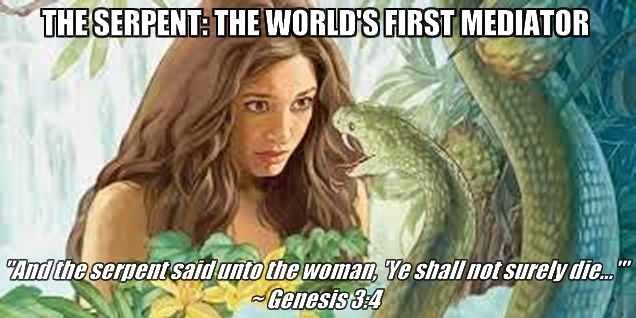 Many assume that the serpent created mistrust in Eve’s mind regarding God, but more than likely, Eve assumed the serpent was a legitimate agent of God sent to aid her for increased wisdom. Didn’t he, in fact, have more knowledge than her to begin with? And without the help of this mediator she had apparently misunderstood God; after all, “So when the woman saw that the tree was good for food, and that it was a delight to the eyes, and that the tree was to be desired to make one wise, she took of its fruit and ate, and she also gave some to her husband who was with her, and he ate.”
Hence; fear, shame (condemnation), and broken fellowship with God is born. When God walks through the garden in the cool of the day for their usual fellowship together, Adam and Eve hide from God because they fear His condemnation. The serpent told Eve a half-truth; she was indeed not going to die on the spot, but she was going to become a mortal knowing the fear of future death. Sin, condemnation, and death become a collaborating trio of reality at this point.
And another reality is born; that of the human mediator. This is the dawning of collectivism versus individualism. Collectivism is the idea that God appoints human meditators to execute His will on earth. Like in the original presentation by the serpent, there is a class of beings who know more than others in regard to being like God resulting in the common quest of wellbeing. They are created “more crafty” than the commoners. They are the mediator class. Rather than God being available directly to every being, in this construct, He is only accessible through His appointed mediators.
And of course, it will be necessary for the mediator class to conquer the lower classes that don’t get it. Yes, unfortunately, it will at times be necessary for the mediator class to conquer and slaughter selfish commoners…for the collective good, and of course, in the name of God.
Herein is the problem: the only proof of legitimate mediation supposedly appointed by God is the claim by men themselves, and historically decided by wars. This is the caste system established by conquest. This system absolutely dominated human history until the American Revolution.
The mediation caste system seizes upon every nuance of difference in humanity and makes it a cause for authority over others. Sex, race, trade, social standing, financial standing—you name it. The earth is a dirt sphere saturated with the human blood of the mediation caste system. The knowers appointed by God know best for the collective good. This is the gnosis of Gnosticism and all other nomenclatures of human history, but the father of them all is the serpent.
From governments who constantly vie for their supposed rightful place as the higher power’s representative on earth down to children playing in the schoolyard, caste division saturates humanity with its many faceted miseries and terror following. How does God intend to make humanity one mind and intrinsically happy? And what do the Jews have to do with that plan? This will be developed over the future parts. But, in the next part, we will look at a simple but profound point most often missed…
…God’s kingdom is not presently on earth at all, it is yet future.
paul
The Present American Political landscape in Respect to Bible Prophecy
 Live Link: Sunday 7/24/2016 @ 5pm Paul and Susan will discuss some Bible prophecy basics and how they relate to the present political landscape in America.
Source: The Present American Political landscape in Respect to Bible Prophecy
The Present American Political landscape in Respect to Bible Prophecy

Live Link: Sunday 7/24/2016 @ 5pm
Paul and Susan will discuss some Bible prophecy basics and how they relate to the present political landscape in America.



leave a comment