Feelings Must Be Ruled by Objective Truth
 Feelings always flow from one’s logic. In addition, one’s thinking construct, if it is healthy, is also complex. Unhealthy feelings are always the result of flawed logic. This is important because feelings co-labor with logic to drive our actions.
With that said, good feelings, bad feelings, and even guilty feelings have their proper place in truthfully evaluated situations. Feelings that flow from hopelessness rarely, if at all, flow from a truthful evaluation of reality. Hopelessness is the result of errant thinking and a distorted logic. Again, hopelessness and truth rarely walk together if at all.
Negative feelings are always tempered by some course of action when they are necessarily experienced in a properly evaluated situation. Always connect your feelings with how you are thinking at the time and evaluate the truthfulness of your thinking accordingly. Feelings of hopelessness are a sure sign that you are partaking in “stinking thinking.”
Let me share a recent experience by way of example. I believe that church has been about justification only since its conception in the 4th century. When Christ came He preached a gospel that made justification and sanctification mutually inclusive though one is a finished act in the life of the believer while the other is progressive. Church makes the function of the two one and the same resulting in a focus on keeping salvation rather than new and abundant life.
This is why TANC Ministries advocates a reversal of that historical focus and precedent. And this is why I chose healthcare as my coming-out-of-retirement career; because I figured it would lend understanding to Christian living more than any other career, and I was right.
So, right now my career is defined by home health care which of course means that I serve needs in people’s personal homes and in the milieu of their lives. That can be good or it can be bad, but will always be bad if you have a simple logic construct defined by feelings alone.
Case in point: I have an account that originally gave me much joy, but now is a burden. Why? What happened? WHY are my feelings different about the account? Initially, I fulfilled immediate needs at GREAT personal expense, and frankly, Susan’s expense as well while evaluating nothing. That’s ok, that’s a good thing and we experienced much satisfaction and joy accordingly.
Then a pattern developed. We the people are too weak to engage successfully in perpetual crisis care; therefore, we the people must be solution oriented. Hard brake/full stop; you cannot help people who are not solution oriented. Neither can you help people who pretend to be solution oriented in order to avoid solutions because solutions necessarily require the doing of something. Yes, you must figure out why said people are not solution oriented and address that problem accordingly before you have any hope of helping them.
Example. Your 20-something son living at home will not get a job. He’s lazy and is sapping your financial resources. He thinks that you are honing in on the problem and is feeling the heat. Therefore, he enrolls in trade school as a prerequisite to getting a job and effectively buys a couple of years because being a fulltime student is easier than working. And by the way, you end up happily paying for the school because he has totally played you into thinking that he is showing some initiative.
This like ploy can be applied to a plethora of life circumstances. You are being used and conned. Your feelings for your son are being used by him to get what he wants from you. Your love for your son is ill-defined according to a lie and you are also what we call an “enabler.” Because our feelings are ill-defined we are often participants in the self-death of others. By protecting others from coming to grips with their own ill-defined fears and feelings we presume ourselves loving.
One may eventually do what is best for the son used as an example which may result in a distress that is very real for him—based on his own ill-defined reality.
This is where this post is headed: perception is reality for that person, but is their perception rightly defined? Here is the position that you may find yourself in accordingly: you have a properly defined love for that person resulting in deep feelings of love. However, the other person feels betrayed, abandoned, and unloved by you based on their errant definitions.
This will lead to bad feelings, but, because of their own misconceptions they will try to make you feel guilty because they think you are guilty of being coldhearted. People’s attempts to make you feel guilty are not always outright manipulation; they actually think you are guilty based on their own flawed logic.
This is very helpful: you know that there misconception makes you feel bad, but you are not guilty; there is a huge difference between bad feelings and guilt. But in both cases these feelings must motivate action.
Back to my original example. When I realized said client refuses to be solution oriented, I began reducing my commitment. In other words, if money is timelife, I stopped throwing good money after bad money. This often means leaving him without care if no other caregiver can be found to cover hours not assigned to me. I am fulfilling the letters of the contract and nothing more.
This is hard because I have strong friendship feelings towards him that are grounded in truth while he is disappointed in me because he defines friendship errantly. Biblically, his definition of a friend is really an enemy. Paul’s question to the believers in Galatia quickly comes to mind:
You know it was because of a bodily ailment that I preached the gospel to you at first, and though my condition was a trial to you, you did not scorn or despise me, but received me as an angel of God, as Christ Jesus. What then has become of your blessedness? For I testify to you that, if possible, you would have gouged out your eyes and given them to me. Have I then become your enemy by telling you the truth?
You cannot be enslaved by you own misconceptions or the misconceptions of others who improperly define the meanings of words and concepts that form perceptions of reality.
Always know why you feel a certain way. Is it a proper response to proper definitions of reality, or unnecessary feelings that flow from ignorance and misinformation?
paul
Romans 12ff. Through the Eyes of a Disciple: The Four Models of Discipleship
 The Four Models of Discipleship Introduction How can Christians change if we don’t even know whether we are changeable are not? On the one hand we are supposed to be evangelizing the world, but on…
Source: Romans 12ff. Through the Eyes of a Disciple: The Four Models of Discipleship
Protestant Pastors are Either Too Light or Too Heavy
Too much sin awareness; too heavy.

Too little sin awareness; too light.
The Key to Bible Reading: Knowing Who You Are
 In addition to the good points made by Andy Young here on Bible reading, I would like to chime in as well. There is an epidemic of non-Bible-reading among professing Christians that is longstanding and the reason is simple: the church caste system predicated on truth as authority. Find truth on your own in the Bible if you will, but it is only legitimate if confirmed by elitist scholars. Protestant scholars say it all the time: the church has the final say on what is true or not true. “Authority” has been “vested in the elders of the local church.” So, why not just get it straight from the horse’s mouth? Whether Protestant or Catholic you don’t need your Bible; Protestantism merely skins the cat in a different way.
How does one define a biblical “disciple.” The word simply means, “learner.” Wait for it; this is the crux of the issue…does one learn directly from God, or mediators? While the Protestant philosopher kings themselves bemoan Bible illiteracy in our day remember this—this is the end result of hundreds of years of orthodoxy and God’s people being drowned in oceans of Protestant ink coming from the pens of church scholars. Like socialism, people keep doing it even though the results speak for themselves. And as the saying goes that’s the very definition of “insanity.” As Ronald Reagan once asked, “After four years are you better off?” Four years? The Reformers have had over 500!
Everybody agrees: professing Christians are biblically illiterate. Why? Because Christ’s assembly is a family body NOT an authoritative institution. The body works like all bodies: it’s a collective effort with ONE head. Elders are “overseers” who protect the body through the gift of discernment not multiple heads. Elders attend to prayer and the ministry of the word as watchmen on the wall—not the usurpers of Christ’s headship over the body.
Body wisdom, growth, God’s glory, and body joy will come only ONE way: a collective effort by all members in learning directly from the head! This is also known as the priesthood of believers. EVERY learner is to learn directly from the head and edify the rest of the body. That’s what a true disciple does. In group settings where God’s people come together in order to edify each other, elders lead that effort because they are gifted with discernment but are far from being the final word on all edification. They lead by example and stimulate edification from all members of the body.
That’s who you are as a disciple. You are to do your part in edifying the rest of the body. You are to study in order to show yourself approved. The present state of God’s body as reflected in the institutional church reminds me of the clients I serve; many have few body functions working properly. Spiritually speaking, the institutional church is full of dialysis machines, nebulizers, and wheelchairs. It not only depicts a one-star nursing facility, it actually claims that such decrepitness is the hallmark of spiritual maturity. Pastors of Protestant temples proclaim proudly Sunday after Sunday that Christians are a “train wreck” and “broken.”
In contrast, the Bible calls us to be a man that walks strongly in good health. In my line of work, we call this “homeostasis.”
That’s why you must study your Bible. It is your primary way of edifying others. You must see for yourself that a teaching is true. This is why orthodoxy denies a permanent indwelling of the Spirit that leads the INDIVIDUAL in “all truth.” If you are merely regurgitating orthodoxy, you are spreading disease in God’s body in contrast to edifying it.
That is our motivation for independent Bible study. This is our calling.
paul
Protestant Pastors Must Resign If They Make the Cross Too Big Which Begs the Question…
 Tullian Tchividjian is a good example of Protestant pastors who must resign when their “Glorious Ruin” becomes too ruinous. Tchividjian recently wrote a post on a website devoted to pastors who got caught with both hands in the cookie jar.
Apparently, the only logical conclusion to be drawn from the post is that while Tullian was a “celebrity pastor” he was not free until he got caught. Hence, thousands of Protestants were following after a man who by his own estimation was in bondage.
He also wrote a very popular book titled, “Jesus + Nothing = Everything.” According to his own testimony in the post, during the time that thousands, perhaps millions were falling all over each other to follow him he had everything, but only now is free since he has lost it all because he got caught.
And as the purpose of expastor.com unfolds so does a very familiar pattern: most of these guys are restored to the ministry. Is this over the top or what? Tullian is all but telling people outright that he duped them, but like all of these guys, they get back into ministry by waving the magic Grace wand. Seriously, the word “grace” seems to put Christians en masse into some kind of catatonic trance. However, what it really boils down to is authority as truth. Since God does not make mistakes, and his past celebrity status confirms that he was originally God’s anointed, the fix is in.
But it begs a question that we will ask soon. By his own testimony, Tullian confesses that he preached the following gospel for years:
I never pretended to have it all together. In fact, one of the reasons people listened to my sermons and read my books and came out to hear me speak when I was traveling is because I was honest about my brokenness and the amazing grace of God that covers us at our worst. I was known for saying that God loves bad people because bad people are all that there are. So I knew I was bad. I just didn’t know I was THAT bad.
The truth is, though, that we are very good lawyers when it comes to our own mistakes, but very good judges when it comes to the mistakes of others. As one of my counselors told me early on, circumstances don’t create the condition of the heart. Rather, circumstances reveal the condition of the heart. And what was revealed to me about my heart in the fiery hotness of dire circumstances was scary and destructive.
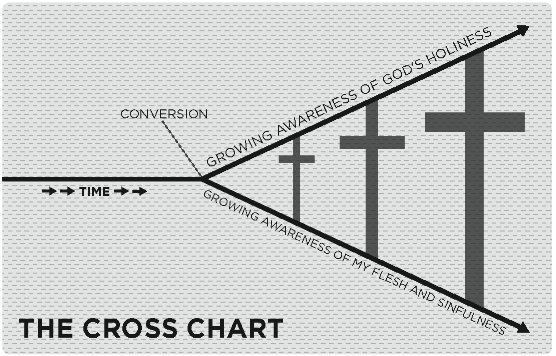
This brings us to the illustration we often use here at TANC Ministries to explain the Protestant gospel. This is a Reformed illustration, not one formulated by this ministry. Note the primary role of the believer; sin-sniffing and “finding the sin under the sin.”

Tullian’s case in the post goes like this:
How did I get to this point of total desperation? How did I arrive at that dark place where I actually wanted to kill myself?
What I see now that I couldn’t see then is that this explosion had been building for a few years. The shift from locating my identity in the message of the Gospel to locating my identity in my success as a messenger of the Gospel was slow and subtle. It came on like the slow creep of the tide rather than a sudden tidal wave. I painfully learned that the more you anchor your identity and sense of worth in something or someone smaller than God, the more pain you will experience when you lose it all.
My confidence was severely misplaced: Confidence in status, reputation, power and position, the way I spoke, the praise I received, financial security and success. In other words, confidence in things that were smaller than God and his grace—confidence in things that were unstable and fleeting and easily taken away. Because I had existentially located my significance in things smaller than God, my loss did not simply usher in grief and pain and shame and regret. It ushered in a severe identity crisis. Without these things and people that I had come to depend on to make me feel like I mattered, I no longer knew who I was. I felt dead. Therefore, I might as well be dead.
In other words, he stopped focusing on the downward trajectory that makes the cross bigger and people smaller. According to him, fame did this, but note who he subtly blames for that; his followers who showered him with cash and praise—it’s their fault. Look, Protestants fall for this every time.
But now we get to our question. At what point in the downward trajectory is a pastor disqualified? While making the cross bigger, does he invariably disqualify himself? And, is the question really whether or not he acts on what he sees? So, in other words, it’s ok if this stuff is in his heart but he doesn’t act on what he sees in his heart? By the way, the Bible states that it is impossible to not act on what is in our heart unless we repent and take action against it. But wouldn’t that make the cross smaller?
Is all this ridiculous much? It begs yet another question: Is there anything goofier than a Protestant?
paul
@JohnPiper At what point on the Cross Chart is a pastor disqualified? And for sin or making the cross smaller? pic.twitter.com/brBA0963CY
— Paul M. Dohse (@PaulMDohse) October 27, 2016



1 comment