Why Every Self‐Respecting Premillennialist Isn’t a Calvinist
 “One’s eschatology will be consistent with their view of justification—unless you’re John MacArthur.” At the 2007 Shepherds’ Conference, Pastor John MacArthur gave the opening message titl…
Source: Why Every Self‐Respecting Premillennialist Isn’t a Calvinist
Follow Up on the Plato Question
Paul,
Thank you – yes that makes sense. I was reading the summary of Plato’s Republic too but it looks like a very in-depth read.
Good description of the analogy…it is interesting how the masses are treated. The authority figures often say how it is the masses who need to humble themselves and they are not worthy to be the ones looking at the glimmer of light inside the dark cave…but then again – who and how do they decide who is good enough to be a philosopher?
Joe,
You buy the right by obtaining a seminary degree.
A Question About Plato
Paul,
Was reading a bit about the allegory of the cave by Plato.
It is fascinating. So is he saying that philosophy is what frees the man from the dark cave that men are naturally enslaved in?
Joe (the name I will use in the post),
No. First, my philosophical studies deal with life and I am not up to speed on the Thanatology of world philosophy, but your question deals with philosophy and life application. Thanatology can be connected to philosophical life application when the latter is first understood.
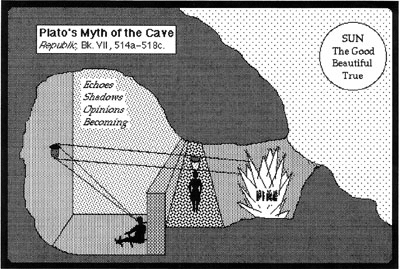
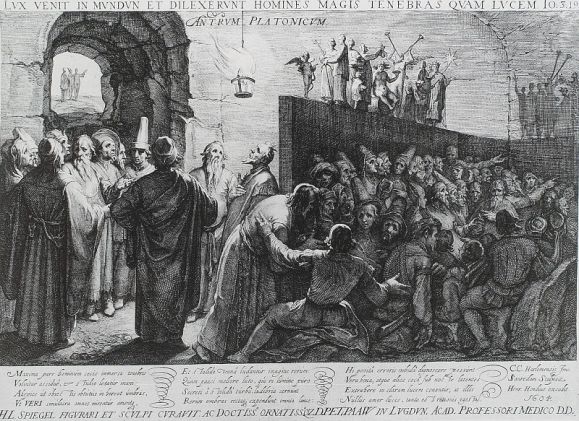
Also, keep in mind that there will be numerous variations of Plato’s basic metaphysical foundation; my answer deals with the basic fundamentals and how they apply to life and religion. I will be using your attached religious version of Plato’s cave; the image on the front of Russ Kennedy’s book is more of a basic secular version. Nevertheless, the title of Kennedy’s book is very relevant to this discussion.
No, while man is alive, he does not escape the dark cave. The guys outside of the cave represent the deity of your choice. The guys inside of the cave looking at the flame are the philosopher kings. Note that they study a light, or flame, but it is only a form of light; the true light is outside of the cave.
Note that the philosopher kings are studying the light form (the flame) and how it makes shadows on the walls that they interpret. Hence, they cannot know truth either, but lead mankind according to their interpretation of the shadows; i.e., “wisdom” that saves mankind from itself.
Note that the masses are behind walls that block out the flame which is a semblance of the true light. The two guys looking around the corner are the warrior class of men that enforce the dictates of the philosopher kings. Here, they are more or less messengers that relay the dictates of the philosophers to the people. Kennedy’s book is written to those behind the walls; since they can’t know reality or anything in general regarding life, his book instructs them how to present their “perplexity” to God. Get it? Perplexity is a virtue that recognizes that we are all like the ones behind the wall blocked from the true light. Russ would consider himself one of the philosopher kings on the other side of the wall.
In regard to Protestantism and Catholicism the ones looking around the corner are the state, and any state that is fulfilling God’s will—will enforce their interpretations of the flame and the shadows on the walls. The angels on top of the wall serve the guys outside of the cave according to the religious version.
In Plato’s construct, all people are made up of philosopher king, warrior, and producer, but are predetermined by the god of your choice (or cosmic force) to have a dominant state of being which determines their proper place in society. So, one’s soul is dominated by one of the three classifications according to lineage. Hence, you serve society according to the trade of the family you were born into. In Platonism, upward mobility is strictly forbidden. Societal wellbeing is determined by what degree every individual is functioning according to their dominant soul.
Generally, the greatest societal sin is failure to recognize your own total depravity; one who believes he can know is public enemy number one. If you’re behind the wall you dare not assume that you know something other than the worldly knowledge of how you are to best serve the collective whole (society) for the collective good. This is collectivism; in the Platonist construct, individualism is the greatest sin.
In Plato’s construct, societal justice is determined by unity around the dictates of the philosopher kings. Upward mobility is the greatest threat to society other than intermarriage between the classes which often leads to genocide. Upward mobility suggests that all men are created equal which is the antithesis of Platonism.
In addition, the material world is evil and empirical knowledge through the five senses can only yield falsehood. The material world can only yield forms or shadows of the true forms outside of the cave. This all flows from the original philosophy introduced in the garden: the knowledge of good and evil. This is why Johnathan Edwards defined the new birth as a sixth sense that enables the “saved” to understand that the five senses cannot yield truth.
Since empirical knowledge involves the five senses, Platonism has never been big on science that would improve quality of life. Martin Luther, a devoted Platonist in the vein of St. Augustine, believed that empirical knowledge only leads to arrogance against God. Hence, the Dark Ages where death and constant warfare ruled the day.
Aristotle was a little different. He believed that reality can be ascertained through the five senses and empirical observation. A chair is a chair and represents part of the reality in the room. A=A. B=B. It is what it is; man can know. Aristotle believed in social caste, but he also believed it could be earned. Aristocrats are not predetermined by God, gods, the force, or the universe. However, those who are willing to invest in knowledge should, in fact, rule over those who are lazy thinkers. America was eventually born from this metaphysic.
Hope this answers your question.
paul
The Latest Tullian Tchividjian / Tom Chantry Episodes Expose the Folly of Protestant Church
 Paul Dohse for TANC Ministries: a response to the call to a repentance process for Tullian Tchividjian.
Tullian Tchividjian, the great-grandson of Billy Graham and a wildly popular teacher among evangelicals is also a sultan of authentic Protestant orthodoxy in our day. No one, but no one, can articulate Protestant orthodoxy better.
So, it shouldn’t surprise us that his immoral sexual exploits have become public, but it should surprise us that the who’s who of evangelicalism are calling for his complete departure from ministry. The same could be said for many other uber-popular evangelical leaders that have been caught with both hands in the cookie jar. Recent examples include RC Sproul Jr., Rob Turner, and Tom Chantry. Those are the most recent ones as these episodes are becoming un-news-worthy due to frequency.
Why should it surprise us that they are expected to resign from ministry? Because their behavior is the logical outcome of Protestant soteriology. I explained this in a recent post:
The Protestant Reformation was NEVER about individual transformation. Instead, it was about the extreme opposite. The real Protestant gospel was about growing in one’s understanding of how large the gulf is between God’s holiness and man’s depravity. This is a salvation process that begins with basic knowledge concerning man’s evil and God’s good (the knowledge of good and evil), and one grows in their salvation as they see the degree of discrepancy between man’s evil and God’s good. Therefore, one’s growth in salvation is determined by their increased appreciation of what Christ did for us, not anything we do.
True salvation, according to authentic Protestantism, begins with recognizing that man can only be evil, and only God can be good. Growth in salvation is determined by one’s understanding of the following: the degree of difference between the two.
Hence, according to the true Reformation gospel, God’s righteousness is purely substitutionary. This is Martin Luther’s “alien righteousness.” Now, what Protestants ASSUME is the following: “Well, but of course, before we were saved we had no righteousness of our own.” Um, no, the Protestant gospel demands an alien righteousness throughout the salvation PROCESS while salvation (being justified before God) requires a “righteousness outside of us.” Our righteousness (justification) is therefore said to be a mere “legal declaration.”
The new birth is then relegated to a mere gift that enables one to perceive (only) God’s holiness as set against our wickedness. That’s the Protestant gospel plain and simple and it’s not even arguable.
Tom Chantry, son of Reformed icon Walter Chantry, and recently indicted for child molestation, put it this way:
One way to summarize the doctrine of divine sovereignty is this: It is God who acts, not man. How will the lost be saved? God must act. How will sinful Christians overcome the “old man”? God must act. How will the church grow in both holiness and influence? Again, God must act. He is the sovereign; He is the great Actor in every aspect of our spiritual life.
This is the typical verbiage we hear non-stop from evangelical pastors in every kind of church. Yet, in light of further allegations concerning Tchividjian, a group of well-known evangelicals have penned an open letter that further illustrates the decadence of the Protestant Institutional church. While knowing grade-A-well that Protestantism promotes the total depravity of the saints, church leaders continue to advertise the church as a cultural moral compass and society’s moral high ground. This is a deliberate ploy that plays to the expectations of society at large.
This is the church’s cultish approach that draws people in under the pretense of individual transformation and healing, and then uses assumptions to slowly strip them of all individualism and personal identity with God. This eventually makes them slaves of ecclesiological authority. If “believers” have no righteousness infused within as a result of the new birth, they have no right to their own lives or ability to determine God’s will for themselves. The church has always claimed authority over the souls of mankind by proxy.
This is the institutional church scam: the same “behaviorism or moralism” disdained as an affront to God within the church is used to recommend itself to the world. While making any moral performance an act of God alone, they call on Tchividjian to “repent.” Really? Tchividjian is a leading authority on what the Reformers meant by that word and must know that these “teachers” are grandstanding. Obviously, none of them really believe that any person can repent or do any good work. In fact, they say it continually.
Furthermore, why are any of these scholarly reprobates shamed at all? According to their theology it was God who didn’t act to prevent their behavior to begin with. Also, such behavior is inevitable according to their presuppositions concerning mankind.
And lastly, why are sane people giving their hard earned money or time to this gargantuan lie called “church”?
Is Protestantism the Greatest Lie of All Time?
For centuries, Protestants have joined churches and answered the altar calls in order to obtain “salvation.” The assumption has always been that salvation changes people. Pastors of Protestant churches even lament over people who lack commitment and only want “fire insurance.” They also call for a life testimony that matches their confession. Fed up with hypocrisy in the church, millions of Protestants sang the praises of John MacArthur Jr.’s “Lordship Salvation” movement spawned in 1988.
Curiously, this put MacArthur at odds with Bible-thumping Baptists who objected to MacArthur’s suggestion that a true confession requires a commitment to obey the Bible rather than a mere mental assent to gospel facts about Christ. Supposedly, a commitment to good works in one’s confession is tantamount to salvation by works and not faith alone, a Reformation no-no. Because few Protestants really know what the Reformation was really about, the Lordship controversy raged for years with no definitive outcome.
The Protestant Reformation was NEVER about individual transformation. Instead, it was about the extreme opposite. The real Protestant gospel was about growing in one’s understanding of how large the gulf is between God’s holiness and man’s depravity. This is a salvation process that begins with basic knowledge concerning man’s evil and God’s good (the knowledge of good and evil), and one grows in their salvation as they see the degree of discrepancy between man’s evil and God’s good. Therefore, one’s growth in salvation is determined by their increased appreciation of what Christ did for us, not anything we do. Growth in salvation is therefore determined by our “increase of gratitude” regarding the gospel. I believe this to be a form of the very religion that the serpent presented to Eve in the garden; the knowledge of good and evil.
True salvation, according to authentic Protestantism, begins with recognizing that man can only be evil, and only God can be good. Growth in salvation is determined by one’s understanding of the following: the degree of difference between the two.
Hence, according to the true Reformation gospel, God’s righteousness is purely substitutionary. This is Martin Luther’s “alien righteousness.” Now, what Protestants ASSUME is the following: “Well, but of course, before we were saved we had no righteousness of our own.” Um, no, the Protestant gospel demands an alien righteousness throughout the salvation PROCESS while salvation (being justified before God) requires a “righteousness outside of us.” Our righteousness (justification) is therefore said to be a mere “legal declaration.”
The new birth is then relegated to a mere gift that enables one to perceive (only) God’s holiness as set against our wickedness. That’s the Protestant gospel plain and simple and it’s not even arguable. And I do believe it is the “knowledge of good and evil” religion that eventually led to Platonism and Gnosticism. Am I saying that Protestantism is founded on Gnosticism? Well, that’s black and white church history for anybody to read at their convenience.
What are the results of all of this? Church. The message on the digital sign facing the highway in front of the church reads, “Real Christians Act Like Christians,” but inside in the milieu of debauchery we hear, “We are all just sinners saved by grace.” This is Martin Luther’s Simul Justus et Peccator or “simultaneously saint and sinner.” The deliberate deception using people’s assumptions suggests some kind of paradox, but what is really being stated follows: the righteousness of “believers” is only a legal declaration while the “believer” remains totally depraved. Your sainthood status is increased by seeing more of your totally depraved state of being.
Those who believe they are totally depraved will either act out accordingly or tolerate those who do. The church is therefore made up of four groups of people: the reprobate, the confused, the enablers (“But for the grace of God there go I”), and those who haven’t been caught yet.
The answer is a return to the true biblical gospel that recognizes a transformative salvation. This is the meeting together of God’s family in a true family setting as opposed to giving the family model lip service. This is a mutual edification that encourages good works that glorify our Father.
paul



leave a comment