Protestantism and the Gnostic Resurgence

Mind triggers. Every time I see one of these advertisements for a “Christian” Alaska cruise I am reminded of how our present age is truly defined: it is a resurgence of the exact same Gnosticism that wreaked havoc on the 1st century assembly of Christ. Whether a pricy cruise/Bible study hosted by the Protestant philosopher king of your choice, or a Christian conference in Palm Springs, it is indicative of the fact that Gnosticism has always been a rich person’s game.
Why? First, money affords one the opportunity to wallow in a stimulating philosophy that doesn’t really work in real life. People who make between 20,000 and 50,000 per year with both spouses working do not have time for mysticism and would certainly end up homeless if they stopped long enough to partake in it. Protestantism is the same old song and dance of ancient caste which goes hand in hand with Gnosticism.
The institutional church in general, and the Protestant church in particular, is totally controlled by the rich and powerful. The power is defined by authoritative expertism and elitism; aka, the gnosis. When John MacArthur Jr. and many others host pricy events that exclude the serf class of Christianity by virtue of money alone, nobody even blinks.
So, these congregations are “families” and not caste institutions? Since when do families go on vacations with only part of the family? It’s a valid question; the church is earmarked for pricey events that exclude the church serf class. The only exception is potluck dinners where the serfs do most of the work. In fact, here is a better illustration: in caste societies, the elitist educated class does little work in the same way that pastors are supported by the working serfs.
Moreover, pastorates are cushy elitist jobs occupied by some of the laziest people on earth. Pastors spend most of their time hanging out in their offices reading the latest book by some other Protestant hack, going out to lunch and dinner with other pastors and rich congregants, or attending conferences paid for by the church serf class.
Pastors are little more productive than congressional politicians. I know, I was a Protestant pastor for years and experienced the pastorate culture up close and personal. I remember, while at a conference, hearing one staff pastor laugh about being able to go golfing after long elder meetings while the lay-elders had to go to work the next day, or in essence, that morning. And if I stated the guy’s name here in this post, most readers would know who he is.
As far as studying to show themselves approved, most pastors use canned orthodox outlines. Few professions on earth are more useless.
Like Catholicism, historical geo-economic conditions fail to hinder the building of splendid infrastructure and the lifestyles of elitist priests. This is because the serf class has bought into the ancient idea that salvation comes by approval from those who have the gnosis of Gnosticism. Regardless of financial hardship, God will smile on doing whatever it takes to support His “authority on earth” to the degree that they think they need supporting. Degree of assurance is measured by the degree of self-sacrifice that benefits these lazy self-proclaimed mediators that replace Christ as the only true mediator between God and mankind.
The better way is God’s family meeting as a family in a family home where all are recognized as part of “God’s holy nation of royal priests.” A literal family in a family setting naturally transcends caste elitism. In such an environment, the head needs more of a variety of gifts than the ability to give money because so much money isn’t needed to fund self-proclaimed authority by serial narcissists. This is a family setting dependent upon a fully functioning body that recognizes ONE authority and ONE mediator.
That being Christ, and Him alone. The Solus Christus of the institutional church is a lie, that mantra is only lived out in home fellowships.
paul
In Regard to Debating Protestants
 Protestants, especially those of the Reformed stripe, are the most intellectually dishonest people among men. When it gets right down to it, as someone mentioned just yesterday, any attempt to debate a Protestant is a “fool’s errand.”
Why is this? I think my encounter with John Piper at the 2016 Cross Conference put the reasons on full display.
During an open Q and A session that will be a format unlikely to be repeated at future Neo-Calvinist conferences, I confronted Piper about Calvin’s three categories of election; the non-elect, the temporary elect, and those who persevere, or the permanent elect (Calvin Institutes 3.24).
He had just finished stating his position on predestination in response to a question about lost relatives. His position? Though the thought of relatives spending eternity in hell is agonizing, the fact that God elects some people for salvation should give us hope. Otherwise, there would be no hope that anyone would be saved.
My question to Piper followed immediately after: how can any of us know we are saved when Calvin’s temporary election is considered? His answer follows:
“I don’t know Calvin well enough to answer. I don’t believe there is any such thing as temporary election. So, if he says that I don’t agree with him.”
I then offered to read Calvin’s position on temporary election from the Calvin Institutes. Piper then replied, “You don’t need to read it he’s not my authority.” Problem is, here is what Piper stated in his opening to the Q and A shortly before our exchange:
“So, I am committed to election, predestination, effectual calling, and the whole Calvinistic scheme.”
I called him out on the contradiction: “You referred to the whole Calvinistic scheme like 5 minutes ago.” To which he replied, “Right, the whole scheme of TULIP. The Institutes are 1100 pages and there are lots of them I don’t agree with but let’s just go to the Bible.”
There are several problems to be noted here regarding Piper’s legitimate knowledge of Calvinism while claiming to be one, and his blatant flip-flopping of positions within the same conversation.
First, if people would educate themselves about Piper’s primary mentor, Jonathan Edwards, they would find that Edwards wrote about the joy we will experience in heaven while watching our former family members suffer in hell. Supposedly. While often referring to Edwards as an example of pure genius, Piper seems to feel our agony about condemned relatives. My point? The history of Protestantism’s psychopathic murdering despot forefathers should discredit Protestantism all by itself. Augustine, Luther, and Calvin are held up as heroes of the faith while a cursory observation of history will reveal who they really were.
Secondly, while Piper surprisingly pointed to his lack of knowledge concerning Calvin while claiming to be a Calvinist, he later claimed to be aware of several pages in the Calvin Institutes that he disagrees with. Which is it? Does he know Calvin well, or not well? He stated both in the same conversation.
Thirdly, when called out about saying he is committed to the whole Calvinistic scheme and then rejecting Calvin as an authority, he answered by saying that his statement only referred to TULIP. There are two problems here: TULIP doesn’t represent the whole scheme of Calvinism and TULIP is not from Calvin but rather the Synod of Dort.
Fourthly, during said Q and A, Piper claimed to be an advocate of OSAS concerning the elect, and contended via the Bible that “those who left us where never of us,” or in other words, were never God’s true elect. But Calvin clearly states in the Institutes that the temporary elect are also temporarily “illumined” and suffer a greater damnation than the non-elect accordingly.
Fifthly, while recognizing that he threw Calvin under the bus to save face and quickly claimed to be a Biblicist instead, he proceeded to use the Bible to defend his version of election which includes “effectual calling.” Only problem is, the Bible makes it clear that “many are called but few chosen.” This is the verse that Calvin used to make his case for temporary election. The “called” are the second class of elect who fall away, or the ones temporarily elected and illumined for purposes of suffering a greater damnation for God’s glory, and those who persevere are the permanent elect.
Hence, in fact, and in contrast to the Bible according to Calvin, some of God’s gifts and callings are revoked.
Though Piper denied this in the Q and A, Calvin’s position of temporary election is reflected in the Protestant tradition of supersessionism. This is the idea that Israel was, well, temporarily elected and replaced by the church.
Sixthly, here was my response to Piper’s rejection of temporary election: “And if that’s true, why is ‘final justification’ (a staple Protestant doctrine) future and not present?” To which he replied, “I do believe that justification is present, and will be confirmed in the last day.”
So, if justification is confirmed on the last day, how can he say that “those who left us were never of us”? If they already left us, why would those who didn’t leave us need to be confirmed on the last day? And if they didn’t leave, doesn’t that mean they persevered?
Seventh, while throwing Calvin under the bus and quickly becoming a Biblicist, he denied the clear teaching of Scripture concerning multiple judgments. If justification is “confirmed on the last day,” doesn’t that mean believers and unbelievers all stand at one final judgement? Sure it does; and in fact, that’s Protestant orthodoxy. The huge problem with that follows: CLEARLY, all who stand at that judgement are condemned and judged by the law. This is not only a Piperist propagation of Progressive Justification, but an admission that Protestants are biblically defined as “under law.”
The problem with debating a Protestant is simple: they will continually move the goal posts and redefine terms. Many of their interpretive doctrines have it both ways: “Already, not yet.” “Simultaneously saint and sinner.” “Distinct, but never separate,” and “the paradoxical gospel.”
Therefore, the endeavor to debate a Protestant is indeed a fool’s errand.
paul
The Feelings are Mutual: Protestants Hate God as Much as He Hates Them According to Orthodoxy
“We are all just sinners saved by grace.” If you protest that common Protestant mantra you will be challenged with this rhetorical question: “Did you sin today?” However, there is debate within Protestant circles about the mantra, “God hates the sin, but loves the sinner.” A meme contesting that notion can be seen below.
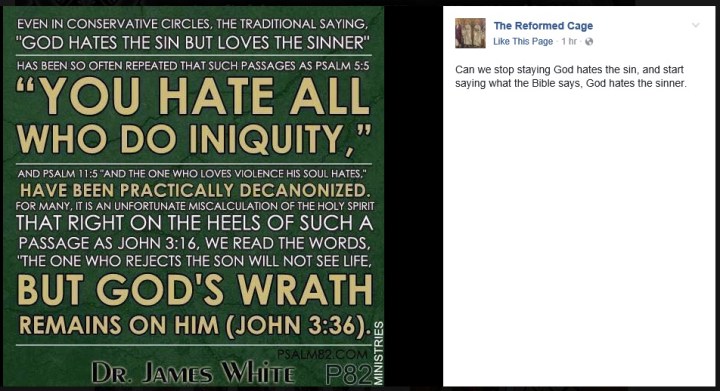
However, if you consider the first mantra with Psalms 5:5, one could conclude that God hates everyone who sins which includes Protestants. The verse states that God hates “all” who commit sin.
And apparently, the feelings are mutual.
We are enemies of God. We are God ignoring. We are God defying. We hate God. (CJ Mahaney: Resolved Conference 2008).
Aside from the logical conclusion that God must hate Protestants because they are sinners and the Bible clearly states that God hates sinners, there is also this:
For, by nature, we can do nothing else but provoke God’s wrath; wickedness will always reign in us; and we are held down under the bonds and tyranny of Satan. (Calvin, Sermons on Ephesians, 1:1-3, p., 33).
We have shown already that we cannot be loved by God, but by means of his only Son. For if the angels of heaven are not worthy to be taken for God’s children except through a head and mediator, what shall become of us who do not cease daily to provoke God’s wrath by our iniquities? [Isa 59:2]. In fact, we fight against him! God, then, must of necessity look upon us in the person of his own Son, or else he is bound to hate us and abhor us. (Calvin, Sermons on Ephesians, 1:7-10, p., 50).
As to general election, there is the same difficulty to satisfy the judgment of men: for as we have already said, there is no difference between men but what arises from hidden election. (Calvin, Commentary on Malachi, 1:2-6).
So, regardless of all the love-bombing that takes place in church; in regard to orthodoxy, Protestants hate God and He hates them even more.




 Paul's Passing Thoughts
7 comments