Closing in on the Details: Principles of the Gospel; New Birth, Baptism of the Spirit, and Covenants
Galatians Study #6 Today, Sunday @ 10:30 am 4/22/2018

Link to BOXCAST livestream Galatians Study #6, 10:30am 4/22/2018
Link to Blog Talk Radio Galatians Study #6, 10:30am 4/22/2018
NOTICE: PPT or TANC Ministries does not profit from or endorse ANY advertisements posted by Blog Talk Radio or WordPress.com



Jane Has a Question: Why Do I call Church’s “Justification by Faith” a False Gospel?
 Hi, Paul.
I read your post today called “The Time of Decision is Near: Are You With God or the Church?” I agree with what you had to say, but I’m having trouble understanding
one thing. What do you mean by “the false gospel of justification by faith”? I thought we are justified by faith in Christ (Rom 3:28, 5:1-2; Gal 2:16; Eph 2:8-10).
Blessings, Jane Doe
Jane,
“Justification by Faith” is the formal title of the Protestant gospel also known as
“Justification by Faith Alone.” Like all cults, church uses assumptions to deceive. Here
is how it works: specific, tailored language allows listeners to assume agreement during
gradual indoctrination. In other words, the assumptions of the listeners are used to
deceive them, and the official title of the Protestant gospel is a perfect example.
Curiously, many now favor the J by F designation while dropping the “alone” word and
actually, there is a reason for that as the former is a more accurate term.
Before we move on, let me mention another assumptive deception used by Protestantism, viz, “total depravity.” What is the assumption? That total depravity only pertains to the unregenerate. Nope, according to orthodoxy, “believers” remain totally depraved. However, parishioners are allowed to assume that while they are gradually indoctrinated to believe saints are also totally depraved which is a major lynchpin of the Protestant gospel.
This brings us to another form of assumptive deception; the assumption that specific terms really don’t mean what they mean. In the former, the missing words that would give a more technical understanding are assumed, but in this latter case, technical terms are not taken literally. This assumption is also used to gradually indoctrinate. Example?
Certainly, while it is assumed that total depravity only pertains to the unregenerate, the
missing information being “saints also,” but assumed that is not the case, we also hear,
“We are all just sinners saved by grace.” If parishioners would pay attention, this is an
accurate description of Justification by Faith, but it is assumed that it is not saying
what it is saying. What is the assumption? That saved people are not perfect, and should
therefore show compassion and mercy to the unregenerate because we also fall short of
God’s perfection in the present.
What is the term plainly saying per orthodoxy? That we [Christians and unbelievers] are
sinners [the biblical designation of the unregenerate] saved [the present perfect assumed
but really present perfect progressive intended] by grace [grace being a replacement word for “salvation”]. Hence, what is really being plainly stated here is that Christians
remain unregenerate and still need to be saved from “present sin” by going back to same
gospel that saved us for re-salvation.
Which brings us to another like assumptive term: “We must preach the gospel to ourselves every day.” What is the assumption? That this is a way to not forget the original gospel that saved us leading to a lack of gratitude for our original salvation. Nope, obviously, if we need the gospel every day, it means that we are still sinners who need daily forgiveness (salvation) for present sin, right? Therefore, after all, “We are all sinners saved [daily] by grace [salvation].”
Let me see, we have touched on TULIP, let’s look at one from the 5 Solas. “Christ alone.”
What is the assumption? That Christ alone for salvation doesn’t mean that the Father and
the Spirit were not equally important participants in salvation. Nope, Protestantism holds to the supremacy of Christ in all things including salvation. When it gets right down to the nitty gritty, orthodoxy teaches that the Father and the Spirit are shadowy
manifestations of Christ.
Now, let’s hone in our your question. Justification by Faith assumes that we are saved by
faith in Christ, which is true, but what are the assumptions in regard to this faith in
Christ? First, it is assumed that this faith invoked a onetime and complete transformation of the believer from being unregenerate to regenerate. Nope. In Protestantism, as we have discussed, the so-called believer remains unregenerate and must be a member of a local church to obtain continual re-salvation for “present” sin that “removes us from grace requiring daily forgiveness of sins which alone keeps us in the family of God” (John Calvin).
Also, it is assumed that faith in Christ alone is only for our justification, and then we
move on with the Christian life (sanctification), and that growth in Christian life is a
growing process, but justification is a finished work in the life of the believer. Again,
nope. Here is were the term, Justification by Faith, is outright deceptive; justification
by faith alone is not the only thing that saves you, but is ONLY “beginning
justification.” The progression of justification (really not a progression, but a keeping
of salvation), is the definition of sanctification according to orthodoxy. BOTH beginning
justification, and progressive justification (what Protestantism calls “sanctification”),
must be maintained by “faith alone.” Then, at a one, final judgement, everybody shows up to find out if they were faithful enough to church to get into heaven. This is called,
“final justification” and is another official Protestant soteriological term.
And though it wears you out, this is a yet another assumption; the assumption that “faith
alone” is merely believing something in your heart. Nope. When salvation is a process that you are living in the midst of, you must do something, even if it is nothing with
intentionality as a decision to not act which is doing something, being a decision, to
keep the salvation process moving in the right direction. And what is that? Their term,
not mine; let me repeat that, THEIR term, NOT mine…”The means of grace (salvation).”
And, what are those means of ongoing salvation because it’s stuff we do presently? Prayer, church membership, being faithful to church, viz, “being there every time the doors are open,” tithing, the Lord’s Table, sitting under “gospel preaching,” ect. Because
Justification by Faith is really progressive salvation, there must be work works, that do
not justify us, and “faith alone works” that are Protestant works that qualify to be by
faith alone, because according to orthodoxy, these are woks “done by the
Spirit”…”through us.”
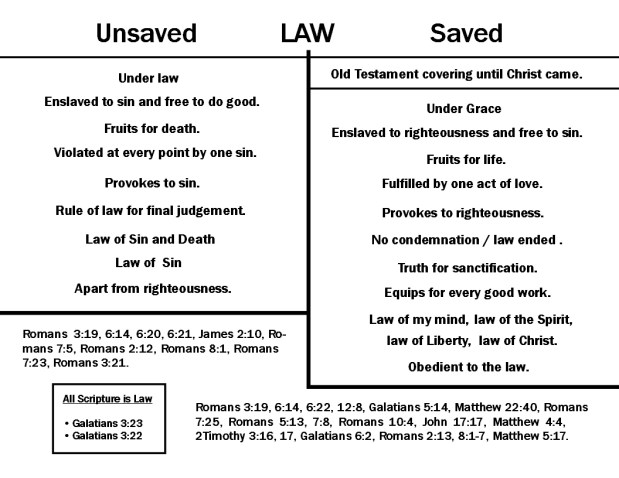
A thought: If justification and sanctification are completely separate, one being a
finished work and the other being a growing in love in the Christian life, and they are,
we are free to obey God’s law aggressively to love God and others without fear of
condemnation. That’s true freedom in Christ.
This brings us to the Protestant doctrines of Double Imputation, Mortification and
Vivification, and the Vital Union. Double imputation calls for the continual works of
Christ’s perfect law-keeping to be imputed to our sanctification to keep us saved through
faithfulness to church and its “means of grace.” M and V teaches that our original baptism in the Spirit is repeated over and over again as we return to the same gospel that saved us for forgiveness of present sin. The Vital Union teaches that the benefits of Christ and His works are manifested in us as a result of practicing M and V, or a revisiting of salvation to keep ourselves saved. Remember, these are definitive stated church doctrines and most Protestant would be shocked to learn that this is really what the church believes as stated orthodoxy. However, it’s the way they function though they would deny it intellectually. How does this happen? Assumptive Indoctrination.
Now, I like the verses you cited and it has brought something to my attention that I was
formally unaware of; there are several versus that actually contain the term,
“justification by faith.” And, the fact that these versus add that this justification is
not by the law is absolutely perfect for our discussion here. I am sure Protestants are
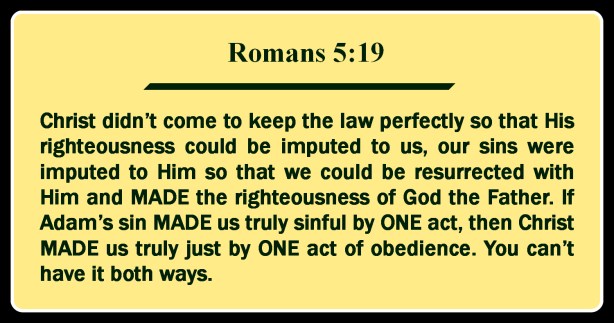
just giddy that the official term for their gospel is biblical wording. BUT, the Protestant JBF gospel is NOT, I repeat, NOT apart from the law. Double Imputation calls
for justification to be defined by perfect law keeping. Hence, Christ not only came to die
for our sins, but came also to live a perfect life of law-keeping so that these works can
be continually imputed to our sanctification IF we are faithful to church. In fact, RC
Sproul has said that Christ became righteous through perfect law-keeping. This ministry
has stated often why Double Imputation is outright blasphemy. Among the many other
reasons, there is no law that can give life, it circumvents the use of the law for love in
the Christian life, and “The Promise” made to Abraham and Christ was based on faith alone 430 years before the law came. The real standard for justification is the new birth.
This is a great question and the making of a good post for this morning. Hope you don’t
mind, I will keep your real name private.
paul
The Time of Decision is Near: Are You With God or the Church?
On the one hand being very busy right now, and on the other hand being sent article links of what’s trending and personal emails of interest, I have decided to write a post here that speaks to all subjects. Article one is this piece by Answers in Genesis aka Ken Ham. The next is this one promoting the idea that church membership is efficacious for salvation. The third is this one here which is indicative of massive concern of late among evangelicals that Marxism is taking over the church. And of course, everything President Trump that is constantly dominating the news feeds. And lastly, an email that I received this morning.
By the way, thanks to all for keeping me in the loop as I have a lot going on right now and little time to serf the net.
As predicted some time ago by this ministry, the church crazy train, by virtue of its gospel and history, will continue to race down the track at faster and faster speeds. For those left in the church still able to think for themselves, the time of decision is looking to be near. Will you capitulate to the authority of men, or be a Hebrews 11 believer? Will you have courage and believe that your true reward is in heaven, or will you continue to be a cowardly lazy servant who will return to the Lord only what was originally given when He returns? You know, the same gospel that saved you originally lest you have a “righteousness of your own.”
Don’t be like John MacArthur Jr. who was confronted with this decision in circa 2008. He had a choice: the Protestant gospel of progressive justification via a bunch of dead Gnostics, or the truth; he chose the former—too much to lose otherwise. Sadly, had he chosen the latter, I believe he could have changed church history. He screwed up big-time, and lost an opportunity to impact Christianity just short of the Apostles. He clearly chose the traditions of men instead of God’s truth. I believe the following; had he stood up and said, “Through the admonition of several notable church leaders responding to my book, ‘The Gospel According to Jesus,’ I now see clearly what the Reformers really believed, and though their persuasion is for the affirmative, I must reject it with prejudice. We have it wrong and must change how we see the truth and how we apply it.” I believe many, if not more than ever, would have followed his leading.
That which is presently trending would have been rejected out of hand by the vast majority of churchians 10 to 20 years ago. But again, when authority is truth, the latter takes a backseat to what the academics say. In other words, when it gets right down to it, anything the academics say goes, and this will continue at breakneck speed. And dear discernment bloggers, there is no saving the church; give it up. It was run of the mill tyranny in the beginning until tempered by the American Revolution, but will most certainly return to its basic roots which is what we are witnessing in our day. In regard to what we see trending today, where will it end up? Read the book of Revelation; it’s all there.
First, know this: you cannot separate politics from church because church has always been a political party. Remember this, the John Calvin Institutes of the Christian Religion is a political/philosophical document written to the King of France. Remember this, the Pilgrims, who were Puritans, who were Calvinists, came to this country as political refugees, not the boloney you hear about risking life and limb for religious freedom. The Puritan Calvinists thought they could do church-state better than the Church of England, so they set sail to where they could have the freedom to do church-state better, or so they thought. Your first clue should be that the American colonies were a full-blown theocracy modeled after Calvin’s Geneva fraught with a religious caste system not even rivaled by Hinduism. In fact, Puritan rule of the colonies was probably the match that set fire to the American Revolution.
Hence, Ken Ham, in his article, takes separation of church and state totally out of context. The true context follows: America was the first non-church-state government in the history of the world. That’s the context. Before America, religion and government always ruled over the great unwashed together. On the one hand, church leaders say they don’t want an American theocracy, but on the other hand they say, “God’s law is higher than man’s law.” Why did I pull my son out of “Christian” school? I didn’t want to pay for the Bible classes that are predicated on progressive justification and the false gospel of justification by faith. I didn’t tell the counselor that, but said, “We teach our boys the Bible at home.” The counselor’s response? “These classes are mandatory because the average Christian is not qualified to teach the Bible at home.” At that point, the meeting was over and I told her why.
Article 2 is merely good ole fashioned Protestant orthodoxy, viz, salvation is progressive through submission to church authority. In the article, the author uses Bible terms that refer to Christians as, a family, a body, a priesthood, ect. to make his point, but the church is an institution and is none of those things, especially a family. Like any other institution, when you are there you are called family, but that’s as far as it goes. And an institution is not a body nor does it operate like one. He refers to meeting together for “accountability” and cites the go-to verse for that in Hebrews, but that verse says nothing about “accountability” but only “encouraging each other unto good works” which the church denies we can do to begin with. And of course, our intelligence is completely offended by the “there is no perfect church” mantra. Hello, NO church has ever separated itself from ANY denomination, or even withheld funds in the face of cover-ups for kidnapping, child rape, murder, embezzlement, and obstruction of justice. If you go to church, you are putting your children at risk with no legal recourse. No perfect church indeed. In truth, going to church denies the new birth which speaks to, at least, individual ability through new creaturehood.
Thirdly, the church’s Total Inability of Man doctrine necessarily requires a Marxist political solution. When Americanism broke up the marriage between church and state, Communism filled the void. The introduction of Communism in the historical timeline is no accident or mere happenstance. Total Inability is a core ideology of the church and Communism and a strong primer for the two to be intimate. Hence, while Susan was surprised to hear about professors at Cedarville University voting for Obama at a dinner party we went to, I really wasn’t surprised at all. While there may be many disagreements between church and Communism, the core value is belief in man’s total inability.
Fourth, this is why the entire political apparatus is against Trump who is a populous movement in and of himself. He believes in the ability of the individual. He wants to empower dumb hicks who like to hunt and drink beer. This is not going over well. Why, in the face of proven history, are Democrats against tax cuts? It makes no sense, right? But remember, money empowers people. That’s what it is all about. In everything, follow the money, but also follow the presuppositions concerning mankind. In both cases, government and religion are always in bed together.
Lastly, a trend I have seen for a long time, but never commented on, and was brought to my attention once again in an email I received this morning. While parishioners are proud to be under the authority of “godly men,” and not Christ, it’s funny how they think they have authority over the unchurched because they are higher in the caste system among the great unwashed. A friend of mine shared, in the email, how she was lectured and demeaned for not being a churchian. When churchians comment here at PPT, they don’t offer a counter-argument based on the points made in any given article, but merely argue from a position of authority. In other words, because they go to church and you don’t, their opinion supposedly has authority over your conscience. So, you could also say that this is an argument between those who have clearly relegated their conscience to the authority of men versus those who have kept their own conscience and insist on being persuaded with the truth.
This is all coming to a head more and more, and decision time for many. My advice is to cut your loses and return to a true Christian fellowship that is the true family of God and functions like a real body.
paul



leave a comment