Why I like Antifa More Than The Church
 We have all heard of Antifa. A short description of them follows: “The Antifa movement is a conglomeration of autonomous, self-styled anti-fascist militant groups in the United States. The principal feature of Antifa groups is their use of direct action, harassing those whom they identify as fascists, racists or right wing extremists, both online and in real life. They engage in violent protest tactics, which has included property damage and physical violence. They tend to be anti-capitalist and they are predominantly far-left and militant left, which includes anarchists, communists and socialists. Their stated focus is on fighting far-right and white supremacist ideologies directly, rather than politically.”
That’s pretty bad and I don’t agree with Antifa groups at all. They think they have a right to hijack my freedom of movement and expected experiences prepaid for in certain venues. They are annoying, but at least honest about what they believe. Many of them wear masks at protests because their stated MO is direct action through civil unrest and violence.
Of late, more annoying is the church which now thinks they have the right to invade your prepaid expectations of certain venues, and think it’s pretty hip. If I want to hear so-called “praise and worship” music, which I don’t, I will go to church, which I never will. Nevertheless, because the stated goal of church orthodoxy is cultural takeover, they have adopted another tactic from the world: flash mobs.
So, let’s say I make a decision to use MY time and money to dine in at Chick-Fil-A, with an expected experience in mind, unless Antifa blocks the highway I use, and suddenly this happens:
It happened at the Rivergate Chick-fil-A in Nashville, Tennessee last Saturday around lunchtime.
More than 60 male a cappella worship leaders from seven nations had gathered for a week-long conference, Worship Leader Institute, hosted by Acappella Ministries and its founder Keith Lancaster. The students attending the conference lead their churches in a cappella worship services without instrumental accompaniment.
The Worship Leader Institute conference was held at the Madison Church of Christ in Nashville. Several years ago, a tradition began for conference attendees to eat lunch together at a nearby Chick-fil-A either during the conference or before going home. That’s when they started group flash mobs.
The first flash mob took place in 2016 after someone in the group had an idea to sing a song together before heading home, and the Chick-fil-A store manager has been supportive of the flash mobs ever since.
This year, the group sang Hezekiah Walker’s “Every Praise” in SATB 4-part harmony.
Chris Armstead, of Atlanta, was among the a cappella worship leaders and told FOX 5’s Katie Burk everyone sat around at tables and booths in the restaurant after placing their orders. Then, the singing began.
“The first group, including the leader, began the flash mob by standing up to start the song at their table, and then the other groups stood in succession at their tables/booths to join into the song at predefined times until all 60+ guys were singing the song,” Armstead said.
Armstead shared a video of the performance on Facebook last weekend, and it quickly went viral with more than 8-million views and nearly 100,000 shares.
Armstead, a Children’s Healthcare of Atlanta employee, said some of the Chick-fil-A staff joined in to sing as the excitement began to build at the restaurant.
“Other customers joined in to sing as well,” Armstead said.
According to Armstead, the a cappella arrangement of the song was created by Mike Rogers, Ph.D., Assistants Professor of Music Theory at Abilene Christian University.
Armstead also works as a part-time Worship Minister at East Cobb Church of Christ in Marietta.
“Maybe we’ll try to do some flash mobs at local Chick-fil-A locations here in Atlanta, Lol!”
But hey, as the “excitement began to build” some of the staff and customers joined in. And by process of elimination, tough crap for the paying customers who were not up with it. So, let’s take a tally here: I don’t care to listen to praise and worship music, and for that reason and many others, I don’t go to church, and lastly, I have never been to Chic-Fil-A and never will because I might get ambushed by church which is far more annoying and detrimental to life than getting ambushed by Antifa. Why so? I’m glad you asked.
With Antifa, everything is pretty straight forward: they disagree with you so they are going to hurt you unless you protect yourself. Church used to be like that as well except church views were enforced by the government so you really couldn’t protect yourself. But after the American Revolution and the subsequent separation of church and state, the church has to resort to mind control and manipulation. We call that, “cultism.”
First, note the arrogance of seizing upon the freedom of those who might disagree. That is time belonging to others that paid money for the expectation of a particular experience.
Secondly, it propagates a false persona: “Look at us. See how happy we are? We are people who live a lifestyle of “celebration.” Fact is, statistics show clearly that churchgoers don’t have it together any more than the world if not much less in many cases. Since its conception in the 4th century, church history has never shown church culture to have the market cornered on happiness. Disgustingly, this is sold as an initial sales hook while knowing what the church really believes about church experience.
Thirdly, the lyrics of these praise songs advocate the church’s false gospel of progressive justification and zero-sum-life philosophy. One of the most popular “flash mob” songs is “Every Praise.” The gist of the song states that absolutely nothing of reality except Jesus is worthy of praise. Of course, the apostle Paul heaped praise on many people other than God. But in the case of this typical promotion of total inability ALL and “EVERY” praise goes to Jesus because everything else in reality is totally depraved.
Fourthly, stunts like this portray the church’s departure from intellectual persuasion and more towards an experience orientation because they have no logical argument and never had one to begin with.
Fifthly, it is a rejoicing in evil so that grace may abound. Yes indeed, churchgoers “celebrate” the idea that no man, woman, or child is praiseworthy which points to the supremacy of God alone. More on that here.
Thanks for asking; my opinions are only given by request.
paul
Why Do Christians Meet at a Designated Place to Be Slaughtered?
Churchgoers routinely deny that the church religion is temple worship, and that no real worship takes place outside of the church building which houses “lawfully appointed ministers of the gospel” (Westminster Confession). Yet, as we have seen in the news often of late, regardless of being located in areas where persecution is taking place, Christians meet at designated public locations for church.
Why would Christians risk the lives of their families by meeting in designated purpose buildings in geographies where ongoing persecution is taking place? Because regardless of their intellectual denials, their functionality reveals what the orthodoxy really is.
Furthermore, where are the well-known evangelical leaders on this? Why have they not spoken up and said, “Yo!, meet in private locations; don’t be fish in a barrel!” Answer: because that would devalue church authority. Not only that, it’s good cause to ask for money. And what for, to build nicer and bigger buildings for them to be slaughtered in?
paul

What is The Goofy Church Speak All About?
This is a partial screen shot of a link I was sent today:
 We hear a lot of odd verbiage in church like “Pastor of Spiritual Formation” etc., etc. that invokes the RCA dog response, “Er?” Does one go to seminary to get equipped to “shape” someone’s life? What does that mean?

I am in the middle of a project right now so I am looking for quick and short ways to respond to links I get. I think this post from the past nails it pretty well.
Originally Posted in 2011:
“The ‘Gospel’ Coalition” Series, Part 13: Dr. John Street Joins the Noun Coalition
Just yesterday, when I was introduced to the new gospel upstart organization in our everything gospel church culture, I was verbless. Somebody sent me a link to the upstart’s Facebook page (the “Biblical Counseling Coalition”) which posted this statement: “Sanctification is the art of getting used to our full salvation: justification, regeneration, redemption, reconciliation.”
Rush Limbaugh often says “Words mean things,” but [do] they really? After all, I did some investigation and this new coalition is overseen by the spiritual brain-trust of our day. So, when the apostle Paul described sanctification as “abstain[ing]” (1Thess 4:3), “running” by obedience (Gal 5:7), also through obedience: “work[ing] out….with fear and trembling” (Phil 2:12), beating our bodies into subjection, discipline, running a race, and for a prize (1Cor 9:24-27); surely, we peasants of this contemporary dark age must be misunderstanding him because that’s a lot of verb-iage. Since Michael Horton says the purpose of corporate worship is for reviving our valley of dead bones by contemplating the gospel, should we forget all that stuff in Hebrews about encouraging each other unto good works? Should we rather relax and say, “Hey bro, how are you coming along in the art of getting use to you salvation?”
Inquiring minds, what’s left of them, want to know. Because one of the board members of this coalition is David Powlison, we could have a clue. In an interview with Nine Marks, Powlison said that the church forgets stuff, but when it is rediscovered by CCEF’s Research and Development Dept., it has to be reevaluated in a contemporary historical context. Hmmmm. Powlison also believes that a thorough search must be made of all past and present philosophies, literature, history, etc., just in case God has shown other people stuff that he hasn’t shown the church, or has shown the church in the past, but was forgotten, because the church forgets stuff. At this year’s TGC (The Gospel Coalition) 2011 conference, Powlison will be conducting a seminar on “Recent Advancements in Biblical Counseling.” So, for all of you that draw propositional truth from interpreting the verb, noun, subject, preposition, etc. structure of sentences in the Bible, you may not want to miss that seminar if you really want to able to take the word and help people.
Yet another clue may come from another board member of the BCC, Paul David Tripp. He believes that biblical verbs must be seen in their “gospel context.” In other words, all verbs in the Bible pertain to Jesus. In “How People Change,” Tripp says that the art of getting use to our sanctification is “resting and feeding” on Christ. In the same book, Tripp also writes, like Michael Horton in “Christless Christianity” (or, “Verb Christianity”), that Christians are dead, and as Tripp states it in HPC: “When you are dead, you can’t do anything.” Tripp also mentions in the same book that Christ is not a cognitive concept that we apply to life, but he is a “person.” Got that? No cognitive concepts, just the personal pronoun.
But another board member that caught my eye on the list was Dr. John D. Street who has actually counseled me in the past. I have been reluctant to write in regard to him previously because I am privy to the fact that he used to employ lots of verbs in counseling that applied to the counselee, and I didn’t want to get him into trouble. In fact, I was a perfect candidate for this new form of counseling when I came to him many years ago. I remember coming to one of our appointments and proudly proclaiming: “I have read my Bible and prayed for—four hours!” Now how do you like that for contemplative spirituality?! His answer? “I’m not going to tell you not to do that, but the power is in the doing.” Ouch! I can just imagine the look of horrific angst on Powlison’s face.
Back then, I think Street might have got this idea from the old way of interpreting the Bible. “But the one who looks into the perfect law, the law of liberty, and perseveres, being no hearer who forgets but a doer who acts, he will be blessed in his doing.” “But” is a coordinating conjunction which indicates contrast in this sentence; so being interpreted, don’t do the previous verses—hearing only, and not doing. But that exact contrast that James warns us of is the mantra of the new biblical counseling movement. I was recently sent a webinar conducted by a NANC Fellow who was clearly propagating a hearing only model of change that left the results up to being “amazed by the gospel.” Apparently, James didn’t get the memo. He presents hearing and doing as two components that work together to bring about—at the very least, blessings. The blessings occur where? Well, if we answer that question by finding the preposition, the blessings are “in” the “doing.” Also note that James does not present the gospel as the primary motivator, but rather blessings.
There is no misunderstanding about how this false approach to counseling fleshes itself out in real life. I was a longtime member and former elder at Clearcreek Chapel, the church John Street founded in Springboro, Ohio. The church is presently endorsed by both CCEF and NANC, and is a NANC training center. Two members on the upstart BCC board, Robert Jones and Paul Tripp, speak there often. My information regarding this doctrine includes hundreds of hours of discussion with the Clearcreek elders, who again, are highly respected in biblical counseling circles. The pastor of the church, Russ Kennedy, has said, “Any separation of justification and sanctification is an abomination.” Obviously, this can only leave sanctification by justification as the dynamic for change. This can also be seen in the statement regarding sanctification as something we “get used to” as opposed to what the apostle Paul taught. Though the movement is hideously covert, if one pays attention, their noun-iage exposes them from time to time.
The former Clearcreek elder who was in charge of counseling at Clearcreek once announced from the pulpit (at Clearcreek) that he learned to read his Bible in “a whole new way” from Chad Bresson, Clearcreek elder and author of “Vossed World,” a blog that promotes the belief that the Spirit only illuminates the word of God in a gospel context. Bresson also believes the postmodern concept that because truth is in a person, it cannot be propositional or cognitive / objective, which is why the Bible is strictly a narrative and not for instruction. Presumably, this is why Dan Turner, another elder / counselor at Clearcreek, sometimes (if not all the time) draws diagrams of people’s lives and shows them where they are at in the diagram / picture / gospel narrative as a way of avoiding an instructive paradigm. I once heard Turner explain how a marriage was miraculously transformed before his eyes after showing them the glory of the gospel from the Scriptures. Turner also told me that I was like the Pharisees because I believed that Scripture should often be used to determine objective truth. No surprise then that the elders at Clearcreek were never heard (while I was there) saying, “How do we do that?” But were rather heard saying—often, “What does that look like.” In fact, we were taught that the “how” word was indicative of a heart problem, and the use of that word in a question to an elder resulted in a repeating of the word (how) back to the inquisitor in question form to correct the parishioner.
Will the BBC be able to help people with a counseling model based solely on nouns? I doubt it. Will John Street get kicked-off the BCC board for taking James literally? Or has he repented of such Phariseeism? Perhaps he now says: “I’m not going to tell you not to obey, but the power is in the contemplation.” I hope he hasn’t, but if not, what does that look like? “[Run] John, [run]!”
paul
Church is a Celebration of Evil
We must thank the forefathers of Neo-Protestantism (a return to authentic Protestantism) for creating the infamous Cross Chart. Nothing depicts Protestant orthodoxy better. Basically, there is only one difference between the lost and the saved; “If You’re evil and You Know It Clap Your Hands”…that makes the cross bigger, viz, degree of gratitude for our original salvation draws us close and closer to “final justification.” By the way, this is also the basis for John Piper’s “Christian Hedonism” which is just another way of stating Protestant soteriology. If you really understand the gospel, you will rejoice in your evil, or, hedonism if you will. Please don’t criticize Piper if you are a Protestant; he knows what he is talking about and you don’t. If you are going to be a Protestant, at least know what one is.
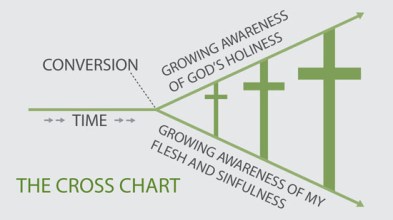
Other than the “praise and worship” participation on every Sunday celebrating the knowledge of our “sin as set against God’s holiness,” we have the following video. Just how confused are churchgoers? They are perplexed when their children start acting like heathens after hearing that’s what they are 24/7 in church culture…and even led in celebrating it. Of course, it is said that “grace” is what is being celebrated, not our evil. That’s like saying you are only celebrating “4” and not the “2+2.”
The apostle Paul said it: “Love does not delight in evil.” But any claim that church is a venue for love makes the cross smaller. It doesn’t add up.
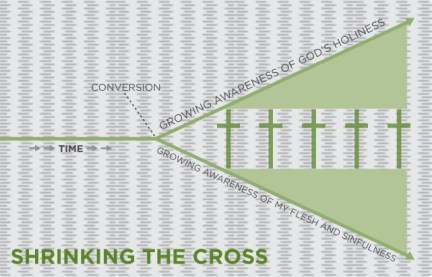
Look, if you go to church, I understand why you do, but bless your heart, and I know you don’t mean to, but you are worshiping evil and how different you are from your Father.



5 comments