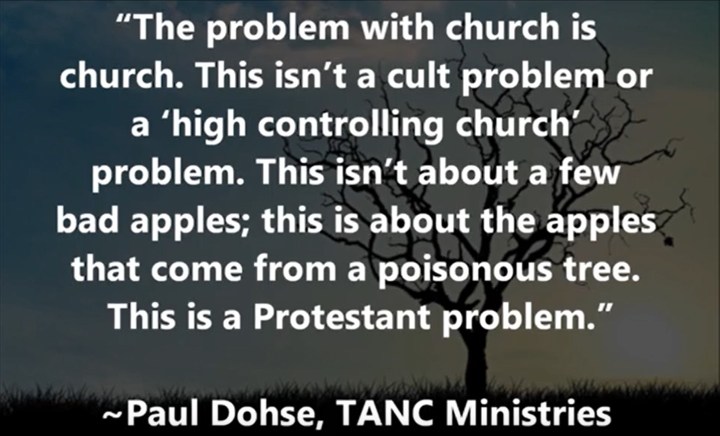
The Church is Not the Love of God, Nor Can Love Be Found in the Church
Church orthodoxy itself excludes the possibility that love can be found in church; lovelessness is in the contract. Of course, like all other words in the dictionary, church redefines all of them because if you control the definition of words you control reality.
Church redefines eight words and two phrases for forming two doctrines that make biblical love impossible; “perfect,” “sin,” “weakness,” “law,” “love,” “justification,” “sanctification,” “antinomianism,” “new birth,” and “under grace.”
Preface: the gospel is both simple and complex. Its complexity is purposeful in confirming its truth while its simplicity doesn’t make it difficult to enter into God’s kingdom. The new birth is a simple concept that is, for the most part, intuitive, while the new birth’s relationship to the law is very complex. However, the truth and reliability of Scripture is confirmed by this complexity and exposes run-of-the mill falsehoods that sound logical. So, the following will take your own thinking and some effort.
Let’s start with law. There are only two people groups in the world in regard to soteriology: “under law,” and “under grace,” viz, lost and saved. Keep in mind: under law is an all-pervasive mindset. Even those under grace must retrain themselves not to perceive reality through the lens of under law.
Church orthodoxy starts with defining law as a single purpose perspective. In other words, the law only has one role in reality: condemnation. Law’s character and purpose in reality is redefined. Law is the linchpin to redefining the other words, so that is why we are starting with law.
Law is defined as perfection’s standard. So, justification is redefined as, perfect law-keeping. Let’s stop for review: church defines law as the standard for perfection and subsequently justification (before God). Therefore, perfect law-keeping is the standard of justification. Please note: the Bible does not define justification as perfect law-keeping. Secondly, if this were true, in regard to humanity, law can ONLY condemn which in fact is the church’s position on the law’s function; it can only condemn because no one can keep it perfectly.
This is in stark contrast to biblical definitions. According to the Bible, the law condemns AND enables people to love. The Bible definition of law defines it as two purposes affected by the Holy Spirit. According to the Bible, the law belongs to the Holy Spirt, and He uses it for two purposes: to condemn those under law, and to sanctify (set apart) those under grace. In other words, being under grace doesn’t mean that you are not under a law, it means you are under the Spirit’s second use of the law. This may be dubbed, “The Spirit’s two uses of the law” which delineates between under law and under grace. Please note Romans 8:2,
because through Christ Jesus the law of the Spirit who gives life has set you free from the law of sin and death (NIV).
The word, “law” in this verse, that is, in both cases, is “nomos.” This is key; nomos refers to God’s truth as revealed in the law. Notice that the Spirit is the life-giver, and He uses one use of the law, “through Christ” to set us free from His other use of the law, to convict the world of sin and the judgement to come. His other use of the law aside from the aforementioned use is to “sanctify” or “set apart” (John 17:17).
Church orthodoxy disallows for the Spirit’s two uses of the law, and only recognizes the law’s condemnation. This is foundational to church soteriology; ONE use of the law. AND, justification defined as perfect law-keeping. Church circumvents the true meaning of Romans 8:2 which as we will see makes love in the church impossible. It also makes the church gospel patently false by redefining the new birth.
Now let’s examine the “through Christ” part of this verse. Christ established the new birth when the Holy Spirit raised Him from the grave. This is “the promise” made to Abraham AND Christ (Galatians chapter 3) AND, the promise is COMPLETLEY separate from the law. The promise regards the fact that the Spirit would not leave Christ in the grave but resurrected Him as the “first fruits” of bringing many children to glory. This is the new birth.
Hence, the believer, when baptized by the Spirit (“You must be born again” John chapter 3) literally dies with Christ, and is also literally resurrected with Christ. This is the abolishment of the first law that condemns, that is, all together, and transforms the believer to the Spirit’s second use of the law. This eliminates ALL condemnation under the first law to the point where the Bible frames it this way: “where there is no law there is no sin.” Church orthodoxy defines sin as violating the ONE law (a single perspective on the law), which makes it impossible for a Christian to be without sin. Hence, we are all “sinners saved by grace.” In the Bible, a “sinner” is defined as one under law. And since church disavows two perspectives on the law, EVERYONE must remain under law. This redefines the new birth as well, and…
…how the church defines “perfect.” The church defines perfect as justification through perfect law-keeping as previously stated. Everyone remains under law. “Under grace” is redefined as a status under law, but NOT completely separate with the former being completely eradicated. In contrast, to be biblically transformed from “death to life” means we are transformed from under law to under grace through the new birth resulting in there being “NO condemnation” for those of us “in Christ.”
Why is it so hard for Christians to say that we no longer sin? Answer: the under law mindset. When Christ called on us to be “perfect” like our Father, He wasn’t deliberately challenging us to an impossible standard for purposes of showing us our inability to keep the law perfectly, He was challenging us to LOVE. As an aside, it is interesting to note that in every place “grace” appears in the Bible, “love” can be substituted. Grace is love in action. Under grace can be fairly referred to as “under love.”
The biblical definition of “perfect” follows: one under grace exercising their faith through love. The standard for love is the Spirit’s use of the law under grace. In contrast, the church does not recognize this second use of the law which necessarily leads to a denial of the new birth. The new birth transforms the believer from under law to under grace or from one use of the Spirit’s law to the other.
Christians who claim they no longer sin will be quickly accused of “perfectionism” and “antinomianism.” They attribute perfectionism to those who claim to keep the law perfectly and thereby earn their own justification. This definition flows from there redefinition of justification: perfect law-keeping.
Let’s pause here to note the biblical definition of justification (righteousness). It is what happens in the second part of the new birth; the believer is born again and is infused with God’s life, or “seed.” THIS ALONE makes us righteous.
Whosoever committeth sin transgresseth also the law: for sin is the transgression of the law. And ye know that he was manifested to take away our sins; and in him is no sin. Whosoever abideth in him sinneth not: whosoever sinneth hath not seen him, neither known him. Little children, let no man deceive you: he that doeth righteousness is righteous, even as he is righteous. He that committeth sin is of the devil; for the devil sinneth from the beginning. For this purpose the Son of God was manifested, that he might destroy the works of the devil. Whosoever is born of God doth not commit sin; for his seed remaineth in him: and he cannot sin, because he is born of God. In this the children of God are manifest, and the children of the devil: whosoever doeth not righteousness is not of God, neither he that loveth not his brother. For this is the message that ye heard from the beginning, that we should love one another (KJV).
Most Christians find this passage in 1John utterly perplexing. Why? Answer: the under law mindset. However, if you look at it from the perspective of what the new birth does, we may read it this way:
Whosoever commits sin transgresses the law: for sin is the transgression of the law of sin and death. And you know that he was manifested to take away our sins; and in him is no sin (so, if we are in Christ, we have NO SIN). And whosoever is in Christ does not sin because they are under grace, and where there is no law, there is no sin (Romans 3:19, 20; 4:15, 5:13, 7:6,8; 10:4): whosoever sins has not seen him, neither know him. Little children, let no man deceive you: he who is under love, and loves accordingly, is righteous, even as he is righteous. He that commits sin is of the devil; for the devil sinned from the beginning. For this purpose the Son of God was manifested, that he might destroy sin, the works of the devil. Whosoever is born of God does not commit sin; for God’s seed remains in him: and he cannot sin, because he is born of God and not under the law of sin and death. In this the children of God are manifest, and the children of the devil: whoever does not love under grace is not of God, neither he that loves not his brother. For this is the message that you heard from the beginning, that we should love one another. Faith works righteousness through love (Galatians 5:6).
God’s indwelling seed, another way of saying we are born of God and permanently indwelled by Christ and the Spirit, is what makes us righteous, NOT perfect law-keeping. By the way, church is in error based on the simplest of points on this wise: perfect law-keeping as the standard for righteousness is not a righteousness “apart from the law.” This would seem evident.
The Bible has another way of driving this point home: those under grace, or the law of the Spirit of life, fulfill the whole law by love (Galatians 5:14, Romans 13:10) in the same way those under the law of sin and death violate the whole law with one sin (James 2:10). Therefore, when the Bible seems to refer to Christians sinning, it should be understood in context. Christians fail to love, and can be chastised accordingly by our Father. Family of God sin, stated technically as a failure to love, does not bring condemnation under the law of sin and death. In contrast to church orthodoxy, sin is not defined through a single perspective due to the fact that hundreds of years of orthodoxy has missed Romans 8:2.
But why do Christians fail to love at all times? This is where church redefines “weakness” as synonymous with sin. Weakness is not sin. There were times when Christ was in a state of weakness, but obviously, without sin. The “holy” angels are without sin, but obviously weaker than God. In regard to us, our mind’s LOVE for God’s law/truth/word is what makes us righteous though clothed in weak mortal bodies. The “willing” spirit (“the spirit is willing but the flesh is weak”) in our mortal bodies is a characteristic of our righteousness. This is why the Bible calls us “holy” in several places, because we are.
According to Romans chapter seven, our struggle is between the “law in my members,” that is, sin, which resides in our weak mortality and attempts to keep us under the condemnation of the law, and “the law of my mind” which is the regenerated part of us that makes us righteous. Though we are no longer under the jurisdiction of the law of sin and death, sin still attempts to use it for condemnation. This is because sin wants to control people whether they are lost or saved (Genesis 4:6.7), and the control is gained through condemnation. So, regardless of the fact that the new birth strips sin of its power to condemn through the law of sin and death (1Corintians 15:56), the sin in our members still tries to make a case for condemnation. Misinformed soteriology will enable sin to be successful in that effort. The “law of my mind” refers to progressive sanctification that uses the law of the Spirit of life for spiritual growth. That is, the Spirit’s second use of the law.
“The law of Moses was unable to save us because of the weakness of our sinful nature. So God did what the law could not do. He sent his own Son in a body like the bodies we sinners have. And in that body God declared an end to sin’s control over us by giving his Son as a sacrifice for our sins” (NLT).
Other than the idea of “we sinners,” this is a good representation of Romans 8:3. We are no longer enslaved by sin and therefore righteous. Though weak, we are free to serve a different Master:
Romans 7:1 – Or do you not know, brothers—for I am speaking to those who know the law—that the law is binding on a person only as long as he lives? 2 For a married woman is bound by law to her husband while he lives, but if her husband dies she is released from the law of marriage. 3 Accordingly, she will be called an adulteress if she lives with another man while her husband is alive. But if her husband dies, she is free from that law, and if she marries another man she is not an adulteress.
4 Likewise, my brothers, you also have died to the law through the body of Christ, so that you may belong to another, to him who has been raised from the dead, in order that we may bear fruit for God. 5 For while we were living in the flesh, our sinful passions, aroused by the law, were at work in our members to bear fruit for death. 6 But now we are released from the law, having died to that which held us captive, so that we serve in the new way of the Spirit and not in the old way of the written code.
Because church defines justification/righteousness as perfect law-keeping, and no one can keep the law perfectly, church must redefine the new birth and everything else that defines the new birth. According to church orthodoxy, all the new birth does is opens our eyes to the fact that we can’t keep the law well enough to be justified. That would be true if we were still under the law of sin and death, and the law wasn’t fulfilled by love. What church does, and this speaks specifically to the formal Protestant doctrine of mortification and vivification, it denies the new birth as a onetime final event.
But before we articulate that point, we must ask a question. If perfect law-keeping is the standard for justification, how are churchgoers saved? Well, someone keeps the law for us; namely, Jesus. This is where we will bring the formal church doctrines of “double imputation” and “mortification and vivification” into the conversation.
The Bible states that we are saved by Christ’s death and resurrection. How so? Because His death and resurrection established the new birth. We are saved by believing that, and wanting it for ourselves. If we are going to be in Christ, we must “take up our cross and follow” Him. What does that mean? It means we call out to God to follow Christ in baptism. This is only a work that God can do through the “Spirit who gives life,” but we can believe it and want it for our own lives. Believing, or saving faith, encompasses a desire to be born again; a desire to die to the present life and resurrected to a new one. Of course, we cannot rebirth ourselves, only the Spirit can do that, but we can believe it and call on the Lord for salvation accordingly. “You must be born again.”
This baptism unto salvation makes perfect law-keeping a mute point unless you are Protestant; if you are Protestant, the “righteous demands of the law” must be continually satisfied. In other words, the law of sin and death doesn’t go away; it doesn’t die with Christ. Church denies that the ordinances of the law were “nailed to the cross” (Colossians 2:14). The old man doesn’t die with Christ and remains under the jurisdiction of the law of sin and death that the Spirit uses to convict the world of sin and judgment to come. Therefore, this remains as the same purpose for so-called Christians as well.
So, according to the church doctrine of double imputation, Christ came to live a perfect law-keeping life to secure righteousness for humanity, and died to pay the penalty of sin, and was resurrected as a confirmation that His law-keeping was good enough to pay the full penalty of sin. In fact, outrageously, many church scholars claim that Christ gained His own righteousness via a life of perfect law-keeping. Churchgoers who have any commonsense remaining find this utterly shocking and usually refuse to believe it. Nevertheless, it’s a fact. And, again, how is that a righteousness apart from the law? In contrast, the Bible says Christ was resurrected so that we can be resurrected with Him as newly created creatures free to serve the law of the Spirit of life rather than the law of sin and death. That is why Christ was resurrected, NOT to confirm His supposed perfect law-keeping. Christ kept the law perfectly by virtue of who He was and hardly needed to prove anything to the Father. Regardless of church pomp and circumstance amidst glorious infrastructure and religious folklore, its orthodoxy is absurd.
Let’s review the contrast. The Bible teaches that Christ came to end the law of sin and death for the old us through His death, and was resurrected so we can be recreated in His likeness which includes the infusion of righteousness within us and the regeneration of our minds. This makes our bodies, in one sense, a holy temple from which we offer living sacrifices to God though sin still resides in our members. Furthermore, the law is now fulfilled in us through love which is mutually exclusive from any motive to be justified by law-keeping. All that is left is using the law for love while knowing justification by law is impossible; the new birth saves us. We are now free to love aggressively with no fear of condemnation.
This speaks to assurance in a big way. If we are still under law, and see law from a single perspective, there is no possible way to know what our motives are when we attempt to please God by obeying the law. However, if we see justification as a finished work, the only motive left is love. Since church deems all of humanity as still under law, sin is not ended and must be continually covered; in essence, there is no possible way of knowing what your motives are in keeping the law. In fact, church orthodoxy teaches that the likely motive is self-justification which is always a possibility if we are still under the law of sin and death. Hence, the only means of assurance is to abandon any effort at law-keeping. Unwittingly, this cancels out the use of the law for love in sanctification. This is one reason why love in the church is impossible.
Now we will examine how this works for churchgoers. There is only one law, and the perfect keeping of it must be maintained in order for justification/righteousness/salvation to be available. Christ came to do that, and once He accomplished that, saving faith is now defined as a belief that one’s righteousness must be substituted by Christ. Instead of sin being ended, it must be covered. The law and its “righteous demands” must be continually satisfied. How does this happen?
Because churchgoers are unable to keep the law perfectly, the ongoing breaking of the law must be forgiven. That’s first; ongoing forgiveness for “present sin” is required. Secondly, in order to “declare” a believer righteous, that righteousness must be substituted as well and “imputed” to the “believer” perpetually. This is the doctrine of double imputation.
So, how is ongoing forgiveness of sin obtained? Mortification, that is, of sin, takes place for “present sin” (death) followed by re-justification (resurrection/vivification). Therefore, the new birth is defined by church as a none-experiential repeating of the baptism of the Holy Spirit. Some church scholars strongly emphasize a joy experience with the vivification part. This is the doctrine of mortification and vivification. It makes the new birth/baptism of the Spirit a perpetual reoccurrence in order for churchgoers to remain saved. As long as the church “means of grace” are performed by the churchgoer; viz, tithing, sitting under “gospel preaching,” prayer, participating in the Lord’s Table, confession of sin, etc., mortification and vivification takes place resulting in perpetual re-justification.
Hence, Christ came to establish double imputation because everyone is still under law, both forgiveness and a righteous state of being must be substituted while real righteousness remains “outside of the believer.” This is Martin Luther’s “alien righteousness.” In order for the so-called believer to continually obtain perpetual baptism for re-justification (mortification and vivification, what church scholars call a “reliving of our baptism”), they partake in the “means of grace” found only in formal church membership. Instead of the baptism of the Spirit saving us from one law and making us a servant of love, this doctrine keeps people under the law of sin and death and thus redefines the new birth for purposes of progressive justification culminating in a “final justification.”
This brings us to another reason why love can’t be found in the church, at least true biblical love. Instead of love being the natural result of a truly biblical new birth, all activity is focused on the “means of grace” that keep churchgoers saved. People aren’t coming to love each other, they are coming to church to save themselves from hell. Not only that, love must be defined as congruent with righteousness which boils down to perfect law-keeping as well, and since churchgoers are fond of reminding us that we cannot keep the law perfectly, this also excludes the possibility of love. Any love that can be pointed to is a love performed by Christ and “imputed” to the churchgoer to keep him or her under legal declaration only. The claim by any churchgoers that they love would also be a “righteousness of their own.” In fact, Martin Luther stated in the Heidelberg Disputation that any belief that one can do a good work, which would necessarily include love, is a belief that damns. John Calvin also concurred in 3.14.11 of his Institutes of Christian Religion.
The claim of personal righteousness necessarily claims righteous works by the individual including love. 1John chapter 3 makes the two synonymous. In contrast, a claim that we have no “righteousness of our own” necessarily eliminates the possibly that we can love. Churchgoers cannot have it both ways. Furthermore, a righteousness apart from us is not a righteousness in us which includes God’s seed. You can’t have that both ways either.
Moreover, this would also mean that under grace is not mutually exclusive from under law but a mere subset of under law. In addition, this would make sanctification a subset of justification. In other words, under grace is merely a pardon under law, and sanctification a mere progression of justification.
Lastly, this would redefine antinomianism (anti-law) as a denial of the law as justification’s standard while biblically, antinomianism denies the use of the law to love God and others in sanctification. The truth of the matter therefore follows: church is an antinomian religion.
This is exactly what church orthodoxy does because it makes an impossibility to obey the law perfectly apply to love as well. Here is what 1John says about that:
There is no fear in love, but perfect love casts out fear. For fear has to do with punishment, and whoever fears has not been perfected in love.
This is fear of condemnation under the law of sin and death versus one who has been perfected in love—love is defined in the Bible as the “perfect thing.”
1Corinthians 13:1 – If I speak in the tongues of men and of angels, but have not love, I am a noisy gong or a clanging cymbal. 2 And if I have prophetic powers, and understand all mysteries and all knowledge, and if I have all faith, so as to remove mountains, but have not love, I am nothing. 3 If I give away all I have, and if I deliver up my body to be burned, but have not love, I gain nothing.
4 Love is patient and kind; love does not envy or boast; it is not arrogant 5 or rude. It does not insist on its own way; it is not irritable or resentful; 6 it does not rejoice at wrongdoing, but rejoices with the truth. 7 Love bears all things, believes all things, hopes all things, endures all things.
8 Love never ends. As for prophecies, they will pass away; as for tongues, they will cease; as for knowledge, it will pass away. 9 For we know in part and we prophesy in part, 10 but when the perfect comes, the partial will pass away. 11 When I was a child, I spoke like a child, I thought like a child, I reasoned like a child. When I became a man, I gave up childish ways. 12 For now we see in a mirror dimly, but then face to face. Now I know in part; then I shall know fully, even as I have been fully known.
13 So now faith, hope, and love abide, these three; but the greatest of these is love.
There is lots of discussion about how “perfect” should be interpreted in these passages. It can be interpreted as “mature” love or “complete” love, but either way, it is NOT perfect law-keeping. For all practical purposes, those under grace are perfect (holy) because the law can’t condemn them, and they are under the perfect thing which is love. We are perfect because we are under love and not law. The practice of love fulfills the law, so it might as well be perfect law-keeping for all practice purposes.
Before we conclude, it should be mentioned as an aside that the doctrines of double imputation and mortification/vivification steer alarmingly close to what the Hebrew writer fustigated: the practice of ritual atonement for sin re-crucifies Christ and puts Him once again in open shame. Church scholars deny that charge by saying Christ only died once, and these doctrines are only a reapplication of Christ’s onetime finished work. But apart from who the Hebrew writer was addressing, the only difference is method of ritual. The church’s means of grace is merely a different way of serving the Old Covenant while claiming the New.
We struggle with the idea that being born of God makes us holy and righteous despite our weak humanity. Again, because of the under law mindset that saturates reality. However, if not for this weakness, we wouldn’t fail to love.
Redemption is the saving of our bodies, when the partial love hindered by weakness will give way to COMPLETE love. This is when we will fully know God (love) as He has fully known (loved) us from the beginning (1Corinthians chapter 13). But until then, be sure of this: love cannot be found in church and God cannot be known (loved) to any degree through the doctrines of double imputation and mortification/vivification.
And the standard for perfection is not law, it is love, which fulfills the law.
paul
Why I like Antifa More Than The Church
We have all heard of Antifa. A short description of them follows: “The Antifa movement is a conglomeration of autonomous, self-styled anti-fascist militant groups in the United States. The principal feature of Antifa groups is their use of direct action, harassing those whom they identify as fascists, racists or right wing extremists, both online and in real life. They engage in violent protest tactics, which has included property damage and physical violence. They tend to be anti-capitalist and they are predominantly far-left and militant left, which includes anarchists, communists and socialists. Their stated focus is on fighting far-right and white supremacist ideologies directly, rather than politically.”
That’s pretty bad and I don’t agree with Antifa groups at all. They think they have a right to hijack my freedom of movement and expected experiences prepaid for in certain venues. They are annoying, but at least honest about what they believe. Many of them wear masks at protests because their stated MO is direct action through civil unrest and violence.
Of late, more annoying is the church which now thinks they have the right to invade your prepaid expectations of certain venues, and think it’s pretty hip. If I want to hear so-called “praise and worship” music, which I don’t, I will go to church, which I never will. Nevertheless, because the stated goal of church orthodoxy is cultural takeover, they have adopted another tactic from the world: flash mobs.
So, let’s say I make a decision to use MY time and money to dine in at Chick-Fil-A, with an expected experience in mind, unless Antifa blocks the highway I use, and suddenly this happens:
It happened at the Rivergate Chick-fil-A in Nashville, Tennessee last Saturday around lunchtime.
More than 60 male a cappella worship leaders from seven nations had gathered for a week-long conference, Worship Leader Institute, hosted by Acappella Ministries and its founder Keith Lancaster. The students attending the conference lead their churches in a cappella worship services without instrumental accompaniment.
The Worship Leader Institute conference was held at the Madison Church of Christ in Nashville. Several years ago, a tradition began for conference attendees to eat lunch together at a nearby Chick-fil-A either during the conference or before going home. That’s when they started group flash mobs.
The first flash mob took place in 2016 after someone in the group had an idea to sing a song together before heading home, and the Chick-fil-A store manager has been supportive of the flash mobs ever since.
This year, the group sang Hezekiah Walker’s “Every Praise” in SATB 4-part harmony.
Chris Armstead, of Atlanta, was among the a cappella worship leaders and told FOX 5’s Katie Burk everyone sat around at tables and booths in the restaurant after placing their orders. Then, the singing began.
“The first group, including the leader, began the flash mob by standing up to start the song at their table, and then the other groups stood in succession at their tables/booths to join into the song at predefined times until all 60+ guys were singing the song,” Armstead said.
Armstead shared a video of the performance on Facebook last weekend, and it quickly went viral with more than 8-million views and nearly 100,000 shares.
Armstead, a Children’s Healthcare of Atlanta employee, said some of the Chick-fil-A staff joined in to sing as the excitement began to build at the restaurant.
“Other customers joined in to sing as well,” Armstead said.
According to Armstead, the a cappella arrangement of the song was created by Mike Rogers, Ph.D., Assistants Professor of Music Theory at Abilene Christian University.
Armstead also works as a part-time Worship Minister at East Cobb Church of Christ in Marietta.
“Maybe we’ll try to do some flash mobs at local Chick-fil-A locations here in Atlanta, Lol!”
But hey, as the “excitement began to build” some of the staff and customers joined in. And by process of elimination, tough crap for the paying customers who were not up with it. So, let’s take a tally here: I don’t care to listen to praise and worship music, and for that reason and many others, I don’t go to church, and lastly, I have never been to Chic-Fil-A and never will because I might get ambushed by church which is far more annoying and detrimental to life than getting ambushed by Antifa. Why so? I’m glad you asked.
With Antifa, everything is pretty straight forward: they disagree with you so they are going to hurt you unless you protect yourself. Church used to be like that as well except church views were enforced by the government so you really couldn’t protect yourself. But after the American Revolution and the subsequent separation of church and state, the church has to resort to mind control and manipulation. We call that, “cultism.”
First, note the arrogance of seizing upon the freedom of those who might disagree. That is time belonging to others that paid money for the expectation of a particular experience.
Secondly, it propagates a false persona: “Look at us. See how happy we are? We are people who live a lifestyle of “celebration.” Fact is, statistics show clearly that churchgoers don’t have it together any more than the world if not much less in many cases. Since its conception in the 4th century, church history has never shown church culture to have the market cornered on happiness. Disgustingly, this is sold as an initial sales hook while knowing what the church really believes about church experience.
Thirdly, the lyrics of these praise songs advocate the church’s false gospel of progressive justification and zero-sum-life philosophy. One of the most popular “flash mob” songs is “Every Praise.” The gist of the song states that absolutely nothing of reality except Jesus is worthy of praise. Of course, the apostle Paul heaped praise on many people other than God. But in the case of this typical promotion of total inability ALL and “EVERY” praise goes to Jesus because everything else in reality is totally depraved.
Fourthly, stunts like this portray the church’s departure from intellectual persuasion and more towards an experience orientation because they have no logical argument and never had one to begin with.
Fifthly, it is a rejoicing in evil so that grace may abound. Yes indeed, churchgoers “celebrate” the idea that no man, woman, or child is praiseworthy which points to the supremacy of God alone. More on that here.
Thanks for asking; my opinions are only given by request.
paul
Why Do Christians Meet at a Designated Place to Be Slaughtered?
Churchgoers routinely deny that the church religion is temple worship, and that no real worship takes place outside of the church building which houses “lawfully appointed ministers of the gospel” (Westminster Confession). Yet, as we have seen in the news often of late, regardless of being located in areas where persecution is taking place, Christians meet at designated public locations for church.
Why would Christians risk the lives of their families by meeting in designated purpose buildings in geographies where ongoing persecution is taking place? Because regardless of their intellectual denials, their functionality reveals what the orthodoxy really is.
Furthermore, where are the well-known evangelical leaders on this? Why have they not spoken up and said, “Yo!, meet in private locations; don’t be fish in a barrel!” Answer: because that would devalue church authority. Not only that, it’s good cause to ask for money. And what for, to build nicer and bigger buildings for them to be slaughtered in?
paul
What is The Goofy Church Speak All About?
This is a partial screen shot of a link I was sent today:
We hear a lot of odd verbiage in church like “Pastor of Spiritual Formation” etc., etc. that invokes the RCA dog response, “Er?” Does one go to seminary to get equipped to “shape” someone’s life? What does that mean?

I am in the middle of a project right now so I am looking for quick and short ways to respond to links I get. I think this post from the past nails it pretty well.
Originally Posted in 2011:
“The ‘Gospel’ Coalition” Series, Part 13: Dr. John Street Joins the Noun Coalition
Just yesterday, when I was introduced to the new gospel upstart organization in our everything gospel church culture, I was verbless. Somebody sent me a link to the upstart’s Facebook page (the “Biblical Counseling Coalition”) which posted this statement: “Sanctification is the art of getting used to our full salvation: justification, regeneration, redemption, reconciliation.”
Rush Limbaugh often says “Words mean things,” but [do] they really? After all, I did some investigation and this new coalition is overseen by the spiritual brain-trust of our day. So, when the apostle Paul described sanctification as “abstain[ing]” (1Thess 4:3), “running” by obedience (Gal 5:7), also through obedience: “work[ing] out….with fear and trembling” (Phil 2:12), beating our bodies into subjection, discipline, running a race, and for a prize (1Cor 9:24-27); surely, we peasants of this contemporary dark age must be misunderstanding him because that’s a lot of verb-iage. Since Michael Horton says the purpose of corporate worship is for reviving our valley of dead bones by contemplating the gospel, should we forget all that stuff in Hebrews about encouraging each other unto good works? Should we rather relax and say, “Hey bro, how are you coming along in the art of getting use to you salvation?”
Inquiring minds, what’s left of them, want to know. Because one of the board members of this coalition is David Powlison, we could have a clue. In an interview with Nine Marks, Powlison said that the church forgets stuff, but when it is rediscovered by CCEF’s Research and Development Dept., it has to be reevaluated in a contemporary historical context. Hmmmm. Powlison also believes that a thorough search must be made of all past and present philosophies, literature, history, etc., just in case God has shown other people stuff that he hasn’t shown the church, or has shown the church in the past, but was forgotten, because the church forgets stuff. At this year’s TGC (The Gospel Coalition) 2011 conference, Powlison will be conducting a seminar on “Recent Advancements in Biblical Counseling.” So, for all of you that draw propositional truth from interpreting the verb, noun, subject, preposition, etc. structure of sentences in the Bible, you may not want to miss that seminar if you really want to able to take the word and help people.
Yet another clue may come from another board member of the BCC, Paul David Tripp. He believes that biblical verbs must be seen in their “gospel context.” In other words, all verbs in the Bible pertain to Jesus. In “How People Change,” Tripp says that the art of getting use to our sanctification is “resting and feeding” on Christ. In the same book, Tripp also writes, like Michael Horton in “Christless Christianity” (or, “Verb Christianity”), that Christians are dead, and as Tripp states it in HPC: “When you are dead, you can’t do anything.” Tripp also mentions in the same book that Christ is not a cognitive concept that we apply to life, but he is a “person.” Got that? No cognitive concepts, just the personal pronoun.
But another board member that caught my eye on the list was Dr. John D. Street who has actually counseled me in the past. I have been reluctant to write in regard to him previously because I am privy to the fact that he used to employ lots of verbs in counseling that applied to the counselee, and I didn’t want to get him into trouble. In fact, I was a perfect candidate for this new form of counseling when I came to him many years ago. I remember coming to one of our appointments and proudly proclaiming: “I have read my Bible and prayed for—four hours!” Now how do you like that for contemplative spirituality?! His answer? “I’m not going to tell you not to do that, but the power is in the doing.” Ouch! I can just imagine the look of horrific angst on Powlison’s face.
Back then, I think Street might have got this idea from the old way of interpreting the Bible. “But the one who looks into the perfect law, the law of liberty, and perseveres, being no hearer who forgets but a doer who acts, he will be blessed in his doing.” “But” is a coordinating conjunction which indicates contrast in this sentence; so being interpreted, don’t do the previous verses—hearing only, and not doing. But that exact contrast that James warns us of is the mantra of the new biblical counseling movement. I was recently sent a webinar conducted by a NANC Fellow who was clearly propagating a hearing only model of change that left the results up to being “amazed by the gospel.” Apparently, James didn’t get the memo. He presents hearing and doing as two components that work together to bring about—at the very least, blessings. The blessings occur where? Well, if we answer that question by finding the preposition, the blessings are “in” the “doing.” Also note that James does not present the gospel as the primary motivator, but rather blessings.
There is no misunderstanding about how this false approach to counseling fleshes itself out in real life. I was a longtime member and former elder at Clearcreek Chapel, the church John Street founded in Springboro, Ohio. The church is presently endorsed by both CCEF and NANC, and is a NANC training center. Two members on the upstart BCC board, Robert Jones and Paul Tripp, speak there often. My information regarding this doctrine includes hundreds of hours of discussion with the Clearcreek elders, who again, are highly respected in biblical counseling circles. The pastor of the church, Russ Kennedy, has said, “Any separation of justification and sanctification is an abomination.” Obviously, this can only leave sanctification by justification as the dynamic for change. This can also be seen in the statement regarding sanctification as something we “get used to” as opposed to what the apostle Paul taught. Though the movement is hideously covert, if one pays attention, their noun-iage exposes them from time to time.
The former Clearcreek elder who was in charge of counseling at Clearcreek once announced from the pulpit (at Clearcreek) that he learned to read his Bible in “a whole new way” from Chad Bresson, Clearcreek elder and author of “Vossed World,” a blog that promotes the belief that the Spirit only illuminates the word of God in a gospel context. Bresson also believes the postmodern concept that because truth is in a person, it cannot be propositional or cognitive / objective, which is why the Bible is strictly a narrative and not for instruction. Presumably, this is why Dan Turner, another elder / counselor at Clearcreek, sometimes (if not all the time) draws diagrams of people’s lives and shows them where they are at in the diagram / picture / gospel narrative as a way of avoiding an instructive paradigm. I once heard Turner explain how a marriage was miraculously transformed before his eyes after showing them the glory of the gospel from the Scriptures. Turner also told me that I was like the Pharisees because I believed that Scripture should often be used to determine objective truth. No surprise then that the elders at Clearcreek were never heard (while I was there) saying, “How do we do that?” But were rather heard saying—often, “What does that look like.” In fact, we were taught that the “how” word was indicative of a heart problem, and the use of that word in a question to an elder resulted in a repeating of the word (how) back to the inquisitor in question form to correct the parishioner.
Will the BBC be able to help people with a counseling model based solely on nouns? I doubt it. Will John Street get kicked-off the BCC board for taking James literally? Or has he repented of such Phariseeism? Perhaps he now says: “I’m not going to tell you not to obey, but the power is in the contemplation.” I hope he hasn’t, but if not, what does that look like? “[Run] John, [run]!”
paul


3 comments