Did John Chau Give His Life For a False Gospel?


You have probably heard about the young American adventurist and Christian missionary, John Chau, who was recently killed by natives on an isolated island near the coast of India. His first attempt to contact them for the purpose of sharing the gospel was met with a flurry of arrows which caused his retreat. Unfortunately, he made a second effort that did not turn out well.
His situation is indicative of problems I have had with church missionary endeavors for years even while I was devoted to church. As a former church pastor, I was always anti-foreign missions for a plethora of practical reasons.
First of all, as a former church pastor, it was evident that the American church didn’t have its own act together, so why would we be arrogant enough to think the rest of the world needs our brand of Christianity?
Secondly, the motives of most missionaries from my perspective was suspect at best. Most presented their mission construct from a personal interest or a lifelong dream to live in a particular region of the world.
Thirdly, vast amounts of money was spent for preparation before the mission ever started.
Fourthly, families had no break from ministry at all and no life apart from ministry. The missionary families barely knew each other. When they did get a furlough, the time was spent dragging their families all over the country to raise or keep support. Missionary children, consequently, and from my perspective, where just plain weird and maladjusted.
Fifthly, actual conversions on the missionary field were far and few in-between.
Sixthly, missionary endeavors were/are according to an institutional construct. Hence, missionary endeavors are limited to regions where the socioeconomics can support institutions, viz, “self-supporting churches,” complete with public buildings, and of course, an ability to support the missionary organization that supported the church planting effort to begin with.
Seventh, many of the missionary plans of action involved breaking foreign laws, which is problematic to begin with, but the way around that was to send the missionary over to the country under the false pretense of a special visa. I was never comfortable with that. But what made it ok? Well, but of course, church authority and the whole, “God’s law is higher than man’s law” and “We must obey God rather than man,” blah, blah, blah. On the one hand, God is all powerful and sovereign, and predetermines who is lost and saved, but on the other hand, we have to break foreign laws because though God is the author of all kinds of other evils in the world, certainly He is totally unwilling to accept laws that ban American missionaries. In elders meetings, I would actually say, “Wait a minute here, we are Calvinists. Is this not God’s way of shutting the gospel door on that country? Whatever happened to, ‘God will have mercy on whomever He will have mercy, et., etc., etc.'”
By the way, Indian law strictly forbids outsiders from visiting the island where Chau was killed, and those he paid to take him there are being prosecuted for being complicit in his murder. His endeavor was a horrible decision and a misadventure that will now have a negative effect on the lives of those who helped him. Which brings me to…
Eighth, in all of this missionary foolishness, missionaries are deemed to be a higher spiritual class among Christians and are often declared spiritual heroes for their foolishness. Stupidity is the gift of faith, and lawbreaking is fearing God more than man.
Ninth, as one who dealt with many, many missionaries, I can tell you, that for the most part, they are basically lazy and think they are spiritual elites that are above being among the working class.
Tenth, Protestant missionaries take the gospel of Justification by Faith with them which is a false gospel to begin with. That’s the only reason one needs to reject church missions to begin with.
This hits on an issue that is very close to home with me. My daughter who was a missionary to remote parts of Kenya for years is presently divorcing her missionary husband for reasons I will not get into here. Per the usual, and as illustrated by a pastor’s conference I went to in Kentucky, none of the pastors of their sending churches had a clue as to what the gospel is. This is the literal horror I lived with for years: the possibility that my daughter and grandchildren would be slaughtered in some third-world banana republic for a false gospel.
On one missionary trip to Kenya with another pastor, my son-in-law held a pastor’s conference where they taught the pastors over there how to do baptisms and the Lord’s Table. Yep, that would be the church’s “means of ordinary grace [read, salvation].” In other words, my family’s lives were being put at risk over progressive justification. Not good times. As I have shared in the past, I am not much of a prayer warrior. If I can fix something and get it done with the gifts the Lord has given me, I have a strong tendency to thank God for the gifts and not wait around to get something done. That was an exception, I did a lot of praying about that situation.
Don’t get me wrong, lots of Protestants are confused enough about Protestantism’s rejection of a literal new birth via Justification by Faith to be saved. While professing Justification by Faith according to pithy truisms, they function more according to an intuitive belief in Justification by New Birth. I trust this was the case with Chau as he seemed to be a free independent spirit though obviously cursed with deadly church ideas.
At any rate, I am sure we all agree that before we put our lives on the line, it should be for a true gospel that we thoroughly understand with our own minds. Once that is the case, missionary work is pretty simple. You go to the country as a legal citizen, you get a job, and you live among the people in a way that glorifies God. If they are drawn to your life and testimony, you break bread, pray, and share the apostle’s doctrine in someone’s home. Basically, you are making another family of God in another part of the world, not an authoritative institution that is an additional mediator other than Christ. You can point to Him alone, not some name brand.
paul
A Discussion About Church Discipline
It is well documented that church discipline no longer addresses congregants behaving badly but instead parishioners questioning the “authority” of a church’s leadership while decadent behavior among the congregants and leaders alike is ignored.
~ Andy
This realization was the straw that broke this camel’s back. 8 years out of the institution now – HalleluYah!
Absolutely. And here was another shocker for me: church discipline is not for public misbehaviors of the baser sort, but rather for ANYTHING that the elders deem, “sin.” The other shocker: church discipline, according to church orthodoxy, is a declaration by the elders concerning one’s salvific status that heaven will bind. You are not only declared an unbeliever, YOU ARE AN UNBELIEVER while under church discipline. Yet another shocker: church membership equals church discipline on different levels. A member in “good standing” is under “instructive discipline” as in “raise up your children in the way they should go.” If a member doesn’t follow the “instructive discipline” they fall under “corrective discipline” and ultimately, if necessary, “redemptive discipline.” Any kind of counseling is considered corrective discipline, so, many, when they seek pastoral counseling, are unwittingly bumping themselves up to the next level. Furthermore, the information gathered in counseling is often used for the redemptive discipline (excommunication). In regard to those who are living in open sin, but not questioning church authority over their salvation, well, we are all just sinners saved by grace anyway, right?
It took me a while to understand all of that even after we left the institution. I knew what I knew but couldn’t quite piece all of it together to make a lucid assertion. You and Andy actually helped me to do that very thing and I am grateful for it.
And we are still learning how it all fits together, and early on you suspect certain conclusions, but you hold off from drawing conclusions because of the absurdity of it. It’s awful tempting to write off Churchians as stupid nitwits but then I must remember that I fell for it for 30 years though I will give myself a little credit; I knew all along that something wasn’t right…something was off, but could never put my finger on it.
EXACTLY!!!
Nevertheless, do a survey of Churchians and you will find that 98% of them think church discipline is for those flaunting sin of the baser sort in public. There isn’t a cult in the world that can even hold a candle for Protestantism. At least Catholics are in the open about their church authority.
As you always point out, most in the institution do not know what the “leaders” actually mean. The same words and phrases are used by “clergy” but they are not saying what the “laity” thinks they are. I experienced this very early on in my church going. I did not understand why we weren’t living and acting (as a congregation) as if we were born again new creations. We kept hearing we are merely saved sinners; saved, being saved, and will be saved. I knew nothing of progressive justification back then, I just knew that what was being taught didn’t seem to reconcile with Holt Writ, but the “powers that be” were saying salvation so we must be speaking the same language? 2 denominations and 20 years and we finally left the institution for exactly what Andy posted in his OP.
Yes, we didn’t know why, but the what becomes enough to know something is seriously defective…we will figure out the why from a safe distance.
Discussion: Did the Real “Church” Meet in Public Buildings? And Are the New Calvinists “Apostate”?
I have nothing against the home church movement per se.
Well, that’s gracious of you, but we do. A church in a house is still church. We are a home fellowship movement driven by Justification by New Birth, not Justification by Faith. Pretty radical, but we welcome challenges to our position.
I read the article, and chapter 11, and I didn’t find much that I thought I disagreed with, other than it seems the Corinthians were already meeting in an established “church” and it wasn’t the homes of Christians, and you seemed to infer that it wasn’t until after the passing of the Apostles that the “church” was organized outside of the home and that this was the “falling away” in part, mentioned by the Apostle. Also, Paul preached in building with at least two stories because a young man fell asleep and fell down, and was revived by Paul. Seems to me that the “church” was meeting in other places than the home and that there was an authority structure in place as well as described to Timothy.
All, or at least most residential homes of that era were multiple story dwellings.
Were the Corinthians not meeting in a “church”, that is, a building outside of their homes that the Apostle Paul refers to as a church? It seems to me that the Apostle Paul is indicating that the Corinthians had a place of meeting where they came together for worship, other than their homes.
Right, it’s a good point. But “church” is not a biblical word and does emphasize a place where authority resides. Ekklesia is a gathering that might take place anywhere for a specific purpose. “Church” denotes institutionalism and was used in the Bible to replace ekklesia when the assembly of Christ was institutionalized. Without lodging a scriptural argument that explains why these passages shouldn’t be understood in the traditional way, let me jump directly to the historical argument. It was against the law for any religion to have purpose build locations that were not state sanctioned religions.
A slightly different rendering, but still, the Apostle asks the question, “Do you not have houses to eat in?” Intimating that where they were meeting was not the homes, but in a single, separate location, as the church…the ecclesia. NASB
The letters to the Corinthian “church” were incited by other “household[s] of faith” tattling on what was going on in some of the other home fellowships. Paul’s second letter to them included the “church’s” expansion into Archaia. This would suggest an expansion of multiple purpose build locations which is historically impossible.
Some were gathering outside the home…that “do you not have houses to eat in” infers that they were not in their “homes” or the home of anyone else. They were wealthy, in Corinth. They had the means, where many Christians did not. I’ll have to do some more research of my own, either way, it’s not a hill for me to die on. I see no prohibition in Scripture that says we cannot gather in a single building, other than homes, or that home gatherings are necessarily superior.
Actually, that verse kinda makes the contrary point. Paul isn’t saying, “Hey, don’t you guys live in homes where you can eat?” He is saying, “Don’t you have your OWN homes to eat in?” The word “have” denotes possession which is why several translations have it, your “own home” rather than A HOME as opposed to some institutional structure. When you observe how this word is used in other verses such as one regarding a woman with child, the baby is her own possession, not just some [other] baby somewhere…So, this particular verse actually makes the contrary argument. However, to your point, in many English translations it comes out as a house as opposed to something else other than another house.
Can’t find the comment you made regarding the issue not being a hill to die on…that’s true, so if both have merit, why not go with the one that has no massive infrastructural overhead and will work in every political and socioeconomic condition?
That and the synagogue was very much part of the Jewish tradition, so it would be a natural for Christians to imitate the structure for the church. I don’t see it as necessarily wrong.
There were institutionalized synagogues that were run by the Jewish religionists and sanctioned by the local government. Indeed, “The Way” ended up doing some business in these places (evangelism), but there are no archeological findings regarding purpose builds for the movement. However, several residential homes with baptismals built inside of them have been discovered dating back to the 2nd century [furthermore, the book of Acts states that Christ’s first century assembly had dramatic global impact which means that archeological evidence should be ample if they used public buildings. Also, traditionally, synagogues were, in fact, for the most part in private homes].
There can, and have been abuses in gatherings of any type, whether in the home or in a “church” building.
True, but our primary dichotomy is family, leadership, gifts, fellowship; not institution, authority, progressive salvation, and membership.
I think you’re reacting to the same “mega church” apostasy that I am. What I see you describing is the apostate “seeker sensitive” “purpose driven” heresy that pervades so many churches, together with the New Calvinists that are bringing in the rock and roll “Christian” music. I think if you watch that video I posted, you could find some things about it that you identify with.
We would also say that home fellowships speak to the confession of our gospel, that is, a new birth into God’s literal family as opposed to an institution where justification is a mere “legal declaration” obtained by submission to an authoritative religious institution. Not passing any judgments here, just stating our position.
No problem. But no church I’ve ever been associated with has ever asserted such things, either from the pulpit or in their church covenants.
Hmmmmm, sorry for my skepticism on that. Nevertheless, let me also say this: there are many people in church who have a proper intellectual idea of Justification by New Birth and also function that way. However, unbeknownst to them, that’s NOT Protestant orthodoxy which denied the new birth in no uncertain terms. Church has totally rewritten its history and uses language that plays on the proper assumptions of parishioners while [slowly] indoctrinating them with Progressive Justification.
I have the Spirit of God, and I know Christ as my Savior, I can tell you I in no way have ever been taught these things “unawares” and if I had, I certainly would have objected. You have a “one size fits all” view of the institutionalized church, and I think it may apply in some areas, especially Catholicism and some Lutheran circles, but not in every case, in every gathering that meets in a “church”. Not by a long shot. The Lord knows those that are His…and they don’t all worship at home…My problem is that you seem to throw the baby out with the bath water. I understand your rejection of organized religion today. It is repugnant in a lot of facets, but there are a great many local gatherings of believers where the Spirit of God is present that you simply are not, and cannot, be aware of that truly do worship God in Spirit and in Truth, and i hope you can at least acknowledge that I am speaking the truth.
That’s what I just said, but here is the problem: Justification by Faith, is, what it is. As far as a “one size fits all,” name one church that would deny Justification by Faith. The problem comes in when somebody like myself is a Berean about bibliology, but then extends that to actually reading the Protestant soteriological documents. Ooops. Houston, we have a huge problem.
I think you are getting into semantical hair-splitting which many hyper Calvinists do. I will post for you what I post for them many times. You are fully persuaded that you are correct, and nothing I can say will ever move you, so I don’t wish to continue. You’ve made your position clear, as have I. Here is what I answer to hyper Calvinists, about their arrogance.
When John Piper states that “Christians still need to be saved,” When Matt Chandler states that “Christians are wicked sinners who still need the cross of Christ,” they are in fact stating Protestant orthodoxy. In regard to Protestant soteriology, they are SPOT ON. How is everyday progressive justification “semantical hair-splitting” [?]. Salvation is either a finished work in the believer or it isn’t. The New Calvinists are right and have done the church a great service in making the church wakeup to what it really believes.
He’s an apostate, as is Chandler, and sadly John McArthur has fallen in with these as well. You’re preaching to the choir, please understand. “The Spirit speaks expressly that in the last days some shall DEPART from the faith…” They’ve departed from the faith they once held, if Chandler ever really held to it at all.
Let’s not get the cart before the horse. Show me an institutional church that rejects Calvin and Luther’s gospel and you are showing me a church that I just might fellowship with. And unfortunately, the New Calvinists are the best thing that has happened to the church because what the Reformers really believed is being brought into the light [in regard to what Justification by Faith really means].
Wrong. John Piper is a New Calvinist, you do realize that, right? As is Mark Driscoll and Al Mohler, et al. Apostates all…These men are seducing the church with “another gospel”.
They are right about what Protestantism is which was confused with people reading the Bible for themselves after the Puritan Theocracy was sent packing. The New Calvinists claim that they are recovering the true Protestant gospel and indeed they are.
And it’s a lie…the New Calvinists are ushering in liberalism into the church and seducing many young people into error. Read the book I posted. Its short and to the point.
The New Calvinists are recovering authentic Protestant orthodoxy, and though they are right, I don’t like them and that’s putting it mildly while I like you, but you are wrong about them.
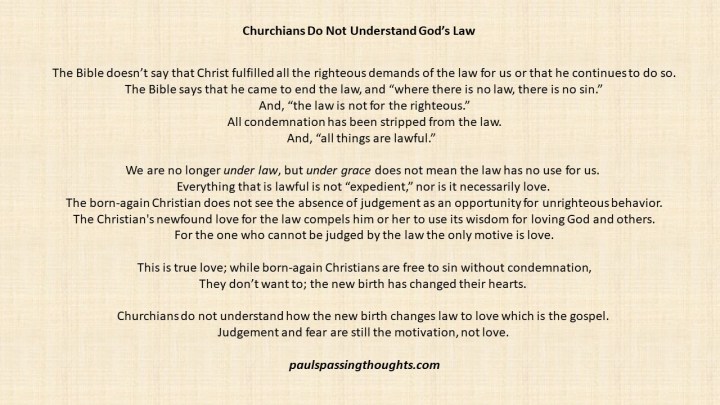
Churchians Do Not Understand the New Birth

So, is “human effort” involved after we give our heart to God?
I think it talks about the first and main factor to achieve having proper relationship with others is to have good relationship with God first. It doesn’t mean we can be rude to others after having proper relationship God, then we will still have proper relationship with others. But it talks about having proper relationships with others is based on our relationship with God.
Why wouldn’t it be based on our new nature?
What do you mean by new nature?
The born again Christian is a new creation, no?
But does being born again mean our sinful nature completely gets rid? If so, why do we still commit sin every day now?
Yes, according to the Bible, “ALL things are new.” A remaining sinful nature wouldn’t be “new.” In the new birth, the old person dies with Christ, so, no, that person is no longer around. And no, since the new person resurrected with Christ is no longer under law, they do not sin because, “where there is no law there is no sin.” Christians fail to love according to the law because they are “weak,” but being weaker than God is not sin. Weakness does not = “sin.” Though not a legal loophole because the nature of the born again Christian is changed from being indifferent to God’s word to loving God’s word, and a willing spirit as apposed to an unwilling spirit, it is incorrect to say that a Christian commits sin that needs ongoing forgiveness to prevent condemnation. Justification is not progressive; our sin is not merely covered, it is ended.



1 comment