Always Ask, “Why?” The Deletion of Counterpoints
 Always ask, “why” if you want to know the reasons people do what they do. First, you have to know that logic drives behavior. Sure, you can argue that lust often drives behavior beyond logical bounds, but that truth is grounded in what people believe about lust in general. In other words, what people believe about feelings will determine how they react to them.
So, a very common trend in social media discussions follow: when someone is clearly losing an argument, they merely delete the thread, or block the one winning the argument. Why does that happen? What is the logic behind that action?
First, you have to understand that most, if not all, social media discussions are fencing with the thoughts of experts instead of swords. For the most part, individual reason is excluded as a valid epistemology. Has it come to the point where people who use personal logic to argue a point are deemed out of touch with reality if not outright mentally ill? Yes, I think it has come to that point.
Again, don’t confuse the use of logic in a debate with individual logic. I am not saying logic isn’t used; I am saying individual logic is not used because it breaks the epistemological caste system. What’s that? Commoners can’t know reality, and must depend on the “authority” of experts. A good example is the video below.
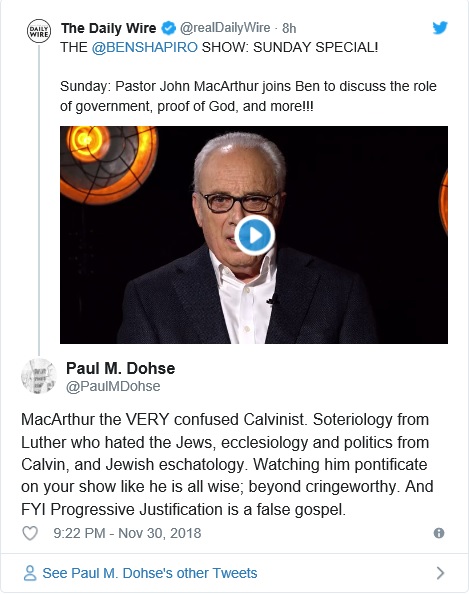
In this video, we hear John MacArthur Jr. clearly state that individual epistemology is insanity. We hear him state clearly that the knowledge of reality must be found in some authority outside of the individual. But this is also clear: all individuals who have ever lived will be judged individually and not by some authority outside of them that they submitted to. Many religions claim they are the one saving authority, so, one must ultimately make a decision based on inner reason or make a lucky guess and hope they win the eternal lottery. Yes, you can say Christ is that one authority, and that is fair enough if not the truth of the matter, but the problem follows: many religions claim that Christ has appointed His authority to them. Therefore, one must evaluate Christ based on their own individual understanding.
Let me close with the main point at hand. Contributions to online debates are going to be deleted if you argue from a standpoint of personal reason. Your ideas are considered to be without merit based on that alone. Furthermore, you will be considered mentally ill and out of touch with reality. Online debates are fencing with thoughts of experts outside of us that have been granted authority by God, god’s, the universe, or some other powers that be because some authority says that they have been given their authority. Because they say so on behalf of the authority.
paul

John Allen Chau and the Absurdity of the Protestant Religion
 John Allen Chau had a fervent well-intentioned zeal for God, but unfortunately, according to Protestant cognitive dissonance. More than likely, Chau is in heaven because motives do count with God. He is a good example of how people who love God often trade too much trust in Protestant academia for God-given logic. Praise God he is in heaven, and has probably met my theological mentor, the apostle Paul who might have said to him, “Dude, what were you thinking?” If Paul did ask him that, I have an answer: unfortunately, he was thinking Protestant thoughts.
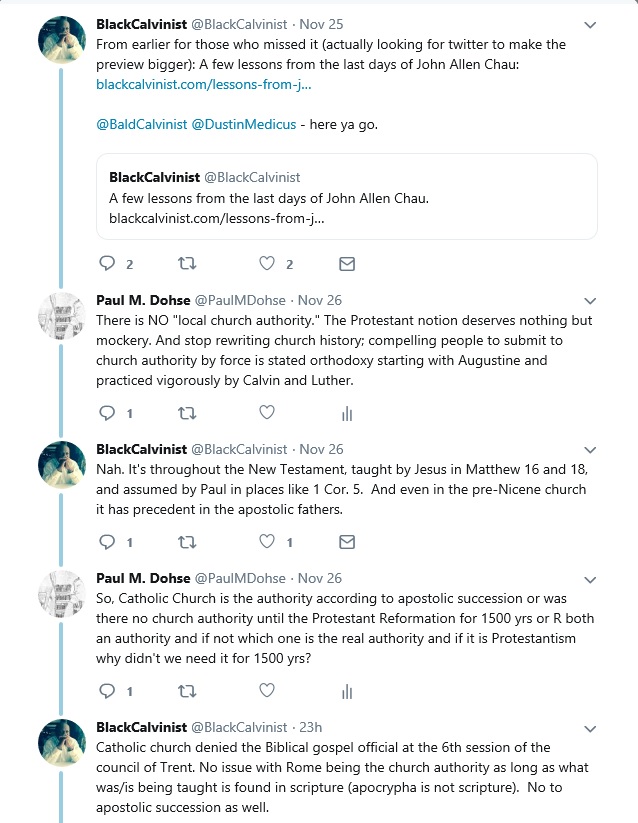
Theory: people who often love God deeply, but sense that something is missing with church, will often put everything at risk to prove to themselves that they are the real deal. Primarily, what haunts every Protestant who has an individual thought left in their bodies follows: the church’s single perspective on the law. Protestantism, clearly, has a single perspective on the law as the standard for justification; this, in and of itself, makes Protestantism a false gospel and assurance impossible.
If perfect law-keeping is the standard for being justified (saved), how can we know what our true motives are in any work we do that is perceived as a “good work.” The Reformers would answer this way: our motives are irrelevant; NO human being lost or saved can do any work that fulfills the righteous demands of the law. NO Protestant scholar has any qualms whatsoever in stating that Christians are under the “righteous demands of the law.” Only problem is, that’s “under law,” no? Um, refer to your Bible in regard to the ramifications thereof.
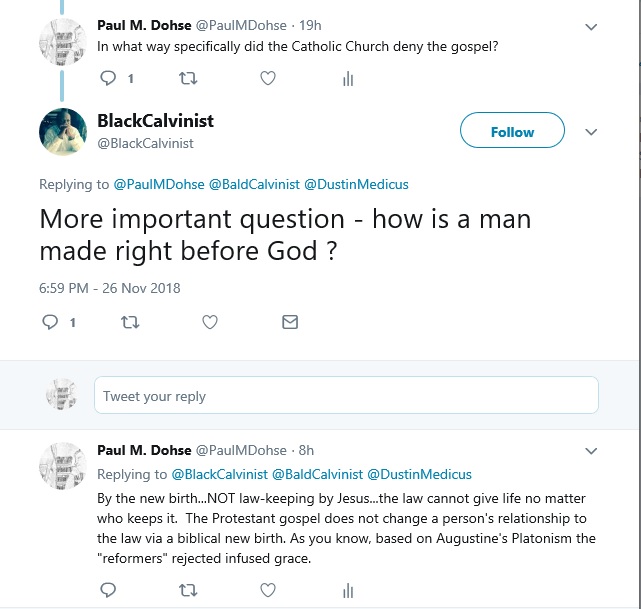
Here is how we, as true born-again believers know that our motives are pure in our acts of love: because we are NOT under the righteous demands of the law, because there is no law, because the us that was under the law died with Christ, and because we are resurrected with Christ, our relationship to the law is different. Since we know that any obedience to the law that we WERE under is gone along with the old us, obedience to the law cannot gain any righteousness or favor with God. It’s impossible since that law is abolished. Side note: when Jesus said He did not come to abolish the law, but fulfill the law, we must ask; how did He fulfilled the law? Answer: with the ultimate act of love. According to Romans 8, how does He presently fulfill the law? Right, through US. Those under grace fulfill the law with love because its demands for righteousness and subsequent condemnation is vanquished; the “written code being nailed to the cross.” Jesus was referring to the total abolishing of the law in any form; He didn’t come to do that, but rather to fulfill its intended purpose.
Since we know this about the law, we know that the only motive left for us in obedience is loving God and others. Earning justification through obedience is impossible because that version of the law is gone along with the old us. This is where assurance is found: there is no law to judge us according to righteousness and subsequent condemnation; we are only judged according to love which is a family matter (Hebrews 12). Yes, God’s seed in us, infused grace, if you will, is what makes us righteous resulting in a willing spirit though the weakness of our mortality will cause us to fall short of love at times.
“Oh, so that means we can just live any way we want to.” That is a typical under law mindset response. Not only does the new birth change our hearts and attitudes about law, which means we would have no desire to use under grace as a cloak for unrighteousness, there are family and practical consequences for doing so (not regarding the law).
This cannot be denied: a single perspective on law cannot free anyone from the fear of condemnation and subsequent doubt concerning one’s standing with God. Those who are zealous for God will often seek some other way to obtain assurance. In letters written prior to his death, Chau, the honest young man that he was, stated that he feared death. The Bible states that perfect love (mature love, or love that fulfills the law which would be perfection for all practical theological purposes) drives out fear while fear has to do with judgment. The question we don’t know the answer to follows: how much of his fear was a practical fear versus fear that comes from an under law mindset resulting in doubt? Again, my theory is that many like Chau will overcome their misguided fears from an under law mindset with misguided efforts to prove who they really are.
In contrast, those who have a proper understanding of the new birth know who we are: we are literal children of God who are free to pursue love aggressively with no fear of condemnation. We are also free to interpret the Bible for ourselves and find the following: we, and we alone, as individuals are culpable before God, and though teachers are a help, they are not mediators in the final analysis of how our lives end.
And per the usual, Protestants are apt in capitalizing on the efforts of goodhearted people to find a way out of a single perspective on the law from an emotional standpoint. The newest Protestant craze trending in the venue of missions is an altruistic approach to oversees missions. A good example of this is To All Tribes missionary society that was previously headed up by nut-job David Sitton. He was sent packing a couple of years ago for undisclosed reasons. While with TAT, he used to perform an initiation of sorts with its missionaries that involved a ceremony in an isolated area while he preached beside an open casket. The ceremony was an agreement that if the missionaries died in an isolated area fraught with various and sundry dangers, that no attempt would be made to recover their bodies.
Curiously, we find this same request by Chau in one of his letters prior to his endeavor to convert the Sentinelese people. Sitton published a highly acclaimed book among evangelicals titled, “Reckless Abandon.” Right, some sort of reckless abandon is needed to prove that your devotion to God is the real deal because the only thing you have to offer to God is an effort under law which according to Protestant orthodoxy is precarious to begin with. You can kinda obey God, but then again you can’t. You sorta obey God, but it’s really Jesus doing it…everything is kinda, you know, sorta, or in theological terms, a “paradox.” As Chau was paddling to the island to create a huge mess for many to cleanup afterwards, how could he know for sure that he was doing it for God’s glory or his own? He couldn’t, to know such is impossible under a single perspective on the law. Paul tells us in Romans 12 to outdo each other in love. Unfortunately, the institutional nature of church often encourages people to outdo each other in folklore; for God’s glory of course.
Being free to love with no fear of condemnation according to God-given reason is much better, and easier.
Moreover, what Chau was trying to do makes no sense according to church orthodoxy to begin with, other than the orthodoxy of “reckless abandon.” The Sentinelese people speak an unknown language. Communicating anything to them would be virtually impossible. Secondly, Protestantism is NOT a one-off, one-time, new birth, once saved always saved gospel. Protestantism is a progressive justification that requires church membership to remain saved through the “ordinary means of grace.” Since perfect law-keeping is justification’s standard, and no one can keep the law perfectly, and we therefore still sin against the law, Jesus’ ongoing double substitution must be re-applied for “present sin” which can only be applied through church membership. If you are a Protestant, I dare you to argue the point for I will merely read Luther and Calvin to you in order to immediately end the argument. So, what did Chau think was going to come of his endeavor even if it was successful? Church planting on North Sentinel? A formation of church authority through elders? What? Dude, what were you thinking?
Unfortunately, the thoughts of other Protestant men you trusted. And all along, you had more love for God than they will ever know. But this I am sure of: the day will come when such men will preach the true gospel of Justification by New Birth, NOT the false, irrational gospel of Justification by Faith.
paul
PS, Dear Father, thank you for the opportunity to write two articles about this awesome young man, and I look forward to meeting Him in our kingdom. Father, please, send many like him to preach the gospel of Justification by New Birth. And thank you for setting us free from the law of sin and death through our brother Jesus to serve under the Spirit’s law of love. We serve love, not fear. And our work is love, not a works righteousness that supposedly fulfills the law by substitution.
Amen.



11 comments