Trumpism: A Kiss Between the Bible and Reality, and Why Trump is Perfect on a “Ship of Fools”
 Unfortunately, when thinking about the word, “sin,” our minds focus on things despised by common goodness, however one may define that. Though most rightly assume the Bible primarily addresses the problem of sin, how the Bible frames sin emerges as the dominant theme. In reality, there is no dichotomy between the spiritual and what we experience in everyday life. A dominant theme in the Bible that saturates the reality we live in is that of freedom versus slavery. Primarily, the dominant theme of the Bible is that of two masters; Sin, and Christ.
Sin probably resulted as Satan’s cheap shortcut to be equal with God in regard to authority and power. This is because freewill is a major pillar of metaphysics. Satan figured out a way to be a powerbroker in the universe; be the opposite of God. The Bible states that sin was “found IN Satan.” However, in a Frankenstein-like narrative, Satan creates something that is totally out of his control—Sin ends up being the master.
Sin was created within Satan by his desire to be equal with God, and according to the Bible, Sin is also driven by one fundamental desire: to control and enslave everything. Sin is the antitheses of everything God is. God has authority by virtue of who He is, but His authority isn’t at all applicable to His relationship with man. God relates to mankind thorough a freewill love that travels both ways. No act of love involves a practical prevention of consequences. Indeed, “God loves a cheerful giver.” The fruits of God and Sin are opposite; love, life, and peace versus hate, death, and fear.
Christ comes as an opposing master according to God’s elected plan. The Spirit brings forth life and death in God’s spiritual baptism. Christ came to establish spiritual baptism according to the Father’s promise through the Spirit. Those reborn of God literally die with Christ, and are literally resurrected with Him. That does not fit well with a need to be controlled by spiritual elitists. Yet, spiritual caste reveals itself in the world on every level of existence. Caste saturates our existence. This is because that is what Sin does—it has an insatiable desire to control. In the very first gospel presentation ever in the Bible, God told Cain that Sin stalks humanity and uses unloving actions to gain control over individuals, “but you must control it,” that is, Sin. People, because of Sin, must control others, and the use of sinful acts to do so leads to guilt, and hence, in the same discourse, God says to Cain, “If you do well, your countenance will be lifted up.” In the New Testament, Peter states that, “If you will love life and see long years, keep yourself from evil.” Fear, or some form of anxiety exists in EVERY case of mental illness without exception. There is a reason for that.
Hence, Christ comes as the saving master who has purchased every slave for himself. His yoke is light, He is the good master. All enslaved to Sin are free to leave the Sin master and come into Christ’s household. By calling on His name, they die by the Spirit in the Sin master’s custody, and are resurrected to new life in the Father’s household. If the slaves are rightly informed, they should know that staying in the Sin master’s household is a choice. They have been purchased by the King of kings and Lord of lords. But love does not compel; it beckons. “I have come that you may have life, and have it more abundantly.” “Come to me, all of you who are weary and carry heavy burdens, and I will give you rest. Take my yoke upon you. Let me teach you, because I am humble and gentle at heart, and you will find rest for your souls. For my yoke is easy to bear, and the burden I give you is light.”
All politics flow from this metaphysical construct. While not joined at the hip with the gospel in every conversation, all of life, as we experience it, is a question of balance between freedom and slavery. Politicians like the Obamas who want to control every aspect of our lives do so because their ideology comes from Sin. At issue is control-lust; presuppositions concerning mankind are merely the excuse. Sin uses caste for its delightful representation of authority and control on every level of life’s existence. The law is also an excuse; that is, how those full of control-lust interpret the law and also legislate it. A proper understanding of man’s ability and the fact that he is created free and wired for specific purposes is the next best thing that brings about peace and justice other than the gospel itself.
And by the way, is the political shaming of America all about using condemnation to control others? Of course it is.
Yes, President Trump is far from being the most likeable individual on the planet, but he understands the ability of mankind and its need to be free. This is the least common denominator that explains why opposition from every corner of the world is upon him with all fury from hell. And even those who understand the issues of collectivism versus individualism feel that they must be honest about Trump’s flaws for the sake of sanctimonious balance and fairness. That’s a big mistake. If a leader understands freedom, and intends to apply it as a primary objective, especially in our day and age, not nurturing that tiny flame while being stranded in the wilderness is utter foolishness.
If America is on a “Ship of Fools,” we better wait to focus on Trump’s shortcomings after the tyrants full of control-lust are thrown overboard. If Trump is one of the few leaders in recent U.S. history willing to do so, and he is, and if a closer position to freedom versus collectivism is paramount, and it is, support for Trump, at least for the present, should be all hands on deck.
paul
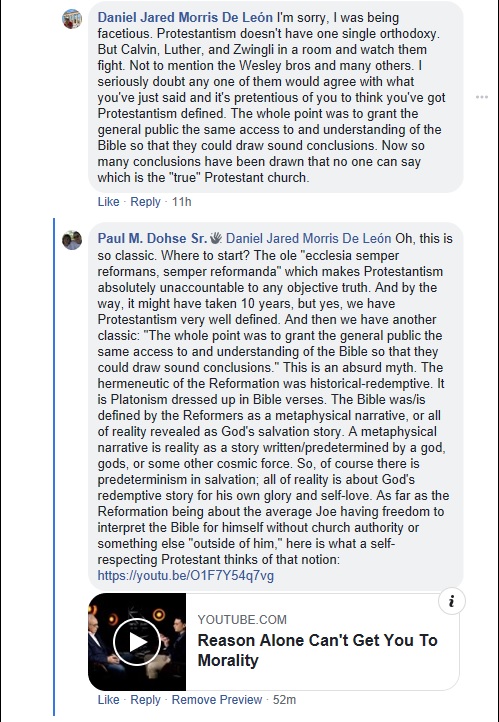
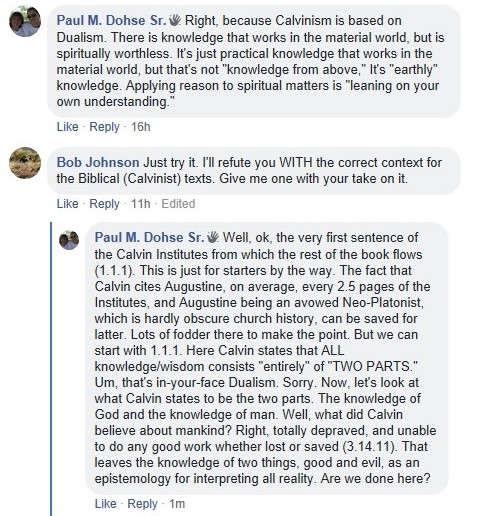
Protestants Have No Idea What a Protestant Is: Part 2
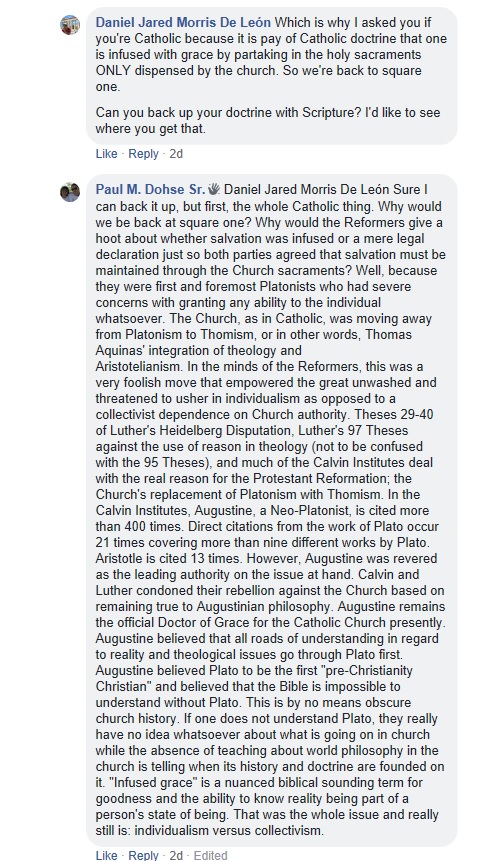
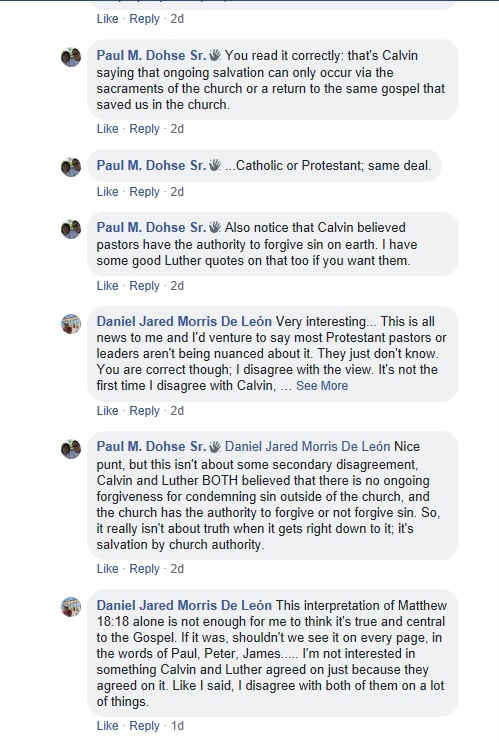
Part One: https://paulspassingthoughts.com/2018/12/05/protestants-have-no-idea-what-a-protestant-is/
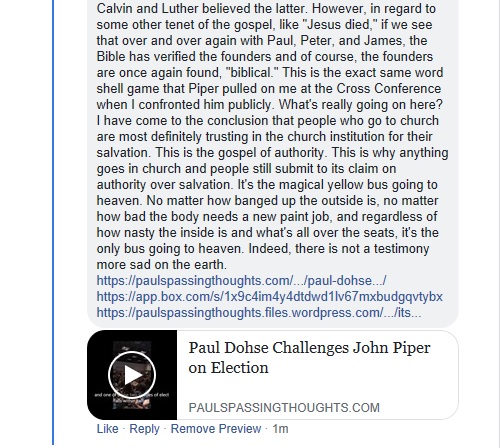
“I have come to the conclusion that people who go to church are most definitely trusting in the church institution for their salvation. This is the gospel of authority. This is why anything goes in church and people still submit to its claim on authority over salvation. It’s the magical yellow bus going to heaven. No matter how banged up the outside is, no matter how bad the body needs a new paint job, and regardless of how nasty the inside is and what’s all over the seats, it’s the only bus going to heaven. Indeed, there is not a testimony more sad on the earth.”


An Important Life Lesson Learned From Urban Meyer About Institutions
 Thinking highly of yourself, when it is earned, can be a lonely place in the world. Earning self-love, which humans are wired to do in order to achieve wellbeing, comes part and parcel with wanting a long list of other things and people to think highly of. Negative people who find something wrong with everything and everybody, contrary to common logic, don’t think too highly of themselves; the opposite is true. Faultfinders want to drag everyone down to a lower place than the faultfinder. When you listen to a faultfinder, what you hear is a reflection of their own soul. The failure they are projecting on you is really what they think of themselves.
For this Ohio State Buckeye football fan, that is, Ohio State University football for those of you who may not know, I have always loved everything OSU football; the school tradition, the folklore, everything. It was a respectable institution. But with all institutions, they must be fed with money and that money comes from the culture.
However, in capitulating to the culture’s penchant for political correctness, there should be some level of loyalty. There should be balance. Unfortunately, OSU has gone full-blown politically correct as illustrated by throwing Urban Meyer under the bus. Wait a minute, that’s not as accurate as it could be; actually, they threw him under the bus and then backed it up and ran him over several more times.
Keep your friends close, and your enemies closer. That was my feelings when OSU hired Meyer after his Florida Gators trounced OSU in a national championship game. The fact that he outcoached Jim Tressel was egregiously and painfully obvious as OSU was a much better team on every level.
Meyer brought his skills to OSU and accomplished an insane result of a 82-9 record and 7-0 against rival Michigan. Then Zack Smith happened. Smith was on the coaching staff and had a troubled marriage. Though Smith was under no indictment by law enforcement for domestic abuse, nor was he ever arrested in regard to criminal complaints filed by his wife (which hardly ever need much of a preponderance of evidence), apparently, as a football coach, Meyer should have…what?…fired him? Meyer alluded to the thought that the last thing a bad marriage needs is loss of income. Aside from that, Smith’s wife was hardly the choir girl in the situation. Furthermore, much of what was reported about Smith in the media was outright fabrication.
At any rate, we now have the big picture. While Meyer was coaching with a brain cyst and struggling physically, they suspended him, and while he was suspended for three games, announced the “coach in waiting.” So, I now see OSU this way: despicable. If justice is served, the program will blow up. What they did to Meyer, regardless of what you think of him, is completely unacceptable. I can no longer respect OSU. I might even become a Michigan fan (actually, for reasons I will not state here, Nebraska). And a recent comment by Meyer is correct: the suspension is what will define the way his career will be remembered. Maybe Paterno deserved that, but not Meyer. By the way, in light of Meyer resigning, two top recruits have already backed out of their verbal commitment to OSU. Good.
Meyer also disappointed me, initially. Here is something you can know about all successful people like Meyer: their self-dignity is not for sale. Personally, I was surprised Meyer accepted the suspension without resigning, and even more surprised that he didn’t resign when they announced the “coach in waiting.” The whole thing was simply a low-blow x 4. But I now understand why he didn’t resign right away. One thing you will hear Meyer say often is, “I Love OSU.” There it is, right there. He loves the students and many of the people attached to the institution. In my opinion, that’s why he finished out the year. And also my opinion, he isn’t too sick to continue as a coach. More opinion: he will be back, and I am not alone in thinking so if you listen to respected sports experts.
Admittedly, this didn’t play out like I thought it would, but I did predict several weeks ago, specifically to my dentist, that he would resign as a result of the suspension. The dentist then asked, “Where do you think he will go?” to which I answered, “Anywhere he wants to.” I believe Meyer will return and be an OSU spoiler. Why do I thing this?
There is only one thing that concerns those who respect themselves about those who don’t respect them: they are a hindrance to self-respect which is the epicenter of wellbeing. That is, they hinder your building process. OSU invited Meyer in, and then took an axe to the sum and substance of his career. Not the sum total of his life, but career is a big enough part of the pie that I doubt Meyer will ultimately stand for it. It’s not about revenge, it’s about getting back what OSU took from him. OSU obviously thinks that no one person is bigger than the institution; they are wrong, every person is more important than every institution—institutions are for the express purpose of serving the individual, it’s not the other way around.
So, what’s the first lesson learned from Urban Meyer? Never sell your soul to an institution. In every case, the institution thinks the value of the individual is determined by the individual’s ability to contribute to the institution—institutions are inherently collectivist. Institutions don’t love anybody, and they are not “family.” Institutions and family are mutually exclusive.
I have matured as a nurse aide. When I used to see a DON coming down the hall smiling at me asking, “How are you?” I actually used to think, “Wow, look how much she likes me.” Frankly, I am embarrassed to admit that. I now, rightfully think, “Ok, what does she want? Obviously, someone has called off.” Institutions are family as long as you are there being a good slave to their politics and morass of agendas. If you falter, you would be better off as a child of Israel when Moses returned from the mountain. Institutions should be seen as useful for building one’s own personal life and loving the individuals who are attached to the institution. When you are attached to an institution that no longer serves that purpose, toss it aside and move on.
Sometime after I began to learn these things, and in a career not what I am presently doing, I was called into an office by a business owner and terminated. Let me add that the unjust termination ended up putting 30,000 dollars in my pocket. The owner informed me that I was terminated, and I replied, “Ok, is that all?” He replied, “Don’t you want to know why?” My answer: “No, I don’t. I am well aware of who I am and what I have done for this company, and knowing your reasons, whatever they are, serves no purpose for me.” Aside from the payout I eventually received, the look on his face was more than worth it. And the party continued. He escorted me out to the company van so I could collect items and tools belonging to me. When we arrived, I picked up one duffle bag off the front seat and said, “Well, this is it, would you like to look through the bag to check the items?” He was surprised, and stated, “You like to keep things in one place.” I replied, “Right, in case you would stab me in the back after everything I have done for your company, and you did.” I am still debating which look on his face was the most priceless, the one in the office or the one at the van.
Never put yourself in a position where you can be thrown under the bus by an institution. Post notice early and often that your self-dignity is not for sale. Of course, I am speaking of a self-dignity that is rightfully earned. That’s what people who have earned self-respect do. This is also why I believe we haven’t heard the last from Urban Meyer.
paul






3 comments