Discussion: Did the Real “Church” Meet in Public Buildings? And Are the New Calvinists “Apostate”?


I have nothing against the home church movement per se.
Well, that’s gracious of you, but we do. A church in a house is still church. We are a home fellowship movement driven by Justification by New Birth, not Justification by Faith. Pretty radical, but we welcome challenges to our position.
I read the article, and chapter 11, and I didn’t find much that I thought I disagreed with, other than it seems the Corinthians were already meeting in an established “church” and it wasn’t the homes of Christians, and you seemed to infer that it wasn’t until after the passing of the Apostles that the “church” was organized outside of the home and that this was the “falling away” in part, mentioned by the Apostle. Also, Paul preached in building with at least two stories because a young man fell asleep and fell down, and was revived by Paul. Seems to me that the “church” was meeting in other places than the home and that there was an authority structure in place as well as described to Timothy.
All, or at least most residential homes of that era were multiple story dwellings.
Were the Corinthians not meeting in a “church”, that is, a building outside of their homes that the Apostle Paul refers to as a church? It seems to me that the Apostle Paul is indicating that the Corinthians had a place of meeting where they came together for worship, other than their homes.
Right, it’s a good point. But “church” is not a biblical word and does emphasize a place where authority resides. Ekklesia is a gathering that might take place anywhere for a specific purpose. “Church” denotes institutionalism and was used in the Bible to replace ekklesia when the assembly of Christ was institutionalized. Without lodging a scriptural argument that explains why these passages shouldn’t be understood in the traditional way, let me jump directly to the historical argument. It was against the law for any religion to have purpose build locations that were not state sanctioned religions.
A slightly different rendering, but still, the Apostle asks the question, “Do you not have houses to eat in?” Intimating that where they were meeting was not the homes, but in a single, separate location, as the church…the ecclesia. NASB
The letters to the Corinthian “church” were incited by other “household[s] of faith” tattling on what was going on in some of the other home fellowships. Paul’s second letter to them included the “church’s” expansion into Archaia. This would suggest an expansion of multiple purpose build locations which is historically impossible.
Some were gathering outside the home…that “do you not have houses to eat in” infers that they were not in their “homes” or the home of anyone else. They were wealthy, in Corinth. They had the means, where many Christians did not. I’ll have to do some more research of my own, either way, it’s not a hill for me to die on. I see no prohibition in Scripture that says we cannot gather in a single building, other than homes, or that home gatherings are necessarily superior.
Actually, that verse kinda makes the contrary point. Paul isn’t saying, “Hey, don’t you guys live in homes where you can eat?” He is saying, “Don’t you have your OWN homes to eat in?” The word “have” denotes possession which is why several translations have it, your “own home” rather than A HOME as opposed to some institutional structure. When you observe how this word is used in other verses such as one regarding a woman with child, the baby is her own possession, not just some [other] baby somewhere…So, this particular verse actually makes the contrary argument. However, to your point, in many English translations it comes out as a house as opposed to something else other than another house.
Can’t find the comment you made regarding the issue not being a hill to die on…that’s true, so if both have merit, why not go with the one that has no massive infrastructural overhead and will work in every political and socioeconomic condition?
That and the synagogue was very much part of the Jewish tradition, so it would be a natural for Christians to imitate the structure for the church. I don’t see it as necessarily wrong.
There were institutionalized synagogues that were run by the Jewish religionists and sanctioned by the local government. Indeed, “The Way” ended up doing some business in these places (evangelism), but there are no archeological findings regarding purpose builds for the movement. However, several residential homes with baptismals built inside of them have been discovered dating back to the 2nd century [furthermore, the book of Acts states that Christ’s first century assembly had dramatic global impact which means that archeological evidence should be ample if they used public buildings. Also, traditionally, synagogues were, in fact, for the most part in private homes].
There can, and have been abuses in gatherings of any type, whether in the home or in a “church” building.
True, but our primary dichotomy is family, leadership, gifts, fellowship; not institution, authority, progressive salvation, and membership.
I think you’re reacting to the same “mega church” apostasy that I am. What I see you describing is the apostate “seeker sensitive” “purpose driven” heresy that pervades so many churches, together with the New Calvinists that are bringing in the rock and roll “Christian” music. I think if you watch that video I posted, you could find some things about it that you identify with.
We would also say that home fellowships speak to the confession of our gospel, that is, a new birth into God’s literal family as opposed to an institution where justification is a mere “legal declaration” obtained by submission to an authoritative religious institution. Not passing any judgments here, just stating our position.
No problem. But no church I’ve ever been associated with has ever asserted such things, either from the pulpit or in their church covenants.
Hmmmmm, sorry for my skepticism on that. Nevertheless, let me also say this: there are many people in church who have a proper intellectual idea of Justification by New Birth and also function that way. However, unbeknownst to them, that’s NOT Protestant orthodoxy which denied the new birth in no uncertain terms. Church has totally rewritten its history and uses language that plays on the proper assumptions of parishioners while [slowly] indoctrinating them with Progressive Justification.
I have the Spirit of God, and I know Christ as my Savior, I can tell you I in no way have ever been taught these things “unawares” and if I had, I certainly would have objected. You have a “one size fits all” view of the institutionalized church, and I think it may apply in some areas, especially Catholicism and some Lutheran circles, but not in every case, in every gathering that meets in a “church”. Not by a long shot. The Lord knows those that are His…and they don’t all worship at home…My problem is that you seem to throw the baby out with the bath water. I understand your rejection of organized religion today. It is repugnant in a lot of facets, but there are a great many local gatherings of believers where the Spirit of God is present that you simply are not, and cannot, be aware of that truly do worship God in Spirit and in Truth, and i hope you can at least acknowledge that I am speaking the truth.
That’s what I just said, but here is the problem: Justification by Faith, is, what it is. As far as a “one size fits all,” name one church that would deny Justification by Faith. The problem comes in when somebody like myself is a Berean about bibliology, but then extends that to actually reading the Protestant soteriological documents. Ooops. Houston, we have a huge problem.
I think you are getting into semantical hair-splitting which many hyper Calvinists do. I will post for you what I post for them many times. You are fully persuaded that you are correct, and nothing I can say will ever move you, so I don’t wish to continue. You’ve made your position clear, as have I. Here is what I answer to hyper Calvinists, about their arrogance.
When John Piper states that “Christians still need to be saved,” When Matt Chandler states that “Christians are wicked sinners who still need the cross of Christ,” they are in fact stating Protestant orthodoxy. In regard to Protestant soteriology, they are SPOT ON. How is everyday progressive justification “semantical hair-splitting” [?]. Salvation is either a finished work in the believer or it isn’t. The New Calvinists are right and have done the church a great service in making the church wakeup to what it really believes.
He’s an apostate, as is Chandler, and sadly John McArthur has fallen in with these as well. You’re preaching to the choir, please understand. “The Spirit speaks expressly that in the last days some shall DEPART from the faith…” They’ve departed from the faith they once held, if Chandler ever really held to it at all.
Let’s not get the cart before the horse. Show me an institutional church that rejects Calvin and Luther’s gospel and you are showing me a church that I just might fellowship with. And unfortunately, the New Calvinists are the best thing that has happened to the church because what the Reformers really believed is being brought into the light [in regard to what Justification by Faith really means].
Wrong. John Piper is a New Calvinist, you do realize that, right? As is Mark Driscoll and Al Mohler, et al. Apostates all…These men are seducing the church with “another gospel”.
They are right about what Protestantism is which was confused with people reading the Bible for themselves after the Puritan Theocracy was sent packing. The New Calvinists claim that they are recovering the true Protestant gospel and indeed they are.
And it’s a lie…the New Calvinists are ushering in liberalism into the church and seducing many young people into error. Read the book I posted. Its short and to the point.
The New Calvinists are recovering authentic Protestant orthodoxy, and though they are right, I don’t like them and that’s putting it mildly while I like you, but you are wrong about them.
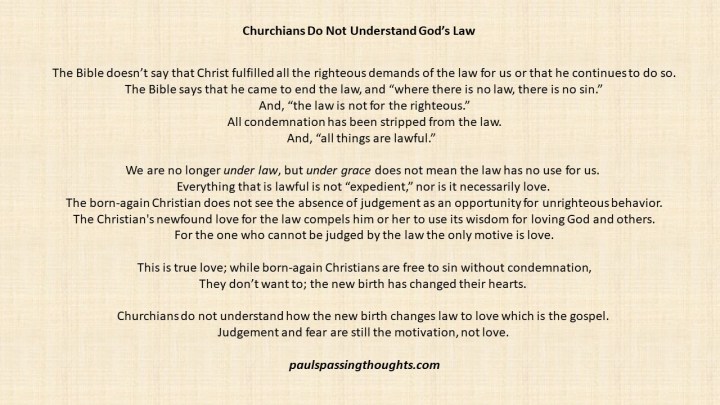
Churchians Do Not Understand the New Birth

So, is “human effort” involved after we give our heart to God?
I think it talks about the first and main factor to achieve having proper relationship with others is to have good relationship with God first. It doesn’t mean we can be rude to others after having proper relationship God, then we will still have proper relationship with others. But it talks about having proper relationships with others is based on our relationship with God.
Why wouldn’t it be based on our new nature?
What do you mean by new nature?
The born again Christian is a new creation, no?
But does being born again mean our sinful nature completely gets rid? If so, why do we still commit sin every day now?
Yes, according to the Bible, “ALL things are new.” A remaining sinful nature wouldn’t be “new.” In the new birth, the old person dies with Christ, so, no, that person is no longer around. And no, since the new person resurrected with Christ is no longer under law, they do not sin because, “where there is no law there is no sin.” Christians fail to love according to the law because they are “weak,” but being weaker than God is not sin. Weakness does not = “sin.” Though not a legal loophole because the nature of the born again Christian is changed from being indifferent to God’s word to loving God’s word, and a willing spirit as apposed to an unwilling spirit, it is incorrect to say that a Christian commits sin that needs ongoing forgiveness to prevent condemnation. Justification is not progressive; our sin is not merely covered, it is ended.
Romans 8:28: God’s Response to Evil
 “And we know that for those who love God all things work together for good, for those who are called according to his purpose.”
Love must necessarily come from freewill. It’s doubtful that God is loved by people because He created them to do so or preordained it. Though God does intervene in the affairs of mankind to guarantee love will win in the end, for the most part God isn’t much interested in making people do what He would like to see them do. God isn’t like a lot of marriages that are under law; the wife is content to get her own way via nagging, and the husband does what pleases her to merely avoid the consequences of breaking her laws. That’s not love.
God is unlimited. A god that controls everything is limited because said god could be overcome by something that comes out of an uncontrolled freewill reality. An all-powerful unlimited God does not fear anything that might come from an unlimited freewill reality. God knowing the future is not that big of a deal if He is the author of a prewritten metaphysical narrative, but if He knows what’s going to happen in a freewill unlimited reality, that’s pretty impressive.
God has a certain way of dealing with evil. No, God isn’t the creator of a limited evil that He needs to control because He is limited and might create a rock too big for Him to move. God allows evil, but turns every act of evil against His children into good. And evil knows it. Evil knows that every act it commits will be turned into good by God, and this in and of itself causes evil to limit itself in some circumstances.
The angels rebelled, and God created man, a living being. The living beings were deceived, and God made them His very family. Formally, they were just living beings. God’s chosen people, Israel, rebelled, and God turned that rebellion into the saving of the whole world (Romans 11). That is God’s mode of operation in dealing with evil. More examples can seen throughout Scripture, and if you think about it, in our own lives.
Recently, we had a neighbor go to the city and complain about two large storage facilities that I built on our property. Eventually, after a few hearings, the city made me tear them down and allowed me to rebuild one in a different area of our property. The neighbor, a devout Catholic, by the way, waited till the buildings were completely finished before complaining to the city. She had also done her homework and knew that the buildings were in violation of a zoning law by 24 inches.
Even though it was a tough situation and very hard, I knew that God was going to bring something better out of it. I am presently finishing the reconstruction and the layout and construction of the new building is a much better situation for us in regard to the use of our property. I knew it would end up that way.
Though a trivial example, this mode of operation applies to every evil event in our lives; it’s a promise. What good God is going to bring out of the evil may not come immediately, but inevitably, it will.
paul
Curing the Matt Walsh Creationism Blues: Take One Red Herring, Authority Pill, and Call Me in The Morning
Blogger Matt Walsh is bummed. He posted the following on Facebook recently: “Let me tell you what’s on my mind right now. I probably shouldn’t, but I’ve never been one to keep my thoughts to myself. I am feeling extremely frustrated and disheartened. Maybe you picked up on that if you watched my video today. Over the last month, as I have waded into the debate about young Earth creationism and expressed my view that the Earth is older than 6,000 years, I have seen a side of Christianity that I’d never experienced before.” Walsh continues: “Many Christians have responded viciously. Even worse than the viciousness is the close-mindedness. I don’t mean close-minded because they disagree with me. There is nothing close-minded about disagreement. I mean close-minded because they are absolutely unwilling to listen to what I have to say.”
I investigated the video and the responses. Indeed, Walsh presents formidable arguments in the video, and indeed, thank God for American separation of church and state jurisprudence or Walsh would be suffering more than bad feelings. And thank God for a well functioning capitalistic economy because in countries like Kenya, burning people alive in a ditch with brush may be illegal, but the economy is in the tank and law enforcement doesn’t have the resources to do anything about it. Here, I could go off on a rabbit trail concerning the stupidity of socialism, but I will show restraint.
Moreover, he dared speaketh against the high priest of young creationism, Ken Ham, who I have had serious problems with for a long time. Ham is not a good person, nor is he the sharpest knife in the drawer, but hey, I can say that because this is not how I make my living. And beside that, people who read my stuff are independent thinkers who are not afraid of ideas and trust me, that’s not a big number.
Walsh, apparently, doesn’t know what hit him, but I do: two things; authority as truth, and the Protestant red herring. First, authority as truth. Walsh, like most Churchians, is confused about church. He actually thinks the churches (Catholic and Protestant) support independent thinking. This is cognitive dissonance of the highest order. Church orthodoxy is based on a hierarchy of spiritual authority and always has been. Regardless of the church’s overt behavior which constantly contradicts the plain sense of Scripture, the church continues to thrive while raking in millions from the working poor. Bottom line: it sells salvation, and part of the price is agreeing with orthodoxy; heterodoxy doesn’t get you into heaven. “Secondary issues” are the sandbox that church despots allow the parishioners to play in while momma church watches from the kitchen window.
But Walsh stepped into something that he thought was a secondary issue because he didn’t get the memo. Ham, a darling of Catholics and Protestants alike, and also the undisputed Cardinal of biblical creation science, so called, has been stating for some time that a rebuttal of a six day creation is akin to denying the gospel. Other high priests of Protestant evangelicalism like John MacArthur Jr. have been aping the same thing. The reaction is the result of a perception that Walsh is denying the gospel. Never mind Walsh’s argument, which I believe has merit, he has spoken against authority as truth. Ok, so I usually don’t play the Nazi card to make a point, but we must ask ourselves why an educated society followed the likes of Adolf Hitler. Same reason. The idea that true social justice is defined by unity for unity’s sake is nothing new and by the way, unity sanctifies the “truth.”
Ken Ham’s creation museum itself is the prime example of church cognitive dissonance. If one reads the Bible carefully, the ark was little more than a huge floating box. “Ark,” is actually a Hebrew word that means, “box.” But boxes don’t sell. You can’t raise millions to build a big box at the head of a holler in Kentucky; it has to be an elaborate boat. That’s Protestantism’s authority as truth: you look right at a big boat and call it a box; brilliant. However, the boat is a box because Ken Ham says so. Get with the program Matt. A literal observation of the Bible’s description of the ark is nothing like what Ham built, but that’s ok. However, thou darest take liberties with a literal interpretation of six days? Remember Rob Bell? He dared question the traditional understanding of hell, and the papal bull came down from John Piper in a tweet: “Bye, bye, Rob Bell.” And so it was written, and so it was done; Bell was finished.
I always ask, “why?” Why such a strong pushback to Walsh’s thesis? I stated one reason, but there is another. If you don’t believe in the literal six solar days of creation (though it is referred to in that way by Ham and others, Walsh explains why they couldn’t be “solar”), you are advocating for Evolution. Well, considering the Protestant doctrine of total depravity, it would be a shame to think we came from apes. So, what do we have so far?
A box is a boat, there are days that are solar before there was a solar system, and we object to the idea that we came from monkeys or apes, who are not totally depraved, which apparently denies our total depravity. Go to church if you will, but I wouldn’t brag about it.
At least church has enough shame left to create lots of red herrings in regard to its paramount item of cognitive dissonance: the Protestant gospel of justification by faith. That’s what the penchant for debate among Churchians is really about. If they stop arguing about “secondary issues” for any length of time, someone might start asking questions about the elementary glaring errors concerning its gospel. Catholics are far less guilty of red herrings than Protestants because they are honest about papal authority while the latter invests in steroidal propaganda concerning freedom of conscience. Walsh thought he was stepping into a Protestant “secondary issue.” NOT.
Catholics have a problem with the Protestant gospel. They deem it, “legal fiction.” The first thing that church leaders fear as a result of the great unwashed not being distracted by red herrings is a discussion about what really sparked the Protestant Reformation. During that time, the Bible was not the primary authority for truth, philosophy was. Saint Augustine was very clear on this; without Plato, there is no real understanding of the Bible. That’s what he said. That’s church history. The church, like all pagan religions before it, believed in a separation of the evil material world and the invisible spiritual world. One is mutable, and the other immutable, and mutually exclusive in all ways. This has always called for additional mediators to guide the great unwashed in the reality of evil apart from any knowledge of good. In essence, man cannot know anything about reality.
In the 13th century, the Catholic Church began to move more towards the idea that man can know reality, and began questioning the strict dichotomy between the material evil and the spiritual good. The Platonist wing of the Catholic Church was not happy about it. If man has any good in him at all, that means he needs less authority from those outside of him who guide the great unwashed through the darkness of the material world with orthodoxy. Yes, those who know that we cannot know must guide those who are affixed to their earthiness; those who are guided by shadows.
Hence, more cognitive dissonance, but this time in regard to the gospel itself. While the Bible declares that believers ARE righteous with a righteousness APART from the law, Protestantism claims that the righteousness that saves is a “legal declaration.” How is something apart from the law a legal declaration? Gee, I don’t know, how is a box a boat? How is a solar day non-solar? Why is it better to be totally depraved than of monkey origin?
Don’t get me wrong, I believe that objective truth can be drawn from the Bible through reason and logic. I also believe that this will only be accomplished through the collective effort of God’s people, primarily the laity. I believe that Christians in our day know very little about the Bible because fixed orthodoxy has greatly limited our knowledge. The few have dictated “truth” to the many for thousands of years; so, here we are.
If man is completely unable, and completely disconnected from spiritual reality, it only makes sense that anyone who is saved is somehow preselected. Obviously, if anyone is going to be saved, the active spiritual realm must act upon the passive material realm. The election debate is also grounded in world philosophy, but how is it tossed about among Churchians? Right, as a “secondary” biblical issue. None of these debates have anything to do with the Bible, but rather philosophical presuppositions concerning mankind.
The whole notion that these debates are biblical is a red herring in and of itself; ALL of these arguments are predicated on metaphysical presuppositions. While accusing Walsh of pandering to the wisdom of man, that’s what church has always been founded on. There is no biblically based statement of philosophy because the church fathers hijacked that possibility as early as the 2nd century. It is a vast work that remains unfinished, and it could be argued that the work has not even been started.
If people like Walsh, who is a formidable thinker, ignores the pushback and joins a collective effort to crawl out of the church cave into the real light, he will need the right diagnosis and the right prescription: a cure for authority as truth and red herrings.
paul

 Paul's Passing Thoughts
4 comments