A Day of Egyptians, Totally Depraved Purity, Beautiful Losers, and Another Church Lie, But Not Under Law
 Well, yesterday is another day in the bag. Regarding what kind of day it was, I will get to that after I describe my present life right now. It’s a mess and I am fine with that. I find life too fun and try to cram too much fun stuff into my schedule. My definition of fun is accomplishing things. Moreover, I live life like a football game: when you don’t score, that’s failure, but it doesn’t count on the scoreboard; I only keep track of the touchdowns because that’s all that shows up on the scoreboard, nothing else counts. And if I don’t keep track of incidents where I know I failed to score, you can bet I fail more to keep track of failures to score as judged by others; that’s irrelevance x 2. And we might pause here to mention yet another example of under-law thinking: it focuses on the fact that you failed to score, not an analysis of why you failed to score so that you can score more in the future. In under-law thinking, which is a religious and secular thing alike, you are destined to fail, destined to fall, and the only solution is some sort of penance. This is worldly sorrow that walks hand in hand with under-law ideology as opposed to the repentance of under-love thinking. Repentance makes adjustments and changes for the better, while worldly sorrow seeks penance in a plethora of self-punishing endeavors.
One should think about how the Bible frames the two realities, but before we look at that, I want to add something to the very, very, long list of dissapologies that define my life. I am a person of the book, and that book is the Bible. And the fact is, the two realities of under-law and under-love (under grace which is the activity of love, or love in action) have two different score boards; one only counts touchdowns, while the other only counts failures to score. The Bible states that there is a great judgement at the end of time, and those under-law will be judged there according to the law. Those under grace will not stand at that judgement. That’s why those of us under grace focus on love and not fear; we are not under condemnation. Human weakness is a hinderance to love, and not something we embrace as an excuse for what is supposedly inevitable: a fall, a failure.
And here is more dissapology: I am a thinker, and thinking is critical for human survival. This present reality is a fight to the death between individual freedom and slavery. All of reality boils down to that. This is why Christ said He came to set us free, and that we may have life, and have it more abundantly. I am far, far from knowing everything, but this one thing I know well: the enemy, which is slavery. This is an enemy that seeks to change our thinking in every venue of life: music, entertainment, school, social caste, professionalism, and friendly conversations around the office watercooler. This is why I often do something that is another thing I must refuse to apologize for: I do throw the baby out with the bathwater often and whenever possible. So, does that cause me to fail in scoring on your scoreboard? Well, get over it.
Yesterday started out with looking at big picture slavery; the Egyptian exhibit in Cincinnati. Some of the artifacts were not encased in glass and it was requested that they not be touched. Many were personal items like hair combs etc. I honored the request not to touch, and thereby denied myself of the experience of touching something that was handled daily by someone who lived 5000 years ago. But back to slavery. Like most cultures prior to the American Revolution, it was dominated by systems antithetical to personal freedom. Regarding the crux of human reality, the balance of freedom and slavery resides in the human soul and manifests itself in everything that is visible. Human government is a manifestation of the freedom/slavery reality. Others argue that this can also be framed according to life and death which is more on the theological side of things, and I would agree with that. Freedom and life/slavery and death.
Reality is interpreted through words. God created things, and named them with words. If words don’t mean things, there is no reality and anything goes. And knowledge frees the mind first, then the existence of humanity. Hence, the Egyptians made literature very complex. In fact, if not for the Rosetta stone (on display at the exhibit), till this day, we wouldn’t have a clue how to interpret hieroglyphs. There were even experts who were overseers of literature, the scribes. They were very important and highly regarded in Egyptian culture. However, this meant that the ability to communicate through literature was kept from the commoners. Ignorance and lack of knowledge is a primary tool of slavery. This is why the Egyptians believed some totally crazy stuff. It is unclear to what degree the upper echelon of Egyptian caste believed these superstitions, but suffice to say, if the commoners believe the Pharaoh is part human and part god, revolution is pretty much a dead issue. If the dark kingdom of slavery cannot keep the words from the great unwashed, they then seek to reinterpret the meanings of the words. This is why the founding fathers of Americanism made a really big deal over education: it is the sum total of freedom. They started the tradition of graduation ceremonies accordingly. Every time you go to a graduation ceremony, think about freedom. Every time you teach someone something new to them, you make them more free.
In the 400 years that the Jews were enslaved in Egypt, their literary abilities would have been all but completely diminished. This is why God did an end-around play with Moses who had been deeply educated in Egyptian literature, and why he was the author of the first five books of the Bible. It could also explain the long 40-year process in the wilderness as God knew that the Israelites were stripped of all grasp of reality except the reality of slavery.
After we returned from the long day at the exhibit, I agreed to watch a church movie with Susan. She denies that “Pure Flix” movies are “church movies” per se, but I am skeptical. I also perceive that these movies are made after the Hallmark genre of which I am not a big fan. In fact, I would rather have a colonoscopy than watch a Hallmark movie. So, we have a combination drug of church and Hallmark, but one will do all things for love, no?
Susan and I engaged in a short discussion of why these movies are called, “Pure Flix.” Apparently, it’s because the movies contain no R-rated material, are just good, clean entertainment, and have little to do with any church orthodoxy…per se. I was even more skeptical.
At times, I think it might be possible to know too much for your own good. The movie, “Moms’ Night Out,” was merely a comic version of the following church ideology:
Also in the vein of the mommy-saver Witney Capps, who states, “Whitney Capps is a national speaker and writer for Proverbs 31 Ministries, in-the-trenches Mom to four little boys and wife to her CEO. Fabulously flawed and happily transparent, Whitney offers hope to the too-tired Mom.”
The movie clearly promoted the latest trending narrative to help people better understand church, and possibly save it. For years, while presenting itself as society’s moral compass and a place where people could find real change, this proved to be nothing short of a ruse to draw people in while slowly assimilating them into the aforementioned ideology. Church is a gargantuan institution that will stop short of little in any effort to save it, and is in the midst of a mass exodus of the dissolutioned. And in typical cognitive dissonance, touts “pure movies” that are family oriented and for consumption by the totally depraved “sinners saved by grace.” Go figure. The movie screams the narrative well articulated by Tullian Tchividjian in the above video from beginning to end complete with dorky husbands. And by the way, no venue demeans husbands like church. Why? Because husbands are gifted with leading the family spiritually through teaching and example. Husbands must be disqualified as individuals who should be listened to above the church. I understand that church wives are taught to obey their husbands, but that is only as far as the husband obeys the church and allows the church to think for him.
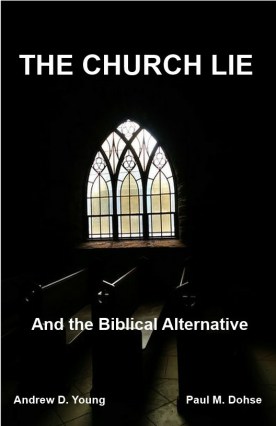
“Gee whiz Paul, can’t you just watch a movie and enjoy it without finding a theological or philosophical fault someplace?” No. And why is that? Because I know the enemy, and the enemy of individual freedom is relentless and never rests. That includes politics also. If you pride yourself as one who is above the fray of politics, you are indicative of every sole presently occupying various and sundry mass graves peppered throughout the earth. Besides, thinking is fun. “Well, Paul, you don’t want to throw out the baby with the bathwater.” Yes I do, that’s exactly what I want to do, and it’s also fun, and how I roll. If you want an in-depth analysis of how the church presents itself as society’s moral compass while being a bastion of evil and how its very orthodoxy demands such, I would recommend Chapters 7 and 10 of “The Church Lie.”
The true family of God does not keep score of how much we lose at love while calling ourselves “fabulously flawed.” However, the church is right about one thing: the world is drawn to that ideology because it, too, is under the condemnation of the law. The world has no objection whatever to “Beautiful Losers.”
paul
The Church Lie: The 11 Theses Review #26
Today 3/25/19 @ 2:00pm to 3:00pm
Weekdays Monday – Friday when posted.
As I see what is trending in Churchland of late, I find myself interrupting my busy schedule to write an article or post a video because it oftentimes is just too rich to pass up. However, in every case, in the back of my mind, I am saying, “That’s chapter…in the book.” The book is meant to be very comprehensive, and what we missed will be included in the next addition. Meanwhile, I will be conducting a reading with commentary on our new book and how what’s trending in the church connects to the points made in the book. Hope you can join me.
LIVE LINK Scheduled to broadcast 3/25/19 @ 2:00pm – 3:00pm
Archives: The Church Lie 11 Theses Channel
Read The Church Lie online for free.


Topics
ACCC Typical of Protestants Who Don’t Know What Protestantism Is, But New Calvinists Do Know What a Protestant Is; Part 3
 Every now and then, I surf through the 4,000 or so articles that have been written here on Protestantism and philosophy not including book publications, videos, and conferences. When something happens to me, and it will, there is enough material to keep TANC ministries going until the second coming. That’s important for a couple of reasons. First, we are not the first ones to realize that Protestantism is built on a flimsy foundation of elementary error. We are not the first to realize that it is a biblically overt false gospel.
However, we are one of the few to discover this in the information age which is critical. All we have to do is not go away and keep growing. Sure, when you are calling out a religious culture that has enjoyed deeply engrained presuppositions for over 500 years, don’t expect a revival overnight. But stay the course; trust me, it is going to be worth it.
Furthermore, I believe there are other ministries like ours, and we haven’t discovered each other yet. The internet has not made the world as small as we think. Susan and I bump shoulders with church people who haven’t even heard of the New Calvinist movement. People will contact us about a “strange doctrine” being introduced in their church by the new pastor and when we tell them it’s New Calvinism, they often ask, “What’s that?” Eventually, if we stay the course, we will discover other ministries that are of the same mind and we will join in with them.
And along the way we will have lots of fun. An example is my discourse with John Piper in front of hundreds of youth at a conference when he contradicted himself like three times in five minutes. That was fun. Another example is the conference where Susan and I interviewed Calvinists and asked them seven questions about Calvinism, and in every case they answered wrongly. That was also fun. Most Calvinists don’t know what Calvinism is, and to see that on full display is indeed a good time.
Our online conferences will also grow, and this year is our ten-year anniversary and we plan to make a big deal of it. We hope you can join us.
As someone who works, maintains three properties, goes to school, and does ministry, I sometimes let things slip through the cracks. The third part of this series is an example. Parts one and two can be read here and here. In regard to the subject of what the third part was going to be, Chapter 6 of the Church Lie serves that purpose very well, and is posted below.
So, What’s Up With All of This “I Didn’t Do It, God Did It” Stuff?
One experiences many confusing things at church, but perhaps the most well traveled road of confusion is people dong stuff that they really didn’t do, God did it. Like the head coach of Clemson football, yesterday, the coach of Liberty’s basketball team gave “all the glory to God” because they didn’t really win the game, God did, because of their “Christ-centered program.”
Truly, there is no religion on earth less self-aware than Protestantism. They are so utterly clueless in regard to their own confessions that any religion, cult, or militant group should be commended for simply understanding what they really believe. Moreover, no one is better than Protestant scholars at dressing themselves up as the epitome of academic acumen. To watch the likes of John MacArthur Jr. and others at conference Q and A sessions present themselves the way they do is absolutely stunning when you realize how clueless they are.
Few Protestants, if any, understand why they do or say anything. So, why do they say God did something they clearly did? I will explain. It starts with something the Liberty coach said while not really knowing what it means like all things Protestants say. “Christ-centered,” is a term that encompasses a vast body of Martin Luther’s metaphysics. While Protestants hail Luther as their spiritual hero and father of their faith, and this includes Evangelicals and Lutherans alike, they are very slow to recognize that Luther was first and foremost a philosopher in Platonist disciplines. Christocentric metaphysics encompass Luther’s Theology of the Cross which was based primarily on Dualism.
We will begin by stating why Protestants say they didn’t do something that they did while not knowing why it is important for them to say it. Reason: if they claim they did something good, they, according to Luther’s Theology of the Cross, have denied the gospel and will consequently go to hell. Now, of course, in regard to that being the reason, the Protestant will protest, while stating that the purpose of the statement is to only give God all the glory. Sounds good, but that is NOT Protestant orthodoxy. If you ever want to know what Protestant orthodoxy is, never ask a Protestant because they don’t know (and the ones who do know are not going to be honest about it). However, we must remember that the talking points they don’t understand lead to a functionality that doesn’t match the intellectual confession, and that is fine with the Protestant industrial complex if not the outright goal.
So, how does this all work? In Luther’s metaphysics, reality is divided into two parts, or realms: 100% evil, and 100% good. Luther didn’t necessarily assign 100% evil to all of the material realm, but he certainly assigned it to humanity. In this metaphysical construct, humanity is both passive and active while the good is only active. What does this mean? In regard to humanity, it is actively evil and passive. When the human is active, only evil occurs, only evil can flow out of man whether lost or saved, but the human being also has a passive element. This passive element is like water. What do we know about water? It is passive; in other words, until it is acted upon by gravity, temperature, or wind (an active force outside of it), it just sits there and does nothing.
Hence, when a person does something good, it is only because their passive element was acted upon by God. Therefore, God did it, not you. When water freezes, the water didn’t do it, the temperature did. When water does the wave dance, the water isn’t doing it, the wind is. HOWEVER, keep in mind, all of this activity, whether passive or active, is experienced as if all of it is active. In other words, it is experiences as if the totally depraved humanoid did it actively.
Now let’s get a little bit deeper into Luther’s metaphysics and how this is experienced in reality. Don’t forget the key element to understanding all of this: EXPERIENCE. We will now mention contemporary lingo that refers to Luther’s Theology of the Cross: “Objective justification/righteousness experienced subjectively.” Good and evil are both objective, but humanity only experiences both subjectively. In other words, in the experience of the totally depraved individual, saved or lost, they cannot distinguish from the active or passive; they cannot distinguish between whether or not their actins are coming from within their own evil self, or whether their passive being is being acted upon by the good. In contemporary lingo, we also hear “The objective gospel outside of us.” All good remains outside of the individual, or Martin Luther’s “alien righteousness.”
Accordingly, Luther split up works this way: human: ALL evil with some of the works appearing as good. The invisible realm: ALL good. It is interesting to consider why Luther (and Calvin) rejected the notion that a human can do a good work: the law. Luther and Calvin both believed a human cannot keep any aspect of God’s law perfectly; hence, ANY act by ANY individual can only bring condemnation. In other words, perfect-law keeping is the standard for righteousness. This is an astonishing contradiction to the Bible which shows us a righteousness “apart from the law.” In the true gospel, mankind and true righteousness become one apart from the law as a result of the new birth. The new birth, according to the Bible, changes a true believer’s relationship to the law from something that can only condemn to something that can only reward. Luther and Calvin both rejected this idea and insisted on a single perspective on law and its sole purpose regarding condemnation.
Therefore, central to Luther’s soteriology based on his metaphysics (view of reality or humanity’s state of being), he coincided all of the aforementioned with a doctrine of mortal sin and venial sin. All venial sin is forgivable through the church’s “common means of grace” while there is only one mortal sin: the belief that humanity can do good works or anything else that would find merit with God as opposed to summary condemnation. This is the doctrine of total depravity. And this is why Protestants, though few realize it, are insistent on “giving all glory to God” and the “Glory to God alone” solas. This philosophy is also the foundation of the 5 Points of Calvinism.
Don’t misunderstand, there are some Protestant scholars who truly know what it’s all about. A few names would be DA Carson and Tim Keller. Some time ago, Tim Keller received pushback from the church at large for teaching that Christians need to repent of good works in order to remain saved. The amount of pushback he received is indicative of Protestant confusion as Keller’s assertion was merely sound Protestant orthodoxy. I would also say many of the neo-Calvinist teachers of our day understand what’s really going on like John Piper and Mark Dever. That’s the T4G, TGC, etc. bunch. This is why they drive many Evangelicals in the church at large nuts—because they don’t understand that the movement is a return to real church.
Just for giggles, and because I know our readers who are original/independent thinkers have some good questions, I am going to delve into this a little deeper with the help of Jonathan Edwards. In other words, I am going to delve deeper into how all of this supposedly works in real life. Let’s begin by defining what is saving faith according to Protestantism. “Faith” is merely an ability to perceive reality according to Luther’s metaphysical construct. Luther and Calvin both equated saving faith with agreement regarding their Platonist worldview, and pretty much stated such often. Anything perceived by the five senses is evil, including technology that would improve life. That knowledge is earthly and is dubbed “the glory story” (the story of man) as opposed to “the cross story” (the story of God and redemption) in Luther’s Theology of the Cross metaphysics. All empirical knowledge that improves life only accomplishes the following: is puffs man up and steals glory from God according to Luther. Accordingly, and supposedly, Christ primarily went to the cross to establish a lifestyle of suffering to obtain true knowledge as opposed to being part of establishing the new birth and ending the condemnation of the law. So, according to Jonathan Edwards, saving faith is a sixth sense that enables one to see the cross story apart from what the five senses perceive which is only evil (Martin Luther’s glory story).
Before any action, people think about it first, or the action is based upon a prior thought. Edwards taught that God was the author of the first thought that produced any good work. The mind of the individual is also actively evil and passive. Any idea that we have is evil, but any idea that comes from God’s action on the passive part of our humanity is good. But again, we have no way of distinguishing between the two because they are experienced by us in the same way, or as if the idea actually was originated by us. This is why Keller rightfully suggested that “Christians” pray to be forgiven of good works; that is, works that only appear to be good but aren’t because they didn’t come from God.
We can therefore close with the suggestion that sports coaches don’t necessarily have to give God all of the glory for winning a big game because winning a big game wouldn’t necessarily be classified as a good work. It might be more theologically correct to ask for forgiveness for winning the game and how winning puffs us up. Or, they could say this: “If we won this game, we ask for God’s forgiveness, but if it was his doing, we give Him all the glory. That would be the truth according to Protestant orthodoxy because life is subjective and the coach has no way of knowing whether God won the game or not.
God loves to win basketball games and football games…who knew?
paul

 Paul's Passing Thoughts
8 comments