John Calvin’s Gospel of Works, Fear, and NO Assurance
…Originally published December 13, 2013
 “According to Calvin, fear of future judgment is one of the primary motivations for repentance in the Christians life:”
John Calvin was pure heretic. The present-day exaltation of him by the who’s who of evangelicals is an abomination before the Lord. For Calvin, the Christian life is lived out in a progression of justification; viz, justification is not a onetime event that is a finished work by God alone. The Christian life starts with repentance and faith, and that not only justifies us in the beginning, it must continue to justify us throughout the course of our life. “Progressive sanctification” is really progressive justification. The Christian life is not lived out as a result of our salvation; we must live in the progression of salvation and stay in its status through faith and repentance alone. We must keep ourselves saved by perpetual repentance. This is the “P” in TULIP, “perseverance of the saints.” No distinction is made between repentance unto salvation and repentance as a son of God. Calvin evokes all Scriptural calls to repentance for salvation as indicative of the Christian life. Calvin cites biblical salvation verses—as verses pertaining to the Christian life throughout the Calvin Institutes.
Furthermore, Calvin insisted that Christian repentance is motivated by fear, and repentance is active, while the results of repentance, a joyful rebirth experience, is the work of God. It is a perpetual revisiting of the gospel that saved us in order to keep ourselves saved. Our only work is repenting of sin while works imputed by God to our Christian life are only experienced, and not performed.
First, Calvin defines repentance in his Institutes. Keep in mind that he is not writing about original salvation, but the Christian life. This will be confirmed after this citation:
Certain learned men, who lived long before the present days and were desirous to speak simply and sincerely according to the rule of Scripture, held that repentance consists of two parts, mortification and quickening. By mortification they mean, grief of soul and terror, produced by a conviction of sin and a sense of the divine judgment. For when a man is brought to a true knowledge of sin, he begins truly to hate and abominate sin… By quickening they mean, the comfort which is produced by faith, as when a man prostrated by a consciousness of sin, and smitten with the fear of God, afterwards beholding his goodness, and the mercy, grace, and salvation obtained through Christ, looks up, begins to breathe, takes courage, and passes, as it were, from death unto life. I admit that these terms, when rightly interpreted, aptly enough express the power of repentance; only I cannot assent to their using the term quickening, for the joy which the soul feels after being calmed from perturbation and fear. It more properly means, that desire of pious and holy living which springs from the new birth; as if it were said, that the man dies to himself that he may begin to live unto God (CI 3.33).
We must now explain the third part of the definition, and show what is meant when we say that repentance consists of two parts—viz. the mortification of the flesh, and the quickening of the Spirit (CI 3.3.8).
And for how long do we partake in this perpetual repentance (mortification) and rebirth (vivification)?
This renewal, indeed, is not accomplished in a moment, a day, or a year, but by uninterrupted, sometimes even by slow progress God abolishes the remains of carnal corruption in his elect, cleanses them from pollution, and consecrates them as his temples, restoring all their inclinations to real purity, so that during their whole lives they may practice repentance, and know that death is the only termination to this warfare…It is not denied that there is room for improvement; but what I maintain is, that the nearer any one approaches in resemblance to God, the more does the image of God appear in him. That believers may attain to it, God assigns repentance as the goal towards which they must keep running [emphasis added] during the whole course of their lives (CI 3.3.9).
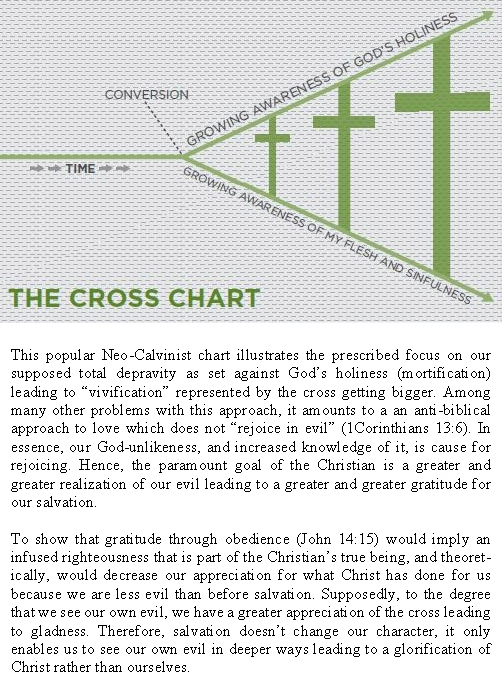
Though Calvin wrote of being transformed into the “image” of God, this is part and parcel with the passive and perpetual rebirth experience by the Christian. This does not denote a change or improvement in the Christian’s nature which would lessen the need for repentance. Obviously, if you look at the chart below, raising the trajectory of repentance makes the cross smaller, so repentance leading to real change is not in focus here. Calvin’s idea of transformation regards the birthing of realms which is experienced by the Christian through joy. Hence, the new birth is perpetual through the Christian’s life and is the result of perpetual repentance. We are to repent and dwell on our own depravity, and leave any quickenings or rebirth experiences to God:
He, however, who has emptied himself (cf. Phil. 2:7) through suffering no longer does works but knows that God works and does all things in him. For this reason, whether God does works or not, it is all the same to him. He neither boasts if he does good works, nor is he disturbed if God does not do good works through him. He knows that it is sufficient if he suffers and is brought low by the cross in order to be annihilated all the more. It is this that Christ says in John 3:7, »You must be born anew.« To be born anew, one must consequently first die and then be raised up with the Son of Man. To die, I say, means to feel death at hand (Martin Luther: Heidelberg Disputation, theses 24).
In obedience to God’s word we should fight to walk in the paths where he has promised his blessings. But when and how they come is God’s to decide, not ours. If they delay, we trust the wisdom of our Father’s timing, and we wait. In this way joy remains a gift, while we work patiently in the field of obedience and fight against the weeds and the crows and the rodents. Here is where joy will come. Here is where Christ will reveal himself (John 14:21). But that revelation and that joy will come when and how Christ chooses. It will be a gift… Heaven hangs on having the taste of joy in God. Therefore, it might not be so strange after all to think of fighting for this joy. Our eternal lives depend on it (John Piper: When I Don’t Desire God; p.43, p.34).
It is also important to note that in this construct, for the most part, repentance is something we focus on, and not something we necessarily try to do. The goal is to see our own depravity in a deeper and deeper way, and this results in a joyful rebirth experience that is totally out of our control. But yet, we must fight for this joy, or rebirth experience because “Our eternal lives depend on it.” Not only is this clearly works salvation, but it makes our eternal destiny ambiguous at best. Therefore…
Let us, therefore, embrace Christ, who is kindly offered to us, and comes forth to meet us: he will number us among his flock, and keep us within his fold. But anxiety arises as to our future state. For as Paul teaches, that those are called who were previously elected, so our Savior shows that many are called, but few chosen (Mt. 22:14). Nay, even Paul himself dissuades us from security, when he says, “Let him that thinketh he standeth take heed lest he fall,” (1 Cor. 10:12). And again, “Well, because of unbelief they were broken off, and thou standest by faith. Be not high-minded, but fear: for if God spared not the natural branches, take heed lest he also spare not thee,” (Rom. 11:20, 21). In fine, we are sufficiently taught by experience itself, that calling and faith are of little value without perseverance, which, however, is not the gift of all (CI 3.24.6).
There is danger on the way to salvation in heaven. We need ongoing protection after our conversion. Our security does not mean we are home free. There is a battle to be fought (John Piper: Bethlehem Baptist Church Minneapolis, Minnesota; The Elect Are Kept by the Power of God October 17, 1993).
According to Calvin, fear of future judgment is one of the primary motivations for repentance in the Christians life:
By mortification they mean, grief of soul and terror, produced by a conviction of sin and a sense of the divine judgment [sec.3]… it seems to me, that repentance may be not inappropriately defined thus: A real conversion of our life unto God, proceeding from sincere and serious fear of God; and consisting in the mortification of our flesh and the old man, and the quickening of the Spirit. In this sense are to be understood all those addresses in which the prophets first, and the apostles afterwards, exhorted the people of their time to repentance. The great object for which they labored was, to fill them with confusion for their sins and dread of the divine judgment, that they might fall down and humble themselves before him whom they had offended, and, with true repentance, retake themselves to the right path [sec.5]… The second part of our definition is, that repentance proceeds from a sincere fear of God. Before the mind of the sinner can be inclined to repentance, he must be aroused by the thought of divine judgment; but when once the thought that God will one day ascend his tribunal to take an account of all words and actions has taken possession of his mind, it will not allow him to rest, or have one moment’s peace, but will perpetually urge him to adopt a different plan of life, that he may be able to stand securely at that judgment-seat. Hence the Scripture, when exhorting to repentance, often introduces the subject of judgment, as in Jeremiah, “Lest my fury come forth like fire, and burn that none can quench it, because of the evil of your doings,” (Jer. 4:4)… The stern threatening which God employs are extorted from him by our depraved dispositions [sec.7] [from the CI 3.3.3-7].
Of course, this is all in egregious contradiction to the Scriptures; viz,
1John 4:18 – There is no fear in love, but perfect love casts out fear. For fear has to do with punishment, and whoever fears has not been perfected in love.
Calvin’s false gospel requires us to run a race of perpetual repentance driven by fear of judgment in order to keep ourselves saved. The new birth is not a onetime event known as regeneration, but is only an EXPERIENCE that follows the mortification of repentance. Calvin states that these quickenings that follow mortification are accompanied by joy and subjective manifestations of God’s image. Many are called, but not all have the gift of persevering in the cycle of mortification and vivification. Therefore, assurance of salvation is dubious at best.
Beside the fact that the apostle John wrote the book of 1John so that we can “know” that we are saved, Calvin’s gospel contradicts a mass of holy writ. This subjective gospel also adds a peculiar twist if you consider Calvin’s power of the keys; ie., whatever elders bind on earth will be bound in heaven. While the soteriology lends uncertainty to one’s eternal destiny, is assurance found more in having the elder’s approval? After all, if he states that you are saved, heaven will bind it.
paul

Loving Ourselves
Does the Bible ever state that to love ourselves is a sin? I don’t believe so. In fact it never even suggests that we are to love others MORE than ourselves. We are to love others AS MUCH AS we love ourselves.
“For no man ever yet hated his own flesh; but nourisheth and cherisheth it…” ~ Ephesians 5:29
“For all the law is fulfilled in one word, even in this; Thou shalt love thy neighbour as thyself.” ~ Galatians 5:14
“If ye fulfil the royal law according to the scripture, ‘Thou shalt love thy neighbour as thyself,’ ye do well:” ~ James 2:8
“Owe no man any thing, but to love one another: for he that loveth another hath fulfilled the law.” ~ Romans 13:8
“But as touching brotherly love ye need not that I write unto you: for ye yourselves are taught of God to love one another.” ~ 1 Thessalonians 4:9
“Ye have heard that it hath been said, ‘Thou shalt love thy neighbour, and hate thine enemy.’ But I say unto you, love your enemies, bless them that curse you, do good to them that hate you, and pray for them which despitefully use you, and persecute you; that ye may be the children of your Father which is in heaven: for he maketh his sun to rise on the evil and on the good, and sendeth rain on the just and on the unjust.” ~ Matthew 5:43-45
“ ‘Master, which is the great commandment in the law?’ Jesus said unto him, ‘Thou shalt love the Lord thy God with all thy heart, and with all thy soul, and with all thy mind. This is the first and great commandment. And the second is like unto it, Thou shalt love thy neighbour as thyself. On these two commandments hang all the law and the prophets.’ ” ~ Matthew 22:36-40
To love yourself is to recognize your own value. If you do not recognize your own worth then you cannot recognize the value of others.
There is application here for just about all of the problems we see in the institutional church. What is the historical orthodoxy? What has been taught about man? The metaphysical premise is man’s depravity. Man is taught that self-loathing is a virtue. Believers have been discouraged from striving for obedience to the law. The law has been replaced with orthodoxy (tradition). This is the definition of anomia; lawlessness. Jesus told the religious leaders of His day that by replacing the law with their traditions that they made the law useless. The result would be that love would grow cold.
This is what such thinking produces. And this is exactly what we are seeing in this day. Is it any wonder? If one is taught that they cannot keep the law because of their own depravity, how can he possibly love himself? Why are there so many cases of divorce, depression, and mental illnesses found in the institutional church? Why do we act shocked when we learn about these sorts of things happening in the institutional church? For the believer, he is taught that an ever-increasing awareness of sin brings about an ever-increasing knowledge of God’s holiness. The Christian life is to be one of dwelling on sinfulness; not on value. How can we expect justice for sexual abuse and other physical or spiritual abuses? If one believes he has no value, how can he possibly love others? Others have no value. Others then are nothing more than objects to be used for one’s own end.
Do you realize that if we spent our time focusing on loving others, we wouldn’t have to worry about breaking any laws? Think about that for a second. When it comes right down to it, isn’t the breaking of any law really a violation of the rights of another? It says, “I don’t value you.” Why don’t we steal? Is it because God said, “thou shalt not steal?” Or is it because we recognize that we would not want our things stolen? This ought to reveal our own sense of self-worth, which flies in the face of religious orthodoxy in direct opposition to the notion of total depravity. And in recognizing this self-worth, we then project that onto others. We recognize the value of others because we recognize our own value. God’s law teaches us that we have value!
Andy
Strange Fire Conference: John MacArthur’s Insufferable Hypocrisy
 Originally published October 16, 2013. See addendum below.
John MacArthur may go down in church history as one of the most confused pastors ever to step into a pulpit. His steroidal cognitive dissonance constantly results in insufferable hypocrisy.
For certain I thought he could not outdo himself in this regard, but he has. After writing Charismatic Chaos in 1992, he partnered with Charismatic CJ Mahaney for eight years in the Resolved conferences sponsored by his church, Grace Community in Sun Valley, California. One year after the last Resolved conference, MacArthur is hosting the 2013 Strange Fire conference that is fustigating Charismatic doctrine in no uncertain terms. The hypocrisy of it all is staggering.
MacArthur also seems to have a problem with the mysticism promoted by Charismatic theology, but yet is a close confidant of John Piper who not only has Charismatic leanings himself, but led the 2012 Passion conference in the mystic practice of Lectio Divina.
Furthermore, Geneva style Calvinists (also at the conference: Sproul, Lawson, Phil Johnson, et al) criticizing Charismatics is beyond the kettle calling the pot black. Calvin and Luther both attributed their theology to Neo-Platonist St. Augustine. The practical outcome is sanctification by faith alone through gospel contemplationism resulting in realm experience/manifestation. MacArthur himself now claims that he only explains the word of God and the Holy Spirit applies it resulting in his followers obeying God without realizing it (http://wp.me/pmd7S-1In).
Moreover, Calvinism is based on Hindu-like sanctification that posits perpetual mortification followed by vivification. As we dwell on our sin only, we are brought to despair (mortification) leading to the joy of our original rebirth (vivification). Calvinists Paul Washer and Michael Horton have both referred to this as continually “reliving our baptism.”
In MacArthur’s keynote address at this year’s Strange Fire conference, he also criticized Charismatics for their misrepresentation and overemphasis on the Holy Spirit leading to the dishonoring of the other two Trinity members. But likewise, Calvinists do the same thing with their Christocentric approach to the Scriptures. In the forward to Rick Holland’s book, Uneclipsing The Son (an in-your-face Gnostic treatise), MacArthur stated that ANY emphasis on ANYONE or ANYTHING other than Christ hinders the sanctification of God’s people.
All in all, Charismatics are barely any different than Calvinists. They both partake in epistemology that sees the horizontal as purely subjective and the vertical as purely objective. The goal is to experience the spirit realm horizontally through mysticism. For the Calvinist it is gospel contemplationism. For the Charismatic it is speaking in tongues.
What’s the difference?
paul
Addendum: John MacArthur is one of the scheduled speakers at the 2016 T4G conference in Louisville, KY. He will be sharing the stage with John Piper, CJ Mahaney, and other influential reformed leaders.
A Blog for TANC Ministries

Paul’s Passing Thoughts .com
The TANC Ministry Network Link: tanc.online
Join The Home Fellowship Network
Comments Off on A Blog for TANC Ministries
Second Epistle of Andy to “Trevor”
Some time ago I relayed the account of a Facebook interaction I had with an individual I called “Trevor”. Trevor is a young man in his early twenties. I’ve had the privilege of having long conversations with him regarding theology and Biblical matters in general. Trevor goes to a local church and has made a profession of faith, so giving him the benefit of the doubt (since it is not my place to make a judgment otherwise) I regard him as a brother in Christ.
Last Friday, Trevor and I got into another discussion, this time about the Law and how it pertains to believers. Since he was pressed for time and our conversation was growing increasingly in depth, Trevor asked if he could pose some specific questions via a Facebook message to which I could then compose a more in-depth reply. What follows is my response to Trevor. His questions are included in the body of the response in bold italics. I hope that you find it edifying!

 Paul's Passing Thoughts
leave a comment