The Lie
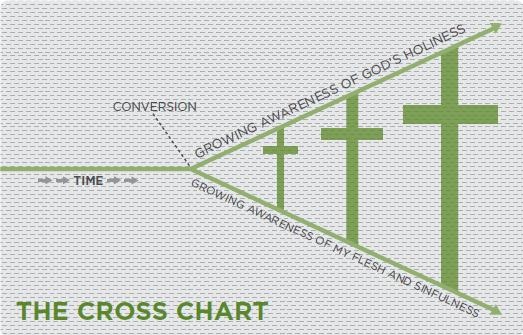
Paul – in my time in the reformed church, I was taught and agreed that through our faith we are saved (justification and salvation done – complete) and we then begin our lifelong journey of sanctification as we learn and grow in our knowledge and faith. When I view the chart I have always interpreted it in the same way that I interpreted my college education – the more you learn the more you realize what you don’t know. In that same way, the more I know of our father, the more ugly and selfish my sins look to me. I have never been taught any more than that and I believe the chart makes a good point in that regard. If there is a deeper meaning than what I have presented I have not heard it.
Anon,
Your perfectly reasonable sounding statement is the bait that hooks people into the lie. The chart is indicative of the founding principle of Reformed theology: knowledge of good and evil. Read the first sentence of book one in the Calvin Institutes. Hence, deeper knowledge of those two things define both (reality) and continually glorify God. But the Scriptures make it clear that God is most glorified by us becoming more like Him and displaying that to the world, not a deeper self-realization of our own potential evil. Moreover, if we aren’t guilty of certain depths of evil, to ascribe ourselves to it is not the truth. Therefore, this is just another primary pillar of biblical metaphysics that Calvinism turns completely upside down. And the implications are chilling: without evil, wisdom cannot be obtained. That is a precedent that has given birth to horrific episodes of evil throughout human history. Obviously, if a deeper knowledge of evil is efficacious to gaining wisdom, evil will not be perceived in a healthy way. I am utterly convinced that this is at the root of indifference to injustice that is so prevalent in Calvinistic circles.
paul

 Paul's Passing Thoughts
Lydia, I love that you put the Jewish factor in this conversation for you are exactly right! Calvinists will claim that we are the new covenant without realizing that we are only grafted into the Jewish branch. God did provide a new covenant but we are NOT the new covenant. We have not replaced Israel; we are here til the fullness of the Gentiles have taken place- big difference. But then again if one looks plainly at Scripture one will find this to be so…..and again man, to fit his own paradigm, will ADD or TAKE AWAY from Scripture. No surprise here. Another factor in seeing the fallacies of certain doctrines is their take on eschatology- not that eschatology is a salvation factor, but it does show whether one is studying the Word accurately and without bias. To so many, the fact that Christ will one day turn His eyes back on Israel and will redeem them is an affront to many. Again, look at Revelation in plain view, instead of an allegorical lens; not that there is not allegorical language interspersed throughout, but you can clearly identify what is and what is not by simple grammar (similes and metaphors).
LikeLike
So, Sam here is my question for you- WHY? why do I need Calvinism or Arminianism, or whatever to give me what I need in my walk with Christ? Should I not rely on the Holy Spirit alone for truth? Should not the pastor or teacher be in close alignment with what Scripture states instead of coming up with a whole new language of its own- like TULIP? I am not going to come on here to get into the details of TULIP or the Institutes vrs. Scripture- Paul has done quite an extensive research on the backgrounds of Calvinism. Plus I am not as theologically astute as you and some others are- that is ok by me because I do not think the Good Lord requires me to be so. But the Lord has given me discernment to understand what is false and what is not and I am no different then the carpenters, fishermen, women, and common folk traveling and learning from our Savior at the time of His ministry. By the way, though, the Pharisees were very learned men and well-versed in the law.
LikeLike
The thing that makes me grin is that you will not come on here to change anyones mind and I do not think you had any plans to. What I do think is that you and others want to come away with winning the argument- sure go ahead, again knock yourself out. I always knew not to argue with Calvinists, circular reasoning is their best weapon.
LikeLike
trust4himonly,
Perhaps you can demonstrate what about my reasoning is circular. I did not say I didn’t want to change minds. I would very much like to change your mind about what you think Calvinists teach. If you want to argue against our position, at least get it right.
LikeLike
Lydia,
If prevenient grace is an Augustine concept, I guess there is one place where Calvin didn’t follow him and the Arminians did.
LikeLike
Lydia,
I want to give you short answers to all your unfounded suppositions.
Who said there needed to be special knowledge for walking in the light beyond the revelation God has given us of himself and his purposes for us. What Calvinist seeks knowledge beyond the Scriptures?
Do you think it is unimportant that we understand the basic nature of those sinners we seek to evangelize. The apostle Paul must have though it was important since he wrote so much about it.
Do you not think it is important we understand the nature of God’s choice of certain sinners before the world was?
Do you not think it is important that God’s people understand that Jesus sealed our pardon on the cross, so that our salvation depends on his work alone and not on the level of our faith at any given time?
Do you not think it is important that we understand whether we should give the glory of conversion to the sinner, for the wise exercise of his will, or to God whose doing it is that we are in Christ (see 1 Cor. 1:30)?
Do you not think it is important to understand that God has guaranteed the continuance of the believer’s faith in Christ, not only by the finished work of Christ for us, but by his continued work in us?
Those seem like pretty important issues to me. They clearly seemed important to the Apostles.
Heb 10: 26 has application for today. It is just not to be interpreted for today. Its interpretation was to warn Hebrew believers who has left Judaism not to leave Christ and return to Judaism. If they rejected Christ’s sacrifice, there was no longer a sin sacrifice since the sacrifices of the Old Covenant had been fulfilled and brought to an end.
I don’t think believers are totally depraved.
Do you think there are ever times in Scripture where “all” does not mean “all?”
Do you think it was a “bait and switch” when God gave the Law to Israel and told them to keep it, knowing full well the would refuse to do so? Commands do not imply ability on the part of the one commanded.
From what I have read here, Barba didn’t back away from anything. Paul stopped posting the comments. I suspect that apart from that, the comments would have continued.
I believe Paul and the elders he and others appointed were teaching the new revelation God had given him in light of the Old Testament revelation. He was teaching them that Jesus was the Messiah who had fulfilled the Law and established a New Covenant that was superior in every way to the Old Jewish Covenant. He told Timothy he was to teach what had been committed to him to faithful men who would be able to teach others also. One would assume that included every teaching Paul had set forth in his epistles.
Apparently, some of those teachings might have been difficult for peasants since even Peter said they were hard to understand. They were to be taught anyway.
What Romans teaches about the Jews is that, in the matter of justification before God, they have no advantage over Gentiles because of their Jewishness. Jews and Gentiles are now on the same level before God. Call that a non-Jewish lens if you wish, but it is the clear teaching of the Epistle to the Romans.
You have written so much, I may have overlooked a point or two. If so, remind me so I can comment on those as well.
One thing I did notice missing in all your comments was any documentation of the likenesses between Platonism, Gnosticism and Calvinism. I am confident that documentation will be forthcoming.
LikeLike
John Calvin: “If I were inclined to compile a whole volume from Augustine, I could easily show my readers, that I need no words but his” (Institutes, Book III, chap. 22).
Just a quote I found of how Calvin did get much of his beliefs from the Roman Catholic Augustine.
LikeLike
There is no question that Calvin derived a great deal from Augustine. That Augustine was a Roman Catholic in the sense that we think of Roman Catholics is simply not true. Remember that much tradition and Papal BULL has been added to their belief system since Augustine’s time.
LikeLike
trust4himonly,
If we believers are not under the New Covenant, don’t you think it a bit strange that Paul, the apostle to the Gentiles, said he was an able minister of the New Covenant?
LikeLike
Additionally, isn’t it odd that the Epistle to the Hebrews, written to Christian believers, extols the New Covenant as better than the Old Covenant which he says has become antiquated and is ready to disappear completely, which occurred decisively in A.D. 70?
LikeLike