The Lie
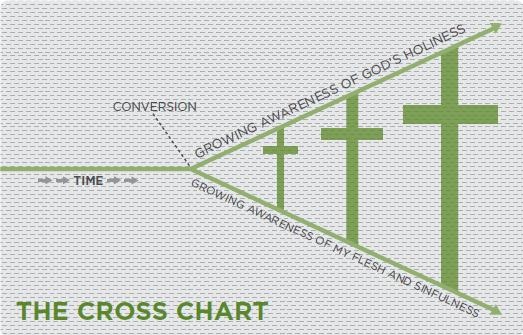
Paul – in my time in the reformed church, I was taught and agreed that through our faith we are saved (justification and salvation done – complete) and we then begin our lifelong journey of sanctification as we learn and grow in our knowledge and faith. When I view the chart I have always interpreted it in the same way that I interpreted my college education – the more you learn the more you realize what you don’t know. In that same way, the more I know of our father, the more ugly and selfish my sins look to me. I have never been taught any more than that and I believe the chart makes a good point in that regard. If there is a deeper meaning than what I have presented I have not heard it.
Anon,
Your perfectly reasonable sounding statement is the bait that hooks people into the lie. The chart is indicative of the founding principle of Reformed theology: knowledge of good and evil. Read the first sentence of book one in the Calvin Institutes. Hence, deeper knowledge of those two things define both (reality) and continually glorify God. But the Scriptures make it clear that God is most glorified by us becoming more like Him and displaying that to the world, not a deeper self-realization of our own potential evil. Moreover, if we aren’t guilty of certain depths of evil, to ascribe ourselves to it is not the truth. Therefore, this is just another primary pillar of biblical metaphysics that Calvinism turns completely upside down. And the implications are chilling: without evil, wisdom cannot be obtained. That is a precedent that has given birth to horrific episodes of evil throughout human history. Obviously, if a deeper knowledge of evil is efficacious to gaining wisdom, evil will not be perceived in a healthy way. I am utterly convinced that this is at the root of indifference to injustice that is so prevalent in Calvinistic circles.
paul

 Paul's Passing Thoughts
Lydia,
As I asked you in another post, does that mean you don’t believe we need pastors and if we have pastors they shouldn’t teach theological truth? The reason you need to read people like Hodge is that you will find they didn’t teach anything like what you and your friends here are alleging.
You have said that Calvinism is an either/or theology. Actually, what you are espousing is an either/or theology. Either God is sovereign or human beings are responsible and rational beings. I believe in BOTH God’s sovereignty AND human responsibility and rationality. How is that an either/or theology? I believe Jesus is BOTH 100% God AND 100% man. Take that to its logical conclusion. I would assume since you claim to believe the Christian Scriptures, you believe that as well. I believe God, the Father is God. I believe Jesus is God. I believe the Holy Spirit is God. If we should take that to its logical conclusion without explanation, which you like to call spin, we would be called Polytheists. Was the Bible inspired by God or was it written by human authors, each with his own style, thought forms, vocabulary and cultural background? The answer is BOTH/AND. Exactly how did that occur? I don’t know? Can I explain it in a way that will satisfy you? Probably not. Do I intend to sacrifice those beliefs because they don’t satisfy your sense of logic? Not in a million years.
I assume you know Greek since you have those tools at your fingertips. Perhaps we could engage in an exegetical study of the Greek Text together. The concepts I believe and teach did not come from Calvin but from a Spirit guided study of the Scriptures. I think one must have to ignore a mountain of Scripture to make the statements you make.
LikeLike
Hey, I ran across a guy on a blog who claimed Calvinists are Gnostics because we don´t take 1 John 3 seriously in believing that true Christians can no longer sin. Does anyone here believe in the sinless perfection of every true believer. If not, I guess we are all Gnostics.
I ran across another guy who, though not wishing to be confused with the ancient Gnostics, believes a great number of doctrines in common with them. Apparently, he has an affinity for them or he would not have adopted the name. The following are tenets he denies:
What True Gnostics DO NOT Believe
True Gnostics should not be confused with the false Gnostics of ages past, as represented by the codices and tractates discovered at Nag Hammadi, Egypt, in 1945. Neither are we representative of those Gnostics whi
True Gnostics:
• do not believe in the fundamental doctrines of Christianity. True Gnostics are not Christians.
• do not accept or believe in the Bible.
• do not believe in original sin.
• do not believe that mankind is inherently evil.
• do not believe in the blood atonement of Jesus Christ, because the doctrine of blood atonement presents a God who demands the human sacrifice of an innocent man, and any God who demands murder to appease justice is unworthy of worship or adoration.
• do not believe in hell or final judgment, because the doctrines of hell and eternal torment are immoral beliefs, and the doctrine of final judgment perverts and distorts mercy, compassion and forgiveness.
• do not believe in Jehovah. However, true Gnostics do accept that the biblical Jehovah is a demiurge, an evil monster who would present himself as God in order to confuse mankind with regard to what is truly right and wrong.
• do not believe in a devil which leads people into sin. Humankind has produced enough devils of its own without having to create the fictional variety in order to explain the evil that people do against each other. We are accountable to God for our acts of inhumanity towards each other. There is no devil to bring to account.
That doesn’t look a great deal like Calvinism to me.
LikeLike
ATTENTION ALL: I WILL NO LONGER WASTE MY TIME POSTING COMMENTS THAT DENY A REFORMED CONNECTION TO GNOSTICISM. ONE ONLY NEEDS TO GO TO JUSTIN TAYLOR’S BLOG AND NOTE THAT THE THEME IS, “BETWEEN TWO WORLDS.” MY TIME IS VALUABLE–STOP WASTING IT WITH YOUR STUPIDITY.
LikeLike
All I have asked for is one true link between Gnosticism and Calvinism. That shouldn’t be too difficult. That they both believed knowledge is important, even knowledge of God, doesn’t cut it. Jesus also believed that. He said, “and this is eternal life that they might know you, the true an living God, and Jesus Christ whom you have sent.”
Between two worlds doesn’t mean we are between the spirit world which is inherently and immutably good and the material world that is immutably evil. That is the Gnostic concept. Though I have not read it yet, I suspect the blog to which your referred to the fact that the believer is a man who no longer belongs to the old creation, but has not yet been perfected in the new.
LikeLike
Where does Calvinism ever talk about the spiritual world being inherently good and the material world being inherently evil?
Where does Calvinism mention the Pleroma and the Demiurge?
Where does Calvinism suggest that Jehovah of the OT and Jesus of the NT were mere emanations from the Pleroma?
Where does Calvinism suggest that one can escape from the material world of evil through knowledge?
Where does Calvinism suggest that the physical body is inherently evil? Or that one can escape the evil of the physical through suffering?
Where does Gnosticism ever teach the doctrine of original sin as it was taught by Augustine and Calvin?
A similarity of terms does not mean an identiy of belief. The Apostle Paul used the term Pleroma. Was he a Gnostic?
And Lydia, I have read all that stuff. All I am asking for is one actual belief that Gnostics and Calvinists have in common.
If in Adam all die, why do we die? Do we die because we followed his bad example, or do we die because his guilt has been imputed to us? If the former, since Adam and Christ are parallel in Paul’s construct, we must be justified because we have followed Jesus good example. Is that what you really believe?
LikeLike
Barba,
Listen, my patience has run out with you even with glancing at your pathetic comments when I post them. I will answer your first question, and then I am shutting you down all together. In the first sentence of the first book of the Calvin Institutes, Calvin echo’s the ancient religions that gave birth to Gnosticism by claiming that ALL significant wisdom comes from the knowledge of God and the knowledge of us. Only thing is, he believes mankind is totally depraved and remains so after salvation. So basically, it’s the age-old garden gig of the knowledge of good and evil. The knowledge of good and evil, and the necessity of both to define reality is a Gnostic concept. Furthermore, Luther and Calvin were Augustine understudies. Calvin claimed mankind only needed the words of Augustine to know anything, and cites Auggie on literally every other page of the Calvin Institutes. The integration of Augustine’s writings with Gnosticism isn’t even disputable and widely recognized–practically common knowledge.
What really agitates me is your poo-pooing of people who have studied this issue extensively and your comebacks with anything that argues the point for the sake of argument. It’s a free country, if you want to pave for yourself a road of destruction, go do it, but you won’t be wasting anymore of my time in the process.
LikeLike
This is Calvinism or even the basis of it? Oh come now.
Evolutionary forces alone are insufficient, however, to bring about spiritual freedom. Humans are caught in a predicament consisting of physical existence combined with ignorance of their true origins, their essential nature and their ultimate destiny. To be liberated from this predicament, human beings require help, although they must also contribute their own efforts.
From earliest times Messengers of the Light have come forth from the True God in order to assist humans in their quest for Gnosis. Only a few of these salvific figures are mentioned in Gnostic scripture; some of the most important are Seth (the third Son of Adam), Jesus, and the Prophet Mani. The majority of Gnostics always looked to Jesus as the principal savior figure (the Soter).
Gnostics do not look to salvation from sin (original or other), but rather from the ignorance of which sin is a consequence. Ignorance — whereby is meant ignorance of spiritual realities — is dispelled only by Gnosis, and the decisive revelation of Gnosis is brought by the Messengers of Light, especially by Christ, the Logos of the True God. It is not by His suffering and death but by His life of teaching and His establishing of mysteries that Christ has performed His work of salvation.
The Gnostic concept of salvation, like other Gnostic concepts, is a subtle one. On the one hand, Gnostic salvation may easily be mistaken for an unmediated individual experience, a sort of spiritual do-it-yourself project. Gnostics hold that the potential for Gnosis, and thus, of salvation is present in every man and woman, and that salvation is not vicarious but individual. At the same time, they also acknowledge that Gnosis and salvation can be, indeed must be, stimulated and facilitated in order to effectively arise within consciousness. This stimulation is supplied by Messengers of Light who, in addition to their teachings, establish salvific mysteries (sacraments) which can be administered by apostles of the Messengers and their successors.
One needs also remember that knowledge of our true nature — as well as other associated realizations — are withheld from us by our very condition of earthly existence. The True God of transcendence is unknown in this world, in fact He is often called the Unknown Father. It is thus obvious that revelation from on High is needed to bring about salvation. The indwelling spark must be awakened from its terrestrial slumber by the saving knowledge that comes “from without”.
LikeLike
What a sad little [and I only mean that in terms of character] man you are. Pitiful!
LikeLike
Anon,
So let me get this straight. You come to my blog as a gutless wonder (anonymously), and call me “pitiful”? Really? Wow.
LikeLike
Can someone explain to me what this is all about? Looks like a brawl.
LikeLike
Sam,
Sure, read the article, apparently things written in it caused some Calvinists to get their panties in a bundle. I am going to reread it myself as I can’t specifically remember what I wrote that would cause such a stir. But whatever it is, I certainly want to remember it.
LikeLike
I just read the first sentence of Calvin’s book and I don’t see a problem with it.
Sam
LikeLike
Sam,
Thanks for sharing your opinion. Isn’t America wonderful?
LikeLike
You’re welcome, and yes, it used to be.
LikeLike