Spiritual and Sexual Abuse in the Church: I Can See Clearly Now
 In preparation for the second volume of The Truth About New Calvinism and The Reformation Myth, I am reading a hefty amount of material written by Socrates and Plato. Though Socrates was obviously a very annoying person, reading his writings is a real eye-opener in regard to how the first philosophical academy of the western world shapes our present-day thinking from some twenty-five hundred years ago. His very same bases of thought, attitude, and communication techniques that can be seen today are eerily exact—not just similar—exact.
Volume one of TTANC focused on the roots and doctrine of the present-day New Calvinist movement. In preparation for volume two, I dined with church historian John Immel who pointed me to the fact that New Calvinists hold to true Reformation doctrine. Immel then suggested that I research the connections between the Reformers and Augustine, and then Augustine’s connections to Plato. He also provided some clues as to what he believes the connections are. Immel is not one who desires to put ideas in people’s minds; he is more or less a modern-day herald of the need for people to think for themselves.
Mark that. It’s an element that contributes greatly to spiritual and sexual abuse in the church. People – thinking for themselves = abuse. That’s the first part of the equation, we will add to it later. Lest you think that I am alone in seeing hefty significance and a direct relationship between the Soc./Plato Academy and modern-day behavior, consider what others say. In Harper Magazine’s endorsement of “The Wisdom And Ideas Of Plato” by Eugene Freeman and David Appel, they stated the following: “Now anybody can understand and appreciate the basic thoughts that support our modern life.” Though true, not everybody “appreciate[s]” them. Renowned philosopher Karl Popper blamed 20th century totalitarianism on Plato specifically:
Karl Popper blamed Plato for the rise of totalitarianism in the 20th century, seeing Plato’s philosopher kings, with their dreams of ‘social engineering’ and ‘idealism’, as leading directly to Joseph Stalin and Adolf Hitler (via Georg Wilhelm, Friedrich Hegel, and Karl Marx). In addition, Ayatollah Khomeini is said to have been inspired by the Platonic vision of the philosopher king while in Qum in the 1920s when he became interested in Islamic mysticism and Plato’s Republic. As such, it has been speculated that he was inspired by Plato’s philosopher king, and subsequently based elements of his Islamic Republic on it (Wikipedia: online source: http://en.wikipedia.org/wiki/Philosopher_king).
Volume 2 of TTANC will trace New Calvinism from its contemporary birth (the Australian Forum:1970), and back to its Reformed roots. It will also lightly survey the Reformation’s philosophical underpinnings that came from the Soc./Plato Academy. However, The Reformation Myth will address these same things in much deeper detail. Both books will address this from three perspectives: history; doctrine; and character.
Immel’s primary concern is spiritual tyranny, but an understanding of church history is critical to understanding what makes spiritual tyranny tick. In my research for TRM, the subject of abuse has become so entangled in the results that I have decided abuse will dominate the “Character” section of the book. The fact that Plato’s philosopher king concept dominates today’s church is inescapable—with the same results following that have always marked this philosophy’s existence throughout history.
Socrates believed that true knowledge could not be obtained through observation of the material. He also believed that truth was eternal, and immutable, and a higher good than the gods. One could only access truth through the mind, or ideas; ie, the nonmaterial. The mind was the conduit to the realm of truth which in essence was god, and like the real God, cannot be fully known. To Socrates, the first step to wisdom was realizing that definitive truth cannot be known, but yet, man had a duty to orchestrate life by the best truth that could be ascertained from the mind. In other words, truth was already in each person, and true education was a rediscovering of information already known. It is unclear to me at this point whether Socrates believed that truth indwells us all in the fullness of the truth cosmos, or indwells each of us to varying degrees.
The method for discovering the truth that is in us, according to Socratism, is to ask ourselves questions. When Socrates taught, the teaching began with a question concerning life, and through a lengthy dialogue of questions and answers, the best solution was drawn from the mind’s connection to pure truth. This entailed three things: hard, certified work; the recognition that we cannot know anything definitively; the belief that truth cannot be known through observation of solid matter; and the belief that the only measure of moralism was in regard to what best served the masses verses the few. His understudy, Plato, later identified these characteristics as belonging to philosopher kings, and believed such should rule over the masses for the betterment of society’s whole. In regard to the moral fitness (which cannot be definitively ascertained anyway) of the philosopher king, it was irrelevant because his knowledge was essential to the society as a whole and his personal life only affected him—not society. Hence, in societies that function by philosopher kings (knowingly [rare] unwittingly, or by default [most often]), the written law is not much more than a strong suggestion in most cases.
Plato divided the ideal society into three parts: philosopher king, soldier, and producer. It doesn’t take a genius to figure out where this all ends up; the soldiers serve the king, and the producers do not understand the basic fundamentals of truth. All–knowing kings + soldiers = you had better know your place + keep your ideas to yourself because you don’t know that you don’t know.
Now enter St. Augustine. Patron saint of the Catholic Church, father of Reformation philosophy/doctrine, and a follower of Plato. Luther was a member of the Augustinian Order, and Calvin quoted him on every (on average) 2.5 pages of his institutes. Augustine was a dyed in the wool Catholic till the end, and revered as its “Doctor of Grace.” No less credit was given to him among the Reformers. Basic Platonist philosophy drawn from Augustine is really what made the Catholic Church and the Reformation tick, with the same results following. The Reformation was really a spat between Rome and the Reformers about who was going to control the ideas.
For all practical purposes, they were two different camps of philosopher kings at war for control of the producers. The primary crux of the argument, if any, was the idea that the Reformers were moral despot philosopher kings verses the decadence of the popish sort. At any rate, this side of the Reformation, the indifferent attitude towards justice, mercy, and freedom of thought is abundantly evident. By and large in today’s church, we don’t have pastors, we have philosopher kings. They are supposedly so paramount to the wellbeing of the church city-state, that concerns over their outrageous behavior should be overlooked for the Platonist good of the whole. Besides, morals, according to Socrates, are not definitive anyway.
Excellent studies that expound on how Augustine integrated Platonism into theology are not difficult to obtain. To cite just a few examples, Socrates’ “truth” became “gospel “; Plato’s two worlds became Spirit and flesh; and much later, Historicism, which was a product of Platonism, became the hermeneutic for interpretation. But in regard to human carnage, Popper’s complaint has become the same in the church. Whether a philosophy is dressed up in Bible verses or not, the results are the same.
In my mind, nothing else can explain the indifference among church leaders regarding the spiritual and sexual abuse now rampant in the church. And what better example than the ABWE/ Donn Ketchum scandal. The ABWE/GARB brain trust first covered for Ketchum for some twenty years and were part of a massive cover-up. Now the same men who perpetrated the cover-up and were directly responsible for putting additional children in harm’s way are honored continuously in GARB circles. One is being honored via a multi-million dollar athletic center that is being named after him. The infamous Jack Hyles was honored with a Bible college that bears his name. Even the formally laudable John MacArthur Jr. is covering for serial sheep abuser CJ Mahaney.
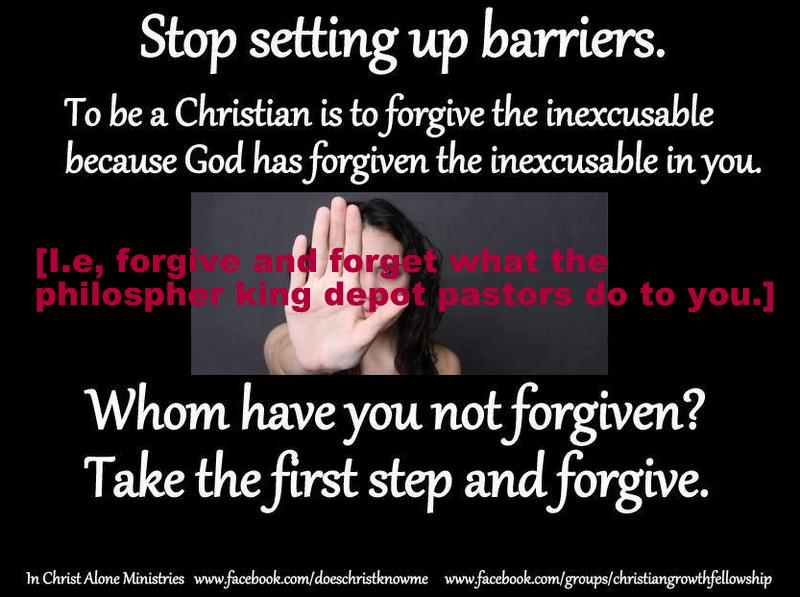
Why? Because they are the philosopher kings. Their higher knowledge leads us through the maze of what’s best for the church as a whole. After all, thousands of souls would be lost without them; so, best that the sexually abused go away quietly for the sake of the bigger picture. And besides, we are all “sinners saved by grace” anyway. In the Platonist vernacular: we are all those who “neither know nor think that [we] know” (Socrates: The Apology).
I’m convinced that the key to getting rid of sexual/spiritual abuse in the church is to totally rethink the organized church that is the breeding ground for the church’s philosopher kings. What is left that is good about the organized church will not stand up against the philosopher kings posing as pastors; so, who needs them?
And let me remind you of who really makes the organized church possible: the producers. I am confident that eventually the producers are going to figure out that they are paying the salaries of those who expect us to offer up our children to the sexual cravings of the philosopher kings.
I have to believe that the whole, “Who are you to judge? Put your money in the plate, buy our books, and keep your mouth shut” routine cannot go on for much longer.
paul

 Paul's Passing Thoughts
I mean, really Randy, what does total depravity mean to you? That’s why I say that doing anything is pointless. Because it is! If you are totally depraved before “salvation” then you must be after. B the cross doesn’t change anyone’s status before God, they are what they have always been. If you can’t earn your salvation, then how can you earn your sanctification? What would be the point of that? There is none. Thus, doing anything is a waste. The command is a waste. Belief and faith a waste. You don’t have to SAY you don’t believe man possesses a rational mind, your very doctrine screams it from every sermon, speech, proof text, and blog post.
LikeLike
If you really need a direct quote, then I’ll find you one. But I submit that if you truly understood the logical extentions of your own doctrine, you’d realize how superfluous a direct quote is. If election is fact, then so is man’s inability to reason. For how can it be said that it is impossible for a rational man to know and desire GOOD? Explain that to me. If is impossible for man to acknowledge that the.
Creator is good, and thus views all good as evil, which he just THINKS is good, then how can man be anything other than a blind fool at best, or a wicked sociopath at worst?
LikeLike
Argo,
All things Randy will no longer be appearing on this blog. He has left several comments that will not be posted. I simply see no need for this blog to be a platform for heretics. His last post was particularity nasty and very indicative of the New Calvinist spirit of despotism. Randy is a particularly vile individual who has stalked me in the past by flooding my inbox with very volatile emails. I have saved all of them for the local police and those who may support him financially.
LikeLike
Thank goodness……this a person whose only desire is to push a doctrine of Calvinism over accurately studying Gods Word. The more I am around this stuff the more suffocating it gets. Where is the freedom? Where is the love of Christ? Where is the discernment?
I find it so amazing, going along with Argos posts, why should it matter to them about election? Why make it such an issue along with salvation? If they don’t know who is elected, why make such “ado” about things that are completely out of their control? Why? CONTROL
To Calvinism, as such with any despot doctrine or religion, it is a matter of control- control over people. If they were so into TULIP like they say, it would not matter what other believers say about them- God so predestined everything – right? God is Sovereign over their doctrine and the outcome of their doctrine- right? So why worry?
Well they know they have holes in their doctrine and they know people are thinking for themselves (can’t have that now can we? For we are too depraved to think
for ourselves). So then I ask what gives them the right to THINK if we are so depraved to begin with? How in the world could John Calvin be able to write 2,000 + pages knowing he was so totally depraved? What gave him such a right?
None of this makes any sense whatsoever- the more you dig the more you find foolishness. I am not an eloquent writer; actually I am more simple in my approach to life. When I read Scripture, I try to look at what is plainly said then trying to search out for something that may not even be there. This is what I feel Calvinism does- it strives too much into findng more meaning then what is plainly said. Now that does not mean I am against good theological study, but one has to be extremely careful one does not take away or add to Scripture (which we all can be guilty of).
Coming up with new theological terms really does not fulfil the Great Commission; it does not bring others to the saving knowledge of Jesus Christ. Complicating doctrines do not help the common person like me grow in my faith with Christ or further my intimacy with the Savior either.
Jesus did not spend most of his time around those of the intellectually elite, but those who were of the lowly. His friends were fishermen, tax collectors and women (some who were ex-prostitutes). This is one reason to stay far away from a complicating “doctrine” such as Calvinism.
LikeLike
Oh, okay Paul. Thanks for letting me know. Can’t say I blame you. I have come to realize that the Calvinist lashing out in anger is a natural by product of their untenable position. At some point they will get backed into a logical corner that they cannot escape from, and no amount of scripture quoting will free them. I have been reading Edwards’ treatise on Free Will, and what is clear is that he was a better preacher than philosopher. What is most disturbing is that he seems to lack a basic understanding of the omnipotence of God, which is essential to the argument. For instance, he claims that the Arminian position is hypocritical because it insinuates that since God cannot help but do good, He is not praiseworthy any more than the saved person is praiseworthy for being elected to his/her reward. Now…let the ludicrousness of that statement sink in and you will see just why I question his understanding of God (God cannot earn a reward or punishment, nor can he be compelled because He IS the standard, not just the Creator of it. He is worthy of praise simply because He IS…there is no external standard that He cannot help keep…Edwards is comparing apples and oranges.) As I continue to read Edwards I am struck with just how weak the philosophical and doctrinal foundations of the TD and predestination arguments are. Thus, any Calvinst who enters the debate and stays in it will realize eventually that they built upon sand. They will either a. Accept that they are wrong. B. Claim paradox or mystery and continue in their folly. Or C. Lash out in anger. Since Calvinism can only ultimately flourish when spiritual tyranny is considered “biblical leadership and submission” they do not tend to tolerate challenge. They lash out in anger now because that is the extent of their civil power. God help us if they merge their doctrine with the power of civil government.
LikeLike
“I have to believe that the whole, ‘Who are you to judge? Put your money in the plate, buy our books, and keep your mouth shut’ routine cannot go on for much longer.”
Its gone on in the Catholic church forever, and it will go on in the Protish world for just as long. There will always be enough smucks buying into it to pay the bills. The fact is, it seems, people want a religion that tells them are stupid and unenlighteneded and totally depraved and sets a pastor king above them. If it weren’t the case, then this form of religion would not be the dominate one, would not have been the dominant one since time immemorial. If anything is going to happen, it may be that an anti-Pauline denomination arises that boots that sophist out of the New Testament so that righteousness and living morally can once again be engaged in without being condemned as ‘trusting in works.’ That’s what needs to be done, and maybe after all the faith-onlyist churches finally fall to the homosexual maffia (and they will) such a anti-Pauline church will arise. Until then, Christianity is screwed, as it has been at least since Augustine.
LikeLike
Rey Jacobs,
Hi Rey. Your comments here have some merit, but for the sake of other readers here, I am going to make some things clear:
1. Comments are not posts that either give credibility or reject credibility.
2. PPT is not afraid of ideas, but may not post certain comments because this is not a platform for error. However, there is a ministry angle here as well.
3. This author believes firmly that the Apostle Paul’s writings were inspired as he was born along by the Holy Spirit and that his statements in Scripture represent God’s positions on life and godliness.
4. The Scriptures are God’s plenary philosophical statement to man concerning life and godlessness, and stand separate and in contention against every thought/religion/philosophy that opposes or contradicts it.
LikeLike