Critical Review of TTANC is Confirming
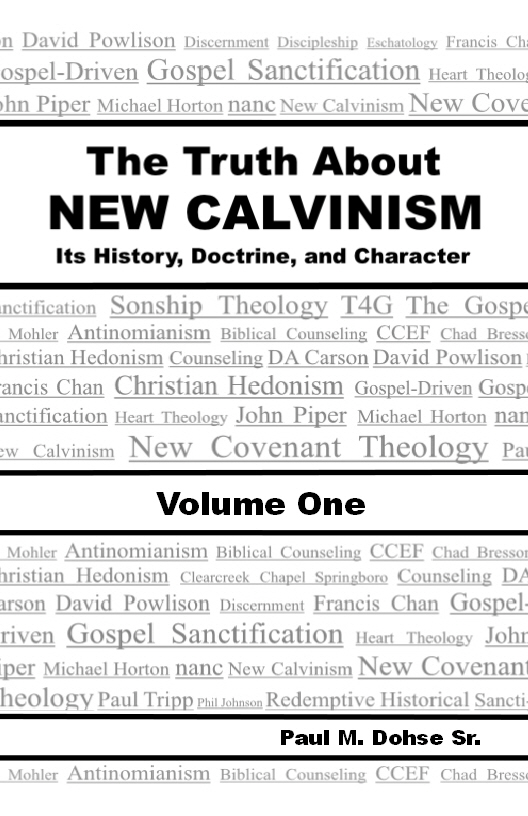 “RS does state in his review that I fail to ‘connect the dots’ between historical events that he doesn’t refute, but then states in another part of the review that the magnum opus of the Australian Forum is the true gospel!”
“But get this: while denying any connection between New Covenant Theology and New Calvinism, he is a New Covenant Theologian that believes in unadulterated New Calvinist theology; specifically, we are not saved by justification alone (‘justification is only one part of God’s salvation’) and Gospel Sanctification.”
The honeymoon is over after the 5 Point Salt review. But all is well from where I am looking. As I shared with an advisor before “The Truth About New Calvinism” was completed, it was not written to persuade anybody; it was written as prevention. The book was written to show the danger behind the red flags flying around in people’s minds, and to show them that everybody isn’t doing New Calvinism. No, it’s not you. No, you do get it. No, you haven’t lost your mind, they have. Yes, all of these hip people who appear so intelligent fell for the musings of a Seventh-Day Adventist who is now an atheist. Brilliant.
Randy Seiver (Th.M from Westminster Theological Seminary) is a New Covenant Theologian and missionary in Costa Rica. His review will be printed in full following my response. His review confirms, thus far, that the Primary goals of TTANC were achieved:
1. The book is easy to understand.
2. The position is stated clearly.
Therefore, the fact that RS strongly disagrees with me, and also thinks the book is laughable, is really irrelevant. The goal of the book was to unravel a complex theological issue of our day and let Christians decide for themselves, and from everything I can see so far, especially from this review, mission accomplished. Look, the biggest problem with this movement is the unavailability of information from which people can make an overall assessment. The book seeks to change that.
1. History Documented in TTANC Not Refuted.
Unfortunately, the best comments I can make are that the book is well written, easy to read, and provides interesting information about the history of Jon Zen’s association with Brinsmead, Westminster Seminary etc….I studied Church History under the Fundamentalist, Dr. George W. Dollar and his sidekick Dr. Robert Delney.
RS is a graduate of Westminster and is acquainted with many of the early movers and shakers of the movement, especially Ernest Reisinger (“I knew Ernest Reisinger”). He is also a student of church history. In all of his contentions against my writings as the most formidable member of PPT’s peanut gallery, he has never refuted my historical account concerning New Calvinism and the Australian Forum. So it boils down to the following: does God reveal long-lost doctrinal truth via the unregenerate or not?
1 Corinthians 2:14
The natural person does not accept the things of the Spirit of God, for they are folly to him, and he is not able to understand them because they are spiritually discerned.
Based on 1Corintians 2:14, I’m thinking, “No.” And let me get this straight from the proponents: “Yes, Brinsmead was an atheist not yet revealed, but he got his ideas from Luther.” So, all of the hordes of New Calvinist brainiacs who have been studying Owens, Calvin, and Luther all of these years had to be pointed to the real crux of the Reformation by a Seventh-Day Adventist who is now an atheist? Really? RS does state in his review that I fail to “connect the dots” between historical events that he doesn’t refute, but then states in another part of the review that the magnum opus of the Australian Forum is the true gospel!
2. The New Covenant Theology Connection
When I first began to post on Paul’s blog, he learned that I believed in New Covenant Theology. From that point on, Paul began to tell me what I believed. It did not matter that I didn’t believe what he thought I believed. I had to believe what he thought I believed because it was the only thing that would fit his preconceived model.
Paul views everything from his narrow understanding of Theology and his preconceived notions about New Covenant Theology and its supposed relationship with New Calvinism. The reality is that though the two may have some doctrines in common, they are neither dependent on one another nor synonymous with one another. In Paul’s world, if they use any of the same vocabulary, they must be the same.
It’s high time somebody said: “This movement, after forty years, still refuses to be honest about who they are. So yes, the right to be heard is now lost, and rightfully so.” Secondly, my evaluation of the connections between New Covenant Theology and New Calvinism are clearly understood by RS. Mission accomplished. Disagreement; irrelevant, let the readers decide for themselves.
3. Anomia
Thus, the charge of antinomianism is an unfounded charge unless it is made against a person who argues that we are absolutely without obligation to obey God’s revealed will.
RS doesn’t fully reveal my argument in the book. The argument is substantiated in two different chapters. He only addresses one of them. The crux of the matter is the following: can we be considered those who believe in an obligation to obey the law while believing that Jesus obeys it for us, and we are completely unable to do so? New Calvinists believe they have an obligation to the law via “offering the obedience of Christ by faith.” Let the reader decide after reading both chapters.
4. I believe New Calvinist doctrine, but I’m not a New Calvinist.
Let me be clear. I do not consider myself a New Calvinist. In fact, were it not for what I believe the Scriptures teach I would not consider myself a Calvinist at all. There are probably as many areas of the Reformed Faith with which I find disagreement as there areas in which I agreement. I am not even an advocate for New Calvinism. Frankly, all I know about New Calvinism is what I have read in magazine articles.
But then he states in the same paragraph:
He regularly confuses justification and sanctification. Somehow, he has the idea that justification is salvation. It is something that happens to us, and then we get beyond it. Anyone who has the most casual acquaintance with theology understands that justification is only one part of God’s salvation.
Justification alone is not salvation; sanctification and glorification are also salvation. And we don’t “get beyond” justification, and justification is “only one part of God’s salvation.” Again, mission accomplished. He understands one of the major points of the book. Look, I have said it before, again and again: New Calvinists believe that sanctification maintains justification, and glorification completes it. Therefore, we are obviously out of the loop because any law-keeping on our part in sanctification would be efforts on our part to maintain justification. Just this morning pastor David Conrad could not have said it better: “Romans 13:11 isn’t talking about getting our salvation when we get to heaven, we are already saved. It’s talking about the full experience of a past event [paraphrase].” Spot on. What RS states here can be reiterated via the New Calvinist mantras, “The same gospel that saved you also sanctifies you,” and “We must preach the gospel to ourselves every day.”
RS, in the past, has also stated that he is a proponent of “Gospel Sanctification” which speaks for itself. Gospel Sanctification is now widely recognized as a New Calvinist doctrine. But get this: while denying any connection between New Covenant Theology and New Calvinism, he is a New Covenant Theologian that believes in unadulterated New Calvinist theology; specifically, we are not saved by justification alone (“justification is only one part of God’s salvation”) and Gospel Sanctification.
5. The Magnum Opus of New Calvinism
For some strange reason, Paul has a problem with the rectitude by which we are declared righteous in God’s sight being an alien righteousness, a righteousness that is totally outside of us–an objective righteousness. The truth is, this is simply the gospel. If we believe we are justified by our improvement on an infused righteousness that flows to us as a result of Jesus’ death, we don’t understand the gospel at all. Additionally, Paul has a problem with the idea that our sanctification is accomplished by the redemptive work of Christ as much as our justification was accomplished by his redemptive work. He talks about people fusing justification and sanctification because he doesn’t seem to understand the biblical teaching about either justification or sanctification.
Again, mission accomplished. What RS has stated above harkens back to my interview with Robert Brinsmead:
Author: What do you think the unique theological findings of the Forum were in light of history? Robert Brinsmead: “Definitely the centrality and all sufficiency of the objective gospel understood as an historical rather than an experiential event, something wholly objective rather than subjective – an outside of me event and the efficacy of an outside-of-me righteousness.”
6. Just because Jesus obeys for us doesn’t mean we are not expected to obey.
He regularly confuses the idea that we are motivated by God’s love in justifying us with the idea that there is now no need for us to obey God since Jesus obeys for us. We are justified because Jesus obeyed for us. That does not mean we are not expected to obey him.
This speaks for itself.
7. Ernest Reisinger didn’t believe in the fusion of justification and sanctification, he
believed the two are always joined.
There are at least three ridiculous statements in the book. One has to do with Ernest Reisinger’s supposed fusion of justification and sanctification. p. 157 “The Lordship teaching puts the order of salvation as follows: 1) Regeneration, 2) Faith (which includes repentance), 3) Justification, 4). Sanctification (distinct from but always joined to justification), and 5) Glorification.”
How does that “fuse” justification and sanctification (It states that sanctification is distinct from justification)? There can be no question at all that both justification and sanctification result from Christ’s redemptive. A person who is not being sanctified has never been justified.
Classic New Calvinist double speak: fusion doesn’t mean joining. The “distinction” that Reisinger was talking about is the supposed idea that sanctification is justification in action, or progressive justification. A boy standing, and a boy running are distinct, but the same boy. In the last sentence quoted, RS makes no distinction between justification making sanctification possible, and spiritual growth in sanctification. If it moves, it must be justification.
I knew Ernest Reisinger and he was neither a New Calvinist nor a New Covenant Theologian.
But for some reason, Reisinger’s understudy and heir apparent to Founders Ministries, Thomas Ascol, is a consummate New Calvinist. Ascol himself claims that Founders was established on the Reformed theology of his “mentor,” Ernest Reisinger, and Founders Ministries is the epitome of New Calvinism.
8. Redemptive church discipline doesn’t have anything to do with regeneration.
The second concerns a resolution that was offered by Tom Ascol to the Southern Baptist Convention in 2008. It urges the churches of the Southern Baptist Convention to repent of the failure among us to live up to our professed commitment to regenerate church membership. . . . p. 160. Granted, the statement would have been clearer if Ascol had inserted an “a” before regenerate church membership, i. e. a regenerate church membership. Baptist have always believed not in a sacral society but in a regenerate membership. Paul, wrongly interprets this statement to mean that church discipline regenerates. In other words he understands the word “regenerate” as a verb rather than as an adjective. Ascol was talking about the kind of church membership to which Baptist have always been committed, not to what regenerates the church membership. A man with any understanding of Baptist churches and of theology would have known this. Instead, Paul wrote, “Notice the implication that church discipline regenerates.” It is just ignorance on fire. I pointed this out to him before he went to press, but he published it anyway.
Ignorance on fire? I have firsthand knowledge concerning why New Calvinists call church discipline, “redemptive church discipline.” Accepting verbal repentance in a Matthew 18 situation “doesn’t get to the heart of the matter.” In this synergistic Dark Age, stuff happens because people believe in a subjective gospel inside of us rather than the objective gospel outside of us. “Redemptive” church discipline focuses on redeeming professing Christians by saving them from a belief that Christ does a work in them as opposed to Christ being formed in them by trusting in a righteousness completely outside of us. To believe that we possess righteousness within us is to, in John Piper’s words, “reverse justification and sanctification” which “imperils our soul.”
Therefore, concerning Ascol’s resolution on church discipline, I strongly suspect his wording was careful, but deliberate:
RESOLVED, That we urge the churches of the Southern Baptist Convention to repent of the failure among us to live up to our professed commitment to regenerate church membership and any failure to obey Jesus Christ in the practice of lovingly correcting wayward church members (Matthew 18:15-18).
The resolution concerns church discipline. So if what I say is true, the “a” is probably missing for a reason.
More could be discussed, but again, the review confirms that the book’s goals have been met. The rest is just rhetoric as far as I am concerned. It is important that the book can be understood by those who want to decide for themselves.
RS concludes with a hallmark of New Calvinism: having the audacity to tell the saints what to read, and not to read. That’s not a good idea.
paul
I just finished reading The Truth About New Calvinism by Paul M. Dohse Sr. The author was kind enough to send it to me for review. Given his kindness, I would be delighted to be able to say very nice things about what he has written. Unfortunately, the best comments I can make are that the book is well written, easy to read, and provides interesting information about the history of Jon Zen’s association with Brinsmead, Westminster Seminary etc.
In the interest of full disclosure, I was reared in a Fundamentalist Baptist home. I studied Church History under the Fundamentalist, Dr. George W. Dollar and his sidekick Dr. Robert Delney. Dr. Dollar used to claim he and Dr. Charles Woodbridge were the only two real Fundamentalist left. He was clearly struck with the same club that Elijah had encountered. I never was sure where that left his friend and colleague Dr. Delney. At the time, the enemy of God and truth was a new movement called, “neo-evangelicalism.” We were taught certain catch phrases to look for. Anyone who used these phrases was to be castigated and avoided as an enemy of the truth. We were able to pigeon hole most anyone we met just by listening to the phrases they used. It didn’t actually matter if they really didn’t believe what we had detected. We knew they must be guilty if for no other reason than that they associated with people who, had some sort of nebulous relationship with someone who had eaten breakfast with someone who was associated with anti-fundamentalism. I cannot shake the feeling that the spirit of George Dollar’s Fundamentalism has risen from the grave and inhabited the body of Paul Dohse.
When I first began to post on Paul’s blog, he learned that I believed in New Covenant Theology. From that point on, Paul began to tell me what I believed. It did not matter that I didn’t believe what he though I believed. I had to believe what he thought I believed because it was the only thing that would fit his preconceived model.
Paul views everything from his narrow understanding of Theology and his preconceived notions about New Covenant Theology and its supposed relationship with New Calvinism. The reality is that though the two may have some doctrines in common, they are neither dependant on one another nor synonymous with one another. In Paul’s world, if they use any of the same vocabulary, they must be the same.
He is convinced that the Greek word “anomia” refers to antinominism. He brands anyone who understands that God’s eternal and universal law has been given different expressions under different divine covenants as an antinomian. Somehow he has convinced himself that when the New Testament writers spoke about lawlessness, they were speaking about antinomianism. There is a difference between a nomia and anti nomia [n]. One is a doctrine that may or may not manifest itself in lawless behavior , the other is a lawless attitude that manifests itself in rebellious acts against God. In order for one to be truly an antinomian in the theological sense, he would have to declare that a believer has no duty to obey God’s eternal and universal righteous standard. The apostle Paul makes it clear that the Mosaic expression of that Law was neither universal nor eternal. Otherwise, he could not have spoken of the Gentiles who “do not have the Law,” and who “have sinned without the Law” and “will be judged without the Law.” It seems to me, that leaves us with two exegetical choices: 1. The Gentiles were without God’s law altogether, or 2. The Gentiles were without the Mosaic codified expression of that Law. Since the apostle also tells the Law entered at a specific point (“the Law came in alongside so that the offense might overflow” Rom 5 “It [the Mosaic Law] was added for the sake of transgressions” Gal. 3) and was given “til the Seed [Christ] came to whom the promises were made.” Gal 3), it could not have been eternal.
If a person argues that that covenantal expression of God’s eternal and universal righteous standard has been replaced by a new expression of the same standard, that does not mean he is against God’s Law or will encourage people to break God’s Law. Thus, the charge of antinomianism is an unfounded charge unless it is made against a person who argues that we are absolutely without obligation to obey God’s revealed will.
Let me be clear. I do not consider myself a New Calvinist. In fact, were it not for what I believe the Scriptures teach I would not consider myself a Calvinist at all. There are probably as many areas of the Reformed Faith with which I find disagreement as there areas in which I agreement. I am not even an advocate for New Calvinism. Frankly, all I know about New Calvinism is what I have read in magazine articles. What I do know is that the evidence Paul Dohse has compiled is not convincing. His book is woefully deficient in the area of documentation. He offers many endnotes, but his references usually do not say what he claims they say. He regularly confuses justification and sanctification. Somehow, he has the idea that justification is salvation. It is something that happens to us, and then we get beyond it. Anyone who has the most casual acquaintance with theology understands that justification is only one part of God’s salvation.
For him, sanctification is simply a matter of obedience. In his view, we are given the equipment in regeneration and the rest is up to us. Once we are underway, God will help us, but the idea that any desire for obedience or ability to obey comes from God seems foreign to his concept of sanctification. He regularly confuses the idea that we are motivated by God’s love in justifying us with the idea that there is now no need for us to obey God since Jesus obeys for us. We are justified because Jesus obeyed for us. That does not mean we are not expected to obey him.
For some strange reason, Paul has a problem with the rectitude by which we are declared righteous in God’s sight being an alien righteousness, a righteousness that is totally outside of us–an objective righteousness. The truth is, this is simply the gospel. If we believe we are justified by our improvement on an infused righteousness that flows to us as a result of Jesus’ death, we don’t understand the gospel at all. Additionally, Paul has a problem with the idea that our sanctification is accomplished by the redemptive work of Christ as much as our justification was accomplished by his redemptive work. He talks about people fusing justification and sanctification because he doesn’t seem to understand the biblical teaching about either justification or sanctification.
Paul is muddled in this thinking. He spins statements to make them say what he wants them to say. He totally misrepresents New Covenant Theology and insists that anyone who subscribes to it must be a New Calvinist. He gives a great deal of interesting history, but fails to accurately connect the dots. There are at least three ridiculous statements in the book. One has to do with Ernest Reisinger’s supposed fusion of justification and sanctification. p. 157 “The Lordship teaching puts the order of salvation as follows: 1) Regeneration, 2) Faith (which includes repentance), 3) Justification, 4). Sanctification (distinct from but always joined to justification), and 5) Glorification.”
How does that “fuse” justification and sanctification. (It states that sanctification is distinct from justification). There can be no question at all that both justification and sanctification result from Christ’s redemptive. A person who is not being sanctified has never been justified. This is neither a New Calvinist position nor a New Covenant Theology position. It is a biblical position. I doubt there was a single old Calvinist who didn’t believe this truth. Additionally, I knew Ernest Reisinger and he was neither a New Calvinist nor a New Covenant Theologian.
The second concerns a resolution that was offered by Tom Ascol to the Southern Baptist Convention in 2008. It urges the churches of the Southern Baptist Convention to repent of the failure among us to live up to our professed commitment to regenerate church membership. . . . p. 160. Granted, the statement would have been clearer if Ascol had inserted an “a” before regenerate church membership, i. e. a regenerate church membership. Baptist have always believed not in a sacral society but in a regenerate membership. Paul, wrongly interprets this statement to mean that church discipline regenerates. In other words he understands the word “regenerate” as a verb rather than as an adjective. Ascol was talking about the kind of church membership to which Baptist have always been committed, not to what regenerates the church membership. A man with any understanding of Baptist churches and of theology would have known this. Instead, Paul wrote, “Notice the implication that church discipline regenerates.” It is just ignorance on fire. I pointed this out to him before he went to press, but he published it anyway.
The third is the claim that Piper encourages meditation on pictures of Jesus. p. 99. From the statement, one would conclude that Piper might be advocating some sort of veneration of or at least contemplation of icons. What a horrible thing, right? Such would be a clear violation of God’s commandments. “My little children, keep yourself from icons.” What Piper was actually talking about was literary portraits of Jesus given us by the four biblical evangelists. I confronted Paul about this prior to publication but he insisted on publishing this nonsense anyway.
Paul continues to interpret the following statements improperly: (see p. 97).
1. “This meant the reversal of the relationship of sanctification to justification. Infused grace, beginning with baptismal regeneration, internalized the Gospel and made sanctification the basis of justification. This is an upside down Gospel. Jn. Piper
2. When the ground of justification moves from Christ outside of us to the work of Christ inside of us, the gospel (and the human soul) is imperiled. It is an upside down gospel.”
Anyone who understands theology, even marginally, would understand that Piper is talking about the basis of our justification. Paul claims Piper is, by these statements, denying the necessity and reality of regeneration.
These statements have nothing whatsoever to do with regeneration. This is the kind of misrepresentation that characterizes the entire book.
There may be many problems with New Calvinism, but Paul has lost all credibility by his prodigious misrepresentations. I know this personally since he has misrepresented my views on many occasions. For all I know, New Calvinism may be fraught with problems. If so, someone needs to write a book that exposes them. Actual quotations in context would be very helpful. If someone is telling us we do not have to be obedient to Christ, we must reject them. If someone is telling us we may do what we like because he is obeying for us, we may safely reject their message. If someone is teaching that believers continue to be totally depraved, they need to be corrected. If someone is abusing their authority in church discipline, they need to stop abusing the sheep and return to a bibilical pattern. Still, we must not “throw the baby out with the bath water.” We need to accept the truth the New Calvinists are teaching and reject whatever we cannot find substantiated in the Bible. “Prove all things; hold fast that which is good.” Unless you need a good laugh, don’t waste you money on this book.

 Paul's Passing Thoughts
Paul,
I didn’t tell anyone not to read it; I just told them not to waste their money on it. Even in you commentary on my critique you have misrepresented my position. You just can’t help yourself. You have a point of view and don’t intend the facts to confuse you at all. I clearly don’t agree with your interpretation of NC beliefs. The best information I can find is that they don’t teach what you claim. I have read your citations of them and found they clearly don’t say what you claim. I know how badly you have misrepresented my views. That is beyond controversy. You simply can’t be trusted to tell the truth. If I heard it from the horses mouth, I would decide for myself whether I believed it or not. I am certainly not going to believe something just because you say so.
It is clear that Ernie Reisinger was not fusing justification and sanctification. All he was saying is that the is no such person as a man who has been justified who is not also being sanctified. That is just clear biblical truth. That doesn’t mean the two are the same work; it simply means God performs both actions in the elect. Our friend J. C. Ryle taught this and you don’t accuse him of fusing the gospel.
Of course, I believe things New Calvinists believe. It is because they are right. The truth is, they are simply teaching what Calvinists have always believed. That doesn’t make me a New Calvinist. I believe some things Roman Catholics believe; that doesn’t make me a Roman Catholic.
Since you are a Baptist, you should know we have never believed we can regenerate church membership. We would assume that church members are regenerate already. We do not believe in a sacral society in which every person in a given location is a member of the Church. We believe the church is comprised of professing believers. Church discipline is necessary to maintain a regenerate church membership. No one who understands Baptist doctrine would think Ascol was thinking that church discipline could regenerate anyone.
As I stated, the righteousness we possess in justification is outside of us. It is not our righteousness; it is Christ’s righteousness. Paul, if you don’t understand that, you simply don’t understand the gospel. We don’t improve on it, it isn’t progressive, it is perfect and complete in Christ. Progressive sanctification or lack of progress in sanctification does not affect it at all. It is an objective reality. I don’t care if that is NC, OC, Arminianism, or whatever ism. It doesn’t change the truth of it.
Sanctification does not maintain justification. I don’t know anyone who is any kind of Calvinist who says it does. That doesn’t change the fact that justification is not all that is involved in salvation. If you think it is, you are deceived. Paul wrote to justified people as said, “now is our salvation nearer than when we believed.”
There is no connection between NC and NCT. That is only in your imagination. If Ascol followed E Reisinger and Ascol is a NC, then Ascol [who incidentally denies being a NCT and states unequivocally that E Reisinger was not a NCT] cannot be a NCT since E R was not a NCT. THERE IS ON CONNECTION!
The reason I didn’t try to refute the historical connection is that it is irrelevant. NCT didn’t come from the forum or Brinsmead or Zens. NC certainly didn’t come from these sources. You have this stuff stuck in your craw because of your bad experiences with Chad Breeson and others and your judgment has been colored by it. You really need to get over it. There are tons of gullible people out there who are going to believe your bilge. You are arguing against truth. I have no idea if these people mean the same things I mean when I use the same terms. I don’t really care. They are responsible for what they say and write. I am responsible for what I say and write. Of one thing I am confident. If you are not sanctified by Christ’s crucifixion, you will not be sanctified at all. If you believe what you claim, you are not even justified.
LikeLike
Paul,
You wrote: “The crux of the matter is the following: can we be considered those who believe in an obligation to obey the law while believing that Jesus obeys it for us, and we are completely unable to do so? New Calvinists believe they have an obligation to the law via “offering the obedience of Christ by faith.” Let the reader decide after reading both chapters.”
There are two reasons I didn’t comment on this aspect of your argument against NC. 1. I have never read anything NC have written or heard anything they have said that indicated believers have no obligation to obey God’s law. Since I don’t have any firsthand information about that point, I can’t really comment on it. 2. If you are right about them at this point, then it contradicts your point about them being or descending from NCT and sharing in common with them Antinomianism. The two positions are quite different. NCT understand that believers do have an obligation to obey God’s law in the hands of Christ, the new and superior law giver. We reject the idea that we have no obligation to obey because Christ obeys for us. We only believe Christ has obeyed for us to provide the basis for our justification before God. If you are right, I simply proves my point that NC and NCT are not the same.
LikeLike
Paul,
Quote a NC who states the following, “New Calvinists believe that sanctification maintains justification, and glorification completes it.” I can’t even imagine how anyone who believes the gospel would phrase such a belief. If justification rests on the objective accomplishments of Christ, and it does, it cannot be maintained by anything the believer does nor does it need to be. If they believe that, they are quite simply wrong. I am just not convinced anyone could be stupid enough to make such a statement. For sure, NCT doesn’t believe that.
LikeLike
Paul,
Regenerating church membership and redemptive church discipline are decidedly different things. Notice, the terms are even different. This difference should give a person a clue. The idea behind redemptive church discipline is that no level of discipline is intended to be punitive in nature. Its view is always to be restorative or “redemptive.” No one believes it has the power to regenerate. We do, however, believe God can use it to restore disobedient believers.
LikeLike
Paul,
I didn’t write that the position of the book is stated clearly. What I said is, “Paul is muddled in his thinking.” It is for that reason many of the statements in the book are muddled and incoherent.
I suspect you are incapable of giving me a straight answer to this question, but I am going to ask it anyway. Suppose you and I both read a book and each adopted certain differing propositions stated in the book and each adopted a couple of propositions in common. Then, on the basis of these propositions, we each developed a theological system that shared one or two ideas but differed in many other areas. Would anyone suggest that your position was the same as my position?
Just because NC and NCT have some views in common does not mean they are to be equated.
LikeLike
Paul,
Can you not see that your heading misrepresents what I wrote.
This is your heading”
“Just because Jesus obeys for us doesn’t mean we are not expected to obey.”
This is what I wrote:
” He regularly confuses the idea that we are motivated by God’s love in justifying us with the idea that there is now no need for us to obey God since Jesus obeys for us. We are justified because Jesus obeyed for us. That does not mean we are not expected to obey him.”
I didn’t write “because Jesus obeys for us,” but “Jesus OBEYED for us.” Do you deliberately twist statements or are you just not bright enough to know the difference?
LikeLike
Randy,
If Jesus “obeyed” for us as part of the atonement, what does that obedience apply to? Justification, or sanctification, or both? Answer the question because my point is that the tense that you use is irrelevant because of the doctrine you say you believe. Is Christ’s “active” obedience still active? Your buddy Chad Bresson believes it is. Answer the question Randy, and don’t complicate the matter.
LikeLike
His active obedience is still applicable in the sense that his entire redemptive work is still applicable. His redemptive work does not lose its efficacy because we have been initially declared righteous. He stands in the center of the throne as a the Lamb who has been slain. Wm. Cowper put it this way,
“Dear dying Lamb, thy precious blood
Shall never lose its power,
‘Til all the ransomed church of God
Be saved to sin no more.”
The same can be said for his active obedience. This has nothing to do with whether we are responsible to obey him. It only has to do with WHY we obey him. We do not obey to obtain a position with God. He has already obeyed every detail of the Law covenant under which he was born as our representative, the Last Adam. That law can ask no more of us. We are called on to obey BECAUSE he obeyed. We obey because we have a right relationship with God.
He is not still obeying for us. His state of humiliation as the incarnate Son in which “he became obedient even unto death” has come to an end. He has now entered into his state of exaltation as the incarnate Son in which he applies to us what he earned for us in his humiliation. We stand justified because he stands crucified.
LikeLike
Jesus keeps us POSITIONALLY sanctified through our justification but not PRACTICALLY. “Be ye holy”. That is God’s command for YOU to carry out. “Be transformed by the renewing of your mind” that is God’s command to YOU which results in practical sanctification. Your justification, regeneration and positional sanctification all makes the practical possible but they do NOT perform the practical.
Alex
LikeLike
Alex,
I don’t know if that post was intended for me or not, but I don’t know what part of it you think I don’t believe. I might not use the term “positional sanctification,” but by it I suspect you are talking about the believer’s union with Christ in which God accounts his once for all death to the relationship to sin into which he had entered for his people’s redemption to be the believer’s death to the reigning power of sin. Our responsibility is, by faith. to account ourselves to be truly dead to sin’s reign and then to present our members to God as weapons for righteousness against sin. None of this means we aren’t responsible to obey. It just means we now can obey.
LikeLike
Good, this means you are at odds with the heresy of New Calvinism.
LikeLike