“Grace” is NOT Salvation, and Why Justification is the Antithesis of Sanctification
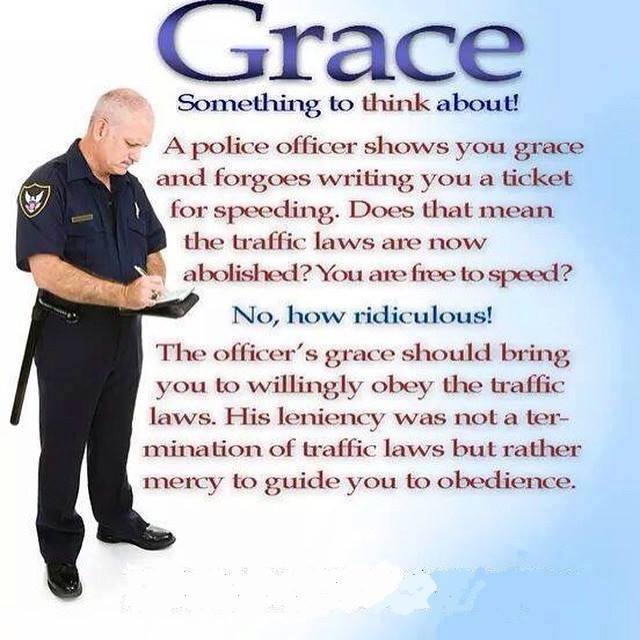 If every verse in the Bible is not about justification, but Protestants believe that, and they do, this will redefine the Bible from cover to cover, and it does. The result is a completely upside down gospel.
For example, the internet placard that inspired this post. How does it define “grace”? Obviously, it defines grace as Christians not getting the punishment they deserve from the “righteous demands of the law.” This “mercy” “guides” you to obedience. But what “obedience”? Well, let me quote the pastor of the person who posted the placard: “You don’t keep the law by keeping the law.”
“You don’t keep the law by keeping the law.” What does that mean in conjunction with “mercy” leading us to this “obedience.” And, do Christians still need “mercy”? According to Protestantism, “yes.” I understand that some Protestants understand this to mean that we are motivated by God’s mercy when we don’t get the punishment that we deserve, but that is a watered down version of the authentic Protestant gospel. And anyway, true Christians no longer need mercy because we are no longer under condemnation; there is “no condemnation” for Christians. But more on the significance of that later.
The crux of the placard and the idea that Christians still need grace is well defined by some comments that were posted in regard to the placard. It starts with the idea that “grace” is synonymous with biblical justification or salvation. And since we still need “mercy” from the law as Christians, we must know how to obtain this mercy leading to keeping the law by not keeping the law. The endeavor is twofold, and exemplified in the following aforementioned comments:
MERCY is when judgement is constrained, and hence is what is being illustrated in this story by the officer letting you off the hook. But GRACE is not that judgement was constrained, but that it was conferred! It’s the picture of the officer, though acknowledging that you were guilty of trespassing the speed limit, determines that he’ll let you go on the premise that he PAID the ticket for you!
And…
What if the police officer decided to jump in the car with you. So every time you drove he’s sitting next to you and just keeps saying don’t worry about speeding I have fulfilled that law. [Viz, I kept the law for you] I’ll whisper to your heart and let you know if you are heading towards the speed limit. I just want to sit and chat with you and get to know you so well that you never ever want to speed again. Because you are forgiven and I love you.
If you think these are armchair theologians, think again. What they are saying is a mirror image of how two heavyweight Protestant theologians stated it in the following video:
What’s the idea here? Since Christians still need mercy from the righteous demands of the law, they must continually receive it by returning to the same gospel that saved them. “Grace” is defined as justification/salvation, so obviously, we must continually return to the same gospel that saved us. To most professing Christians in our day, the idea that Christians still need grace and mercy is a no-brainer and is pontificated with the often-heard, “We must preach the gospel to ourselves every day.”
What is that gospel? It is twofold as exhibited by the two comments. Christ died for our sins which takes care of the penalty of sin (first comment), and then He kept the law perfectly so that His righteousness (perfect obedience) can be imputed to our Christian life. Therefore, as Christians, we continually go back to the salvation well for forgiveness and a righteousness that is not our own. That’s how we keep the law by not keeping the law: Jesus keeps it/kept it for us. The same gospel that saved you also sanctifies you.
Why is this an egregious false gospel? First, we are not under the law for justification. There is no law for Jesus to keep for us. Jesus didn’t come to keep the law for us, He came to end the law… for Justification (Romans 10:4). The fulfilling of the law by Christ does not refer to Him keeping the law perfectly so that His obedience can be imputed to our sanctification.
And “grace” is NOT justification or salvation. “Grace” defines why God saved man; it’s an act of love that expects nothing in return, and of course, we need this same kind of love in our Christian lives, but that doesn’t make our sanctification a progression or specific expression of justification. The love of God is not applied to justification in the exact same way it is applied to our Christian lives (sanctification). Grace, as the reason God justified us (His unmerited love) expects nothing in return because man is utterly unable to justify himself.
However, God also displays His love (“grace” also means “help”) in regard to the purpose for which he saved us: good works…that we actually do in order to please Him. God doesn’t love Himself through us—we are not mere conduits from which God loves Himself; we in fact love God or we do not belong to Him. God’s love towards man in justification has a different application in sanctification. In the former man is completely helpless, in the latter man needs help. Both expressions of love are “grace.”
This is demonstrated by Ephesians 2:8-10…
8 For by grace you have been saved through faith. And this is not your own doing; it is the gift of God, 9 not a result of works, so that no one may boast. 10 For we are his workmanship, created in Christ Jesus for good works, which God prepared beforehand, that we should walk in them.
Grace, or charis, is a Greek word that means “a joyful benevolence.” Actually, the word has a wide variance of applications including, “favor,” “love,” “help,” “dignity,” etc. To define “grace” as synonymous with salvation is inaccurate; grace is the reason God saves, but it is also the reason God does many other things as well. Grace is also the reason that God is our advocate, comforter, co-laborer, and helper in our Christian life. In regard to our Christian life (sanctification), these words are used interchangeably (Heb 13:6, Jn 14:16 Rom 8:26).
Note verse 8: grace is the reason God saved us (John 3:16), but salvation is “the gift.” It is not the result of “works” (v.9), but the result of grace. This is where we have a radical dichotomy between justification (gift) and sanctification (reward). The two are mutually exclusive, and “grace” does not bridge the two. Gift and reward are mutually exclusive. In fact, Hebrews 6:10 says that God would be “unjust” to forget our works in sanctification. Why? Because our works in sanctification is an earned reward that deserves to be recognized. There is no other conclusion that can be drawn from that passage.
The word for “works” in verse 9 is ergon which according to Greek scholar Spiros Zodhiates “stands in direct antithesis” to charis (grace) and the two words are “mutually exclusive” (The Complete Word Study Dictionary, AMG Int. 1992, p.1469). Yet, verse 10 indicates that good “ergon” or works is the purpose of salvation. Salvation is caused by grace, but works is the purpose of salvation. This is why justification and sanctification are mutually exclusive and not bridged by grace. One result of grace is the gift of salvation while the result of the other is reward. Gift and reward cannot be intermingled.
The type and kind of works were predetermined, but we are responsible to “walk” in them with God’s help. In justification, God is a savior; in sanctification, God is a “helper.”
Notice how the professing Christians of our day are obsessed with SIN. Because we are still supposedly under law and need the same “grace” that saved us, our Christianity is obsessed with failure and our dire need for more and more mercy. Life is lived under the cloud of the law, and the focus is how often the holy policemen in the sky does not write a ticket of condemnation.
A pity, because we are not under law and are rather under grace which means we seek to obey God’s law in love. The focus isn’t failure so that we can supposedly glorify God by returning to the foot of the cross, the focus is love which “covers a multitude of sin” (1Pet 4:8). We would sin a lot less if our focus was love, not the expectation of failure under the heavy burden of the law. We are not under the law of sin and death, we are under the law of the Spirit of life (Rom 8:2). We strive to obey that law in love as the primary focus of our life; we dwell on love, not sin.
Moreover, if we glory in more and more mercy that saves us from the law that we are supposedly still under, that will result in a relaxing (lyō) of the law in sanctification that Christ warned us about (Matt 5:19) because after all, we can’t keep it perfectly anyway.
As Christians, our sin is family sin against our Father and can bring chastisement, but it is not sin under the condemnation of the law that requires a return to the same “grace” that saved us. That’s a false gospel. That’s under law, NOT under grace.
So, you do in fact keep the law by keeping the law, because that’s love.
paul
Controversy Among the Dead; What the Resignation of Jean F. Larroux, III Tells Us About the Institutional Church
 It has been brought to my attention that Jean F. Larroux, III has resigned as “pastor” from Southwood Presbyterian Church. Back when I thought the institutional church, that is, Protestantism and all of its various stripes was a victim of New Calvinism, I wrote something like thirty articles about the hostile takeover of Southwood by the New Calvinist machine.
Yes, if only those good Presbyterians understood what Larroux really believed, the Session would run him out of there and save God’s people from a wolf in sheep’s clothing. Well, I have done a lot of growing up since then.
I invested in the fight at the behest of Southwood members and other Presbyterian pastors because I was in the process of publishing The Truth About New Calvinism. I was sort of the go-to guy at that time for the “Old Calvinists.” I don’t know why Larroux is resigning, but a perusal of Southwood’s website clearly indicates that everything is business as usual. The church is presently “led” by fifteen, count them, fifteen “ruling elders.” It is unclear as to whether or not they are paid staff.
I have paid my dues in documenting Larroux’s outrageous doctrine and behavior, so no more time will be invested here. Suffice to say that Larroux was the topic of a whole chapter in the book “Sin Boldly” (a Luther truism) written by Cathleen Falsani. When Larroux was the overseer of a ministry in Bay St. Louis, Miss., he was known as “The Screaming Frenchman” and such is the title of chapter 8. I received an interesting email from someone who did ministry with him there in a leadership capacity, but refused to divulge the information. Why? Because by that time I realized it was not going to accomplish anything—it simply didn’t matter.
Furthermore, Larroux was recently invited by friend Tullian Tchividjian to speak at a Coral Ridge Presbyterian men’s conference where he furthered Calvin’s dark roast version of justification by faith which is really sanctification by justification through faith alone and faithfulness to the institutional church.
Listen, the institutional magic salvation bus supposedly going to heaven will continue to roll with the Jean Larrouxs’ onboard because…despite all of the fuss, what Larroux believes is at the heart of the Reformation gospel. It’s just that simple. There will always be quarreling and confusion on the way because many do not understand that reasoning from a grammatical interpretation of the Scriptures was contrary to Luther and Calvin’s interpretive approach.
We find a hint of that from this exchange:
Tullian Tchividjian was preaching on Friday night of the conference and his message centered around the need of grace and the preaching of the Gospel as vital in the lives of Christians. The message was moving, helpful and delivered with great passion. When he was done we sat in the pew following worship soaking in the reality of the Gospel. Brock turned to me and said, “We’re not crazy are we?” I said, “Well, we might be crazy, but we are not wrong…”
I had two emotions when Brock said that to me. The first was offense. I was offended. What did he mean, ‘we’re not wrong, are we?’ How dare he insinuate that what I had been preaching was wrong. “WHAT A JERK!” said my heart. But then I thought about his statement, our history at Southwood, the incessant chatter that said over and over again that we had taken grace ‘too far.’ Brock wasn’t making a statement of criticism. He was making a sigh of relief. It was easy to begin to believe the blogs and sidebar comments, but hearing the same exact message from a different voice in a different venue was not only affirming, but very reassuring.
And there you have it my friends; the institutional church, regardless of the stripe, is made up of Progressive Justification Light and Progressive Justification Dark, and sometimes there is disagreement in regard to the essence. If you are old enough like me, you remember the old Miller Light commercials, “Less filling! ‘No, great taste!’” And so it goes, “Not enough justification! ‘No, too much justification!”
This false gospel has circumvented a vast doctrinal body under the auspices of Christian living in sanctification. We must take back that doctrine, but it will only be accomplished by the laity fellowshipping in home fellowships apart from the institutional church.
Let the dead bury their own dead.
paul
What Your Sanctification Says About Your Justification: Is Your Gospel True or False?
 “The law is the standard for love, not justification. In all of the aforementioned systems of sanctified justification by works, faith doesn’t work because it can’t lest salvation be lost. In the Christian life faith works because it can for the sake of love without condemnation.”
“Knowing that justification is a settled issue that has nothing to do with the law anyway, the true Christian only sees law-keeping as an opportunity to love. Christians not only have the anthropologic law of conscience written on the heart, the new birth writes the Bible there as well. In other words, we love the law.”
“Obviously, those who must focus on faith alone works in order to remain justified cannot focus on aggressive obedience to the law that defines love.”
What do you believe about salvation? Your Christian life will tell you. Therefore, the parable of the talents in Matthew 25:14-30 should not confuse us. The “wicked” servant was not cast into outer darkness because he didn’t put his talents to work, but rather what he thought it meant to be a servant. In other words, in order to be saved, you need to know what a Christian is. That should be fairly evident.
Do you live your Christian life by “faith alone”? That is a statement in regard to what you believe about salvation, or what happened to justify you; viz, justification.
This is not complicated. Don’t complain that I am making your touchy-feely “simple” gospel a theological treatise. I am sure you concur that some Bible words have to be understood in order to be saved. The Bible splits humanity into two categories: saved and unsaved; i.e., “under law” or “under grace” (Romans 6:14).
“Under law” is the biblical nomenclature for the unregenerate lost. Under law means that sin rules you. Not in a plenary sense, because man’s conscience and fear of punishment from civilian law restrains people. Yet, they are under the condemnation of God’s law and every violation is documented. Unless they are saved, they will be judged according to their works in the final judgment. Though some who followed their conscience more than others will receive a lesser condemnation, it is still eternal separation from God. They are under law, and enslaved to sin. The last judgment DOES NOT determine justification; it ONLY determines the degree of eternal condemnation. It doesn’t determine justification; it only determines the wages of sin.
Moreover, sin uses the condemnation of the law to provoke people to sin. Primarily, sin uses desires to tempt people, but sin’s incentive is the law because it condemns. Sin lives for the purpose of condemning people, and uses desire to get people to sin against God’s law. This leads to present and eternal death. Sin’s desire is to bring death. When the Bible speaks of “the desires of the flesh” it is referring to instances when the flesh is serving the desires of sin.
The flesh can also be used to serve the desires of the Spirit (Romans 12:1). The flesh has NO desires; it is used by the dweller for good or evil purposes. We will either use our bodies to serve the desires of sin or the desires of the Spirit. Of course, people have their own desires, but unfortunately, the unregenerate are guided by the desires of sin. They assume sinful desires are their own desire which is true. In contrast, sinful desires are not part and parcel with the regenerate soul.
Said another way: among the lost, the desires of sin are very much the same desires possessed by the individual who are indifferent to the law of God. A desire for God’s law is absent while their life is continually building a death and condemnation dividend. Some of that dividend is paid in this life until the full wages of death are paid at the final judgment.
Under grace is not void of law. The law (same as “Scripture” or same as “Bible”) has a different relationship to the saved, or those under grace. A literal baptism of the Holy Spirit takes place, as symbolized in water baptism, which puts to death the old person under law and resurrects the new person under grace. The saved person is now a new creature created by the Spirit of God. The person under grace is literally born of God—he/she is God’s literal offspring.
Therefore, the old person is no longer under the condemnation of the law in the same way a dead person cannot be brought under indictment for a crime. Consequently, the motivation for sin is gone. The power of sin is the law’s condemnation that leads to death (1Corintians 15:56, 57). In addition, the person under grace has been given a new heart that loves God’s law and its way of life. The book that could only bring death is now a book that brings life. Either way, it is the Spirit’s law; He uses it to condemn those that are under it, or uses it to sanctify those who are under grace (John 17:17).
THEREFORE, how you see the law determines what you believe about salvation. If you believe that you can somehow obey the law in a way that unwittingly seeks to be justified by law-keeping, you are still under law. If you believe justification is defined by perfect law-keeping, you are still under law. Those who believe this also believe they need a salvation system that filters all their works into a category of faith alone. The Christian life is categorized or departmentalized into works that attempt to be counted for justification and faith alone works that qualify as “living by faith alone.” Do not miss the point that this also includes abstaining from certain things that aren’t necessarily sin as defined by the Bible.
Yes, hypothetically, a person would need to keep the law perfectly to be justified by the law, but that doesn’t make perfect law-keeping the standard for righteousness. If that were the case, the law is a co-life-giver with the Holy Spirit, and a death would not be necessary. We are justified APART from the law—law has NO part in justification. The Bible defines justification, but it’s not a standard of justification (Rom 3:21, Gal 2:19, 4:21). Law-keeping by anyone does not justify.
If one is trusting in a system that fulfills the law for justification, particularly if it calls for not doing something in order that the law is fulfilled in our place, that is works salvation through some kind of intentionality whether passive or active. These kinds of systems are always indicative of being under law rather than under grace. One such system that has several variances calls for doing certain things or not doing certain things on the Sabbath which can be Saturday or Sunday depending on the stripe of system. If you follow the system on the Sabbath, all works done by you during the week are considered to be by faith alone.
In Reformed theology, particularly authentic Calvinism, contemplation on your sin leading to a return to the same gospel that saved you imputes the perfect law-keeping of Christ to your life. Notice that a fulfillment of the law is required to keep you saved, but we do faith alone works in order that Christ’s perfect law-keeping is imputed to our account. The problem here is that a fulfillment of the so-called “righteous demands of the law” is the standard for justification. Hence, clearly, this keeps so-called “Christians” UNDER LAW. In addition, a so-called faith alone work is still a work.
Not so with under grace. We are now free to follow our new desire to obey the law out of love without fear of condemnation. The law is the standard for love, not justification. In all of the aforementioned systems of sanctified justification by works, faith doesn’t work (or love) because it can’t lest salvation be lost. In the Christian life (sanctification) faith works because it can for the sake of love without condemnation (Galatians 5:6).
Knowing that justification is a settled issue that has nothing to do with the law anyway, the true Christian only sees law-keeping as an opportunity to love. Christians not only have the anthropologic law of conscience written on the heart, the new birth writes the Bible there as well. In other words, they love the law. Obviously, those who must focus on faith alone works in order to remain justified cannot focus on aggressive obedience to the law that defines love.
This is exactly what the books of James and 1John are about. Faith is not afraid to work because there is no condemnation. Faith without works is dead, “being alone” (James 2:17 KJV).
Are you in a religious system that propagates faith “alone” in the Christian life? Your faith is not only dead, it speaks to what you believe about justification. You believe justification has a progressive aspect and is not completely finished. Secondly, you believe the law has a stake in justification. Thirdly, your system categorizes works as faith alone works (an oxymoron of sorts) or works that are unfiltered in some way and therefore are efforts to “self-justify.”
If you believe the right gospel, you know that it is impossible to unwittingly partake in an endeavor to justify yourself. It’s a metaphysical impossibility—it’s not in the realm of reality. No false religion teaches that you earn your justification by perfect law-keeping—there is always a system that prescribes sanctified do’s and don’ts that in turn fulfill the law for you, otherwise known as “the traditions of men.”
It’s the fallacy of faith alone works for justification. But any work for justification is justification by works whether doing nothing (abstinence is still doing something), something passive (contemplationism or prayer is also a work) or anything active.
Law and justification are mutually exclusive, and true faith is “faith working through love” (Galatians 5:6). Faith works because there is no fear in love (1John 4:18). Don’t be like the servant who was afraid and hid his talents in the ground. Christ said it best:
“If you love me, keep my commandments.”
paul
What is the Race of Faith? Justification or Sanctification? Or Both? A Biblical Evaluation, Part 1: First Letter of John 1:7-10
But if we walk in the light, as he is in the light, we have fellowship with one another, and the blood of Jesus his Son cleanses us from all sin. 8 If we say we have no sin, we deceive ourselves, and the truth is not in us. 9 If we confess our sins, he is faithful and just to forgive us our sins and to cleanse us from all unrighteousness. 10 If we say we have not sinned, we make him a liar, and his word is not in us.
1John 1:7-9 are the go-to verses for most Protestant denominations, particularly verse 9. The rendering promotes the idea that we must continue to confess known sin after salvation in order to keep our salvation. This isn’t considered to be works salvation because repentance is a faith-alone work that originally saved us. So, since we are going back to the same gospel that saved us, and that salvation is by faith alone, and repentance is by faith alone, doing this act in order to keep ourselves saved is by faith alone and not works.
Hence, the Christian life is a “race of faith” in which the prize, or reward is salvation. As long as we live our Christian life by “faith alone” we are not disqualified from the race. In verses like 1Corinthians 9:24, the prize for winning the race is taken to mean salvation.
The key to how this works is the confession of sin that is brought to our attention by conscience or the Holy Spirit. If we confess that, we are then cleansed of all unknown sin and sin beneath the sin. As long as we are returning to the same faith-alone gospel that originally saved us, it doesn’t count as works. As plainly stated by many Protestants, Christians still need ongoing salvation from sin. And verse 7 is the icing on the cake; if we “fellowship” with each other, viz, if we are a member of the church in good standing, this in and of itself also continues to cleanse us. John Calvin et al taught that ongoing repentance for re-cleansing (re-salvation) was only valid if one is a member of the institutional church. For several citations on this, read the booklet “It’s Not About Election.”
This is the prime example of traditions of men (orthodoxy) fulfilling the law of God on behalf of the “believer.” The so-called believer partakes in some kind of activity in order for a substitution of some sort to be perpetually imputed to the subject for the maintaining of salvation. Of course, the fundamental error is law being a standard for justification. Law either condemns or sanctifies, but it has no part in justification. Second to that, when justification is not a finished work, ambiguous classifications for what is a work and what isn’t a work is needed to keep justification moving forward by “faith alone.” See the problem? A faith-alone work is an oxymoron.
Even more icing is heaped on the cake when you approach these verses with the Redemptive Historical hermeneutic. This interprets every verse in the Bible as a salvation verse, or justification verse in a supposed context of progression.
So what’s really going on with these verses and others like them? It’s simple when you approach the same with the Grammatical Historical hermeneutic. Historically, John was addressing the rampant Gnosticism of the day that saturated the 1st century church and culture. There were and are many, many veins of Gnostic thought, but John was addressing the one that believed man was spirit and therefore pure; only the material realm is evil. Therefore, no person sins because they are spirit—it’s the material world that’s evil. Moreover, it doesn’t matter what one does in the body because it is of the sinful material realm.
While many recognize this historical fact, they proceed to see these verses as sanctification verses. While rightly dividing the difference between sin unto condemnation and sin against God’s family relationship, they errantly concede a continued need for “cleansing.” It goes something like this: because we also fail to recognize family sin that we commit, it is necessarily for that sin to be cleansed as well when we confess sin against family. While this is far closer to the truth than the former, and perhaps harmless, it is best to see 1John 7-10 as verses pertaining to justification as a onetime finished work.
An idea that man is sinless because he is spirit denies the need for the gospel altogether; it makes God a liar. In that context, 1John 7-10 makes perfect sense. But the question becomes that of Greek tenses, moods, and voices. Is this forgiveness an ongoing need, or did it just happen once? And if it only happened once, is the effect still ongoing? When this is considered grammatically, the arguments can fly in every direction. The English translation seems to imply an ongoing need for forgiveness.
First of all, the New Testament does not emphasize repentance in sanctification to the degree that repentance for justification is emphasized. The emphasis is a onetime turning away from who you presently are to save yourself from a perverse generation (Acts 2:40). Don’t get me wrong, repentance is a part of sanctification, but the emphasis is a positive one regarding what we are free to do, not what we have been set free from. The past bondage to sin is not emphasized in the Bible, the freedom we have to love is what is emphasized.
1Peter 4:8 – Above all, keep loving one another earnestly, since love covers a multitude of sins.
God is love (1Jn 4:16), love matters more than sacraments (Gal 5:6), casts out fear (1Jn 4:18), covers a multitude of sins (1Pet 4:8), is the only gift that will not pass away (1Cor 13:8), and is greater than faith and hope (1Cor 13:13). The idea that Christianity is a “lifestyle of repentance” is egregiously misguided; Christianity is a lifestyle of love. The past bondage is not emphasized in the Bible; the freedom we have to love is what is emphasized.
No wonder then that 1John 1:7-10 is interpreted through the prism of a continued focus on condemnation and sin. In contrast, it is pitting repentance from sin unto salvation against the idea that man is already sinless and has no need to be forgiven through belief in Jesus Christ. This idea is also calling God a liar in regard to man’s true status. Therefore, we see that 1John 7-10 regards justification as set against the historical teachings of Gnosticism that was infiltrating the Christian assemblies at that time. 1John is also peppered with a pushback against the same vein of Gnosticism that posited the idea that Christ didn’t really come in the flesh (I John 1:1).
1 John 1:7-10, though having a grammatical semblance of present continuous, is speaking of the onetime finished work of justification that all people need as opposed to the Gnostic idea that the invisible is good, and the material is evil, and that all sin belongs to the material realm and not relevant to the spiritual. We have looked at the historical, now let’s examine the grammatical.
Verse 7… “the blood of Jesus his Son cleanses us from all sin.” The book of Hebrews makes it absolutely clear that this only happened once.
Hebrews 10:11 – And every priest standeth daily ministering and offering oftentimes the same sacrifices, which can never take away sins:
12 But this man, after he had offered one sacrifice for sins for ever, sat down on the right hand of God;
13 From henceforth expecting till his enemies be made his footstool.
14 For by one offering he hath perfected for ever them that are sanctified.
15 Whereof the Holy Ghost also is a witness to us: for after that he had said before,
16 This is the covenant that I will make with them after those days, saith the Lord, I will put my laws into their hearts, and in their minds will I write them;
17 And their sins and iniquities will I remember no more.
18 Now where remission of these is, there is no more offering for sin.
Is the blood of Jesus reapplied to our sins each time we repent? This is the only contextual conclusion that can be drawn from the aforementioned orthodox use of 1John 1:7-10. It is a perpetual application of the blood for each known sin that we commit, plus an additional cleansing for unknown sin.
To the contrary, there is one sacrifice for ALL sins and for ALL time resulting in God not remembering any sin committed by believers. Said interpretation of 1John 1:7-10 states that God will in fact remember our sin if we do not reapply the one sacrifice of Christ. Again, 1John 1:7-10 is a justification verse; that justification is a finished work that only occurs once.
Surrounding verses in context also support this view. “I am writing to you, little children, because your sins are forgiven for his name’s sake” (1John 2:12). Also, those who walk in the light are representative of those who have been cleansed from “all” sin (v.7), and the washing is always indicative of justification as a onetime finished work (note John 13:9-11).
Repentance for family sin resulting in prevention of Fatherly chastisement is another issue altogether and has nothing to do with 1John 1:7-10.
James 5:13 – Is anyone among you suffering? Let him pray. Is anyone cheerful? Let him sing praise. 14 Is anyone among you sick? Let him call for the elders of the church, and let them pray over him, anointing him with oil in the name of the Lord. 15 And the prayer of faith will save the one who is sick, and the Lord will raise him up. And if he has committed sins, he will be forgiven. 16 Therefore, confess your sins to one another and pray for one another, that you may be healed. The prayer of a righteous person has great power as it is working.
A “lifestyle of repentance” keeps our focus on “keeping ourselves in the love of God” or stated more plainly, keeping ourselves saved for a best shot at “standing in the judgment.” There is no condemnation for those who believe Christ and we will not stand in any judgment that determines justification (John 5:28,29, Luke 14:12-14). However, Christians who live out their calling to righteous living will have confidence when we are swept up in the general judgments that come upon the world, or His appearing at the end of the tribulation period (1John 2:28, 4:17). Peter spoke of a “rich entry” into the kingdom (2Peter 1:11).
Focusing on assumed sin that we are supposedly powerless to overcome will keep us from a successful Christian walk that gives us confidence (I Jn 3:18,19, 2Pet 1:9,10, Heb 10;22), a walk that pursues peace and love as a focus and not an endeavor to discover how sinful we are.
This will only lead to fear, and a shrinking back from the thought of seeing God. In contrast, mature love casts out fear.
paul
A Reformed Myth: Calvinists Believe in Election
 Originally published July 25, 2013
“And this is far from being a John Piper exclusive, this is the Reformed tradition.”
It would seem that something good could be said about Calvinism’s doctrine of election; at least if you are one of the lucky chosen, you are guaranteed eternal life, right? Wrong.
So-called “election” only takes care of original sin, you must now continue to live by faith alone in your Christian life so that the perfect obedience of Christ continues to be imputed to your account. The specific terms for this are “Christ 100% for us” and “already not yet.” Since Calvinists see justification and sanctification as the same thing, “100%” means Christ must perform all works in both justification and sanctification.
John Piper preached a series entitled, “How Does the Gospel Save Believers?” Did you know believers still need to be saved? In the series he explains how we are already saved but not yet:
We are asking the question, How does the gospel save believers?, not: How does the gospel get people to be believers? When spoken in the power of the Holy Spirit, the gospel does have power to open people’s eyes and change their hearts and draw them to faith, and save them. That’s what is happening on Tuesday nights and Wednesday nights this summer. People are being drawn to Christ through the power and beauty of the gospel. But I am stressing what Paul says here in verses 16 and 17, namely, that “the gospel is the power of God for salvation to everyone who believes.” Believers need to be saved. The gospel is the instrument of God’s power to save us. And we need to know how the gospel saves us believers so that we make proper use of it.
So, did you know that believers need to make “proper use” of the gospel in order to be “saved” as believers? And this is far from being a John Piper exclusive, this is the Reformed tradition. Piper’s next statement defies the imagination in regard to how mind numb people must be at Bethlehem Temple:
I say it with Paul: I, John Piper, am eager to preach the gospel to you who believe – exactly to you who believe – because this gospel which is laid out in the book of Romans, is the power of God to save you. You believers need to hear the gospel in order to be saved. And Paul labors mercifully for 16 chapters to tell us the gospel and how it works to save believers.
Well, this should be a crude awakening in regard to what Calvinists mean when they say, “We must preach the gospel to ourselves every day.” They mean this as a matter of eternal life and death for the believer.
And so it goes: election isn’t the issue, the gospel of progressive justification is the issue, and besides that, Calvinists don’t even believe in election to begin with.
paul

 Paul's Passing Thoughts
leave a comment