TANC 2015: Paul Dohse Session 1 – Introduction to Biblicism
Session 1: Introduction to Biblicism
Who do we think we are? Why would Western culture be immune from populous deception? In fact, history, even recent history reveals the dangers of collective logic whether by tradition or some sort of neo-movement. Moreover, examples of bad fruit coming from collective logic can be taken from the best of what Western culture has to offer.
There is one constant that shapes culture; change occurs as a result of bad fruit. The collective pain threshold begins to surpass the threshold of life value. Society then becomes split into two types of people: those with new ideas and those willing to listen.
Tyranny has always been a foolish endeavor by virtue of God’s design of things. The reason is simple: the people always outnumber the rulers, and the rulers need people to have a government, and you can only kill so many people. This is why controlling the way people think is so important; this taps into the human resource without killing the donor.
From the cradle of society, caste was the norm. Unfortunately, the consensus had always been that bad fruit had nothing to do with the system, but only those running it. The American experiment was the first successful challenge to collectivism. The definition of the words and the understanding of them are a matter of life and death on a massive scale. For example, “individualism” does not exclude cooperation and organization for the common good, but rather, asks who will determine what the common good is and how one reaches that conclusion. The assumption that individualism leads to societal chaos has in fact produced chaos in incomprehensible proportions.
Once again, history is repeating itself in many ways, but the particular aspect that TANC focuses on is Protestantism. Once again, fruit demands reevaluation because of the threshold of pain. But this time of historical reevaluation is utterly unique because it is post American Revolution. For the first time in over 500 years, Protestantism faces a reevaluation without the force of state at its disposal.
Nevertheless, Protestantism has done its job well. It yet has no fear of replacement because those who have given up on it believe there is no alternative. Hence, its utter failure has produced no competitors. The Nones and the Dones are just that, none and done. Yet, lest Protestantism would break from protocol and show mercy to its detractors, the Nones and the Dones are declared damned to hell on their way out to the wilderness of hopelessness because being a member in good standing in the institutional church is synonymous with loving Christ and being a legitimate part of His body.
We at TANC reject such an arrogant notion with extreme prejudice, and believe we understand a legitimate alternative—a return to the assembly of Christ and its priesthood of believers. A return to individual gifts, not spiritual collectivism; fellowship, not membership; leadership, not dictatorship; organization, not institutionalization; not many masters, but only one; a body, not a corporation, and finally, freedom of conscience. Individual saints with one word, one Lord, and one body. It’s a body, not a spiritual caste system, and we have but one mediator—the Lord Jesus Christ.
Biblicism
The alternative to Protestant orthodoxy is Biblicism. What is it? Let’s begin with a definition from Wikipedia. This is by far the best definition of Biblicism that I have ever found, and unfortunately listed under an alternative name for Biblicism, “Biblical Literalism.” And, as rightfully noted by Wikipedia, often used as a pejorative. Don’t you know, any Biblicist that has read Matthew 5:30 has cut off his right hand or feels guilty that he hasn’t. Let’s examine the definition:
Alternatively, the term can refer to the historical-grammatical method, a hermeneutic technique that strives to uncover the meaning of the text by taking into account not just the grammatical words, but also the syntactical aspects, the cultural and historical background, and the literary genre. It emphasizes the referential aspect of the words in the text without denying the relevance of literary aspects, genre, or figures of speech within the text (e.g., parable, allegory, simile, or metaphor).
Let me add that Biblicism starts with literalism and the plain sense of the text first, and then utilizes the elements of the historical-grammatical methods as needed to make the rendering consistent with the rest of Scripture. As one person has said, “When the plain sense of Scripture makes common sense, seek no other sense.” Let me also add that Biblicists would normally be impressed with a method of interpretation known as Occam’s razor. Again, we are indebted to Wiki for a definition:
…a problem-solving principle devised by William of Ockham (c. 1287–1347). It states that among competing hypotheses, the one with the fewest assumptions should be selected. Other, more complicated solutions may ultimately prove correct, but—in the absence of certainty—the fewer assumptions that are made, the better.
In context of the lay person, learning is a jigsaw puzzle. I want to use this example of a jigsaw puzzle that is a map of Xenia, Ohio. Let’s say the map, to the degree that it is fitted together, represents knowledge of Xenia. Until the puzzle is completely fitted together with all of the pieces, what do we do with the pieces that we can’t get to fit into the map presently? Answer: we lay those pieces aside for the time being. Dear layman, you don’t need the scholars. In fact, please remember that we live in the Information Age. Study to show yourself approved as a “workman.”
As a parenthesis regarding interpretation, let me offer all the proof you need to know that every verse of Scripture must be interpreted in context of justification or sanctification; Christians, throughout the New Testament, are referred to as “workman.” If justification is not a finished work, the fact that we are participants in it is unavoidable, either by direct participation or intentional non-participation. Intentional non-participation is doing something. If justification is not a finished work, invariably, religious formulas for work works and faith alone works emerge. The problem here is evident: if you can lose your salvation, what do you have to do, or not do, in order to keep it?
The Dirty Little Secret
What we are talking about here is deductive/inductive study of the Bible that begins with the presupposition that man is able to reason. Here is where we must stop and state a huge historical fact in this matter that is irrefutable. Historically, there have only been two schools of thought on Bible interpretation: the historical-grammatical method, and the historical-redemptive method.
But please, if you don’t take anything else away from this first session, please know the dirty little secret in all of this: these are ALSO two different ways of interpreting reality itself. Listen: the Protestant Reformers started first with their interpretation of reality, and then extrapolated that method onto the Bible as well.
If you have been following our TANC series on the first and foundational doctrinal statement of the Reformation, the Heidelberg Disputation, you know that Martin Luther laid the foundations in that document for the historical-redemptive method of interpreting reality and consequently the Bible as well. Luther believed that all of reality is a redemptive metaphysical narrative written by God. Look out the window right now. See that car driving down the street? The only reason that just happened is because God wrote it into the script of the metaphysical narrative, what many of the Reformed call the “divine drama.” Reality is nothing but a story written by God.
Hence, salvation is only an ability to perceive or “see” the story. The unregenerate are defined by those who think they have ANY measure of freewill. To have freewill is the ability to write your own reality. Luther’s assessment of freewill is therefore called “the glory story of man.” Either one confesses that God wrote the story of history and reality, or man is foolishly trying to write his own reality.
Luther received this idea primarily from Saint Augustine and Saint Gregory, established the Protestant Reformation with its premise, and John Calvin later articulated its supposed life application in the Calvin Institutes of the Christian Religion. It called for a repeat of our spiritual baptism throughout the Christian life by progressively seeing/perceiving two things: the depravity of man and the holiness of God. Plunging the depths of our sinfulness supposedly brings about humbleness and self-death resulting in a resurrection of joy regarding our original salvation. Therefore, the joy of our salvation is progressively increased throughout our Christian lives regardless of circumstance. In fact, tragedy only facilitates our ability to see our depravity and the judgement that we deserve. Tragedy is merely a part of God’s prewritten gospel narrative.
Consequently, Spirit baptism is not a onetime event, but is repeated throughout our Christian life. The Bible has one purpose and one purpose only: to aid the “believer” in continually revisiting salvation and the perpetual revisiting of Spirit baptism. This is an official Protestant doctrine called mortification and vivification. Several Protestant organizations use the chart below to illustrate this doctrine and the historical-redemptive use of the Bible:
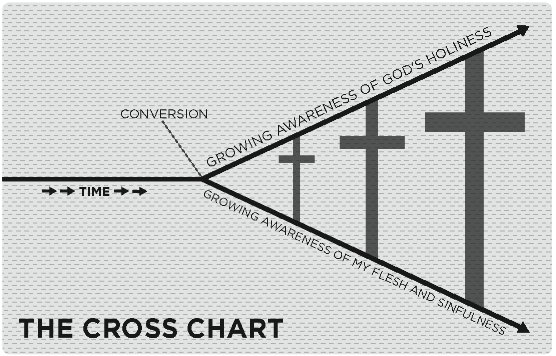
Therefore, God uses circumstances and the Bible to help us in the downward trajectory illustrated by this chart. A contrary perspective on reality is illustrated by another chart widely published by Protestant organizations:
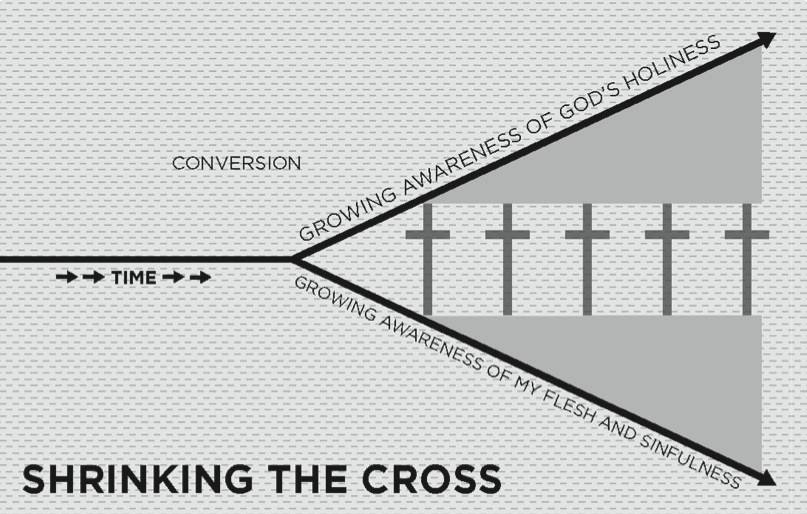
What is behind the popularity of this worldview? Simply, an ability to live a carefree life without fear of unknown circumstances (with the only exception being your eternal destiny). We all know that investing in life can set us up for enhanced disappointments and suffering. This is a worldview that completely separates us from the responsibilities of life and its suffering. Don’t worry, be happy, it’s a just a divine video tape anyway, and what will be, will be. If one of your loved ones dies tragically, don’t sweat it, it’s just part of God’s divine drama prewritten before the foundation of the earth. Besides, God is using this to make the gospel bigger and you smaller. Listen, even Protestants who don’t get this function according to the same worldview: “It’s God’s will.” “I didn’t do it! God did it!” “We are all just sinners saved by grace.” All of these Protestant truisms fit the downward trajectory of the above cross chart.
As far as Biblicism, there is a huge pushback against it. A focal point of the pushback is a book written by Protestant turned Catholic Prof. Christian Smith titled, The Bible Made Impossible: Why Biblicism is Not a Truly Evangelical Reading of Scripture. I must credit the Christian Research Institute with the following review of the book which is endorsed by many evangelical heavyweights such as Rachel Held Evans, and will help us further define Biblicism:
Smith asserts that biblicism is the constellation of ten different assumptions or beliefs: (1) The words of the Bible are identical with God’s words written inerrantly in human language. (2) The Bible represents the totality of God’s will for humanity. (3) The divine will for all issues relevant to Christian life is contained in the Bible. (4) Any reasonable person can correctly understand the plain meaning of the text. (5) The way to understand the Bible is to look at the obvious, literal sense. (6) The Bible can be understood without reliance on creeds, confessions, or historic church traditions. (7) The Bible possesses internal harmony and consistency. (8) The Bible is universally applicable for all Christians. (9) All matters of Christian belief and practice can be learned through inductive Bible study. (10) The Bible is a kind of handbook or textbook for Christian faith and practice.
While some evangelicals may downplay or deny some of these points, Smith suggests as long as you hold to some of these points, you are still a biblicist (pp. 4–5).
Before we address these points for a clearer understanding of what Biblicism is, it shouldn’t surprise us that the only alternative in the book is the Christocentric hermeneutic which is the same thing as the historical-redemptive hermeneutic. It sees the gospel or Jesus in every verse of the Bible as a result of interpreting reality itself through the suffering of the cross. It should be noted that this hermeneutic is crossing over into Catholicism as well.
(1) The words of the Bible are identical with God’s words written inerrantly in human language.
A Biblicist believes no such thing. God used fallible humans to write the Bible over 1600 years in many different languages. Because Christ warned that there would be serious consequences for tampering with God’s word, we can assume many have in fact tampered with it.
The key follows: the Bible is God’s statement on being including metaphysics, epistemology, ethics, and politics. The Bible is not without error in the transmission of these truths, but none of the truths are lost due to God’s oversight and assistance. Included is the way that the Bible was written, or its overall structure of checks and balances. As the “workman” studies to show himself approved, God’s principles become more and more apparent.
(2) The Bible represents the totality of God’s will for humanity.
This point is vague, but one assumes it speaks to the accusation that Biblicists believe the Bible speaks to every detail of life like how to fix our cars etc. While the notion is absurd, the Bible does tell us what kind of car-fixer we should be—not the details of a how-to-manual. The Bible is a manual for how we should love God and others, so while it does not give specific instructions on how to fix our wife’s Toyota, it does convey a principle of love that would prevent us from taking shortcuts on safety issues in order to save money. If it’s our wife’s car, we don’t repair the brake lines with duct tape, etc.
(3) The divine will for all issues relevant to Christian life is contained in the Bible.
This is true, and the reason for the contention is evident: the sole purpose of the Bible should be to show us how wicked we are, not instruction on loving God and others.
(4) Any reasonable person can correctly understand the plain meaning of the text.
True, with the exclusion of the straw man argument that the meaning in every text is always “plain.” The Bible states that individual study is required, and acknowledges that obtaining understanding can be difficult work.
(5) The way to understand the Bible is to look at the obvious, literal sense.
This is true as the primary organizing principle, but gain, the straw man is the assertion that Biblicists believe this is true of every verse.
(6) The Bible can be understood without reliance on creeds, confessions, or historic church traditions.
This is absolutely true because Biblicism rejects spiritual caste systems of all kinds. Teachers are a help, they are a gift to the church for purposes of equipping, NOT an office. But when it gets right down to it, in context of the apostle John addressing the Gnosticism that was wreaking havoc on the 1st century church, he stated, “You have no need for anyone to teach you.” Biblicism is predicated on collective individualism, not group-think overseen by an elite class of those who supposedly possess the “gnosis.”
(7) The Bible possesses internal harmony and consistency.
Absolutely. Again, the complexities of the Bible are used to argue against human reason as a valid epistemology for reasons of selling a redemptive interpretation of all reality.
(8) The Bible is universally applicable for all Christians.
Sure it is. Loving God and others pertains to principles that are universal.
(9) All matters of Christian belief and practice can be learned through inductive Bible study.
In regard to loving God and others, absolutely.
Note the continual distinction being made between love and law. There is a specific reason for that which we will see more of later.
(10) The Bible is a kind of handbook or textbook for Christian faith and practice.
The word “practice” factors in huge here. As previously noted, Protestantism defines salvation as an ability to see/perceive/experience APART from practice. Therefore, the Christocentric approach to interpretation of reality, and consequently the Bible as well, will reject any practice by man to be of any value to God. Therefore, the sole purpose of the Bible is to aid mankind is seeing that all righteousness is an alien righteousness completely outside of man.
So, this is an introduction to Biblicism. In the next session, we will look at the Biblicist gospel, its evaluation of law/gospel, the nature of God, the nature of man, evangelism, and the nature of sin. In the fourth session, we will examine Protestantism and the extreme contrast that it presents. I will conclude this first session with a few more principles of interpretation:
Deuteronomy 29:29 – The secret things belong to the Lord our God, but the things that are revealed belong to us and to our children forever, that we may do all the words of this law.
Deuteronomy 30:11 – For this commandment that I command you today is not too hard for you, neither is it far off. 12 It is not in heaven, that you should say, ‘Who will ascend to heaven for us and bring it to us, that we may hear it and do it?’ 13 Neither is it beyond the sea, that you should say, ‘Who will go over the sea for us and bring it to us, that we may hear it and do it?’ 14 But the word is very near you. It is in your mouth and in your heart, so that you can do it.
Two basic interpretative principles can be drawn from these verses. First, some things we cannot know, but what we can know we are responsible for. Second, we have no need for interpretive mediators between us and God. There is only ONE mediator between God and man—Christ.
TANC 2014 Susan Dohse, Session 2: Three Myths of Puritanism: Freedom, Destiny, and Worldview
Okay, George Santayana is credited with saying “Those who cannot remember the past are condemned to repeat it.” How many of you have heard that? It’s very popular catchy phrase has taken on several variations. Now many moons ago when I taught high school history and social studies, I would sometimes introduce the classes by saying my teacher variation of that quote. First day of U.S. History, “Welcome to U.S. History. It is important for you to do well in this class for remember, those who do not learn history are doomed to repeat it.” One particular year, this one poor guy in the back of the room put his head down on his desk and went, “I’m doomed! I’m doomed!” And his friend is faking compassion patted him on the back, “It’s okay, man. She always gives extra credit.” “But you don’t get it. I hate History and Mrs. [UNINTELLIGIBLE 0:01:12] is the only history teacher in the school. I’m double doomed!” Not only having to repeat history but having to have me for two years, but he did pass the class, and I do believe he still dislikes history.
But that phrase though, “Those who cannot remember the past are condemned to repeat it” is impressive, is common and is difficult to disagree with. If it is true and if history is so ugly and objectionable, then this proverbial quote ought to be a guide to public and private policy. For example, couples who do not learn from their fights, break up. People who don’t learn from their mistakes, they don’t mature. Revolutions that give an individual absolute power inevitably end up as brutal dictatorships. After repeated wars between Germany and France, France made harsh demands on Germany and their terms of surrender after World War I, then the Second World War happened. After Stalin’s brutal regime of secret police and leader worship, Cuban revolutionary has allowed their charismatic revolutionary leader to seize absolute power, and Castro still hold the seat of dictatorial power in Cuba today. History shows that those who do not learn from history are doomed to repeat it.
What about this idea? And what about those who do learn from history? Are they still doomed to repeat it? If the converse is true, then the saying has no power and adds nothing at all to the discussion. What adds power to that quote is the word “learn” because with learning, with knowledge, there’s a hope of change. But will it, can it happen? Will knowledge lead to change? Will learning what history taught us provoke us to make the changes necessary to keep it from being repeated? Can it be that all the good and bad things about people and the way we organize ourselves simply creates patterns as we make history? Could it be that we are given to a certain irrationality which leads us down paths, some disastrous, again and again?
Now consider this different approach. When you look back through history and you see man taking the exact same steps, coming to the exact same conclusions generation after generation, millennia after millennia, what were their root assumptions? “It does not matter how inconsistent the ideas. It doesn’t matter how insane the rationale. They will act until the logic is fulfilled. Therefore, when you see masses of people taking the same destructive actions, find the assumptions and you will find the cause.” That’s the gospel according to John Immel, chapter 3 verses 1 through 3. I did learn something from our first conference.
Knowing the cause should provoke us to take some kind of action, hopefully, preventative action, proactive action, and proactive changes. WXY and Z now I know my ABCs. Tell me what you think of me… Well, I think you know your ABCs. Now tell me what are you going to do with that knowledge? Will you take action and make meaning of the letters, connect them with sounds and letter combinations and create words and words that build sentences and ideas? Will you take your ABCs to that ultimate conclusion and learn to read and write? Will we learn the lessons of the history past and use that knowledge to take action to stay off those irrational and destructive past? Maybe yes maybe no. I do know some children who know their ABCs. Blaine [SOUNDS LIKE 0:06:05] knows his ABCs, but he has not yet learned to read. There are those who know history and are dooming themselves and us by repeating it or causing it to repeat.
So, are we like the Calvinists who believe and hold on so tenaciously to the doctrine that we are predestined to live in this time and space with no choice, no say in the direction we are to take and no say in how we stand, no chance for change. Are we to take up that clarion call, become like the Puritans of old and all things will be set to right? Now why not consider the assumptions and logic and end results of the Puritans? Remember what George said, “Those who do not remember history are doomed to repeat it” because their patterns of irrationality, their faulty root assumptions are leading the institutional church down the same disastrous paths again.
What I’ve been reading from Christian homeschool blogs and from leaders in the homeschool movement, this is what I’ve been reading. Let’s return to the Puritan way and put our children on the road to better education. I’ve read that more than once. A Southern Baptist seminary professor wrote, “We can learn from the old, namely the Puritans, for the doing of theology, for the life and health of the church today,” Stephen J. Wellum, Editorial: “Learning from the Puritans,” Theology Professor at Southern Baptist Seminary, Louisville, Kentucky. And without some understanding of Puritanism, there’s no solid understanding of dominionism, the patriarchy movement and the downward spiral of our Christian institutions. And without understanding Puritanism, you really have a partial knowledge of New Calvinism. And without understanding Puritanism, there is no solid understanding of America either.
Remember what you learned in U.S. history? The New England colonies were started under austere circumstances. Other colonies with more financial support from their mother country, more material resources, suffered collapse. The Puritans faced severe climate, a howling wilderness, yet they made themselves physically secure and began immediately to lay the foundations of government, education, thought and literature that outdid the achievements of all the other colonies. The Puritans made New England the intellectual leader of the nation at that time. Their belief in God’s sovereignty and of divine predestination provided a measure of comfort and stimulus to these early settlers. Did this consciousness that they were not ultimately responsible but that they were being led by God, have anything to do with their success? It is a shining example of human discipline and energy that in the face of circumstances would have discouraged and ruined most other adventurers. Could it be that holding fast to a doctrine that man is not free, he is a not free agent provided, them with a more powerful stimulus to exert extreme effort and a more moral force than any doctrine of human freedom?
Perhaps this is one of the ironies of history. If you compare Americans of the 18th and 19th century to the Puritans, one would have to say that the Puritans were theology-minded. Now I would say they were Calvin-minded. The doctrines of the fall of man, of sin, of salvation, predestination, election, conversion were their meat and drink. But what distinguished them is they were less interested in theology than in the application of Calvin’s theology to everyday life and especially to society. They became consumed with making the society in America embody the truth that they thought they already knew and less concerned with perfecting how they form truth. So Puritan New England was a grand and noble experiment in applied Calvinism.
A sidebar, the Puritans did not learn from history past. John Calvin tried this noble experiment in Geneva, enforced a theocracy, a holy commonwealth. If you read any part of Calvin’s Geneva experience, they did take Calvin’s faulty assumption. They applied a faulty logic and they tried to enforce their theology of theocracy, a holy commonwealth, and the end result was the same.
New England offered a rare opportunity for the Puritans in the New World. The Calvinistic theology was their point of departure when they left England, and they did not waver from it. Life in this New World was life in the wilderness, away from the great university libraries and the higher institutions of learning of their motherland. Daily threatened by hardships and the perils of a savage America, elaborating a theology and disputing its finer points was not practical. It was not the writing of books that was impossible for New England. New England flowed with an abundance of sermons, textual commentaries, collections of providences, statutes and works of history which were of themselves quite remarkable. Cotton Mather wrote 400 books.
With the exception of Roger Williams, who is not in the stream of New England orthodoxy anyway, Massachusetts Bay did not produce, I’m going to repeat, did not produce a major figure in theology until Jonathan Edwards. And when he arrived on the scene, by then the Massachusetts Bay Colony Puritanism was waning. Now during the great days of the New England Puritanism, there was not a single important dispute which was primarily theological. There were arguments over who should rule New England, whether John Winthrop or Thomas Dudley or Harry Vane should be governor, whether the power representation of different classes in the community should be changed, whether the Child Petition Act should be accepted, penalties for crimes by fixed statutes, whether outlying towns should have more representation in the general court. If they were theology-minded, what they argued about was institutions.
Let me do a comparison. At this time in history, the Puritans in England, the mother country, were discussing the fine points of their theory. What was the true nature of liberty? When should a true Puritan resist a corrupt civil government? When should diversity be tolerated? Now the debates of these topics expand the social classes in England for not only the John Miltons but the officers in Cromwell’s Puritan army reveal how different the intellectual atmosphere in England was from that of New England. Soldiers, men of action stopped to debate the theory of revolution and the philosophy of sovereignty. But let’s remember this crucial difference. Puritanism in England was more complex than Puritanism in the Massachusetts Bay Colony. The Puritans in good old England had representatives from a wide range of doctrines–Presbyterians, Independents, Separatists, Levellers, Millenarians. So, naturally, Puritanism in England was a matter of dispute. But consider this. In England, any community they built would have to find some space for the dozens of sects, from Quakers to Papists, because England was their home, too. Now Massachusetts Bay Colony did not possess this vigor. They possessed orthodoxy. It was organized and ran as a community of self-selected conformists.
In 1637, the general court of Massachusetts passed an order forbidding anyone from settling within the colony without first having his orthodoxy approved by the magistrates. These immigrants were required to be free from contamination. John Winthrop was bold and clear in defending this ruling. This community was formed by free consent of its members. Why should they not exclude dangerous men or men with dangerous thoughts? Now take for example Reverend Wheelwright. His brother-in-law’s wife was Anne Hutchinson. We all read about Anne Hutchinson in our history books. He and Anne accused the majority of the colony’s ministers and their magistrates of preaching a covenant of works. So, both he and Anne were banished from the colony. The Governor John Winthrop said, “If we conceive and find by sad experience that Wheelwright’s opinions are such and by his own profession cannot stand with external peace, may we not provide for our peace by keeping of such as would strengthen him and infect others with such dangerous tenets?” This was a peculiar opportunity for the Puritans of New England. Why not see what true orthodoxy could accomplish? In one unspoiled corner of the world, declare a truce on doubts and on theological debate. Here at last, man could devote their full energy to applying Christianity, not to clarifying doctrine, not to build Zion.” Puritan Nathaniel Ward wrote, “I dare take upon me to be the herald of New England so fair as to proclaim to the world in the name of our colony that all Familists, Antinomians, Anabaptists, and other enthusiasts shall have free liberty to keep away from us and such as will come be gone as fast as they can, the sooner the better,” taken from his pamphlet, Simple Cobbler, 1647.
A dissension in England would have created a new sect of Puritanism. In America, dissension simply produced another colony. In England, the Puritans had to find a way to live with dissenters. In New England, the Puritans found ways to live without them. What truly distinguished Massachusetts Bay was its refusal to develop a practice of toleration. Unlike England of the 17th century, the leaders of Massachusetts enjoyed their pure and simple orthodoxy. And that orthodoxy was conformity with established and accepted Calvinistic standards. Now let’s consider another side of the coin. Intolerance was a source of strength for the New England Puritans. This was not a philosophical enterprise they were engaging in. They were community builders. They were building the New Jerusalem. They were building Zion, a city upon a hill. All the energy their counterparts in England were using to debate and war over compulsive and restrictive powers in religion between matters essential and matters indifferent, these are still being debated today by political science students. The American Puritans put all that energy to mark off boundaries of their new towns, enforce criminal laws and to fight the Indian menace. Theology and metaphysics were not going to distract them because they had no doubt and they had no dissent. Had they spent as much energy debating with each other as their English counterparts, would they have still had the single-mindedness to overcome the perils of the wilderness and build a nation? I hold three things that held Massachusetts Bay Colony together initially made them successful–notice I said initially–no toleration, democracy was of the devil, community and unity over individual freedom.
In England the various sects of Puritanism were daring each other to extend and clarify their doctrines, but there was little of this in America. In New England, the critics, the doubters and dissenters were expelled from the community. Roger Williams, I read a wonderful book about Roger Williams. He was expelled for confronting the leaders about separation of Church and State, not doctrinal issues. He agreed in doctrine point by point by point with Calvinistic doctrine. They did not have a problem with his doctrine, but he was relentless in preaching from the pulpit and talking to the magistrates and the civil leaders in public and in private that the Church had no business in civil government, that there had to be a separation. He was expelled for confronting the leaders about this issue. Later, he established the colony of Rhode Island.
Whereas in England, the Puritans had to find ways to live together, which in turn helped to develop a theory of toleration. In New England, they transcended theological preoccupation because what was it? There were no doubts. They allowed no dissent. They just could not be distracted from these practical tasks of theology and metaphysics. In 1637, the General Court passed an order forbidding anyone from settling within the colony, and I’ve said this without having this orthodoxy approved, okay?
Number two, the goal of creating a democracy in Massachusetts had never stirred the leadership except the opposition. The idea that authority and sovereignty came from below, from the government as opposed to from above, from God was completely foreign. Winthrop believed that the magistrates even though being called freemen, we have our authority from God. And by the way, I was kind of misled in my reading when it said the freemen could vote, the freemen elected their magistrates, and then the next paragraph defined what freeman was, a member of the Puritan church. If you were not a member, you were not a freeman. Therefore, you could not vote. So, the freemen were an elite few, who made the decisions for the entire colony. “Freeman, even though being called by you freeman, we have our authority from God; therefore, they must be obeyed,” Governor John Winthrop. “So, shall your liberties be preserved in upholding the honor and power of authority among you.” And he declared, “Democracy amongst civil nations accounted the meanest and worst form of government.” He called it a breach of the Fifth Commandment and noted that history records it has always been of least continuance and fullest of troubles. Now Cotton, John Cotton wrote, “Democracy, I do not conceive that God ever did ordain as a fit government, either for a church or commonwealth. If people be governors, who shall be the governed? As for monarchy and aristocracy, both of them clearly approved and directed by Scripture.”
An example of this lack of tolerance practice is witnessed in the life of Roger Williams. He claimed the people were sovereign. I infer that the sovereign original and foundation of civil power lies in the people. Now these were hardy and rebellious ideas that ended Williams being expelled from the community in the dead of winter during the blizzard, and if it had not been for the Native Americans who rescued him, he would have perished. And he does pay them tribute for aiding him in his time, and he spent the entire winter with them, nursed back to health and taken care of.
Now consider these ideas. The Puritans were concerned with the organization of their New Jerusalem society with making their communities effective. Now three problems which worried them in New England: 1) how to select their leaders and representatives. They had to decide who were the fit rulers and how should they be selected. 2) The proper limit of power: John Cotton said it is therefore more wholesome for magistrates and officers in the church and commonwealth never to afflict more liberty and authority that will do them good and the people good. It is necessary therefore that all power that is on earth be limited. 3) And how power should be distributed between local and central [organs 0:26:21]. Now are not these three problems you hear addressed in the constitution? How to select the leaders and representatives, okay? How much power that they have and how to separate federal and state government?
Though denying democracy is a valid way to address the community’s organizational needs, they unknowingly used democratic ideas to solve these worrisome problems. To the Puritans, the American destiny was inseparable from the mission of community building. It always sounds good to say we need to build a community, you know. What’s her face said a village raises your child, you know. The community is – yeah, it takes a village. It takes a community to raise your child. So to the Puritans, this mission of community building was inseparable from the ongoing relationship among man. Individualism threatened the delicate strings that held the community together. A main component of the emerging American ideology from the Puritan through the Enlightenment was focused on keeping the community united while trying to find some place for individualism.
There was the need for community involvement in the church. They had to show unswerving devotion to the church, perform good works, have unquestioned obedience to the church leaders. Good works and charitable acts would not lead a person to salvation, but was necessary to show their natural grace to prove that they might be considered one of the elect. The concept of unity as a community was communicated, and it was sermonized aboard the Arabella on their way over crossing the Atlantic Ocean. Winthrop: “We must knit together in this work as one man, mourn together, labor, suffer together, always having before our eyes our commission and community in the work, our community as members of the same body.” John Winthrop: “If one part of the community was ill, then the entire community would suffer. Each individual was responsible for their actions because it would affect the entire community. A person could not do simple things without harming the community.” Well, we know we have examples of this from the Bible. Achan, in the camp of Israelites, when he took spoil from Jericho in disobedience, read the results in Joshua. That action had a devastating community result in the Book of Joshua. They lost the next battle, death, judgment from God in a sense, and then of course they had to put the family on trial, and earthquake and execution and all of that. So individuals do affect the community, but it’s not the sole reason for having a community.
Family, community, and nationalism are principles that we can find in God’s word. No person has ever been commanded to isolate themselves. No person in God’s word has been commanded to pursue total individualism, deny and forsake the community. The entire Book of Genesis shows historically how mankind as individuals they formed families, they formed communities, cities, nations. Danger comes to a community when control becomes punitive, leadership turns into tyranny, and unity, unity becomes total conformity. There’s difference in the meaning of those two words. Unity is not total conformity. The Puritans felt that conformity was essential to keeping the community together. The leaders not only felt, it demanded conformity. The leaders not only felt, it demanded conformity and enforced it. Dissention and divisiveness were silenced. The community could not thrive if too many independent thinkers attempted to change the power structure of the community. Individual beliefs and liberties would have to be sacrificed in order to promote a strongly linked community. Individual beliefs and liberties would have to be sacrificed in order to promote a strongly linked community, according to the Puritans.
Eventually out of necessity, the role of the individual evolved and was seen as an asset and not a threat, not until the Enlightenment and revolutionary eras, that’s the 1700s, was individualism recognized. The emphasis focused on individuals using their unique abilities to better the community. One of the Founding Fathers, James Madison, warned of absolute individualism in his federalist paper. In essence, he wrote that there was a delicate balance between expressing individuality and hurting another member of the community. Now during the Puritan era, individualism was suppressed in order to keep that delicate community balance, and individualism was suppressed to assert the power of the church. As the colonies grew and prospered, new ideas began to arise and some individualistic thoughts and ideas were seen as important and necessary for the growth of the community. The puzzle though, the Puritans had to put together, was how to balance individualistic expression and the welfare of the community. Intolerance grew the nation. Distaste of democracy organized their communities and community building necessitated individualism…



 Paul's Passing Thoughts
1 comment