The Philosophy of the Reformation and Its Historical Impact, by John Immel – Part 3
Taken from John Immel’s third session at the 2012 Conference on Gospel Discernment and Spiritual Tyranny
Published with permission
~ Edited by Andy Young
Click here to read Part 1
Click here to read Part 2
Click here to read Part 4
In part two, I addressed the concepts of metaphysics, epistemology, ethics, and politics. Then I explained how the progression of those concepts produces specific outcomes. The principle I highlighted was that all metaphysical premises determine epistemological qualification. Epistemological qualification defines ethical standards, and ethical standards prescribe political culture. Said another way, foundational assumptions determine how effective man is to understand his world. This defines man’s moral value, and his moral values prescribe the government use of force.
Christians say polity when they talk about church government. My goal is to tie the spiritualized word polity to the reality: polity = force. Most people fail to understand that government is nothing more than a monopoly of force. Likewise, church polity is nothing more than a monopoly of force. The reason force becomes the primary crux of these metaphysical issues is because the central fight for the whole of human existence has been the question of “who owns man?”
Historically the predominant assumption has been that man is the property of the state. Government owns man. It doesn’t really matter what government. It doesn’t matter what age that government is in, whether we are talking about Sparta, or Rome, or the Holy Roman Empire and Charlemagne, the conclusion was that the state owned man. Man’s specific function was to lead his life at the behest of the state.
Some historical background:
From AD 350 to roughly AD 450, there was a massive evolution in Christian thought. Up until about AD 300, Christianity was a marginal religion in a much broader intellectual and religious world. Then a series of events brought Christianity to the forefront, and Christianity emerged as the state religion. This merged the quest for truth with the power of the state, forever changing the face of Christianity. Follow the logic: the moment government is the arbiter of religious orthodoxy (read doctrine) the government must be in charge of reality. And if the government is in charge of reality then government is in charge of compelling people to believe specific things. Always remember government is force.

We know what is best for you!
So when Christians talk about polity aka government they are trying to take the sting off what they really mean. When a man insists that he has Biblical polity, what he is ostensibly advocating is the moral right to compel everyone else there to conform to what he says.
In the unfolding drama in modern American Christianity, one of the leading doctrines is the issue of submission to authority. When truth is placed in the hands of “authority” they are claiming for themselves the right to force people to believe what they believe. The loose logic reasoning goes like this: if right ideas were enforced all the bad things would go away.
But notice that the bad things never go away.
Notice this logic played out in Islam. Islam calls itself a religion of peace because it believes that as long as Islam rules the world, it will enforce peace. The world will be at peace because Islam will brook no dissent.
Now notice the same logic from Marxists. “The reason there’s bloodshed is because those dang bourgeoisie won’t give up all their money to the proletariat. If we compel evil rich people to do what is “right” there would be no more bloodshed.” And this is the trap that this always produces. The presumption is that the utopia will occur if everybody would just get their ideas right.
But it never happens because it cannot happen. The moment you decide that one person, even a group of people, are somehow uniquely qualified to use force to defend truth, what you have is religious orthodoxy. Religious orthodoxy and political correctness are nothing more than two heads of the same beast: one is secular orthodoxy and one is a religious orthodoxy. It is the use of government force to tyrannize people to believe the same thing.
Through marketing and packaging, religious orthodoxy tries to portray itself as being done on behalf of God. And who can argue with things that are done on behalf of God? Since God isn’t standing here to say otherwise, it is a pretty easy thing to get away with.
So where is the plumb line? How do you know who is in charge of what?
Some insist the answer is in the “bible”. They pound the book and say, “See, it’s all said right here.” But the moment anybody stands up and says, “Well, I don’t happen to agree with what that says. I don’t happen to agree with your conclusion on that scriptural “interpretation.”…
…Then what do you do?
The dirty little secret is that nothing gets resolved until somebody points a gun. The epistemological standard requires force.

Baghdad Bob…Mediator Extraordinaire!
Notice that those who govern “For the glory of God” call their form of government theocracy, when in actual fact, theocracy is always oligarchy. Since God is not personally dictating what happens next, dictating his will defaults to men who have – somehow – magically transformed themselves into the recipients of divine mandate. That means you have a very, very small group of men who believe they are uniquely qualified to define truth for everyone. This is oligarchy.
So this means that there are a few men who monopolize force to define God’s existence. It is a simple matter for them to say they are doing whatever they are doing on behalf of God. They get to define God on their terms. God’s will is the subjective whim of those using force. This is why faith and force are the destroyers of the world.
By contrast when we are discussing reason, we are discussing the whole of human understanding, rationality, and logic. We are actually having the only exchange that cannot be resolved with violence. We are arguing the elements that are measurable and identifiable by anybody who chooses to enter into the conversation. So there is a right answer. There is a right conclusion. There is something out there whereby we can all arrive at the same plumb line.
The appeal to faith on the other hand is really an appeal to subjectivity. In fact the appeal to faith has become a license to subjectivity. The moment the world is subjective, force becomes the only means to compel other minds to enter in to like minded subjectivity. This is the real source of all religious wars. This is the background history that confronted our Founding Fathers. They were the first men to successfully challenge at the root the substantive cause of tyranny. For the first time in the world, these key elements were articulated:
- Man owns himself.
- The state is subordinated to the will of the individuals.
- Truth can never be the property of the state.
This revolution of thought is directly tied to the Enlightenment. Remember the progression: Foundational assumptions determine how effective man is to understand his world, which defines moral value, which proscribes government force. The Founding Fathers believed in man’s competence. That was the central theme of everything for which they argued, that man was specifically competent to self-govern. This collides head-on with the Calvinist-Puritan construct: man equals incompetence.
Calvin believed this:
– Pervasive depravity has fully corrupted the whole of human existence.
– This determines that all good is a product of God’s specific sovereign action.
– This defines that man’s life is predetermined in action and outcome.
– This prescribes an elect few who are divinely appointed to shepherd the flock in God’s behalf.
The Puritans brought that mindset into the colonies. Puritanism was the most virulent strain of Christianity to come out of Europe and to land on these shores. It has always collided with the Enlightenment thought. Here is a summarization of some articles of religion from Puritan thinkers.
Puritan Leaders’ Impact On Colonial Religious Life
- “Sinners in the hands of an angry God” is the lingering metaphysical worldview etched in the minds of men declaring God as a vindictive sovereign.
- Whatever God’s benevolence might theoretically represent, ultimately, this worldview may seem wrathful and damning; terror is the only appropriate reaction to divine awareness.
- Man’s depravity requires authoritarian government to stand between yourself and his lascivious impulses.
- Pride in human ability is man’s leading vice and the outworking of wretched deception.
- Salvation is the miracle of being approved access to heaven that this otherworldly utopia is granted or denied according to God’s mysterious plan.
- The unintelligible nature of God’s intention in the feeble minds of men makes it capricious and malicious to every failing of human existence.
- Men are pilgrims through this worldly realm, a hostile empire fraught with all manner of evil. Man is a depraved creature, entirely ill-suited in the bewildering environments, specifically prone to sinful self-destruction.
- The boons of wealth and health are gifts. Therefore, man is merely the steward charged with a divine trust. The elect are then qualified to dispose of their brothers as the collective sees fit. Stewards in God’s appointment rule those siblings granted to their control.

#religioushashtagsforcalvinists
This is why I point out the ultimate full philosophical power from metaphysics to politics. This is Calvin’s role. Very few human beings on the face of the planet have ever successfully integrated an entire philosophical statement – from metaphysics through epistemology, through ethics, all the way to politics – into something that can be digested for human consumption. While it is the single-most disastrous body of ideas ever perpetrated on man, he was still a genius. The power of his ideas is fact that he parsed it in such a way that it was easily understandable from start to finish. Its power is its full statement.
What are the results of his ideas?
Civil War: Eventually, this body of thought becomes centered in England. Between the time of Calvin’s Institutes of Christian Religion in 1536, and the beginning of the Enlightenment period, England experiences three civil wars: the first from 1642-1646, the second from 1648-1649, and the third from 1649-1651. It will take a trivial amount of research for you to find the causes of the English Civil Wars: They were religious wars based on a fight over religious orthodoxy e.g. Calvin’s doctrine.
The Puritans: In modern American lore, the Puritans are everybody’s favorite Thanksgiving story. We like the Puritans because we think they are like us, but in actual fact there was a reason the Puritans were persecuted. They were militant ideologues who were determined to create a theocracy . . . somewhere. The closest they got in Europe was when Oliver Cromwell ruled as Lord Protector from 1653 to 1658. He called himself the Protestant Moses. The closest they got was to a theocracy was the Massachusetts colony.
The Act of Uniformity: The Church of England decided, after a series of wars, to dictate a specific form of public prayer, the sacraments, ordination, and church rights. The Puritans thought the Church of England was far too permissive, and when they couldn’t establish their doctrinal “purity” by force they left England because of “persecution”. They were not looking for religious freedom. They were looking for a place where they would be unopposed in setting up a religious tyranny.
The Salem Witch Trials: These occurred between 1692 and 1693. Again, a trivial amount of research will reveal these were specific religious persecutions, the merging of civil force with religious orthodoxy to create a culture of death. I know that is not popular and I’m sure that will make you nervous. That’s fine. I want you nervous. I want you to see the trend of social destruction.
Jonathan Edwards: To the Neo Reformed crowd, Jonathan Edwards is their homeboy. However, if you have ever read “Sinners in the Hands of a Angry God” you know it is a vicious piece, and you know that Jonathan Edwards was an evil little man.
Click here to read Part 1
Click here to read Part 2
Click here to read Part 4
The Philosophy of the Reformation and Its Historical Impact, by John Immel – Part 2
Taken from John Immel’s second session at the 2012 Conference on Gospel Discernment and Spiritual Tyranny
Published with permission
~ Edited by Andy Young
Click here to read Part 1
Click here to read Part 3
Click here to read Part 4
People hear “philosophy” and they tend to think of academics talking about useless ideas. This perception has everything to do with the collapse of philosophy as a science. In the middle 1700s, Immanuel Kant took hold of “reason” and wrote a book called The Critique of Pure Reason. His goal with to reduce reason to ash. He wanted to destroy man’s competence and reason so that the Christian religion could regain its monopoly on faith.
If you tell people long enough that thinking is irrelevant, then eventually everyone thinks thinking is irrelevant and the average fifteen-year-old sitting in math class says, “Why do I need to know this?” Or the average eighteen-year-old sitting in advanced history class says, “Well, why do I need to know this? Why isn’t it okay that I’m stupid?”
Now they don’t say that out loud because they feel entitled to what they do know, their mastery of the latest X-Box game or their knowledge of whatever is in pop culture, for example. But they see no causal relationship between their given body of thought and their given body of action. No one has ever explained to them that the content of their thinking is in fact a cohesive whole.
Everybody has individual stray thoughts, but those don’t amount to much. On the other hand, full philosophical statements have enormous power. For example, the statement, “Give it over to the universe,” is a philosophical statement. It is a tenet from the book The Secret written by Rhonda Byrne in 2006. This philosophical statement summarizes the elements of quantum physics and the mystical assumption that the universe is a conscious creature that is aware of your needs.
Another example is, “No one can know anything for sure.” This philosophical statement presupposes that there is no objective truth. It is a summation of Friedrich Hegel and Immanuel Kant’s full philosophic conclusions. When somebody insists to you that you cannot know anything, that there is no absolute in life, they are citing a deep philosophical tradition that goes back to the mid 1700s.
Here is another example. “Jesus died for our sins,” is often believed to be a “Biblical” statement. While it is true that Paul makes this statement in 1 Corinthians 15:3, the traditional “orthodox” interpretation of that statement is rooted in the doctrines of “original sin”, federal guilt, atonement, and the ratification of a new covenant. And further notice that doctrine of “original sin” first recorded by Irenaeus, who lived from AD c125-c202, differs from Saint Augustine’s theology of “original sin.” Irenaeus taught that God saw sin as a necessary step for the education of mankind rather than some obstacle that God must continually overcome (source: http://www.lifeissues.net/writers/zim/ev/ev_01evolution_sin13.html). Notice that Augustine’s variation of Original sin necessitated the concept of federal guilt: the presumption that Adam ultimately is responsible for the simple destruction of the whole race. And then notice that to solve the problem of “salvation” that these doctrines advance requires a specific understanding of “atonement.” All of these doctrines emerge almost 400 years after the gospels were written and are the requisite foundation for the throwaway line “Jesus died for our sins,” to be understood.

Can’t we all just get along?
In each statement discussed above there are layers upon layers upon layers in understanding. The conceptual layers are philosophy. It is the progression from the assumptions all the way through to the final summation that ultimately ends up on a bumper sticker. When you see a bumper sticker such as the popular one now that says “coexist” written out in formula or symbols representing all the various spiritual faiths and beliefs. But the bumper sticker means to ask the question: “Can’t we just all get along?” And the bumper sticker presumes that all religions are created equal. If one does not know the content of each religion, then it seems “logical” that people of faith should all be able to coexist.
This is the ultimate power of philosophy, taking ideas, very big, very large ideas and ultimately rolling them down so that you and I can grasp ideas in the simplest terms.
The Gospel According to John Immel, chapter 3:1-3
1. All people act logically from their assumptions.
2. It does not matter how inconsistent the ideas or insane the rationale. They will act until that logic is fulfilled.
3. Therefore, when you see masses of people taking the same destructive actions, if you find the assumptions, you will find the cause.
Humans are the sum of their collective ideas. Humans are built to think and to use our minds to engage the world in which we live. The command from the beginning, “be fruitful and multiply,” rule and subdue the earth, presupposes a mastery of the earth. It presupposes the ability to master the earth, and it specifically presupposes that you are charged with the responsibility to master the earth. The one thing that sets man apart above all else is that man is not specifically designed to live in any given environment. He must alter his environment to live in it, which means he must think. He must manipulate his environment to his advantage. Every other creature, every other animal is specifically built to function within its environment. Man is not. Man is utterly separated from all the rest of creation, set at its pinnacle as a master of that creation by virtue of his rational mind. This means by necessity we must understand the difference between good and bad ideas.
Disciplines of Philosophy
– Metaphysics
– Epistemology
– Ethics
– Politics
So when I talk about philosophy, I’m not talking about vain concepts, “vain philosophies,” or intellectual beach balls batted around in ivory towers. I am specifically referring to how we know what we know. The nature of existence is called metaphysics. How we know what we know is called epistemology. How we value what we know is called ethics. And how we interact with people is called politics.
Our metaphysical assumptions about the nature of existence is the beginning of the path down to mass of action. They are the concepts that are above the physical realm that we must come to understand and are in fact transcendent specifically of the here and now. Once we understand this, then we understand epistemology. Man understands how he knows what he knows. Once he understands his existence, he then understands how he interacts with that existence. That ultimately produces his values.
Here is an example. How do you know you should drink water? What is the value of water? You value water because it is necessary to keep you alive. Your specific metaphysical truth that your body needs water to survive makes water good. Those are your ethics. Now let us ask this question. Once we have our ethics, how do we know how to interact with human beings? That is the study of politics. This is the driving force of human existence, from the most rudimentary, to how man understands, to how man derives his specific set of values, to ultimately how man interacts with the rest of the world, the other individuals in the world.
What does this have to do with Calvinism, Reformed theology, and spiritual tyranny?
Absolutely everything.
The existing fight over Neo Calvinism and the Neo Reformed movement in the United States is specifically built upon philosophical issues. They portray the nature of human existence as a moral evil. Man’s very being IS the problem. It is this metaphysical premise that has undergird man’s trend towards destruction. This is a bold statement, but you will understand shortly.
I want you understand a specific principle. The major metaphysical premises, which are your foundational assumptions, determine your epistemological qualification. This speaks to the idea of competence. When we discuss epistemological qualification, we are talking about where we decide who is qualified to do what. Epistemological qualification defines ethical standard. Once you decide how competent you are, that determines what your ethics are. From there, ethical standards prescribe political culture.
This is high-level stuff but let me try to break this down a little more. Foundational assumptions (metaphysics) determine how effective man is to understand his world, defines moral value, and prescribes government force.
Plato was one of the first man to author a full comprehensive philosophical statement. There were others prior to him, but Plato has dominated the vast percentage of western history, which is ultimately the heritage of the United States. Here is Plato’s premise:
“This world is a mere reflection of other worldly forms.”
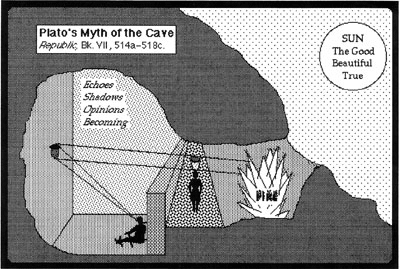 In other words, if I were to hold up a bottle of water for you to consider, that bottle of water does not really exist. There is actually a pure and true bottle of water in some other place. The bottle that I hold in my hand is imperfect. It is a form of something else. This assumption therefore determines that man cannot know truth because he experiences the imperfect shadow world. The metaphor Plato uses is that man stands in a cave. There is a fire in the cave that ultimately casts a shadow on the wall. All man sees is in fact that shadow. That’s all man truly understands about the nature of the world. In Plato’s philosophy, only select men of the highest character and a longstanding study can achieve enlightenment.
When you make these first three assumptions about reality, the resulting conclusion is that “philosopher kings” should govern the great unwashed.
Do you see the progression?
The moment you accept as true that man is incompetent, the moment you decide that truth is beyond his capacity, that is the moment you accept that only a select few are somehow able to know the truth, and they are the only ones uniquely qualified to force the rest of us to their enlightened understanding.
Here is another example.
Karl Marx said that history is a community fight over resources. That was his metaphysical premise. The community is first and the community creates truth. Therefore, all members of the community must work for the common good, and the common good is synonymous with the collective will. This means that government is right to force each person to provide according to his ability and to be given only according to his need. Notice that the metaphysical premise ultimately turns part of a culture into slaves.
Here is another example.
Augustine said “original sin” means the “fall of man.” That is the metaphysical premise. This means that man qua man is fully and entirely disqualified. His very existence is a moral affront. The nature of sin so fully corrupted who and what he is that ultimately man cannot know any good. In other words, you cannot know that water is good for you. The nature of your depravity so corrupts what you are that you cannot define good. The conclusions that arise from this assumption are of vicious nature. Primarily, man has no ethical standard because he has no good. He can never act with good on his own. It then follows that:
God must enforce moral standards, and the doctrine insists that the Holy Mother Church is responsible to use that force against depraved humanity.
Anybody who has an inch of knowledge about Catholic church history knows this is where the disaster of the Dark Ages comes from: the massive tide of human destruction and the warfare. The warfare and destruction is no accident; it follows from the metaphysical premise. When you presume that the masses of humanity are functionally incompetent, you can arrive at no other conclusion than that man must be compelled by force.
This is my contribution to the discussion of philosophy in the world.
Universal Guilt + Mass Incompetence = Dictated Good
The first three elements of every cause of tyranny follow exactly this way. All tyranny is derived from two primary presumptions. I call them universal guilt and mass incompetence. Universal guilt basically says that because man is pervasively guilty of some primary moral inferiority, he has no redeeming quality in and of himself. These ideas combine to a government model for dictated good.
This philosophical equation is the source of all tyranny!
Every time you hear a despot, a tyrant, an autocrat speak, if you listen to him long enough you will hear him tell you how incompetent you are and how guilty you are. The primary example in our current culture is the environmentalist propaganda campaign to “Go Green.” Notice the political forces in our culture saying that man is polluting the world and destroying it. Man, is incompetent to do anything else. We must therefore revert to a primitive state where the world is somehow saved. Notice then the themes within the propaganda: man, is universally guilty of destroying the world and he is collectively incompetent to fix the world. The political conclusion is: government must destroy anything that is modern – get rid of cars, get rid of oil, get rid of power, get rid of coal.
Universal guilt equals the metaphysical premise. Mass incompetence equals man’s epistemological determination. In other words, man can’t get the point. He is incompetent at his root. The only thing that’s left is dictating good, and this prescribes the function of government.
Now notice that this is the central premise of John Calvin. Pervasive depravity has wholly corrupted human existence. This determines that all good is the product of God’s specific sovereign action. Notice the vast gap that this places between good and man. Notice how far this removes man from his very environment. This defines man’s life as predetermined in action and in outcome. Lastly, this prescribes an elect few who are divinely appointed to shepherd the flock in God’s behalf.
Americans live with ontological certainty of religious freedom. That big word, ontological, means we are positive that we should be entitled to our own faith. We have never suffered a religious war in the United States. Churches tend to fracture and divide long before it becomes a fight, long before it comes to blows, long before it becomes bloodshed. 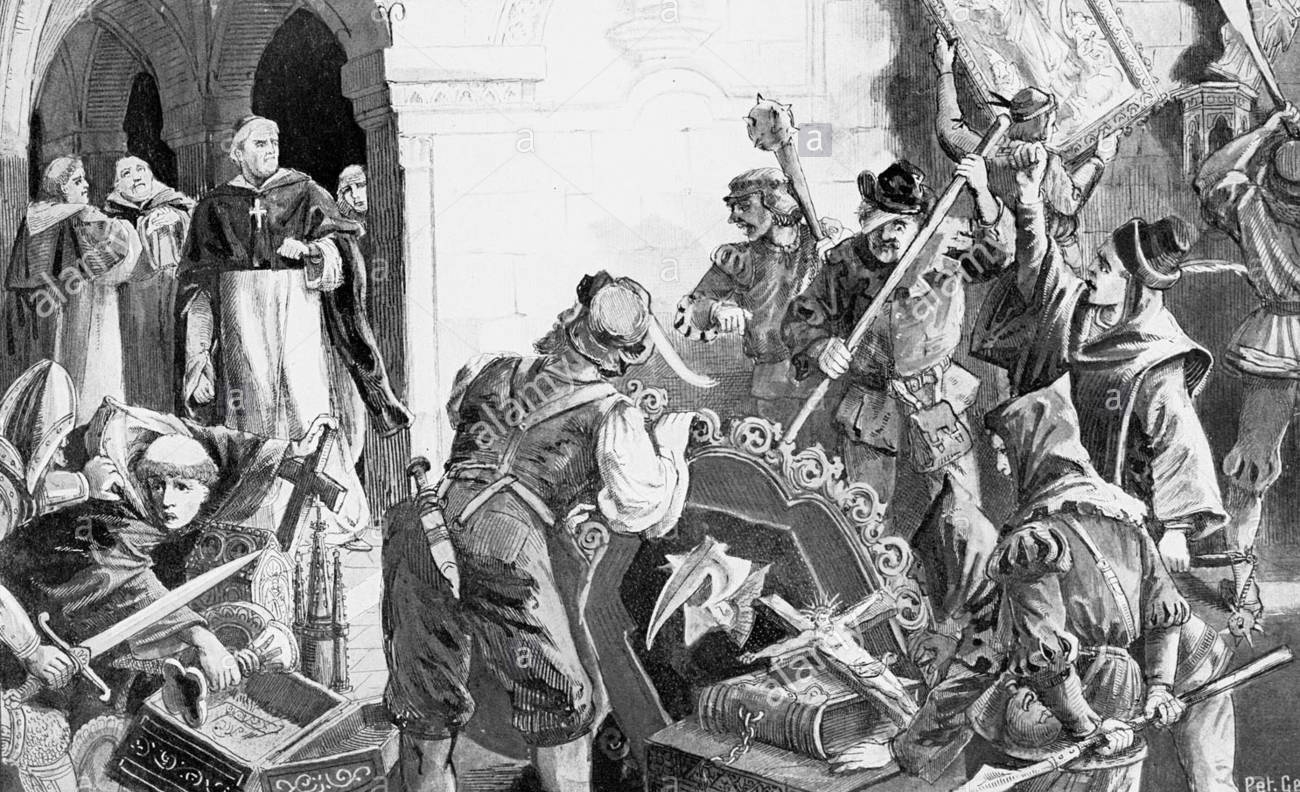 But Calvinism validates violence— or civil force.
To John Calvin, total depravity equals mass incompetence. The irresistible grace of the T.U.L.I.P. acronym equals universal guilt. Irresistible grace implies that the prevailing manifestation of humanity is in fact incompetence, so he must be given a specific grace, but only a select few that will get there. Those select few, those who have experienced limited atonement, are the ones that get to dictate the good. They are the ones that get to wield the force to compel a given body of outcome.
Take each of the doctrines of T.U.L.I.P. and pull them apart – the total depravity, the unconditional election, the irresistible grace, the perseverance of the saints – begin to pull those doctrines apart and notice how they fit into the logical progression that I’ve discussed.
Now you can grasp where our current Christian malaise comes from. It is no accident. The doctrines lead to the exact same result. Every time this body of doctrine has risen its ugly head in the world it has led to bloodshed and destruction. It leads to political force. It leads to civil force. This is where it ends.
And now you understand where tyranny comes from.
~ John Immel
Click here to read Part 1
Click here to read Part 3
Click here to read Part 4
The Philosophy of the Reformation and Its Historical Impact, by John Immel – Part 1
Taken from John Immel’s first session at the 2012 Conference on Gospel Discernment and Spiritual Tyranny
Published with permission
~ Edited by Andy Young
Click here to read Part 2
Click here to read Part 3
Click here to read Part 4
I was listening to the radio and a song by one of our modern philosophers came on.

Steven Tyler, lead singer, Aerosmith
“There’s something wrong with the world today.
I don’t know what it is.
Something is wrong with our eyes.
We’re seeing things in a different way.
And God knows it ain’t His.
It sure ain’t no surprise.”
This is from a song by Aerosmith, “Living on the Edge.” The song’s refrain says over and over that we can’t help from falling.
It is true: there is something world with the world today. But I contend that it is not inevitable that we fall.
Throughout my life I have been involved in various flavors of Christianity, and I continually found myself running up against the same interaction over and over and over. And, of course, for the longest time the easy criticism was, “It’s you. You’re the problem.” There are a lot of doctrines within Christianity that affirm that – yeah, it’s probably you. If there is a problem, you are probably the problem.
But then I began to realize that the same problem exists whether I’m involved in the social dynamic or not.
How is that possible? How is it possible that I can go from denomination to denomination to denomination – from Word of Faith to Charismatic to Baptist to Methodist – and it didn’t matter?
After much thinking I arrived at what I believe is the root of all failed human actions.
The Gospel According to John Immel, chapter 3:1-3
- All people act logically from their assumptions.
- It does not matter how inconsistent the ideas or insane the rationale. They will act until that logic is fulfilled.
- Therefore, when you see masses of people taking the same destructive actions, if you find the assumptions, you will find the cause.
The words “logic” or “logically” in this context refers to the consistent progression of a given set of ideas. That does not mean the ideas are logical in the sense that it is accurate thinking. I am talking about how Idea “A” through Idea “Z” go together to create an entire perspective. What I realized was that when the same people take the same action, they will produce the same outcome.
Let me break this down by section.
Verse 1 says: assumptions + logic = action.
Verse 2 says: faulty logic or erroneous rationalizations = ideas that flow from one to the next to the next.
Verse 3 concludes: mass action + destructive outcomes = common premise.
Something is wrong with the world today, but I submit that the error is imbedded in common faulty root assumptions. When I surveyed history and I saw men taking the exact same steps, coming to the exact same conclusions generation after generation, millennia after millennia, I realized they all held similar root assumption about man and about life.
Typically, when I start talking like this is people say something like: “Well, people just need Jesus.” What they mean to say is that ideas are irrelevant unless the mystical solution of “Jesus” is applied to the problem. But that can’t be right because other people might say: “Well, people just need Buddha,” and still others might say, “Well, if Islam ruled the world, all the problems would go away.”
And here is why “people just need Jesus,” is no answer to the world’s problems: bromides are not solutions. Bromides never address the forces driving the problem.
The problem with faith is people tend to take their own faith very personally and very seriously . . . and very uncritically. They tend to assume that faith equals a license to subjectivity; that they are entitled to believe whatever they happen to believe just because they believe it.
So the challenge that I have forever run up against is that when I start talking about digging into the roots of our assumptions, the reaction is, “You know what? That’s complicated. That requires me to think. And I don’t really care to do that too terribly much.”
I am sympathetic on many levels to that frustration. We would like to say to ourselves, “The declaration of God’s love is so simple. Why on earth does this have to be complicated?” I understand that frustration. It seems that if something is so simple, the process of believing should be left to that simplicity. But here is the challenge – I contend that theological bumper stickers are not simple because thinking is at no point simple.
Let us use the following metaphor to try to illustrate this complexity. Throwing a ball seems like a very rudimentary process. You let it go. It goes from point “A” to point “B”. Yet no matter how many times you throw a ball from point A to point B, it consistently drops to the earth. Now consider the question, why does the ball always hit the ground? Some very smart people put together the physics of throwing a ball.
D = (Vo ˟ sinθ ˟ t) + (½A ˟ t2) + h
where:
D = distance
Vo = initial velocity
θ = initial arc angle
t = time
A = acceleration
h = initial height
Since I am no math wizard, I could not begin to explain to you the details of this equation. But that’s okay. I don’t have to. What I want you to understand is that a child throwing a football on the beach is engaging in the above formula. This formula details the level of complexity that is involved in throwing a ball from point “A” to point “B” even though a child can perform the action.
Now back to the issue at hand: thinking about what we believe and why.
Thinking is hard because thinking is also complex. It is just as complex as, if not more so, than throwing a ball because thinking is the mechanics of human action. This is where we get our energy to act in life. From the time when we are old enough to recognize our own consciousness to start motivating ourselves through life, the thing that dominates us every waking moment of our lives are the thoughts that we specifically put into action.
Here is the beauty of my metaphor – ideas are just as calculable as the mechanics in throwing the ball.
People want simplicity but it is in the details that we find the root problems. You may read articles on discernment blogs discussing the issue of “New Calvinism” or a resurgence of Calvinism and Reformed theology. Most people will conclude that denouncing the doctrines of those movements is grand conspiracy. The real solution is if a few “misled” souls would just get on the right path then all will be well with the church.
But the reality is conspiracy as an explanation does not satisfy the discussion of New Calvinism any more than liberation theology describes why America is treading down the path of Marxism, or why Marxism has dominated the whole of the western world, or why Islam is on the rise throughout the globe.
 People prefer conspiracies. “Christians” would rather hear people say it is the Illuminati or the Bilderbergers or some dastardly mastermind twirling his mustache in a hideaway, spending lots of money to compel people to do things and take mass action. People prefer conspiracy and world masterminds because that is easy. Conspiracies are easy. Thinking is hard.
I contend that the issue driving the world towards the edge is ideas, and ideas are hard. Ideas demand that individuals invest a stunning amount of personal discipline. You must bring your “A” game every minute of every day to be about ideas.
Consider once again the metaphor of throwing a ball. There is a specific problem with that metaphor. It is the issue of gravity. When you throw a ball, of course, the ball at the end of its trajectory hits the ground. It is the existence of gravity within that equation which leads people to believe that the ball must hit the ground every time it is thrown. Because of that gravity, my metaphor tends to break down because in the grand scheme of ideas, I am overtly saying that we can control what we think. If we can understand the progression and the mechanics of our thinking, then we can arrive at a different outcome. But historically, the inevitability of the “gravity” of human action is the observation that man tends down the path of his own self-destruction over and over and over. It is this very observation which has been used as a case in point to say that man is in effect “depraved.”
So how do I remedy the weakness of my metaphor? How do I integrate the immutability of “gravity” with the power of choice and the ability of man to set his own course?
The answer is, change the beginning assumption.
The formula for throwing a ball assumes that you are in an environment affected by gravity. The formula for throwing a ball assumes that your desired outcome is to propel the ball from point “A” to point “B.” Yet with the right amount of velocity, acceleration, and arc, it would be possible to put a ball into orbit or escape gravity altogether. Therein lies the consistency with the metaphor.
I contend that when you challenge the assumptions that have dominated the whole of the western world, you can arrive at a new set of assumptions, and those assumptions can defy the “gravity” that has driven men down to self-destruction.
 So now let’s discuss Calvinism, New Calvinism, and Reformation theology. The question is: why within this emergent movement do we see such consistent actions, such consistent outcomes, such consistent stories of oppression and domination and coercion? Why, from one congregation to the next, do you see the exact same outcomes?
To answer these questions, we must first find the assumptions, and that means we are going to have to take on ideas. It takes enormous effort to fully evaluate the content of ideas. This is the process of education and expertise. One must be specifically aware of one’s own thoughts. This is intentional consciousness. From the time, you are old enough to say, “I want a cookie,” to the day you read, “For God so loved the world that He gave His only begotten Son,” and every day after and in between, when you crack open a book and you read an equation and you determine to understand what the variables within that equation mean . . . all of these are examples of intentional consciousness.
It takes enormous discipline to order one’s thinking, to evaluate the progression from “A” to “Z.” It takes enormous effort to arrive at real logic, or non-contradictory thinking. Real reason is the determination to understand the over-arching mechanics of your own individual consciousness. By order I mean non-contradictory logic. It is what happens when you can follow the progression of thought from “A” to “B” to “C” to “D,” and you do not find any inconsistencies in that progression. Such a process takes enormous self-definition, that is, an absolute trust in one’s own rational faculties. And this requires self-esteem.
Bookmark the concept self-esteem.
My root assumption is that man is rationally competent. This assumption defies almost all historic Christian doctrine. Now the term “self-esteem” in American culture has been so utterly corrupted that I hesitate to use it, but it still captures what I’m after; an identification of the effectiveness of self. But you cannot get to self-esteem by someone holding your hand, patting you on the back, and telling you that you are okay. You can only get to self-esteem by doing the work, overcoming challenges, and succeeding.
The definition of human consciousness and self-esteem comes from the ability to successfully prevail over challenges. By contrast “New Calvinism” or Reformed theology is designed to undermine this ability at the root. It is designed to undermine man at his most fundamental level. It is designed to eradicate his specific ethical egoistic self. Most people don’t understand that every argument you encounter in Calvinist doctrinal debate, whether it is the distinction between sanctification and justification, or whether it is your moral right to keep the substance of what you have, are all moral arguments designed to de-legitimize your self-esteem. The doctrines fueling the argument are designed to condemn you at your root: to prevent you from having the right to your own self and your moral responsibility for the sum and substance of your own life.
What I am describing is the study of philosophy. In the western world since Immanuel Kant, philosophy has been utterly corrupted, and thus most people have a negative impression of philosophy. And Christians are particularly fond of flipping the page over to Paul’s consternation with what he called “vain philosophies” in order to de-legitimize discussing ideas. But regardless of how you feel, since philosophies exist, you need figure out how to deal with “vain philosophies.” So despite Paul’s anxiety over “vain” philosophies, it follows that understanding good philosophies is important.
Here’s the reality: the ideas we encounter are no accident, and the outcomes are not happenstance. The source of all world evil can be found in evil ideas, or evil philosophies. The outcomes of those ideas have been displayed over and over and over, so we know they are evil. Christians are then confronted with this reality: if the world remains evil then the solutions we have been offering do not work. So one more sermon, one more frothing-at-the-mouth preacher, one more guy pounding his ESV will not fix the problem.
Instead we must have the courage to think, or maybe better said: rethink. Unless people are willing to turn on their minds and challenge their deepest-held beliefs, finding the solution is impossible. Nothing will change. It won’t matter how much we dissect sanctification and justification or the centrality of the cross. It won’t matter how many scriptures we stack up in service to pet doctrines. It won’t matter how much we rail against misplaced church government (Is it presbytery? Is it democracy? Is it papacy? et al). That has already been done over and over and over, council after council, synod after synod, inter-Nicene fight after inter-Nicene fight. For the first time in history, men must rethink the historical fight from its roots.
 Mystic despots have always ruled over the masses with portents and disasters for those who dared to live life beyond the mediocre. Tyrants can only succeed when men refuse to think. Autocrats rely on being able to compel outcomes because no one opposes their arguments. This is the challenge that I have as a man who is passionate about thinking: to inspire people to engage in understanding and scrutinizing the complex ideas that drive tyranny.
So here’s my challenge: do not be seduced into believing that righteousness is retreat from the world. Do not be seduced into believing that spirituality is defined by weakness and that timid caution for fear of committing potential error is a reason to be quiet. Do not be intimidated by vague, hazy threats of failure. Do not let yourself believe that faith is a license to irrationality. Do not mistake the simple nature of God’s love as a justification for simple-mindedness. Do not deceive yourself with the polite notion that you are above the fray, that your right to believe is sufficient to the cause of righteousness. There is no more stunning conceit. Do not pretend that your unwillingness to argue is the validation of truth.
Know this: virtue in a vacuum is like the proverbial sound in the forest – irrelevant without a witness. Character is no private deed. To retreat is nothing more than a man closing his eyes and shutting his mouth to injustice. Virtues are not estimates to be wafted gently against evil. Virtues are not to be withheld from view in the name of grace. Virtues are not to be politely swallowed in humble realization that we are all just sinners anyway. Love is not a moral blank check against the endless tide of indulgent action. Love is not blind to the cause and effect of reality. Love is not indifference to plunder and injustice and servitude.
The time is now, you men of private virtue, to emerge from your fortress of solitude and demonstrate that you are worthy of a life that bears your name. The time is now, you men of private virtue, to answer Steven Tyler of Aerosmith and all the nihilists that insist we are living on the edge and we cannot help but fall. It is time for you men of private virtue to take up the cause of human existence and think.
~ John Immel
Click here to read Part 2
Click here to read Part 3
Click here to read Part 4
Government Is Not a Business
In the interest of full disclosure, I do not believe Donald Trump would be a good President.
With that being said, that does not mean I will vote for Hillary. I believe it goes without saying that Hillary Clinton should at most be doing time in prison or at the very least be disqualified as a presidential candidate. However…
In the interest of full disclosure, I believe Trump is just as dangerous as Hillary.
In fact, he may be even more so. At least with Hillary we know what we’re getting. But my own observations have led me to conclude that Trump is a pretender; someone who presents himself to be something he’s not. The Trojan Horse comes to mind (and history shows us just how well that worked out for Troy).
 Nevertheless, I know that there are plenty of people who consider themselves “conservatives” who think that Trump is the answer to our nation’s woes. My aim here is not to convince those people otherwise (although by the end of this article you might be). One factor that people often point to with regard to Trump is this notion that he is a successful businessman. The merits of such a statement are subject to speculation, especially when one considers Trump’s four bankruptcies, his pending litigation with regard to Trump University, his failed business ventures like Trump Steaks, and the fact that he refuses to open his tax records for public scrutiny. But the topic I would like for you to consider is the question of, does being a successful businessman mean you will be a successful President? Or asked another way, should you run a government like you run a business? (Please notice I said “should” and not “can”)
As a small business owner, I am often amazed by the assumptions most people have when it comes to private business. Probably the greatest fallacy that people have is this idea that a business, any business, exists for the sole purpose of providing them (the consumer) with something they need or want. While this is ultimately an end result of business, it is only a secondary purpose at best.
You must first understand that a business is an independent entity. It exists for the sole purpose of providing for the needs and desires of the OWNER, who is also an independent entity. The reason most people don’t get this is because most of us have been conditioned to think that selfishness is evil. But that is not the case. Believe it or not, the Bible even presents selfishness in a positive manner.
“… Thou shalt love thy neighbour as thyself.” ~ Matthew 22:39
“For all the law is fulfilled in one word, even in this; Thou shalt love thy neighbour as thyself.” ~ Galatians 5:14
“For no man ever yet hated his own flesh; but nourisheth and cherisheth it…” ~ Ephesians 5:29
You will notice that the Bible doesn’t tell us to love ourselves LESS than others. It tells us to love others AS MUCH AS we love ourselves. Loving oneself is intrinsic to who we are as individuals. It is not evil to love oneself. It is in fact a necessary part of survival and self-preservation. We are wired in such a way to instinctively seek out those things that will help further our own existence. Ayn Rand called this the “virtue of selfishness”.
In the quest for furthering one’s existence, some people will discover that they are particularly adept at some skill and will then use that skill to produce those things they need to sustain life; farming, building, making clothes, etc. Those who are especially adept discover that they end up with a surplus of production. Rather than letting the surplus go to waste, they seek out others who may have a surplus of their own production – something they the deem necessary for their own existence – and enter into a fair exchange with another individual, value for value. Trade is nothing more than two individuals, each with a surplus of production, entering into a fair exchange of value. And thus, a business enterprise is born.
So you see, any individual engaging in a business venture is doing so in order to meet his own perceived needs. Therefore, those things produced by a business are a product of the business owner; the individual. A business therefore is a representation of the individual; his “self”. It belongs to him because he produced it. And so, because it belongs to him, it is up to the business owner and him alone to decide how to dispose of it, according to that which will best help him to further his means of sustaining his own existence.
A mutual exchange of value for value is the key to every inter-personal relationship throughout the course of our lives. And it is up to each individual to determine what constitutes “fair and equitable”, and if one party does not consider the exchange to be fair, then he is under no obligation to engage in it.
This mutual exchange extends to employees. When the means of production have become too overwhelming for the business owner to handle by himself, rather than reduce production, he may deem it desirable to hire a labor force to expedite production. This brings up another false assumption that people have about business – that businesses exist to create jobs. My response to this is a resounding NO! Businesses are not in the business of producing jobs, they are in the business of production for the benefit of the business owner alone! But when labor becomes necessary to the success of the owner in achieving his ends, he determines wages based on what he decides to be the value of the TASK, NOT the value of the worker. A potential worker can then decide if he wishes to engage in such an exchange (his labor for agreed-upon wages). But it is important to note that neither party compels the other to engage in an exchange that is not deemed mutually beneficial by both.
Because the business owner is motivated by moral self-interest, any power he has is self-appointed. In other words, he can take whatever steps necessary to achieve his ends, which is rooted in furthering his own existence. The only restraint to his power is another self-actualizing individual. His power ends where another begins. His power cannot violate another individual from furthering his existence. One “self” cannot violate another “self”.
From a certain aspect, the individual/business is much like a tyrant. He makes the rules to benefit himself. He has the liberty to dispose of his resources as he sees fit because he is the owner of them (yes, even labor because remember that labor has been “purchased” in exchanged for something of value that has been mutually agreed upon) because he produced them. They are a representation of “self”. He is free to take whatever action he thinks is necessary to achieve his ends of furthering his ability to exist. But such tyranny and pragmatism is tempered by the morality of mutual exchange of value.
These same characteristics apply even if the business is a corporation. While a corporation is in reality a “collective” that consists of a CEO, board of directors, and shareholders, it is technically considered to be a individual entity, much like a “body” is made up of individual “parts” that function as a whole. Therefore, the same truisms that apply to an individual business owner also hold true for a corporation.
But a government (and for argument’s sake, let us assume the U.S. federal government as prescribed by the Constitution) is not a business. A government does not exist for the benefit of itself. A government exists to secure and preserve the RIGHTS of the individual. The “Founding Fathers” understood this when they penned these words in the Declaration of Independence:
“We hold these truths to be self-evident, that all men are created equal, that they are endowed by their Creator with certain unalienable Rights, that among these are Life, Liberty and the pursuit of Happiness.-That to secure these rights, Governments are instituted among Men…”
If there can be said to be any moral justification for government, it is here. We acknowledge that the rights of the individual are endowed to them by virtue of them being individual “self”. That “self” has the right to seek out those things which further its own existence. That government is practical in helping to ensure that such rights are not violated.
So first and foremost, government is not a business because government is not a “self”. If anything, it is a collective appointed by many “selfs” for the express benefit of those “selfs”. Said another way, government is not self-actualizing and it does not exist to serve its own interest, it exists for the express purpose of serving another.
And this brings us to another point, that government only exists by consent. It cannot wield any power without that power first being loaned to it by the consent of those of whom it is to govern. A business needs no consent to exist or wield power any more than an individual needs consent to exercise his power to live. Without consent, however, ANY government is immoral because it presumes to usurp for itself that which does not belong to it.
A third point to consider is that government produces nothing. Let me say that again. Government is a producer of nothing! For government to be a producer it would have to have something of value to offer as a representation “self”, and we have already established that government is not a “self”. And since it is not a “self” and produces nothing, it has nothing to offer in an exchange of value. Unless of course it first confiscates what someone else has produced. Before government can “give” you anything it must first take it from someone else, most often by force. This is the definition of theft.
For these very reasons, by definition and by the proper and moral usage of government, government MUST NOT be run like a business. Any government that attempts to run as such ultimately ends up tyrannical and becomes destructive of the rights of the individual.
Therefore, since government is not a business, the notion that someone would make a good president because he was a good businessman should not even be offered for consideration. I would submit that our federal government has been already been operating like a business (granted, a poorly run business) for far too long. It has been operating for the benefit of itself and those in its collective body instead of operating for the purpose of securing individual rights. Government does not need a different CEO, it needs to operate within the constraints placed upon it by consent of the governed as enumerated by the Constitution.
Is Donald Trump a good businessman? Perhaps. How does he function as a businessman? He spends other people’s money (investors) and then goes bankrupt leaving those investors out to dry. He engages in business ventures that lure in consumers with bait-and-switch tactics. He oversteps the bounds of law in order to achieve his own desired benefit for his business at the expense of others. He uses power, money, and influence to coerce others to do what he wants. Could not the same be said of Hillary? Trump claims he is not a politician, but haven’t politicians engaged in these very same behaviors for decades?
In the end, the argument doesn’t come down to Hillary vs. Trump or whether or not you think Trump is a good businessman or whether or not you think he’s a politician. The argument is first and foremost about the proper role and use of government. The argument is about finding a leader who will be willing to operate under constraint.
Andy

 Paul's Passing Thoughts
6 comments