
Classic New Calvinist Double Speak: Tchividjian; Christians Are Not Totally Depraved, But they are Totally Depraved
 Again, as I am getting further and further behind schedule because New Calvinist heretics continue to herald outrageous error while cowardly HIV’s (highly respected leaders with international visibility) remain silent, I have to stop in the middle of a project to address something that I stumbled across while doing research. Apparently, questions about New Calvinism’s total depravity of the saints are causing enough stir to demand some answers. So Tullian Tchividjian (hereafter: TT) wrote a response on his blog.
As he sat down to write his response, a little mouse overheard him talking to himself and reported the following to me after running all the way up here from Florida:
“Hmmmm, how ate-up in the brains are my beloved Kool-aid drinking followers? Should I just plainly admit it, or use doublespeak? I don’t think they are quite ready for the whole truth yet, so I will use doublespeak. Now let me see, how can I say that we are totally depraved, while saying at the same time that we aren’t? Hmmmmm.”
Does the mouse story seem farfetched? So what? Christians will believe anything these days—why can’t I have some fun? TT’s treatise on how we are totally depraved, but not totally depraved, can be read here. First, TT gets us warmed up with a traditional view of what totally depravity is, and isn’t. Ie., it doesn’t mean we are all as evil as we could be because of God’s restraints. TT spends the first half of the post on that, and cites five Bible references.
After assenting to the fact that we are born again (and keep in mind that the New Calvinist definition of the new birth is NOT orthodox), he states the following:
But once God regenerates us by his Spirit, draws us to himself, unites us to Christ, raises us from the dead, and grants us status as adopted sons and daughters, is there any sense in which we can speak of Christian’s being totally depraved?
Yes.
I, by no means, am going to stop here and write a book on what New Calvinists really believe about the new birth, but notice in his statement that he stops short of a description of new creaturehood. The apostle Paul said of the new birth:
2 Corinthians 5:17
Wherefore if any man is in Christ, he is a new creature: the old things are passed away; behold, they are become new.
One might also note that TT conveniently leaves out the fact that the old man died with Christ’s death which means the power of sin over us is broken:
What shall we say, then? Shall we go on sinning so that grace may increase? 2 By no means! We are those who have died to sin; how can we live in it any longer? 3 Or don’t you know that all of us who were baptized into Christ Jesus were baptized into his death? 4 We were therefore buried with him through baptism into death in order that, just as Christ was raised from the dead through the glory of the Father, we too may live a new life. 5 For if we have been united with him in a death like his, we will certainly also be united with him in a resurrection like his. 6 For we know that our old self was crucified with him so that the body ruled by sin might be done away with, that we should no longer be slaves to sin— 7 because anyone who has died has been set free from sin (Romans 6:1-7).
TT then continues to build on his thesis:
Theologians speak of total depravity, not only in terms of “total inability” to come to God on our own because we’re spiritually dead, but also in terms of sin’s effect: sin corrupts us in the “totality” of our being. Our minds are affected by sin. Our hearts are affected by sin. Our wills are affected by sin. Our bodies are affected by sin. This is at the heart of Paul’s internal struggle that he articulates in Romans 7: “For I do not do what I want, but I do the very thing I hate.”
Note what he is stating here carefully—words mean things: because we are still affected by sin in our mortal bodies, or because it is still there—there is still a “total inability” to come to God in the same way that there was before we were saved. In other words, and for all practical purposes, sanctification is a continual coming to Christ by faith. TT relates this further by writing in the same post:
Paul’s testimony demonstrates that even after God saves us, there is no part of us that becomes sin free–we remain sinful and imperfect in all of our capacities, in the “totality” of our being. Even after God saves us, our thoughts, words, motives, deeds, and affections need the constant cleansing of Christ’s blood and the forgiveness that comes our way for free.
No it’s different. Sin’s relationship to us as believers is not the same as when we were unbelievers—it’s present, but its power over us is broken. TT at the very least deemphasizes that, and for the most part denies it. But the smoking gun here is the fact that TT reveals a theological flaw in New Calvinist thinking that repentance unto salvation and repentance in sanctification are the same. This reflects their belief that the relationship to sin and its power over us is the same as it was when we were unregenerate. Again, words mean things—what does the “blood” refer to? It refers to our justification, or Christ’s death on the cross for our “washing” (1Cor.6:11). But we don’t need that kind of washing/forgiveness anymore; we only need forgiveness for sin in sanctification that disrupts our relationship to the Father as adopted sons (John 13:9-11).
TT then elaborates on how New Calvinism fleshes out in an unbiblical fusion of sanctification and justification:
The reason this is so important is because we will always be suspicious of grace (“yes grace, but…”) until we realize our desperate need for it. Our dire need for God’s grace doesn’t get smaller after God saves us–in one sense, it actually gets bigger. Christian growth, says the Apostle Peter, is always “growth into grace”, not away from it. Many Christians think that becoming sanctified means that we become stronger and stronger, more and more competent.
And,
The truth is, however, that Christian growth and progress involves coming to the realization of just how weak and incompetent we continue to be and how strong and competent Jesus continues to be for us. Spiritual maturity is not marked by our growing, independent fitness. Rather, it’s marked by our growing dependence on Christ’s fitness for us. Because we are daily sinners, we need God’s daily distributions of free grace that come our way as a result of Christ’s finished work. Christian growth involves believing and embracing the fact that, even as a Christian, you’re worse than you think you are but that God’s grace toward you in Christ is much bigger than you could ever imagine.
In other words, total depravity is a good thing because the more we realize how sinful we are, the smaller we get and the bigger the cross and our need for it becomes. This can be illustrated by the following chart published by a New Calvinist organization:
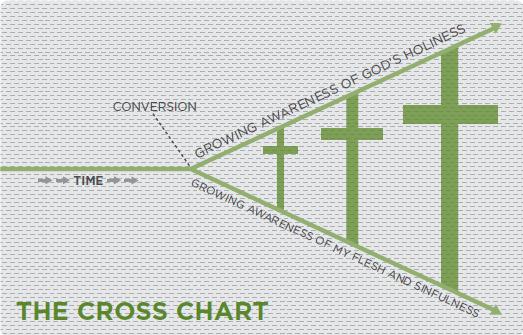
Basically, this is indicative of the New Calvinist gospel that makes much of sin so that Jesus is magnified. It is the antithesis of the true gospel.
TT concludes:
Because of total depravity, you and I were desperate for God’s grace before we were saved. Because of total depravity, you and I remain desperate for God’s grace even after we’re saved.
Thankfully, though our sin reaches far, God’s grace reaches infinitely farther.
Conclusion? We are still totally depraved. And what is really the difference between this and the apostle’s literary gasp concerning the amplification of sin so grace can abound?
In my book, nothing.
paul
Two Roads to Hell Named “Gospel”
It happened again on Facebook. A twenty- something professing Christian posting casual information about cohabitation with a boyfriend/girlfriend. What struck me about it was the following: as in other cases that I have seen and heard about, the shameless normality in which the information is shared.
Why is this the norm of our day? Answer: the gospel. The gospel means “good news,” and since the Fifties there has been two primary gospels preached in America and both are great news to most people. The first gospel (from the 50’s to the 90’s) emphasized the importance of believing that Christ died for our sins, and if you believed that, you were going to heaven. Obeying the ten commandments was a nice thing to do for Jesus, but optional. Even if you later denied Christ and the gospel, you were still saved, and keeping the law was optional. After all, we aren’t saved by the law, so how important could it be? Just in case you think that’s a generalization, consider these quotes from the book, “Eternal Security” written by evangelical superstar Charles Stanley:
PAGE 6 “As long as I have an ongoing role in the salvation process, my natural tendency will be to focus on my behavior rather than on Christ.”
PAGE 7 “People who are constantly examining their spiritual condition tend to fall into the trap of legalism.”
PAGE 200 “But isn’t it true that people who believe they must maintain some kind of good works in order to stay saved are trusting in themselves for their eternal security?”
PAGE 195 “Placing the responsibility for maintaining salvation on the believer is adding works to grace. Salvation would no longer be a gift. It would be a trade – our faithfulness for His faithfulness.”
PAGE 7 “Show me a believer who is caught up in trying to maintain God’s acceptance through good works, and I will show you a fragile saint. My experience has been that these are the people who on the surface appear to be completely sold out to personal holiness and purity but who suddenly disappear. It is not unusual for these well-meaning types to end up in a lifestyle completely opposite of what they once stood for.”
PAGE 93 “Even if a believer for all practical purposes becomes an unbeliever, his salvation is not in jeopardy.”
PAGE 72 “The Bible clearly teaches that God’s love for His people is of such magnitude that even those who walk away from the faith have not the slightest chance of slipping from His hand.”
PAGE 93 “Christ will not deny an unbelieving Christian his or her salvation because to do so would be to deny Himself. Why? Faithful or not, every person who has at any time had saving faith is a permanent part of the body of Christ.”
PAGE 104 “In Christ, the requirements of God’s holiness have been completely fulfilled!”
PAGE 63 “According to Jesus, what must a person do to keep from being judged for sin? Must he stop doing something? Must he promise to stop doing something? Must he have never done something? The answer is so simple that many stumble all over it without ever seeing it. All Jesus requires is that the individual “believe in” Him.”
Then more good news came in the latter Nineties. The first gospel didn’t emphasize the law enough, but the second gospel places very strong emphasis on the law. But the news is still good; Jesus obeys the law for us! In fact, it was part of the atonement; His perfect obedience was imputed to our sanctification! Moreover, even the relaxed approach to the law in the first gospel was legalism! So relax, be happy, live in peace with thy girlfriend. As one of the propagators of this second gospel has said,
The irony, of course, is that it’s only when we stop obsessing over our own need to be holy and focus instead on the beauty of Christ’s holiness that we actually become more holy! Not to mention, we start to become a lot easier to live with! Will someone please keep reminding me of this? (Tullian Tchividjian, Accountability Groups: The Tyranny of Do More, Try Harder).
And trust me, everyone is getting the message.
Besides, why bother with keeping the law? After all, as second gospel guru Paul David Tripp has stated in regard to Christians, “When you are dead you can’t do anything” (p. 64, How People Change 2006). Likewise, CJ Mahaney: “We [who is “we”?] are [present tense] enemies of God. We are God ignoring. We are God defying. We hate God” (2009 Resolved Conference).
Hence, compare the following quotes from these second gospel gurus to those of Stanley:
Francis Chan: “To change our hearts, what we value, what we risk, how we act, we don’t need more guilt or more rules, we just need to be in love with God. Because when you’re wildly in love with someone, it changes everything.”
DA Carson: “In this broken world, it is not easy to promote holiness without succumbing to mere moralism; it is not easy to fight worldliness without giving in to a life that is constrained by mere rules.”
John Piper: “So the key to living the Christian life – the key to bearing fruit for God – the key to a Christ-exalting life of love and sacrifice – is to die to the law and be joined not to a list of rules, but to a Person, to the risen Christ. The pathway to love is the path of a personal, Spirit-dependent, all-satisfying relationship with the risen Christ, not the resolve to keep the commandments.”
Tullian Tchividjian: “A taste of wild grace is the best catalyst for real work in our lives: not guilt, not fear, not another list of rules.”
These two gospels are two roads to hell. Why? Because both gospels restrict saving faith / belief to limited knowledge of the true gospel. Both limit saving faith to what Jesus did to make our entry into the kingdom possible, and not its purpose. “Jesus died for our sins, just believe that.” No, there is more. Jesus died for the purpose of setting us apart. The biblical word is “sanctification”:
Or do you not know that wrongdoers will not inherit the kingdom of God? Do not be deceived: Neither the sexually immoral nor idolaters nor adulterers nor men who have sex with men 10 nor thieves nor the greedy nor drunkards nor slanderers nor swindlers will inherit the kingdom of God. 11 And that is what some of you were. But you were washed, you were sanctified, you were justified in the name of the Lord Jesus Christ and by the Spirit of our God (1Corinthians 6:9-11).
But we ought always to thank God for you, brothers and sisters loved by the Lord, because God chose you as firstfruits to be saved through the sanctifying work of the Spirit and through belief in the truth (2Thess. 2:13).
In other words, the Spirit’s purpose is to set us apart, and Christ died for our sins to make that possible, resulting in us being declared righteous by the Father. Any gospel that excludes that purpose thereof is a half gospel:
It is God’s will that you should be sanctified: that you should avoid sexual immorality (1Thess.4:3).
The one who does what is sinful is of the devil, because the devil has been sinning from the beginning. The reason the Son of God appeared was to destroy the devil’s work (1John 3:8).
Therefore, the “new convert” supposes that Jesus only died to save us, and “enters the kingdom” indifferent to one of the primary reasons Christ died for us—to set us apart from the rest of the world unto the Father as a peculiar people. Hence, Facebook. Yea, flaunt thy supposed “festival of freedom.” After all, he only died to save us. Supposedly. For the true Christian beholding the heart of Christ and his purpose of setting us apart unto the Father, and His willingness to leave Heaven and obey the cruel cross—I beg you to tell me—how can being like the world be like business as usual? Furthermore, how can any man claiming to be a bishop of God tell us not to “obsess” over our holiness? It is the very essence of being a saint. It is what we signed up for. According to Mark G. Cambron, D.D. in Bible Doctrines:
Again we emphasis that the words “holiness,” “sanctification,” and “saint” all come from the same word meaning “set apart,” “separation.” The word “sanctify” in Exodus 13:2, and the word ‘holiness” in Psalm 29:2, and the word “saints” of Psalm 34:9 are the same word. The word “sanctify” of John 17:17, and the word “saint” of Philippians 1:1, and the word ‘holiness” of Hebrews 12:10 are all from the same word.
The call of the true gospel is a call to believe in the works of Christ and a commitment to be set apart according to His will. It is a call to embrace Him as Savior and Lord. It is most certainly an obsession with truth and holiness. It recognizes that being born again is to be set apart by the Spirit. Christ went to the cross to see this happen in His children, resulting in the destruction of the devil’s work. How it must grieve the Holy Spirit and Christ when we not only do the world’s bidding, but report it to others in casual fashion.
And because of this, should not the wording of the gospel be of major concern when we present it? How is it that the gurus of the second gospel proudly herald a five word gospel: “Christ died for our sins”? And then even go as far as to say that we live by that as well! How is it that John Piper presents the gospel in “one sentence,” excludes sanctification, and then says, “that’s the gospel”?
It is not the gospel. It is a half gospel. Both of these gospels breed an indifference for one of the primary reasons Christ went to the cross—sanctification. And by the way, the word of God is the standard for what that separation is and the knowledge to obtain it. It is not just law, it is every word that comes from the mouth of God that we live by (Matthew 4:4).
paul
Why New Calvinism is Works Salvation and a False Gospel
“So, as long as we don’t, ‘move on to something else’ we don’t ‘lose both.’ What does ‘lose‘ mean?”
I’m going to keep saying it: any doctrine that fuses justification and sanctification together is necessarily a false gospel. Sanctification does not complete justification, and sanctification does not link justification to glorification. That is why Romans 8:30 is stated the way it is. Salvation is a finished work by God alone before the foundation of the Earth and it guarantees glorification. Nothing that you do in sanctification can change that.
New Calvinism fuses justification and sanctification together. This is not even arguable; for, “The same gospel that saves you also sanctifies you.” Here is where New Calvinism goes the way of many other works salvation systems: they erroneously make a false dichotomy between mental activity and physical effort. They think this makes the fusion of justification and sanctification possible because mental activity is supposedly not a work.
Hence, we can keep our salvation by NOT “trying to please God in our own efforts or in our own strength.” So how do we do that? Oh, sorry, rather, “What does that look like” (as if looking isn’t a human activity either). Answer: by contemplating more on the gospel instead of making an effort to do something because contemplation supposedly doesn’t qualify as a human activity. Instead of NOT “trying harder and doing more” we need to “contemplate more and contemplate harder.” Searching the Scriptures in search of “pictures of Jesus” is supposedly not human activity or works either.
But ANYTHING we participate in to MAINTAIN our justification IS works salvation. Indicative of this fusion is the belief that we can lose our salvation. The fusion of justification and sanctification is always coupled with the idea that we can lose our salvation; the two are mutually inclusive. If we can lose our salvation, what do we have to do to keep it? For New Calvinism, the answer is: nothing in our own effort. Salvation by Christ plus doing nothing except for contemplation. For you folks old enough to remember, it’s salvation by Bachman—Turner Overdrive theology: “we work hard at doing nothing all day.” But that is still something that we participate in to maintain our salvation.
Of course, New Calvinists would vehemently deny this, but their teachings often imply, well, “implicit” is really a better word—that we need to perform tasks to maintain our salvation daily. Am I kidding? Well, if words really mean things, no! In Paul David Tripp’s chapel message at Southeastern Theological Seminary in the Spring of 2008 entitled “Playing With The Box,” he plainly stated that Romans 7:24 referred to a “daily rescue.” You do the math.
In “Christless Christianity” by Michael Horton on page 62, he states the following:
Where we land on these issues is perhaps the most significant factor in how we approach our own faith and practice and communicate it to the world. If not only the unregenerate but the regenerate are always dependent at every moment on the free grace of God disclosed in the gospel, then nothing can raise those who are spiritually dead or continually give life to Christ’s flock but the Spirit working through the gospel. When this happens (not just once, but every time we encounter the gospel afresh), the Spirit progressively transforms us into Christ’s image. Start with Christ (that is, the gospel) and you get sanctification in the bargain; begin with Christ and move on to something else, and you lose both.
We Christians are dependent on what at every moment? Answer: the same thing that the unregenerate are dependent on. For what? Answer: spiritual life. How often? Answer: “not just once, but every time we encounter the gospel afresh.” What happens if we “move on to something else”? Answer: “we lose both.” Both what? Answer: obviously, both justification and sanctification. So, as long as we don’t, “move on to something else” we don’t “lose both.” What does “lose” mean?
Yet another example is a comment on The Gospel Coalition blog in regard to an article written by Tullian Tchividjian:
It’s not that complicated: the ground of all Christian obedience is the faithfulness of Jesus Christ. Justification occurs EACH time a believer confesses and receives forgiveness for his sins. The pattern of justification is illustrated by Paul in Romans 4. Abraham believes in the God who justifies the ungodly (in this case gentile Abraham), David is forgiven for his adultery and murder. God’s condemnation for sin has reached into history at the cross, glorification has reached into history at conversion where believers experience a foretaste of glory. Neither Old or New Covenant obedience require moral perfection, they both require obedience of faith….so, having been justified from faithfulness we have peace with God!
I have quoted this example in many articles, resulting in TGC pulling the comment down. However, for some reason they thought the following comment by NCT guru Chad Bresson on the same post is more subtle:
I usually take it a half-step back further in the indicative, including Christ’s life, death, and resurrection. The indicative isn’t simply our position in Christ, but is (more importantly) Christ for us. IOW, not only should we be encouraging our people to become who they already are in Christ Jesus, we must be reminding them of what He has already been and done for them. We *do* the imperatives, not simply because of who we are in our union with Him, but because Christ has already done the imperatives on our behalf because we couldn’t. When I can’t do any given imperative perfectly (failing miserably), I rest in the One who has. Christ’s imputed active obedience is never far from the indicative-imperative rhythm of the Pauline ethic.
Obviously, if obedience in sanctification was imputed to us as part of the atonement, then any attempt by us to obey in sanctification is a denial of the gospel. If at any time in our Christian life we believe that we must put forth effort—that’s works salvation. Instead, we must continue to believe in a supposed salvation by doing nothing which is really Christ plus doing nothing, but is something because it is doing nothing for the purpose of maintaining our salvation because justification and sanctification are fused.
And this of course leads to total confusion among Christians, and I believe a built-in intent of don’t you dare try sanctification at home because it could (as John Piper states it): “imperil your soul.” We supposedly need these spiritual brainiacs to guide us through the very tricky business of deciphering what is works salvation and what isn’t. Good luck with that.
This is the problem you get into when you try to toy with God’s law and its relationship to the gospel. It’s not only antinomianism, but it also tampers with salvation and the true gospel.
paul
New Calvinism is Totally Debunked by 2Peter 1:1-15
2 Peter 1:1-14 contradicts almost all of the major tenets of New Calvinism: Christocentric salvation; Christocentric interpretation; double imputation; Christocentric sanctification; the total depravity of the saints; sanctification by faith alone; the imperative command is grounded in the indicative event; assurance based on gospel contemplationism; sanctification is not “in our OWN efforts”; the apostolic gospel.
Christocentric Salvation
Simeon Peter, a servant and apostle of Jesus Christ, to those who have obtained a faith of equal standing with ours by the righteousness of our God and Savior Jesus Christ (v1).
Salvation is not Christocentric. Peter states that we obtained our faith by God the Father AND Jesus Christ.
Christocentric Interpretation
May grace and peace be multiplied to you in the knowledge of God and of Jesus our Lord (v2).
The benefits of salvation are multiplied by the knowledge of both the Father and the Son. Of course, this knowledge can only come from the Scriptures. Obviously, knowledge of both is required for the multiplication of grace and peace. One may also note that when Peter restates this truth in verse 3, he only mentions the one “who called us” which of course is God the Father.
Double Imputation
“The imputed righteousness of Christ” is an often heard slogan among New Calvinists. But it is the righteousness of God that was imputed to us by believing in Christ (see v1). God’s imputed righteousness is sufficient—Christ lived a perfect life as a man because of who He is, not for the purpose of imputing obedience to us as part of the atonement in sanctification.
Christocentric Sanctification
His divine power has granted to us all things that pertain to life and godliness, through the knowledge of him who called us to his own glory and excellence (v3).
Again, God the Father is the member of the Trinity who called us. Knowledge pertaining to the Father is efficacious in sanctification.
The Total Depravity of the Saints
His divine power has granted to us all things that pertain to life and godliness, through the knowledge of him who called us to his own glory and excellence, 4 by which he has granted to us his precious and very great promises, so that through them you may become partakers of the divine nature, having escaped from the corruption that is in the world because of sinful desire (v3,4).
“Partakers” is: koinōnos from koinos; a sharer, that is, associate: – companion, fellowship, partaker, partner. Koinos means: common, that is, (literally) shared by all or several and is derived from a primary preposition denoting union; with or together, that is, by association, companionship, process, resemblance, possession, instrumentality, addition, etc.: – beside, with. In compounds it has similar applications, including completeness.
Sanctification by Faith Alone
For this very reason, make every effort to add to your faith goodness; and to goodness, knowledge; 6 and to knowledge, self-control; and to self-control, perseverance; and to perseverance, godliness; 7 and to godliness, brotherly kindness; and to brotherly kindness, love (v 5,6,7).
Obviously, if sanctification is by faith alone, Peter wouldn’t tell us to ADD anything to it.
The Imperative Command is Grounded in the Indicative Event
For if you possess these qualities in increasing measure, they will keep you from being ineffective and unproductive in your knowledge of our Lord Jesus Christ. 9 But if anyone does not have them, he is nearsighted and blind, and has forgotten that he has been cleansed from his past sins. 10 Therefore, my brothers, be all the more eager to make your calling and election sure. For if you do these things, you will never fall, 11 and you will receive a rich welcome into the eternal kingdom of our Lord and Savior Jesus Christ (v8,9,10,11).
Glorification (and one could argue assurance as well) is an indicative act, but in these verses, it is contingent and preceded by imperatives. Peter uses the conjunction “if” three times to conjoin imperatives preceding the indicative.
Assurance Based on Gospel Contemplationism
One of the more hideous teachings of New Calvinism is that guilt is indicative of not understanding grace. Therefore, saints will not be told to take biblically prescribed action to relieve guilt, but will be told to further contemplate the gospel. There is barely anything more powerful in the Christian life than full assurance of salvation and Peter tells us in no uncertain terms how to obtain it: aggressively adding certain things to our faith.
Sanctification is not “in our OWN efforts.”
New Calvinism, by default, disavows our effort in sanctification by continually utilizing the either/or hermeneutic: it’s either all our effort, or all of Christ. Though we can do nothing without Christ, Peter makes it clear that peace and assurance will not take place if we do not “make every effort” (ESV).
The Apostolic Gospel
So I will always remind you of these things, even though you know them and are firmly established in the truth you now have. 13 I think it is right to refresh your memory as long as I live in the tent of this body, 14 because I know that I will soon put it aside, as our Lord Jesus Christ has made clear to me. 15 And I will make every effort to see that after my departure you will always be able to remember these things (v12,13,14,15).
Think about it. It had been revealed to Peter that his departure was near, so his ministry was focused on what he thought was the most important thing that they needed to be continually reminded of. Where is, “The same gospel that saves us sanctifies us”? Where is, “We must preach the gospel to ourselves every day”? Where is, “Beholding the face of Christ as a way of becoming”?
paul

 Paul's Passing Thoughts
leave a comment