Classic New Calvinist Double Speak: Tchividjian; Christians Are Not Totally Depraved, But they are Totally Depraved
 Again, as I am getting further and further behind schedule because New Calvinist heretics continue to herald outrageous error while cowardly HIV’s (highly respected leaders with international visibility) remain silent, I have to stop in the middle of a project to address something that I stumbled across while doing research. Apparently, questions about New Calvinism’s total depravity of the saints are causing enough stir to demand some answers. So Tullian Tchividjian (hereafter: TT) wrote a response on his blog.
As he sat down to write his response, a little mouse overheard him talking to himself and reported the following to me after running all the way up here from Florida:
“Hmmmm, how ate-up in the brains are my beloved Kool-aid drinking followers? Should I just plainly admit it, or use doublespeak? I don’t think they are quite ready for the whole truth yet, so I will use doublespeak. Now let me see, how can I say that we are totally depraved, while saying at the same time that we aren’t? Hmmmmm.”
Does the mouse story seem farfetched? So what? Christians will believe anything these days—why can’t I have some fun? TT’s treatise on how we are totally depraved, but not totally depraved, can be read here. First, TT gets us warmed up with a traditional view of what totally depravity is, and isn’t. Ie., it doesn’t mean we are all as evil as we could be because of God’s restraints. TT spends the first half of the post on that, and cites five Bible references.
After assenting to the fact that we are born again (and keep in mind that the New Calvinist definition of the new birth is NOT orthodox), he states the following:
But once God regenerates us by his Spirit, draws us to himself, unites us to Christ, raises us from the dead, and grants us status as adopted sons and daughters, is there any sense in which we can speak of Christian’s being totally depraved?
Yes.
I, by no means, am going to stop here and write a book on what New Calvinists really believe about the new birth, but notice in his statement that he stops short of a description of new creaturehood. The apostle Paul said of the new birth:
2 Corinthians 5:17
Wherefore if any man is in Christ, he is a new creature: the old things are passed away; behold, they are become new.
One might also note that TT conveniently leaves out the fact that the old man died with Christ’s death which means the power of sin over us is broken:
What shall we say, then? Shall we go on sinning so that grace may increase? 2 By no means! We are those who have died to sin; how can we live in it any longer? 3 Or don’t you know that all of us who were baptized into Christ Jesus were baptized into his death? 4 We were therefore buried with him through baptism into death in order that, just as Christ was raised from the dead through the glory of the Father, we too may live a new life. 5 For if we have been united with him in a death like his, we will certainly also be united with him in a resurrection like his. 6 For we know that our old self was crucified with him so that the body ruled by sin might be done away with, that we should no longer be slaves to sin— 7 because anyone who has died has been set free from sin (Romans 6:1-7).
TT then continues to build on his thesis:
Theologians speak of total depravity, not only in terms of “total inability” to come to God on our own because we’re spiritually dead, but also in terms of sin’s effect: sin corrupts us in the “totality” of our being. Our minds are affected by sin. Our hearts are affected by sin. Our wills are affected by sin. Our bodies are affected by sin. This is at the heart of Paul’s internal struggle that he articulates in Romans 7: “For I do not do what I want, but I do the very thing I hate.”
Note what he is stating here carefully—words mean things: because we are still affected by sin in our mortal bodies, or because it is still there—there is still a “total inability” to come to God in the same way that there was before we were saved. In other words, and for all practical purposes, sanctification is a continual coming to Christ by faith. TT relates this further by writing in the same post:
Paul’s testimony demonstrates that even after God saves us, there is no part of us that becomes sin free–we remain sinful and imperfect in all of our capacities, in the “totality” of our being. Even after God saves us, our thoughts, words, motives, deeds, and affections need the constant cleansing of Christ’s blood and the forgiveness that comes our way for free.
No it’s different. Sin’s relationship to us as believers is not the same as when we were unbelievers—it’s present, but its power over us is broken. TT at the very least deemphasizes that, and for the most part denies it. But the smoking gun here is the fact that TT reveals a theological flaw in New Calvinist thinking that repentance unto salvation and repentance in sanctification are the same. This reflects their belief that the relationship to sin and its power over us is the same as it was when we were unregenerate. Again, words mean things—what does the “blood” refer to? It refers to our justification, or Christ’s death on the cross for our “washing” (1Cor.6:11). But we don’t need that kind of washing/forgiveness anymore; we only need forgiveness for sin in sanctification that disrupts our relationship to the Father as adopted sons (John 13:9-11).
TT then elaborates on how New Calvinism fleshes out in an unbiblical fusion of sanctification and justification:
The reason this is so important is because we will always be suspicious of grace (“yes grace, but…”) until we realize our desperate need for it. Our dire need for God’s grace doesn’t get smaller after God saves us–in one sense, it actually gets bigger. Christian growth, says the Apostle Peter, is always “growth into grace”, not away from it. Many Christians think that becoming sanctified means that we become stronger and stronger, more and more competent.
And,
The truth is, however, that Christian growth and progress involves coming to the realization of just how weak and incompetent we continue to be and how strong and competent Jesus continues to be for us. Spiritual maturity is not marked by our growing, independent fitness. Rather, it’s marked by our growing dependence on Christ’s fitness for us. Because we are daily sinners, we need God’s daily distributions of free grace that come our way as a result of Christ’s finished work. Christian growth involves believing and embracing the fact that, even as a Christian, you’re worse than you think you are but that God’s grace toward you in Christ is much bigger than you could ever imagine.
In other words, total depravity is a good thing because the more we realize how sinful we are, the smaller we get and the bigger the cross and our need for it becomes. This can be illustrated by the following chart published by a New Calvinist organization:
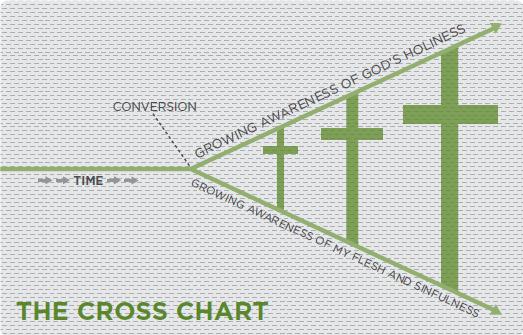
Basically, this is indicative of the New Calvinist gospel that makes much of sin so that Jesus is magnified. It is the antithesis of the true gospel.
TT concludes:
Because of total depravity, you and I were desperate for God’s grace before we were saved. Because of total depravity, you and I remain desperate for God’s grace even after we’re saved.
Thankfully, though our sin reaches far, God’s grace reaches infinitely farther.
Conclusion? We are still totally depraved. And what is really the difference between this and the apostle’s literary gasp concerning the amplification of sin so grace can abound?
In my book, nothing.
paul



Paul,
Finally! How many months have I been asking you for an actual quotation of someone saying “Christians are totally depraved?” TT, as you call him, is simply wrong. Do we have sin remaining in every part of our personality, intellect, emotions, will, conscience? Without question! But, does this remaining sin gain the ascendancy? Sin shall not have dominion over you, for you are not under the law, but under grace.
LikeLike
Ya, he would say, “See Randy, you agree with me, Paul said we are “under grace.”
LikeLike