The Good News About God
 God is good news. This is perhaps the simplest distinction between Biblicism and Protestantism; Biblicists believe that the gospel, or the good news about God is good news to everyone. It believes that the offer of salvation is a valid offer. It believes that the gift is offered to everyone. This speaks to the pejorative claim that Biblicists are unreasonable wooden literalists; indeed, we believe that words mean things. We believe that “news” informs someone of something that they didn’t know previously, and that God is a good reporter tending towards full disclosure; it isn’t good news to some and bad news to others. How is predetermined eternal suffering for the glory of God good news? How can a promise be a promise to you if you have no way of knowing if the promise is actually for you or not? Biblicists assume different word choices from a God that is not a God of confusion. Biblicists believe words mean things; Protestants don’t, and even say so in no uncertain terms! (Note Rick Holland’s heading on page 39 of Uneclipsing The Son: “When Bad Grammar Makes Good Theology”).
In these sessions, the term “Protestant” refers to the authentic doctrine of the Protestant Reformation. The fact that many have strayed from the original article is noted, but what Protestant gives a waiver to a Buddhist that doesn’t believe everything Buddha believed? It’s still Buddhism.
Consider an apple tree. Apple trees do not produce peaches. However, nor are the branches or the fruit exactly the same. The branches differ, and the apples vary in size and color, but it is still an apple tree. Biblicism is an altogether different tree.
Before we examine the Biblicist gospel, let me take you to the book of Genesis to illustrate the aforementioned elements of Biblicism.
Genesis 1:1 – In the beginning, God created the heavens and the earth. 2 The earth was without form and void, and darkness was over the face of the deep. And the Spirit of God was hovering over the face of the waters.
3 And God said, “Let there be light,” and there was light. 4 And God saw that the light was good. And God separated the light from the darkness. 5 God called the light Day, and the darkness he called Night. And there was evening and there was morning, the first day.
All kinds of hay is made with these opening statements from God’s word; if this creation account is really about the gospel, or symbolic of it, then outrageous presuppositions can be assimilated into the thinking of people without plainly stating the thesis. If you believe that the creation account is about the gospel, you also concede that God preordained the fall of man, created evil (darkness), and goodness, (light). And in fact, as I think will be ascertained from Susan’s sessions, this very belief, that God created evil and preordained the fall of man for his own glory, is very much a part of Protestant tradition.
There is no doubt that many of the biblical authors used the creation account for metaphors, but that does not speak to the primary purpose or point of the passage. The idea that this creation account is about the gospel is an assumption, and Biblicism chooses conclusions that are plainly stated over assumption in all cases. This is an account of the “first day” of creation and how God brought that about. The rightness of this epistemology can also be seen in the same passage:
God called the light Day, and the darkness he called Night.
Hence, from the very beginning, we see that reality is defined by what it is called through using words. If the meaning and science of words are not concrete, reality cannot be known. If this is a metaphysical statement concerning the gospel and good and evil, why wouldn’t God simply state that accordingly?
As far as words interpreting reality, God involved Adam in the process:
Genesis 2:19 – Now out of the ground the Lord God had formed every beast of the field and every bird of the heavens and brought them to the man to see what he would call them. And whatever the man called every living creature, that was its name.
Don’t misunderstand, things don’t cease to exist because they are not named, but there is no way to define existence without words, at least not in our reality, and therefore, the unnamed thing has no meaning. Remember also that people can be manipulated into doing absolutely anything if they are convinced by others that certain words mean certain things.
The definitions of words define reality in the minds of people. Those who control the definitions control what and how people think, and thus control their actions as well. Some call this “propaganda.”
Symbolism is the most often-used communication technique to convince people that certain words mean things they don’t mean. This is very subtle and effective; if creation represents the gospel, then obviously God anticipated the fall of man because it was part of His intended will for mankind.
But mankind did fall, and the recorded account in Genesis gives us insight into the nature of God, the nature of man, the nature of Sin, the gospel, evangelism, and the Caste religion.
This shouldn’t surprise us, but the serpent approached Eve with a religion. Well, really, THE religion. If this approach worked, and it did, why would there be a deviation from the original article? Sure, applications will differ, but the basic principles remain the same; it’s a tree of kind. What is it?
Genesis 3:1 – Now the serpent was more crafty than any other beast of the field that the Lord God had made.
He said to the woman, “Did God actually say, ‘You shall not eat of any tree in the garden’?” 2 And the woman said to the serpent, “We may eat of the fruit of the trees in the garden, 3 but God said, ‘You shall not eat of the fruit of the tree that is in the midst of the garden, neither shall you touch it, lest you die.’” 4 But the serpent said to the woman, “You will not surely die. 5 For God knows that when you eat of it your eyes will be opened, and you will be like God, knowing good and evil.” 6 So when the woman saw that the tree was good for food, and that it was a delight to the eyes, and that the tree was to be desired to make one wise, she took of its fruit and ate, and she also gave some to her husband who was with her, and he ate. 7 Then the eyes of both were opened, and they knew that they were naked. And they sewed fig leaves together and made themselves loincloths.
Let’s focus on the obvious here. The Religion has four basic principles, and the second point is less obvious, but valid: for the most part, ALL religious and political ideologies flow from this religion. Mankind was absolutely hell-bent on functioning by this premise until the Enlightenment Era. Here are the four basic principles of the Caste religion:
1. There is spiritual knowledge that is separate from material knowledge; the knowledge of good and evil.
2. Mankind is unable to comprehend the spiritual; he is enslaved to the material world.
3. Mediators are needed between God and man to understand the spiritual knowledge and apply it to the material realm for the overall well-being of mankind.
4. These mediators are divinely gifted by God and preordained.
The first three points can clearly be seen in Genesis 3:1ff. “Hey Eve, there is a whole body of wisdom that God is keeping from you, and you need me to mediate that wisdom between you and God because I am superior to you and therefore qualified to do so.”
Notice the communication techniques used by the serpent to deceive Eve: he changed the definition of words; “No, no, Eve, you misunderstand what God said, he didn’t mean that you will literally die.” And she ate, and guess what? She didn’t drop dead. The serpent changed the definition of the word, “death” as God meant it in that context, and nothing has ever changed accordingly. When we allow mediators between ourselves and God, we are trusting them to define words for us because we supposedly can’t understand God. Take note: when men speak of “subordinate truth,” this is set against the superior truth that only they and God understand, and we call that “orthodoxy.” When Biblicists are criticized for thinking we do not need creeds and confessions, that ought to make cold chills run up our spine. Creeds, confessions, and counsels are nothing more than mediators penning bedtime stories for the great unwashed who are childlike in their ability to understand realty. Consider this illustration once again:

What is this? Right, the knowledge of good and evil. Right? Let me show you something else:
Our wisdom, insofar as it ought to be deemed true and solid wisdom, consists almost entirely of two parts: the knowledge of God and ourselves.
That’s the very first sentence of the Calvin Institutes. If only God is good, and mankind is totally depraved, how is this not the knowledge of good and evil as the premiere epistemology of all metaphysics? It’s the knowledge of good and evil mediated by those preordained by God for the well-being of society at large. This religion brought death in the garden, and created elitist caste systems that dictate life from the family unit to offices of governors and kings.
We saw it in high school, and we even see it in the Republican primary. The elitist party hacks are beside themselves that the great unwashed are being duped by Donald Trump, but instead of asking “why?” and looking in the mirror, it is chalked up to the total depravity of the masses. Therefore, the party elitists must neutralize Trump in order to save the great unwashed masses from themselves. Though Trump continues to lead the pack in the polls by double digits, he is summarily dismissed by political pundits. One cannot by any means separate this from an elitist mentality that dismisses the discernment of the voters.
SIN: THE BIBLICAL DEFINITION
Something else can be learned here about the nature of sin. What is the biblical definition of sin? It is defined as a master, or slave master. Sin is defined as a separate entity that seeks to enslave.
Genesis 4:5 – So Cain was very angry, and his face fell. 6 The Lord said to Cain, “Why are you angry, and why has your face fallen? 7 If you do well, will you not be accepted? And if you do not do well, sin is crouching at the door. Its desire is for you, but you must rule over it.”
In what can be considered the first detailed account of a gospel presentation and that by God Himself, sin is identified as something that has desire, and that desire is to rule over others. God tells Cain that he must instead rule over sin. We also find that sin makes its appeal through desire:
Genesis 3:6 – So when the woman saw that the tree was good for food, and that it was a delight to the eyes, and that the tree was to be desired to make one wise, she took of its fruit and ate, and she also gave some to her husband who was with her, and he ate.
James 1:13 – Let no one say when he is tempted, “I am being tempted by God,” for God cannot be tempted with evil, and he himself tempts no one. 14 But each person is tempted when he is lured and enticed by his own desire. 15 Then desire when it has conceived gives birth to sin, and sin when it is fully grown brings forth death.
This is a fundamental definition of sin that is an important building block for additional understanding: it is a slave master that desires to rule over others and makes its appeal through desires, or “sinful desires.” The results of sin are types of death experienced throughout life leading to ultimate death. Sin is also empowered by its ability to condemn:
1Corinthians 15:56 – The sting of death is sin, and the power of sin is the law. 57 But thanks be to God, who gives us the victory through our Lord Jesus Christ.
When we get into the subject of law/gospel in part 3 of this session, the correlation between law and condemnation will be explained, but for now, the main point is that sin is empowered by its ability to condemn. It’s a master who desires to rule over people and bring many faceted deaths into their lives, and makes its appeal through the desires of others. It is empowered by the condemnation that results. In one way, sin rules over people by paralyzing them with guilt and fear.
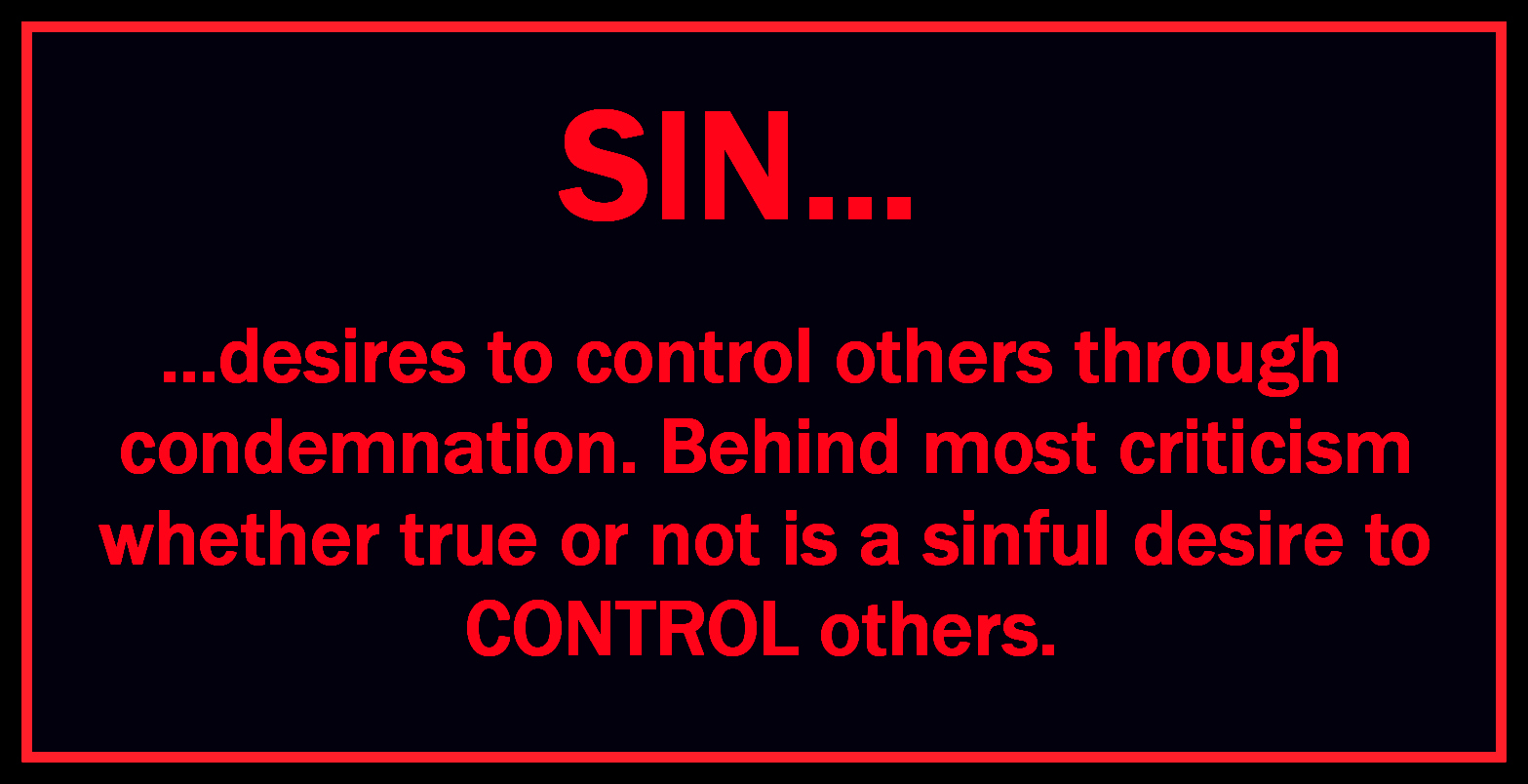
We see this in the garden. After Adam and Eve sin, they hide from God because they are afraid of God’s condemnation.
Genesis 3:9 – But the Lord God called to the man and said to him, “Where are you?” 10 And he said, “I heard the sound of you in the garden, and I was afraid, because I was naked, and I hid myself.” 11 He said, “Who told you that you were naked? Have you eaten of the tree of which I commanded you not to eat?”
Sin and fear of condemnation go together. This also speaks to evangelism and free will. Protestants love to make much of “No man seeks after God” (Rom 3:11). But this is not because man is totally depraved and has no inkling towards God whatever. Man does not seek God because he fears condemnation. Obviously, when Adam and Eve sinned, they did not immediately seek out God for a solution. Instead, they hid from God because they were afraid of His condemnation. This is why man does not seek God, he is afraid—not because he is totally depraved.
In addition, we see the essence of evangelism from the very beginning: God seeks out man with the remedy for sin. Just because God is the one who is proactive does not mean man has no ability to make a choice when confronted by God. Adam and Eve had no ability to come up with a plan that would fix the fall. Obviously, God is the only one who could remedy the problem. Man’s inability is in regard to proposing a plan of reconciliation with God, not an inability to accept the gift of salvation through a plan devised by God when offered.
Blog TalkRadio Podcast, Session 2: Challenging Doctrinal Presuppositions of Orthodoxy
Bad Marriages and the Simple Side of Tyranny
 The Bible isn’t complicated; to the contrary, its simplicity often escapes us as we look for something more complicated in the text. The journey in understanding the Bible begins with the stepping stones that you understand. You are simply looking to increase your understanding by building truth with one objective fact at a time. Pieces that fit together in the jigsaw puzzle lead to the fitting of more pieces. For some, the pieces take longer to find, and the journey is longer, but what they really know is more than most Protestant scholars who are ever learning but never coming to the knowledge of the truth. They are blind guides leading the blind.
Be sure of this: scholars make the Bible complicated because they want to control you. When it gets right down to it, “You have no need of anyone to teach you.” Teachers are gifted people who accelerate your learning; they are not seers or mediators between you and truth. If they ask you, “Did God really say…” you are to answer, “Yes, that’s exactly what He said.”
Hence, the simplicity of a very important fundamental truth found in Genesis:
4:6 – The Lord asked Cain, “Why are you angry? Why do you look so unhappy [has your face/countenance fallen; 4:5]? 7 If you do things well [correctly; appropriately], I will [will I not…?] accept you, but if you do not do them well [correctly; appropriately], sin is ready to attack you [crouching at the door]. Sin wants [desires to control; 3:16] you, but you must rule over it” (EXB).
We also know from the New Testament that sin is a master that pays death wages, while Christ came to purchase us with His blood from that master. We are now free to serve another master who only pays life wages. A slave that dies (through the baptism of the Spirit) is no longer under the authority of the sin master, and is a new creature resurrected to life and free to serve another (Rom 7:4).
But lest we are careful, the simple truths of this passage and a wiser life will escape us. Sin is described as an entity that has a desire; specifically, a desire to control others. One of the fundamental characteristics of sin is a desire to control others.
Secondly, in this verse, sin’s means of doing so are also described: sin is crouching at the door waiting for us to fail. Sin then seeks to exploit that sin for purposes of control. At least to some degree, sin seeks to use the failure to destroy a true self-assessment and make a case for needed lordship. Certainly, this is how the serpent approached Eve. He wanted to convince her that she was unable to understand God without a mediator. Has God really said…?
At this point, this truth needs more development, but here is a basic building block that we can be sure of: the sin master uses condemnation to enslave, and pays death wages for one’s work:
1 Corinthians 15:56 – Death’s power to hurt [sting] is sin, and the power of sin is the law. 57 But we thank God! He gives us the victory through our Lord Jesus Christ.
58 So my dear [beloved] brothers and sisters, stand strong. Do not let anything move you. Always give yourselves fully to [excel in] the work of the Lord, because you know that your work in the Lord is never wasted [not useless/in vain] (EXB).
This is why Christ came to end the law. Sin crouches at the door waiting to seize the opportunity to condemn, and the more law, the better. The “law of sin and death” empowers sin because the power of sin and its ability to pay death wages is condemnation. When Christ died to end the law, He stripped sin of its power to enslave and pay wages.
Don’t misunderstand; being in Christ does NOT mean that we are not under a law, but it is the “law of the Spirit of life.” Why is it called that? Because the new Master pays life wages for the obedience of love, and that has never been any different:
Deuteronomy 30:15 – “See, I have set before you today life and good, death and evil. 16 If you obey the commandments of the Lord your God that I command you today, by loving the Lord your God, by walking in his ways, and by keeping his commandments and his statutes and his rules, then you shall live and multiply, and the Lord your God will bless you in the land that you are entering to take possession of it. 17 But if your heart turns away, and you will not hear, but are drawn away to worship other gods and serve them, 18 I declare to you today, that you shall surely perish. You shall not live long in the land that you are going over the Jordan to enter and possess. 19 I call heaven and earth to witness against you today, that I have set before you life and death, blessing and curse. Therefore choose life, that you and your offspring may live, 20 loving the Lord your God, obeying his voice and holding fast to him, for he is your life and length of days, that you may dwell in the land that the Lord swore to your fathers, to Abraham, to Isaac, and to Jacob, to give them.”
Nothing has ever been different in regard to the law. When we serve God, it is the law of love that brings life wages; when we “serve other gods” it is the law of sin and death that pays death wages accordingly…
Romans 6:16 – Do you not know that if you present yourselves to anyone as obedient slaves, you are slaves of the one whom you obey, either of sin, which leads to death, or of obedience, which leads to righteousness?
With all of this said, consider the lion’s share of bad marriages. It never fails. Two people, at war, and each with a laundry list of the other’s faults. Check that. Better said, a condemnation list. And of course backed up with many Bible verses; the Bible is either the law of sin and death that condemns, or the law of the Spirit of life that loves.
What’s going on? Answer: sin, and its desire to control using condemnation.
Genesis 3:16 – “I will surely multiply your pain in childbearing; in pain you shall bring forth children. Your desire shall be for your husband, and he shall rule over you.”
This is the same exact grammatical construction found in Genesis 4:6 concerning sin’s desire to control Cain. Sin will manifest its desire in marriages by each spouse desiring to control the other, and using failure to do so. When the failure of a spouse presents itself, the other spouse will use it to make a case for ruling over the other spouse. In essence, “Since you are stupid, I should be running the show in this marriage.”
In Reformed circles, elders make a case for being the rulers because we are all…what? Right, “totally depraved.” Same deal.
If you know this simple Bible fact, you know more than most “expert” counselors. In most bad marriages, both spouses need to repent of being tyrants. They need to stop using the Bible to condemn each other, and start using the Bible to love each other. After all, “love covers a multitude of sins.”
Go and do likewise…you are now an expert Bible counselor.
paul
An Introduction to TANC 2015: Why the Protestant Reformation is a Lie

Protestants don’t know anything. That’s not a derogatory remark, it’s merely a staple of Reformed ideology. It’s who we are supposed to be. Protestantism is predicated on the idea of spiritual caste as an accepted norm. The average Protestant parishioner is not supposed to know anything, and again, this is an accepted norm. In fact, many Protestant laymen who didn’t get the memo will concur; knowing something in the institutional church will usually get you in trouble. If you know something, you lack humbleness, and are trying to undermine… The Pastor.
This should not surprise us at all if we understand our authentic roots and the ideology of our spiritual heroes. Though Martin Luther’s 95 Theses is credited with launching the Reformation, its first and defining doctrinal statement came six months later in the form of the Heidelberg Disputation to the Augustinian Order. In the 22nd thesis of that document, Luther declared knowledge to be a vice that does nothing but puff people up, and like with all lust, it can never be satisfied. Luther’s disdain for reason is well documented, referring to it as…
Reason is the Devil’s greatest whore; by nature and manner of being she is a noxious whore; she is a prostitute, the Devil’s appointed whore; whore eaten by scab and leprosy who ought to be trodden under foot and destroyed, she and her wisdom … Throw dung in her face to make her ugly. She is and she ought to be drowned in baptism… She would deserve, the wretch, to be banished to the filthiest place in the house, to the closets.
Reason is the greatest enemy that faith has; it never comes to the aid of spiritual things, but more frequently than not struggles against the divine Word, treating with contempt all that emanates from God.
Reason must be deluded, blinded, and destroyed. Faith must trample underfoot all reason, sense, and understanding, and whatever it sees must be put out of sight and … know nothing but the word of God.
There is on earth among all dangers no more dangerous thing than a richly endowed and adroit reason… Reason must be deluded, blinded, and destroyed.
Reason should be destroyed in all Christians.
Whoever wants to be a Christian should tear the eyes out of his Reason.
To be a Christian, you must “pluck out the eye of reason.”
In our day, this fruit doesn’t fall far from the tree as reflected in this quote by a pastor sent to our ministry by one of his former parishioners:
Paul told the Corinthian church that “‘knowledge’ puffs up but love builds up” (1Cor 8:1). So, if you love knowledge and look into the word of God to gain mere knowledge and you absolutely love doing it to the exclusion or ignoring of everything else, you may be “puffed up” and indeed not “building up.”…. Puffiness rips and tears. Puffiness pushes people away. Puffiness divides. Perhaps even more critical is the fact that puffiness portrays a small gospel and devastatingly distorts God’s glory.
To the puffy I say, “Stop studying your Bible.” Go on a quest for Jesus. He is the Word! Study Him, not it.
Studying Jesus and not any knowledge regarding Jesus is the most popular rendering of 1Corithians 2:2 in our day: we are supposed to make every effort to know NOTHING but Christ and him crucified. After all, according to another popular truism in our day, “He is a person—not a precept.”
Of course, most Protestants would deny all of this out of hand when confronted, but the roots and foundation of Protestant ideology has at least resulted in a lax view of knowledge while leaving the thinking to Protestant academia. Some well-known evangelicals such as Dr. Jay Adams have stated the obvious: Protestants are biblically illiterate, and have no wisdom in regard to Christian living other than God-given commonsense and even that is at an all-time low.
Christians, who strive for wisdom and spiritual maturity in the institutional church, if they don’t give up, will eventually find themselves in turmoil and at a crossroads. Striding towards commonsense spiritual objectives will continually put them at odds with the Protestant herd. I was certainly no exception. As someone who was always considered knowledgeable wherever I attended church as a Baptist, in reality, I knew nothing. The knowledge that I had accumulated in various seminaries and Bible colleges was all but worthless. Though I read and studied my Bible more than most, I understood little of it. Most of what I read made no sense at all. Nevertheless, I deemed myself knowledgeable relative to the environment, yet in my heart, I knew the Christian life made no sense and I was for the most part confused. In reality, I was good at constructing Protestant sentences with orthodox bumper stickers and pithy truisms.
So, I set out on a journey eight years ago to search for clarity after 23 years of confusion and strife. The part of my journey that really made everything come together began in 2011 when I embarked on a personal study of Paul’s letter to the Romans. I was determined to make this the time—the endeavor that would reveal once and for all what I was searching for: why my God seemed to be a God of confusion. I prayed earnestly at the beginning of the study that I would just let Paul’s words say what they plainly said. If something he wrote was definitive, I would use that as a building block of understanding.
Though I stayed true to the plan, not much happened until Romans 4:15. That’s the day my life came to a full stop.
For the law brings wrath, but where there is no law there is no transgression.
What in the world did Paul mean by that? NO law, NO sin: especially in the context; speaking of Christians. I kept it mind and continued to work through the letter. Then I came to Romans 5:13…
for sin indeed was in the world before the law was given, but sin is not counted where there is no law.
There it was again: no law, no sin. I stopped there in my verse by verse study and read through the rest of the letter and found the following:
Romans 7:6 – But now we are released from the law, having died to that which held us captive, so that we serve in the new way of the Spirit and not in the old way of the written code. 7 What then shall we say? That the law is sin? By no means! Yet if it had not been for the law, I would not have known sin. For I would not have known what it is to covet if the law had not said, “You shall not covet.” 8 But sin, seizing an opportunity through the commandment, produced in me all kinds of covetousness. For apart from the law, sin lies dead.
Apart from the law sin lies dead. There it is again. No law, no sin. Then I read the following as well:
Romans 10:4 – For Christ is the end of the law for righteousness to everyone who believes.
Conclusion: Christ died on the cross to end the law, and where there is no law, there is no sin. That’s how Christ took my sins away: He died on the cross to end the law. The true Christian is free from any judgement or condemnation—we are not under the jurisdiction of the law.
I wasn’t the least bit sure where this left the law in regard to the Christian life, but pondering the simple fact that we are no longer condemned was exhilarating and freeing. The old self that was under the law of sin and death died with Christ; you can’t indict a dead person, they are no longer under the law. And even if you exhumed my body and presented it in court, the judge has no law in which to convict me (Rom 7:1-6). There is NOW no condemnation for those in Christ (Rom 8:1).
Again, I was not sure where this left the law in regard to the believer’s life, but I had my building block; part of the pieces fit together which would lead to more pieces fitting and an increased understanding of the bigger picture.
Then I came to Romans 8:2.
For the law of the Spirit of life has set you free in Christ Jesus from the law of sin and death.
Remember, I had committed to simply letting the words say what they say. As a result, I saw something in this verse that I had never seen before; clearly, Paul wrote of two separate laws…the law of the Spirit, which I had always thought of as the Spirit’s realm of influence, and the law of sin and death.
“Wait a minute here,” I thought to myself. “If the law of sin and death refers to the written law that condemns mankind, and the two laws spoken of here are the same Greek word, and they are, why would one refer to a realm while the other one referred to a written law? Could it be that this is two perspectives on the same law?” I knew that a literal take on this verse would demand that, and then John 17:17 came to mind:
Sanctify them in the truth; your word is truth.
Then another verse came to mind:
And when he comes, he will convict the world concerning sin and righteousness and judgment (Jn 16:8).
That’s when I realized that the law has two different applications/perspectives: one for the lost and one for the saved. But verses were not done coming to mind:
Love does no wrong to others, so love fulfills the requirements of God’s law (Rom 13:10).
For in Christ Jesus neither circumcision nor uncircumcision counts for anything, but only faith working through love (Gal 5:6).
So, the Christian is free to aggressively love God and others through obedience without ANY fear of condemnation:
There is no fear in love, but perfect [mature] love casts out fear. For fear has to do with punishment, and whoever fears has not been perfected [matured, or growing] in love (1Jn 4:18).
Therefore, why the Reformation is a lie is not complicated at all. This SIMPLE fact makes Protestant theology a house of cards: it keeps so-called believers under the law of sin and death; its very definition of a Christian is the Bible’s definition of a lost person…under law (Rom 6:14). Protestantism is predicated on a single perspective on the law that Christians remain under; they remain under condemnation. This condemnation is covered by Christ’s righteousness as the “Christian” lives by faith alone. Living by faith alone works (usually some kind of ritual like “preaching the gospel to ourselves everyday”) imputes the obedience of Christ to our Christian lives as a way to keep ourselves justified. The Reformed call this “double imputation.”
Once one gets past all of the theological Protestant-speak, it boils down to extremely simple theological math: a Christian is NOT free to love—Jesus must love for us lest it be works salvation. And it almost goes without saying that there is a love famine in the institutional church for this very reason. The Protestant is not free to love, but must focus on a convoluted life formula that supposedly imputes the righteousness of Christ to our lives and thereby keeps us saved. Yes, this is the dirty little secret: total depravity doesn’t merely apply to the unregenerate, but also to the “saints.”
Yes, yes, many a Protestant doth protest against this accusation because few Protestants know what Protestantism is. Nevertheless, it is a false gospel that denies the new birth and keeps people under law and not under grace—a grace that frees the individual to aggressively love without fear of condemnation and the mire of unhealthy introspection.
We are saved APART from the law of sin and death…period (Rom 3:21), and it does NOT matter who keeps the law, the law of sin and death itself is the issue. Salvation is accomplished by the ENDING of the law of sin and death—not the fulfilling of it. Christ came to fulfill the law of the Spirit of life (and love) through us (Rom 8:4)…NOT the law of sin and death.
That would make the law of sin and death a co-life-giver with Christ. The law cannot give life unto salvation. If Christ fulfilled the law of sin and death with loving obedience to the Father, that law is a co-life-giver. That is Paul’s entire point in Galatians chapter 3. There is only ONE seed. If we are still under the law, the law is an additional seed that can give life…but there is only ONE!
Hence, Protestantism goes the way of most other false religions; some ritual or tradition fulfills the law of sin and death and separates the individual from the freedom to love without condemnation and according to the law of the Spirit of life. Love is replaced by obeying men and faithfulness to their institutions. The law of love is replaced with the traditions of men and their orthodoxy.
Consequently, we are in a Protestant dark age. In the same way that secular America has awakened to the failure of the elitist political class, Christians must awaken to realize the failure of Protestant academia. The assembly of Christ was a laity movement, and only the laity can return God’s people to the truth of the gospel. This is a repeat of history when God’s elect where continually troubled by the 1st century Gnostic elitists. Paul wrote to them…
For consider your calling, brothers: not many of you were wise according to worldly standards, not many were powerful, not many were of noble birth.
Likewise, the beloved James addressed the problem as well:
Listen, my beloved brothers, has not God chosen those who are poor in the world to be rich in faith and heirs of the kingdom, which he has promised to those who love him? But you have dishonored the poor man. Are not the rich the ones who oppress you, and the ones who drag you into court? Are they not the ones who blaspheme the honorable name by which you were called?
This is our mission at TANK, to aid the priesthood of believers in rediscovering the truth of the gospel and kingdom living robbed from us by 500 years of Protestant orthodoxy. The light has been covered by the Protestant basket long enough, and this is a matter of simple theological math: the new birth is the standard of righteousness, NOT the law of sin and death, and it matters not who keeps it—it CANNOT give life.
So, the speakers at this year’s conference are partaking in this journey in the arena of ideas. This is an issue that addresses every area of life and culture. Other than the gospel of first importance stated here, everything is being examined and revisited. It’s not group think, it’s collective truth made up of individuals seeking the one mind of Christ, not the traditions of men.
Let all be convinced according to their own conscience. Protestant elitists will not stand in our stead regardless of their claims, but each person will give an account for the sum and substance of their own lives. Let us do it with trembling and fear; not any fear of condemnation, but a fear of trading the life of Christ for the death of tyranny.
Because only truth sanctifies,
Paul M. Dohse
Dee Parsons of Wartburg Watch: The Personification of Everything Wrong with Church
 When Paul’s Passing Thoughts .com was started in 2009, the goal was to find out why church turned on me with a vengeance despite my best efforts. Second to that was the question, “What now, where does one go from the point of diagnosing the problem?” You have to properly diagnose the problem before you can fix it.
This article will not wear you out with points leading up to a final conclusion; I will begin by stating what I have found. Church produces the fruit of its ideology. What is wrong with church? Answer: church is what’s wrong with church. Christ’s mandate to his followers was never intended to look anything like church. The solution is to depart from church and pursue Christ’s mandate to His followers. You can’t fix church. There is nothing there that is salvageable.
Let me back up a tad because this post is not the least bit personal, but seeks to sharpen the objectives of TANC Ministries. This is some information that I have not shared before. PPT was primarily a blog for the express purpose of sharing my research. My focus was research. I had to know why—how could dozens of pastors stand by and watch Clearcreek Chapel do to my family what they did?
Clearly, obviously, from a literal interpretive standpoint in regard to the Bible, what they were doing was dead wrong and unbiblical. During the episode, I was even under the counsel of a church that was part of the same fellowship of churches that Clearcreek Chapel belongs to. The pastor, the late Rick Wilson, was a former associate pastor at CCC. The present pastor of the church, Paul Craig, was an elder at the time and according to Wilson found the situation, “unsettling.” Grace Covenant (Beavercreek, Ohio) was obviously stuck in the middle, and was also the recipient of a significant exodus of people from CCC at the time. Though I was clearly under church discipline at CCC, I was allowed to attend Grace Covenant on a regular basis. I even thought about applying for membership which would have forced the Grace Covenant elders into making a judgment regarding the veracity of CCC discipline. I should have; watching that play out would have been priceless.
Eventually, Wilson instructed me to go back and play along in order to get my wife back, but I had already tried that for four months. During that time, I was subjected to cult-like break sessions conducted by CCC elder and Psychiatrist Dr. Devon Berry. The CCC elders knew that I had overcome serious depression in the past, and it was obvious they thought they could use Berry and the circumstances they were bringing to bear in my life to drive me into debilitating despair. It was very apparent to me at the time: that is what they were trying to do.
I want to stop right here and thank God publically for something right now—I want to give Him the glory. At the time, I was working out of town and laid in bed at night before going to work the next day…in perfect peace. My favorite time of the day during that time period was bedtime. Why? I laid there in the quiet darkness, not really thinking about anything except how peaceful it was. I was doing nothing but laying there soaking up the peacefulness. Do I have any theories regarding this experience? One: I had begun a long journey in search for the truth. God is with one on such journeys. That’s my best shot at answering that question. By all reasoning, I should have been a basket case.
Let’s now pause here for some simple clarification. It all boiled down to two things:
AUTHORITY, and how I interpreted reality versus how they interpreted reality.
I have discovered something in my research—research enables you to come to a point more and more where you can explain complex problems in simple terms. In the 2500 + articles I have written on Reformed ideology, you can see the focus move from the what to the why. My first book articulated the what and how it contradicted a grammatical interpretation of reality, though I didn’t understand the latter dynamic. My second book articulated the contemporary history of the Neo-Calvinism movement and added some more data about grammatical contradictions.
My third book and subsequent booklets articulate the grammatical contradictions in regard to soteriology. They also describe the dynamics between the Old Calvinism/New Calvinism question and how the interpretation of reality drives that debate.
Including time spent prior to PPT, eight years later, I can now put all of this in simple terms. It boils down to AUTHORITY vested in the interpretation of reality.
And, the established credential thereof known as “orthodoxy.” What is the premise of orthodoxy? Nothing more or less than the claims of men that people choose to believe. You can put any number of things in place of “naked” in regard to the following question posed by God, “Who told you that you are_____?” Be very, very, very wary of what men say God told you. And that’s orthodoxy. And the place we go to get certified in orthodoxy is called “seminary.” In case you haven’t noticed, God isn’t the dean or an adjunct professor in any of these schools.
 Here is something else that should be evident: you, and only you alone will answer to God. Therefore, pick your orthodoxy well. There are no attorneys in God’s court save Christ, “hear ye Him.” “God has spoken to us in these last days through His Son”, not a horde of academics.
So, what do we have in the recent dust-up between PPT and Wartburg Watch? Be advised, I am not going to rehash all of the gory details. Dee Parsons is right and I am wrong because she has college degrees, and holds to orthodoxy. Paul Dohse does not have college degrees, and does not hold to orthodoxy. Paul Dohse holds to a grammatical interpretation of realty, and therefore asks, “How can those who proclaim themselves ‘wicked’ lay claim to salvation?”
Be sure of this: NOTHING has changed since Christ ministered on earth. The primary pushback against Christ was clearly the orthodoxy of the day. Christ deliberately avoided the lauded academia of that day. I just don’t know what is more obvious. In addition, he had to personally reeducate the apostle Paul who was the only religious academic that He used for foundational purposes.
I am weary of documenting the steroidal cognitive dissonance that takes place over at Wartburg and their e-church hosted by the Barney Fife of pastors, Wade Burleson. Regardless of his credentials, from a standpoint of interpreting reality grammatically, his theological snafus are just plain embarrassing. For example, you can’t make the point that a biblical author was teaching something based on the analysis of a word that didn’t exist in the first century. This all takes place in the face of common sense for the same reason I experienced what I experienced at CCC:
AUTHORITY vested in a particular interpretation of reality.
Because one is credentialed in knowing how to lead those who cannot know reality, one should have authority over you for your own good and the common good of people in general.
In varying degrees, CHURCH, established in the 4th century by St. Augustine et al, is the expression of this primary root, and the fruit doesn’t fall far from the tree. Chaos and drama will continue in the church with no solution in sight because of its foundational presuppositions concerning the interpretation of reality and the authority vested in its epistemology.
This ministry’s series on the Heidelberg Disputation focuses on the following fact: at issue with the Reformation was a debate about the interpretation of reality. Of course that spoke to how the Bible is interpreted, but the issue started with how reality itself is to be interpreted. Let me give you the thumbnail:
Words don’t necessarily mean things.
By and large, there are two kinds of Protestants roaming about, Calvinists and functioning Calvinists. Susan and I often have conversations with people who hate Calvinism, but verbally espouse Calvinism unawares constantly. We don’t even address the particulars anymore because we know a complete reeducation is needed. This is what we are attempting to do with the HD series. This series reexamines the roots of the poisonous tree.
This is why Dee Parsons, in the recent dust-up, insinuated that I am mentally ill. What is the definition of a person who does not properly perceive reality? Hence, the CCC elders involved a Psychiatrist in my situation because they honestly believe I am mentally ill because I interpret reality grammatically. Reformed scholars such as Geerhardus Vos have stated such openly. Pastor Russ Kennedy told me I was “mad” and begged me to allow them to “shepherd” me. I believe the guy honestly meant well and still does. Unfortunately, as the saying goes, the road to hell is paved with good intentions.

By the way, I am not talking about grammatical interpretation that leads to a redemptive outcome. I am talking about the interpretation of reality beginning with exegetical presuppositions in the purest sense. I realize Reformed scholars interpret a verse literally when it can serve a redemptive historical outcome…
…that doesn’t make you a proponent of interpreting reality grammatically.
One of the accusations that flowed from the recent dust-up was that TANC Ministries is merely developing its own orthodoxy. Not so. Orthodoxy fundamentally interprets reality according to Martin Luther’s Heidelberg Disputation which was expanded upon by John Calvin’s Institutes of the Christian Religion. Seminary degrees guarantee that individuals will not do independent research that will reveal the real tenants of orthodoxy:
- It is a metaphysical redemptive narrative that interprets all reality through a dualism of good and evil.
- It demands the fusion of faith and force for the common good of mankind.
- It is predicated on spiritual caste that adds additional mediators between God and man other than Christ.
- All of reality progresses as predetermined by manifestations of good completely outside of man.
Dee Parsons’ response to me that “I don’t believe what you say I believe” is most likely due to her ignorance regarding the true sum and substance of the same Reformed orthodoxy that she promotes. Perhaps. While claiming to be an advocate for the spiritually abused, she picks and chooses from orthodoxy what she wants to acknowledge.
The Westminster Confession is just wonderful, but its call to control the free press and execute those who are heterodox is due to the authors being “men of the time.” Of course, their politics and ethics had nothing to do with their ideology. Perish the thought, and no, American Jurisprudence isn’t the only difference between Calvin’s Geneva and the present-day church. It’s absurd to think Dee Parsons would actually have you committed to a mental institution because she thinks you are mentally ill. It’s absurd to think Mark Driscoll would really put you in a wood chipper just because he said that’s what ought to be done. It’s absurd to think James MacDonald would catapult you into the next county, and to your certain death just because he said he wishes he could.
Church is a place where professional clergy interpret reality in a completely different way than most parishioners. Congregants follow the dictates of church leaders while being clueless in regard to their interpretation of reality. They are given elements to follow while being totally unaware as to what those elements are based on. Hence, chaos and confusion reign. Duggar-like drama is paraded before the world constantly like an out-of-control stampede of rats. Yet, that isn’t the madness; the madness is suggesting that we rethink how church is done. After all, Catholicism and Protestantism have had only 1500 + years to get it right. Not only that, the Neo-Calvinist movement has been in total control of the church for at least ten years. Growing steadily since its conceptual resurgence in 1970, discernment/spiritual abuse blogs exploded in 2009 when the movement shifted into 4th gear. Starting in 2008, a historical phenomenon of mediation organizations to keep churches out of court exploded onto the scene as well.
With all of this considered, I think I have heard the best assessment of Wartburg Watch yet:
Subconsciously or consciously, Dee uses her blog as a means to leverage her desire for a seat at the American church’s authoritarian table. Period. Whether this was an initial objective of her blog or merely a pitfall of unforeseen success, who knows? But the reality is obvious:
Dee creates better soldiers, not better souls. And the irony is thus that the “victims” who frequent her site often become the very image of that which they initially despised: manipulative self-appointed God-proxies who claim that the only legitimate doctrinal discussions are with those whom already concede their reformed hermeneutic (Muff Potter, anyone?).
My point is that the cognitive dissonance, the categorical rejection of reason as a yard stick for measuring reality (the efficacy of existence), makes contending with her an almost perfect waste of time.
So what’s the solution? I believe the solution is an utter rejection of orthodoxy and church as we know it. The immense ramifications of that is not the issue—truth is the issue. The church has had its chance to make a case for hope, and has not measured up.
I believe the task ahead is daunting, but will supply a freedom and joy beyond our wildest imaginations. It is a call for Christians to submit themselves to the one mediator Jesus Christ. It is a call for Christians to stop listening to men, and “hear ye Him.” Orthodoxy has NO authority, ALL authority has been given to Christ and no one else.
Past this, God’s people must gather together for mutual encouragement and edification in the ways prescribed by the Bible and not the traditions of men.
When is the misery and suffering produced by orthodoxy enough to make us question everything?
That time is well past.
paul
Susan Dohse on Plato, Augustine, Calvin, and the Reformation
 TANC 2013 Conference on Gospel Discernment and Spiritual Tyranny
Transcript: Susan D. Dohse MEd.
Plato
I’m Susan Dohse. I’m married to Paul Dohse for two years, and it has been an adventure. My role in this year’s conference has changed. This year I became Paul’s research assistant. The pay stinks, but the fringe benefits are really nice. Unlike last year when I spoke from personal experience, which though difficult and emotional at times, was easier than this year’s assignment. This year I was asked to step outside my preschool box and share what I’ve learned through not personal experience but personal study and research. And I am thankful for the World Wide Web, computers, and the Internet even though I fuss and say unkind things to the computer, I am thankful that the Lord created those on the eighth day. If I had to find answers to the questions that I had in the old-fashioned way, by using the card catalog and the Dewey Decimal system, I wouldn’t be here this morning. I would still be at the library roaming the stacks. My role in this year’s conference is to share my research. My goal though is to provoke you to think. What I want to share is only an introduction. It’s not even a scratch on the surface of what there is to know about these historical figures. It’s up to you though to continue the research project. So you do have an assignment. I want you to think of me as just a grain of sand, an irritant in the oyster that over time though yields a pearl.
Matthew 7:24-27, Jesus is speaking here. “Therefore, whosoever hears these sayings of mine and does them, I will liken him unto a wise man who built his house upon a rock. And when the rains descended and the floods came and the winds blew and beat upon that house, it fell not, for it was founded upon a rock. And everyone that hears these sayings of mine and does them not shall be likened then to a foolish man who built his house upon the sand, and the rains descended and the floods came and the winds blew and beat upon that house, and great was the fall of it.”
The foundation of thought that I want to illustrate is built upon a historical figure that I just knew initially in a Jeopardy quiz show fashion, you know. Student of Socrates, Greek philosopher, The Republic. Who is Plato? Well, if I were to ask you to tell me something that you know or you’ve been taught about this man, I’m certain I would get classic textbook answers. Greek philosopher, student of Socrates, established the first university called The Academy, wrote The Republic, I would give you credit for being correct. For over 2,500 years, Plato has been studied, admired, modified, personalized, and deified. He has been described as a great thinker, lover of wisdom, a crusader against error, and an enemy of falsehood. Well, after reading hundreds of pages about him, I cannot help but agree that he was a man of great intelligence. He was a mathematical genius, an advocate of education. In your list of trivia facts, would you also include pagan, polytheist, crusader against individuality, founder of communistic, socialistic, and Darwinian evolutionary thought, enemy of God, hero of the reformers?
Born in 427 BC, the son of noble and wealthy Athenian parents with the blood of ancient kings of Attica flowing through his veins. It was this status in life that gave him the way and the means to pursue his quests. Unlike others of his day, he didn’t have to earn a living and go to school at night or hold two jobs to pay for his education. He was of the ruling class of Athens, a privileged elite.
At the age of 20, Plato came to Socrates and asked to be his pupil. And Socrates saw before him a handsome youth, broad shoulders of an athlete, a noble brow of a philosopher, the limpid eyes of a poet. Those aren’t my descriptive terms. This is how Socrates described him. Socrates accepted him as a student, and this became the beginning of a tender and an intimate relationship that lasted until Socrates’ death. The respect and admiration of the student for his teacher was profound and lasting.
Well, after Socrates was executed, Plato and the other disciples of Socrates took to the world, and they traveled the ancient world. Now whether of fear that they would be arrested and also executed because of their association with Socrates or because they wanted to be foreign exchange students is not really well documented. Plato went to Cyrene where Theodorus instructed him in mathematics. He went to southern Italy where he studied the science of numbers under three of the most learned doctors of the Pythagorean mathematical system of his day, went to Egypt to receive instruction from those learned doctors and priests of that ancient land. Some records say he visited Persia, Babylonia, and even India. So he returns to Athens and establishes his Academy, the first university in Europe where he taught until the age of 81.
So up until his return to Athens, we can say letter P for professional student, P for pagan polytheist. Plato regarded the sun, moon, stars, and planets as the visible gods. These heavenly bodies do not come into beings and then pass away. Plato attributed divine souls to the sun, moon, stars, and planets because they followed that intelligible course through the sky. He also held [SOUNDS LIKE] the invisible gods, the gods of the civilized life where the king was Zeus. These gods care about humans. They’re aware of whether we are good or evil. Though invisible, they can reveal them themselves when they want to. They are not standards of justice, beauty, truth, and goodness, but they were living beings who have the perfect knowledge of those standards. Plato wrote, “I do believe that there are gods, and that in a far higher sense than that which any of my accusers believe in them.”
P for platonic wisdom which unites with methodology. P for philosopher ruler. Plato referred to himself as a philosopher ruler. He stressed the importance of living the life of a philosopher by worshipping ideas. The search of ideas, the appreciation of ideas, the participation of the ideas—that’s the life of a philosopher, and that’s what he taught, and that’s what he believed. So the life of Plato was a tireless quest for those ideas. His life is a sustained effort to live by those ideas and to teach others to do so.
P, political scientist, his political philosophy was explained in his writing The Republic. The ideal state, he says, should be divided into three classes of citizens, and each class has its own particular duty to be performed and a special virtue to be developed. The lower class, the laborers and the artisans, their immediate task, acquire skill. The second class, that’s the warriors, and they’re given the opportunity to develop courage and fortitude at their stage of evolution. And the ruling class, those are those men who have learned how to govern themselves and are therefore fit to govern others. I quote from Plato, “Unless philosophers become rulers or rulers become true and thorough students of philosophy, there will be no end to the troubles of the state and humanity.” When each state concentrates upon its own duty and virtue, there will be a well-balanced and harmonious state in which all of the citizens will work, but not for the interest of self but for the common good of the whole. The state will be in charge of production and that sphere of physical goods and life. (more…)

 Paul's Passing Thoughts
leave a comment