Are Babies Totally Depraved? Follow the Protestant Money
 No, because man is not totally depraved. This is simple theological math. Man is not totally depraved by virtue of how God creates us. Every human being born into the world is born with the works of God written on their hearts. They are also born with a conscience that either excuses them or accuses them of wrongdoing.
Romans 2:14 – For when Gentiles, who do not have the law, by nature do what the law requires, they are a law to themselves, even though they do not have the law. 15 They show that the work of the law is written on their hearts, while their conscience also bears witness, and their conflicting thoughts accuse or even excuse them 16 on that day when, according to my gospel, God judges the secrets of men by Christ Jesus.
Those who have the law, that is, the written word of God plus the works of the law written on their hearts, are under the law’s judgment. This is why religious people will be judged more harshly than the nonreligious—they are responsible for two laws, not just one.
Christ came to die on the cross to end the law’s condemnation for those under it, or those under law, and was resurrected so that the same can find life in the law apart from any condemnation. Under grace means that we are now under the “law of the Spirit of life” (Rom 8:2). What does that mean? It means the Spirit now imparts life to us through the same law that condemned us prior to our salvation (Jn 17:17, Eph 6:1-3). The old us that was under law literally dies with Christ, and is resurrected by the Spirit as a new creature who finds life in the law (see Psalms 119).
Andy Young and I were having this discussion this morning. In the garden, there was only one law: you may eat of any tree in the garden except the one. As long as they obeyed, there was life in that law; when they disobeyed, death came into the world.
But, back to babies. Babies are not totally depraved, and in fact go to heaven because they are not yet under law; where there is no law there is no sin (Rom 5:13). Don’t confuse this with the pre-fall of man where there was only one unbroken law. Babies do NOT have a developed conscience; therefore, they cannot negotiate right and wrong as administered by conscience according to the written law or the law written on their hearts. So, babies are born under law like all people, but are not accountable to it, and therefore NOT condemned by it until they have a developed conscience that can ascertain right from wrong. I believe mentally handicapped people would fall under this category as well.
Where there is no law, there is no sin. So if babies cannot know law, they have no sin. And if they have no sin—they are going to heaven:
Roman 7:7 – What then shall we say? That the law is sin? By no means! Yet if it had not been for the law, I would not have known sin. For I would not have known what it is to covet if the law had not said, “You shall not covet.” 8 But sin, seizing an opportunity through the commandment, produced in me all kinds of covetousness. For apart from the law, sin lies dead. 9 I was once alive apart from the law, but when the commandment came, sin came alive and I died. 10 The very commandment that promised life proved to be death to me. 11 For sin, seizing an opportunity through the commandment, deceived me and through it killed me. 12 So the law is holy, and the commandment is holy and righteous and good. 13 Did that which is good, then, bring death to me? By no means! It was sin, producing death in me through what is good, in order that sin might be shown to be sin, and through the commandment might become sinful beyond measure.
Babies have no concept of law. People are accountable to the law when their consciences are developed to the point of knowing right from wrong.
Follow The Protestant Money
Early in the Protestant Reformation the subject of total depravity was a big deal. This also included the total depravity of the saints. Simply stated, the Reformers believed little different than Rome in regard to salvation via church membership. The biggest draw for the Protestant Reformation was no fault salvation through church membership. The Reformers clearly stated that new sins committed by “believers” removed them from grace, and continued forgiveness of sins through the perpetual reappropriation of Christ’s death was needed to keep oneself saved (for example: The Calvin Institutes, 3.14.9-11). This reapplication of Christ’s death was only valid when administered by the institutional church through baptism, the Lord’s Table, and the grace-infusion of preaching by ordained Reformed elders, in today’s Neo-Calvinist vernacular, “We must preach the gospel to ourselves every day.” Why? Because we need the same gospel that saved us initially to keep us saved daily because the new sins we commit remove us from grace. This would seem fairly evident.
The Reformers believed that baptism initiated church membership, and as long as the baptized remained in good standing as church members, their baptism retained its saving efficacy (Calvin Inst. 4.15.1ff). Salvation is maintained within the institutional church, so baptism doesn’t save you per se, but is necessary for church membership which keeps you saved through faithful attendance to “gospel preaching” by ordained elders and the Lord’s Table. This ministry has compiled a mass of citations by “New” Calvinists who state this in no uncertain terms.
And this is the crux of the infant baptism debate. Protestants were big on baby baptism because it made the babies church members and therefore guaranteed them salvation as long as they remained faithful to the institutional church as they grow up. This led to the birth of Baptists who became half pregnant Protestants over the baby baptism issue. Unfortunately, this boiled down to when a child was old enough to be a church member which was also synonymous with being saved among the Baptists. This closer approximation to truth created the whole never ending “Do babies go to heaven?” debate.
No, Babies are not totally depraved, and yes, they go to heaven. The Baptists only focused on the baby baptism issue without further investigating what was driving the belief to begin with; i.e., salvation by institution.
This began a long deep-seated tradition by Baptists to focus on symptoms and not causes. This is why Presbyterians and Lutherans are far less confused than Baptists—Baptists are both confused and wrong, while the Protestants and Lutherans are just merely wrong…about the gospel.
paul
Victims and Discernment Bloggers: Let’s Ask the Right Questions
 “So, they would say to the young ladies and boys who have been molested in the church, ‘So what?’ The same sin that indwells the pedophile is in the victim as well. Can we not survey the past and present abuse and see this worldview plainly?”
Even though we hate to think commonsense is important in understanding spiritual issues, the fact remains that such is the case. We struggle with this because of our notion that material is evil and spiritual is good. This notion is deep-seated in the Western psyche. Consequently, we are often willing to throw math out the window for something spiritual. Also, the spiritual get out of commonsense free card comes in handy when we have invested too much of our own self-esteem in a bad idea. If we humble ourselves and admit we were wrong, our intellect labeled as “humbleness” (lest it have no credibility) seems to lose its credibility.
Frankly, I find admission of wrong freeing. Yes, it may make you feel stupid for a while, but the problem with being wrong is that you can’t get anything done with bad information, and not getting anything done leads to hopelessness. Ultimately, even if you are stupid, people will judge you by what you get done, and even if they don’t, God will. Christ is documented throughout the New Testament as being annoyed by verbal assent to righteousness rather than actual doing, and bad information does not lead to right doing. This would seem evident.
But what if you can’t really know anything? And what if you can’t really do anything good? What would the results of that be? Well, look at the blogosphere spiritual discernment and victim “healing” ministries. In full force since 2009, matters continue to get worse, not better, and to date, justice for the victims is found nowhere. Why? Why doesn’t discernment ministry work? In the analysis of Herman Cain’s acronym, W-A-R, discernment bloggers are not working on the right problem, asking the right questions, nor removing the necessary obstacles.
What is the right question? It follows: “Why doesn’t discernment ministry accomplish anything?” Need proof? Anybody remember the outrageous ABWE scandal? Thought so. A secular media producer just cancelled “Here Comes Honey Boo Boo” because of the mere potential of a smidgen element of the ABWE scandal, yet, ABWE continues to thrive unabated. How can this be? is another right question.
No, that is THE right question. And what is the obvious answer? It follows: people keep supporting ABWE financially. In case it escapes anyone, ABWE cannot continue unless it receives money. That raises another question: “Why do people keep sending such an organization money despite their deplorable behavior?”
Um, I can only tell you why the people who keep sending ABWE money say they keep sending ABWE money. Would that suffice? The reasons follow:
- Because ABWE, and institutions like it are God’s anointed, preordained vessels to take the gospel to a dying world, they are the only ones qualified to do so. If ABWE fails, thousands and thousands of souls will go to hell for eternity. ABWE must survive.
- ABWE must operate with people, and where there are people, there is sin, this is unavoidable.
- ABWE should be forgiven as Christ forgave us.
These are the reasons that no justice can be found in the institutional church. These are the reasons that religious institutions continue to spiritually abuse unabated. That’s the problem that must be worked on. Those answers assume the following: spiritual hierarchy, moral equivalency, and individual value defined by contribution to the group; i.e., no justice for the individual is what’s best for the many.
Note: the institution in and of itself is not the problem, people in and of themselves within the institution are not the problem, and money in and of itself is not the problem: the logic is the problem. The threefold logic clearly gives license to the behavior. The threefold logic insists that nothing can be done, or that nothing should be done. In fact, the threefold logic insists that there really isn’t a problem to be worked on in the first place—this is clearly ascertained by the normative results of all of these scandals.
So, how do discernment blogs work on the problem? By exposing the problem, “properly” identifying the problem, and assuming that the institutions will respond and seek justice for the victims. How’s that working for us so far?
So let’s ask another right question: “Why isn’t that approach working?” One reason is the identification of a particular problem that discernment bloggers like to call “cognitive dissonance.” This is the study of how people believe contradictory propositions and their attempts to reconcile the contradictions. But this is where discernment bloggers totally miss it: spiritual hierarchy is more times than not predicated on the idea that the masses cannot properly interpret reality itself. How many times have we heard the following?
No matter what it looks like, you need to trust the leaders who have been working close to the situation and know all of the details.
Though we would not agree with a naked verbalization of the idea that only spiritual leaders can properly interpret reality, we by all means function that way. However, more and more in Reformed circles, this concept is being openly stated in the following way:
All of reality, or what is truly reality, is interpreted through redemption, and only the gifted are able to do so. Meanwhile, it is acceptable to obtain worldly knowledge, and some of it is good, but a good thing is not always the best thing.
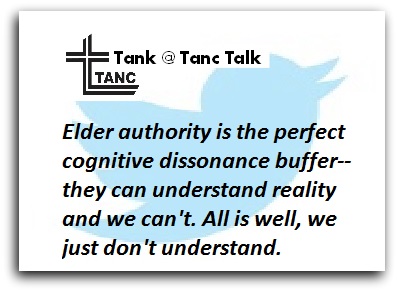 Therefore, when it comes to spiritual matters, trust God’s anointed regardless of the obvious. In cognitive dissonance, the thing used in an attempt to reconcile two contradictions as much as possible is called the “buffer.” In this case, the buffer is the belief that spiritual leaders must be obeyed because they are the ones who can see reality and we can’t. Sure, we can understand worldly things that have no eternal value, but when it comes to eternal matters the leaders must be trusted at all cost. The right problem to address is the buffer, not the symptom of being comfortable with contradictions. Discernment bloggers wrongly identify the real problem and work on the wrong one. They fail completely on Cain’s “W.”
And by the way, if you want to read a sermon by a conservative evangelical that exemplifies this dualist approach to reality, you can read it here, and listen to it here.
In addition, this author can give firsthand evidence of this mentality via correspondence from someone upset by what this ministry publishes.
Deep down you know that it is true. Turning logic on its head, twisting words, pseudo-scholarship, and outright attacking people for things that both you and I know they do not believe does no one any good.
Another misunderstanding is that I somehow knew and stood behind any improper things you may have experienced at Clear Creek.
These statements were made in light of the fact that citations/quotations make-up approximately 30% of what our ministry writes, and improper things “you may have” experienced is set against a website that thoroughly documents what exactly happened. The individual wrote these statements in the face of undeniable documentation. How can he do that? Because only those with authority can properly interpret reality despite the evidence presented to the contrary. That’s why. The individual also accused our ministry of “pseudo-scholarship.” Why is it such according to him? Because it doesn’t have the authority of Reformed institutional scholarship—they are the ones who really know the truth. Discernment bloggers seem to miss the point that institutional tyrants do not interpret reality in the normative sense.
Another point missed by discernment bloggers is: tyrants who interpret reality differently will not always act out in the same way. However, if the same ideology does not produce shameful behavior, it will at least produce tolerance for it. And the right question here is, “why is this so?” Answer: moral equivalence. If everyone is Adolf Hitler at heart, who is anyone to judge anybody for anything? We are ALL just sinners saved by grace after all. “Justice,” you say? What justice? We ALL deserve hell! Again, this is also seen in the aforementioned correspondence:
I truly grieve for the things that you have shared have happened with your family, but all either of us can do from here is look to faithful God and away from the sin that is in our heart and other men who will always ultimately disappoint because none of us are sinless.
Notice that he grieves for the things “that you have shared happened with your family,” i.e., how I interpret their actions, not what they actually did. And notice that the sin these men may have committed against me is also in my heart as well. So, they would say to the young ladies and boys who have been molested in the church, “So what?” The same sin that indwells the pedophile is in the victim as well. Can we not survey the past and present abuse and see this worldview plainly?
So, if there is no moral unequivalence necessitating a need for justice, all that is left is unity and peace for the sake of unity and peace which can only be obtained by blindly following those preordained to lead the great unwashed masses. We must also understand that this logic gave rise to institutions in general and the institutional church in particular.
Let’s work on the right problem: the worldview of the institutional church. Let’s ask the right question: “What should we do about it?” And finally, let’s remove obstacles to what works.
The obstacle that needs to be removed is fellowship with the institutional church. Again, the institution in and of itself is not the problem, but its caste worldview is the problem. Christians en masse must stop giving their money to the institutional church and must warn all people that they involve themselves with the institutional church at their own risk. It looks something like this:
Mark, likewise, I don’t care to debate with you because we see reality differently. I interpret reality grammatically, and you interpret reality redemptively like the Neo-Platonist “Christians” that you follow. Even John Street has bought into this latter-day antinomian nonsense. All I want to hear is that you stay clear of my family, and let’s be clear, it is not a wish—it is a demand, and I will protect my family at all cost—be sure of it.
Keep your family away from the institutional church. What else needs to happen in order to demonstrate that its fundamental worldview is horribly distorted? Husbands need to step up and take over their responsibility before Christ to lead their own families spiritually. You need to join a fellowship and be encouraged by men of God who can think for themselves and fear the Holy Spirit more than puffed-up control freaks. If you cannot find such a fellowship, do so in your own home.
paul
Related articles:
The Truth About Paul Tripp’s “How People Change”
 How People Change
by Paul David Tripp and Timothy S. Lane
Punch Press: Winston-Salem (2006, 2008)
Reviewed by Donn R. Arms
The Journal of Modern Ministry: Volume 8, Issue 1, Winter 2011
Jay E. Adams Founder and Senior Writer; Kevin Backus General Editor
_________________________________________________
The traditional view of the gospel’s relationship to change is that salvation is foundational to change. Once a person is justified before God by believing in Christ’s saving work on the cross, and made a new creature, he then begins the work of co-laboring with God in the growth process, also known as sanctification. The traditional view sees our role, after being made a new creature (born again), as many-faceted in regard to biblical instruction—the primary role being the learning of God’s Word and the application of it to life via obedience in how we think and behave (Matthew 7:24).
The traditional view makes a significant distinction between justification (redemption), sanctification (growing into Christ-likeness), and glorification (complete transformation). It sees justification and glorification as acts of God alone apart from human participation or monergistic, but sees sanctification as synergistic or a cooperative (but none the less dependent) work with God. Obviously, an accurate view and description of our participation is vital to affecting real and lasting change.
For Tripp and Lane, the gospel message is not only for the unregenerate, but efficacious for real and lasting change in the life of a believer. Certainly, as Christians move into our relationship with Christ as not only Savior, but also Lord, we should never leave behind an appreciation for the sacrifice of Christ that saved us. The authors claim, however, that the same elements of justification must be carried forward into sanctification without anything being added. In fact, for believers to even make an effort to align our thinking with Scripture is an act on our part that denies Christ as Savior:
. . . and the Bible does call us to change the way we think about things. But this approach again omits the person and work of Christ as Savior. Instead, it reduces our relationship to Christ to “think his thoughts” and “act the way Jesus would act” (p. 27, 2006 edn).
Throughout the book, the authors embrace parts of the traditional view, but view the traditional elements through a non-traditional prism, and give the traditional elements of change a different meaning. In this case they trade the traditional idea that Christians are to make an effort to align our thoughts with Scripture with the idea that we should do something else instead that leads to biblical thinking as a natural result of the “living Christ” acting on our behalf and apart from our initial efforts. According to the authors, the traditional approach omits the “work” of Christ in our sanctification and omits Christ as “Savior.”
Lane and Tripp do not deny that Christians have a role in the sanctification process. But what exactly is that role? If the traditional view of our exertion (effort in aligning our life with Scripture) in sanctification is out, what is in? Answer: deep repentance, the second major thrust of the book.
Repentance is a form of emptying the heart . . . Along with deep repentance, Scripture calls us to faith that rests and feeds upon the living Christ. He fills us with himself through the person of the Holy Spirit and our hearts are transformed by faith. (p 28)
Our efforts are out; a faith that “rests and feeds” is in. So, like justification, sanctification is limited to the narrow elements of faith and repentance only. We don’t apply effort to align our lives with Scripture in order to be saved, and we don’t for sanctification (real and lasting change) either.
Throughout HPC, Christ is referred to as “the living Christ.” Believers have no ability to perform works, or add works to their faith because believers are still spiritually dead, and the only life within us is Christ. On pages 64 and 65 of the 2006 edition Christians are described as being dead, powerless, enslaved, alienated from God, enemies of God, fools, and those who suppress the truth in unrighteousness. In other words, our condition is not changed from what we were before salvation. Referring to believers, the authors write: “when you are dead, you can’t do anything” (p. 64). Therefore, we can’t do anything leaving only the “living Christ” to perform works on our behalf.
This is a synthesizing of justification and sanctification. Our ability to perform works pleasing to God is in the same context as those who are unregenerate. We are clearly unable. The authors illustrate this with the story of Andy:
In both phases of his Christian life, the work of Christ on the cross was radically minimized by Andy’s own efforts. The first three years evidenced a Christ-less activism that produced pride and self-sufficiency (p. 184, 2006 edn).
Andy’s “own efforts” in “his Christian life” are in direct relation (according to the authors) to how prevalent redemption (“the work of Christ on the cross”) was in Andy’s life. The fact that Andy’s efforts to obey might have been misguided is not the point that the authors are making here. The authors only cite Andy’s “own efforts” in “his Christian life” with no traditional consideration of erroneous efforts to obey that are inconsistent with the Scriptures being rightly divided.
In essence, it resembles an ongoing need to be saved (redeemed) daily through the works of Christ only. Referring to 1 Cor. 10:13-14 the authors state:
What Paul envisions here is not just the change that takes place when we come to Christ, but the lifestyle of change that results from an ongoing sense of our need for redemption (progressive sanctification) [p. 102, 06 edn].
Progressive sanctification is redefined as “an ongoing sense of our need for redemption.” However, the redemption he is speaking of is the same redemption that originally saved us (“when we came to Christ…and the ‘ongoing’ need for it”). Tripp and Lane believe that there is little difference between justification and sanctification. If we can’t do works to be saved, neither can we do works in the sanctification process.
But what about all the commands in the Bible that are obviously directed toward us? Are we not supposed to obey the principles and commands of Scripture? Yes, but . . .
. . . a behavioral approach to change is hollow because it ignores the need for Christ and his (sic) power to change first the heart and then the behavior. Instead, even the Christian version of this separates the commands of Scripture from their Christ-centered, gospel context. [p. 26]
By “Christ-centered, gospel context,” they mean obedience via the cross (works of Christ, not ours). This can also be seen in their view of the use of Scripture as instruction, or “directions” to be read and then followed:
One of the mistakes we make in handling God’s Word is that we reduce it to a set of directions on how we live. We look for directions about relationships, church life, sex, finances, marriage, happiness, parenting, and so on…..This does violence to the very nature of the Word of God and robs it of its power. The Bible is the world’s most significant story, the story of God’s cosmos-restoring work of redemption. The Bible is a “big picture” book. It introduces us to God, defines our identity, lays out the meaning and purpose of life, and shows us where to find help for the one disease that infests us all—sin. If you try to reduce the Bible to a set of directions, not only will you miss its overall wisdom, you will not make sense of the directions. They only make sense in the context of the whole story (p. 92, 2006 edn).
Seeking, then, to find in the Scriptures instruction in Godliness (2 Tim 3:16) “does violence to the very nature of the Word of God and robs it of its power.”
The second tenet advocated by Tripp and Lane is deep introspection, or “deep repentance.”
Repentance is a form of emptying the heart….Along with deep repentance, Scripture calls us to faith that rests and feeds upon the living Christ. He fills us with himself through the person of the Holy Spirit and our hearts are transformed by faith. [p. 28]
Deep repentance, also called “intelligent repentance” by the authors, is a necessarily embellished form of orthodox repentance because of the narrow approach (faith and repentance only as our role) the book’s theory takes in regard to change. Heart idols must first be identified. Then repenting of them leads to the elimination thereof, creating a void that is filled by Christ and the release of His power accordingly.
Elements of deep repentance include asking God to forgive us of our own efforts, i.e, “repenting of righteousness” (p.190, 2006), and “seeing the sin beneath the sins” (p. 190, 2006) which requires an understanding that it is impossible to violate commands 4-10 (of the 10 commandments) without first violating commands 1-3, which are the commands that speak to heart idols. Therefore, you must get to the heart of why you sinned (idols of the heart covered in commands 1-3) before the violation of all other sins can be prevented. On pages 163-165 Lane and Tripp suggest a list of “X-ray questions” to determine types of desires linked to heart idols to aid in this “deep repentance.”
The third tenet is that of “the Bible as a narrative for change.” The authors say that the Bible is a simple story that all Christians can understand, and that God uses creation to write the book in word pictures (p. 93, 2006). The very purpose of the Bible, according to the authors, is to supply believers with a model of change that involves four basic elements: heat, thorns, cross, and fruit (p. 96, 2006). The authors say the Bible is a grand gospel story that encompasses all of the necessary elements needed for life and godliness in regard to our life story. Therefore, God calls us to come to the grand story with our story, and He invites us to place our life story into the grand story, discovering where our experience of life fits into one of the four elements of heat, thorns, cross, and fruit:
This big picture model is the story of every believer. God invites us to enter into the plot!”(p. 94, 2006).
All of Scripture falls under one of these categories, and these categories form the grand gospel story, which is the sole purpose of the Bible—to present a gospel story of real change that reveals God’s grace and provision accordingly.
By seeing our circumstances in heat (circumstances of life), thorns (desires and idols of the heart that cause us to sin), fruit (Christ working in us, or the consequences of sin), and God’s provision for all three (cross), we gain wisdom, encouragement, and a mentality that seeks to know a deeper need and dependence on Christ. Using Scripture for this purpose exalts Christ in our minds, makes us desire Him more, and deepens our sense of dependence on Him. This deepening sense of our dependence on Christ, which results from using the Scriptures in this way, creates a lifestyle of change because we come to realize that we need redemption every day, not just when we were originally saved. Total dependence on Christ becomes synonymous with faith to the exclusion of almost everything else. The Bible, then, is designed for the sole purpose of aiding the believer in faith (total dependence on God) and deep repentance.
How People Change is a pronounced departure from the traditional (or nouthetic) model of biblical change. It starts by synthesizing justification and sanctification, and narrowing our role in spiritual growth to faith and repentance only. The authors then present a “big picture” model of interpretation that describes their view of the proper use of Scripture in the change process, and the role the Bible plays accordingly. Their model presents the Bible as a gospel narrative, and to the exclusion of all other purposes. The authors of HPC present a strange picture of believers who are still dead in trespasses and sins while being indwelled by Christ who is the only life within us, and therefore the only one working in the change process. Accordingly, total dependence on Christ is the key to real change—a Christ Who obeys for us!
Christ referred to the Holy Spirit as our “helper” in John 14:16. Who is he helping? And what is He helping with? The verse begins with a coordinating conjunction that connects it to the idea presented in the preceding verse, which says: “If you love me, you will keep my commandments.” One of the ministries of the Holy Spirit is to help us obey Christ. Let’s teach counselees to do just that.
LOL! John Piper Would Only Change “One Thing” About John Calvin
Originally published May 14, 2012
….and by the way, we are all totally depraved; so you know, stuff happens.
In this video, Piper forgets a lot of history about Calvin. Listen to the short clip, and then read the following excerpt from a church historian. Listen, I’m really busy today, but it’s ok, I know the smartness/intelligence of my readers; they are not going to take Piper’s word that ONE of the people Calvin had murdered taught false doctrine about the Trinity. Remember, New Calvinists believe that emphasizing the other two members of the Trinity as much as Jesus is misguided “emphasis” and therefore a false gospel (please don’t make me dig up the Michael Horton quote on that one).
In preparation for TTANC volume 2, I am studying the teachings of theologians who contended against Calvin in his day. Very interesting, seems that some of them had a problem with Calvin’s view of the relationship between sanctification and justification. Sound familiar?
Furthermore, Piper states that the melding of church and state didn’t serve the Puritan legacy well. Oh really? This ministry is inundated with information that I unfortunately don’t have time to pursue regarding consolidated attempts by the New Calvinist movement to get in bed with the government. Trust me, they would luuuuuuuvvvvvv to silence their critics through law enforcement—starting with bloggers. In fact, the present cases on this are not that hard to find: lawsuits; outrageous defamation of character; bogus church discipline; blackmail; coercion border-lining on outright kidnapping ; etc. On the last one, I know of an actual case right now and am working with the situation. The New Calvinist church is holding an individual hostage (in regard to remaining under their authority via church membership) because of what the person knows about the church. They “have something” on the individual and are using it to control them. Which, by the way, is a criminal act according to the state law where the church is located.
Piper is right about one thing: job one for the founding fathers of America was to make sure the church did not get back in bed with the government on this side of the pond. Particularly, churches of the Reformed type, which were barely less forgiving than Rome towards those who disagreed with them. Also like Rome, the Reformers were a little uncomfortable with the free reasoning of mankind in religious issues. Consider this soundbite from Martin Luther:
“Reason is the Devil’s greatest whore; by nature and manner of being she is a noxious whore; she is a prostitute, the Devil’s appointed whore; whore eaten by scab and leprosy who ought to be trodden under foot and destroyed, she and her wisdom… Throw dung in her face to make her ugly. She is and she ought to be drowned in baptism… She would deserve, the wretch, to be banished to the filthiest place in the house, to the closets.”
—Martin Luther, Works, Erlangen Edition v. 16, pp. 142-148.
“Reason is the greatest enemy that faith has; it never comes to the aid of spiritual things, but—more frequently than not—struggles against the divine Word, treating with contempt all that emanates from God.”
—Martin Luther, Table Talks in 1569.
“Heretics are not to be disputed with, but to be condemned unheard, and whilst they perish by fire, the faithful ought to pursue the evil to its source, and bathe their heads in the blood of the Catholic bishops, and of the Pope, who is the devil in disguise.”
—Martin Luther, Table Talks (as quoted in Religious History: An Inquiry by M. Searle Bates, p. 156).
In other words, Luther would not have thought much of the “NOBLE” Bereans. And again, Piper is right because the founding fathers of America were a product of the Enlightenment era. I’m thinkin’ they didn’t agree with Luther’s attitude toward free thought; unless of course, it was Reformed, and preferably Augustinain, a forefather of Gnosticism.
As the Institutes of the Christian Religion greatly influenced the theology of the Reformation, Calvin’s Ecclesiastical Ordinances greatly affected the structure of many Reformed churches and their relation to the community. One major element of the Ecclesiastical Ordinances was the Consistory, the central church governing apparatus, composed of ministers and elders. Its purpose was to maintain ecclesiastical discipline and theological orthodoxy, but when the social community of the city is identical to the church community, the result is that ecclesiastical discipline and religious heterodoxy have social implications. Very quickly church offenses become civil offenses or at least offenses with civil consequences, as the medieval Church came to see.
The Consistory oversaw the conduct of the believers-citizens of Geneva down to the minutest detail, intervening with disciplinary measures such as public rebuke and excommunication. But because the civil and the ecclesiastical authority were so closely intertwined, condemnation by the Consistory could lead to civil punishments such as public fines and even exile and execution. People were brought before the Consistory for every sort of offense, including petty ones such as singing jingles critical of Calvin, card playing, dancing, and laughing during a sermon. The Consistory also sent out members to each parish to look for transgressors, who, if discovered, were tried by the Consistory. Every household was visited annually, before Easter, to ascertain the status of prospective communicants. If Geneva was the “Rome of the Reformation,” the Consistory was its Inquisition and Calvin its Pope.
Geneva under Calvin’s influence controlled its citizens’ lives, including their private lives, well beyond what the medieval Church did. The individual Christian in the Church of Geneva was “free” to interpret the Bible for himself, provided he interpreted it exactly as Calvin did.
Was Calvin a “dictator”? Surely not in the conventional sense. He held no elected office, nor did he exercise direct political power in Geneva. He was mainly a pastor, not a politician. And yet we mustn’t go as far as some of Calvin’s supporters, who say he was “simply” a pastor. He possessed tremendous influence in the political community, well beyond that of a mere civic leader. And that influence translated directly into civil law strictures and punishments. Geneva was not an absolute State, in the modern sense, but neither was it a free state, except perhaps for those who already accepted its rigid norms of conduct.
A prime example of Calvin’s influence in Geneva is the case of Pierre Ameaux, a member of the city council, who had criticized Calvin as a preacher of false doctrine. The council told Ameaux to retract his statement, but Calvin wanted a harsher punishment. Ameaux was forced to go through town dressed only in a shirt, with a torch in hand.
Ameaux’ fate was a mere embarrassment; the embryonic freethinker Jacques Gruet was executed for criticizing Calvin, for blasphemy and for protesting the stringent demands of Calvin’s Geneva. He was tortured and beheaded. Calvin also got Jerome Bolsec banished for the Frenchman’s disagreement with Calvin regarding predestination, thus proving that, while Geneva was a haven for Protestants throughout Europe who agreed with Calvin, it could be oppressive for those who did not.
But the most celebrated case is that of Michael Sevetus, who didn’t get off as lightly as Bolsec. The Spanish physician-writer took it upon himself to reformulate the doctrine of the Trinity in what were essentially Gnostic categories. But Sevetus made the mistake of sending Calvin an advance copy, which led, by a rather Byzantine route, to Calvin tipping off the Catholic magistrates in Vienna that the heretical Sevetus was practicing medicine in their city. That brought the apparatus of the Inquisition down on him. Sevetus managed to escape and wound up, in all places, Geneva, en route to Naples. Calvin had him arrested, tried and sentenced to death. As an act of mercy, Calvin requested that Sevetus be beheaded, instead of burned, but in this case Calvin’s request was not honored (http://goo.gl/1Y1u5) [sic].
Charles Haddon Spurgeon: The Prince of Preachers?
Originally published July 29, 2013
“The problem is the fusing of law and grace, not election. People on both sides of that argument can fuse law and grace together and often do….Notice that who does the work is not the issue. Work period is the issue.”
Protestantism is the foundation of the American church. Our heroes of the faith are those who protested Rome but never left Rome. Augustine, Luther, and Calvin merely believed they could do Rome better. Luther and Calvin in particular were fed-up with the popes and gave birth to a resurgence of Plato’s moral tyranny. The popes were in the tyranny business for money and the fulfillment of sinful desires; the Reformers were in the tyranny business for the glory of God. Their mentor, Augustine, boldly proclaimed that the Bible was useless without Plato’s insight and proclaimed Plato a pre-Christian Christian.
Plato’s philosophical principles and anthropomorphic presuppositions laid the foundation for every political and religious caste system in Western culture. Plato’s DNA is in every tyrant ever born in the West whether political or religious. His philosophy lives in both anemic form and viral, fleshing itself out in either philosophical capitulation or the zealot’s bloody axe. Only God knows the number buried in that landfill named, “The Traditions of Men.”
During the first advent, Christ spoke often of two concerns: the traditions of men and antinomianism. Anti-law of God is made possible to the degree that the authority of men usurp the authority of God’s word. Tradition is powerful and often relegates truth to a metaphysical anomaly. Such is the case with American religious heroes. Their stardom defies logic and truth. While Americans shake their heads in disbelief at documentary films that show Hitler pontificating to swooning masses, we celebrate the Pilgrim Puritans who hung Quakers and baptized women in waters of death. Tradition knows no limits in regard to hypocrisy and ignorance. Better to skim the Cliff Notes of tradition than to suffer a possible stroke by the exercise of thinking.
Calling Charles Haddon Spurgeon the “Prince of Preachers” is perhaps the grandiose example of illogical tradition. Spurgeon was a shameless Calvinistic hack. He once said,
There is no such thing as preaching Christ and Him crucified, unless we preach what nowadays is called Calvinism. It is a nickname to call it Calvinism; Calvinism is the gospel, and nothing else.
The most inconvenient thing ever for admirers of Spurgeon is the truth. He constantly disregarded the plain sense of Scripture, though eloquently. While comparing Augustine and Calvin to the apostle Paul in the same sermon (A Defense of Calvinism), any concern for Paul’s warning of being a proponent of a doctrine named after a man was totally disregarded by Surgeon in open defiance to the truth (1COR 3:1-9).
But the fundamental problem is the fact that Calvin taught a blatant false gospel. He believed that grace was not possible unless Christ fulfilled the law for us (CI 3.14.9-11). He believed that Christians are still “under law” which is the very definition of a lost person in the book of Romans and the premise for Calvin’s total depravity.
Hence, Christians remain under the law for justification and must live their Christian lives by faith alone in order to keep their salvation. If Christians live by faith alone in sanctification, the perfect obedience of Christ is perpetually imputed to us and we remain saved. Of course, this requires a complex doctrinal judgment in regard to what is works in sanctification and what is not a work in sanctification in order to live our Christian lives by faith alone resulting in the maintaining of our salvation. This is the very reason for the anemic sanctification that has plagued Protestantism for centuries. We either throw Law out the window completely, or live in fear regarding what is a work and what isn’t a work in our Christian lives lest we find ourselves in “works salvation.”
The problem is the fusing of law and grace. Not election. People on both sides of that argument can fuse law and grace together and often do. Unbelievers are “under law” while believers are “under grace.” We are justified APART from the law (ROM 3:21). Christ didn’t come to fulfill the law FOR OUR JUSTIFICATION; He came to die for our sins so that a righteousness APART from the law could be credited to our account. If Christ had to fulfill the law…. for our justification, law is still the BASIS for our justification and justification is then NOT OF GRACE. The basis of our justification is not law, we are rather UNDER GRACE. This is what the apostle Paul wrote:
Romans 11:6 – But if it is by grace, it is no longer on the basis of works; otherwise grace would no longer be grace.
Notice that who does the work is not the issue. Work period is the issue. The BASIS of grace is the issue here, and if the basis of grace is works it is no longer grace. If Christ had to keep the law for us to make grace possible, according to Paul, grace is no longer of grace. To the contrary, Paul states that Christ came so that he could fulfill the law through us in sanctification completely separate from justification:
Romans 8:1 – There is therefore now no condemnation for those who are in Christ Jesus. 2 For the law of the Spirit of life has set you free in Christ Jesus from the law of sin and death. 3 For God has done what the law, weakened by the flesh, could not do. By sending his own Son in the likeness of sinful flesh and for sin, he condemned sin in the flesh, 4 in order that the righteous requirement of the law might be fulfilled in us, who walk not according to the flesh but according to the Spirit. 5 For those who live according to the flesh set their minds on the things of the flesh, but those who live according to the Spirit set their minds on the things of the Spirit. 6 For to set the mind on the flesh is death, but to set the mind on the Spirit is life and peace. 7 For the mind that is set on the flesh is hostile to God, for it does not submit to God’s law; indeed, it cannot. 8 Those who are in the flesh cannot please God.
Notice that a perfect keeping of the law is not required for us in sanctification to please God for justification. Why? Because the two are separate and there is no law in justification for the believer. The two are separate. We are saved apart from the law for justification and the law informs our sanctification (ROM 3:21, GAL 4:21). Calvinism propagates a grace based on works. Its consummation is an antinomianism where Christ must keep the law for us because we are unable to please God through the perfect fulfillment of it in our Christian lives—perfection as a goal not withstanding in sanctification, but not for justification. According to Calvinism, we have no faith that is alive; we are still dead in our trespasses and sins. It is of the variety that separates us from the fulfillment of the law in sanctification as well. Only Calvin was genius enough to devise a doctrine that combined the best of works salvation and antinomianism.
Only truth sanctifies (John 17:17). The idea that Spurgeon ever helped anyone with his preaching is an illusion grounded in the traditions of men.
paul

 Paul's Passing Thoughts
11 comments