Are Calvinists Saved?
 Originally published October 6, 2012
The begging of the question has a sound Scriptural argument.
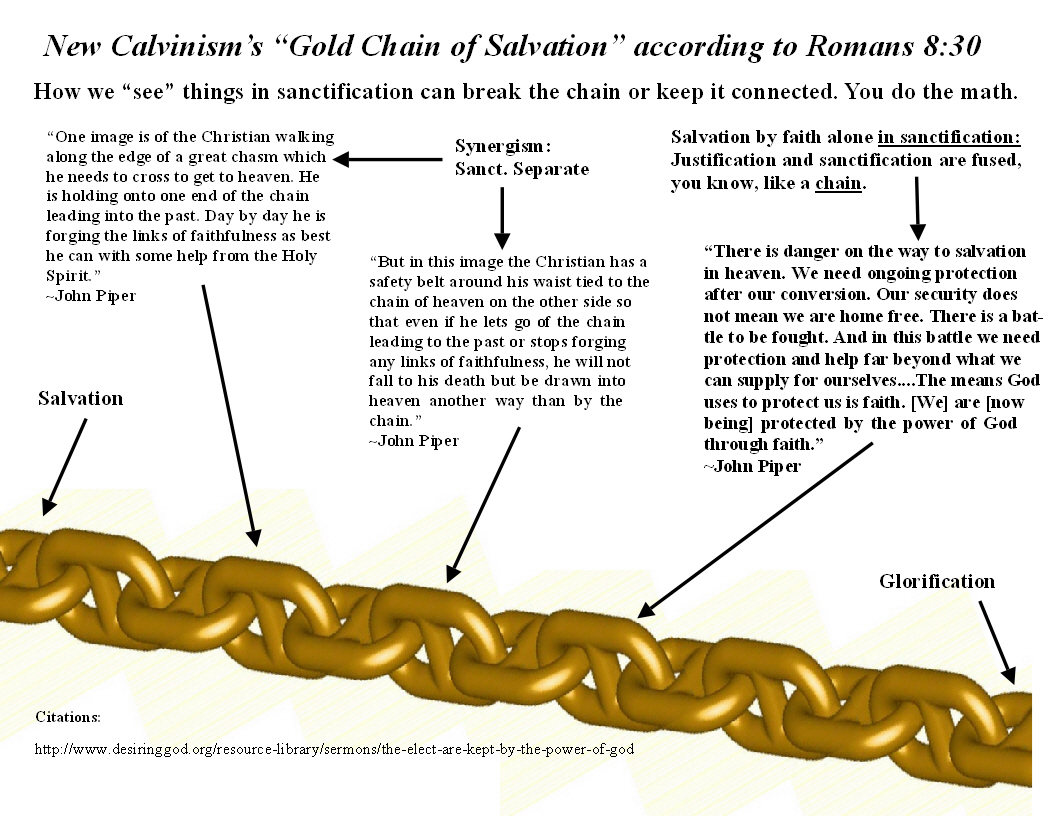
This ministry has made much of the critical importance of separating justification (salvation) and sanctification (growth in holiness, or kingdom living). The Reformed (Calvin/Luther Reformation doctrine/gospel) “never separate, but distinct” doublespeak doesn’t cut it in the arena of truth, and we will see why. “Never separate” =’s false gospel. If you get a little lost in the first part of my argument which gives the lay of the land, don’t worry, when I get into the specific Scriptural argument, it will clear things up and make it all come together for you. It must delight the ghosts of the Reformation that the argument has always been in the arena of freewill verses predestination. It’s the primary thrust of this ministry to change that argument. This isn’t a quibbling about semantics in the mainstream—this is about the truth of the gospel. As New Calvinist Russ Kennedy once thundered from the pulpit in his mousy voice: “Any separation of justification and sanctification is an abomination!” I have often argued from the standpoint of this issue. If sanctification is the middle of the Reformed “golden chain of salvation” then sanctification is part of finishing justification. This means that what happens in sanctification determines whether or not justification is properly finished. What’s a chain? John Piper even preached a message about the eternal importance of our contribution to the “links” in just the right way. In essence, sanctification becomes a spiritual minefield. This is exactly the same thing that the Reformed crowd has always accused Rome of: the fusing together of justification and sanctification. However, as we shall see, they are both guilty of the exact same heresy/false gospel. As we shall see, both teach that sanctification finishes justification. This is a linear gospel (one unified chain from salvation to resurrection (glorification) versus a parallel gospel with salvation on one plane as a finished work before the foundation of the world, and kingdom living that runs parallel with the finished work and reflects the reality of our salvation until glorification. Typical in the linear gospel is the idea that Christ died for all of our past sins, but we must now finish the work (with the Holy Spirit’s help [sanctified works salvation]) until glorification when we are completely transformed into complete holiness. This is the often-heard bemoaning of “Christ PLUS something.” 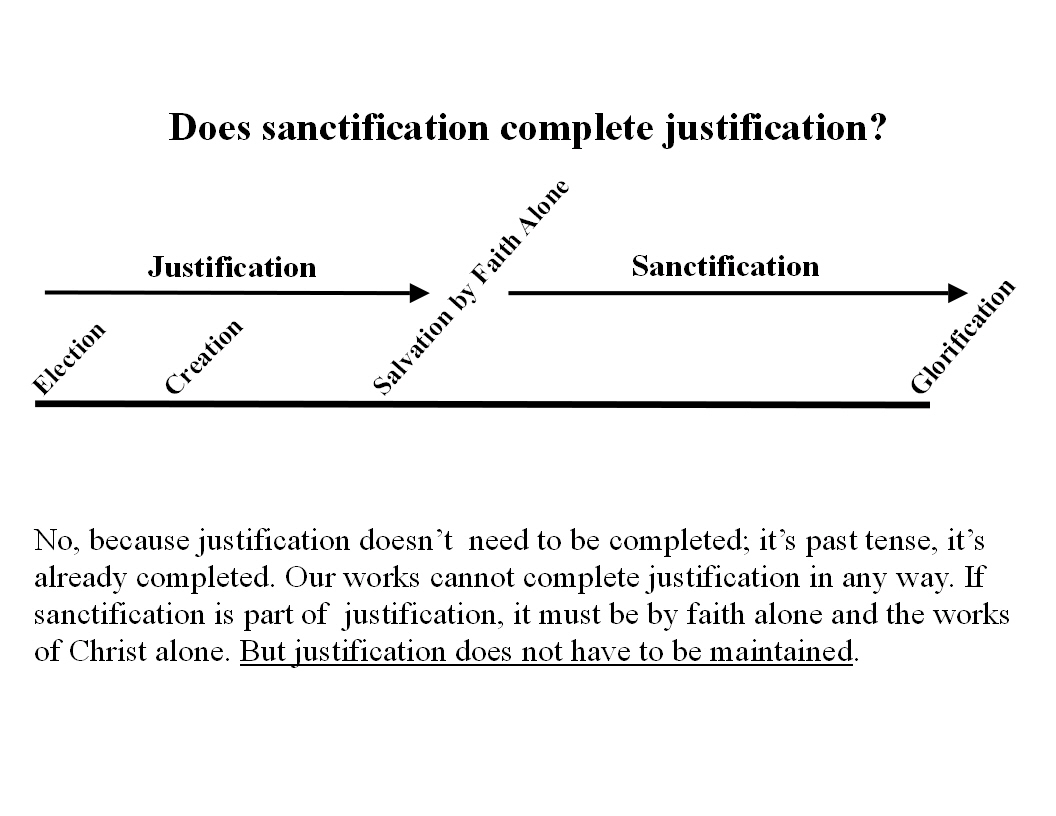 An excellent example is some strains of Freewill Baptists who teach that Christ died for all of our past sins, but with the help of the Holy Spirit, we must confess and repent of every sin we commit until the resurrection, e.g., Christ plus salvation by repentant prayer for sins committed after we are “saved.” My grandparents were saved out of this tradition. When my grandfather asked my grandmother if she thought that God could ever forgive him of all the sins he committed, she answered: “Yes, but you are going to have to pray awful hard!” Praise God that through the ministry of several individuals my grandparents eventually abandoned that gospel for the true one of salvation by faith alone as a finished work. Likewise, Rome teaches that you must let the Catholic Church finish your justification through ritual, e.g., Christ plus Catholic ritual. The Reformation gospel is also Christ plus something else, but the something else is ever-so-subtle. In both cases, sin must be dealt with in sanctification in order for the saint to remain justified until the final judgment. In other words, the righteous standard of justification must be maintained on our behalf. Like all other proponents of a linear gospel, the Reformed crowd contends that anything less than the perfection demanded of the law (“all sin is transgression of the law”) is “legal fiction.” So both Rome and the Reformers agree: justification must be maintained by sanctification, and in the case of the Reformers specifically, they believe that the perfect standard of the law must be maintained until glorification; otherwise, our justification is “legal fiction.” Here is where Reformed subtlety is uncanny: Christ keeps the law for us in sanctification. He maintains the perfect standard. All the fruit of sanctification (obedience/good works) flows from the life He lived on Earth and His death on the cross. Christ plus the works of Christ to finish salvation. “But Paul, what in the world is wrong with that?!” Here is what is wrong with it: works are still required to maintain justification. That is a huge problem, even if it is Christ doing the work. What did the Hebrew writer say about Christ’s work for justification not being complete? And even more subtle is the following Reformed idea: believing that the law is no longer a standard for maintaining justification is antinomianism. Antinomianism =’s legal fiction. Their definition of antinomianism is the removal of the law from justification as the standard for maintaining it. Traditionally, among Biblicists, antinomianism is the removal of the law from sanctification, and herein lays even further steroidal subtlety: the Reformed theologians would refute a removal of the law from sanctification as well, not only because they think justification and sanctification are the same thing, but because its perfect keeping is required to maintain a true declaration of the just that is not “legal fiction.”
  However, the Biblicist believes that the law is a standard for kingdom living and is no longer a standard for justification. Therefore, if we attempt to obey it with the Holy Spirit’s help, and to please/serve the Lord, it can have no bearing on our just state. While the Biblicists think they are therefore joint contenders with the Reformers against antinomianism, such is far from the truth. The Reformed mind believes the Biblicist is either a legalist or an antinomian, or both. The Biblicist is supposedly an antinomian because he/she has removed the law from justification as a just standard, or is a legalist because they think they should strive to keep the law in sanctification. Since sanctification finishes justification’s perfect standard of law keeping, our “own” attempts to keep the law in sanctification is an attempt to finish justification. Hence, what the Biblicist fails to understand is the Reformers belief that Christ must maintain the law for us in sanctification because justification and sanctification are not separate. Anything more or less is supposedly works salvation. On the other hand, because it is vital that Christ obeys the law for us in sanctification, the likes of John Piper and Tullian Tchividjian contend that those who are really preaching the Reformed gospel will indeed be accused of antinomianism. All in all, their position is easy to see if you pay attention. John Piper and many other Calvinists often state that, “Good works are the fruit of justification.” And, “Justification is the root, and sanctification is the fruit.” Well, the average Biblicist then thinks, “Yes, but of course, our salvation makes good works in sanctification possible.” But that’s not what they are saying. If you pay closer attention, they are saying that justification is a tree that produces its own fruit. Justification is the root, and whatever happens in true sanctification is the fruit of the root of the justification tree. Problem is, justification doesn’t grow. Justification is a finished work. What Calvinists refer to as “progressive sanctification” is really the fruit of the root: progressive justification. Another name for this that they throw around is “definitive sanctification.” The word “definitive” refers back to the definite completion of justification.
  Revision: this ministry now rejects the idea that orthodoxy is truth; orthodoxy is the traditions of men. Never in Scripture do we find premise for a body of teaching that explains the teaching. The above illustration is valuable for demonstrating that the fruit of justification is glorification, NOT sanctification. This brings us to the Scriptural argument which begins with a question I asked myself just this morning: “Paul, you are always harping about the crucial importance of the separation of justification and sanctification—a parallel gospel versus a linear one. But where does the Bible say specifically that this is critical?” First, the very definition of a lost person in the Bible is one who is “under the law”:
Romans 3:19 Now we know that whatever the law says it speaks to those who are under the law, so that every mouth may be stopped, and the whole world may be held accountable to God. Romans 6:14 For sin will have no dominion over you, since you are not under law but under grace. Romans 6:15 What then? Are we to sin because we are not under law but under grace? By no means! 1 Corinthians 9:20 To the Jews I became as a Jew, in order to win Jews. To those under the law I became as one under the law (though not being myself under the law) that I might win those under the law. Romans 7:1 Or do you not know, brothers —for I am speaking to those who know the law—that the law is binding on a person only as long as he lives? Romans 7:2 For a married woman is bound by law to her husband while he lives, but if her husband dies she is released from the law of marriage. Romans 7:3 Accordingly, she will be called an adulteress if she lives with another man while her husband is alive. But if her husband dies, she is free from that law, and if she marries another man she is not an adulteress.
The unsaved are “under the law” and will be judged by it in the end. This is the very definition of the unsaved. Calvinists define Christians the same way—we are supposedly still under the law and will be judged by it in the end. That’s why Christ must keep the law for us—because we are still under it. If not this position, why do many in the Reformed tradition hold to the idea that Christ’s perfect obedience is imputed to our sanctification? His death justifies us, and His perfect life sanctifies us. Hence, His death pays the penalty for past sins, and then His perfect life imputed to our sanctification keeps us justified. Why would an imputation to our sanctification be necessary if we are no longer under the law? This is known as the Reformed view of “double imputation” and has been called out as heresy by many respected theologians for this very reason: it implies that Christians are still under the law. In regard to sustaining the law in our stead, why? It has been totally abolished in regard to our just standing:
Romans 3:20 For by works of the law no human being will be justified in his sight, since through the law comes knowledge of sin. Romans 3:21 But now the righteousness of God has been manifested apart from the law, although the Law and the Prophets bear witness to it— Romans 4:15 For the law brings wrath, but where there is no law there is no transgression.
The keeping of the law by anybody DOES NOT do anything to justify mankind:
Romans 3:28 For we hold that one is justified by faith apart from works of the law.
Here is where the separation of justification and sanctification is vital on this first point: we ARE NOT under the law for justification, but rather UPHOLD THE LAW in sanctification. The two must be separate because of the differing relationships to the law:
Romans 3:31 Do we then overthrow the law by this faith? By no means! On the contrary, we uphold the law. Romans 6:15 What then? Are we to sin because we are not under law but under grace? By no means!
Furthermore, if we are still under the law (whether or not Christ obeys it for us to keep us in a just standing), this means we are still under the power of sin. Being under the law and also under its spell to provoke sin in the unregenerate is spoken of as being synonymous in the Bible. Those who are “under the law” are also under the power of sin and enslaved to it:
Romans 7:4 Likewise, my brothers, you also have died to the law through the body of Christ, so that you may belong to another, to him who has been raised from the dead, in order that we may bear fruit for God. Romans 7:5 For while we were living in the flesh, our sinful passions, aroused by the law, were at work in our members to bear fruit for death. Romans 7:6 But now we are released from the law, having died to that which held us captive, so that we serve in the new way of the Spirit and not in the old way of the written code. Romans 7:8 But sin, seizing an opportunity through the commandment, produced in me all kinds of covetousness. For apart from the law, sin lies dead.
If we are still under the law, and will be judged by it, whether or not Christ stands in the judgment for us with His own works, we are still enslaved to sin by virtue of being under the law…. for justification. And Calvinists know this to be true, that’s why they say we are still…. what? Right, even as Christians, “totally depraved.” And, “enemies of God.” Of course, throughout the Bible, Christians are spoken of as being friends of God and no longer His enemies. Our status as enemies of God is stated in the past tense. But the Reformed crew continually state that Christians are vile enemies of God and are enslaved to sin. They realize that this goes hand in hand with being under the law. To the contrary, dying to the law in the death of Christ….for justification—sets us free to be enslaved to the righteousness that is defined by the law. We are dead to the law for justification and alive to obey truth….for sanctification:
Romans 8:2 For the law of the Spirit of life has set you free in Christ Jesus from the law of sin and death. Romans 8:3,4 [emphasis by author] For God has done what the law, weakened by the flesh, could not do. By sending his own Son in the likeness of sinful flesh and for sin, he condemned sin in the flesh,….in order that the righteous requirement of the law might be fulfilled in us, who walk not according to the flesh but according to the Spirit. Romans 8:7 For the mind that is set on the flesh is hostile to God, for it does not submit to God’s law; indeed, it cannot. Romans 9:31 but that Israel who pursued a law that would lead to righteousness did not succeed in reaching that law. John 17:17 Sanctify them in the truth; your word is truth. James 1:25 But the one who looks into the perfect law, the law of liberty, and perseveres, being no hearer who forgets but a doer who acts, he will be blessed in his doing.
So, that is the separation that must be for the true Christian: Justification has no law for which we are judged, and we live by the law of blessings in sanctification. This brings us to another important separation in the two: the judgments. Those under the law and sin will stand in a final judgment which will be according to the law. Again, because Calvinists believe that we are still under the law, albeit that Christ obeyed/obeys it for us, Christians will supposedly stand in the same judgment as the damned who are under the law and enslaved to it. At that time, the children of God, according to Calvinists, will be “made manifest.” But because Christians are not under the law and cannot be judged by it, they will stand in a judgment for rewards and not a judgment that determines a perfect keeping of the law by Christ in our stead. Hence, there will be two different resurrections: one for those under the law and another for those under grace, and two different judgments for the same two groups. One for rewards, and one to determine if those under the law kept it perfectly. The latter judgment doesn’t go well for any standing in it.
Luke 14:12-14 He said also to the man who had invited him, “When you give a dinner or a banquet, do not invite your friends or your brothers or your relatives or rich neighbors, lest they also invite you in return and you be repaid. 13 But when you give a feast, invite the poor, the crippled, the lame, the blind, 14 and you will be blessed, because they cannot repay you. For you will be repaid at the resurrection of the just.” [Notice that this is a resurrection for the “just.” They are already determined to be just before they are resurrected]. 2Corinthians 5:9,10 So whether we are at home or away, we make it our aim to please him. 10 For we must all appear before the judgment seat of Christ, so that each one may receive what is due for what he has done in the body, whether good or evil. 1Corintians 3:11-15 For no one can lay a foundation other than that which is laid, which is Jesus Christ. 12 Now if anyone builds on the foundation with gold, silver, precious stones, wood, hay, straw— 13 each one’s work will become manifest, for the Day will disclose it, because it will be revealed by fire, and the fire will test what sort of work each one has done. 14 If the work that anyone has built on the foundation survives, he will receive a reward. 15 If anyone’s work is burned up, he will suffer loss, though he himself will be saved, but only as through fire. Hebrews 6:10 For God is not unjust so as to overlook your work and the love that you have shown for his name in serving the saints, as you still do. Revelation 20:6 Blessed and holy is the one who shares in the first resurrection! Over such the second death has no power, but they will be priests of God and of Christ, and they will reign with him for a thousand years. Revelation 20:11-15 Then I saw a great white throne and him who was seated on it. From his presence earth and sky fled away, and no place was found for them. 12 And I saw the dead, great and small, standing before the throne, and books were opened. Then another book was opened, which is the book of life. And the dead were judged by what was written in the books, according to what they had done. 13 And the sea gave up the dead who were in it, Death and Hades gave up the dead who were in them, and they were judged, each one of them, according to what they had done. 14 Then Death and Hades were thrown into the lake of fire. This is the second death, the lake of fire. 15 And if anyone’s name was not found written in the book of life, he was thrown into the lake of fire.
Don’t let anyone tell you that eschatology is a “secondary” or “nonessential” consideration. Your eschatology is your gospel. It will state your position regarding whether or not you fuse justification and sanctification together; ie, likening Christians to those under the law.
Yet another vital difference in sanctification and justification is repentance. Repentance for salvation (when you are justified) is different from our repentance in sanctification. Among many in the Reformed tradition where the “same gospel that saved you also sanctifies you,” the repentance is the same. Repentance unto salvation is not a onetime “washing,” but rather a means to continue “in the gospel” through what they call “deep repentance.” Biblicism holds to repentance in sanctification that restores his/her fellowship and communion with God as His children. They would see repentance unto salvation as differing, and only necessary for salvation—a onetime decision to take one’s life in a new direction by following Christ, and believing in his death, burial, and resurrection. Reformed repentance, according to the likes of Paul David Tripp and others is a “daily rescue.” Our original repentance was for rescue, and we need rescue today as much as we needed rescue when we were saved. Again, this indicates their belief that we are still under the curse of the law and need to be continually rescued from it while remaining under the bondage of sin. However, Christ made it clear to Peter (John 13:6-11) that those who have been washed (1Corinthians 6:11, Romans 8:30) do not need another washing. Those who drink of the living water do not thirst again (John 4:13,14). Lastly, though many other separations could be discussed, why saints can be considered just while they still sin at times is of paramount importance. There is no sin in our justification because there is no law, and where there is no law, there is no sin. Though unfortunate, there can be sin in our sanctification because it is totally separate from justification and can’t affect our just standing with God. Basically, all of the aforementioned makes it of necessity to deny the new birth. If we have God’s seed in us, and we do (1John 3:9), that dispels total depravity, and without total depravity, justification and sanctification cannot be fused together. The new birth is a huge problem for Reformed theology. If the old man that was under the law is dead (Romans 7:1ff), and the seed of God is in the saved person, and the sin due to our weakness in the flesh cannot be laid to our account for justification, then our justification is not “legal fiction” because we do not exhibit perfect obedience to the law. This is another grave consideration because Christ said, “You must be born again.” Obviously, despite their denials that they deny the new birth—you can’t be both totally depraved and born again. Reformation doctrine is clearly a false gospel. Its version of justification does not void the law, and denies the new birth while distorting everything in-between. Freewill verses predestination is hardly the issue, the very gospel itself is the issue.
paul
Why Home Fellowships Can Help Abused Women and the Institutional Church Cannot

In our vision for a return to the way Judeo-Christian assemblies were done for about the first 300 years, let’s look at why home fellowships can help abused women and the institutional church cannot.
I would like to use this article as a catalyst for argumentation. The article was posted (author is not clearly stated) by Anna Wood who co-authored a book with Jeff Crippen, a Reformed pastor. The book can be found here.
The post is titled, What domestic abuse victims need from the church. My contention is that abused women cannot get what they need from “the church” as demonstrated over and over and over again. In fact, clearly, as also demonstrated over and over and over again as well, the institutional church adds to the abuse and becomes a co-abuser.
Why is this? The article offers a perspective from which to answer. This issue also speaks to the differences between home fellowships and the institutional church, hereafter “the church.” In an institution, it is easy to sign on the dotted line, give at the office, and pretend. Pastors can bark from Calvin’s Geneva pulpit all they want to; all folks have to say is, “Hey, I am a member in good standing, and as often heard, humble and incompetent—it’s not my gift and I am not qualified.” Likewise, in said article, the author’s call to “get involved” is going nowhere in the church in case anyone hasn’t noticed.
To the contrary, home fellowships are comprised of people who are sick of playing church, are weary of being mere spectators, and are not looking to walk into an arena with hungry lions, but know it could lead to that. They are also confident in the Spirit-filled laity and recognize where 500 years of academic popeism has brought us. In addition, they have a literal view of reality versus the functional dualism that drives orthodoxy. What am I saying? I am saying that home fellowships have a radically different worldview than orthodoxy and this will lead to aggressive participation in all kinds of needs.
Let me further this point by using the article at hand:
Statistics say that one out of four women in the United States experience domestic abuse of some form in their lifetime. Men can also be victims of domestic abuse. When those who have suffered are members of the Lord’s church, the faithful among them have an obligation to help them. And, if we know of someone in the community who is being abused, I also believe we have an obligation to help if we can. When, for whatever reason, we shy away from this obligation, either through ignorance or willful refusal to get involved, we lay waste to the Gospel we claim to believe. Christians are called to defend the oppressed yet when it comes to domestic violence, so few do.
What abuse victims need from their fellow Christians is pretty simple and straightforward. We need you to be Jesus to us. Do what He would do, say what He would say, were He the One ministering to us. Isn’t that what we all need from each other, anyway? Christians are called to stand in the place of Christ here on the earth and be His representative and do the works He would do. To fail in this is to fail in serving Christ.
Whoa, what a minute here! This is entirely unrealistic because of the message constantly drilled into the heads of Protestants. We are “all just sinners saved by grace.” We are, according to one prominent evangelical, “enemies of God.” According to yet another, “we hate God.” On the one hand, it is constantly drilled into the heads of those in the church that “when you are dead, you can do nothing,” but on the other hand we really think that parishioners shouldn’t think twice about getting involved in a domestic abuse situation?
First of all, getting involved in domestic violence is not “pretty simple.” Actually, it can get you killed by someone who doesn’t much appreciate your intervention. Moreover, getting the facts and evaluating the situation biblically is far from simple. Now couple that with the constant total depravity of the saints mantra heard in the church and it is little wonder that few will get involved in domestic abuse needs. The completely upside down worldview of the church makes laity involvement in domestic abuse nothing more than a pipe dream.
And, “Christians are called to defend the oppressed yet when it comes to domestic violence, so few do.” This complaint is not only a mere symptom, but is not even a symptom of the real problem. Congregants not only fail to defend the oppressed, they either turn a blind eye or defend the defender of the abusers—the church. Ever heard of SGM? Ever heard of ABWE? Ever heard of the SBC? In case you haven’t noticed, they are not only still in business, but business is booming! Why? Because regardless of what happens in the church, it is the only ticket to heaven. “What? so billions of people should go to hell because some bad things happen in the church that is made up of sinners? Well, get a grip—where there are people, there is sin!” That is in quotations because this is exactly what we hear in response to a “cry for justice.”
So far, if you are keeping notes, we have two reasons the church cannot help abused women: 1. The total depravity of the saints resulting in a few “experts” attempting to minister to a massive throng 2. Salvation is found in the institution, and therefore the institution will be defended at all cost. Better that a few suffer by themselves rather than all of humanity being sent to hell.
Before we move on to the next points, a little more clarification: why does the church defend abusers? It starts with its worldview. Without going into a lot of detail, we must first recognize that Calvin and Luther are the church’s heroes, and then recognize what their “theology of the cross” was all about. This is a philosophy that interprets all reality via the suffering of the cross. As Luther stated, “all wisdom is hidden in suffering.” Luther, as well as Calvin, split reality into two epistemologies: the cross story and the glory story. Only preordained leaders can lead the great unwashed masses in the cross story—only the preordained can save humanity from the story of man, or the glory story. As Al Mohler once said, “pastors are preordained to save God’s people from ignorance.”
 However, theologians of the cross and the spiritual peasantry have something in common: we are all just sinners saved by grace. So, everything going on in the material realm is fairly insignificant—it’s just the same old sin and dance anyway. But by the same token, theologians of the cross are preordained of God and invaluable. And besides, many are icons of the institution that keep the money rolling in. Sure, you can reject this theory and opt for another one, but in the process you will drive yourself nuts trying to figure out why ABWE defended and protected Donn Ketcham until the bitter end.
Need another example among myriads? What about Jack Hyles? The guy was a mafia don dressed in Bible verses and is still a spiritual hero among many Baptists. David Hyles, Jack’s son, was also a well-respected pastor in the church who had affairs with at least 19 women and is a suspect in an unsolved murder. Yet, to the best of my knowledge to date, David Hyles is still invited to speak at Baptist conferences/churches and receives robust ovations. Jack Hyles remained in the pulpit until his death in 2001 and was succeeded by his son in law Jack Schaap who is presently in prison for statutory rape. Jack Hyles is notorious for his quip, “If you didn’t see it, it didn’t happen” and is still revered among many Baptists as the best preacher since the apostle Paul.
The article continues with its list of things abuse victims need from “the church.” But the thesis of this article is that the church is not only unable to supply these things, but becomes a co-abuser. In contrast, the original Christian model for fellowship is well able to help and more likely to do just that.
First on the list is “The Pure Gospel.”
The church long ago got away from the pure gospel. We water it down, mix it up and serve it with a side of fun. No wonder it doesn’t save. It can’t save. It’s poison. We need preachers dedicated to the truth of God’s Word who are willing to stand up and preach that truth without changing it one iota. We need Christians who long after righteousness. When we have that–the pure Gospel preached and lived–we’ll see more Christians helping abuse victims and we’ll see less abusers masquerading as Christians.
Uh, ok, not sure how to add to this. It’s a stunning admission while calling on the same church to do something about the problem it has created. We don’t need “preachers” to do anything. Preachers have been preaching long and hard for thousands of years and the results are evident. We need God’s people to stand up and get back to the first works of home fellowship. The laity waiting on the experts is long traveled and worthless. More of what is beginning to happen needs to happen more and more. Ordinary Spirit-filled Christians are meeting together around the word and fellowship, and seeking God’s face in this whole matter about how church is traditionally practiced. And the fact that the church is grounded in a false gospel is something I addressed in another article posted today and Friday.
Without addressing every single point in the article other than those mentioned already, let me move on to this one:
Someone to care for their needs
Do you know what keeps a lot of abused women and children with their abusers? The lack of money to leave. If a woman is trying to get herself and her children to safety, don’t spend time telling her why she’s wrong, what you think about her decision or trying to talk her out of it. She knows what it’s like to live in abuse and you don’t. Even if she stays, chances are great that she and her children need something or maybe a lot of things. Financial abuse often accompanies other types of abuse. Instead of lecturing, get busy serving and help them.
According to the first-century model, a home fellowship network would be several small groups meeting in several homes in the same geographical area. And because of freedom from massive infrastructure cost and “tithing” versus New Testament giving based on NEED only funds and resources to help the abused would be ample. In fact, I could share an example from our very own home fellowship. We have a young lady living with us, and other people connected to our fellowship contribute financially to her needs. She is fully supported independently from anybody who might be a problem in her life. And when people live with you, trust me, you know the facts and you do a lot of listening. She will be completely self-reliant this month after living with us for about two years.
In regard to a different kind of abuse, a home fellowship network that I know of in Africa operates in the following way: the network assimilates street orphans from Nairobi into their fellowships. There is a leader from the network, equipped with the latest information about funds and availability that goes into Nairobi searching for orphans, and upon finding some, brings them back to the fellowship network where they will have a home, food, protection, and education. Let’s say that our home fellowships are connected with theirs; many of these children could be brought stateside and assimilated into fellowship here as well.
In addition to being freed from the bondage of infrastructure expense, the authority of the church’s clergy is suffocating. Clergy, more times than not, are control freaks obsessed with keeping the herd calm. They are spiritual cowboys constantly concerned with the herd being spooked. This speaks to the rest of the concerns in the post being considered here. More times than not, the laity are kept in the dark concerning the needs of those abused. There is a wall of confidentiality between the church’s “trained” counselors and the parishioners who fund the whole mess. When red flags are raised in regard to how certain situations are handled, we are told that “we should trust the elders who are closest to the situation and know all of the details.” This continually proves to be a recipe for disaster, and elders are granted NO such authority via the Scriptures.
Small groups in private homes offer intimate support and confidentiality from the other home fellowships. It is a perfect balance of intimate care and financial support if needed. All of the different gifts and experiences of Christ’s body are brought to bear on the situation.
Also, we must remember that the home fellowship movement is comprised of people from all walks of life: policemen, mental health professionals, etc., etc. These people or their areas of expertise are not separated from any situation by the professional clergy for inappropriate reasons.
paul
“Godly” Philosophy
 I used to be in the camp that views “philosophy” as “worldly”, “man-centered”, “evil”; all of those things as juxtaposed with “Biblical wisdom”, or “scriptural”, or “God’s Wisdom”. After all, it seemed to be a reasonable conclusion when confronted with verses of scripture like:
“Where is the wise? where is the scribe? where is the disputer of this world? hath not God made foolish the wisdom of this world? For after that in the wisdom of God the world by wisdom knew not God, it pleased God by the foolishness of preaching to save them that believe. For the Jews require a sign, and the Greeks seek after wisdom: But we preach Christ crucified, unto the Jews a stumblingblock, and unto the Greeks foolishness; But unto them which are called, both Jews and Greeks, Christ the power of God, and the wisdom of God. Because the foolishness of God is wiser than men; and the weakness of God is stronger than men. For ye see your calling, brethren, how that not many wise men after the flesh, not many mighty, not many noble, are called: But God hath chosen the foolish things of the world to confound the wise; and God hath chosen the weak things of the world to confound the things which are mighty; And base things of the world, and things which are despised, hath God chosen, yea, and things which are not, to bring to nought things that are:” ~ 1 Corinthians 1:20-28
What you choose to believe is a philosophical statement about what you believe about reality. Everyone has a philosophy whether they realize it or not. You cannot escape it. So to say that “philosophy is evil” is really a philosophy itself. It therefore unwittingly becomes its own metaphysical statement about man. If philosophy is evil, then man is evil because man has no relevance apart from his beliefs about reality. It should come as no surprise then that reformed theology holds such a metaphysical view of man with regard to its doctrine of total depravity. But that’s another topic altogether.
It is ironic that I had to get out of the church before I finally began to better understand just what the apostle Paul was addressing here with the Corinthians. Religious despots don’t see themselves as having “worldly wisdom”, but yet they are the very ones that Paul is criticizing. Religious orthodoxy is the epitome of “man’s wisdom”; crafted by the scholars and academics and elites who spend their years in seminary and other institutes of religious training for the so-called “right” that they think they have purchased for themselves in order to rule over the unenlightened.
I have come to realize that the notion of philosophy being evil is nothing more that organized religion’s attempt to keep man beholden to it; to keep him enslaved; to keep him from thinking. Those of us who call ourselves “Christians” must begin to shed this false notion of philosophy. Philosophy deals with things such as reality and the nature of existence. To believe God and what He tells us in His word is our own philosophical statement. It stems from our rational, thinking mind; a mind that is part of a creature made in the very image of God, made for the purpose of thinking and reasoning and coming to rational conclusions. I implore believers everywhere to consider what God Himself has told us: “Come, let us reason together.”
Andy
How Christians Change: Biblical Dynamics of Change in Sanctification; Part 2, Defeating the Enemy, “Who Are We?”
Listen to audio or download file. Link will open in a separate tab.
Good evening, everyone. Welcome to Blog Talk Radio False Reformation. This is your host, Paul Dohse. If you would like to call in and add to the lesson tonight, the number is 347-855-8317. You will hear me say, “You are on the air. This is your host, Paul. What is your question or comment?” and just start talking. Identifying yourself is optional.
Per the usual, we’ll be checking in towards the end of the conclusion of our presentation and try to get a conversation going with Susan about the topic at hand to kind of round everything out.
The subtitle for tonight is, “Defeating the Enemy.” Last week, we met the enemy, “sin.” This series is about how we grow in our Christian lives and a big part of that is defeating sin, but that shouldn’t be our major focus. I have come to believe that we have been trained mentally to be sin-focused in our Christian lives rather than love-focused. The reason for this will be discussed shortly.
But our focus tonight is on who we really are as Christians. In regard to the stalwarts of Protestantism, who did they say we are? Well, Simul Iustus et Peccator, simultaneously saint and sinner. And trust me, that describes Protestantism in a nutshell: the Dr. Jekyll and Mr. Hyde’s of humanity. You ever wonder why the church is such a mess? It’s full of people who profess to have split personalities—how obvious is that?
Interestingly, many psychologists believe that split personality, or dissociative identity disorder is the biggest responsibility escape mechanism afoot in our culture. Hey, we just recently witnessed that in the American sniper murder trial, right? The guy who murdered Chris Kyle and Chad Littlefield claimed innocence by reason of split personality. “Hey, the other guy did it, not me.”
This is so prevalent in the Protestant church, and worse yet, it’s drilled into the churched youth as well—“I’m just a sinning saint, and the sin did it, not me.” “Sorry I said that to you, I was in the flesh. Now that I am in the spirit, I feel really bad about it.”
Now, actually, that’s not authentic Protestantism—that’s Protestant Light that came alone in later years because our natural bent is to interpret God’s word grammatically, and the Reformers never meant for us to interpret our Bibles grammatically. Their prescribed method of interpretation matched their gospel. Simul Iustus et Peccator never meant that we had a split personality, what it really meant is that Christians remain unchanged and totally depraved. First, we need to understand how our spiritual forefathers defined us, and then we will discuss how the Bible defines us. Defeating sin begins by knowing who we are. And by the way, how can we even believe a true gospel if we don’t understand a true biblical definition of man?
Simul Iustus et Peccator does not mean that we are both saint and sinner at the same time. Another way of stating this is perhaps the more formal version, simul justus et peccator. This means simultaneously just and sinner. The saint is not changed, he/she is still a sinner, but the righteousness of Christ is imputed to the believer by faith alone.
Said another way, we don’t change; only God’s perspective on us is changed. Christ died for our past sin, and therefore our past sins are imputed to Christ who paid the penalty for sin, but from then on, our sins are covered by the righteousness of Christ. This is known as double imputation. We don’t change, only God’s perspective in regard to us changes.
And so with this formula Luther was saying, in our justification we are one and the same time righteous or just, and sinners. Now if he would say that we are at the same time and in the same relationship just and sinners that would be a contradiction in terms. But that’s not what he was saying. He was saying from one perspective, in one sense, we are just. In another sense, from a different perspective, we are sinners; and how he defines that is simple. In and of ourselves, under the analysis of God’s scrutiny, we still have sin; we’re still sinners. But, by imputation and by faith in Jesus Christ, whose righteousness is now transferred to our account, then we are considered just or righteous. This is the very heart of the gospel.
~ RC Sproul, simul justus et peccator, www.ligonier.org June 26th, 2012
Indeed, that is the heart of the Protestant gospel. We remain unchanged, but by faith alone, we receive God’s Christ perspective. And by the way, when it gets right down to it, the Catholicism that Protestantism came from believes little different in regard to justification; the difference is really not even worth talking about. That’s why the 1999 Catholic-Lutheran Joint Declaration on the Doctrine of Justification was possible—you can barely slip a playing card between the two gospels. In both cases, justification is a process, and not a finished work, and the sin of the sinner is lessened in sanctification, but we still remain short of the glory of God which is synonymous with a justified state of being. If salvation makes the “believer” just that is what both Catholics and Protestants call “legal fiction.”
Why? Because as Christians, we still sin, right? And look, here is the problem: the church is under the same classification as the world; i.e., “sinners.” “But Paul, we sin less than the world.” Oh really? Who is to say? Where is that standard? Besides, look at the real world: you will be hard pressed to make that case on any wise. What a confused mess!
So, who are we? Are we different people who really change, or merely people who are seen differently by God? Are we new creatures, or merely seen as God’s children when He looks at the world with His Jesus glasses on?
Here is the answer: we are different if we are really Christians. We are not only declared righteous, we are not only seen as righteous—we are righteous. Obviously, the idea that we are still classified as sinners is going to greatly hinder sanctification. “As a man thinks in his mind, so is he” (Prov 23:7), Right? You know what, so much of my and Susan’s life is consumed with the fallout of this reality right now; in our lives, and the people that we counsel.
Bottom line: the Holy Spirit is not going to unleash His power in people who think they are still sinners. Susan and I are constantly trying to minister to people who have been told all of their lives that they are sinners just like everyone else that Jesus sees differently. In regard to the worst that society has to offer, we hear, “But for the grace of God, there go I.” And then we wonder why our kids have to learn everything the hard way. They are absolutely befuddled until the trap door lets loose underneath their feet while on the short end of a rope around their neck.
How does this work biblically, this whole notion that we are righteous beings? I think the best place to start is with a proper definition of sanctification elements. First of all, the flesh, or “members,” or “body” is not inherently evil. Listen carefully: the flesh is not biblically defined as “evil,” it is biblically defined as, “weak,” and “weak” is not necessarily evil. Christ was weaker than he was when He was in heaven with God, does that make Him evil? Hardly. Christ was weaker while not in His full glory; yet, He was completely holy. The elect angels are called “holy angels” (Mark 8:38), yet they are weaker than God, right?
Being weaker than God does not equal “evil.” God’s omnipotence doesn’t necessarily correlate 100% with His holiness.
Hence, “the spirit is willing, but the flesh is ‘weak’” (Matt 26:41). Christ said the body is weak, but He didn’t say it is evil. And get a load of this: creation, even post fall, is “good.” This is what I am trying to say: the Gnosticism that Protestantism was founded on, the whole material is evil and spirit is good construct drives a lot of the anemic sanctification of our day and years past.
For example, creation is still both weak and good.
Romans 8:19 – For the creation waits with eager longing for the revealing of the sons of God. 20 For the creation was subjected to futility, not willingly, but because of him who subjected it, in hope 21 that the creation itself will be set free from its bondage to corruption and obtain the freedom of the glory of the children of God. 22 For we know that the whole creation has been groaning together in the pains of childbirth until now. 23 And not only the creation, but we ourselves, who have the firstfruits of the Spirit, groan inwardly as we wait eagerly for adoption as sons, the redemption of our bodies. 24 For in this hope we were saved. Now hope that is seen is not hope. For who hopes for what he sees? 25 But if we hope for what we do not see, we wait for it with patience.
And…
1 Timothy 4:4 – For everything created by God is good, and nothing is to be rejected if it is received with thanksgiving,
And…
Romans 15:14 – I myself am satisfied about you, my brothers, that you yourselves are full of goodness, filled with all knowledge and able to instruct one another.
So this can be the first point here in regard to who we are as Christians, we are weak, yet good. Let me add another definition: We are saved spiritually, our souls are righteous, but we await another salvation—that of the body. See it in the passage that we just read?
And not only the creation, but we ourselves, who have the firstfruits of the Spirit, groan inwardly as we wait eagerly for adoption as sons, the redemption of our bodies.
Redemption is not salvation/justification. Redemption is glorification, or the complete renovation of our mortal bodies. It is salvation from weakness. It is when our willingness is set free to serve God in immortality. That’s redemption. This is important because when we are reading in our Bibles about salvation, we must interpret the passage according to which salvation is being talked about; justification or redemption. Let’s look at an example.
Romans 7:24 – Wretched man that I am! Who will deliver me from this body of death?
By the way, the word for “wretched” in this verse is a Greek word that means perseverance in the midst of affliction. Paul isn’t calling himself wicked, he is stating that he is afflicted by sin and longing to be saved from what? Right, the body of weakness. That’s redemption. Let me point out another verse to make an additional point:
2Corithians 5:9 – So we make it our goal to please him, whether we are at home in the body or away from it (NIV).
The goal is the same whether we are here in these weak bodies or in heaven—we make it our goal to please Him. Let’s add yet another point: the body is not evil because it can be used to serve God or sin:
Romans 6:13 – Do not present your members to sin as instruments for unrighteousness, but present yourselves to God as those who have been brought from death to life, and your members to God as instruments for righteousness. 14 For sin will have no dominion over you, since you are not under law but under grace.
Romans 12:1 – I appeal to you therefore, brothers, by the mercies of God, to present your bodies as a living sacrifice, holy and acceptable to God, which is your spiritual worship.
How about this one?
1Corinthians 6:19 – What? know ye not that your body is the temple of the Holy Ghost which is in you, which ye have of God, and ye are not your own? (KJV)
1Corinthians 6:13 – The body is not meant for sexual immorality, but for the Lord, and the Lord for the body. 14 And God raised the Lord and will also raise us up by his power. 15 Do you not know that your bodies are members of Christ? Shall I then take the members of Christ and make them members of a prostitute? Never! 16 Or do you not know that he who is joined to a prostitute becomes one body with her? For, as it is written, “The two will become one flesh.” 17 But he who is joined to the Lord becomes one spirit with him. 18 Flee from sexual immorality.
Ok, as most of you that read my blog know, I normally use the ESV unless otherwise stated. In regard to my citation of 1 Corinthians 6:19, I read from the KJV because most translations have “a temple,” or “a sanctuary” etc. “The temple” in the definitive is the better rendering. This gets more than a little interesting because more times than not when the word “temple” is used in the New Testament, it refers to the Holy of Holies. A good example of this would be Revelation 11:2 and 11:9:
2 …but do not measure the court outside the temple; leave that out, for it is given over to the nations, and they will trample the holy city for forty-two months.
19 Then God’s temple in heaven was opened, and the ark of his covenant was seen within his temple. There were flashes of lightning, rumblings, peals of thunder, an earthquake, and heavy hail.
In both cases, the exact same word that is used in 1Corinthians 6:19 for temple is used in these two verses out of Revelation. If you note Rev 11:19, the ark was located in the Holy of Holies, or the most holy place. 1Corinthians isn’t merely saying that our bodies are a run-of-the-mill temple where the Holy Spirit dwells, our bodies are likened to the Holy of Holies. Something to think about.
When the Bible instructs us to be holy as our Father in heaven is holy, that’s because we are holy. That’s who we are. We are aren’t sinners saved by Grace, we are saints saved by grace. Note Hebrews 10:
18 Now where remission of these is, there is no more offering for sin. 19 Having therefore, brethren, boldness to enter into the holiest by the blood of Jesus, 20 By a new and living way, which he hath consecrated for us, through the veil, that is to say, his flesh; 21 And having an high priest over the house of God; 22 Let us draw near with a true heart in full assurance of faith, having our hearts sprinkled from an evil conscience, and our bodies washed with pure water.
This is a call for Christians to boldly enter the Holy of Holies which only the high priest of Israel could do on the Day of Atonement once a year after washing his entire body. The only reason we have access there is because we are in fact holy. Entering by the blood of Jesus means that His death removed the veil that separated us from the most holy inner chamber.
We are holy as our father is holy, but isn’t that legal fiction because we still sin? No. Last week, we met the enemy, sin. It is important to note that sin dwells in the flesh, but sin and flesh are not one. When the Bible speaks of the “desires of the flesh” or the “sinful flesh,” it is speaking of when the body is being used in the service of sin rather than a holy sacrifice to God. Romans 6 makes it clear that Christians are no longer enslaved to the sin master, but are now enslaved to righteousness. They have traded one master for another.
Last week, we also discussed the fact that there is a reaping and sowing among the lost and saved. Christians can suffer present consequences for obeying the sin master that no longer has jurisdiction over us. In severe cases, especially sexual sin, this can lead to physical death (1Cor 5:5, 11:30, 1Jn 5:16). In the case of the unregenerate, they bear fruits for death in the present and eternal. Christians should not fear eternal judgment, but we are commanded to fear present consequences (Phil 2:12, 13, 1Thess 4:3-7, James 5:9, 1Pet 4:17, Acts 5:1-11, 1Jn 5:16).
On the one hand, when the unregenerate sin, present death and eternal death are being compounded, on the other hand, when a Christian sins, only the death of present consequences are being sown. This is where we add another definition in regard to sin: there is sin that leads to more and more death culminating in eternal death, and family of God sin that reaps present consequences. Excessive family sin leads to the forfeiture of a rich entry into God’s kingdom resulting in a fearful shrinking back at the appearance of God (Eph 6:1-3, 2Pet 1: 9-11).
Also, the sin that formerly dwelled in the unbeliever died with Christ, and enslaved, but when the believer was resurrected, a remnant of the former sin somehow remains in the body, but has been stripped of its ability to enslave. I am not saying that I totally understand it, but Romans 6:20 seems to describe it as a reversal of freedom and slavery. We were formerly enslaved to sin and free to do good, but now we are enslaved to righteousness and unfortunately free to sin.
But that sin does NOT count towards our status as God’s children. As His children of weakness, we sin against our heavenly Father which also grieves the Holy Spirit (Eph 4:30), but the only reason we sin is because we are clothed in weakness where some sort of remnant of sin exists. Some suggest that it is merely the habits of the old you that are in your memory—there are many different theories that fall short of being concrete.
Nevertheless, our souls are righteous (2Pet 2:8), and sin is an unfortunate choice when it gets right down to it, and not enslavement—the masters have been changed. You have been bought by the blood of Christ from the Sin master. You are considered holy because you are enslaved to righteousness (Rom 7:25; the word for “serve” in that verse is douleuō which means bond slave). Actually, Romans 7:25 is stating that Christians are enslaved to the law of God. Hence, they are considered holy.
Let’s pause here and add another element along with a biblical definition: the new birth is a literal death of the old person with Christ and a resurrection unto a new person with Christ (Romans 6:3-14). The saint is considered righteous and holy because he/she is no longer enslaved to sin. This staus is not forfeited because of the weakness and remaining sin that has been stripped of its status and ability to enslave. We are the actual offspring of God through the baptism of the Holy Spirit (1John 3:9).
In conjunction with the new birth, I would like to conclude with the legal proclamation by God that declares us sinless. We are not only anthropologically holy, we are legally holy—we are just. How does that work?
Before we died with Christ in the new birth, we were under law. Every sin we committed was imputed to that law, also known as the law of sin and death, and were reaping fruits for death stored up for the final judgment. Now, I know that the Bible says that Christ was also born under the law, but so what? That wasn’t a problem for him because he could keep all of it. That’s just another way for the Bible to state that he was born into the world as a man like everyone else—under law.
In Romans 7:1ff, we find that when we died with Christ, the old us that died with Him was under that law, so guess what? According to Paul in Romans 7, it’s like a marriage covenant where one of the spouses died. The living spouse is no longer obligated to that marriage covenant, and is free to enter into another covenant.
The resurrection with Christ enters the recipient into another covenant—the new one; specifically, the law of the Spirit of life (Romans 8:2). Along with the new birth comes a desire to love and obey the new covenant which is really a different perspective from the law’s point of view.
Hence, the believer is free to aggressively love God and others through obedience without fear of condemnation. The sin we were once enslaved to is not the focus, love is. Why would the focus be on the former slavery and not the present freedom?
It makes sense that if we don’t change, sin, failure, and our depravity would be the focus. I fear that we empower sin in the lives of Christians because we give it far more attention than what is warranted. Sin shouldn’t be the focus, love should be the focus. God is love (1Jn 4:16), love matters more than sacraments (Gal 5:6), casts out fear (1Jn 4:18), covers a multitude of sins (1Pet 4:8), is the only gift that will not pass away (1Cor 13:8), and is greater than faith and hope (1Cor 13:13). The idea that Christianity is a “lifestyle of repentance” is egregiously misguided; Christianity is a lifestyle of love. The past bondage is not emphasized in the Bible; the freedom we have to love is what is emphasized.
Next week, we will talk about the particular applications of what we have learned. How do we do the Christian walk?
“How Christians Change: Biblical Dynamics of Change in Sanctification; Part 3, Doing the Christian Walk”
Notes added to the audio version:
To the Ruling Elders of Southwood:
On September 4, 2011, our daughter and her family from Atlanta were here and we attended the Sunday worship at Southwood. After the service, our 13 year old granddaughter, who is well grounded in scripture, stated that she was very confused by the message. She had come away hearing that every good thing she does is wrong. Why would she believe that? We have gone back and listened again to that message, entitled “Duh,” and here is what we found:
The message is from Galatians 3:1-6. Paul is chastening the church for falling prey to the persuasion of the Judaizers, exhorting them again that God’s love for them was not by any of their own works but through the miraculous work of Christ and the Holy Spirit. Jean seems to take the written word beyond its intent. He subtly changes ‘God’s love’ to ‘God’s favor.’ He changes legalism to performance. He takes Jewish law and extends it to almost any action one does. Here are some paraphrased quotes from the sermon. “To keep God’s favor, the Galatians were believing they needed Christ and a dash of obedience which looks like those things called Christian disciplines. Christian walk Christianity is from the Devil. Faithfulness is feeling condemned for work you haven’t finished (as contrasted with faith: resting completely in Christ). Faith is a litmus test for teachers and leaders; the difference between faith in Christ alone and faithfulness is like the difference between truth and falsehood, between Heaven and Hell. Faith alone is all we will teach.” (Here Jean says this is what Paul is teaching but he gives no supporting scriptures to support his interpretation.) “Discern as false any book, sermon, or Bible study where you hear a dash of self justifying obedience. Self justifying obedience is from Satan.
Jean’s statements, combined with the tone and inflections in his delivery, imply that he is scornful of Christian disciplines, preachers, Christian writers, the Christian walk, obedience, faithfulness, good works, and an individual’s efforts. This message can lead to the conclusion that everything we do is evil and, by extension, that God and the Holy Spirit can do nothing through us. The message lacks balance and leaves sanctification out of the equation. A new believer under this teaching would be moribund after accepting Christ, hidebound in fear that he can do nothing right. While it is true none of us have all pure motives, it is also true that God commands us to go forward and that the Holy Spirit will be with us. God says we are His instruments for spreading the Truth. We cannot do this if we are strapped by guilt; we can do this if we seek partnership with the Holy Spirit.
From here Jean goes back to Paul saying “…since you were 100% depraved when you were brought into the Kingdom by the Holy spirit and by no works of your own, why are you trying to be perfected by your own human efforts? You are being deceived by the Devil.” I believe Jean is paralleling Paul in this. Jean then goes on to “We are like alcoholics ; we use Bible study, prayers, small groups, etc. as a crutch and the church rewards our ‘addiction’ with its approval. How would you know if you were addicted? Stop everything. If you feel anxiety, then you are afraid of leaving your ‘fix.’” So we ask: what does God have us do? Jean’s answer is “rest totally in Jesus.” So in turn we ask, what does Scripture say about resting totally in Jesus? But we hear no clear answer from the pulpit.
…………………………………………………………………………………………………………………………………………………………………………………………..
Unless sanctification is rooted in justification and constantly returns to justification, it cannot escape the poisonous miasma of subjectivism, moralism or Pharisaism…. Since the life of holiness is fueled and fired by justification by faith, sanctification must constantly return to justification. Otherwise, the Christian cannot possibly escape arriving at a new self-righteousness. We cannot reach a point in sanctification where our fellowship with God does not rest completely on forgiveness of sins…. Christian existence is gospel existence. Sanctification is justification in action.
~ Present Truth magazine: Volume 16, Article 3; http://www.presenttruthmag.com/archive/XVI/16-13.htm
…………………………………………………………………………………………………………………………………………………………………………………………..
The Holy Spirit gives the sinner faith to accept the righteousness of Jesus. Standing now before the law which says, “I demand a life of perfect conformity to the commandments,” the believing sinner cries in triumph, “Mine are Christ’s living, doing, and speaking, His suffering and dying; mine as much as if I had lived, done, spoken, and suffered, and died as He did . . . ” (Luther). The law is well pleased with Jesus’ doing and dying, which the sinner brings in the hand of faith. Justice is fully satisfied, and God can truly say: “This man has fulfilled the law. He is justified.
We say again, Only those are justified who bring to God a life of perfect obedience to the law of God. This is what faith does—it brings to God the obedience of Jesus Christ. By faith the law is fulfilled and the sinner is justified.
~ Present Truth magazine: Law and Gospel; Volume 7, Article 2, Part 2
The Non-Doing Doesn’t Damn Protestants; It’s What They Believe About the New Birth
Originally published October 17, 2014
“Protestantism speaks of being saved from the condemnation of the law to a rest from obedience to the law of the Spirit of life. This is a rejection of the new birth and leaves the Christian enslaved to sin. This denies the good news of the incorruptible seed that Christians are born of. Protestantism makes the case that “the law” cannot produce righteousness, but this totally neglects the true biblical relationship between the believer and the law of the Spirit. A one-dimensional law necessarily rejects the new birth and circumvents the Christians ability to love God and others.”
In the parable of the talents, the slothful servant wasn’t sent to hell because he was lazy, what sent him to hell is the logic that caused the laziness. In other words, his laziness was a symptomatic cause of what he believed about God.
All liars will be thrown in the lake of fire, but it’s not the lying that paves the way—what they believe paves the way. How they act is merely a natural result of what they believe. Likewise, how Abraham lived is not what made him righteous, what he believed made him righteous—his life as set against the weakness of his mortality was the result.
BUT we cannot stop there because what we believe is not the direct thrust of what we do. Yes, it’s a symptom, but not the main thrust. What we believe leads to God recreating us or not recreating us through the new birth. The argument is better defined by behavior flowing from a particular type of human creature: born again of the Spirit or not born again of the Spirit. We must be careful to not say it’s belief alone while excluding the regeneration of the new birth.
It is also very important to know that regeneration is a colaboring with the Spirit that puts us in the love-loop. If we are not truly recreated into new creatures born of God who actually participate in righteous doing, we are not really participating in loving acts. Simple belief only watches the love being performed or manifested by the Spirit with no involvement by us. When Jesus says, “well done faithful servant,” he supposedly isn’t really talking about anything we did other than simply believing, which also ironically includes, “as much as you did it to one of these, you did it to me as well.”
Now let’s use this paragraph to dismiss some stupidity. The title of this post does not include people who consider themselves Protestants, but really have no idea what the Protestant gospel states. But would you go to a Kingdom Hall church because you have points of agreement with them? No, and why is that? Because you know the fundamentals of their gospel are false. So, if the official stated gospel of Protestantism is false, you need to get out of there. And that is the case. Secondly, Protestants like to interpret reality via either/or. This is because it is a Gnostic religion founded on all reality being interpreted by two categories only: material evil or invisible good. What you are discussing, whatever that may be, is one or the other. In contrast, OUR doing is not either evil or good, it can be one or the other, or both. In Protestantism, man’s doing must be totally good, or totally evil according to its Platonist/Gnostic foundations, and it is therefore the latter because man is part of the material world. The Reformers then went to the Bible and stuffed the Bible into that prism come hell or high water.
Protestantism is a false gospel because it redefines the new birth and denies the biblical definition of it. How is this done? We will use Romans 8:2 to explain.
For the law of the Spirit of life has set you free in Christ Jesus from the law of sin and death.
This is not complicated. Protestantism denies the new birth by making the law one-dimensional. The law can only do one thing: condemn. Therefore, you are not set free to “serve,” you are only set free from the condemnation of the law. YOU do not pass from death to life functionally, only positionally. By faith alone in Christ’s death and resurrection, the Spirit performs all of the acts of love described in the Bible in our stead. That becomes the Protestant definition of being free in Christ: Jesus performs all obedience in your stead through the Spirit. The Christian life of faith is a “rest.” As Joseph Prince has stated,
When we work, God rests, when we rest, God works.
And that my friends is good old fashioned authentic Protestant soteriology. That is almost word for word from John Calvin himself.
When the law can only condemn, we must stay clear of it because it demands perfection as a standard for righteousness. Its righteous demands must be fulfilled by the law-giver Himself. And again, there is no dynamic from which any person can please God because they are of the material realm in which only evil can come. Therefore, the new birth must be redefined as a position rather than something that results in a function performed by humanity. A command to love is really a command to see what you are unable to do while watching its manifestation by the Spirit…
When we work, God rests, when we rest, God works.
Rather than the new birth being defined as an actual new creature able to please God through loving obedience to the law, it is defined as a rest that merely perceives the works of the Spirit apart from us. We do not love functionally because belief does not bring about an actual new creature—only an ability to perceive works done by proxy. Christ said, “You MUST be born again”; therefore, a true gospel must properly define the new birth. Is it being set free to rest, or is it being set free to serve as literal new creatures reborn of God?
In the former, note that the law of the Spirit of life is something that the Spirit does and not us according to Protestantism. The law of the Spirit of life is a realm in which the Spirit performs obedient acts of love in our stead. This frees us from the condemnation of the law of sin and death and its demands for perfect obedience. Any attempt to obey the law directly is not of faith—the law must be obeyed for us as a result of complete rest “in Christ.” The law can only condemn.
In Protestantism, some teach that the law of the Spirit of life is a realm, and the law of sin and death is an actual written law while others teach that both are a realm; viz, Spirit realm versus sin realm, or material versus invisible. But either way, the Christian life is a rest.
In addition, according to them, remember that the Christian life must continue by faith alone, the same way we were saved. This necessarily connects the Christian life to our original salvation; in other words, salvation must be maintained the same way it began: by faith alone. If works must be eradicated in the Christian life save the work of faith only, it must be concluded that salvation is an ongoing work. If it wasn’t, we could safely leave the gospel that saved us and move on to something else. The who’s who of Protestantism warn continually that this would be a false gospel.
Start with Christ (that is, the gospel) and you get sanctification in the bargain; begin with Christ and move on to something else, and you lose both (Christless Christianity: published by Dr. Michael Horton in 2008, p.62).
It’s remaining in a rest to keep yourself saved by faith alone, the same way you were saved. Working in the Christian life is made synonymous with works salvation and law-keeping for the same.
Now, let’s look at this from the biblical point of view. In Romans 8:2, in both cases concerning the law of the Spirit and the law of sin, the word is “nomos.”
g3551. νόμος nomos; from a primary νέμω nemō (to parcel out, especially food or grazing to animals); law (through the idea of prescriptive usage), genitive case (regulation), specially, (of Moses (including the volume); also of the Gospel), or figuratively (a principle):— law.
The strict grammar calls for the meaning to be a prescriptive application of principles or regulations. There is a law of the Spirit, and a law of sin and death, and both refer to a prescriptive standard. It is such with a different dimension for the saved and another dimension for the unsaved—one law with two different perspectives and result. To the unbeliever, the law is the law of sin and death because sin within provokes the unbeliever to sin against the law. Therefore, it can only condemn the unbeliever; the power of sin is the law’s condemnation. Sin can provoke the unbeliever to compounded wages of judgment and wrath.
More than likely, “sin” is the seed of the serpent, and those born again of the Spirit have the seed of God within them.
Genesis 3:15 – I will put enmity between you and the woman, and between your offspring [seed] and her offspring [seed]; he shall bruise your head, and you shall bruise his heel.
1John 3:9 – No one born of God makes a practice of sinning, for God’s[b] seed abides in him, and he cannot keep on sinning because he has been born of God. 10 By this it is evident who are the children of God, and who are the children of the devil: whoever does not practice righteousness is not of God, nor is the one who does not love his brother.
1Peter 1:22 – Having purified your souls by your obedience to the truth for a sincere brotherly love, love one another earnestly from a pure heart, 23 since you have been born again, not of perishable seed but of imperishable, through the living and abiding word of God; 24 for
“All flesh is like grass and all its glory like the flower of grass. The grass withers, and the flower falls, 25 but the word of the Lord remains forever.” And this word is the good news that was preached to you.
… 1Peter 2:1 – So put away all malice and all deceit and hypocrisy and envy and all slander. 2 Like newborn infants, long for the pure spiritual milk, that by it you may grow up into salvation— 3 if indeed you have tasted that the Lord is good.
This exchange of seeds is vital. Notice that being born anew with an imperishable seed is actually “the good news preached to you.” Notice also that this gospel preached to us is PAST TENSE. And by the way, the “grow[ing] up unto salvation” is NOT salvation in the justification sense, but salvation in the redemption sense. Justification is a onetime finished act by God, the redemption of the body (glorification) is future. What is telling is that Peter doesn’t say that the gospel IS being preached to you (present continuance). Moreover, Peter states in his second epistle that we are to add several different actions to our faith, not continue in the same faith.
Let me also add this: it is an “imperishable seed.” Once you are born of it, it is irrevocable. The seed doesn’t qualify you to help God finish your justification (Catholicism), it is an eternal seed within you whether you are silly enough to attempt to finish a work that is already finished or not. Granted, if you believe justification has to be finished, you are probably not born of the seed. In addition, to say the seed of God is not in us (Protestantism) is equally egregious.
When the ground of justification moves from Christ outside of us to the work of Christ inside of us, the gospel (and the human soul) is imperiled. It is an upside down gospel.
~John Piper
The new birth and the seed of God within us makes it possible for us to obey God according to the law of His Spirit, which is the Bible—a written standard. Christ said we must love Him by keeping His commandments, and immediately after stating that, He added a very significant caveat: He would send a “helper/counselor” to aid us in doing so. The indwelling Holy Spirit HELPS us, he doesn’t love Himself in our stead. Neither does He grieve Himself by not obeying for us all of the time—that’s our job. To deny that is to deny the new birth and the gospel of the kingdom.
When we died with Christ, the old us that was born with a perishable seed also died. We were then born anew with the same Spirit that raised Christ from the grave. This set us free to SERVE…not rest.
Romans 7:1 – Or do you not know, brothers—for I am speaking to those who know the law—that the law is binding on a person only as long as he lives? 2 For a married woman is bound by law to her husband while he lives, but if her husband dies she is released from the law of marriage. 3 Accordingly, she will be called an adulteress if she lives with another man while her husband is alive. But if her husband dies, she is free from that law, and if she marries another man she is not an adulteress.
4 Likewise, my brothers, you also have died to the law through the body of Christ, so that you may belong to another, to him who has been raised from the dead, in order that we may bear fruit for God. 5 For while we were living in the flesh, our sinful passions, aroused by the law, were at work in our members to bear fruit for death. 6 But now we are released from the law, having died to that which held us captive, so that we serve in the new way of the Spirit and not in the old way of the written code.
Now, please note: “the old way of the written code.” What is that? That was servitude to the Old Covenant which was a will with the inheritance being eternal life. All sins committed against the law were imputed to that covenant.
Galatians 3:21 – Is the law then contrary to the promises of God? Certainly not! For if a law had been given that could give life, then righteousness would indeed be by the law. 22 But the Scripture imprisoned everything under sin, so that the promise by faith in Jesus Christ might be given to those who believe.
23 Now before faith came, we were held captive under the law, imprisoned until the coming faith would be revealed. 24 So then, the law was our guardian until Christ came, in order that we might be justified by faith. 25 But now that faith has come, we are no longer under a guardian, 26 for in Christ Jesus you are all sons of God, through faith. 27 For as many of you as were baptized into Christ have put on Christ. 28 There is neither Jew nor Greek, there is neither slave nor free, there is no male and female, for you are all one in Christ Jesus. 29 And if you are Christ’s, then you are Abraham’s offspring, heirs according to promise.
Hebrews 9:15 – Therefore he is the mediator of a new covenant, so that those who are called may receive the promised eternal inheritance, since a death has occurred that redeems them from the transgressions committed under the first covenant. 16 For where a will is involved, the death of the one who made it must be established. 17 For a will takes effect only at death, since it is not in force as long as the one who made it is alive. 18 Therefore not even the first covenant was inaugurated without blood. 19 For when every commandment of the law had been declared by Moses to all the people, he took the blood of calves and goats, with water and scarlet wool and hyssop, and sprinkled both the book itself and all the people, 20 saying, “This is the blood of the covenant that God commanded for you.” 21 And in the same way he sprinkled with the blood both the tent and all the vessels used in worship. 22 Indeed, under the law almost everything is purified with blood, and without the shedding of blood there is no forgiveness of sins.
The Old Covenant still has a function today. All those who do not know Christ are still provoked to sin against it, enslaved to its condemnation, and all of their sins are imprisoned in it. When they believe in Christ, that law, signified by the marriage covenant of the dead spouse in Romans 7, is ended along with all sins imputed to it and its condemnation. There is then no law to judge us, and where there is no law there is no sin. The Bible never says that the Old Covenant is presently ended for all purposes (Hebrews 8:13).
But now, the newly born spouse is free to “serve” Christ. The Spirit uses His law (word) to counsel us, encourage us, and instruct us in regard to life and godliness. To “serve” (in the new way of the Spirit) is the following word:
g1398. δουλεύω douleuō; from 1401; to be a slave to (literal or figurative, involuntary or voluntary):— be in bondage, (do) serve (- ice). AV (25)- serve 18, be in bondage 4, do service 3; to be a slave, serve, do service of a nation in subjection to other nations metaph. to obey, submit to in a good sense, to yield obedience in a bad sense, of those who become slaves to some base power, to yield to, give one’s self up to.
It is an exchange of seeds from death to life, and an exchange of slavery from sin to righteousness:
Romans 6:5 – For if we have been united with him in a death like his, we shall certainly be united with him in a resurrection like his. 6 We know that our old self[a] was crucified with him in order that the body of sin might be brought to nothing, so that we would no longer be enslaved to sin. 7 For one who has died has been set free[b] from sin. 8 Now if we have died with Christ, we believe that we will also live with him. 9 We know that Christ, being raised from the dead, will never die again; death no longer has dominion over him. 10 For the death he died he died to sin, once for all, but the life he lives he lives to God. 11 So you also must consider yourselves dead to sin and alive to God in Christ Jesus.
12 Let not sin therefore reign in your mortal body, to make you obey its passions. 13 Do not present your members to sin as instruments for unrighteousness, but present yourselves to God as those who have been brought from death to life, and your members to God as instruments for righteousness. 14 For sin will have no dominion over you, since you are not under law but under grace.
15 What then? Are we to sin because we are not under law but under grace? By no means! 16 Do you not know that if you present yourselves to anyone as obedient slaves,[c] you are slaves of the one whom you obey, either of sin, which leads to death, or of obedience, which leads to righteousness? 17 But thanks be to God, that you who were once slaves of sin have become obedient from the heart to the standard of teaching to which you were committed, 18 and, having been set free from sin, have become slaves of righteousness.
This brings us full circle back to Romans 8:2. We are set free from the law of sin and death “in Christ,” that is, His death on the cross to obey “the standard of teaching to which you were committed.” That would be the law of the Spirit.
To deny that the Christian is able to please God through their own obedience aided by the Holy Spirit is to deny the new birth. Christ said we must be born again. Protestantism speaks of being saved from the condemnation of the law to a rest from obedience to the law of the Spirit of life. This is a rejection of the new birth and leaves the Christian enslaved to sin. This denies the good news of the incorruptible seed that Christians are born of. Protestantism makes the case that “the law” cannot produce righteousness, but this totally neglects the true biblical relationship between the believer and the law of the Spirit. A one-dimensional law necessarily rejects the new birth and circumvents the Christians ability to love God and others.
Romans 8:3 – For God has done what the law, weakened by the flesh, could not do. By sending his own Son in the likeness of sinful flesh and for sin,[c] he condemned sin in the flesh, 4 in order that the righteous requirement of the law might be fulfilled in us, who walk not according to the flesh but according to the Spirit. 5 For those who live according to the flesh set their minds on the things of the flesh, but those who live according to the Spirit set their minds on the things of the Spirit. 6 For to set the mind on the flesh is death, but to set the mind on the Spirit is life and peace. 7 For the mind that is set on the flesh is hostile to God, for it does not submit to God’s law; indeed, it cannot. 8 Those who are in the flesh cannot please God.

 Paul's Passing Thoughts
leave a comment