The Magnum Opus of the Reformation: Martin Luther’s Heidelberg Disputation, Part 7: Martin Luther’s Unveiling of the Bondage of the Will
Listen to, or download audio file.
Welcome truth lovers to Blog Talk radio.com/False Reformation, this is your host Paul M. Dohse Sr. Tonight, part 7 of “The Magnum Opus of the Reformation: Martin Luther’s Heidelberg Disputation, Martin Luther’s Unveiling of the Bondage of the Will.”
Greetings from the Potters House and TANC ministries where we are always eager to serve all of your heterodox needs. Our teaching catalog can be found at tancpublishing.com.
If you would like to add to our lesson or ask a question, call (347) 855-8317. Remember to turn your PC volume down to prevent feedback. If you choose to use Skype to listen to the show, my advice is to just dial direct from your Skype account without using any of the Blogtalk links. 347-855-8317.
Per the usual, we will check in with Susan towards the end of the show and listen to her perspective.
Remember, you may remain anonymous. When I say, “This is your host; you are on the air, what’s your comment or question”—just start talking.
If you would like to comment on our subject tonight, you can also email me at paul@ttanc.com. That’s Tom, Tony, Alice, Nancy, cat, paul@ttanc.com. I have my email monitor right here and can add your thoughts to the lesson without need for you to call in. You can post a question as well.
Tonight, we continue in our sentence by sentence evaluation of the HD [Heidelberg Disputation] after addressing some asides in parts five and six. We hear a lot about Martin Luther’s bondage of the will. Tonight, we are looking at the very conception of Luther’s beliefs on the human will. What we are going to find is that Luther’s explanation of human will derived from his position of mortal and venial sin.
Simply stated, if one believes that every act they perform is mortal sin, even their good works, their life is forgivable. Man must not believe he can do a good work. Let’s use theses 11 and 12 to segue into thesis 13 which is the first unveiling of Luther’s bondage of the will.
Thesis 11: Arrogance cannot be avoided or true hope be present unless the judgment of condemnation is feared in every work.
This is clear from Thesis 4. For it is impossible to trust in God unless one has despaired in all creatures and knows that nothing can profit one without God. Since there is no person who has this pure hope, as we said above, and since we still place some confidence in the creature, it is clear that we must, because of impurity in all things, fear the judgment of God. Thus arrogance must be avoided, not only in the work, but in the inclination also, that is, it must displease us still to have confidence in the creature.
Here is something that I haven’t talked about enough in this series: the Reformers were masters of doublespeak. So far, it is obvious that Luther disavowed any value in regard to human life. Yet, in some sentences, he sort of makes it sound like that the issue is life without God. This isn’t the case at all; this is a strict dichotomy between 100% evil and 100% good with nothing in-between.
In contrast, God makes new creatures of mortal men. This flies in the face of Reformed ideology and all of the theology that flows from it. Note that, like all good Gnostics, Luther saw impurity in “all things.” And of course, that includes mankind.
Hence, as stated in this thesis by Luther, man must not have any confidence in self. In other words, God’s creation of man has no inherent ability. The natural ability to do anything is the glory story. Anything that brings glory to man diminishes God. Listen, as one example, the Puritans didn’t dress like they did for no good reason. To wear something with a little color or style would have been the glory story. By the way, do you want to help people? Know this: EVERYTHING people do they do for a reason. Logic drives action. If you want to help people, find the logic behind the action.
So, Reformed ideology splits reality into a strict either/or dichotomy; it’s either the glory story or the cross story. The glory story, or the story of man, can only bring about arrogance.
Let’s pause here to look at the foundational ideology of the Reformation which deals primarily with metaphysics. Like I said, everything people believe and do flows from their logic, so what is the logic that all of this stuff flows from? This is a very simplified version, but it really boils down to this: God does everything that He does because of His self-love. And because God loves Himself, He created evil as a contrast to His holiness. In other words, evil helps to define His holiness by contrast.
This leads to the essence of state of being, or metaphysics, or why things are, or their state of being, according to the metaphysical narrative. What’s a metaphysical narrative? Simply stated: state of being is a story written by God. Everything that is happening in the world today, right down to what people decide to wear, is predetermined by God in His historical prewritten narrative.
All of this benefits God’s self-love. Everything is for His glory. And according to this story, man thinking that he has freedom of choice on any level is evil, and what is he doing? Right, he is writing his own story. If you think that it was your decision to wear what you wore today, you are writing your own glory story. Either you are writing your own life story, or God is writing your life story. You are either god writing your own reality, or God is writing your realty.
Of course you don’t have freedom of the will—that would be writing your own reality—that would be making yourself God. We can also stop here and talk about how the Bible fits into this. The Bible becomes a prototype or model for interpreting reality according to God’s story which is primarily about redemption. The Bible is therefore a tool for interpreting reality according to the cross story, or God’s prewritten metaphysical narrative. And folks, this is everywhere. This way of using the Bible saturates the institutional church.
An example, one of myriads, is the Bible Mesh study material. Listen carefully to what these guys are saying in this promo for the study:
Notice the constant theme of Bible as story, and everything in the Bible being about Christ; ie., redemption. Notice that the Bible is also “your story” and this study enables you to put yourself in the story. You have heard me talk often about the redemptive historical method of interpreting the Bible and this is what it is. They make the Bible a tool for interpreting all of reality according to Martin Luther’s cross story metaphysics. And frankly, 90% of the evangelicals occupying the pulpit in the institutional church take this approach to the Bible.
Thesis 12: In the sight of God sins are then truly venial when they are feared by men to be mortal.
This becomes sufficiently clear from what has been said. For as much as we accuse ourselves, so much God pardons us, according to the verse, »Confess your misdeed so that you will be justified« (cf. Isa. 43:26), and according to another (Ps. 141:4), »Incline not my heart to any evil, to busy myself with wicked deeds«.
So, if you look at two slides on the program slide show, you see two contemporary illustrations published by the Reformed camp that explain where we have come to this point. The two man chart explains the metaphysics,


and the cross chart explains the application as stated in this thesis by Luther: “For as much as we accuse ourselves, so much God pardons us…” His use of Isaiah 43:26 pretty much puts it in a nutshell: confession of sin leads to ongoing justification which can only be found in the institutional church. If we believe man has no will to choose good, and that everything we do is sin, we qualify to be forgiven for purposes of ongoing justification. It’s not complicated.
Thesis 13: Free will, after the fall, exists in name only, and as long as it does what it is able to do, it commits a mortal sin.
The first part is clear, for the will is captive and subject to sin. Not that it is nothing, but that it is not free except to do evil. According to John 8:34,36, »Every one who commits sin is a slave to sin.« »So if the Son makes you free, you will be free indeed.« Hence St. Augustine says in his book ›The Spirit and the Letter‹: »Free will without grace has the power to do nothing but sin«; and in the second book of ›Against Julian‹, »You call the will free, but in fact it is an enslaved will,« and in many other places.
The second part is clear from what has been said above and from the verse in Hos. 13:9, »Israel, you are bringing misfortune upon yourself, for your salvation is alone with me,« and from similar passages.
Again, we will take note of something Luther was accustomed to in his doublespeak. Though he quotes Augustine saying that the will can do nothing but sin without grace, we know that Luther also believed that the will can do nothing but sin WITH grace. This is just another example of his doublespeak. This seems to be very indicative of Reformed teachers; they sow seeds of doubt that they are stating outrageous ideas, but after a space of time the outrageous, tempered by a contradictory statement, will be accepted through repetition. The doublespeak is a red herring until you are fully indoctrinated.
Luther is stating here that the will is “not free except to do evil.”
Thesis 14: Free will, after the fall, has power to do good only in a passive capacity, but it can always do evil in an active capacity.
An illustration will make the meaning of this thesis clear. Just as a dead man can do something toward life only in his original capacity (in vitam solum subiective), so can he do something toward death in an active manner while he lives. Free will, however, is dead, as demonstrated by the dead whom the Lord has raised up, as the holy teachers of the church say. St. Augustine, moreover, proves this same thesis in his various writings against the Pelagians.
Here is where we will employ some help from one of the leading Reformed scholars on Luther’s theology of the cross. This is from Gerhard O. Forde’s “On Being a Theologian of the Cross” which is a commentary on the HD.
Theses 14 and 15 are an attempt to define a little more closely what sort of ability may be ascribed to the will. If, as we have seen in thesis 13, the will is not nothing and is not forced or determined, and if, as we might say, we are not puppets, how then may the power of the will be described?
Pause.
Stop right there. This is the Reformed, “But of course we are not puppets, so how do we explain this?” But the only logical conclusion to Reformed ideology is that we are in fact puppets. In classic Reformed teaching protocol, the brainwashing technique is to deny the logical conclusion while hoping that you will function according to the very logical conclusion and goal that they are seeking.
Listen, according to their very own redemptive-historical hermeneutic, we are nothing but characters in a narrative. No, no, no, we are not puppets, rather, we are mere characters in a metaphysical narrative who are penciled in. And we have a choice, and this is a paraphrase, “…join the plot of the divine drama that includes your story, or attempt to be your own god and write your own glory story.” That’s it. That’s it in a nutshell.
I have been learning a lot from Susan about Jonathan Edwards, and she has so much data already accumulated that I don’t know whether she is going to be able to find this or not, but she was sharing with me about Edwards’ view of the will. Basically, he believed that before a person performs an action, God puts the thought, idea, will, and decision to act in one’s mind beforehand. This kind of goes hand and hand with Edwards’ belief that God is recreating reality at every moment. So, in essence, everything you do is a recreation of reality when it gets right down to it.
So this is how this works: the Reformed will continue to deny that we are puppets while teaching all of the elements of puppeteering. If you teach all of the elements constantly while never speaking of the logical conclusions, people will eventually function according to the logical conclusions which is what they are after. Functionality is the goal—not understanding. Reformation ideology is vehemently opposed to reason and understanding.
Here is another example: the official Reformed doctrine of already not yet. So classic. Sure, sure, you are already saved, of course you are! But not yet. So you think: “Well, sure, our salvation will be fully realized when we are resurrected. That makes total sense.” Well guess what? You just bought into progressive justification. See how this works? Salvation doesn’t have a beginning and an end. It’s a conception. Conception is a onetime final event that completes its work in an instant. You didn’t exist, now you do—end of story.
Let’s continue with Forde’s quotation.
If the claim is that we are to “do what is in us,” then the question quite naturally follows: What then is in us? What sort of capacity do we have?
Pause. Stop right there. Let me shortly answer that question according to 1John chapter 3 before we move on: God’s seed. God’s DNA. We are literally born of God and have His seed IN us. We are new creatures born of God.
To get at the question Luther here uses a distinction current in his day between what our translation has called a “passive capacity” and an “active capacity.” What does that mean? In its passive capacity the will can do good when it is acted upon from without but not on its own, not in an active capacity. A commonly used physical analogy is water. Water has a passive capacity to be heated, but it can’t heat itself. It has no active capacity to do that.
The example Luther uses in his proof is even more to the point because it deals with death and life. On the one hand, corpses could be said to have a passive capacity for life because they can be raised from the dead. But not, of course, on their own power, not in an active capacity, not even in the slightest. Not even by doing their best! The capacity they have is strictly passive. They can be raised, but only by divine power. On the other hand, it is of course true that while a people live they have the active capacity to do something about life and death. They can take life, either their own or some other, but they can’t create or give life. Yet, that only demonstrates that, after the fall, will in its active capacity can only do evil. Since will after the fall is dead and bound to do deadly sin, it can be rescued only from without, as indicated by the fact that it could not bring life out of death but could only be commanded from without by our Lord.
Thus, the fact that even after the fall the will is not nothing means that there is something there. What is it? It is a strictly passive capacity, not an active one. That means that it can be changed but it will not change itself. To be changed, it will have to be accessed “from without.” But it will take radical action. It will take death and resurrection. So we are again pointed toward the cross.
Here, we have plunged the depths of Martin Luther’s bondage of the will. Man is dead, and death is defined as the waters of mortal sin. The waters of mortal sin are not only what man dwells in, he is those waters. He is passively dead. The only active works he can do is dead works. The material realm is man’s glory story of death. He ebb and flows between dwelling in death and experiencing resurrection resulting from him being acted upon from the outside. Being acted upon is completely determined by God’s decision and good pleasure. The long and short of being saved is merely giving testimony to this fact and seeing it for what it is. Saving faith is giving testimony to what you see only, and not anything that you do.
To think you are not dead is mortal sin that cannot be qualified for forgiveness. And again, do see what these guys do? No, no, we are not puppets, right? A question: what do we know about puppets? Well, we know that they are dead. We know that they cannot do anything until they are acted upon, right? This Gerald Forde guy is just like all of the Reformed; he will deny that he is saying that we are mere puppets, and then will describe our Christian existence as puppetry.
This is what annoys me so deeply about people who listen to these yahoos because, “they say some good things.” Why would anybody spend any time investing in this intellectual dishonesty?
So, what is the biblical view of the will? Romans chapter 6. Before one is saved, they are enslaved to sinful desires and free to do good works. Slavery indicates the type of wages that the slave gets—only wages for death. Unsaved people are also indifferent to the law that they will be ultimately judged by. They do not love God’s law. But, they definitely have a free will to follow their God-given conscience and receive rewards for doing so. A person who lives a good common sense life will of course suffer fewer calamities than the foolish. But in the end, this only means less condemnation.
The saved person also has a free will. They are enslaved to righteousness, but unfortunately free to commit sin. However, they do not receive wages of death because they are no longer under the condemnation of the law. They can only receive wages for life. They are no longer indifferent to the law, but love God’s law and its truth. The chart below may help:
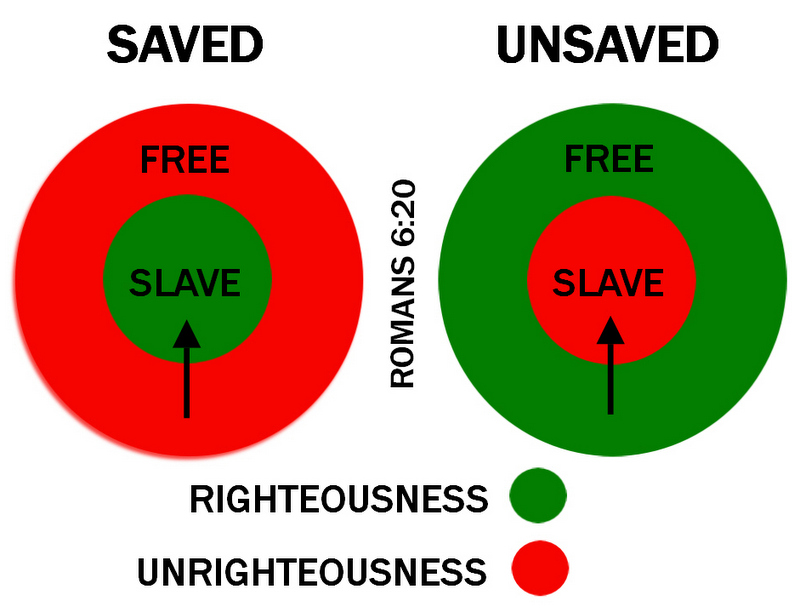
The new birth is a reversal of sin and slavery resulting in a change of direction. No one sins perfectly, and no one loves perfectly. It’s a direction, not perfection. But if you look at the Reformed cross chart again, neither is it a downward direction of sinful perfection resulting in making the cross bigger.
That’s the end of our lesson tonight—let’s go to the phones.
A Clarification on my Anti-Reformation, Anti-Protestant Stance
 It is true, I have totally written off every Calvinist that has ever lived in regard to having any value for sanctification or justification except for two, one being Dr. Jay Adams. After all, I don’t want to be extreme.
So, what’s my excuse for excusing Adams? He brings something to the table that isn’t Reformed. Sure, he may argue that it is Reformed, but nevertheless the results are the same: people find a measure of real help in a contemporary church where there isn’t any help. In fact, the consensus is in: people are better off after they leave church. This ministry has witnessed several marriages on their way to divorce court until the couple simply stopped going to church. In fact, I dare say their marriages are getting better.
We are in a Protestant Dark Age. A movement is needed where the wisdom of God found in the Scriptures is rediscovered in Western culture. What needs to be rediscovered specifically? It starts with the knowledge that the Bible is written for the able individual. That’s first.
Secondly, the issue of how we interpret reality must be addressed. The Reformers did not interpret reality literally, and that tradition was passed down to all that followed them. In the church today, by and large, the pastorate does not interpret state of being in the same way that congregants do. The Reformers reinterpreted every word and term according to their own worldview. For example, “God’s glory” really means “God’s self-love.” Stated simply, John 3:16 in reverse.
The Reformers devised an ingenious indoctrination system of sliding metaphysics. They redefined every word and term, and allowed the listeners to assume what they meant by each word and term. In the process of using these words and terms in a certain way, listeners are slowly indoctrinated in accordance with the primary goal of the Reformers: a desired functionality albeit foggy understanding.
Let me give some specific examples. Total depravity. From the beginning in Reformed thought, this included believers. So, while assuming total depravity pertains to the unregenerate only, many are eventually indoctrinated into the original Reformed idea that this also includes believers.
Sola scriptura. The assumption is Scripture alone, but the Reformers knew that few would ask the following question: “What exactly did the Reformers believe about the Scriptures?” Sure, Scripture alone, but for what purpose?
Election. The assumption is that this argument focuses on man’s ability to choose God for salvation, but it goes much, much deeper than that and is directly relevant to what the Reformers believed about reality itself. Few know that Calvin believed in three classes of elect: non-elect, temporarily elect, and the final elect, or those who persevere.
The Reformers believed that reality is a narrative written by God in which mankind is written into the script. Reformers such as Jonathan Edwards believed that man has no will per se, but God preordains every thought that precedes every act of man which makes it seem as if man has a will. My wife Susan will be doing three sessions on Jonathan Edwards at this year’s TANC conference. Many will find her research fairly shocking.
Sola fide. The assumption is faith alone for salvation/justification. By far, this is the one that the Reformers get the most mileage out of. Using this assumption, they continually talk about sanctification in a justification way. Eventually, sanctification becomes justification. Eventually, the Christian life becomes perpetual re-justification which is the Reformation gospel in a nutshell.
Protestantism is truly the super-cult of the ages.
And the institutional church finds itself in a huge dilemma. Traditional institutional worship beginning with the Reformation was tailored for perpetual re-justification down to the alter call routine. The Lord’s Table is a solemn ceremony where additional grace is imparted through repentance. In reality, the first century assemblies met for dinner, and the fellowship meal was supposed to remind them of their fellowship with God and His Son. It was all very informal and not for the purpose of imparting additional grace.
The gatherings were an extension of worshipful living specifically designed for private homes and nothing more. The institutional version is an extension of two pillars of Reformed theology: the doctrine of progressive justification, and the politics of church-state. Hence, traditional institutional worship necessarily circumvents the original intent of Christ’s mandate for His assemblies.
With all of that said, Adams supplies a little help that can be found right now in the institutional church, and at least for the time being, we need to seize upon everything we can get. I am not talking about those who think they are helped by adopting a Reformed worldview of zero-sum-life (viz, “second generation” biblical counseling). I am not talking about those who seem to stand strong in the face of adversity because they see all of life as nothing but a divine prewritten narrative for the sole benefit of a divine self-love. No, here is my reasoning in regard to Adams per a comment I posted yesterday:
God used Jay Adams to save my life. How? Jay emphasized the need for biblical counseling using a grammatical approach to the Scriptures. This approach proffered the idea that seizing upon the literal promises of God in the Bible is curative. Of course, this would seem evident. That gives hope; if I follow God’s instruction on this, God will do that.
In the midst of the hell I found myself in, I could begin to please God. Nothing could keep me from doing so except myself, and in God’s timing, and in God’s way, it would be curative as well.
As someone who prided himself as a knowledgeable, objective evangelical, Jay’s teachings exposed the fact that I was really a functioning mystic that used all of the orthodox verbiage. While I disagree with Jay on many things, this is the powerful approach that he brings to the table.
“Christians” have a choice to make in regard to how they will interpret the Scriptures and reality itself: grammatically, or according to Christocentric Gnosticism. I am not talking about pseudo grammatical interpretation used for a purely redemptive outcome, I am talking about authentic exegetical interpretation, not cross-centered eisegesis leading to the antinomianism of “second generation” biblical counseling.
And, Jay is an example to all of us in practicing our gifts faithfully to the end. There is no retiring from a love for the ministry that you are called to whatever it is.
May the Lord give God’s people many more years of his living sacrifice.
Am I willing to give a Calvinists credit where credit is due? Yes, if he brings something to the table that can give life. If we were in a time when the laity has retaken its rightful place in Christ’s mandate supplying ample sanctification wisdom, would I recommend Adams in any regard? I am not sure, my due to him in this particular age notwithstanding. But for the time being, we must scrape up everything we can get until the laity obeys its calling, as long as it is truly worth scraping up.
The Reformation has failed. A resurgence of it commenced in 1970. By 2008, it dominated American evangelicalism and continues to do so today. But, the chickens are coming home to roost. Its leaders are dropping like flies. The damage control is now unmanageable. The institutional church is a train wreck while the Nones and the Dones are laying about everywhere on the landscape. The latest trail blazer of the neo-resurgence to fall at the hands of his own gospel sanctification Reformed doctrine is Tullian Tchividjian. He is one of seven of the most visible leaders of the movement to resign for misconduct in less than two years. Others have been the focus of controversial bully-like conduct in the same time frame, along with numerous Neo-Calvinist mega church pastors who have resigned for sexual misconduct, three in the Orlando, Florida area alone.
The answer is NOT Reformation—the answer is a laity revolution. The laity has been conned into investing huge sacrifice in Reformed academia, and to what end? Who will deny that the laity understands less about Christian living than we ever have? Rather than seeking God’s face on our own, we run to orthodox sand boxes like The Warburg Watch and play with the same regurgitated Reformed talking points. This only serves to help the failed Reformation with its damage control. It only serves to send the message that being confused is acceptable.
But we do not serve a God of confusion. It’s time for the laity to stop worshiping Reformed academia and give honor to the one who sanctifies us with truth—not the traditions of mere men.
paul
The False Protestant Gospel of “How Much?”
 “At any moment, any lost person can choose to have their sins ended. It is not a question of whether or not they are elected, it is a question of whether or not they are under the law—and they are.”
The Protestant gospel effectively denies the biblical interpretation of the new birth. Because of its Platonist metaphysical presuppositions, it denies the treasure of God’s seed dwelling in weak vessels. Hence, the new birth is redefined and confined to the ability to perceive realm manifestations apart from any ability to do a good work of any kind. As stated by some, “Sanctification is done TO you, not BY you.”
In the biblical good news schema, Christ does ONE act of obedience as His part in God’s reconciliation plan. There is no question of “how much?” because His death was all that was required.
Now enter the heinous “Reformation” gospel of confusion. A cursory observation of Reformation history reveals that the dust-up between Rome and the “Reformers” was over metaphysics first. The very first and foundational doctrinal statement of the Reformation contained 12 theses of philosophical metaphysics. Luther was miffed that Rome was moving away from its Augustinian/Platonist roots and coming under the spell of Thomism. This shift began in the 13th century via St. Thomas Aquinas and eventually incited the Reformation. The assertion that the Reformation was driven by sola scriptura is absurd.
Martin Luther introduced his metaphysical answer to Thomism and foisted his theses that supported it onto Scripture. The centerpiece eventually came to be known as double imputation. To Luther’s credit, he created a timeless soteriology based on metaphysics that continues to turn the world upside down. John Calvin articulated Luther’s foundation in the Institutes of the Christian Religion. Both were dedicated to returning the church to its Augustinian roots.
What is double imputation? Basically, it’s the idea that Christ’s role in the gospel of first importance (as set apart from God’s full counsel which is also good news) was twofold as opposed to ONE single act. This was necessary as a “biblical” doctrine that keeps the material being of man separate from Plato’s trinity: the good, true, and beautiful, ie., the invisible. The true gospel turned dualism philosophy completely on its head by infusing good into weakness and defining the true definitions of God’s creation and the state of being.
The idea that God infused His righteousness into the being of mankind is repugnant to the Reformed mindset. How repugnant? The colonial Puritans executed Quakers for even asserting an errant view of the idea.
Therefore, distorting Christ’s role in God’s elected plan of reconciliation was necessary. Christ’s redefined soteriological role removes all goodness from mankind proper and “Christians” in particular. Christ not only came to die for the sins of particular persons preselected by God, but He also came to live a perfect life in obedience to the law so that His obedience could be imputed to the “elect.”
Now the questions are begged: “How much suffering was necessary to pay the penalty for sins committed by the preselected, and how much obedience was necessary for righteousness to be imputed to the preselected as well. When a false doctrine is predicated on errant presuppositions, not only do these kinds of questions arise, but the attempted answers give rise to more questions.
And displays of nonsense. An example is the weird and embarrassing ad lib “Scream of the Damned” propagated by John Piper and CJ Mahaney at a conference hosted by John MacArthur Jr.’s Grace Community Church.* The sheer weirdness of it all even raised eyebrows within Reformed circles by the likes of Steve Camp. The premise was an adolescent-like attempt to explain how much? in regard to Christ’s death. Imagining the response from my older than dirt and probably dead father in the faith, Pastor Richard Peacock, put me on the floor rolling around while laughing uncontrollably. Only the thought of thousands of attending pastors supported by the hard work and sweat of the laity watching without a blink shocked me into the horror of reality and put an end to my shameless response.
When are people going to stop and say to themselves, “Wait a minute here; what drives this stuff? This kind of stuff just doesn’t happen for any or no reason.”
Likewise, in regard to how much?, how long did Christ have to live and how much of the law did He have to obey for the elect? Theories abound because the question itself flows from the false presuppositions of Platonism foisted on the Scriptures resulting in the doctrine of double imputation.
Christ did ONE thing to secure reconciliation for mankind: He died. How much? Answer: enough for ALL mankind. How? Answer: by ending the law. How is that possible? Answer: because all sin is against the law and imputed to the law, and Christ died to end it. Sin is not covered by Christ’s law–keeping; no, sin is not covered, it is ENDED. At any moment, any lost person can choose to have their sins ended. It is not a question of whether or not they are elected, it is a question of whether or not they are under the law—and they are.
What else did Christ do to secure our reconciliation? Answer: nothing. But wasn’t He resurrected? Answer: yes, but He didn’t do that, that was the Holy Spirit’s role in God’s plan of reconciliation. The fact that Christ would be resurrected was a promise made TO Christ and Abraham BY God. That surprises many Christians who don’t read their own Bibles for themselves, viz, most.
In other words, this is the gospel: Christ DIED to END sin. The Spirit resurrected Christ as the first fruits of those who would also be resurrected to new life and justification which is NOT merely a legal declaration, but a metaphysical fact. It does of course have a legal aspect, but it is adoption court where the Holy Spirt bears witness with us that we are the children of God. Christ was “resurrected” for our justification” by the Holy Spirit. “Forensic Justification” does have a legal aspect, but not only in the halls of criminal court, but just as much in the court of adoption with the Holy Spirit appearing as a witness.
Obedience to the law by Christ does not justify us, the new birth justifies us because we are in fact righteous. The resurrection justifies us, not law-keeping by anyone including Christ.
True resurrection with Christ is “under grace,” but that by no means states that we are no longer under a law. It means that we are no longer under a law that condemns us. This is what strips sin of its power. This is what strips death of its sting. We must remember that the law is the Spirit’s law. He will use it to convict the world of sin and warn of the judgment to come, or he will use it to sanctify God’s children. The law is a savor of death to those who do not believe, and a savor of life as we walk in it as God’s children.
The time has come to stop dwelling in the Protestant metaphysical narrative of death, and to follow Christ in our duty to write a narrative of life.
How much? That will depend on OUR obedience as children of God. The Spirit gave us life and opportunity to use His law to love God and others. “Do’s and don’ts” are not the issue, LOVE is the issue. We do not stay at the foot of the cross while Christ loves for us; we will be rewarded for the narrative of life that we write by using the gifts granted to us when Christ sat down beside the Father and rested from justifying all who will believe in Him.
We zealously write our narrative of life without fear of condemnation because of Christ’s love for us. And our love will never be enough because of the freedom we feel. The freedom purchased by His blood that freed us from the condemnation of the law and the Master empowered by it, and the freedom to love by obeying the law of the Spirit—the perfect law of liberty. When God looks at us, He sees more than Christ, he sees one that Christ is not ashamed to call a brother—He sees one of His children. Christ doesn’t cover us, He presents us.
He is not ashamed of us. His death was enough for our life.
paul
* “Apparently, they got the concept from RC Sproul, who used to be rock solid, but now it would appear that senility has opened his mind to the nonsensical theological acrobatics of our day. Likewise, the same consideration might apply to John MacArthur who spoke at the conference and also sponsored it; he is getting up in years as well. I offer this as a possible excuse for both of them though the vision of my heart longs to see them as the gray-haired stalwarts of the faith that I thought they were. Here is what Sproul said:
‘Once the sin of man was imputed to Him, He became the virtual incarnation of evil. The load He carried was repugnant to the Father. God is too holy to even look at iniquity. God the Father turned His back upon the Son, cursing Him to the pit of hell while on the cross. Here was the Son’s ‘descent into hell.’ Here the fury of God raged against Him. His scream was the scream of the damned. For us’ (Tabletalk magazine, My God, My God, Why Hast Thou Forsaken Me? April 1990, p. 6).
Steve Camp, on his blog, wrote a tame but thoroughly convincing argument against such a notion. But the fact that Camp thought such a significant expenditure of effort was needed is indicative of our day; surely, only ten years ago, such a thesis would have invoked a horrendous outcry among God’s people” (The New Calvinist License To Kill: And Did God Really Condemn Christ To Hell?, Paul’s Passing Thoughts blog, Paul Dohse, Sr., September 2, 2011).

 Paul's Passing Thoughts
2 comments