An Introduction to TANC 2015: Why the Protestant Reformation is a Lie

Protestants don’t know anything. That’s not a derogatory remark, it’s merely a staple of Reformed ideology. It’s who we are supposed to be. Protestantism is predicated on the idea of spiritual caste as an accepted norm. The average Protestant parishioner is not supposed to know anything, and again, this is an accepted norm. In fact, many Protestant laymen who didn’t get the memo will concur; knowing something in the institutional church will usually get you in trouble. If you know something, you lack humbleness, and are trying to undermine… The Pastor.
This should not surprise us at all if we understand our authentic roots and the ideology of our spiritual heroes. Though Martin Luther’s 95 Theses is credited with launching the Reformation, its first and defining doctrinal statement came six months later in the form of the Heidelberg Disputation to the Augustinian Order. In the 22nd thesis of that document, Luther declared knowledge to be a vice that does nothing but puff people up, and like with all lust, it can never be satisfied. Luther’s disdain for reason is well documented, referring to it as…
Reason is the Devil’s greatest whore; by nature and manner of being she is a noxious whore; she is a prostitute, the Devil’s appointed whore; whore eaten by scab and leprosy who ought to be trodden under foot and destroyed, she and her wisdom … Throw dung in her face to make her ugly. She is and she ought to be drowned in baptism… She would deserve, the wretch, to be banished to the filthiest place in the house, to the closets.
Reason is the greatest enemy that faith has; it never comes to the aid of spiritual things, but more frequently than not struggles against the divine Word, treating with contempt all that emanates from God.
Reason must be deluded, blinded, and destroyed. Faith must trample underfoot all reason, sense, and understanding, and whatever it sees must be put out of sight and … know nothing but the word of God.
There is on earth among all dangers no more dangerous thing than a richly endowed and adroit reason… Reason must be deluded, blinded, and destroyed.
Reason should be destroyed in all Christians.
Whoever wants to be a Christian should tear the eyes out of his Reason.
To be a Christian, you must “pluck out the eye of reason.”
In our day, this fruit doesn’t fall far from the tree as reflected in this quote by a pastor sent to our ministry by one of his former parishioners:
Paul told the Corinthian church that “‘knowledge’ puffs up but love builds up” (1Cor 8:1). So, if you love knowledge and look into the word of God to gain mere knowledge and you absolutely love doing it to the exclusion or ignoring of everything else, you may be “puffed up” and indeed not “building up.”…. Puffiness rips and tears. Puffiness pushes people away. Puffiness divides. Perhaps even more critical is the fact that puffiness portrays a small gospel and devastatingly distorts God’s glory.
To the puffy I say, “Stop studying your Bible.” Go on a quest for Jesus. He is the Word! Study Him, not it.
Studying Jesus and not any knowledge regarding Jesus is the most popular rendering of 1Corithians 2:2 in our day: we are supposed to make every effort to know NOTHING but Christ and him crucified. After all, according to another popular truism in our day, “He is a person—not a precept.”
Of course, most Protestants would deny all of this out of hand when confronted, but the roots and foundation of Protestant ideology has at least resulted in a lax view of knowledge while leaving the thinking to Protestant academia. Some well-known evangelicals such as Dr. Jay Adams have stated the obvious: Protestants are biblically illiterate, and have no wisdom in regard to Christian living other than God-given commonsense and even that is at an all-time low.
Christians, who strive for wisdom and spiritual maturity in the institutional church, if they don’t give up, will eventually find themselves in turmoil and at a crossroads. Striding towards commonsense spiritual objectives will continually put them at odds with the Protestant herd. I was certainly no exception. As someone who was always considered knowledgeable wherever I attended church as a Baptist, in reality, I knew nothing. The knowledge that I had accumulated in various seminaries and Bible colleges was all but worthless. Though I read and studied my Bible more than most, I understood little of it. Most of what I read made no sense at all. Nevertheless, I deemed myself knowledgeable relative to the environment, yet in my heart, I knew the Christian life made no sense and I was for the most part confused. In reality, I was good at constructing Protestant sentences with orthodox bumper stickers and pithy truisms.
So, I set out on a journey eight years ago to search for clarity after 23 years of confusion and strife. The part of my journey that really made everything come together began in 2011 when I embarked on a personal study of Paul’s letter to the Romans. I was determined to make this the time—the endeavor that would reveal once and for all what I was searching for: why my God seemed to be a God of confusion. I prayed earnestly at the beginning of the study that I would just let Paul’s words say what they plainly said. If something he wrote was definitive, I would use that as a building block of understanding.
Though I stayed true to the plan, not much happened until Romans 4:15. That’s the day my life came to a full stop.
For the law brings wrath, but where there is no law there is no transgression.
What in the world did Paul mean by that? NO law, NO sin: especially in the context; speaking of Christians. I kept it mind and continued to work through the letter. Then I came to Romans 5:13…
for sin indeed was in the world before the law was given, but sin is not counted where there is no law.
There it was again: no law, no sin. I stopped there in my verse by verse study and read through the rest of the letter and found the following:
Romans 7:6 – But now we are released from the law, having died to that which held us captive, so that we serve in the new way of the Spirit and not in the old way of the written code. 7 What then shall we say? That the law is sin? By no means! Yet if it had not been for the law, I would not have known sin. For I would not have known what it is to covet if the law had not said, “You shall not covet.” 8 But sin, seizing an opportunity through the commandment, produced in me all kinds of covetousness. For apart from the law, sin lies dead.
Apart from the law sin lies dead. There it is again. No law, no sin. Then I read the following as well:
Romans 10:4 – For Christ is the end of the law for righteousness to everyone who believes.
Conclusion: Christ died on the cross to end the law, and where there is no law, there is no sin. That’s how Christ took my sins away: He died on the cross to end the law. The true Christian is free from any judgement or condemnation—we are not under the jurisdiction of the law.
I wasn’t the least bit sure where this left the law in regard to the Christian life, but pondering the simple fact that we are no longer condemned was exhilarating and freeing. The old self that was under the law of sin and death died with Christ; you can’t indict a dead person, they are no longer under the law. And even if you exhumed my body and presented it in court, the judge has no law in which to convict me (Rom 7:1-6). There is NOW no condemnation for those in Christ (Rom 8:1).
Again, I was not sure where this left the law in regard to the believer’s life, but I had my building block; part of the pieces fit together which would lead to more pieces fitting and an increased understanding of the bigger picture.
Then I came to Romans 8:2.
For the law of the Spirit of life has set you free in Christ Jesus from the law of sin and death.
Remember, I had committed to simply letting the words say what they say. As a result, I saw something in this verse that I had never seen before; clearly, Paul wrote of two separate laws…the law of the Spirit, which I had always thought of as the Spirit’s realm of influence, and the law of sin and death.
“Wait a minute here,” I thought to myself. “If the law of sin and death refers to the written law that condemns mankind, and the two laws spoken of here are the same Greek word, and they are, why would one refer to a realm while the other one referred to a written law? Could it be that this is two perspectives on the same law?” I knew that a literal take on this verse would demand that, and then John 17:17 came to mind:
Sanctify them in the truth; your word is truth.
Then another verse came to mind:
And when he comes, he will convict the world concerning sin and righteousness and judgment (Jn 16:8).
That’s when I realized that the law has two different applications/perspectives: one for the lost and one for the saved. But verses were not done coming to mind:
Love does no wrong to others, so love fulfills the requirements of God’s law (Rom 13:10).
For in Christ Jesus neither circumcision nor uncircumcision counts for anything, but only faith working through love (Gal 5:6).
So, the Christian is free to aggressively love God and others through obedience without ANY fear of condemnation:
There is no fear in love, but perfect [mature] love casts out fear. For fear has to do with punishment, and whoever fears has not been perfected [matured, or growing] in love (1Jn 4:18).
Therefore, why the Reformation is a lie is not complicated at all. This SIMPLE fact makes Protestant theology a house of cards: it keeps so-called believers under the law of sin and death; its very definition of a Christian is the Bible’s definition of a lost person…under law (Rom 6:14). Protestantism is predicated on a single perspective on the law that Christians remain under; they remain under condemnation. This condemnation is covered by Christ’s righteousness as the “Christian” lives by faith alone. Living by faith alone works (usually some kind of ritual like “preaching the gospel to ourselves everyday”) imputes the obedience of Christ to our Christian lives as a way to keep ourselves justified. The Reformed call this “double imputation.”
Once one gets past all of the theological Protestant-speak, it boils down to extremely simple theological math: a Christian is NOT free to love—Jesus must love for us lest it be works salvation. And it almost goes without saying that there is a love famine in the institutional church for this very reason. The Protestant is not free to love, but must focus on a convoluted life formula that supposedly imputes the righteousness of Christ to our lives and thereby keeps us saved. Yes, this is the dirty little secret: total depravity doesn’t merely apply to the unregenerate, but also to the “saints.”
Yes, yes, many a Protestant doth protest against this accusation because few Protestants know what Protestantism is. Nevertheless, it is a false gospel that denies the new birth and keeps people under law and not under grace—a grace that frees the individual to aggressively love without fear of condemnation and the mire of unhealthy introspection.
We are saved APART from the law of sin and death…period (Rom 3:21), and it does NOT matter who keeps the law, the law of sin and death itself is the issue. Salvation is accomplished by the ENDING of the law of sin and death—not the fulfilling of it. Christ came to fulfill the law of the Spirit of life (and love) through us (Rom 8:4)…NOT the law of sin and death.
That would make the law of sin and death a co-life-giver with Christ. The law cannot give life unto salvation. If Christ fulfilled the law of sin and death with loving obedience to the Father, that law is a co-life-giver. That is Paul’s entire point in Galatians chapter 3. There is only ONE seed. If we are still under the law, the law is an additional seed that can give life…but there is only ONE!
Hence, Protestantism goes the way of most other false religions; some ritual or tradition fulfills the law of sin and death and separates the individual from the freedom to love without condemnation and according to the law of the Spirit of life. Love is replaced by obeying men and faithfulness to their institutions. The law of love is replaced with the traditions of men and their orthodoxy.
Consequently, we are in a Protestant dark age. In the same way that secular America has awakened to the failure of the elitist political class, Christians must awaken to realize the failure of Protestant academia. The assembly of Christ was a laity movement, and only the laity can return God’s people to the truth of the gospel. This is a repeat of history when God’s elect where continually troubled by the 1st century Gnostic elitists. Paul wrote to them…
For consider your calling, brothers: not many of you were wise according to worldly standards, not many were powerful, not many were of noble birth.
Likewise, the beloved James addressed the problem as well:
Listen, my beloved brothers, has not God chosen those who are poor in the world to be rich in faith and heirs of the kingdom, which he has promised to those who love him? But you have dishonored the poor man. Are not the rich the ones who oppress you, and the ones who drag you into court? Are they not the ones who blaspheme the honorable name by which you were called?
This is our mission at TANK, to aid the priesthood of believers in rediscovering the truth of the gospel and kingdom living robbed from us by 500 years of Protestant orthodoxy. The light has been covered by the Protestant basket long enough, and this is a matter of simple theological math: the new birth is the standard of righteousness, NOT the law of sin and death, and it matters not who keeps it—it CANNOT give life.
So, the speakers at this year’s conference are partaking in this journey in the arena of ideas. This is an issue that addresses every area of life and culture. Other than the gospel of first importance stated here, everything is being examined and revisited. It’s not group think, it’s collective truth made up of individuals seeking the one mind of Christ, not the traditions of men.
Let all be convinced according to their own conscience. Protestant elitists will not stand in our stead regardless of their claims, but each person will give an account for the sum and substance of their own lives. Let us do it with trembling and fear; not any fear of condemnation, but a fear of trading the life of Christ for the death of tyranny.
Because only truth sanctifies,
Paul M. Dohse
Calvinism and the Problem with Perfection
 Originally published November 7, 2013
Augustine, Luther, and Calvin were first and foremost Platonists. They integrated the Bible with Platonism. Plato’s theory of forms posits the idea of two worlds; the mutable material world of illusion where reality can only be partially known, and another world where the immutable objective true forms exist. This material world is a shadow world; everything is shadows of the true forms. Therefore, man can only interpret and experience this world subjectively. The tendency is to interpret reality by observing the shadows. To the degree that mankind thinks the material world is reality according to the five senses, subjectivity and chaos will abound.
Therefore, Plato’s ethic was to improve the subjective experience of this life by accessing the true forms through ideas and mathematics—things that transcend the five senses (he believed math was an unchangeable rule and therefore not part of the shadow world). He believed that those who have the capability and willingness to bring more understanding of the objective into the subjective to be an elite minority. These were Plato’s philosopher kings whom he thought should rule society in order to decrease chaos as much as possible. Without philosopher kings, the world would be awash in a sea of subjectivity, everyone living by their own subjective presuppositions based on the shadows of this world. Hence, the arch enemy of the Platonic ideal is individualism.
Plato’s world of true objective forms was his trinity of the true, good, and beautiful. Experiencing the pure form of goodness in this world is impossible—only a shadow of good can be experienced subjectively. Plato’s social engineering has a doctrine, and to the degree that doctrine is applied, a higher quality of subjective existence occurs.
The Reformers put a slightly different twist on this construct. There is no doctrine to apply, only an orthodoxy that focuses on seeing and experiencing. Their version of Plato’s philosopher kings are pastors who possess the power of the keys. Orthodoxy is mediated truth determined by “Divines,” and passed down to the masses for the purpose of experiencing the objective power of the gospel subjectively. The Reformers made the true forms “the gospel,” and reality itself the gospel, ie., the work and personhood of Jesus Christ in particular.
Therefore, in the same way Plato envisioned a society that experiences the power of the true forms subjectively through ideas and immutable disciplines like mathematics, the Reformers sought a heightened subjective experience through a deeper and deeper knowledge of their own true, good, and beautiful—the gospel. And more specifically, instead of the gateway of understanding being reason, ideas, and immutable disciplines, they made the gospel itself the interpretive prism. So: life, history, the Bible, ie., everything, is a tool for experiencing true reality (the gospel) in a higher quality subjectivity. The Bible and all life events are a gospel hermeneutic. Salvation itself is the interpretive prism. All of reality is about redemption. Salvation itself is the universal hermeneutic.
But both constructs have this in common: Pure goodness and perfection cannot exist objectively in the material world. This is where Calvinism and Platonism kiss. The Bible only agrees with this if it is a “gospel narrative.” But if it is God’s full orbed philosophical statement to all men to be interpreted grammatically and exegetically, contradictions abound. To wit, if man possesses goodness and the ability to interpret reality objectively, Platonism and its Reformed children are found wanting. If Reformation orthodoxy is not evaluated biblically with the very theses of its own orthodoxy as a hermeneutic, even more wantonness is found.
The Apostles rejected Platonism because they believed goodness and perfection could indeed be found in this material world. There is no question of the quality of goodness inside of man that enables mankind to interpret reality objectively, the quantity of goodness notwithstanding. In contrast, a dominate theme in the Calvin Institutes is the idea that no person lost or saved can perform a good work. Like Plato’s geometric hermeneutics, the Reformers believed the Law lends understanding to man’s inability to do good because eternal perfection is the standard. The best of man’s works are tainted with sin to some degree, and therefore imperfect. Even if man could perform one perfect work, one sin makes mankind a violator of the whole law. The Reformers were adamant that no person could do any good work whether saved or lost.
Why all the fuss over this point? Why was Calvin dogmatic about this idea to the point of annoyance? Because he was first and foremost a Platonist. The idea that a pure form of good could be found within mankind was metaphysical heresy. Because such contradicts every page of the Bible, the Reformers’ Platonist theology was made the hermeneutic as well. Instead of the interpretation method producing the theology, they made the theology the method of interpretation. If all of reality is redemptive, it must be interpreted the same way.
For the Platonist, the coming of Jesus Christ in the flesh poses a huge problem. He is the truth. He came to the material world in a material body. Platonism became Gnosticism and wreaked havoc on the 1st century church. Notice how the first sentences of 1John are a direct pushback against the Gnosticism of that day:
1John 1:1 – That which was from the beginning, which we have heard, which we have seen with our eyes, which we looked upon and have touched with our hands, concerning the word of life— 2 the life was made manifest, and we have seen it, and testify to it and proclaim to you the eternal life, which was with the Father and was made manifest to us— 3 that which we have seen and heard we proclaim also to you, so that you too may have fellowship with us; and indeed our fellowship is with the Father and with his Son Jesus Christ. 4 And we are writing these things so that our joy may be complete.
Christ is the true, good, and beautiful, and He was touched, felt, seen, heard, and understood. Game over. This is the paramount melding of Plato’s two worlds resulting in a plenary decimation of his philosophy. Nevertheless, Calvin et al got around that by keeping mankind in a subjective realm while making the material world a gospel hermeneutic. Reality still cannot be understood unless it is interpreted by the gospel—everything else is shadows.
Martin Luther took Plato’s two worlds and made them two stories: our own subjective story, a self “glory story” that leads to a labyrinth of subjectivism, or the “cross story” which is the objective gospel. Luther made Plato’s two worlds two stories, but still, they are two realms: one objective and one subjective. In the final analysis mankind is still incompetent, and void of any good whether saved or lost.
Whether the Reformed gospel or Platonism, the infusion of objective goodness is the heresy. Man cannot have any righteousness in and of himself, whether lost or saved. The pushback against this idea can be seen throughout the New Testament. A few examples follow:
1John 2:4 – Whoever says “I know him” but does not keep his commandments is a liar, and the truth is not in him, 5 but whoever keeps his word, in him truly the love of God is perfected.
1John 2:20 – But you have been anointed by the Holy One, and you all have knowledge.21 I write to you, not because you do not know the truth, but because you know it, and because no lie is of the truth.
1John 2:26 – I write these things to you about those who are trying to deceive you. 27 But the anointing that you received from him abides in you, and you have no need that anyone should teach you. But as his anointing teaches you about everything, and is true, and is no lie—just as it has taught you, abide in him.
1John 2:29 – If you know that he is righteous, you may be sure that everyone who practices righteousness has been born of him.
1John 3:2 – Beloved, we are God’s children now, and what we will be has not yet appeared; but we know that when he appears[a] we shall be like him, because we shall see him as he is. 3 And everyone who thus hopes in him purifies himself as he is pure. 4 Everyone who makes a practice of sinning also practices lawlessness; sin is lawlessness. 5 You know that he appeared in order to take away sins, and in him there is no sin. 6 No one who abides in him keeps on sinning; no one who keeps on sinning has either seen him or known him. 7 Little children, let no one deceive you. Whoever practices righteousness is righteous, as he is righteous.
Romans 15:14 – I myself am satisfied about you, my brothers, that you yourselves are full of goodness, filled with all knowledge and able to instruct one another.
Christians can know goodness, and perform righteousness objectively. This speaks to the quality of the righteousness when it is performed—it is perfect and acceptable to God. We are not limited to a mere subjective experience in regard to righteousness. When we are resurrected, the quantity thereafter will be 100%, but our present righteousness is acceptable to God when it is performed by us. If it is accepted by God, it is perfect.
Even the unregenerate know good, and can perform it. The works of the law are written on their hearts, and their consciences either accuse or excuse them (Romans 2:12-15). Though enslaved to unrighteousness, they are free to perform righteousness (Romans 6:20). The very goodness of God can be understood from observing creation as well (Romans 1:20).
The only way the Reformers can make all goodness outside of man is to make the Bible a salvation hermeneutic. It is the only way they could integrate the Bible with their Platonist philosophy.
paul
Know Your Cuts of Calvinism
Originally published June 2, 2013
1. Total Depravity: Pertains to the saints also.
2. Justification by Faith Alone: Pertains to sanctification also.
3. Mortification and Vivification: Perpetual death and rebirth for living by faith alone in sanctification to maintain justification. The reliving of our baptism “again and again.”
4. Double Imputation: Christ’s passive obedience to the cross for justification, and His active obedience as a substitution for our obedience in sanctification.
5. Deep Repentance (aka Intelligent Repentance): Seeks the death of mortification in re-experiencing our new birth.
6. New Obedience (aka New Fruit): The experience of Christ’s active obedience in sanctification (vivification).
7. The New Birth: Perpetual mortification and vivification.
8. The Objective Gospel: All reality is interpreted through the redemptive works of Christ.
9. Christ for Us: Christ died for our justification, and lived a perfect life for our sanctification.
10. The Imperative Command is Grounded in the Indicative Event: Biblical commands show forth what Christ has accomplished for us and what we are unable to do in sanctification. Works are experienced only as they flow from the indicative event of the gospel.
11. Neo-Nomianism (New Law, aka New Legalism): The belief that we can please God by obeying the law in sanctification.
12. Progressive Sanctification: The progression of justification to glorification.
13. Progressive Imputation: Whatever is seen in the gospel narrative and meditated upon is imputed to our sanctification, whether mortification or vivification.
14. The Golden Chain of Salvation: See cut 12.
15. Good Repentance: Repenting of good works.
16. In-Lawed in Christ: Christ fulfilled the law perfectly and imputed it to our sanctification.
17. Redemptive Historical Hermeneutics (the Christocentric Hermeneutic, aka the Apostle’s Hermeneutic): The Bible as historical narrative for the sole purpose of showing forth Christ’s redemptive works.
18. Faith: A neutral entity within us with no intrinsic worth that is able to reflect the object of its focus outside of us. The object of focus can be experienced within, but remains outside of us.
19. The Heart: The residence of evil desires and faith. It can be reoriented (the “reorientation of the heart” or “reorientation of desires”) to reflect Christ via mortification and vivification.
20. Flesh: The world realm where evil is manifested and experienced.
21. Spirit: The Spirit realm where the imputed works of Christ are manifested and experienced (not applied through our actions).
22. Christian Hedonism: Seeks to experience the joy of vivification.
23. Obedience of Faith: New Obedience.
24. Christ in Us: “By faith,” and faith only has substance and reality to the degree of the object it is placed in; i.e., Christ outside of us.
25. Vital Union: Makes experiencing the gospel possible. Makes mortification and vivification possible.
26. Eclipsing the Son (aka the Emphasis Hermeneutic): Focusing on anything other than Christ. Anything that is not seen through a Christocentric prism creates shadows that we live in. The obstacles that create the shadows may be truth, but they aren’t the “best truth.” “They may be good things, but not the best thing.”
27. Sabbath Rest: Sanctification. We are to “rest and feed” on Christ for our Christian life. The primary day this is done is Sunday. Through preaching and the sacraments we “kill” (mortification, or the contemplation of our evil and misery) resulting in vivification throughout the rest of the week.
28. The Subjective Power of the Gospel: The manifestation of the gospel that flows from gospel contemplationism. We never know for certain whether it is a result of our efforts or the Spirit’s work (although the Spirit’s work is always experienced by joy); hence, the power of the objective gospel is subjective (Heidelberg Disputation: Thesis 24).
29. Mortal Sin: Good works by the Christian not attended by fear that they may be of one’s own effort (HD 7).
30. Venial Sin: Good works by the Christian attended with fear (HD 7).
31. Power of the Keys (aka Protestant Absolution): Reformed elders have the authority to bind or loose sin on earth (Calvin Institutes 3.4.12).
32. Redemptive Church Discipline: In all cases to convert one to cuts 1-31. This redeems them to the only one, true faith. This can be a long process, and said person is not free to leave a given church until the elders bind or loose.
33. Preach the Gospel to Yourself: See cuts 1-32.
The Nature of God
 I believe incredibly exciting times await God’s people as they break free from the Protestant Orthodoxy Dark Ages. The key will be the realization that God wrote the Bible for the average individual. We have an example of this regarding the nature of God; a subject thought to be too deep for the average disciple.
Our only head is Christ who teaches all, and the idea of being taught assumes the ability to understand. God’s people need to simply let the words in the Bible say what they plainly say, and we are individually responsible for doing so. One must free their minds from the tyranny of orthodoxy and journey into the Bible with their own God-given mind, and they will be responsible to God alone for doing so.
What then does the Bible teach us about God’s nature? The Bible states that God is love:
Beloved, let us love one another, for love is from God, and whoever loves has been born of God and knows God. Anyone who does not love does not know God, because God is love.
So we have come to know and to believe the love that God has for us. God is love, and whoever abides in love abides in God, and God abides in him.
Obtaining God’s Love
Protestant orthodoxy has a peculiar teaching known as the “vital union.” According to Reformed tradition, we maintain this vital union of “Christ in us and us in Christ” by “preaching the gospel to ourselves.” This is done by searching for sin in our lives so that we can return to the cross for forgiveness resulting in increased salvation. The following chart publicized by several Reformed organizations illustrates the process:
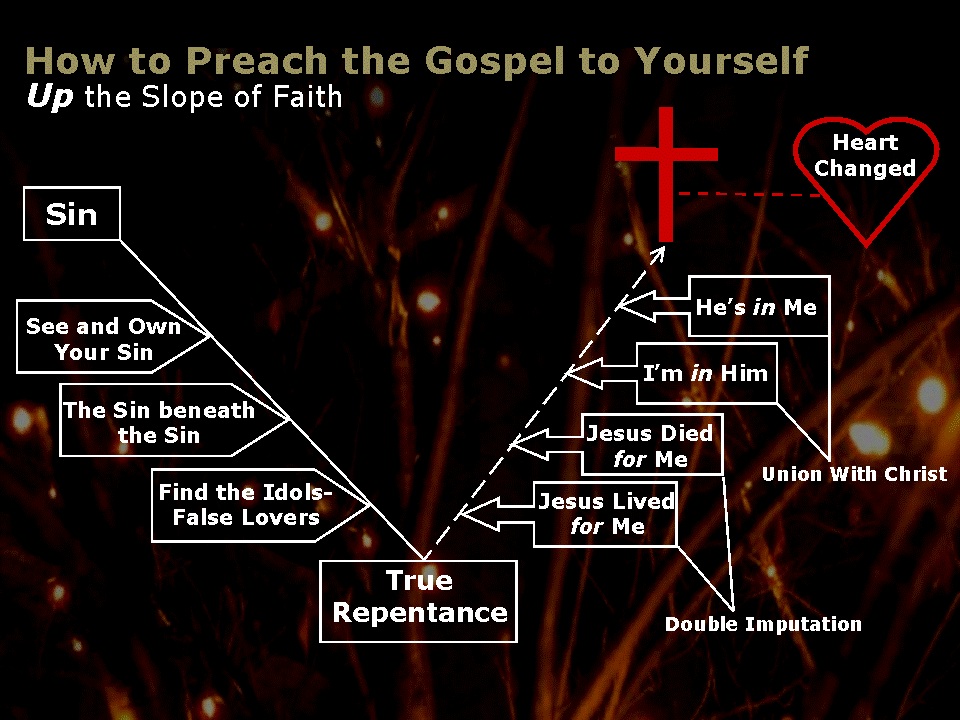
In case you think this is a “biblical” process for best results in growing as a disciple expressed in the illustration by “Heart Changed,” think again as illustrated by another chart published by several Reformed organizations as well:

In this chart, what is growing? Us, or our “salvation”? Many Reformed teachers in our day are fond of telling us how to “keep ourselves in the love of God” by “preaching the gospel to ourselves every day.” In fact, if we change, the following chart from the same camp shows the consequences:

…our salvation gets smaller! In contrast, we obtain God’s love once, and for all time, by believing in His Son, and experience assurance of that love but walking according to our new being.
Little children, let us not love in word or talk but in deed and in truth. By this we shall know that we are of the truth and reassure our heart before him…
But according to Protestant orthodoxy, if we make every effort to love God and others instead making every effort to find more and more sin in our lives, the gospel effect in our lives is diminished.
The Nature of God
How we obtain the love of God as prescribed by Protestant orthodoxy flows from its tenets regarding the nature of God. Primarily, God is defined as sovereign. Rather than sovereignty being an aspect of God’s nature, it is made to be the primary organizing principle—not love. This is an important distinction for those who take part in the exodus from Protestant darkness; will God’s nature be defined by a grammatical and exegetical interpretation of Scripture, or an interpretation based on orthodoxy?
Clearly, the Bible states that God is love. So, how does the Bible define love? Let’s see:
1Corinthians 13:1 – If I speak in the tongues of men and of angels, but have not love, I am a noisy gong or a clanging cymbal. 2 And if I have prophetic powers, and understand all mysteries and all knowledge, and if I have all faith, so as to remove mountains, but have not love, I am nothing. 3 If I give away all I have, and if I deliver up my body to be burned, but have not love, I gain nothing.
4 Love is patient and kind; love does not envy or boast; it is not arrogant 5 or rude. It does not insist on its own way; it is not irritable or resentful; 6 it does not rejoice at wrongdoing, but rejoices with the truth. 7 Love bears all things, believes all things, hopes all things, endures all things.
8 Love never ends. As for prophecies, they will pass away; as for tongues, they will cease; as for knowledge, it will pass away. 9 For we know in part and we prophesy in part, 10 but when the perfect comes, the partial will pass away. 11 When I was a child, I spoke like a child, I thought like a child, I reasoned like a child. When I became a man, I gave up childish ways. 12 For now we see in a mirror dimly, but then face to face. Now I know in part; then I shall know fully, even as I have been fully known.
13 So now faith, hope, and love abide, these three; but the greatest of these is love.
The so-called Reformed gospel of sovereignty calls for the total inability of man to love God even after their definition of conversion. One well known Reformed theologian wrote a book titled One Way Love. This staple Protestant belief is defined in the doctrine of double imputation which calls for the imputation of Christ’s alien righteousness to be imputed to our lives apart from anything we do other than preaching the gospel to ourselves. Much is made of living the Christian life by faith alone in order to maintain our “just standing.”
What it boils down to is God creating evil for His own glory. Whether you consider the teachings of Martin Luther or John Calvin, the founding fathers of Protestantism, this is an irrefutable fact. Luther taught that God created mankind with a passive will; in other words, a will that can only act if acted upon from an outside source. This testifies to God’s nature as defined by sovereignty. Hence, certain people are predetermined to suffer for eternity. In regard to this, John Calvin stated,
[God] arranges all things by his sovereign counsel, in such a way that individuals are born, who are doomed from the womb to certain death, and are to glorify him by their destruction.
~Institutes 3.23.6
I again ask how is it that the fall of Adam involves so many nations with their infant children in eternal death without remedy, unless it so seemed meet to God?…The decree, I admit, is dreadful; and yet it is impossible to deny that God foreknew what the end of man was to be before he made him, and foreknew, because he had so ordained by his decree.
~Institutes 3.23.7
This is contrary to love which is the true nature of God, being “kind,” and “Love does no wrong to a neighbor; therefore love is the fulfilling of the law.” The Reformed even make it a point to say that God did no wrong by creating man in an evil state because the end cause is God’s glory. If God brings good out of something evil, in the final analysis it is good because the end is good. It is also said that God created evil to make good better. However, that still does not dispose of the kindness issue. Love CANNOT be unkind to ANYONE.
Furthermore, it does not seek its own way, and you can insert “its own glory” in that list as well. Moreover, love does not rejoice in evil for any outcome, and always rejoices in truth and not the temporary demise of truth for some kind of better outcome. That notion is absurd.
In the final analysis, one of God’s attributes is sovereignty, but sovereignty is not the organizing principle of his nature because his nature is love.
paul

 Paul's Passing Thoughts
leave a comment