Gut Check for Evangelicalism: Control, Despair, and Fear IS the Specific Protestant Orthodoxy
 One of the memories burned into my psyche is the big picture narrative book that my dad bought me when I was a young boy about the NFL titled, “The First 50 Years.” One of the subtitles in the book is, “Pain and Injuries are in the Contract.” Of course, those who love the game know that’s one of the downsides of the game, but hardly the focal point. In boxing, pain and injury is obviously the focal point; the objective is to knock the opponent unconscious.
Here is what “Christians” need to start considering: Protestantism is boxing, not football, and that’s in the contract.
There is a book recently written by Dr. Marlene Winell titled, “Leaving the Fold – A Guide for Former Fundamentalists and Others Leaving Their Religion” wherein she coins the term “Religious Trauma Syndrome” (RTS). In the book, she writes, “I think we can acknowledge we have a subculture now – a group of people who were once religious but have left and are reclaiming their lives. This group is special and identifiable. It’s not just exChristian; it’s exMormon, exMuslim, ex-Jehovah-Witness, ex-cult, and ex-authoritarian.” And, “Religious indoctrination can be hugely damaging, and making the break from an authoritarian kind of religion can definitely be traumatic. It involves a complete upheaval of a person’s construction of reality, including the self, other people, life, the future, everything. People unfamiliar with it, including therapists, have trouble appreciating the sheer terror it can create and the recovery needed.”
There is perhaps something that Dr. Winell herself does not understand: these very symptoms (at least in regard to Protestantism) qualify these people to be religionists par excellence. Fear, pain, and misery are in the contract. And here is something else many understand not: cultism is defined by authority and subsequent control. Ironically, most people think of cults as loosey-goosey splinter groups lacking authority structure when the opposite is true; cultism and authority ALWAYS walk together. At any rate, a pity so many leave the institutional church when they have finally come to where the church wants them: on the verge of a nervous breakdown or in the spectrum of personality disorders born of orthodoxy. Obviously, they misunderstood orthodoxy from the very beginning.
Protestant orthodoxy states in no uncertain terms that RTS is a description of the perfect Christian. This religion is one of the largest in the world, and fundamentally representative of most, especially regarding the authority issue. The founding doctrinal statement of the Protestant Reformation, the Heidelberg Disputation, insists that all life meaning must be found in suffering and death. I would cite specific theses among the forty, but every thesis in the document states such. As with most of us, it might escape Dr. Winell that the paramount icon of the Christian faith is an instrument of death and torture, the cross. The Heidelberg Disputation’s major theme gave birth to this icon for the ages as Christianity’s foremost representation. But somehow, we find the results profound in some way and in need of much research.
John Calvin’s Institutes of the Christian Religion articulated the Heidelberg Disputation. In that work, Calvin stated that constant fear of condemnation was efficacious to remaining saved and growing in one’s salvation (3.3.3-7). Furthermore, according to Calvin, if one has assurance of salvation, such fear is of no necessity and puts one’s soul in peril (3.24.6). For both Martin Luther (the author of the Heidelberg Disputation) and Calvin, the redeeming trump card is periodic experiences of joy gifted to us by God for recognizing our depravity, but both warned that these joyful experiences should not give one affirmation of future glory. This is the official Reformed doctrine of mortification and vivification. You do the math.
Yes, there is a mass exodus taking place from the institutional church because many misunderstand the premise of their faith…
…fear and pain are in the contract. And it is not just a downside, it is the name of the game.
paul
Romans 12:17-21, More on Forgiveness and Enemies
 I don’t know how many articles I have written for my ongoing attempt to slay the blank check forgiveness evangelical sacred cow, but I continue to chop away at him. Despite all of the blood, the stinkin’ thing still lives.
So, let’s keep trying, but first, where does this “offering grace” blank check forgiveness stuff come from? If you followed our Heidelberg Disputation series, you know. There are two kinds of Protestants: Calvinists, and functioning Calvinists. The former hold to predestination and the soteriology, the latter function according to the soteriology while denying the specific orthodoxy.
Blank check forgiveness comes from the Reformation doctrine of total depravity which results in moral equivalency and a single perspective on justice. Basically, due to the total depravity of man, and the idea that man saved or unsaved possesses no good or righteousness within (Luther’s Alien Righteousness), everybody deserves hell; including Christians regardless of their conversion; anything other than hell or lesser than hell is “grace,” and therefore, being wronged is only valuable for showing forth the same grace that we received. Few Protestants understand the doctrine of mortification and vivification. That’s “deep theology,” so instead, they teach and apply the applications of the doctrine that are too deep for them to understand. Blank check forgiveness is one of them.
Mortification and vivification is the perpetual revisiting of our spiritual baptism. In other words, the new birth doesn’t happen once, but is experienced numerous times throughout our Christian lives. Now, Baptists can moan and cry in denial like alley cats in heat, but that’s Protestant doctrine reflected in the Westminster Confession and London Baptist confessions as well. I will keep saying it; there is no religion more confused nor pathetic than Protestantism. At least even Muslims know what they believe for crying out loud.
But back to mortification and vivification which is the primary model for change in Protestant orthodoxy. The goal is to experience our baptism as much as possible via joy. That’s the vivification part that is totally out of our control—it is the resurrection part. But it begins with our part/role in the Christian life: “dying daily,” or mortification. This is how the whole taking up our cross and dying daily verses are interpreted. According to Luther and Calvin, God helps us out with the dying part by bringing tragedy into our lives. Look, if you are, for example, a rape victim that has been counseled by ACBC or CCEF, lightbulbs are starting to turn on right about now.
Enough of that for now, let’s go to Romans 12:
“17 Do not repay anyone evil for evil. Be careful to do what is right in the eyes of everyone. 18 If it is possible, as far as it depends on you, live at peace with everyone.19 Do not take revenge, my dear friends, but leave room for God’s wrath, for it is written: ‘It is mine to avenge; I will repay, says the Lord.’ 20 On the contrary: ‘If your enemy is hungry, feed him; if he is thirsty, give him something to drink. In doing this, you will heap burning coals on his head.’ 21 Do not be overcome by evil, but overcome evil with good.”
This is one of the many love your enemies verses. I guess I will keep on saying it: why would Paul concede that we will have enemies in spite of our best efforts if we are to simply forgive everybody who offends us? This passage gives instructions for dealing with enemies. Furthermore, the Bible promises rewards for relating to our enemies in the biblically prescribed way; therefore, does blank check forgiveness deprive us of reward? I think it does. And moreover, there is NO forgiveness of enemies with God unless they repent. In the same way that God blesses His enemies who have not repented, we bless our enemies who have not repented, and this is what leads them to repentance (Romans 2:4). Now, I have some learning to do in regard to how this model works itself out, but that IS the model, NOT blank check forgiveness. It would appear that replacing revenge with blessings prevents bitterness and leads to repentance. It would also seem that the goodness unresponded to will lead to a greater judgment in the end by God.
So, all in all, do I think blank check forgiveness keeps people from repenting? Yes.
paul
Reality Itself Disproves the Church’s Doctrine
 From the Huffington Post in 2013:
Citing the “serious sins” of its leader, a Texas-based ministry that promotes home schooling and “male patriarchy” has been shut down by its board.
Doug Phillips wrote on Oct. 30 that he would step down as president of Vision Forum Ministries and stop his speaking engagements after acknowledging an extramarital relationship.
His public admission proved to be a fatal blow for the ministry he headed. Vision Forum was geared for a segment of evangelical and fundamentalist Christians who profess a traditionalist understanding of Scripture, sexuality and gender roles.
“In light of the serious sins which have resulted in Doug Phillips’s resignation from Vision Forum Ministries, the Board of Directors has determined that it is in the best interests of all involved to discontinue operations,” according to a statement on the Vision Forum website.1
What happens in reality continues to disprove the doctrine of the Catholic Church and its offspring, viz, Protestantism and its various stripes thereof. Between the two, Protestantism offers the more glaring contradictions and confusion.
Let’s just take Vision Forum as a prime example. Doug Phillips was often fond of referring to himself as a “sinner.”2 Likewise, Tullian Tchividjian, who also recently resigned due to marital infidelity,3 once boasted that he has never done one good work and stakes his assurance of salvation on that fact accordingly.4
Just how insane is church? People give their whole lives to the church and its sinners saved by grace gospel. This is the message they come to hear week in, and week out; yet, when a leader sins, he must resign to save the ministry’s credibility and subsequent financial support. What in the world is going on?
What is going on follows: the institutional church has been trying to save humanity from reality for over 2000 years. The problem with reality is mankind is basically good. Now, please note: I didn’t say that man’s basic goodness will save him, but nevertheless, man is wired for basic goodness. Why does this surprise us? Perhaps because of our Christian insanity. On the one hand, we are created in the image of God, a fact that Christians verbally toss about frequently, but on the other hand we are totally depraved? Which is it?
The case for basic goodness is stated plainly by what’s trending of late: the lost nor the saved will ultimately tolerate sinning leaders in the church or politics. This is because the world pins its hope on basic goodness. That’s a problem for the institutional church; if man is basically good, he doesn’t need the institutional church to find God and have a relationship with Him, and the church needs to be needed. If man is basically able, he doesn’t need institutional religion as an additional mediator other than Christ. That’s bad for business.
Let’s pause for a reality check; clearly, there is evil in the world, but if man is basically evil, what would the world really look like? And in context of this post, if the function of parishioners was consistent with the message that they pay good money to support, no sinning leader would need to resign, and no ministry would lose support. There is a clear disconnect between reality and the “amen” echoed from the church pews.
And frankly, at pastors conferences and closed-door elders meetings, I think this disconnect is seen as the problem. The institutional church is trying to sell a difficult package, but nevertheless, it is a package they believe in. Resignations are primarily fiscal considerations that sometimes fail to save a given part of the institutional church industrial complex. Many church leaders, whether Catholic or Protestant, see resignations as indicative of the hard work that yet remains in striving for saints to really “understand grace.” However, progress is being made; one example would be the ministry of Pastor Jean F. Larroux, III5 in Presbyterian circles with perhaps the best example being Jack Hyles in Baptist circles:
“What better example than pastor Jack Hyles who remained in the pulpit till his death in 2001. Hyles pastored the largest Baptist church in the US, boasting a membership of 100,000 and Sunday attendance approaching 20,000. Till this day, the Sunday School operates 250 school buses. Hyles was the personification of the first gospel wave that emphasized getting people saved and had very little emphases on life changing discipleship. And then there is this:
‘Hyles had also become known for his alleged immorality, specifically his behavior with his secretary (the wife of a deacon in the church)…. Besides Hyles’ own church and schools being scandalized with immorality and pedophilic activity (numerous FBCH men have been charged or convicted of child molestation), Hyles spawned a number of “ministries” (there are approximately 200 independent Baptist churches nationwide that hold Hyles and his teachings in high regard) that have been scandalized in the same manner. For example, seven Hyles-affiliated churches from 1984-1993 were rocked by child molestation scandals.
David Hyles, Jack Hyles’ son, had affairs with at least 19 different women at Miller Road Baptist Church in Garland, Texas, during the time he pastored there. (He was dismissed when a janitor found photos of Hyles having sex with a deacon’s daughter.) Back in the Chicago area (Bolingbrook, IL), and after David’s divorce from his wife, David was cohabitating with a woman by the name of Brenda Stevens. Brenda posed for pornographic pictures in Adam and Chicago Swingers magazines (in an advertisement for group sex) during the time she and David were living together. After David married Brenda, Brenda’s 17-month-old son by a previous marriage was found battered and dead at the Hyles’ home. The police still consider the case a murder and continue to view David and Brenda as prime suspects.’”6
This post is an idea for TANC Ministries’ 2016 project and is not meant to be an in-depth look at this hypothesis, but I want to close with another thought that is related: ministries that are fed by the following of men. Vision Forum is one example among many. So goes the man, and so goes the ministry. In contrast, the Bible makes it clear that any ministry founded on the following of a man has no credibility whatsoever and is false on its face value. Yet, most Protestant denominations are founded on some man’s teachings. Baptists would seem to be the exception except for those who claim a “bloodline” to…you guessed it…John the Baptist.
Project 2016 seeks to explore the extreme cognitive dissonance of the institutional church, and we hope to have the final product of this research available at the TANC 2016 conference in August.
paul
2https://paulspassingthoughts.com/2013/10/31/the-doug-phillips-fall-and-the-new-calvinist-before-and-after-gospels/
5https://paulspassingthoughts.com/2015/03/02/controversy-among-the-dead-what-the-resignation-of-jean-f-larroux-iii-tells-us-about-the-institutional-church/
6Paul M. Dohse: The Truth About New Calvinism; TANC Publishing 2011, pp. 128, 129.
Why People Say No to the Gospel and Yes to Evangelicalism
 What I have come to learn is the lost world understands more about the gospel than professing Christians. The longer a professing Christian goes to church, the less they know about the things of God. I am not saying they don’t know things and learn a bunch of stuff, it’s just that none of it is biblical.
As a born again Christian in 1983, I was totally full of joy and on fire for God, and then church happened. And worse yet, I added to the calamity by going to seminary. What followed was a long dark path of doubting my salvation, being unnecessarily enslaved to sin, and total confusion in regard to what the Bible clearly stated as set against what happens in church. I went through periods where I just threw in the towel and said, “Just keep your mouth shut and serve the church; obviously, I am the problem, all of these people couldn’t be wrong.” Then the stupidity would once again become more than I could bear, and I would start asking questions again.
Finally, I got too good at asking questions in 2007 and the church folks put a full court press on me. After being cast outside of the camp, I sat alone save a few, but there was only one thing that I could see: the promise that “If you seek me you will find me.” And so the journey began at the place where I came from, the joy of my original salvation, but this time with the addition of real knowledge. I believed the promise, and I would find the truth in this life or run out of time and find it in the next—either way was fine with me at that point.
This post is about one of the things I have learned in the journey. People don’t say no to the gospel because they are “totally depraved and have not been shown the kingdom by God’s divine providence,” they say no to the Evangelical gospel because they know it’s not the gospel. Actually, they say no to the Evangelical gospel for the same reason evangelicals say yes to their own false gospel; neither want to lose their own lives to find it.
That’s right, unbelievers don’t want to lose their present life, and they know being saved means exactly that. For the most part, they know this intuitively because the “works of God’s law” have been written on their hearts as with everyone born into the world. As an unbeliever, I said no to many evangelicals who told me that I only needed to believe, and it had nothing to do with anything regarding behavior as that would be “works salvation.” As an unbeliever, I agreed with the basic framework of the wording, but knew that wasn’t the gospel. A demand to cease from the present things that I enjoyed was not the issue, I knew that those things would no longer be part of my being. I would indeed lose my present life, and would be launched into a life that would be something totally new apart from what I had lived with all of my life.
What is it that I didn’t like about the Evangelical gospel? Basically, no new birth. You remain the same, and maybe God will change you and maybe he won’t—it’s totally by faith alone. I knew do’s and don’ts wasn’t the issue, I knew it was a faith alone gospel without the new birth. They plainly told me that any change that would occur in my life was totally up to God because it’s faith alone apart from works, but I intuitively interpreted that as no new birth. Granted, I wasn’t ready to change, but if I ever was, I wanted real change/salvation. They plainly stated, and we hear this today, all of the time, that CHANGE isn’t the issue, but rather “seeing more Jesus.” I interpreted that as no new birth, though I wouldn’t have used that terminology. They were selling a no loss of present life gospel. It sounded tempting; you can keep your present life while merely seeing more Jesus, but I knew it was a pipe dream. I knew what the true result of believing is: new birth; the loss of present life and a future completely entrusted to Christ.
This is why evangelicals say no to the true gospel of new birth and embrace the idea that justification is nothing more than a “legal declaration.” If justification is a legal declaration, new creaturehood doesn’t justify us, a mere declaration does. Skeptical? Let me prove my point with “waist deep theology” rather than Jesus seeing. Evangelicals further state that the declaration alone would be “legal fiction.” Why so? Well, because we are in essence unchanged, but yet God is calling us “justified.” What to do? Their solution is a double denial of the new birth known as double imputation. Supposedly, Christ came to not only die for us, but to keep the law perfectly in our stead. If we continue to live by faith alone, Christ’s BEHAVIOR is also imputed to our account totally apart from any behavior we have. We hear it all the time: “It’s not about anything we do—it’s about what Jesus has done.” Obviously, this makes a real and literal new birth completely unnecessary. OUR behavior is completely irrelevant… “We proclaim the gospel, we don’t try to be the gospel.” If you’re an evangelical, you can have your cake and eat it to. And look at the church accordingly; any questions?
As a new believer, I assumed the church did not deny the new birth as a whole, and that I would find bliss on earth frolicking about with God’s new creatures. Chuckle. Oh the naivety of youth. I took the new birth so seriously, that as I began to live out my Christian life, the fact that I still sinned dismayed me. I searched for answers within the church in regard to reconciling present sin with the new birth. Of course, I wasn’t able to find satisfactory answers because the evangelical definition of new birth is not the biblical definition. Hence, I wallowed in weakness and confusion for years. And sadly, in every church I was ever in, I was one of the leaders! It would be hilarious if not so utterly pathetic.
The home fellowship movement is the freedom and hope believers need. It holds forth the true gospel of new birth. It is the literal family of God, and that’s why we worship where we live. A false gospel has no authority. Come out from among them and be free.
paul
The Good News About God
 God is good news. This is perhaps the simplest distinction between Biblicism and Protestantism; Biblicists believe that the gospel, or the good news about God is good news to everyone. It believes that the offer of salvation is a valid offer. It believes that the gift is offered to everyone. This speaks to the pejorative claim that Biblicists are unreasonable wooden literalists; indeed, we believe that words mean things. We believe that “news” informs someone of something that they didn’t know previously, and that God is a good reporter tending towards full disclosure; it isn’t good news to some and bad news to others. How is predetermined eternal suffering for the glory of God good news? How can a promise be a promise to you if you have no way of knowing if the promise is actually for you or not? Biblicists assume different word choices from a God that is not a God of confusion. Biblicists believe words mean things; Protestants don’t, and even say so in no uncertain terms! (Note Rick Holland’s heading on page 39 of Uneclipsing The Son: “When Bad Grammar Makes Good Theology”).
In these sessions, the term “Protestant” refers to the authentic doctrine of the Protestant Reformation. The fact that many have strayed from the original article is noted, but what Protestant gives a waiver to a Buddhist that doesn’t believe everything Buddha believed? It’s still Buddhism.
Consider an apple tree. Apple trees do not produce peaches. However, nor are the branches or the fruit exactly the same. The branches differ, and the apples vary in size and color, but it is still an apple tree. Biblicism is an altogether different tree.
Before we examine the Biblicist gospel, let me take you to the book of Genesis to illustrate the aforementioned elements of Biblicism.
Genesis 1:1 – In the beginning, God created the heavens and the earth. 2 The earth was without form and void, and darkness was over the face of the deep. And the Spirit of God was hovering over the face of the waters.
3 And God said, “Let there be light,” and there was light. 4 And God saw that the light was good. And God separated the light from the darkness. 5 God called the light Day, and the darkness he called Night. And there was evening and there was morning, the first day.
All kinds of hay is made with these opening statements from God’s word; if this creation account is really about the gospel, or symbolic of it, then outrageous presuppositions can be assimilated into the thinking of people without plainly stating the thesis. If you believe that the creation account is about the gospel, you also concede that God preordained the fall of man, created evil (darkness), and goodness, (light). And in fact, as I think will be ascertained from Susan’s sessions, this very belief, that God created evil and preordained the fall of man for his own glory, is very much a part of Protestant tradition.
There is no doubt that many of the biblical authors used the creation account for metaphors, but that does not speak to the primary purpose or point of the passage. The idea that this creation account is about the gospel is an assumption, and Biblicism chooses conclusions that are plainly stated over assumption in all cases. This is an account of the “first day” of creation and how God brought that about. The rightness of this epistemology can also be seen in the same passage:
God called the light Day, and the darkness he called Night.
Hence, from the very beginning, we see that reality is defined by what it is called through using words. If the meaning and science of words are not concrete, reality cannot be known. If this is a metaphysical statement concerning the gospel and good and evil, why wouldn’t God simply state that accordingly?
As far as words interpreting reality, God involved Adam in the process:
Genesis 2:19 – Now out of the ground the Lord God had formed every beast of the field and every bird of the heavens and brought them to the man to see what he would call them. And whatever the man called every living creature, that was its name.
Don’t misunderstand, things don’t cease to exist because they are not named, but there is no way to define existence without words, at least not in our reality, and therefore, the unnamed thing has no meaning. Remember also that people can be manipulated into doing absolutely anything if they are convinced by others that certain words mean certain things.
The definitions of words define reality in the minds of people. Those who control the definitions control what and how people think, and thus control their actions as well. Some call this “propaganda.”
Symbolism is the most often-used communication technique to convince people that certain words mean things they don’t mean. This is very subtle and effective; if creation represents the gospel, then obviously God anticipated the fall of man because it was part of His intended will for mankind.
But mankind did fall, and the recorded account in Genesis gives us insight into the nature of God, the nature of man, the nature of Sin, the gospel, evangelism, and the Caste religion.
This shouldn’t surprise us, but the serpent approached Eve with a religion. Well, really, THE religion. If this approach worked, and it did, why would there be a deviation from the original article? Sure, applications will differ, but the basic principles remain the same; it’s a tree of kind. What is it?
Genesis 3:1 – Now the serpent was more crafty than any other beast of the field that the Lord God had made.
He said to the woman, “Did God actually say, ‘You shall not eat of any tree in the garden’?” 2 And the woman said to the serpent, “We may eat of the fruit of the trees in the garden, 3 but God said, ‘You shall not eat of the fruit of the tree that is in the midst of the garden, neither shall you touch it, lest you die.’” 4 But the serpent said to the woman, “You will not surely die. 5 For God knows that when you eat of it your eyes will be opened, and you will be like God, knowing good and evil.” 6 So when the woman saw that the tree was good for food, and that it was a delight to the eyes, and that the tree was to be desired to make one wise, she took of its fruit and ate, and she also gave some to her husband who was with her, and he ate. 7 Then the eyes of both were opened, and they knew that they were naked. And they sewed fig leaves together and made themselves loincloths.
Let’s focus on the obvious here. The Religion has four basic principles, and the second point is less obvious, but valid: for the most part, ALL religious and political ideologies flow from this religion. Mankind was absolutely hell-bent on functioning by this premise until the Enlightenment Era. Here are the four basic principles of the Caste religion:
1. There is spiritual knowledge that is separate from material knowledge; the knowledge of good and evil.
2. Mankind is unable to comprehend the spiritual; he is enslaved to the material world.
3. Mediators are needed between God and man to understand the spiritual knowledge and apply it to the material realm for the overall well-being of mankind.
4. These mediators are divinely gifted by God and preordained.
The first three points can clearly be seen in Genesis 3:1ff. “Hey Eve, there is a whole body of wisdom that God is keeping from you, and you need me to mediate that wisdom between you and God because I am superior to you and therefore qualified to do so.”
Notice the communication techniques used by the serpent to deceive Eve: he changed the definition of words; “No, no, Eve, you misunderstand what God said, he didn’t mean that you will literally die.” And she ate, and guess what? She didn’t drop dead. The serpent changed the definition of the word, “death” as God meant it in that context, and nothing has ever changed accordingly. When we allow mediators between ourselves and God, we are trusting them to define words for us because we supposedly can’t understand God. Take note: when men speak of “subordinate truth,” this is set against the superior truth that only they and God understand, and we call that “orthodoxy.” When Biblicists are criticized for thinking we do not need creeds and confessions, that ought to make cold chills run up our spine. Creeds, confessions, and counsels are nothing more than mediators penning bedtime stories for the great unwashed who are childlike in their ability to understand realty. Consider this illustration once again:

What is this? Right, the knowledge of good and evil. Right? Let me show you something else:
Our wisdom, insofar as it ought to be deemed true and solid wisdom, consists almost entirely of two parts: the knowledge of God and ourselves.
That’s the very first sentence of the Calvin Institutes. If only God is good, and mankind is totally depraved, how is this not the knowledge of good and evil as the premiere epistemology of all metaphysics? It’s the knowledge of good and evil mediated by those preordained by God for the well-being of society at large. This religion brought death in the garden, and created elitist caste systems that dictate life from the family unit to offices of governors and kings.
We saw it in high school, and we even see it in the Republican primary. The elitist party hacks are beside themselves that the great unwashed are being duped by Donald Trump, but instead of asking “why?” and looking in the mirror, it is chalked up to the total depravity of the masses. Therefore, the party elitists must neutralize Trump in order to save the great unwashed masses from themselves. Though Trump continues to lead the pack in the polls by double digits, he is summarily dismissed by political pundits. One cannot by any means separate this from an elitist mentality that dismisses the discernment of the voters.
SIN: THE BIBLICAL DEFINITION
Something else can be learned here about the nature of sin. What is the biblical definition of sin? It is defined as a master, or slave master. Sin is defined as a separate entity that seeks to enslave.
Genesis 4:5 – So Cain was very angry, and his face fell. 6 The Lord said to Cain, “Why are you angry, and why has your face fallen? 7 If you do well, will you not be accepted? And if you do not do well, sin is crouching at the door. Its desire is for you, but you must rule over it.”
In what can be considered the first detailed account of a gospel presentation and that by God Himself, sin is identified as something that has desire, and that desire is to rule over others. God tells Cain that he must instead rule over sin. We also find that sin makes its appeal through desire:
Genesis 3:6 – So when the woman saw that the tree was good for food, and that it was a delight to the eyes, and that the tree was to be desired to make one wise, she took of its fruit and ate, and she also gave some to her husband who was with her, and he ate.
James 1:13 – Let no one say when he is tempted, “I am being tempted by God,” for God cannot be tempted with evil, and he himself tempts no one. 14 But each person is tempted when he is lured and enticed by his own desire. 15 Then desire when it has conceived gives birth to sin, and sin when it is fully grown brings forth death.
This is a fundamental definition of sin that is an important building block for additional understanding: it is a slave master that desires to rule over others and makes its appeal through desires, or “sinful desires.” The results of sin are types of death experienced throughout life leading to ultimate death. Sin is also empowered by its ability to condemn:
1Corinthians 15:56 – The sting of death is sin, and the power of sin is the law. 57 But thanks be to God, who gives us the victory through our Lord Jesus Christ.
When we get into the subject of law/gospel in part 3 of this session, the correlation between law and condemnation will be explained, but for now, the main point is that sin is empowered by its ability to condemn. It’s a master who desires to rule over people and bring many faceted deaths into their lives, and makes its appeal through the desires of others. It is empowered by the condemnation that results. In one way, sin rules over people by paralyzing them with guilt and fear.
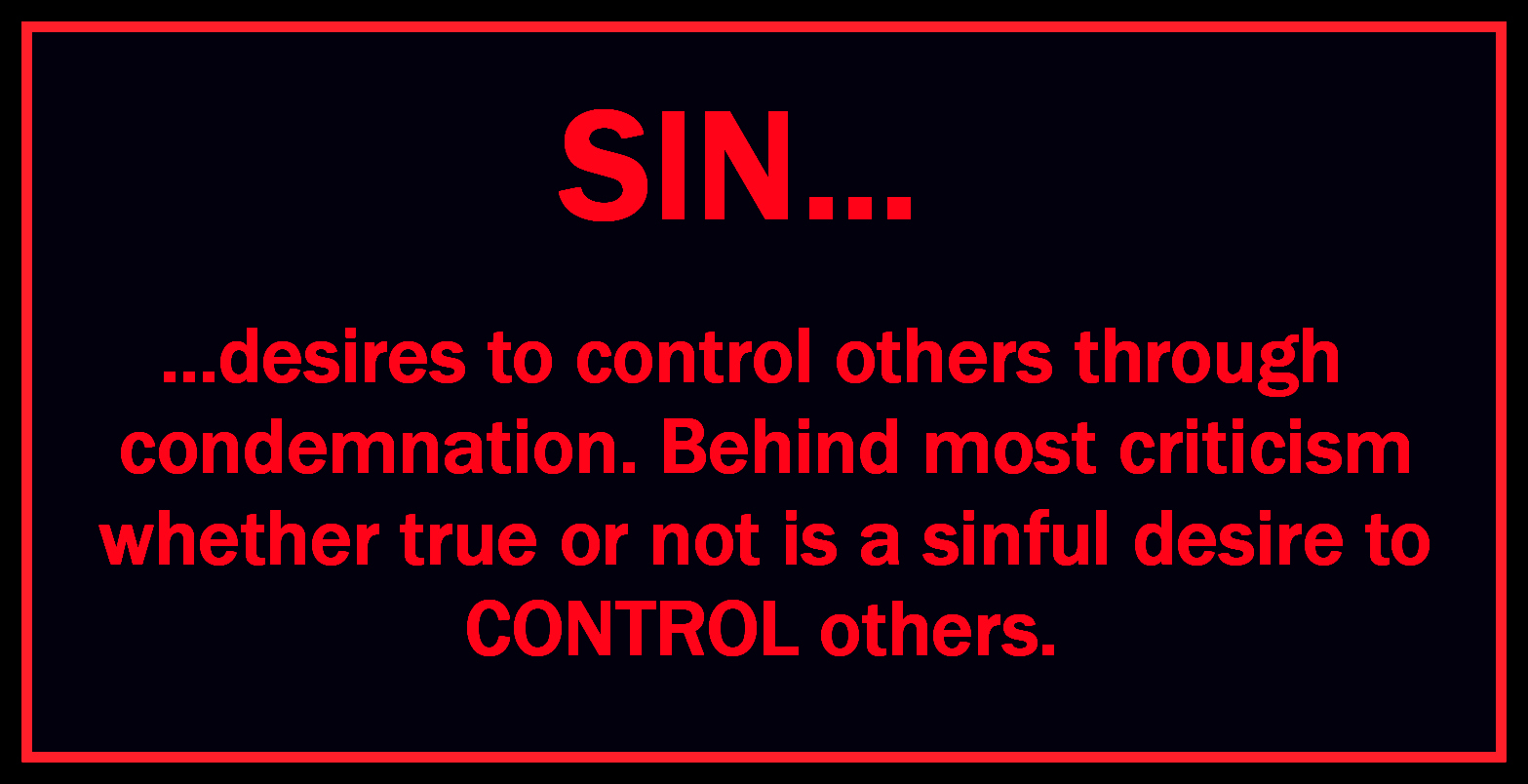
We see this in the garden. After Adam and Eve sin, they hide from God because they are afraid of God’s condemnation.
Genesis 3:9 – But the Lord God called to the man and said to him, “Where are you?” 10 And he said, “I heard the sound of you in the garden, and I was afraid, because I was naked, and I hid myself.” 11 He said, “Who told you that you were naked? Have you eaten of the tree of which I commanded you not to eat?”
Sin and fear of condemnation go together. This also speaks to evangelism and free will. Protestants love to make much of “No man seeks after God” (Rom 3:11). But this is not because man is totally depraved and has no inkling towards God whatever. Man does not seek God because he fears condemnation. Obviously, when Adam and Eve sinned, they did not immediately seek out God for a solution. Instead, they hid from God because they were afraid of His condemnation. This is why man does not seek God, he is afraid—not because he is totally depraved.
In addition, we see the essence of evangelism from the very beginning: God seeks out man with the remedy for sin. Just because God is the one who is proactive does not mean man has no ability to make a choice when confronted by God. Adam and Eve had no ability to come up with a plan that would fix the fall. Obviously, God is the only one who could remedy the problem. Man’s inability is in regard to proposing a plan of reconciliation with God, not an inability to accept the gift of salvation through a plan devised by God when offered.
Blog TalkRadio Podcast, Session 2: Challenging Doctrinal Presuppositions of Orthodoxy

 Paul's Passing Thoughts

1 comment