Is America a Christian Nation? Dissecting the Worldview
 Originally aired January 31, 2015
Tonight we are discussing the question, “Is America a Christian nation?” Is America a Christian nation? The fact that the question is trending really should alarm us. The fact that the very question is trending is an open display of the average Christian’s errant view of history and really reality itself. Because of Protestant tradition, most Christians have a completely bogus worldview. Nevertheless, we will answer the question biblically tonight. We will present a truly biblical worldview. We’re not going to spend a lot of time on that. I’m going to present what I think is the biblical worldview at the end of the presentation reading from Romans Chapter [UNINTELLIGIBLE 0:03:35]. Really another way you could ask it is, “How should true Christians process reality itself?”
Well, where to start? First, let’s start with defining what a Christian is. Christian is one of those generic words that we kind of throw around, right? We are going to stop here and ask why that is. Why do we just kind of – are able to throw around these words like Christian, Gospel and so on and so forth? And we need to look at that because it speaks hugely to the point at hand here. How can we have this conversation without a definitive understanding of what the word Christian means? This question is discussed on radio and other venues, that is, the question of “Are we a Christian nation?” America, that is. The question is discussed on radio and other venues comfortably while crossing every line between everything and the kitchen sink that calls itself Christian, and nobody blinks. How can this happen? Well, here’s how. Because all stripes under the nomenclature of Christian define the word this way. You ready? Not secular. That’s the definition of Christianity, not secular.
So during the day when Christian soccer moms are running the home base and listening to this discussion on the radio via the Janet Mefferd Show or whatever, it can be Catholic, Jehovah Witness, Mormon, Unitarian or whatever. To all of them, the word Christian in this context means the same thing: not secular. Yes. While this subject is being discussed, all theological differences can be put away because all of these parties have one thing in common. They believe in God in one way or the other. For the time being, they are united against the greater evil, the secular, the big S, those who don’t believe in God. And as we know, the godless have been out to destroy the godly since the beginning of time, us against them. Yes, as we think, the primary nemesis of the Church has been all of those secular people who don’t believe in God. And on the other hand, you could also say their definition of secular are those who don’t believe in God. Usually, more times than not, it’s just equated with atheism. Secular equals atheism.
This so not human history. Do this. Find one account in human history where a secular government persecuted religion. Well, your answer is probably going to be, “Well, Marxism.” But even if that’s true, even if you could use Marxism as an example, Marxism is a parenthetical historical anomaly really. But let’s look at the notion. Marxism was/is an equal opportunity persecutor when it gets right down to it, that is merely intolerant of different views on how to achieve its utopia. I think it’s fair to say for the most part Marxism doesn’t care what you believe. It primarily believes whether or not you give them any trouble or stand in their way. Those who die under its tyranny usually do so as a result of its policies, not a targeted persecution. Its targeted persecution is usually against dissenters. Even if you find fault with my assessment, remember Marxism is primarily a 19th and 20th century phenomenon. And, by the way, secular governments in general are really a post-American Revolution phenomenon. Before that, church states were the norm, and by church, which is a very handy word with a 5th-century etymology, we mean organized religion. Organized church states were always the norm by and large before the American Revolution, and again, really, the whole secular government thing is kind of a post American Revolution phenomenon.
Okay. So here at TANC, which sponsors this radio show, we are big on defining words because words mean things. “Church” is defined as a religious institution with an authority structure. By and large, all international violence in human history is predicated by religious intolerance. This is a violence that will not even tolerate those who keep their mouths shut and look the other way. This is a violence that goes door to door demanding that you agree with them. This is an intolerance that one day announces that your race has been proclaimed anathema. Have a nice day. Please note the first step kind of sounds like this: Don’t you want a government ruled by godly principles? Of course, you do. Christian good, secular bad. Those who believe in God, good. Those who don’t believe in God, bad. Second step, once they get into power using that ploy, hark! Not all who claim God really believe in God. Then the secular boogeyman that never existed in the first place is now the pseudo-Christian. Let the slaughter begin. That’s history, period. This is the way it always happens.
So this is what we really are asking when we ask if America was founded on Christian principles. Was America founded on belief in God? Was belief in God principal in which the nation was supposed to function? After all, don’t we have money with “In God we trust” printed on it? We have defined what is really behind the trending conversation. I’m going to pause and give a short answer to the question, really longer than I thought it would be, and then develop the first notion. Really, I’m going to first develop more the second notion, that is, what’s behind the trend? I’m going to address the second notion first, actually. What is the true historic answer to the question? Then I’m going to conclude with what a true biblical worldview should be. (more…)
Escaping Church and its Culture of Death
 Originally published August 19, 2015
“This isn’t a technique for boosting our spiritual growth; this is a means of re-salvation because we are still technically lost and under law. ‘Under grace’ merely qualifies us for perpetual re-salvation. That’s Protestantism…period!”
Week in, and week out, and days in-between, professing Christians meet at a local institutional church to further indoctrinate their families in the Protestant culture of death. It doesn’t seem like death as families cheerfully socialize together and lift up their hands as the hipster praise bands make a joyful noise to the Lord. In addition, charismatic orators speak of things that are clearly in the Bible.
But let’s talk about good old fashioned theological math found in the Bible. The Bible addresses the only two people groups that exist in the world: the lost and the saved. As professing Christians, we want to be biblically defined as saved people, no? Can a case be made in this post that present-day evangelicals define themselves according to what the Bible defines as “lost”? Yes. All in all I am sure you will agree; any religion that defines itself as unregenerate is a really bad idea.
Here is how the Bible defines the two people groups:
Romans 6:14 – For sin will have no dominion over you, since you are not under law but under grace.
Every person living in the world is under law or under grace, lost or saved. Protestants define themselves as under law with under grace as a covering. Romans 6:14 is defined this way:
We are under grace because the righteousness of Christ continually saves us from being under law.
So, with Protestantism, it’s both. Under grace means we are still under law but progressively saved by grace. Under law is who we are, while we “experience” grace. Under law is what we do, under grace is what we experience. Supposedly, when Paul stated that we are “not” under law, what he really meant to say is under law is the absence of grace. The lost are only under law, but the saved are under both.
Hence, we are still under the “righteous demands of the law,” but if we are under grace, Jesus keeps the law for us. This is achieved by focusing on our sinfulness against the law, and returning to the same gospel that originally saved us out of gratitude. Objections to this idea are met with accusations of indifference to Christ’s sacrifice. Therefore, the “Christian” must live a “lifestyle of repentance” and constantly seek a “greater revelation of self” which is inherently sinful. The goal is to plunge the depths of our supposed total depravity. And if you are paying attention, our sin and the original gospel that saved us are the constant drumbeats we hear in the institutional church week in and week out.
Consequently, our goal is to see more and more of our reality of being under law resulting in an increased joy regarding our original salvation. Mainline evangelical Paul Washer states it this way:
At conversion, a person begins to see God and himself as never before. This greater revelation of God’s holiness and righteousness leads to a greater revelation of self, which, in return, results in a repentance or brokenness over sin. Nevertheless, the believer is not left in despair, for he is also afforded a greater revelation of the grace of God in the face of Christ, which leads to joy unspeakable. This cycle simply repeats itself throughout the Christian life. As the years pass, the Christian sees more of God and more of self, resulting in a greater and deeper brokenness. Yet, all the while, the Christian’s joy grows in equal measure because he is privy to greater and greater revelations of the love, grace, and mercy of God in the person and work of Christ. Not only this, but a greater interchange occurs in that the Christian learns to rest less and less in his own performance and more and more in the perfect work of Christ. Thus, his joy is not only increased, but it also becomes more consistent and stable. He has left off putting confidence in the flesh, which is idolatry, and is resting in the virtue and merits of Christ, which is true Christian piety (Paul Washer: The Gospel Call and True Conversion; Part 1, Chapter 1, heading – The Essential Characteristics Of Genuine Repentance, subheading – Continuing and Deepening Work of Repentance).
This not only turns the Bible completely upside down, but leaves the Christian in a lifestyle of death while rejoicing in it. This is a true celebration of death, and church is the culture thereof. Romans 6 is clear about what it means to remain under law:
3 Do you not know that all of us who have been baptized into Christ Jesus were baptized into his death? 4 We were buried therefore with him by baptism into death, in order that, just as Christ was raised from the dead by the glory of the Father, we too might walk in newness of life.
5 For if we have been united with him in a death like his, we shall certainly be united with him in a resurrection like his. 6 We know that our old self was crucified with him in order that the body of sin might be brought to nothing, so that we would no longer be enslaved to sin. 7 For one who has died has been set free from sin. 8 Now if we have died with Christ, we believe that we will also live with him. 9 We know that Christ, being raised from the dead, will never die again; death no longer has dominion over him. 10 For the death he died he died to sin, once for all, but the life he lives he lives to God. 11 So you also must consider yourselves dead to sin and alive to God in Christ Jesus.
Obviously, if we believe our formal sinful self has been “brought to nothing,” Paul Washer’s sanctification construct is impossible, and his statement speaks to the authentic soteriology of the Protestant Reformation. How do you achieve a greater revelation of your sinful self when your former sinful self has been “brought to nothing”?
You don’t, which leaves the “believer” yet under law and in need of salvation. The “believer” needs to continually return to the same gospel that saved him/her in order to remain saved. Instead of the new birth being a onetime event that brings the former sinner to “nothing,” the new birth is defined as a joy experience resulting from revisiting the gospel afresh for forgiveness of sin that still condemns us.
This cycle simply repeats itself throughout the Christian life. As the years pass, the Christian sees more of God and more of self, resulting in a greater and deeper brokenness. Yet, all the while, the Christian’s joy grows in equal measure because he is privy to greater and greater revelations of the love, grace, and mercy of God in the person and work of Christ (Ibid).
We are asking the question, How does the gospel save believers?, not, How does the gospel get people to be believers?… Believers need to be saved. The gospel is the instrument of God’s power to save us. And we need to know how the gospel saves us believers so that we make proper use of it (John Piper: Part 2 of a series titled, “How Does the Gospel Save Believers”).
Progressive sanctification has two parts: mortification and vivification, ‘both of which happen to us by participation in Christ,’ as Calvin notes….Subjectively experiencing this definitive reality signified and sealed to us in our baptism requires a daily dying and rising. That is what the Reformers meant by sanctification as a living out of our baptism….and this conversion yields lifelong mortification and vivification ‘again and again.’ Yet it is critical to remind ourselves that in this daily human act of turning, we are always turning not only from sin but toward Christ rather than toward our own experience or piety (Michael Horton: The Christian Faith; mortification and vivification, pp. 661-663 [Calvin Inst. 3.3.2-9]).
…by new sins we continually separate ourselves, as far as we can, from the grace of God… Thus it is, that all the saints have need of the daily forgiveness of sins; for this alone keeps us in the family of God (John Calvin: Commentaries on the Catholic Epistles; The Calvin Translation Society 1855. Editor: John Owen, p. 165 ¶4).
Moreover, the message of free reconciliation with God is not promulgated for one or two days, but is declared to be perpetual in the Church (2 Cor. 5:18, 19). Hence believers have not even to the end of life any other righteousness than that which is there described. Christ ever remains a Mediator to reconcile the Father to us, and there is a perpetual efficacy in his death—viz. ablution, satisfaction, expiation; in short, perfect obedience, by which all our iniquities are covered (The Calvin Institutes: 3.14.11).
Where we land on these issues is perhaps the most significant factor in how we approach our own faith and practice and communicate it to the world. If not only the unregenerate but the regenerate are always dependent at every moment on the free grace of God disclosed in the gospel, then nothing can raise those who are spiritually dead or continually give life to Christ’s flock but the Spirit working through the gospel. When this happens (not just once, but every time we encounter the gospel afresh), the Spirit progressively transforms us into Christ’s image. Start with Christ (that is, the gospel) and you get sanctification in the bargain; begin with Christ and move on to something else, and you lose both (Michael Horton: Christless Christianity; p. 62).
Nor by remission of sins does the Lord only once for all elect and admit us into the Church, but by the same means he preserves and defends us in it. For what would it avail us to receive a pardon of which we were afterwards to have no use? That the mercy of the Lord would be vain and delusive if only granted once, all the godly can bear witness; for there is none who is not conscious, during his whole life, of many infirmities which stand in need of divine mercy. And truly it is not without cause that the Lord promises this gift specially to his own household, nor in vain that he orders the same message of reconciliation to be daily delivered to them (The Calvin Institutes: 4.1.21).
Therefore, “under grace” is defined as a mere qualification to return to the same gospel that saved us; in other words, “We must preach the gospel to ourselves every day” in order to keep ourselves saved. How prevalent is this idea in the contemporary church? Consider this laundry list from Peter Lumpkins .com:
“As Pastors we must first preach the gospel to ourselves before we proclaim to the world the necessity of a Savior” (Scott Thomas, President of Acts 29 Network).
“Yet even when we understand that our acceptance with God is based on Christ’s work, we still naturally tend to drift back into a performance mindset. Consequently, we must continually return to the gospel. To use an expression of the late Jack Miller, we must ‘preach the gospel to ourselves every day’ (Jerry Bridges, Reformed author).
“We must preach the Gospel to ourselves and one another every day” (Ashland Avenue Baptist Church Distinctives, Lexington, KY).
“The Gospel must be central to our lives and central to our message. Strive to keep the Gospel in the center of your worship ministry. Jerry Bridges tell us that we must preach the Gospel to ourselves everyday. It has been said that we never move on from the Cross, only to a more profound understanding of the Cross” (Dr. Greg Brewton, Associate Dean for Music and Worship Leadership at The Southern Baptist Theological Seminary).
“We must preach the Gospel to ourselves” (Francis Chan, Passion 2011).
“Yesterday was a powerful moment in the Word of God as we studied Romans 8:1-4. I challenged those present to learn to preach the gospel to ourselves daily. Why? If we do not preach the gospel to ourselves daily, we will return to sin, bondage, guilt, the Law, and legalism…You see, this is why we must preach the gospel to ourselves daily” (Ronnie Floyd, former Chairman of the Great Commission Resurgence Task Force).
“I’ve been re-reading Jerry Bridges’ excellent book The Discipline of Grace…Bridges reminded me of just how important it is to ‘preach the gospel to ourselves everyday’ if we are going to be transformed into the likeness of Christ” (Tullian Tchividjian, Senior Pastor, Coral Ridge Presbyterian Church).
“…I once assumed…that the gospel was simply what non-Christians must believe in order to be saved… But I’ve come to realize that once God rescues sinners, his plan isn’t to steer them beyond the gospel, but to move them more deeply into it. The gospel, in other words, isn’t just the power of God to save you, it’s the power of God to grow you once you’re saved… . This idea that the gospel is just as much for Christians as it is for non-Christians may seem like a new idea to many but, in fact, it is really a very old idea” (Tullian Tchividjian, Senior Pastor, Coral Ridge Presbyterian Church).
“We must preach the gospel to ourselves everyday… . As we preach the gospel to ourselves, we should be both encouraged and overwhelmed with gratitude, and both should give us a desire to deal with the sin in our lives” (Casey Lewis, student, Southwestern Baptist Theological Seminary).
“A Prayer for Preaching the Gospel to Ourselves… . …Most gracious Lord Jesus, even as Paul was eager to preach the gospel to believers in Rome, so I’m eager to preach it to my own heart today…” (Scotty Smith, Guest blogger at Justin Taylor’s The Gospel Coalition site and Pastor, Christ Community Church, Franklin, TN).
“We must constantly be preaching the gospel to ourselves, filling our hearts with your beauty and bounty, Lord Jesus… . Dear heavenly Father, it’s not about “mind over matter,” or the power of positive thinking, or the pragmatic good of cognitive therapy. It’s all about preaching the gospel to ourselves every opportunity we get…” Scotty Smith, Pastor, Christ Community Church, Franklin, TN (here and here, respectively)
“We must constantly be preaching the gospel to ourselves, filling our hearts with your beauty and bounty, Lord Jesus… . Dear heavenly Father, it’s not about “mind over matter,” or the power of positive thinking, or the pragmatic good of cognitive therapy. It’s all about preaching the gospel to ourselves every opportunity we get…” Scotty Smith, Pastor, Christ Community Church, Franklin, TN (here and here, respectively)
“How can we not shift from the hope of the Gospel? By preaching the Gospel to ourselves daily… . ‘Preaching the Gospel to yourself’ is a phrase I first ran across in ‘The Discipline of Grace’ by Jerry Bridges, and have observed for years in the life of my good friend, C.J. Mahaney. C.J. has written persuasively, biblically, and practically on this topic in his new book, ‘Living the Cross Centered Life’… . Don’t take a day off from preaching the Gospel to yourself” (Bob Kaulfin, Director of Worship Development for Sovereign Grace Ministries and worship leader at Covenant Life Church led by Josh Harris).
“Far too many Christians are passive in their fight for joy…. What can I do? ‘Well, God does not mean for us to be passive. He means for us to fight the fight of faith the fight for joy. And the central strategy is to preach the gospel to yourself’…” (John Piper, When I Don’t Desire God, p.81, as quoted by Bob Kauflin).
“I am thoroughly engrossed with Joe Thorn’s personal mediations on preaching the gospel to oneself” (Tom J. Nettles, Professor of Historical Theology, Southern Baptist Theological Seminary, promoting Joe Thorn’s book, Note to Self: the Discipline of Preaching to Oneself).
“In the few months prior to Verge God was really working on me. I’ve been doing a lot of repenting of the idols in my heart. I’ve been preaching the gospel to myself” (Steve McCoy, SBC Pastor).
“This may sound really selfish, but faithfully preaching the gospel to myself is actually what enables me to share it faithfully to others” (Timmy Brister, SBC Associate Pastor).
“I chose not to include the response to the gospel…but just tried to focus on what the gospel actually is. I edit it regularly as I try to grasp and preach the gospel to myself” (Ed Stetzer, LifeWay).
This isn’t a technique for boosting our spiritual growth; this is a means of re-salvation because we are still technically lost and under law. “Under grace” merely qualifies us for perpetual re-salvation. That’s Protestantism…period!
And the culture that will result is defined in the Bible:
Romans 6:15 – What then? Are we to sin because we are not under law but under grace? By no means! 16 Do you not know that if you present yourselves to anyone as obedient slaves,[c] you are slaves of the one whom you obey, either of sin, which leads to death, or of obedience, which leads to righteousness? 17 But thanks be to God, that you who were once slaves of sin have become obedient from the heart to the standard of teaching to which you were committed, 18 and, having been set free from sin, have become slaves of righteousness. 19 I am speaking in human terms, because of your natural limitations. For just as you once presented your members as slaves to impurity and to lawlessness leading to more lawlessness, so now present your members as slaves to righteousness leading to sanctification.
20 For when you were slaves of sin, you were free in regard to righteousness. 21 But what fruit were you getting at that time from the things of which you are now ashamed? For the end of those things is death. 22 But now that you have been set free from sin and have become slaves of God, the fruit you get leads to sanctification and its end, eternal life. 23 For the wages of sin is death, but the free gift of God is eternal life in Christ Jesus our Lord.
Christ said, “You must be born again.” This is clearly a doctrine that redefines the new birth by defining the “believer” as unchanged and yet under law. Along with that is an unavoidable conclusion that this also includes a fruits unto death existence that is part and parcel with being under law.
This will, and does make sin and condemnation the focus and theme of church while the Bible emphasizes ADDING virtue to our faith in contrast to a continual re-visitation of our supposed depravity.
1Peter 4:8 – Above all, keep loving one another earnestly, since love covers a multitude of sins.
2Peter 1:3 – His divine power has granted to us all things that pertain to life and godliness, through the knowledge of him who called us to his own glory and excellence, 4 by which he has granted to us his precious and very great promises, so that through them you may become partakers of the divine nature, having escaped from the corruption that is in the world because of sinful desire. 5 For this very reason, make every effort to supplement your faith with virtue, and virtue with knowledge, 6 and knowledge with self-control, and self-control with steadfastness, and steadfastness with godliness, 7 and godliness with brotherly affection, and brotherly affection with love. 8 For if these qualities are yours and are increasing, they keep you from being ineffective or unfruitful in the knowledge of our Lord Jesus Christ. 9 For whoever lacks these qualities is so nearsighted that he is blind, having forgotten that he was cleansed from his former sins.
Romans 15:14 – I myself am satisfied about you, my brothers, that you yourselves are full of goodness, filled with all knowledge and able to instruct one another.
Hebrews 10:24 – And let us consider how to stir up one another to love and good works.
In the past, Protestants were confused enough about their own soteriological traditions that the fruits unto death were minimal, but during this Neo-Reformed resurgence that we are witnessing presently, such is not the case; the institutional church is a blatant culture of death. And those who would expose their children to it are woefully undiscerning. Ask yourself this simple question: do I leave church better equipped to see something that the Bible states isn’t there or better equipped to love God and others? Am I better at seeing my own depravity, or have I learned new ways to love which covers a multitude of sins anyway?
The remedy for this malady is a return to where the gathering of believers belongs: in home fellowships where believers are equipped to love God and others as a lifestyle, NOT a “lifestyle of repentance.” The institutional church was first called “church” when it was founded in the 4th century, and it was founded on the same idea that believers remain under law. Therefore, an authoritative institution was created that supplied official re-salvation for those under law. The institutional church goes hand in glove with the idea that it supplies a place for re-salvation, i.e., those qualified to receive it by being “under grace.”
To impart this blessing to us, the keys have been given to the Church (Mt. 16:19; 18:18). For when Christ gave the command to the apostles, and conferred the power of forgiving sins, he not merely intended that they should loose the sins of those who should be converted from impiety to the faith of Christ; but, moreover, that they should perpetually perform this office among believers” (The Calvin Institutes: 4.1.22).
Secondly, This benefit is so peculiar to the Church, that we cannot enjoy it unless we continue in the communion of the Church. Thirdly, It is dispensed to us by the ministers and pastors of the Church, either in the preaching of the Gospel or the administration of the Sacraments, and herein is especially manifested the power of the keys, which the Lord has bestowed on the company of the faithful. Accordingly, let each of us consider it to be his duty to seek forgiveness of sins only where the Lord has placed it. Of the public reconciliation which relates to discipline, we shall speak at the proper place (Ibid).
Come out from among them and be separate.
Know Your Cuts of Calvinism
Originally posted July 2, 2013
1. Total Depravity: Pertains to the saints also.
2. Justification by Faith Alone: Pertains to sanctification also.
3. Mortification and Vivification: Perpetual death and rebirth for living by faith alone in sanctification to maintain justification. The reliving of our baptism “again and again.”
4. Double Imputation: Christ’s passive obedience to the cross for justification, and His active obedience as a substitution for our obedience in sanctification.
5. Deep Repentance (aka Intelligent Repentance): Seeks the death of mortification in re-experiencing our new birth.
6. New Obedience (aka New Fruit): The experience of Christ’s active obedience in sanctification (vivification).
7. The New Birth: Perpetual mortification and vivification.
8. The Objective Gospel: All reality is interpreted through the redemptive works of Christ.
9. Christ for Us: Christ died for our justification, and lived a perfect life for our sanctification.
10. The Imperative Command is Grounded in the Indicative Event: Biblical commands show forth what Christ has accomplished for us and what we are unable to do in sanctification. Works are experienced only as they flow from the indicative event of the gospel.
11. Neo-Nomianism (New Law, aka New Legalism): The belief that we can please God by obeying the law in sanctification.
12. Progressive Sanctification: The progression of justification to glorification.
13. Progressive Imputation: Whatever is seen in the gospel narrative and meditated upon is imputed to our sanctification, whether mortification or vivification.
14. The Golden Chain of Salvation: See cut 12.
15. Good Repentance: Repenting of good works.
16. In-Lawed in Christ: Christ fulfilled the law perfectly and imputed it to our sanctification.
17. Redemptive Historical Hermeneutics (the Christocentric Hermeneutic, aka the Apostle’s Hermeneutic): The Bible as historical narrative for the sole purpose of showing forth Christ’s redemptive works.
18. Faith: A neutral entity within us with no intrinsic worth that is able to reflect the object of its focus outside of us. The object of focus can be experienced within, but remains outside of us.
19. The Heart: The residence of evil desires and faith. It can be reoriented (the “reorientation of the heart” or “reorientation of desires”) to reflect Christ via mortification and vivification.
20. Flesh: The world realm where evil is manifested and experienced.
21. Spirit: The Spirit realm where the imputed works of Christ are manifested and experienced (not applied through our actions).
22. Christian Hedonism: Seeks to experience the joy of vivification.
23. Obedience of Faith: New Obedience.
24. Christ in Us: “By faith,” and faith only has substance and reality to the degree of the object it is placed in; i.e., Christ outside of us.
25. Vital Union: Makes experiencing the gospel possible. Makes mortification and vivification possible.
26. Eclipsing the Son (aka the Emphasis Hermeneutic): Focusing on anything other than Christ. Anything that is not seen through a Christocentric prism creates shadows that we live in. The obstacles that create the shadows may be truth, but they aren’t the “best truth.” “They may be good things, but not the best thing.”
27. Sabbath Rest: Sanctification. We are to “rest and feed” on Christ for our Christian life. The primary day this is done is Sunday. Through preaching and the sacraments we “kill” (mortification, or the contemplation of our evil and misery) resulting in vivification throughout the rest of the week.
28. The Subjective Power of the Gospel: The manifestation of the gospel that flows from gospel contemplationism. We never know for certain whether it is a result of our efforts or the Spirit’s work (although the Spirit’s work is always experienced by joy); hence, the power of the objective gospel is subjective (Heidelberg Disputation: Thesis 24).
29. Mortal Sin: Good works by the Christian not attended by fear that they may be of one’s own effort (HD 7).
30. Venial Sin: Good works by the Christian attended with fear (HD 7).
31. Power of the Keys (aka Protestant Absolution): Reformed elders have the authority to bind or loose sin on earth (Calvin Institutes 3.4.12).
32. Redemptive Church Discipline: In all cases to convert one to cuts 1-31. This redeems them to the only one, true faith. This can be a long process, and said person is not free to leave a given church until the elders bind or loose.
33. Preach the Gospel to Yourself: See cuts 1-32.
Why Church is the Perfect Storm of Evil: Carte Blanche Forgiveness, Part 1
 “With all of the hoopla about anger over being wronged turning to ‘bitterness,’ and thus destroying us, where is the same angst about people being destroyed by guilt? Yes friends, that is conspicuously missing. Yet, while there is abundant evidence that guilt destroys, the Bible never states that people are destroyed by anger towards injustice; to the contrary, anger over injustice provokes people to defend righteousness. Why is the focal point righteous indignation in contrast to an emphasis on the real destroyer, GUILT?”
When it gets right down to it, collectivism is a metaphysical pipe dream. The idea that a select few can rule over the masses for the sake of the masses is always a house of cards waiting to fall when too many people get the same idea. God created us as free individuals, and ultimately, majority rules if it wants to; it’s a matter of numbers and the reality that a government is made up of people and you can’t have a government if the government kills everyone. It’s self defeating, so in the final analysis, collectivists must depend on propaganda and misinformation to get cooperation.
So what holds the whole thing together? If man, in reality, self-governs, what prevents total chaos? Here is the answer: man is basically good. Man is also capable. The Bible makes this absolutely clear (Romans 2:14,15). Every person born into the world is created by God with His law written on their hearts. They are also born with a conscience that either accuses them or excuses them. This is why lie detectors work: when the conscience indicts someone, the body reacts physiologically. The conscience is a judge that sees your inner self hidden away from others and punishes you with guilty feelings and fear. Guilt can utterly destroy a person and often does. Many psychologists attribute at least 90% of all mental illness to a guilty conscience. In contrast, people feel good about themselves when they behave honorably. There is no question that much mental illness comes from physiological imbalance, but the question remains as to which comes first: bad choices or the fallout from the choices?
How does Christian carte blanche forgiveness circumvent this whole natural process and create a perfect environment in the church for evil to ply its trade? Answer: carte blanche forgiveness is a symptom of the church’s contra-reality view of man; he is basically evil and unable. This concept of forgiveness flows from false presuppositions concerning mankind. But, as we shall see, the “unable” aspect is just as important to understand as the basically evil element. In the balance is also a proper perspective on justice.
Let’s make an initial point lest we forget. With all of the hoopla about anger over being wronged turning to “bitterness,” and thus destroying us, where is the same angst about people being destroyed by guilt? Yes friends, that is conspicuously missing. Yet, while there is abundant evidence that guilt destroys, the Bible never states that people are destroyed by anger towards injustice; to the contrary, anger over injustice provokes people to defend righteousness. Why is the focal point righteous indignation in contrast to an emphasis on the real destroyer, GUILT?
The starting point to answering these questions, once again, starts with presuppositions concerning mankind. Blank check forgiveness flows from these presuppositions; therefore, proponents will defend the talking points no matter how illogical. Do people often drive you completely nuts with their illogical arguments? It’s because their arguments flow from certain presuppositions. And, that logic also drives their mentality and behavior.
The first proposition is that man is basically evil, and therefore, has no rightful claim to fair treatment. Justice is strictly vertical, or from God’s perspective only because He is the only good. Hence, God is the only one who deserves justice. All sin is against God only as it is ridiculous for thieves who steal from each other to call each other thieves with a clamoring for justice; horizontal justice becomes a ridiculous notion. Of course, no one would verbalize that outright, but this logic manifests itself in indifference towards sin and justice.
But this ideology, which sprang forth from the Protestant Reformation, does not stop with the idea that people are partially evil and partially good. And before we move on, it must also be said that this ideology was hardly unique to the Reformation; the Reformers borrowed it from run of the mill ancient philosophy and put their own biblical spin on it. This is where the ancient philosophy of total inability comes into play. The standard for creating a strict dichotomy between man and ability varies greatly in the ancient philosophies, but our focus here examines how the Reformers used the law of God to create that dichotomy; one infraction renders man totally unable. Man is a pure sinner because he is not perfect. If man is not perfect—all bets are off. There is but one reality: 100% perfection, or 100% evil. And, this is key: salvation is defined by merely knowing this. The idea that any man can do any good is the paramount false gospel according to the Protestant Reformation.
So, you say you want justice because someone wronged you? Well… “He who has no sin throw the first stone.” In this typical twisting of Scripture to support a false premise, the “stone” represents justice. And since we all have sin which proves that we are purely evil and unable to do good, the stone of justice needs to be left on the ground lest we be hypocrites and destroyed by a longing for justice that will lead to the dreaded “bitterness.” Again, concern over the destructive emotion of guilt can hardly be found anywhere. Why? Because that emotion is actually deemed healthy because we are all guilty all of the time. Anger over sin leads to “bitterness.” A recognition of our guilt leads to “humbleness.” In fact, counsel that we hear often from the Protestant elite prescribes a return to the gospel as a medicine for guilt, not repentance towards those whom we have wronged. As far as remedy for the unrepentant that have wronged us, the prescription is the SAME via, “Forgive others the same way you have been forgiven.” The immediate illogical contradiction that comes to mind is the fact that God’s forgiveness is contingent on repentance.
In the next part, we will further examine these illogical presuppositions and how it creates a perfect environment for evil to ply its trade. The unthinkable is the realty: presuppositions concerning mankind either foster or restrain evil. The ideology determines whether or not evil has a healthy environment for breeding. In reality, is the unhealthy environment inside, or outside of church?
paul
Absolutely Critical to Effective Ministry: Knowing the Two Realities of Protestantism

If we are to accomplish anything in contemporary Christianity, we must begin to live by a basic hard-fast rule: our actions must be guided by the knowledge that there are two realities in contemporary Christianity – grammatical-historical and redemptive-historical.
These are usually discussed as methods of Bible interpretation, but they are really much more than that according to Protestant tradition. These are two different ways of interpreting reality itself.
We will begin by defining the redemptive-historical interpretation of reality along with this caution: one of the most powerful influences that this view of reality has is the dismissal of its basic premise as mere mysticism held by fringe elements of Protestantism. Those who dismiss it out-of-hand then proceed to function by its tenets unawares. The who’s who of Protestantism care little that the masses understand this ideology, just so they function by it.
In fact, Protestant leaders assume most parishioners are unable to grasp its tenets. Therefore, redemptive-historical reality must be explained in a way that will enable congregants to apply it to their lives and function a certain way within church culture. Redemptive-historical reality is primarily the crux of Protestant orthodoxy and its spiritual caste system.
In mythology, we often link the bizarre narratives to the philosophy itself, but that’s a mistake. Roman, Greek, and Babylonian culture was not developed by superstitious idiots. What we fail to understand is the narratives are stories that convey principles to the spiritual underlings so they can apply principles of higher knowledge to their lives. They cannot understand the higher knowledge, but those who can need to tell the underlings how to live in order to obtain the best possible society.
“Orthodoxy” can be likened to mythological narratives that teach those of lesser spiritual understanding how they should live, but they are based on well thought out metaphysical (state of being) systems of knowledge. We shouldn’t be surprised that what seems to be superstition has ruled the greatest empires on earth. This is because the core ideology is always a succinct system of thought that is greatly underestimated. The ancient philosophers were not idiots. Democritus (circa 400 BC) was the originator of atomic theory. The sophist class of philosophers were the first to apply philosophy to sociology in an in-depth way (circa 500 BC). ALL present-day psychologies are founded on the basic theories of that day. For example, the basic ideology that drives the theory of rehabilitation in our modern-day prison systems came from Socrates.
Let’s now define redemptive-historical reality. I will be using a quote from Graeme Goldsworthy who is considered to be the contemporary father of redemptive-historical hermeneutics:
If the story is true, Jesus Christ is the interpretative key to every fact in the universe and, of course, the Bible is one such fact. He is thus the hermeneutic principle that applies first to the Bible as the ground for understanding, and also to the whole of reality (Graeme Goldsworthy: Gospel-centered Hermeneutics; p.48).
This is a pretty straight forward statement and accurately depicts what Protestantism is really founded on; not a theology per se, but a way to interpret reality itself. How in the world does one interpret all of reality through the one person Jesus Christ? You MUST understand: Martin Luther articulated the answer in the foundational treatise of Protestantism, the Heidelberg Disputation.
The Heidelberg Disputation is a concise systematic ideology that explains how all of reality is to be interpreted through redemption, or if you will, the man of redemption, Jesus Christ. Again, the power of this ideology is a dismissal of it out-of-hand by those who proceed to sit under its “theology.” The theology of the metaphysics redefines biblical terms, and uses them to lead the masses into a functioning Christocentric view of reality.
We will not plunge the depths of the Heidelberg Disputation in this writing, but the principles will be outlined and their inevitable functionality among Christians. Before we move forward, let’s examine additional statements that confirm this approach among Christians. This testimony was given in a recent email to me:
An old acquaintance of ours (Presbyterian as they get) has said more times than I can remember something like this: “Every verse in the Bible, from Genesis 1 through Revelation, is talking about Jesus.” Years ago that sounded so intellectual, holy; today it sounds like hogwash. I mean, are we really expected to believe that the passages talking about incestuous rape are talking about Jesus? Come on, really?
Well, as ridiculous as it sounds, the answer is, “yes.” Many function according to the theology that is predicated on this foundational interpretive method for not only the Bible, but reality itself.
Pause: keep in mind that those who function according to this interpretation of reality without understanding its premise will reflect back the resulting interpretation of Scripture. They repeat pulpit talking points without ever investigating the source of them, or the logical conclusions of the talking points. Sometimes, such people are referred to as “useful idiots.” But again we need to be cautious: people who blindly follow others do not do so for the sake of following blindly—they are functioning according to some sort of ideology that leads to the blind following.

Let’s look at some more examples from proponents of New Covenant Theology:
New Covenant Theology insists on the priority of Jesus Christ over all things, including history, revelation, and redemption. New Covenant Theology presumes a Christocentricity to the understanding and meaning of all reality (1st tenet of NCT according to the Earth Stove Society, a NCT think tank).
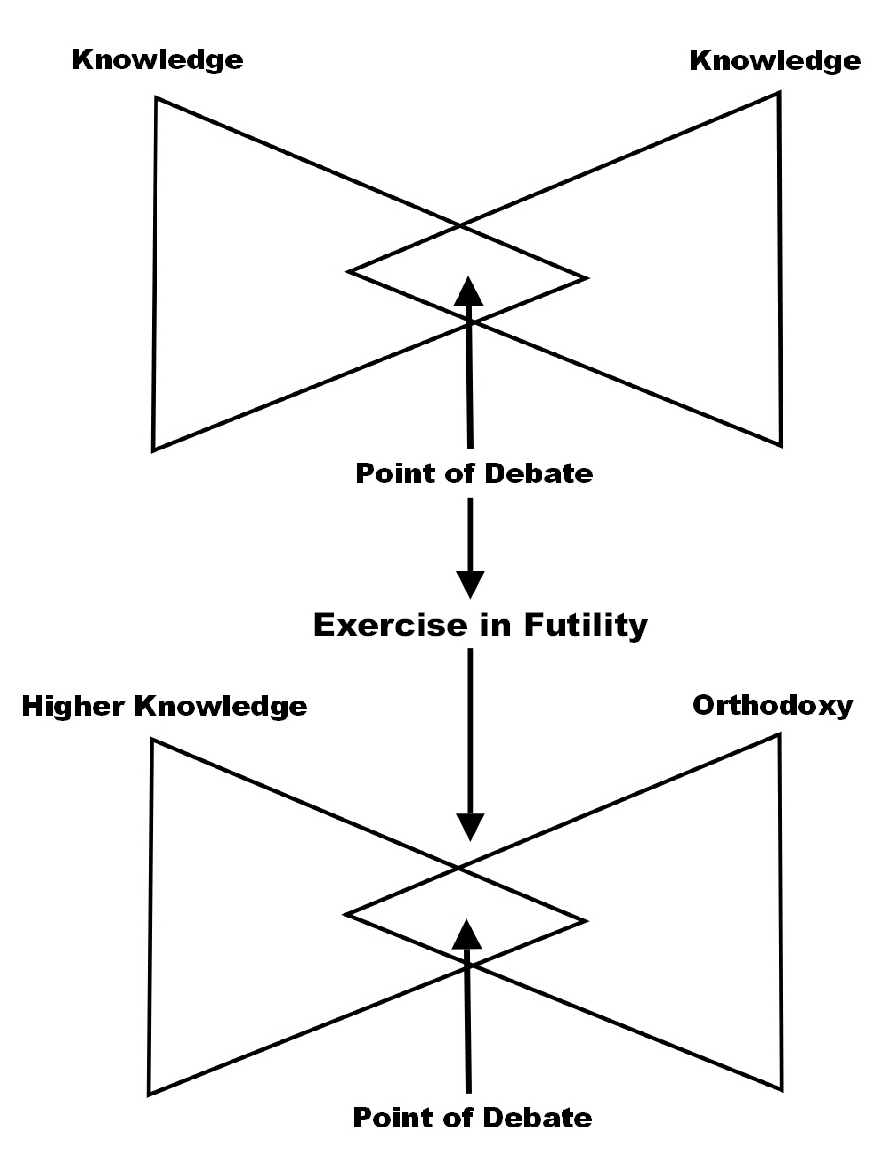
Not much ambiguity in that statement. Pretty clear on its face except for how one would apply it to real life. Again, many might scratch their head in regard to that statement, but proceed to let the theological orthodoxy that flows from it shape their life and thinking. At the point of debate with such people, their orthodoxed talking points will reflect the metaphysical premise. They will absolutely not be swayed in their thinking because they concede that they cannot understand the higher knowledge, and the authority of the higher knowledge is part of the orthodoxy.
Pause: I used to be involved in a ministry that evangelized Jehovah Witnesses. Debating the Bible with them led nowhere because their orthodoxy reinterprets all biblical terms and phraseology. When Christ is referred to, it is assumed that their presuppositions regarding Christ are the same, and they are not. Instead, we challenged their orthodoxy, i.e., the Watchtower publication. Likewise, let me reveal a concluding theme of this study: never debate the Bible with a Protestant; instead, bring their authority into question. Refuse to discuss anything else for it will be futile for reasons yet to be examined.
Let’s look at another statement from the New Covenant Theology camp:
At this time, resist the temptation to utilize subsequent passages to validate the meaning or to move out from the immediate context. Remembering that all exegesis must finally be a Christocentric exegesis.
Look for Christ even if He isn’t there directly. It is better to see Christ in a text even if He isn’t, than to miss Him where He is (The Biblical Theological Study Center: A Christo-Presuppositional Approach to the Entire Scriptures; Max Strange. Online source: http://goo.gl/5sGjP).
The question quickly becomes, “How can you see Jesus in every verse in the Bible?” This is where the Bible becomes a “meta-narrative.” That can mean, “grand narrative,” but in this case it means “metaphysical narrative.” The Bible is a narrative, or story that depicts redemptive reality. You will get confused unless you understand that the theory also posits the inclusion of multi-purpose perspectives into the metaphysical story (a story that depicts true reality). The text grammar doesn’t determine the perspective resulting in a particular objective outcome, but the assumed outcome determines the perspective. So, can “passages talking about incestuous rape” say something about redemption? Of course. In this example, the passage is not talking about Jesus specifically, but denotes why His redemptive works are needed. In some way, according to the prism, the verse always speaks of Jesus and His redemptive works.
This approach to interpreting reality (state of being, or metaphysics), what we call epistemology, plugs into the basic ancient philosophy of total inability. This proffers the idea that man cannot know or comprehend reality. The metaphysic follows: man dwells in a realm apart from true reality that he cannot comprehend. Secondly, somehow, usually via a theory of predeterminism, there are a select few that can ascertain truths from the other realm. Usually, the delineation of the realms is the material versus invisible with mankind residing in the material realm.
The Reformers recognized a reality that man functions in, but deemed it “subjective,” or shadowy. Focusing on this shadowy realm leads to despair. In the aforementioned foundational document of Protestantism, Luther contended that man’s material realm only feeds “the glory story,” or the story of man.
In Luther’s construct, ALL reality is interpreted through two stories: the glory story (the story of man), and the cross story (the story of redemption). Giving any credence to the material world or the belief that man can know the material world empirically only contributes to the story of man and his glory. Yes, man functions in this world, but it does not possess any objective wisdom that can bring true well being. Only an ever-clearer understanding of the cross story can bring well being.
What then is the cross story specifically? It is twofold: it is the holiness of God as set against the sinfulness of man. This is the only objective truth and reality that can bring well being. The goal is a deeper and deeper understanding of how inept we are in every category of life as set against the glory and holiness of God.
Pause for main point: according to this philosophy, the sole purpose of the Bible is to lead us in seeing the cross story with more and more clarity. To the extent that we do that, we will have well being. AND, to the extent that each individual lives according to the cross story, the well being of society as a whole will increase. When Reformed folks talk about “transforming society with the gospel,” this is exactly what they are talking about. To the extent that the populous embraces the doctrine of inability, society will be transformed.
One reason for lauding this epistemology is unified agreement on interpretation. If every verse is about Jesus, there is no division in opinions. Secondly on this point, it gives Christianity a pass on defending inerrancy; e.g., narratives are not meant to be technical systems of theology that require consistency in logic. Thirdly on this point, if some sort of Christocentric conclusion is drawn from the text—it can’t be wrong. If the interpretation of the text somehow demeans man and exalts God, error is impossible.
Before we address the grammatical-historical approach to interpreting reality, let me add some thoughts to the redemptive-historical perspective. This perspective now dominates the institutional church. Just yesterday, I participated in a conversation on a social media site in which the following statement was made about Proverbs chapter 8:
The Old Testament reveals shadows of what Jesus Christ will be in the New Covenant. I can easily say that wisdom personified in Proverbs 8 is Jesus Christ.
If one reads Proverbs 8, the assertion that it is about Christ is beyond presumptuous at best. It is a complete rejection of the plain sense of the grammar; even in lieu of the personification being in the female gender.
Also, these two perspectives on reality are a salvific issue with the Reformed. A denial of total inability equates with the grammatical-historical view of reality which is supposedly an attempt by man to glorify himself by writing his own story. By believing that you can understand reality, you are in essence making yourself God.
The most common question is the issue of biblical imperatives that are clearly directed at mankind. This assumes that man is able to obey because grammatically, the commands are directed at him with a demand for obedience. But again, addressing these commands with the presupposition of total inability that equates with the redemptive-historical prism, the commands are supposedly meant to deliberately frustrate man and “drive him to despair of self-righteousness.”
The Reformed continually concede that the Bible states things in grammatical form, but that is always followed with the proper “gospel context” according to the redemptive-historical interpretation of reality. The classic example is this quotation from Neo-Calvinist Paul David Tripp:
….and the Bible does call us to change the way we think about things. But this approach again omits the person and work of Christ as Savior. Instead, it reduces our relationship to Christ to “think his thoughts” and “act the way Jesus would act.” (How People Change 2006, p.27).
Notice that Tripp concedes that the Bible calls us to do things according to the grammatical context, but goes on to say that is a denial of the gospel (omits the work of Christ as savior). On page 26 of the same book, Tripp calls obedience to the word of God a “behavioral approach” that “separates the commands of Scripture from their Christ-centered gospel context.”
Lastly before we move on, when one is able to wrap their minds around the redemptive-historical approach to interpreting reality, it will be recognized that this approach now saturates the Protestant institutional church.
What is the grammatical-historical approach to interpreting reality? As with the other prism, I am not going to elaborate on the “historical” part except to say that the redemptive-historical hermeneutic makes history part of the prewritten gospel narrative. History is simply the redemptive story playing out as scripted by God.
The political commentator Rush Limbaugh often notes that “words mean things.” This is a good working definition of grammatical-historical interpretation; it draws conclusions from a technical evaluation of the words in a sentence whether spoken or written. The many categories of language that give meaning are considered also, which speaks to the “historical” part of the term. Does the sentence mean the same thing today that it meant then? For instance a sentence written in 1940 might say, “Bob is gay.” History informs us of the meaning in that day: Bob is happy. Today that means Bob is a homosexual. The etymology of words and many other factors weigh-in, but all have this in common: they are empirical tools.
This interpretive method also assumes mankind is able to comprehend the realty he dwells in according to empirical observation and can draw conclusions on his own. Man has ability.
Pause: how did Luther get away with denying that mankind had any kind of ability at all? He chalked-it-up to man’s self-perceived ability that can accomplish things in the material world. These accomplishments are of no worth and only accomplish one thing and one thing only: they serve man’s lust to glorify himself. Luther believed that satisfaction from accomplishment was nothing more than sinful pride. To Luther, the only redeeming thing about the world was that heaven manifested its works on earth according to God’s sovereign will. If man lives life subjectively and professes that his evil “good” works cannot be distinguished from heavenly manifestations “experienced subjectively,” that is venial sin that can be forgiven. In accordance with authentic Reformed tradition, Luther believed the following: the belief that any man, including Christians, can perform a good work is mortal sin.
Therefore, the Reformed often define wisdom/knowledge according to two categories: “worldly knowledge” and “wisdom from above.” Sure, man can obtain worldly knowledge that improves his circumstances, but it is all prideful according to Luther. Wouldn’t this approach propagate a lot of death and misery due to a lack of science? Yes, but that was exactly Luther’s point. Many are perplexed by the embracing of ideologies that result in third world cultures, but those who are perplexed make the point for those in the other camp: what is the perplexity of the detractors? Answer: they are perplexed that other people do not lust after materialism as they do. Hence, third world cultures are often seen as being virtuous by the Reformed.
This is why Luther introduced suffering as a hermeneutic that interprets reality. There is true wisdom in the cross story because according to Luther, “all wisdom is hidden in suffering.” According to Luther, many reject this interpretation of reality and dub it the “foolishness of the cross.” Luther also stated that men call the good evil (suffering), and evil good (anything that prevents suffering). This is why Luther called reason an “ugly whore who should have dung rubbed in her face.”
The grammatical-historical perspective of reality assumes man can interpret his own reality, and the material world is not inherently evil. Believers and unbelievers share common realities that are simply practical and not evil.
Here is the challenge: to bring biblical knowledge to bear on grammatical-historical reality when the prevailing view of Protestantism has been the redemptive prism for hundreds of years.
But there is good news as well: the grammatical prism is what man utilizes intuitively. People assume they can interpret their own reality. Of course, the Reformed see this as the very problem.
Does this mean that grammatical-historical Christians should evangelize the lost world and forgo debate with Protestants? Yes it does, because it is a futile endeavor. You are trying to reach people who define reality itself differently. Protestants are redemptive-historical religionists.


 Paul's Passing Thoughts
leave a comment