Easter Sunday in America: A Celebration of Christian Depravity
 “The lie that is sucking the life out of the American church started early and was repeated often throughout the service; Jesus Christ is alive and we are dead.”
“This is why the American church is chocked full of spiritual despots and pedophiles; we only preach Calvin and Luther’s half-gospel of one resurrection and deny the primary purpose of the second, that resurrected saints would fulfill the law of God and destroy the works of the devil for the glory of God in this life.”
My wife Susan likes music and people. I love Christ, but don’t much care for contemporary Christian music that makes Him a Brahman and not the Lord and King of the forthcoming new heavens and new earth. We Americans love our mystical Jesus. We make much of Him so we can know little of Him. He is so high above us that to claim to know anything save Him crucified is arrogance. It’s Tal Bachman theology; he knew a girl that was so high above him, “Like Cleopatra, Joan of Arc, or Aphrodite,” that, “She comes to speak to me I freeze immediately,” and, “What could a guy like me ever really offer?”
The more subjective a god is, the more we can make it a god of our own making. Many will stand before Christ’s eyes of fire in the judgment and claim Him so wonderful that they couldn’t have known anything about Him that is objective. After all, only the gospel is objective and anything we think we know is subjective at best. Dishwalla, in their song, “Tell me all Your Thoughts on God,” present us as children who can’t really know God, but the song surmises that God is a woman. But that’s ok, after all, we are merely children who, “count only blue cars and skip the cracks in the street. And ask many questions like children often do.” The world has this gig down better than Christians; we are nothing compared to whatever the higher power is, so who is the higher power to find fault? Don’t worry, she won’t, all will end well.
Oh, but like Susan, I like people too, it was one of the conditions of our marriage contract. We compromised on the music. Since the Potter’s House is a very humble upstart, and the wonderment of the Easter holiday was upon us, off we went to a morning cantata service to experience American Easternism. And because I am a mere worm like all others that attended, I won’t name the Southern Baptist church located in Xenia, Ohio that we attended. Besides, the point here is that this service was undoubtedly representative of the vast majority of Easter Sunday services taking place in the evangelical church.
The lie that is sucking the life out of the American church started early and was repeated often throughout the service; Jesus Christ is alive and we are dead. One who was leading music pontificated that Jesus was resurrected to confirm that God was pleased with the sacrifice. What he couldn’t say would get someone thrown out of the church in our day: Christ was resurrected to give us life in the here and now; the same power that raised Him from the dead (EPH 1:18-20). This is why the American church is chocked full of spiritual despots and pedophiles, we only preach Calvin and Luther’s half-gospel of one resurrection and deny the primary purpose of the second, that resurrected saints would fulfill the law of God and destroy the works of the devil for the glory of God in this life (ROM 8:3,4, 1JN 3:8, JN 14:12). As a man thinks in his heart so is he, if he thinks he is a worm, he will act like one.
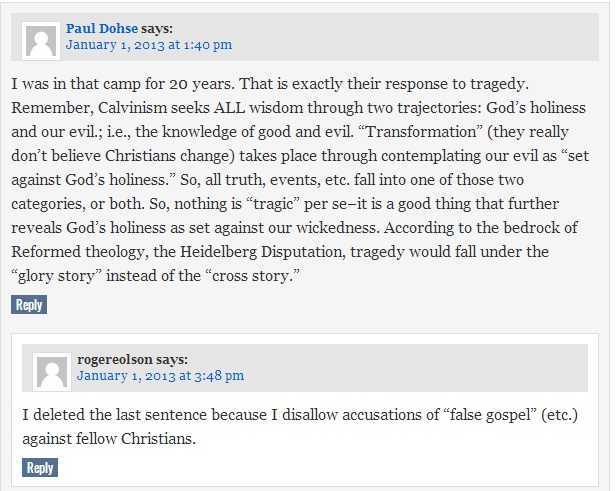
After an hour of everything life of Jesus and our depravity music, the pastor delivered a mini-treatise that was the usual Heidelberg Confession construct: all wisdom and true theology is a deeper and deeper knowledge of our evil as set against the holiness of Christ. He said we are “broken people in a broken world” and unable to do anything with pure motives. This is not how the Bible describes Christians at all. We are described as being resurrected WITH Christ and in high places with Him. We are described as “more than conquerors.” And the Bible does not even describe the unregenerate as incapable of impure motives because they were born with the works of the law written on their heart. They will not be justified by that, but it doesn’t render them incapable of doing good works. Yes, works they do in order to be justified are filthy rags, but that is not a sweeping metaphysical indictment of mankind in general.
Then he added the caveat that there is no real purpose in this life. And believe me, that’s how the American church lives. What purpose could there be if only Christ was resurrected and we are dead? And the practical application? As stated, “We overcome with the joy of our salvation.” Really? This aped the song that we also sang earlier: “We overcome by the blood and our testimony.” Stated another way by the Neo-Calvinists of our day running the church: “We shouldn’t be the gospel, we should only preach the gospel.” While New Calvinists bemoan the idea that the world is mostly unevangelized, I assure them that the gospel of preaching only is well known throughout the world and God is blasphemed accordingly.
Susan and I are beginning to note a trend in these churches as we visit some that we were previously acquainted with in the past: They are dead. The worship is half-hearted. It’s like, “Are we having fun worship yet?” But what do we expect? We are dead, right? I know that the theses is that by making much of Christ and little of us that worshipful manifestations will take place, but joyful skeletons singing aloud in praise is a pipe dream that Calvinists will never realize. They are sucking what life was left of the church after Billy Graham’s first gospel wave. Dr. Kevorkian is presiding over the terminal ill patient that is the American church: a reputation for being alive, but really dead, and proud of it.
Unfortunately, Susan and I had watched the epic Star Wars movie late into the night before. By the end of all of this, a part of the movie seized my mind: Darth Vader; “I find your lack of faith disturbing.” As I focused on the pastor finishing his skeletal rendition of the resurrection, I observed my hand raised up in a grasping configuration. I looked to Susan for help, but found little on her frowning face as she commented, “I have a problem with the suggestion that God [the Father] was resurrected.” But when you reduce Christianity to a narrow objective door, you enter into a reality of subjective monstrosity. Anything goes from there. Dishwalla followers see no need to change venue; counting blue cars and going to church is all the same.
Christ never commanded us to celebrate His resurrection via a special day on the calendar. It’s optional. But if we are going to do it, don’t make it a lie and a half-gospel—celebrate not only what Christ did, but His purposes as well. He came to give us purpose in the here and now as well as eternally. Easter is not only about the resurrected Christ Himself, but what he sought to do in us being resurrected WITH him as new creatures.
The half-gospel of total depravity is a lie and a false gospel. And let those who preach it be accursed.
paul
TANC Prediction: The New Calvinists Are in the Process of Forming Their Own Denomination or the Completed Takeover of the SBC is Imminent
 Some recent trends have tempted me to partake in a little prognostication. First, the primer for all of this is the brazen disregard for bad press in light of recent sex scandals among the “Gospel-centered” crowd. Look, I know “Gospel-centered” sounds spiritually generic but it’s not. “Gospel-centered” is indicative of a radical worldview that many in the church don’t comprehend. Two-thousand years later, even in the midst of the Information Age, they are propagating an, “underestimated,” “unadjusted,” “scandalous” gospel. That should be your first clue. And indeed, there is plenty of scandal.
This worldview disregards the concept of justice and has an antinomian pedigree. That is causing a significant pushback between this movement and others in the church. That is perhaps the primary catalyst that will provoke some kind of significant separation. Historically, spiritual tyranny ALWAYS follows this movement, and the chickens have come home to roost. Unfortunately, the church has done a poor job of pinpointing this logic and rejecting it beforehand, but the one thing everyone understands is when bad things start happening.
Again, justice isn’t even on the radar screen, but if you want to pay the bills you act like it’s important. The New Calvinists no longer portend that it is—so something is up in my book. ABWE, which has strong ties to the New Calvinist cartel and its four Dons, “Big Al” Mohler, Mark Dever, Ligon Duncan, and CJ Mahaney, just snubbed its nose up at the Evangelical world by firing the feel-good intermediating organization GRACE. The public facts surrounding this scandal, now ten years in the making, has destroyed GARB credibility in the minds of anyone who is not a consummate Kool-Aid drinker. Creditability in the GARB community may no longer be relevant; i.e., a merger with likeminded despots may be in the works. By the way, New Calvinist Dr. William Brown has been fired from GARB enclave Cedarville University. He was the president thereof, and has been temporarily appointed as chancellor to candy-coat the event as much as possible. But there is a serious catfight going on there that is difficult to sort out. Here is one example: http://cedarvilleproblems.com/index-1.htm . But at any rate, it’s not surprising; some kind of fight ALWAYS follows a New Calvinist beast. Always.
The business as usual motif in regard to CJ Mahaney, the Underboss of the Charismatic wing of the New Calvinist cartel, is also striking. As president of SGM, he has been besieged with controversy over sex scandal cover ups and basic run of the mill despot leadership style. His behavior was so outrageous that his cult following at SGM, including his own son-in-law, dismissed him. The cartel bosses in Louisville, Kentucky (home of their front organization, “Together for the Gospel”) partook in an image makeover and had Mahaney reinstalled as president of SGM. The outrageous event squeezed so hard that every bit of integrity oozed out of SGM and several of its member churches jumped ship. Regardless of all of this, including the fact that Mahaney is a defendant in a class action sexual abuse law suit, he is scheduled as the main act in all upcoming cartel conferences. Again, a total in your face- kiss our sanctified booties stance toward the rest of the Evangelical community. This is hard to miss as the Evangelical community at large has launched a petition for CJ to step out of the limelight while the trial flaunts itself in the mainline news media: http://www.causes.com/actions/1730803-an-appeal-to-national-leaders-regarding-c-j-mahaney
But beyond this snubbing of the Evangelical community, take note that Mahaney recently moved the corporate headquarters of SGM to Louisville, Kentucky. This is the home base for Big Al, president of Southern Seminary, and well known as “ground zero” for the New Calvinist movement (Collin Hansen: Young, Restless, Reformed; A Journalist’s Journey With The New Calvinists, chapter four, “Ground Zero: Southern Baptist Theological Seminary, Louisville, Kentucky”). I mean, I know they are buddies and all, but you just don’t move a whole organization to another city for sentimental reasons. Something is up.
The New Calvinist movement has been hard at work to take over the SBC since 1981. A Presbyterian started Founders Ministries for the express purpose of that agenda. They even printed a manifesto accordingly. Scoff at the conspiracy theory if you must—but it is just plain fact. I document those facts in The Truth About New Calvinism: Its History, Doctrine, and Character. That’s why Southern is “ground zero” for the New Calvinist movement. It is also behind the attempted name change of the convention. If that goes through—it’s over—what the cartel has been working for since a small group of egomaniacs met at the Holiday Inn in Euless, Texas circa 1981 will be complete.
But the Southern Baptist faithful have proven to be a tuff nut to crack. To some degree, the doctrinal illiteracy of Southern Baptists has saved them. It is difficult to deceive people into changing their soteriology when they don’t even understand the difference between justification and sanctification. Southern Baptist New Calvinist heretics like David Platt only end up offending the faithful by dissing the concept of asking Jesus into my heart and reciting the sinner’s prayer. Hence, Southern Baptists don’t disdain New Calvinists because they propagate the false gospel of progressive justification, but because they offend their traditional sensibilities. Perhaps the greatest sin is the New Calvinist absence of Southern Baptist absolution: the alter call that replaced aggressive sanctification long ago.
So, this is down to the wire. The New Calvinist takeover of the SBC is at hand, or these guys are going to start their own gig. They have what’s left of SGM, they have the Passion Movement, they have the Emergent Church for the most part, the biblical counseling culture, and many Presbyterian churches as well. This is a gargantuan mass of time tested Kool-Aid drinking humanity. They no longer need to feed off of the Evangelical community. But what is immensely sad is the fact that we have ignorantly funded the cause while ignoring the muffled cries of those buried alive in the backyard.
I would also like to throw something else into my prognostic stew. John Piper recently “retired” from his pastorate at the Bethlehem temple. Do we really think he is going to retire to a life of seashell hunting in Florida? Yes, I know, he’s not beyond such hypocrisy, but it’s still highly doubtful. Trust me; he’s moving on to something bigger—much bigger. But what? I know where I would put my money if I had to.
This is all going somewhere because history always repeats itself. This movement has died five times since its conception in Geneva, and it will die again. It’s getting more and more difficult to suck the blood out of churches that the movement has covertly taken over because of the internet and those pesky discernment bloggers. For the first time since 1972, New Calvinists are being fingered in the pastoral interview process. The gig is up. There is not much more to pilfer in the Evangelical church at large, so they will separate.
But that will be the beginning of the end. Progressive justification always implodes. Progressive justification is like the lollypop knives Eskimos use to kill wolves. Fitting. Christians do not grow by staying at the foot of the cross. We do not grow by feeding on the gospel of first importance that saved us. Children in adult bodies will eventually devour themselves. It’s already happening: in all major wings of the New Calvinist movement there have been scandals that have made national headlines. It’s time for them to prove that bastard Semi-Pelagian evangelicals are to blame. If only they were not held back by the zombies of synergistic sanctification. If only they were not defiled by those who believe Jesus is a precept and unable to see His astounding personhood! Why, we don’t even know what Jesus’ favorite color is! Away with those who will not be wowed by what Jesus did rather than anything we can do! Ahhmen.
One way or the other, regardless of how wrong or right my prediction is, something is going to give. Every day, the Evangelical community is gaining a clearer picture of what’s going on. But if they do start their own denomination, the scene would be to die for. The Star Wars bar scene could not hold a light-sabre to it.
paul
The 2007 John MacArthur Controversy: “It’s the Judgments, Stupid”
 “Here is what many are missing: you can’t separate the gospel from eschatology. Your eschatology will be consistent with your gospel or inconsistent.”
Who can forget James Carville’s motto to keep people focused in Bill Clinton’s 1992 presidential campaign? “The economy, stupid.” Carville didn’t want Clinton’s campaign workers to expend energy on matters that would not ultimately persuade people to vote one way or the other. Likewise, Christians love to pile-up Bible verses in a heap that doesn’t serve change in the least. Carville knew how to get change; Bush’s 90% approval rating could not keep him in office.
At the 2007 “Shepherds” Conference held annually at John MacArthur’s church in California, he opened the conference with a devastating, complete undressing of amillennialism. The controversy among the Reformed raged for several months. The often touted “In essentials, unity; in non-essentials, liberty; in all things, charity” was taken out with the morning trash. Per the usual, most of the Reformed gang who had spent their parishioner’s money to go to the conference moaned and screamed like alley cats in the night that MacArthur dissed “Reformed orthodoxy.” In the debate, also per the usual, Scriptural arguments were replaced with the endless droning of dead mystics and rabid Puritans.
But what’s the real issue? The real issue is sanctification by justification. That’s the authentic Reformed gospel; i.e., progressive justification. Bottom line: if there is a literal millennial kingdom before the new heavens and new earth, there must also be two resurrections and two judgments. That strongly insinuates two different groups and two different purposes in regard to the types of judgments. In the Reformed construct, there must be one judgment that determines everybody’s just state. MacArthur, even with all of his education doesn’t get that; his gospel of progressive justification doesn’t fit the eschatology that he dragged into his partial conversion to the authentic Reformed gospel.
This brings us to the four types of pastors in our day:
1. Authentic Calvinist: Luther and Calvin’s Gnostic progressive justification. These are the Neo-Calvinists wreaking havoc on the church in our day. Progressive justification (justification and sanctification are both monergistic because sanctification finishes justiifcation)/amil. Examples are Al Mohler, David Powlison et al.
2. Sanctified Calvinist: Leftovers from the periods in church history when authentic Calvinism dies a social death because of the tyranny that comes part and parcel with it. They change their soteriology but retain the eschatology of progressive justification. Monergistic justification/synergistic sanctification/amil. Examples are Jay Adams, and many other Presbyterians, and Baptist acadmiacs.
3. Inverted Calvinist: Converts to progressive justification that retain their former eschatology that is some form of dispensationalism. The best example is John MacArthur.
4. Biblicist: The Bible is their authority; not orthodoxy. This breed is an endangered species in our day.
Here is what many are missing: you can’t separate the gospel from eschatology. Your eschatology will be consistent with your gospel or inconsistent.
paul
Apparently, I am Fed-up With All the Whining About Symptoms of Calvinism
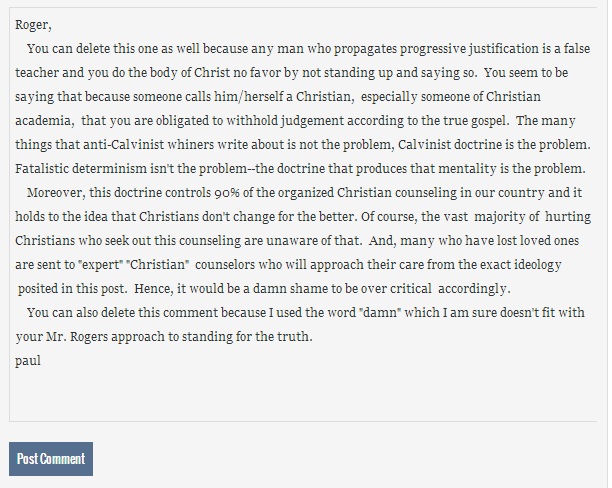
 Apparently, I begin the New Year completely fed-up with all of the whining about the symptoms of Calvinism which is a false gospel. Christians seem to be oblivious to the fact that ill behavior flows from bad ideas. The blogosphere is saturated with incessant whining about the spiritual abuse and tyranny foisted on the American church by Calvinism, but yet, they refuse to address the core of the problem. Hence, many blogs have become little more than the National Inquirer adorned in Bible verses.
But though annoying, there is a reason for it: we are Protestants. Our foundation is Calvin and Luther who believed that Christians remain totally depraved and ignorant. Therefore, present-day Christianity in this country is predicated on the idea that we must be led by a sanctified pre-ordained academia. Like Catholicism? Absolutely, because the Reformers maintained Rome’s metaphysical presuppositions; especially in regard to mankind, and only changed their doctrine which strives for the exact same goal: CONTROL.
That’s why we have such a comfortable relationship with St. Augustine and the fact that our Protestant founding fathers were his followers. This is why we whine about spiritual abuse but continue to give these guys our money:
Ya, they’re bad guys, but we need them. I mean, look what David did, but he was God’s anointed. Israel needed him.
And why do we continually whine about symptoms while giving them our money when their philosophy and doctrine is clearly anti-God and anti-Bible? Because: we do not deem ourselves capable of speaking to their doctrinal error. We are not qualified. We could falsely accuse them because we have supposedly not been preordained to see Christocentric reality the way they do. God gave them metaphysical eyes that we don’t have. And if we step out and teach with the authority of the word, and without their permission, we may be found naked by them. Our hidden “ignorance” may be exposed. Reformed despots have worked for 510 years to develop this unspoken bondage.
So, we know our place and only speak to the behavior. We are exactly like the slaves in the South during the Civil War who were powerless to do anything but complain about the abuse. Or so they thought. Others questioned that assumption and sought solutions. The results speak for themselves. America now has a two-term black President. Christians should take note of that. Like him or love him, Obama is solution oriented. And any Christian who likes to speak their mind probably benefits from the Civil Rights Movement because the hangman’s noose differs little from the burning stake stoked with green wood for those who dared to understand Scripture apart from Reformed elders. The abuse we see today is Reformed Light tamed by the U.S. Constitution.
Look, rat on the behavior—keep doing that, but when are folks going to start blogging about the philosophy and the doctrine?
When they think they have the authority and capability to do so.
Well, touché. Yes, I know about the behavior, but what about the fact that these guys believe that we are resaved every day and that we can only receive daily forgiveness that maintains our justification in their churches? Heeeellllloooooo.
I posted a comment on a blog and the response from the author hit a nerve and prompted this post (here). My response was so knee-jerk that I stopped and pondered why I responded in that way. Hence, the title of this post. I’m clearly exasperated. But I let the comment stand.
Stop whining and study to show thyself approved. And then blog about it. Until the doctrine is dealt with, we will continue to be slaves to heretics rather than the Chief Shepherd.
paul

Ground Zero: Pope Gregory and New Calvinist Gospel Contemplationism
“Monks. That’s what we are missing here. Martin Luther. Ever heard of him? He was a monk.”
“In that Disputation, Luther postulates Pope Gregory’s take on the gospel which is the exact same calling card of present-day New Calvinism.”
“Powlison points to Pope Gregory and Augustine as the pioneers of biblical counseling using a ‘Christ-centered,’ ‘full gospel’ approach. And what was that approach?”
Let’s just take one contemporary example: a Presbyterian church that is now a mere shell of what it was; the remains of a war over the arrival of a New Calvinist pastor who exhibited outrageous behavior and leadership style. Today, some parishioners stand dumbfounded that the Presbytery took positive steps to keep said pastor in place.
As TANC, our newly formed think tank that researches Reformed theology continues to journey into church history for answers, the reasons for present-day tyranny in the church become clearer every day. First, it is driven by the gospel that founded the Reformation. Simply put, it is a gospel that does not believe that people change, but are rather called to contemplate the saving works of Christ in order for His righteousness to be manifested in one of two realms. Whether Baptist, Methodist, or whatever, this Reformed seed, the idea that people really don’t change is at the core of their function though they would deny it verbally. The Western church as a whole buys into this basic concept.
Secondly, the basic concept of spiritual elitists ruling over the totally depraved. You know, the they really can’t change crowd. The Reformation clarion call of total depravity—what’s our second clue if we need one? The spiritual is accessed through the chief contemplationists, and since they have the dope directly from God, they should rule over the totally depraved. Look, I have been a Baptist since 1983, and this is how it works. Again, we wouldn’t verbalize that, but to some degree it is true of all Western denominations because we are the children of the Protestant Reformation. What were we protesting? Naughty philosopher kings; past that, not much.
If we don’t change, the church doesn’t either. Think about that. And we wonder why things are a mess. Apparent growth in numbers is being driven by something else other than a true gospel. And the Reformers deny that while pontificating total depravity. It is testimony to the depth of which this Protestant construct has dumbed down the average parishioner; i.e., the totally depraved change. And nobody blinks. The assumption is that total depravity only pertains to the unregenerate, but that’s not the case according to the Reformed gospel and its time for people to start doing the math on that. The “Nones” and the massive exodus from the evangelical church is taking place for a reason.
I’m not ready to declare Pope Gregory the Great the father of the Reformation and present-day New Calvinism just yet, but recent discoveries reveal some things that should be fairly obvious. We aren’t stupid, just trusting, and that needs to end. Christians need to take advantage of the information age and start studying for themselves as the Christian academics of our day refuse to be forthcoming. They didn’t forget to mention that sola fide is also for sanctification. They didn’t forget to mention the total depravity of mankind AND the saints. They didn’t forget to mention that the new birth is a realm and not something that happens in us—it’s deliberate deception because the Reformed gospel is “scandalous.” The totally depraved are not “ready” for what the enlightened class of philosopher kings understand. By the way, many seminary students will testify to the fact that they are told as much by their seminary professors. Seminaries are where you go to be certified for the purpose of ruling over the totally depraved in order to, in Al Mohler’s words, “save them from ignorance.” Sorry, I prefer to let the Bible and Google save me from ignorance. Thank goodness for the Gutenberg press.
Monks. That’s what we are missing here. Martin Luther. Ever heard of him? He was a monk. What is the very premise of monkism? It’s the idea that the spiritual is obtained by contemplationism. And monkism is not unique to the Catholic Church—it is the link from the Catholic Church to the ancient concept of mystic dualism. Though it pans out in various different ways, it’s the idea that matter is evil and spirit is good. In other cases, it holds to the idea that both good and evil are necessary to understand true reality. Good defines evil, and evil defines good. The more you understand both, the more “balance” you have in the universe. Then there is the goal to birth the spiritual into the physical through meditation/contemplationism. Like I said, there are many takes on the basic approach.
Monks believe that the physical or world realm is a distraction from the spiritual realm. In some cases, they believe that all matter is merely a form of the perfect, or spiritual. Hence, monasteries. Traditionally, monasteries have been clearing houses for the dope from God through contemplationism. And since they have the dope, they should rule the totally depraved for their own good. In some spiritual caste systems, the monks rule directly, in others like the Catholic Church, the monks are the Scribes and Prophets for the rulers; i.e., the Popes.
The fact that monkism would be part and parcel to any doctrine formulated by Martin Luther is a no-brainer. Mysticism is simply going to be a significant factor, and so it is with Protestantism. This becomes more apparent when you consider the core four of the Protestant Reformation: Martin Luther, John Calvin, St. Augustine, and Pope Gregory the Great. Luther’s 95 Theses was a protest against naughty Popes, but he was completely onboard with the Catholic caste system. When his 95 Theses resulted in the unexpected societal eruption that took place, he presented a doctrinal disputation to the Augustinian Order in Heidelberg. And don’t miss this:
In that Disputation, Luther postulates Pope Gregory’s take on the gospel which is the exact same calling card of present-day New Calvinism. In theses 27 of his Disputation, Luther states the following:
Thus deeds of mercy are aroused by the works through which he has saved us, as St. Gregory says: »Every act of Christ is instruction for us, indeed, a stimulant.« If his action is in us it lives through faith, for it is exceedingly attractive according to the verse, »Draw me after you, let us make haste« (Song of Sol. 1:4) toward the fragrance »of your anointing oils« (Song of Sol. 1:3), that is, »your works.«
There could not be a more concise statement in regard to the New Calvinist gospel. Deeds in the Christian life come from the same acts in which Christ saved us. Secondly, they are not our acts, but the acts of Christ applied to our Christian lives by faith alone. Thirdly, when the works of Christ are applied to our Christian lives by faith alone, it will always be experienced by the exhilarating emotions of first love—this is the mark of Christ’s active obedience being manifested in the spiritual realm through the totally depraved. We “reflect” the works of Christ by faith alone. Even John MacArthur has bought into this nonsense, claiming that obedience to the Lord is “always sweet, never bitter.” Francis Chan states that it always “feels like love.” And of course, poke John Piper’s rhetoric anywhere and this same monkish mysticism comes oozing out.
Moreover, Luther states this same concept from many different angles in his Disputation, and theses 28 is clearly the premise for John Piper’s Christian Hedonism.
No wonder then that New Calvinists of our day sing the praises of Pope Gregory. Here is what heretic David Powlison stated in an interview with Mark Dever’s 9Marks ministry:
Caring for the soul, which we try [try?] to do in biblical counseling, is not new. Two of the great pioneers in church history would be Augustine and Gregory the Great. Even secular people will credit Augustine’s Confessions as pioneering the idea that there is an inner life. Augustine did an unsurpassed job of tearing apart the various ways in which people’s desires become disordered. Gregory wrote the earliest textbook on pastoral care. He pioneered diverse ways of dealing with a fearful person, a brash and impulsive person, an angry person, an overly passive person. He broke out these different struggles and sought to apply explicitly biblical, Christ-centered medicine—full of Christ, full of grace, full of gospel, and full of the hard call of God’s Word to the challenges of life.
Powlison points to Pope Gregory and Augustine as the pioneers of biblical counseling using a “Christ-centered,” “full gospel” approach. And what was that approach? It was primarily contemplationism and dualism. In fact, Gregory practically saw “doing” as a necessary evil. In Roland Paul Cox’s Masters dissertation, Gregory the Great and His Book Pastoral Care as a Counseling Theory, Cox states the following:
The overall theme in Gregory’s dichotomies is balance. It is possible that this comes from Gregory’s own struggles in balancing his desire for the contemplative life of a monk versus his reluctant, but active, service as ambassador to Constantinople and pope.“The Regula Pastoralis was in large part devoted to describing how to reconcile the two types of life. He came to the conclusion eventually that while the contemplative life was the better and more desirable of the two, the active life was unavoidable, and indeed necessary in order to serve one’s fellow man.…There could be no better exemplar of the two lives than Gregory himself, but he would have been less than human had he not from time to time mourned the fact that so much of his time must be given over to the active at the expense of the contemplative” [Jeffrey Richards, Consul of God : The Life and Times of Gregory the Great (London ; Boston: Routledge & Kegan Paul, 1980), 57.].
Powlison, in true Reformed tradition, invokes the either/or hermeneutic, or the either cross story or glory story hermeneutic of Luther’s Disputation by suggesting that any denial of this “Christ-Centered” approach is a wholesale denial of an “inner life.” In other words, suggesting that doing something should be emphasized as much as contemplationism is paramount to denying that there is an inner life. Such statements by Powlison are indicative of his utter lack of integrity.
In addition, Gregory’s penchant for mystic dualism is seen in the same dissertation:
Gregory’s view of health revolved around balance. In Pastoral Care 34 dichotomies are given. For each one Gregory discusses how either extreme is detrimental. The following are a few examples of Gregory’s dichotomies: poor/rich, joyful/sad, subject/superiors, wise/dull, impudent/timid, impatient/patient, kindly/envious, humble/haughty, obstinate/fickly, and gluttonous/abstemious. Further, Gregory explains how certain traits although they appear to be virtues are in reality a vice. For example, in describing the dichotomy of impatient and patient, Gregory says the following about the patient: “…those who are patient are to be admonished not to grieve in their hearts over what they suffer outwardly. A sacrifice of such great worth which they outwardly offer unimpaired, must not be spoilt by the infection of interior malice. Besides, while their sin of grieving is not observed by man, it is visible under the divine scrutiny, and will become the worse, in proportion as they claim a show of virtue in the sight of men. The patient must, therefore, be told to aim diligently at loving those whom they needs must put up with lest, if love does not wait on patient” [Pastoral Care: pp. 109, 110].
In other words, self-control is a vice. Unless cross-centered love is mystically applied according to Luther’s Disputation (theses 28), the latter evil of self-control is worse than the former sin of being offended since such offences serve to humble us (LHD theses 21).
What goes hand in metaphysical hand in all of this is good ole’ ancient spiritual caste tyranny. As Cox further observes,
Shortly after becoming pope, Gregory wrote Pastoral Care. In addition as pope, he reorganized the administration of the papal states, he maintained papal authority in the face of encroachments from the Patriarch of Constantinople, he established links with the Frankish Kingdoms, and most importantly (for these English writers), he sent a party of monks, led by Augustine, to convert the Anglo-Saxons.
Gregory was very influenced by the Rule of St. Benedict and Benedictine monks who came to Rome after the monastery that St. Benedict founded was burnt. In some letters, Gregory calls his work Pastoral Rule. “There is every reason to assume that Gregory in conceiving the plan for Liber Regulae Pastoralis [Pastoral Rule] intended to provide the secular clergy with a counterpart to this Regula [the Rule of St. Benedict].
….This culture of rulers and emperors also helps explain why Gregory saw Pastoral Care and Pastoral Rule as one in the same. By modern day standards, Gregory would be considered overly authoritarian.
A culture of “rulers and emperors” had precious little to do with it, but rather ancient spiritual caste systems that answered the supposed preordained call of God to control the totally depraved. With the sword if necessary. While many of these systems were based on mythology prior to the 6th century, Plato systematized the idea and gave it scientific dignity. But his trifold theory of soul consisting of king, soldier, and producer called for a sociological counterpart that was a mirror image to fit the need. Sir Karl Raimund Popper, considered the greatest philosopher of the 20th century, fingered Platonism as the primary catalyst for religious and secular tyranny in Western culture. And Plato’s mystic dualism (shadows and forms) added not just a little to the MO of the Reformers. According to church historian John Immel:
Calvin’s Institutes (1530) is the formal systematic institutionalization of Platonist/Augustinian syncretism that refined and conformed to Lutheran thinking and became the doctrinal blueprint for the Reformed Tradition [Blight in the Vineyard: Prestige Publishing 2011].
Christ promised us that He would build His Church and the gates of hell would not prevail against it. The idea that the Reformers rescued His church from the gates of the Roman Catholic Church is both laughable and the biggest hoax ever perpetrated on mankind. The idea that Christ needed, and continues to need the services of Plato’s philosopher kings is arrogance on steroids. Somewhere, God’s church moves forward. Let us shed the Reformed load that hinders and find our place in that true church.
paul

 Paul's Passing Thoughts
2 comments