Elyse Fitzpatrick, The Antinomian, Out With New Book About Let Go and Let God Parenting
 Elyse is at it again. She has published a new book on parenting that is the feminine version of Paul Tripp’s “Age Of Opportunity.” I can’t wait to buy it for Bob and Jane (names changed). They have a rebellious teen to deal with. How bad is the situation? Bob removed the firing pins in all of the guns in the house, and they lock their bedroom door at night. So, I can’t wait to tell them that Elyse can instruct them how to show forth the gospel to their son which will result in a miraculous transformation. That’s their only hope according to Elyse because parents are bad, and bad parents can do nothing to raise bad children. I mean, duh, hasn’t everybody seen the John Piper video, “John Piper Is Bad”?
I will be writing a review on EF’s new book after I get done with Mr. Holland’s opus. The title is: Give Them Grace: Dazzling Your Kids with the Love of Jesus. I have read one review, and other than what I mentioned above, there is even more good news for Bob and Jane: not only will they be able to dazzle their violent teen, but guess what? Their teen is really not any worse than well behaved teens! In fact, well behaved teens are worse because they are just little Pharisees! Wow! Hope is on the way for Bob and Jane.
For now, I conclude with a comment that “Anne” wrote regarding the book review on her.meneutics about EF’s new book:
“*Sigh* I get that burying your kids under a pile of rules can set up the expectation that holiness is completely predicated on one’s behavior rather than grace and one’s heart attitude. But what’s wrong with having compliant children? Can’t we teach them manners and good behavior, AND teach them that manners and good behavior don’t save them?
Because I can just hear it across churches and the blogosphere now: My kids are terrors, but I’m a “grace-based parent” and therefore better than you because you make your kids obey the rules like a good little Pharisee.
Please tell me the book addresses potential misinterpretations of its point, like I’m bringing out here.”
Don’t hold your breath Anne.
paul
Rick Holland’s “Uneclipsing The Son,” Part 3: Mr. Holland’s Theological Train Wreck Has A Destination
There isn’t much new thus far in Mr. Holland’s “Uneclipsing The Son,” other than being the usual theological train wreck one expects from the New Calvinist crowd.
On pages 4-7, Holland expounds on the whole how Ephesus lost their first love routine. They supposedly lost their first love by not focusing on seeing Jesus in deeper and deeper ways as a person (ie., contemplative spiritually). However, Christ makes it clear how the Ephesians were to repent and find their first love again: “….do the works you did at first.” Holland begins the book by butchering Scripture and does not relent moving forward.
On page 8, Holland connects “think[ing] of Christianity as behavior modification” with “effectively estrange[ing] ourselves from Christ.” Regardless of the fact that many verses in Scripture are concerned with behavior modification, Holland doesn’t qualify the statement. In fact, consider 1Thess. 4:3; “For this is the will of God,your sanctification:that you abstain from sexual immorality….” Neither does he qualify what being “estrange[d] from Christ” means. The statement strongly insinuates that behavior concerns in sanctification will separate us from Christ. This is run of the mill Gospel Sanctification stuff.
On page 9, things get a little creepy: “After all, Christianity is the worship of Jesus Christ. It’s the worship of Jesus Christ exclusively, and it’s the worship of Jesus Christ comprehensively. He alone is worthy; He alone is God….” Uh, what about the Father? In many instances, GS proponents hint at some kind of skewed view of the Trinity, and Holland is no exception. There is very little doubt that GS theology often eclipses the other two members of the Trinity.
On page 10, Holland again takes a jab at obedience by saying biblical books “….are not a mere directive for a new way to live, but a manifesto of the amazing greatness of Jesus.” The focus is the greatness of Jesus, not what Jesus says (….”teaching them to observe all that I have commanded you.”). Holland’s thesis seems to clearly contradict Luke 11:27, 28 which records the reaction of a woman who realized the greatness of Christ: “As Jesus was saying these things, a woman in the crowd called out, ‘Blessed is the mother who gave you birth and nursed you.’ He replied, ‘Blessed rather are those who hear the word of God and obey it.’”
On page 11, Holland writes that the book of James presents Christ as the “rule and standard of all spiritual instruction” (in other words, as Paul David Tripp says: “All commands must be seen in their gospel context”). This is simply not true, and again, what about the Father?! The Father has no part in spiritual instruction? What standard did James use to “serve” God AND the Lord Jesus Christ? Holland plainly contradicts James’ opening statement of the book.
On page 12, he reiterates the thesis of the book; primarily, conjuring up a heightened “value” of Christ in our minds as the key to emerging from the eclipse which he assumes most Christians are in because after all, like all New Calvinists, he is on the cutting edge of the great Reformation that wasn’t finished by Luther et al. All and all, it reduces the Scriptures to a tool for contemplating the greatness of Christ exclusively for the purpose of being motivated by emotions, as we will see later.
On page 14, obedience is again devalued by describing it as a “treadmill” of engagements, polite conversation, and good behavior. Yet, Peter exhorted Christian wives to win their lost husbands through their “good behavior.” Once again, Holland does not qualify any of these statements regardless of the fact that they contradict the plain language of Scripture.
On page 15, he toe’s the usual GS line by indicting Christianity for considering the gospel to be “Basic/Christian /Truth,” and reiterates the need to see the gospel “afresh.” This contradicts 2Peter 1 and Hebrews 5:11-6:3, as well as many other Scriptures that speak of the gospel as a foundation of faith that we build on. In addition, and on the same page, he makes feelings the standard for whether or not the gospel is once again stirring our hearts: “Do these words move you as they once did?”
In the previous post, I eluded to Holland’s butchering of Romans 5 starting on page 18 and following where he speaks of Christians as being presently in a pre-salvation condition. In other words, it is strongly insinuated that Christians are still spiritually dead as they were before salvation. This idea is often promoted by other New Calvinists such as John Piper, Paul David Tripp, and Michael Horton by citing pre-salvation texts that are clearly in the past tense as pertaining to Christians presently. On page 39, Holland has the audacity to make the following statement under the heading “When Bad Grammar Makes Good Theology”: “The rules of grammar are intended to be guardrails for communication. But sometimes they prevent it.”
At that particular place in the book, Holland uses that point to speak of the apostle Paul’s supposed “awkward” grammar. His idea is that Paul used the phrase “to live is Christ” to communicate the idea that true spiritual life only comes from contemplating the person[hood] of Christ. Also insinuated is the idea that Christ’s greatness transcends mere grammatical rules, and therefore, one must break those rules to communicate how consumed our life must be with Christ. But in what context? Who Christ is as a person (whatever that means) only, or what Christ teaches about our role in sanctification? But in his relentless onslaught of distortion, he claims that Paul’s grammar is “awkward”; no it isn’t, Paul is using a simile to communicate the idea that Christ should be first priority in our lives—it’s not awkward or “bad grammar” at all. But first priority doesn’t equal a nebulous contemplation that supposedly results in a passive obedience earmarked with a joy that gives all obedience moral value. That isn’t biblical truth, and Paul didn’t distort grammar guardrails—it’s the New Calvinists that do the distorting based on their version of the gospel interpreting all reality. And if grammar gets in the way, they do what all good antinomians do—change the rules.
On page 23, Holland addresses one of the newest challenges to New Calvinism—that being the subject of hell and the New Calvinist paranoia that somebody might think that hell is an incentive to confess the gospel rather than the pure unadulterated motive of seeing Christ in His full glory and the accompanying treasure chest of joy that validates the confession. The story line that seems to be emerging from New Calvinists is that hell is good news because it shows how Christ saves us from God. In fact, the heading on page 23 reads, “Saved—From God.” So, apparently, hell is a God the Father sort of thing. On page 43 and following, Holland presents God as “our most pressing problem.” And, “man’s greatest problem is God, God Himself.” And of course, it’s Christ to the rescue, right? Though few would reject that premise, it’s not exactly right and promotes the subtle New Calvinist goal of making Christ more significant than God the Father. Holland gives no Scripture references for this concept of Christ saving us from God because there isn’t any. God was just as involved in the salvation solution as Christ was, and Christ is also a God of wrath just as much as the Father is (Rev. 6:16,17 and 19:11-16) This whole concept is a subtle, but dangerous distortion. At the very least, making a strict dichotomy that associates wrath with God and salvation with Christ is ill advised.
On page 25 and 26, Holland espouses the well traveled indicative / imperative GS paradigm. This is the idea that all commands in the Bible are always preceded by a description of what Christ has done through the gospel, which incites gratitude and awe, which in turn incites joy, and the joy incites us to do whatever the following verses describe in the way of imperatives. Michael Horton describes it as a formula (formulas are ok if they are NC approved): Gratitude + (leads to) Doxology = (leads to) Obedience. Of course, the notion that the Scriptures always follow that grammatical pattern is patently absurd, but yet, New Calvinists now realize that our dumbed-down Christian culture will drink anything you put in front of them. This is especially crippling for Christians to buy into because the Bible often presents the exact opposite: obedience + (leads to blessings) doxology = gratitude (for example: James 1:25). To refute this, New Calvinists will refer back to a text several chapters prior and claim that the indicative there is linked to the other pattern in question, which is ridiculous.
On pages 29 through 41, chapter 3, Holland toes the GS line on the desire = value paradigm. This entails using the Bible for the sole purpose of contemplating the greatness of Christ and the gospel (as Piper describes: “always reading with an eye for the gospel”) with the result of our desires being changed, which in turn changes our value, which in turn changes our behavior. It’s based on the premise that we are controlled by our desires, and therefore, change the desire, and you will change behavior and what you worship. This also coincides with the supposed purity of feelings with the action that gives obedience its moral value. In fact, throughout chapter three, Holland suggests that feelings are an acid test for how we are progressing in uneclipsing the Son: “Do you seek to enjoy and honor and feel the fellowship of the risen, living Jesus?” And, “What does that feel like? It’s all about appraising Jesus as infinitely and personally precious. It’s all about a conscious, deliberate enjoyment of His worth.” Oh really? Is that what it is “all about”? I thought it was all about “make[ing] it our goal to please him.” What’s so complicated about the word “goal” and the fact that it is God’s pleasure being the focus, not ours?
To drive this point home, Holland uses “Gollum” of JRR Tolkien’s Lord of the Rings to make his point. Gollum called the ring “precious” because that was his focus. In the same way, Christ will be precious to us if we focus on just Him, and our lives will be consumed with Him like the ring consumed Gollum’s life. But this is not the biblical paradigm of fighting desires of the flesh while putting off the old man and putting on the new creation. Christians are to withhold provisions from the flesh that bolster sinful desires while walking in the Spirit. Nowhere in Scripture are we commanded to change our desires through spiritual contemplation as the singular discipline from which all other disciplines flow as a natural result. Rather, “walk by the Spirit (according to the Spirit’s will as revealed in the Bible), and you will not gratify the desires of the flesh.”
In order to make his points in this chapter, Holland blatantly distorts several texts. According to Holland, when Christ restored Peter with the three questions, He only wanted to know if Peter loved Him, not “Do you have your philosophy of ministry down?’ Not, “do you have church strategy ready?’ Not, ‘have you practiced your sermon for the day of Pentecost?’” Holland’s point is that “affection” is the issue, not anything we do. However, Holland completely excludes the fact that Christ followed-up each question with three imperatives that cover three different aspects of ministry—all but a total contradiction of how he exegetes that particular text. Does Holland think his audience is biblically illiterate? To conclude the chapter, Holland summarizes the main point: “If there’s anything in your faith that isn’t anchored in the person of Jesus, you’re living in an eclipse. You are not enjoying the eternal life made available by the gospel.” Note the focus of all biblical truth, according to Holland (and all other New Calvinists as well) is the nebulous “person of Christ” rather than the objective “….teaching them to obey all that I have commanded” which was Christ’s mandate to the church.
What a theological train wreck! But yet, it has a destination: away from the law; and to let go and let God theology.
paul
By Request: A Summary Of The New Calvinist Genealogy Chart; Part 1 / Introduction
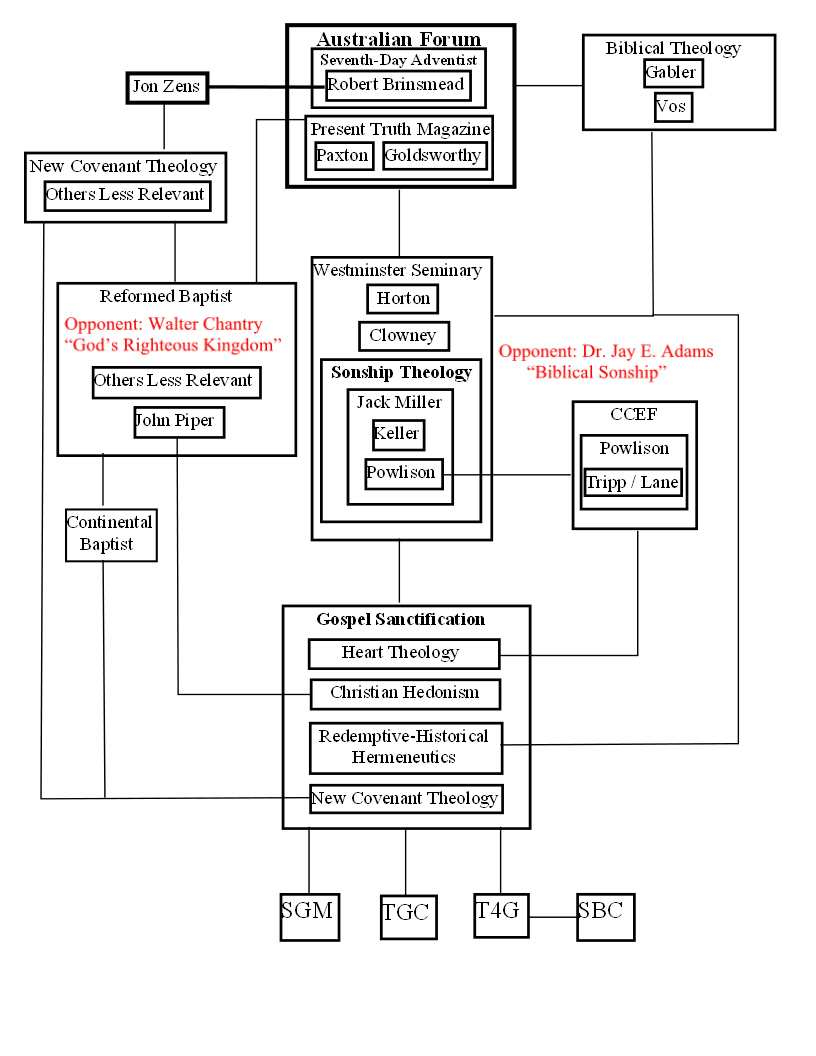 The contemporary history of New Calvinism begins with Robert Brinsmead and Jon Zens. They are the fathers of New Calvinism. Between my interview with Brinsmead and an informal document written by Zens I found on the internet—this is apparent. Brinsmead started a project called the Australian Forum (he wanted me to note that it was one of many projects that focused on certain subjects) that sought to articulate a gospel-centered sanctification into a unified, consistent systematic theology. One of the major considerations was a focus on covenant theology in relationship to this endeavor. Jon Zens is the father of New Covenant Theology, but it is clear that Brinsmead had a major influence in the formulation of that doctrine. All of this took place in the 70’s. So, New Calvinism has been around for about 35 years in various forms. It is primarily based on the Forum’s centrality of the objective gospel (COG). COG is the very heart of New Calvinism. Though NC has many different expressions, this doctrine is the heartbeat that drives it.
The Forum was having a significant impact on two spheres of Christianity in the 70’s and early 80’s; namely, Reformed Baptist and Westminster Seminary. Zens was a Reformed Baptist and also a student at Westminster. Zens taught a Sunday School class where his ideas on New Testament ethics were being presented, and Westminster students attended those studies. Michael Horton was infatuated with the Forum’s teachings, and COG can be seen in many of his teachings throughout his career. Keep in mind, the Forum’s magazine, Present Truth, and later, Verdict, according to Zens, had the largest readership among all Evangelical publications at that time. Apparently, Zens was initially introduced to the Forum by receiving Present Truth while he was a student at Westminster, and eventually formed a close relationship with Brinsmead. Also, G. Goldsworthy’s involvement in the Forum as one the AF three is one of the interesting the top is the same as the bottom in the genealogy chart. Till this day, the Goldsworthy Trilogy is a mainstay of New Calvinism’s Gospel Theology. Again, at the very heart of Goldsworthy’s Trilogy is COG. Goldsworthy was close to Brinsmead, and Brinsmead learned his Hebrew skills from Goldsworthy.
Zens, with the help of several men who are now the who’s who of New Covenant Theology while Zens is in the background (probably because of his connections with Brinsmead), attempted to propagate the doctrine, yet unnamed, via the Baptist Reformation Review . Zens received a very zealous contention from other Reformed Baptist such as Walter Chantry. At that time, Brinsmead wrote several articles defending Zens’ doctrine in the BRR. According to Zens:
“A sort of (unintended) [I doubt that] culmination occurred in the Spring, 1981, BRR. There were lengthy review articles of Walt Chantry’s God’s Righteous Kingdom [a book Chantry wrote to contend against COG, though he saw it as neo-antinomianism, which is also a correct assertion] and Robert Brinsmead’s Judged by the Gospel: A Review of Adventism. The dynamic N.T. approach to law and gospel [“NT approach to law and gospel” is a present-day NC mantra] was stated forcefully by RDB:
‘[Paul’s] appeals on how to live are made on the basis of what God has done for us in Christ. It is in view of God’s gospel mercies that we are to present our lives as a living sacrifice to God (Rom.12:1-3) . . . . Paul virtually never appeals to the law – ‘Thou shalt not.’ When he demands certain behavior of the church, he appeals instead to the holy history of Christ . . . and from that stand point then makes his ethical appeal.’”
Note here, and this is very important: the Forum’s the imperative command is grounded in the indicative event can be seen in Brinsmead’s statement cited by Zens above, which is a pillar of Gospel Sanctification till this day, and originated in COG doctrine by the AF. Chantry and others effectively beat COG within an inch of its life, and the doctrine, coined by Zens one year later as “New Covenant Theology” (in 1981), continued on in a meager existence among Continental Baptist. Most likely, John Piper was introduced to COG among Reformed Baptist and was probably well aware of the controversy. The wherewithal of his injection of Christian Hedonism into the movement is sketchy at this time and needs extensive investigation which I will do Lord willing.
Meanwhile, COG was finding new life at Westminster Seminary. In fact, Brinsmead and the Forum met with the Westminster faculty in the I think early 80’s, I will add references to this summary later. Brinsmead remembers little about the meeting other than he noted that the faculty served pork to him and the other forum members which he suspected was deliberate due to the Forum’s connection with Adventism. I informed him that it was deliberate because they were incited to do so by Jay Adams (a faculty member at the time) who was not a happy camper that the meeting took place. Brinsmead stated that one individual present at the meeting seemed to be an “elder statesman” of Westminster. I’m guessing it was Edmund Clowney.
At this point, COG, as the face of the AF disappears, leaving behind its remnants with Continental Baptist because Robert Brinsmead departed from orthodox Christianity all together. But the heart of COG incited a new movement begun by Westminster professor John “Jack” Miller called “Sonship Theology.” Again, COG met stiff resistance in Presbyterian circles under the new name of Sonship. Leading the charge was Dr. Jay Adams who also knew Jack Miller personally. His contention against Sonship is well documented in his book, “Biblical Sonship: An Evaluation Of The Sonship Discipleship Course.” Unfortunately, the book is out of print. One may well note: Some big dogs of the present-day New Calvinists movement; specifically, Tim Keller and David Powlison, were disciples of Jack Miller and his Sonship program. Tim Keller’s propagation of Sonship is well known and documented. At a conference conducted at John Piper’s church while Piper was on sabbatical, Powlison specifically cited Miller as his “mentor” and ridiculed Adams for criticizing Miller while failing to mention that the “criticism” was in the form of a book—which I am sure slipped his mind. Miller is the one who coined the phrase often aped by Jerry Bridges: “We must preach the gospel to ourselves everyday.” Funny, while an elder at a reformed church in the mid-nineties, I heard Jerry Bridges say that without realizing what a profound effect that little phrase would have on my life ten years later.
But with COG again under heavy fire and the Sonship coat of arms being shot full of holes, “Sonship” was replaced with “gospel,” ie., “gospel-driven” this, and “gospel-centered” that. The movement was now underground, but steadily growing while avoiding labels like the plague. Take note: for almost ten years between 2000 and 2009, the movement was nameless. The name “New Calvinism” is very recent and was attached because movements that become massive cannot avoid a label. Meanwhile, David Powlison had been busy for a number of years integrating Jack Miller’s form of COG into “biblical counseling” through his Dynamics of Biblical Change which became the basis for biblical counseling at Westminser Seminary. Hence, different players were at work making COG relevant to different areas of Christian theology and life that were important to them in making COG work. Brinsmead conceived the primary foundation (with other Reformed elements not unique with him—what he called “jewels” that contributed to what was important to him) and helped Zens formulate the covenant theology. Goldsworthy integrated COG into hermeneutics and eschatology with a little bit of Gabler and Vos mixed in for good measure. Piper contributed to the experience / emotional aspect, and Powlison was paramount in his contribution to the life application part; otherwise, COG would be more vulnerable to its unbiblical passivity in the sanctification process.
Unbeknown to many in the biblical counseling movement, the integration of COG into biblical counseling, primarily in David Powlison’s Theology of the Heart that came out of Westminster’s DBC, was at the core of tensions between NANC and CCEF, the counseling wing of Westminster Seminary (other than the integration of Psychology as well, but COG deserves infamous merit there as well). Eventually, CCEF’s influence totally infected NANC with the disease, and NANC advocates act as if the cupbearer, upon realizing he has tested a deadly cup, should use his last words to compliment the superb taste of the drink. Eventually, disciples of David Powlison; Paul David Trip and Timothy Lane, wrote a book that articulated COG’s supposed life application in the book, How People Change. The centrality of the objective gospel (COG) and all of its elements are glaringly obvious in the book—almost as if it was written by Robert Brinsmead himself.
Starting in, or about 2004, Christians began to realize something was wrong, but because the movement had no label, other than, “gospel” (and who is going to diss the “gospel”?), many simply just remained confused as to what this was all about. However, I was in a unique situation at the time. I was in a church that was on the cutting edge of the movement for many reasons. In NANC’s glory days, this church was a training center for biblical counselors. The church was eventually infected by COG via CCEF’s influence over NANC, and Reformed Baptists who joined the same afoermentioned church who were of the Jon Zens persuasion. Once I knew something didn’t smell right, I spent several months researching and interacting with the elders of that church. Their story, which of course I didn’t buy, was that COG has been historically true all along, and a Reformation was afoot. Eventually, after hundreds of hours of conversation / debate with these elders and my own research, I named the movement “Gospel Sanctification” and started a blog called the “Berean Call” which later became PPT. Initially, I thought the movement was confined to those group of elders (who are all men drunk with visions of grandeur), and they were trying to formulate a system that made Heart Theology, Christian Hedonism, NCT, and redemptive-historical hermeneutics work together as a unified theology. Four years later, I came to realize that they were a mere reflection of a total package.
About a year ago, I received a book from an individual whom I suspect knew that there was a connection between Gospel Sanctification and Sonship Theology, but wanted me to see it for myself. The connection was immediately seen in the first 100 words of Adams’ book. After much more research, it looked like Jack Miller was the father of Gospel Sanctification, but I was haunted by a few things. GS seemed to need NCT’s view of the law to function without contradiction. Also, all elements of Sonship and the historical connections were easy to match with GS, but NCT theology seemed to be dropped in out of nowhere. Of course, it didn’t surprise me that the elders of the church I was a member of or CCEF never uttered the name, “Sonship” because that would supply Christians with an interpretive prism that could expose them. Then, several months later, by accident, I stumbled upon an article that mentioned the Australian Forum and how it had a profound effect on the theological mindset of Michael Horton. That prompted me to say to myself, “Oh really?” “What is the Australian Forum?” Well, the rest is history.
Future parts will put veneer on the framework posted here, but any clarifying questions are welcome.
paul
Why I Doubt The “Old Covenant” Has Been Completely Eradicated At This Time
Certainly, the covenants are a complex issue and one should always be open and teachable accordingly, but though the New Covenant is definitely superior to the old, even to the point of its glory being insignificant because of the glory of the new, I can’t buy into an ending to the old covenant and all of its attributes altogether prior to the Lord’s return. The following is my eight reasons why:
1. Because the “OC” includes the law. And the “law” includes all Scripture (Matt. 5:18). Two choices there: Law of Moses, or “law” as all of Scripture. Either way, nothing passes away till all is accomplished.
2. When Paul speaks of the OC’s uselessness and its ministry of death, I think this is in regard to justification and not sanctification. If the OC has no more use, what is Paul’s point in Ephesians 6:1-3?
3. As an aside for additional thought: I know “Decalogue” is not a biblical term, but is “Old Covenant” a biblical term? I can’t find that specific term anywhere in the Bible. We have to be careful that language not used in the Bible doesn’t suggest ideas that aren’t in the Bible. For instance, “church” which suggests a special and particular distinction between the Gentiles and the Jews. And “legalism” which suggests that there is an abuse of the law that is separate from anti-law. All abuses of the law are against the law. I don’t think I am belaboring a mute point here because many foul doctrines are afoot due to a distinction between the so-called “ten commandments” and the rest of the law as if the fact that there are ten is some kind of monumental purpose intended by God to set it apart from the rest of Scripture. Just because there are ten. I’m not buying that. The Hebrew writer referred to a “first covenant.” John referred to an “old commandment.” So, if we are going to refer to it, let’s refer to it in biblical language: the “first covenant” (which of course raises some questions at that point). With all of that said, this may be a simple case of missing that term in Scripture, but I’m still looking.
4. I am uncomfortable with a grammatical tense contradiction between total eradication and total replacement verses what Paul and the Hebrew writer say: they seem to be saying that the OC is in the process of passing away, rather than being totally eradicated. Kenneth Wuest’s expanded translation presents those passages in that tone as well.
5. Jeremiah said the NC is specifically a covenant with Israel, and implies that the consummation is future. I mean, I’m just saying; not everybody from the least to the greatest knows the Lord right now. There is no need for anybody to be taught about the Lord at this present time? Paul writes in 1Cor. 13 that only love will endure, but knowledge will pass away in the future. What knowledge is he talking about? NCT teaches that the “old law” has been replaced with the law of Christ, or the single law of love. That seems to be what Paul is saying in 1Cor. 13, except it’s future.
6. And hearkening back to my third point, “OC” implies that there is only one significant covenant other than the New Covenant. The term “OC” carries that implication with it, but nothing is farther from the truth: there are many other covenants in the OT. Are they eradicated as well?
7. All of the OT covenants had “promises.” The “OC” is certainly no exception. The “OC” also had “blessings and cursings.” If those are not still valid, what do you do with James 1:25 and Ephesians 6:1-3?
8. Because the OC is part of “All Scripture” (2Tim.3:16) and “every word that comes from the mouth of God” (Matt. 4:4). We still live by it and it is still profitable that the man of God will be equipped for every good work. “All” means “all” and “every” means “every.”

 Paul's Passing Thoughts
2 comments