Calvinism and New Calvinism: When the Black Lamb of the Family is the Patriarch
 Originally posted August 27, 2012
“Nevertheless, it is interesting to see the tacit admissions that Calvinism has a history that makes some Calvinists, ‘uncomfortable.’”
There are a lot of Presbyterian pastors that I have much respect for. And I understand their dilemma: Lutheran = Luther, Methodist = Wesley, etc., and Presbyterian = John Calvin. I mean, this is tough: “Hi, my name is Fred. I have been a Presbyterian all of my life, which is a denomination founded on a murdering mystic despot.” Geez, I feel for them—I really do.
Nevertheless, it is interesting to see the tacit admissions that Calvinism has a history that makes some Calvinists, “uncomfortable.” This is where New Calvinism is like a distinguished family getting a visitation from a long lost relative with a long dark past. It’s like already having several dinner parties planned in a small town where a past relative is new in town, and meaner than a junkyard dog, and starts blabbing about family roots. That’s when you cancel the dinner parties or preplan your responses: “Well, many of our relatives are uncomfortable with that part of our family tree.” It is then hoped the guests will be polite and not mention that it is the root of the tree.
As will be thoroughly documented in The Truth About New Calvinism: Volume 2, New Calvinism has the history, doctrine, and character of authentic Calvinism down pat—they are the incarnation of the original article to a “T.” This is a simple thing; the present-day church being awash in spiritual abuse is merely Calvin’s Geneva: act 2. It is what it is. And thanks to the Australian Forum, all of the heavy lifting in regard to the research has been done.
These thoughts bring me to an article that was sent to me by a reader. It was from The Aquila Report which is “Your independent source for news and commentary from and about conservative, orthodox evangelicals in the Reformed and Presbyterian family of churches.” Recently, Aquila reported on a family forum held (I think) in Dallas TX where the Reformed family tried to get some understanding between them and the part of the family tree that showed up again in 1970—wreaking havoc on the rest of the family in the form of Sonship Theology and New Calvinism. Unfortunately, in regard to Powlison, Keller, and Duncan, et al, these are your daddy’s Presbyterians. Presbyterians that have truly grown in grace, but kept the name, are in a quandary to say the least.
The article was reposted on The Aquila Report by Matt Tuininga, a blogger of the United Reformed stripe. It is a commentary on an article written by sociologist Phillip Jenkins who, in the original article written by him, states uncanny parallels between early Reformed clans and Islam. Tuininga begins his post this way:
In a fascinating column in RealClearReligion the famous sociologist of religion Philip Jenkins compares the radical Islam of figures like Sayyid Qutb (author of Milestones and an intellectual father of modern day Islamism) with 16th Century Calvinism.
Well, that’s not good!
But then Tuininga adds this:
Jenkins’s overall point is to demonstrate that a religion often evolves in positive ways only by first passing through dark times.
I’m not sure that’s Jenkins’ overall point, but hey, let’s roll with it. This would then indicate that the “dark” side of the family tree is back with a vengeance in the form of New Calvinism. And be sure of this: the only difference between the behaviors is the filter of American jurisprudence. I have dealt with New Calvinists first hand (some well-known), and trust me, they would light me up with the green wood in a heartbeat if they could get away with it. What they actually did wasn’t much less.
Incredibly, Tuininga then makes the exact same point that author John Immel has been making for years and propagated on Spiritual Tyranny .com and in his book, Blight In The Vineyard. Tuininga quotes Jenkins with conspicuous undisagreement:
In the case of the West, he suggests, the Enlightenment followed the radicalism and iconoclasm of the Reformation; Protestants had to destroy much of what came before them in medieval Christianity in order to forge new ways to the future.
The fact that America’s founding fathers were children of the Enlightenment which was a pushback against European spiritual despotism was a major theme of our 2012 TANC conference. Immel presented the thesis brilliantly, and left little room for denial in regard to the fact that the Reformers were separated from Rome on doctrine (both false, by the way), but not the underlying philosophy that leads to spiritual tyranny. Overall, knowing beforehand that people are not lining up to hear this proposition, we are happy with how the conference turned out and are looking forward to next year.
Hence, “Protestants had to destroy much of what came before them in medieval Christianity in order to forge new ways to the future” focuses on iconic superstition and conveniently leaves out superstitions like the truth test to determine if someone was a witch: if you can swim, you get hung or burned at the stake; if you can’t swim—you drown. Suspicion equaled certain death, so I imagine woman of that era were particularly well behaved. The present-day replacement is the Patriarchy Movement.
ADMISSION
Tuininga continues:
In the process of making this argument Jenkins accurately portrays a side of 17th Century Calvinism that most present-day Calvinists would find troubling. Speaking of the Dutch Reformed iconoclasts of the 1560s, he writes,
“Beyond smashing images, the insurgents had other ideas that look strikingly familiar to anyone familiar with radical Islam today, with thinkers like Sayyid Qutb and Maulana Mawdudi.
The Calvinists of the 1560s sought to remodel society on the basis of theocratic Old Testament law strictly interpreted, with the role of the sovereign measured by how far he or she submitted to God’s will. Some thinkers devised a pioneering theory of tyrannicide, justifying the removal of any allegedly Christian ruler who betrayed Christ’s true church. Protestant radicals pursued a harsh policy of reading rival believers out of the faith, defining the followers of images as utterly anti-Christian, deadly enemies of God.…
In the English-speaking world, the heirs of 1566 were the Puritans, the radicals who dreamed of an austere New England. When Puritans seized power in England itself in the 1640s, their agents toured the country, smashing statues and windows in every parish church they could find. By the 1640s, at the height of Europe’s death struggle between Protestants and Catholics, Calvinist ideas that to us seem intolerably theocratic dominated not just the Netherlands, but also New England, Switzerland and Scotland, and were struggling for ascendancy in the whole British Isles. Religious zeal often expressed itself through witchcraft persecutions.”
DENIAL
….To be sure, what Jenkins describes here was not true of all Calvinists. John Calvin himself, living in an earlier century, explicitly rejected the sort of strict allegiance to the Old Testament civil law that Jenkins here describes, and he absolutely rejected the theories of tyrannicide and rebellion articulated by some of his followers. But Jenkins nevertheless accurately describes a strand of Calvinism, and his description of the violence and disorder that was sparked by radical Calvinist notions of what allegiance to God in the public square demanded is truthful, if not representative of the whole tradition.
In regard to Calvin himself, this is blatant denial in the face of historical fact that is not even difficult to find, but he finishes with this head-scratcher:
But Jenkins nevertheless accurately describes a strand of Calvinism, and his description of the violence and disorder that was sparked by radical Calvinist notions of what allegiance to God in the public square demanded is truthful, if not representative of the whole tradition.
The “whole tradition”? Is it a “strand” or the “whole tradition”?
THE DINNER PARTY
….One question we might ask here is to what extent was this old militant Calvinism different from the Islamism with which our nation is in conflict today. If Calvinists today were advocating theories of resistance and revolution, or if they were suggesting that the current U.S. government of Barack Obama is illegitimate such that Christians do not owe it allegiance, would the state have to launch a campaign against them as well? What if they were defending tyrannicide, based on the belief that Barack Obama is a tyrant?
Actually, this is not so theoretical. If there is one thing I have learned since starting this blog, it is that there are a number of Calvinists out there today who would espouse virtually all of these views (perhaps even tyrannicide? I’m not sure …). I don’t think most Reformed Christians give the time of day to these thinkers, but there is a minority that is with them all the way…. But I would like to ask those who find these arguments persuasive, do you really want to go back to the heyday of Calvinist revolution and theocracy? Is it the American project that you reject – with its commitment to religious liberty and the separation of church and state? And if so, how do you distinguish your own cause from that of the Islamists, especially the more respectable groups like the Muslim Brotherhood, or the intellectual followers of Sayyid Qutb? To those who, like me, find this brand of Calvinism profoundly troubling, how do you reject it without some sort of distinction between the two kingdoms, between the kingdom of Jesus, and the political institutions of this age?
Well, obviously, Tuininga has no intentions of cancelling his dinner parties. And hopefully, the guests won’t bring up the new family in town who claims kinship: while the children of other families build snowmen and sandcastles, the children of the new family in town build guillotines and gallows. And the New Calvinist’s constant haranguing of the “American dream” has become a constant drumbeat. The particular video of a New Calvinist stating that “every corner of the Earth belongs to us” is also particularity chilling. Just two weeks ago, Susan and I sat under the teaching of a well-known college professor at a Christian University (who is a New Calvinist). His message was absolutely nothing short of a Communist manifesto. Recently, I have received emails from people who attend a Southern Baptist church that is strongly influenced by David Platt. His social socialist gospel is beginning to give people the creeps big-time.
John Immel is way ahead of the curve on this stuff. I recently heard John Piper say that he didn’t believe in a marriage between church and state; I DON’T BELIEVE HIM. In fact, I am going to attempt to meet with people who have information on this for my upcoming book project. More and more, a formula is emerging that seems to explain everything: a united front of denominations (think: John MacArthur hanging with CJ Mahaney etc) who can all agree on a central theme/doctrine: the total depravity of all mankind including Christians, and the need for philosopher kings to save humanity from themselves with the use of the sword if necessary. And by the way, agreement with a knowing nod from Communists and Muslims lingers not far behind. This formula begins to make sense of perplexing love affairs; such as, MacArthur/Mahaney, Horton/ Warren, Piper/Warren, Piper/Wilson, Obama/Warren, Mohler/United Nations, Dever/United Nations, etc., etc., ect., add cold chills.
A SORT-OF ADMISSION
But lastly, to bolster this point, Tuininga’s conclusion is to die for:
Jenkins appreciates the fact that the violence and revolution associated with early Calvinism was an important part of the story of how the democratic liberties and political structures that we take for granted came to exist. Calvinism had its own growing pains, and the best political theological insights from its earlier years need to be extracted from a number of assumptions and applications that were inconsistent with the teaching of Scripture. But not every Calvinist views things this way. That’s why we need to keep making the point.
Can we say, I-m-m-e-l? John has shared something with me that I agree with: in my own words; America’s founding fathers were humming Willy Nelson’s “You Were Always on My Mind” while framing the Constitution, and the “you” pertained to John Calvin in particular. While I think that Tuininga would give tacit merit to that assertion….
The Dinner Party:
Host:
….Calvinism had its own growing pains, and the best political theological insights from its earlier years need to be extracted from a number of assumptions and applications that were inconsistent with the teaching of Scripture. But not every Calvinist views things this way. That’s why we need to keep making the point.
Guest: (polite silence).
paul
Calvinist Gospel Sexy Time is a Longstanding Reformed Tradition
 “Let me add one to the pile: Francis Chan has noted that Christ was his grandmother’s ‘lover.’ What did he mean by that? Well, he is paid millions to be a communicator—you be the judge. Is he overpaid or did he mean what he said?”
Unrivaled by the Marxist masters of propaganda, the Protestant Reformers of old and new have effectively sold the historic motif that they are the antithesis of mysticism. This is the biggest hoax ever perpetrated on mankind in all of human history. The results speak volumes: the Calvinist camp exemplifies steroidal confusion and weirdness dressed up in scholarly garb. A good example is John MacArthur Jr. who is the personification of religious academia, but in fact is the King of Confusion. Never in the history of the church has confusion been so well-articulated since the other religious John—Calvin.
You can only dignify mystical despotism for so long before remnants of it start showing; it is the proverbial Freudian slip at the formal dinner party. In regard to “intimacy” with God versus the dreaded “O” word (obedience), or the even more dreaded “D” word (duty), it starts with Jesus is my boyfriend music, and progresses to Jesus is my boyfriend theology, and culminates into including children in the wonderful intimacy with the more dignified covering for them. Admittedly, that is a bit snarky, but one wonders since intimacy is in the eye of the beholder. That’s the problem with going to the Bible with a prism, the results are always unpredictable.
It all starts with the idea that man’s fall was a total fall into madness and chaos. In fact, some in the Reformed tradition assert that man was fallen before the fall by virtue of the fact that he was material. Before the fall, man had some integrity, but lost all of it at the fall. That’s why he was fallible in the first place; his fallibility was predetermined for God’s glory. This was John Calvin’s position, also known as supralapsarianism.
In the scheme of determinism, God also predetermines chosen ones to save humanity from chaos and madness. Almost every leader in human history until the American Revolution, whether secular or religious, claimed determinism as the premise of their authority via the Universe, Mother Nature, or God. In Reformed circles, the practical application for that is reality being a narrative written by God. The elect, who get it, see life as a prewritten redemptive-historical meta-narrative (metaphysical narrative) where everything is predetermined for God’s glory including the good, bad, ugly, and mundane. Leaders that rule in God’s stead and save the masses from chaos are predetermined characters in God’s metaphysical narrative. And characters they are.
This is the premise of Pilgrims Progress written by the Puritan John Bunyan. Like the Bible, it is the “story of every believer” and for that matter, every unbeliever as well. Books like How People Change by Calvinist Paul David Tripp supply an interpretive prism for mentally processing life according to God’s gospel meta-narrative. It rivals any mysticism that a shaman from an obscure rain forest could muster up, but again, the traditional Reformed ability to present it as intellectualism is uncanny.
So, if the narrative is all about what God has done in redemption, and not about anything we do, of course, books like The Song of Solomon must be representative of man’s relationship to God. In this narrative of prewritten reality, everything must be vertical; any horizontal consideration is another story, specifically, man’s story. Martin Luther contended that all reality was interpreted through the cross story, and man’s story was darkness and insanity, what he referred to as the glory story. Anything at all to do with man was a contra reality of insanity—only the cross story was real. Luther asserted that only a theologian of the cross story was a true theologian.
Therefore, sex must have a vertical identity. Sex should reveal more about the gospel. Sex CANNOT be separated from the gospel narrative. Sex cannot be separated from its “gospel context.” So, when we have sex with our spouse, it’s not about us, it’s about the gospel. When you have sex with your spouse, or for the YRR crowd, your girlfriend, don’t you dare forget John Piper, John Calvin, or Charles Spurgeon. But fear not for you who are less able to worship, Viagra is sold at a retail outlet near you.
So, when Dort damsel Ann Voskamp wrote of her gospel sexy time with G __ __, was she able to defend herself from the rest of the Reformed, Oh crap! You can’t just come right out and say it plainly like that crowd? Absolutely. Note this post here: http://www.aholyexperience.com/intimacy-with-god/, along with the soft music in the background, where she shows decisively that gospel sexy time is a longstanding Reformed tradition. Let me add one to the pile: Francis Chan has noted that Christ was his grandmother’s “lover.” What did he mean by that? Well, he is paid millions to be a communicator—you be the judge. Is he overpaid or did he mean what he said?
True, at times, the apostle Paul used marriage as an idiom to make a theological point. But this goes far beyond that. This is the idea that sex enhances our actual experiential intimacy with G __ __. Paul used marriage as a metaphor to distinguish the differences between law and gospel. The goal was understanding law and gospel, not a means of experiencing part of our future glorification.
This is a segway into the vital union aspect of the Reformed gospel that keeps us saved by faith alone in our Christian life. The idea of the church being the bride of Christ, oneness with Christ like a married couple become one, and the Reformed doctrine of the vital union are closely related here. We remain one with Christ by faith alone by believing that we can do no work pleasing to God; we are merely playing the part he wrote for us in the gospel narrative. We have all said it: I didn’t do that good thing, it was the Spirit! lest we do a good work and make “the fruits of sanctification the root of justification.”
Hence, all spiritual disciplines merely enhance the gospel experience of grace in our lives resulting in a transformation from “glory to glory” as far as what we experience, see, or perceive, not anything we do. This is an increased experience of the actual full glory that we are to experience at the resurrection and a source of our present assurance. Experiencing more and more of the future full glory is evidence that we are abiding in the vital union. Church fellowship, the Lord’s Table, baptism as the initial experience, trials, John Piper’s exultation style of worship, and yes, sex, all contribute to the experiential future glory found in the gospel narrative. Otherwise known as the “means of grace (salvation).”
Justin Taylor, VP of Editorial at Crossway:
“I think Peter Kreeft is on the right track in his analysis:
For we are designed for something beyond morality, something in which morality will be transformed. Mystical union with God. Sex is a sign and appetizer of that.”
Mysticism is no less mysticism though dignified with credentials.
paul
Notes from aforementioned citation:
The Language and Analogy of Scripture & Historical Protestant Christianity:
John Piper:
“Hosea 2:14-23 is one of the tenderest and most beautiful love songs in the Bible…
In the context of a broken marriage being renewed with the fresh vows of betrothal must not the words, “and you shall know the Lord,” (v. 20) mean, you shall enjoy an intimacy like that of sexual intercourse.
~ John Piper The entire sermon is available here.
Timothy Keller:
“Sex is for fully committed relationships because it is to be a foretaste of the joy that comes from being in complete union with God. The most rapturous love between a man and woman is only a hint of God’s love for us (Rom. 7:1–6; Eph. 5:21–33). …
Positively, we are called to experience the spousal love of Jesus.”
J. Vernon McGee, Thru the Bible Radio:
“When a man and a woman give themselves to each other in an act of marital love, they can know the love of Christ as no one else can know it.”
Jonathan Edwards in the Excellency of Christ:
“So again, we being united to a divine person, as his members –
can have a more intimate union and intercourse with God the Father.”
~ John Calvin:
“The strong affection which a husband ought to cherish towards his wife is exemplified by Christ, and an instance of that unity which belongs to marriage is declared to exist between himself and the Church. This is a remarkable passage on the mysterious intercourse which we have with Christ.”
~John Calvin’s Commentary on Ephesians 5
“…a loving soul wants fresh food every day from the table of Christ.
And you who have once had the kisses of His mouth, though you remember the past kisses with delight, yet want daily fresh tokens of His love.”
–Charles Spurgeon’s sermon on “The Church’s Love To Her Loving Lord

“Consider he makes love to thee. Not one soul that hears me this day but the Lord Jesus is a suitor unto, that now ye would be espoused to him; “He came unto his own, and they received him not.” Whatever the secret purpose of Christ is, I regard not.
In this evangelical dispensation of grace, he makes love to all.…
‘Tis fervent, vehement, earnest love… The Lord longs for this… pleads for this,… mourns when he has not this… Take thy soul to the Bride-chamber, there to be with him forever and ever….” ~ Read the rest of the sermon at Puritan and Reformed Sermons
Peter Leithart, Reformed Pastor: “Sex is allegory… and as allegory it is …theology. For Christians, sexual difference and union is a type of Christ and the church… Only as allegory can the Song play its central role in healing our sexual imaginations.”
A.W. Tozer: The Pursuit of God … to read the entire compelling excerpt, click here …
“We have almost forgotten that God is a Person…
The continuous and unembarrassed interchange of love and thought between God and the soul of the redeemed man is the throbbing heart of New Testament religion.
This intercourse between God and the soul is known to us in conscious personal awareness.
It is personal: that is, it does not come through the body of believers, as such, but is known to the individual…
And to the body through the individuals which compose it. And it is conscious: that is, it does not stay below the threshold of consciousness and work there unknown to the soul (as, for instance, infant baptism is thought by some to do), but comes within the field of awareness where the man can ‘know’ it as he knows any other fact of experience.
From the hymn: The Church is One Foundation
The Church’s one foundation
Is Jesus Christ her Lord,
She is His new creation
By water and the Word.
From heaven He came and sought her
To be His holy bride;
With His own blood He bought her
And for her life He died….
’Mid toil and tribulation,
And tumult of her war,
She waits the consummation
Of peace forevermore;
Till, with the vision glorious,
Her longing eyes are blest,
And the great Church victorious
Shall be the Church at rest.
Yet she on earth hath union
With God the Three in One,
And mystic sweet communion
With those whose rest is won,
With all her sons and daughters
Who, by the Master’s hand
Led through the deathly waters,
Repose in Eden land.
C.H. Spurgeon: Morning and Evening
Song of Solomon 1:2
Let Him kiss me with the kisses of His mouth.
For several days we have been dwelling upon the Saviour’s passion, and for some little time to come we shall linger there…. let us seek the same desires after our Lord as those which glowed in the heart of the elect spouse.
How bold is her love! …
Esther trembled in the presence of Ahasuerus, but the spouse in joyful liberty of perfect love knows no fear. If we have received the same free spirit, we also may ask the like.
By kisses we suppose to be intended those varied manifestations of affection by which the believer is made to enjoy the love of Jesus.
The kiss of reconciliation we enjoyed at our conversion, and it was sweet as honey dropping from the comb.
The kiss of acceptance is still warm on our brow, as we know that He hath accepted our persons and our works through rich grace.
The kiss of daily, present communion, is that which we pant after to be repeated day after day, till it is changed into the kiss of reception, which removes the soul from earth, and the kiss of consummation which fills it with the joy of heaven.
Faith is our walk, but fellowship sensibly felt is our rest.
Faith is the road, but communion with Jesus is the well from which the pilgrim drinks.
O lover of our souls, be not strange to us; let the lips of Thy blessing meet the lips of our asking; let the lips of Thy fulness touch the lips of our need, and straightway the kiss will be effected.
This Evening’s Meditation
C. H. Spurgeon
Art thou, beloved one, with Christ Jesus? Does a vital union knit thee to Him?
… Come, my soul, if thou art indeed His own beloved, thou canst not be far from Him.
If His friends and His neighbours are called together to see His glory, what thinkest thou if thou art married to Him? Shalt thou be distant?
Though it be a day of judgment, yet thou canst not be far from that heart which, having admitted angels into intimacy, has admitted thee into union.
Has He not said to thee, O my soul, “I will betroth thee unto Me in righteousness, and in judgment, and in lovingkindness”?
Have not His own lips said it, “I am married unto thee, and My delight is in thee”? If the angels, who are but friends and neighbours, shall be with Him, it is abundantly certain that His own beloved Hephzibah, in whom is all His delight, shall be near to Him, and sit at His right hand.
Here is a morning star of hope for thee, of such exceeding brilliance, that it may well light up the darkest and most desolate experience.
~ Thomas Watson, Puritan (1620-1686):
There is a closer union in this holy marriage than there can be in any other.
In other marriages, two make one flesh, but Christ and the believer make one spirit: “But he who is joined to the Lord is one spirit with Him.” (I Cor. 6:17).
Now as the soul is more excellent than the body, and admits of far greater joy, so this spiritual union brings in more astonishing delights and ravishments than any other marriage relationship is capable of.
The joy that flows from the mystic union is unspeakable and full of glory (I Peter 1:8).
To read his entire sermon: Mystic Union of Christ and the Saints
“Yet you were naked and bare.
Then I passed by you and saw you, and behold, you were at the time for love;
so I spread My skirt over you and covered your nakedness I also swore to you and entered into a covenant with you so that you became Mine,”
declares the Lord GOD.
Then I bathed you with water, washed off your blood from you and anointed you with oil…
32″You adulteress wife, who takes strangers instead of her husband!“
“God very commonly takes on the character of a husband to us. Indeed, the union by which he binds us to himself when he receives us into the bosom of the church is like sacred wedlock…
“Therefore that joining together of head and members, that indwelling of Christ in our hearts—in short that mystical union—are accorded by us the highest degree of importance.”
John Calvin ~ Institutes of Christian Religion
14″Therefore, behold, I will allure her,
and bring her into the wilderness,
and speak tenderly to her…
16″And in that day, declares the LORD, you will call me ‘My Husband,’ and no longer will you call me ‘My Baal.’…
19And I will betroth you to me forever. I will betroth you to me in righteousness and in justice, in steadfast love and in mercy.
20 I will betroth you to me in faithfulness. And you shall know the LORD.
Edward Fisher in his 1650 book The Marrow of Modern Divinity (Christian Focus, 2009):
––––––––––––––––––
I tell you from Christ,
and under the hand of the Spirit,
that your person is accepted,
your sins are done away,
and you shall be saved;
and if an angel from heaven should tell you otherwise,
let him be accursed.
Therefore, you may (without doubt) conclude
that you are a happy man;
for by means of this your matching with Christ,
you are become one with him,
and one in him,
you ‘dwell in him, and he in you’ (1 John 4:13).
He is ‘your well beloved, and you are his’ (S. of S. 2:16).
So that the marriage union betwixt Christ and you
is more than a bare notion or apprehension of your mind;
for it is a
special,
spiritual, and
real union:
it is an union betwixt the nature of Christ,
God and man,
and you;
it is a knitting and closing,
not only of your apprehension with a Saviour,
but also of your soul with a Saviour.
Whence it must needs follow that you cannot be condemned,
except Christ be condemned with you;
neither can Christ be saved,
except you be saved with him.
And as by means of corporeal marriage all things become common betwixt man and wife;
even so, by means of this spiritual marriage,
all things become common betwixt Christ and you;
for when Christ hath married his spouse unto himself,
he passeth over all his estate unto her;
so that whatsoever Christ is or hath,
you may boldly challenge as your own.
‘He is made unto you, of God,
wisdom,
righteousness,
sanctification,
and redemption’ (1 Cor. 1:30).
And surely,
by virtue of this near union it is,
that as Christ is called ‘the Lord our righteousness’ (Jer. 23:6),
even so is the church called, ‘the Lord our righteousness’ (33:16).
He leans on Christ his beloved and lives by communications of grace from him.
“His life is hid with Christ in God;” and “the life which he now lives in the flesh, he lives by faith on the Son of God.”
This is the vital or real union; the union of affection between Christ and believers. Faith has be some been called the hand or instrument by which believers lay hold on and receive Christ.
But with more propriety may it be called the act of unition itself, or the uniting act, by which Christ and the believer
become one.
~ Jonathan Edwards: The Works of Jonathan Edwards
And would you have him nearer to you than to be in the same nature, united to you by a spiritual union, so close as to be fitly represented by the union of the wife to the husband, of the branch to the vine, of the member to the head; yea, so as to be one spirit?
For so he will be united to you, if you accept of him.
~ Jonathan Edwards: the Excellency of Christ
There he is, for “he feeds among the lilies.” The spouse sees him of whom she speaks; he may be a mere myth to others but he is a substantial, lovable, lovely, and actually beloved person to her.
He stands before her, and she perceives his character so clearly that she has a comparison ready for him, and likens him to a gazelle feeding on the tender grass among the lilies. This is a very delightful state of heart. Some of us know what it is to enjoy it from year to year.
Christ is ours, and we know it. Jesus is present, and by faith we see him.
Our marriage union with husband or wife cannot be more clear, more sure, more matter of fact, than our oneness with Christ and our enjoyment of that oneness.
Joy! joy! joy! He whom we love is ours!
PPT Top 10 Gnostics of the American Church
 The present day New Calvinism movement is a return to the exact same viral Gnosticism that plagued the New Testament church. New Calvinists proudly claim St. Augustine who was an avowed Neo-Platonist. Platonism later became various forms of Gnosticism. Martin Luther’s theology of the cross laid the foundation for the functioning Platonism that has plagued the church sense the 16th century. Luther, in his endeavor to define Augustinian philosophy for the Reformation, made the cross a Platonist hermeneutic that transcends the material world and the five senses. This was Luther’s definition of a true theologian. Said Luther:
That person does not deserve to be called a theologian who looks upon the »invisible« things of God as though they were clearly »perceptible in those things which have actually happened« (Rom. 1:20; cf. 1 Cor 1:21-25).
This is apparent in the example of those who were »theologians« and still were called »fools« by the Apostle in Rom. 1:22. Furthermore, the invisible things of God are virtue, godliness, wisdom, justice, goodness, and so forth. The recognition of all these things does not make one worthy or wise.
He deserves to be called a theologian, however, who comprehends the visible and manifest things of God seen through suffering and the cross.
The manifest and visible things of God are placed in opposition to the invisible, namely, his human nature, weakness, foolishness. The Apostle in 1 Cor. 1:25 calls them the weakness and folly of God. Because men misused the knowledge of God through works, God wished again to be recognized in suffering, and to condemn »wisdom concerning invisible things« by means of »wisdom concerning visible things«, so that those who did not honor God as manifested in his works should honor him as he is hidden in his suffering (absconditum in passionibus). As the Apostle says in 1 Cor. 1:21, »For since, in the wisdom of God, the world did not know God through wisdom, it pleased God through the folly of what we preach to save those who believe.« Now it is not sufficient for anyone, and it does him no good to recognize God in his glory and majesty, unless he recognizes him in the humility and shame of the cross. Thus God destroys the wisdom of the wise, as Isa. 45:15 says, »Truly, thou art a God who hidest thyself.«
So, also, in John 14:8, where Philip spoke according to the theology of glory: »Show us the Father.« Christ forthwith set aside his flighty thought about seeing God elsewhere and led him to himself, saying, »Philip, he who has seen me has seen the Father« (John 14:9). For this reason true theology and recognition of God are in the crucified Christ, as it is also stated in John 10 (John 14:6) »No one comes to the Father, but by me.« »I am the door« (John 10:9), and so forth.
~ The Heidelberg Disputation to the Augustinian Order of 1518: Thesis 19, and 20.
Hence, the visible is evil, and man is visible. Like Plato’s theory of the pure forms, the invisible is the true, good, and beautiful. The material is the world of shadows. Any wisdom connected to the material world is the “theology of glory.” Luther stated it in no uncertain terms:
The manifest and visible things of God are placed in opposition to the invisible…
John Calvin then articulated Luther’s theology of the cross by developing a full-orbed philosophical application in his Institutes of the Christian Religion. Calvin also affirmed the foundations of Augustinian Neo-Platonism by citing Augustine, on average, on every 2.25 pages of the Institutes.
Like certain Platonic disciplines that were immutable gateways to the immutable true ideas in the mutable shadow world, Luther merely made such the cross. Plato’s philosopher kings were able to transcend the five senses enslaved to the material world and extract the ideas of the true forms for the betterment of the Republic. Luther’s “true theologian” is the present-day philosopher king dressed in biblical garb. The top ten follow:

#10 Elyse Fitzpatrick

#9 Albert Mohler

#8 Mark Driscoll
#7 Phil Johnson
#6 John MacArthur Jr.

#5 Mark Dever

#4 Michael Horton

#3 Tullian Tchividjian

#2 Tim Keller

#1 John Piper
 “The New Calvinists are not worried; they don’t believe the American church has the intellectual wherewithal to grasp the fact that John Calvin was a Platonist philosopher. It is time for that theory to be vigorously tested. Even if that theory is believed, it can be attributed to Reformed orthodoxy predicated on the incompetence of the human race wondering about in the shadow world while rejecting the idea that the new birth makes a difference. The new birth is not the mere experience of a changed realm; it is the reality of a changed person, a person that is not only justified positionally, but changed into a just person living for God’s glory. Christians don’t merely “reflect” the glory of God, they are not merely “transformed into an image” of God’s glory, they are new creatures who glorify God with their own actions. The Spirit does not merely manifest Christ in a realm, he colabors with the new creature in the truest sense.”
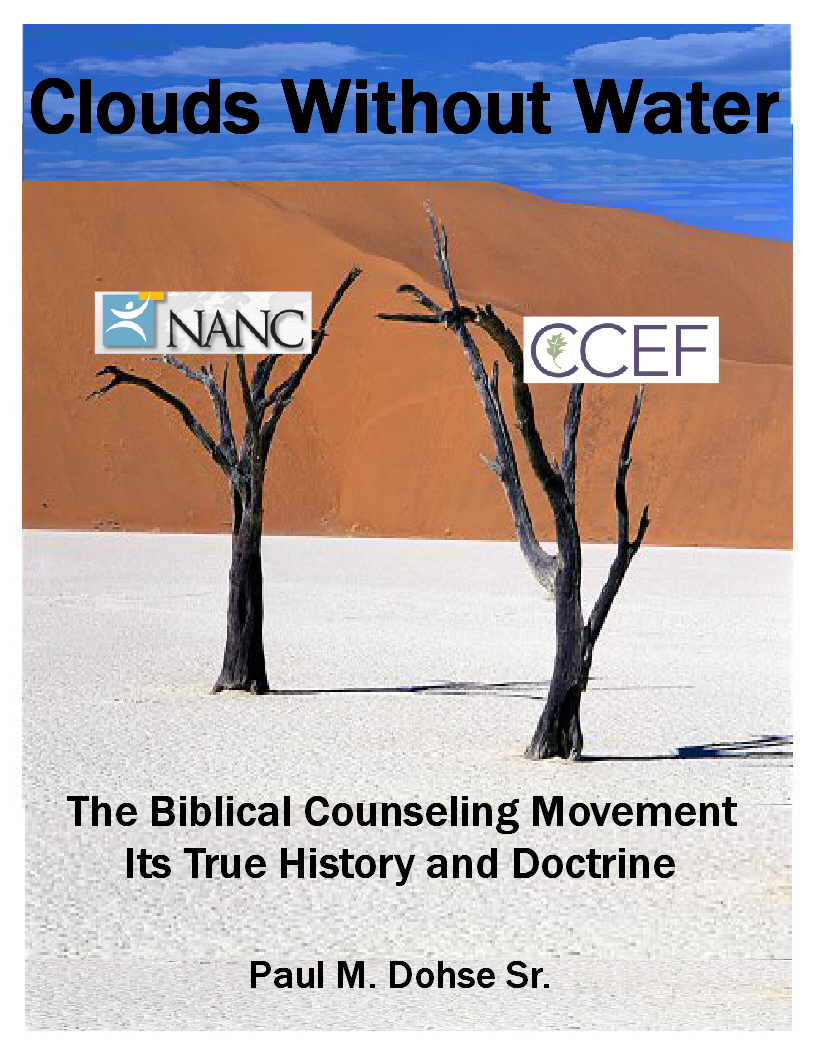
Ground Zero for Understanding the Biblical Counseling Movement
 “I believe this will go down in church history as one of the most grotesque betrayals ever perpetrated on a man in the name of friendship and the gospel.”
A Chapter Theses for Clouds Without Water: The Biblical Counseling Movement; It’s True History and Doctrine
In the Beginning, Plato, and then Augustine.
During the first century, the upstart assemblies of the risen Christ suffered a viral affront from Gnostic sects. The first century church was made up of people from all socioeconomic strata, and the Gnostics infiltrated Christianity for that purpose. Those in the first century church well-endowed with money were a valuable resource, and this is who the Gnostic sects primarily targeted with their false doctrine.
Gnosticism has always been about elitism, power, and money. If you want to see an immaculate mural of the American church, read Philip J. Lee’s “Against the Protestant Gnostics.”
Gnosticism finds its roots in the philosophy of Plato. Every American born into the world should be thoroughly apprised of Plato the man and his philosophy. To understand Plato is to understand Western culture politically and spiritually. All the philosophers agree on this point. From there, the math is easy: Augustine was the father of Reformation doctrine, and a rabid follower of Plato. Augustine had little use for the Bible without Platonist insight, and considered Plato a Pre-Christianity Christian.
Of course, the favorite red herring is that Plato is not agreed with on every point, but the fact remains that his primary construct founded Reformed theology: the incompetence of man, and the need for a select few (the enlightened) to rule over the masses. Those with gnosis know how society best functions, and they know how the masses can find individual peace from the desires that rule over them.
The Age of Enlightenment (circa 1630) produced men who were the first to confront Plato’s construct successfully. The most formidable product of that movement was the American experiment which obviously turned out quite well. It was founded on the competence of the individual. The competition was the Platonist Puritans who unfortunately survived the voyage from Europe and wreaked havoc on the East coast. But fortunately, their worldview kept them from settling further inland. “Go west young man!” is hardly the motivational words of competence found among the purer forms of Reformed thought.
Let there be no doubt about it, the idea of merging church and state is grounded in the religion of man’s incompetence. The masses need the state to take care of them. Plato’s philosopher kings contrive orthodoxy, and the soldiers enforce it. This concept did not find its way into the Westminster Confession by accident. Even those who think the state should be separate from the church think a utopia would arise if the church ran the state. “Separation of church and state” doesn’t mean no theocracy, theocracy would be a good thing, supposedly. The state has always had an interest in ruling over religion because ideas are dangerous, and the church has always been a willing participant if the state agrees to enforce their orthodoxy. The battle between the two for the upper hand of control is the political intrigue that is European history in a nutshell. And that is how the world as we know it will end: the zenith of church statecraft as described in the book of Revelation.
This is Western history, and the children of the enlightenment would have no part of it on American soil. Ten years after the Declaration of Independence, James Madison successfully stopped a European style push for a church state in A Memorial in Remonstance Against Religious Assessments. For all practical purposes, it was an indictment against the fruits of European Reformed doctrine.
The Reformation’s Historical Cycle of Social Death and Resurgence
The Reformers, being children of Plato, didn’t interpret reality with a normative epistemology. Plato’s Achilles’ heel has always been the application of Eastern mysticism. Instead of reality being interpreted empirically, and a course of action being determined by discovery, conclusions are drawn by using interpretive gateways to the “pure” form of reality that is hopefully good. Plato thought it was good, but his interpretive gateway to reality rejected the five senses out of hand. Gnosis was the key.
The Reformers merely replaced gnosis with the personhood of Christ as a sort of stargate to reality. That reality was predicated on the difference between the unchangeable pure form of Christ, and the inherent evil of man dwelling in a world that constantly changes. Plato equated the pure forms with immutable objectivity, and evil matter with mutable subjectivity. Hence, today’s Platonist Reformers speak of the “objective gospel experienced subjectively.” This is clearly Plato’s metaphysical construct based on the incompetence of man in regard to interpreting reality. Like Plato, the Reformers of old and new alike bemoan man’s attempt to understand reality “in the shadows” of all matters that “eclipse Christ.” While donning the persona of Biblicism, pastors like Steve Lawson call for pastors to “come out from the shadows.”
This is the theme of books like “Uneclipsing the Son” by John MacArthur confidant Rick Holland. In his book, he hints at why purest Reformed theology gets lost in the minds of Christians from time to time and therefore needs periodic resurgences and rediscoveries. He notes in his book that good grammar makes bad theology. The mystic heretic Paul David Tripp makes the same assertion in “How People Change,” noting that a literal interpretation of Scripture circumvents the personhood of Christ and His saving work. What’s in an interpretation method? According to Tripp—your salvation.
This is the paramount point at hand: the Reformers did not interpret the Bible grammatically, objectively, exegetically, or literally at any point; they interpreted the Bible through the dual prism of “reality” seen in God’s holiness and our evil. The only objective truth is the person of Christ leading to a mere subjective experience of His power and grace manifestations. Hence, many Reformed purists in our day embodied in the New Calvinist movement speak of, “spiritual growth in seeing our own evil as set against the holiness of God.” Therefore, commands in the Bible become part of the narrative that helps us see what we are unable to do rather than commands to be obeyed. We merely seek to see, and wait for the subjective experience of “vivification.” The seeing is the “mortification.” Reformed theologians like Michael Horton explain this as a continual re-experience of our original baptism as we perpetually revisit the same gospel that saved us “afresh.”
This reduces the Christian life to experiences of perpetual rebirth found in Eastern concepts Plato borrowed for “practical life application.” This is the foundation of Historical Redemptive hermeneutics born of Reformed purism. This is also the interpretive method that is all of the rage in our day through programs like BibleMesh.
This is not the natural bent towards interpreting truth. We are wired to interpret truth objectively, and grammatically—tools like allegory and parables notwithstanding. This is why Reformed purism dies a social death from time to time throughout history. Thus, this metaphysical anomaly experiences “rediscovery” and “resurgence” movements. Be certain of the following: this is the New Calvinist movement in our day, and in essence, a return to the exact same viral Gnosticism that plagued the New Testament church with this caveat added: we by no means possess the doctrinal intestinal fortitude of the first century church.
Ground Zero: The 1970 Resurgence
1970 is ground zero for the present landscape of American Christianity. In that year, two movements emerged. Since colonial times, the third resurgence of Reformed purism was born through a project called the Australian Forum. In that same year, Dr. Jay E. Adams, a hybrid of Calvinism and Historical Grammatical interpretation, launched the biblical counseling movement. His movement was predicated on the competence of enabled congregants to counsel each other through the deepest of human problems. Adams also recognized the simple concept of anthropology and its relationship to helping people. Because all humans are created by God, what works well for the unsaved should work even better for the saved. If unsaved people who don’t violate their consciences are happier, this should also aid Christians in their walk with God. Bad ideas are simply bad for everyone, the ultimate need for eternal salvation notwithstanding. But that doesn’t mean you throw out the unsaved baby with the bath water of practicality. And in addition, does practicality show forth the wisdom of God and thereby point people to God? Should God not know what makes people tick? Moreover, what is the authority for interpreting human existence? Philosophy, or the Bible?
Adams’ biblical construct produced astounding conclusions, especially in areas where a medical model covered for escape mechanisms that create another reality for realties one may not like. If Bob is in big trouble, he merely becomes Ted, or maybe even Jane. This is a bad idea for Christians. Adams created a dichotomy between salvation and the Christian life. He believed in the utter incompetence of man to save himself, but abundant competence in colaboring with God for a victorious life over sin. With Adams, it is about CHANGE for the glory of God and the happiness of His people.
Thus, with the resurgence of Reformed purism at the same time, the battle lines were drawn, and a confusion of conflict emerged in the biblical counseling movement. The one predicated on the utter incompetence of man whether saved or unsaved, and the other predicated on the competence of the Spirit-filled Christian. The one predicated on Christians only being righteous positionally, and the other predicated on the idea that Christians are also practically righteous. The one predicated on contemplationism, the other predicated on obedience. This is the civil war that has raged in the biblical counseling movement from its conception until this day. It is for the most part a civil war of servility, lest two different gospels be separate, and careerism maimed.
The Forum doctrine quickly found footing at Westminster Seminary in Pennsylvania where Adams was a professor. The initial vestige of relevant infection was found in Dr. John “Jack” Miller, also a professor at Westminster Seminary. True, Westminster was founded by Reformed purists that believed the many acts of Christ’s righteousness were part of the atonement, not just His one act of death on the cross, but for the most part, the Reformation’s metaphysical anomalies had reduced Westminster to moderate Reformed ideology. If you will, a hybrid Calvinism that interpreted reality grammatically.
Miller changed that. While the doctrine was in the process of suffering a brutal death in Reformed Baptist circles by moderate Calvinists, being labeled as antinomianism, it found resurgent life at Westminster in Miller’s Sonship Theology incubator. The forerunner of this doctrine in Reformed Baptist circles, Jon Zens, discovered the doctrine in the early years of the Forum while he was a student at Westminster. He actually became heavily involved with the Forum in the 70’s, convincing them that everyday Covenant Theology would be a hindrance to infecting Christianity with the newly rediscovered disease. From that conversation came the birth of New Covenant Theology circa 1981. It was a significant addition to the present repertoire of elements that confuse the real crux of the issue. Till this day, few moderate Calvinists make this historical connection between New Covenant Theology and New Calvinism.
But it was a particular mentoree of Miller’s that saw Adam’s construct as a threat to the successful spread of the Forum’s rediscovery: Dr. David Powlison. Powlison, working closely with Miller, developed the Dynamics of Biblical Change which is a counseling construct based on Reformation purism. This became the counseling model for Westminster’s biblical counseling wing known as The Christian Counseling & Education Foundation (CCEF). Later, there was a proposal for an organization that would certify counselors for CCEF. Adams was opposed to it as it smacked of the kind of elitism that he was trying to avoid. Remember, Adams was all about the competence of the average congregant to counsel. But Purist Reformed ideology is all about elitism because Gnosticism is all about elitism; the two go hand in glove.
Show Me the Money
Gnosticism rejects the average man’s ability to understand reality. So, assimilation for purposes of functionality is the main concern; ie., that the masses are controlled by indoctrination that is not necessarily understood, but invokes behavioral goals. But another primary goal is the spiritual caste system that provides millions of dollars for elitist educators. In essence, these are the professional Sophists produced by Platonism. This is why Gnosticism always dwells in the upper socioeconomic strata, as Phillip J. Lee notes in the aforementioned book, Gnosticism is a rich man’s game. CCEF certified counselors are extremely rare in zip codes of average incomes less than $80,000 per year, and nowhere to found in zip codes of $50,000 or less. This of course, is very telling. Their conferences require registration fees of $300.00 per person or more.
Meanwhile, NANC Happens
Powlison followed a classic mode of Gnostic deception by seeking to be identified with the persona of Adams’ successful counseling construct while despising the doctrine as a supposed false gospel. To be more specific, he wanted to gain ground by being identified with Adams’ success, and with a deliberate long-term goal of destroying the historical grammatical approach to biblical counseling.
Unfortunately, and to the chagrin of Adams, the National Association of Nouthetic Counselors was born (NANC). “Nouthetic” counseling was a Greek term introduced by Adams and often associated with him. Therefore, Powlison et al were able to be identified with the tsunami like personal transformations of the Adams reformation as a jump start for their own construct, and with a long-term goal of destroying the competition. They did this so effectively that Adams was often thought of as the founder of NANC, which was never true.
Consequently, Adams experienced an increased persecution from within the contemporary biblical counseling movement that he founded. His counseling was dubbed “first generation” biblical counseling and referred to as nothing more than “producing better Pharisees.” I believe this will go down in church history as one of the most grotesque betrayals ever perpetrated on a man in the name of friendship and the gospel.
The fallout in our day is indicative of the spiritual carnage that has always been left in the path of Gnosticism. While the spiritual peasantry cries out in hopes that the elite will police their own, the Nicolaitans of our day laugh all the way to the bank. After all, subjective reality is messy business and peasants just don’t understand. The biblical counseling community has founded organizations who seek to keep them out of court and prevent the obscuring of cash flow. The New Calvinism movement is intrinsically connected by a complicated and massive network of associations—in many cases disagreeing with each other on “secondary issues.” A prime example is the G.R.A.C.E mediatory organization headed by Boz Tchividjian. While playing the part of advocates for the spiritually abused, they are professionally networked with serial abusers of the worst sort.
Conclusion
The biblical counseling movement embodied in New Calvinism is nothing more or less than a return to the exact same Gnosticism that plagued the first century church. The fact that Eastern mysticism is often the application can be seen by what happened at a Passion Conference where the who’s who of New Calvinism led the audience in a form of Transcendental Meditation. Tim Keller, a co-mentoree of Miller along with David Powlison in the early days, is a staunch advocate of Eastern mysticism as a practical application for Christian living.
CCEF, and NANC are the epitome of false advertising. They advertise the gospel and change, but believe in neither. Like the father of their faith, St. Augustine, it is Plato they trust. The banner over them is not love, but a sense of elitist entitlement to be paid and supported by the unenlightened masses for their own good. Sheep that don’t get it are more than expendable; the one in 99 is expendable for the 99 who know their place and pay the Shamans their tax deductible dues.
They invent and sell orthodoxy, the layman’s manual for experiencing perpetual rebirth. On the one hand, there is a Christianity that posits the living water that is received once, the onetime washing, and the moving on to maturity from the beginning principles of baptisms, and then there is the gospel of our day that posits the perpetual rebirth of Eastern mysticism.
But this is not a mere disagreement about how to live the Christian life. How we see the Christian life reveals the gospel that we really believe. When our salvation is not a finished work, something must be done by us to finish it—even if that means doing nothing with intentionality. NOT living by a list of do’s and don’ts is the work that keeps us saved. It is playing it safe by hiding our talents in the ground and giving the Lord back what He originally gave.
Christians would do well to choose which gospel they will live by in our day. At this point, that conversation has not arrived yet. And to be sure, many do not want the conversation to be clarified to that point. The gospel itself has become the elephant in the room.
paul
More on why New Calvinism Has Massive Appeal
 “So what is the appeal of New Calvinism? Basically, five things….”
Mass appeal, rarely commendable in the Bible, is an earmark of New Calvinism. But why? As cited in another post, this quote from a New Calvinist organization reveals one primary reason:
What, then, is the subjective power of this message? Firstly, we find that there is real, objective freedom, the kind that, yes, can be experienced subjectively. We are freed from having to worry about the legitimacy of experiences; our claims of self-improvement are no longer seen as a basis of our witness or faith. In other words, we are freed from ourselves, from the tumultuous ebb and flow of our inner lives and the outward circumstances; anyone in Christ will be saved despite those things. We can observe our own turmoil without identifying with it. We might even find that we have compassion for others who function similarly. These fluctuations, violent as they might be, do not ultimately define us. If anything, they tell us about our need for a savior (David Zahl and Jacob Smith: Mockingbird blog).
This enables New Calvinists to boast an objective, factual gospel, while claiming that the objective gospel functions subjectively. In other words, the gospel (Christ and His works) is factual, but obtaining a deeper and deeper knowledge of those facts imputes those objective facts to our lives subjectively. This enables us to live our Christian lives by faith alone, while leaving the subjective results to God. Our primary goal is to contemplate the two things that saved us (the gospel): God’s holiness and our sinfulness (faith and repentance), and then as we go about living our lives, we don’t have to take anything that happens too seriously because it is all preordained by God.
Tragedy is a good thing because it testifies to our need for Christ; good works give us joy as we “experience” them, but we really don’t know whether they are in “our own efforts” or conducted by God. It’s subjective. According to Martin Luther, if we believe that we did the good work, that’s works salvation. If we attend our good works (as Christians) with fear that it could be us who did it and not God, that’s venial sin and not mortal sin. Hence, part of the New Calvinist daily repentance regiment is asking forgiveness for good works that we have done just in case it was us who did them. All in all, it insulates from responsibility for sin, and enables us to detach ourselves from negative emotions. Joy is a result of God’s goodness and good works. Tragedy reminds us of what we deserve and what God has saved us from—it’s just more good news!
Further appeal can be seen in a recent post by Dr. Ed Welch of CCEF. He starts off with the usual metaphysical curve-ball that seems to come in straight with the idea that our faith is objective truth. Then when he gets us swinging at that pitch, it curves with….
Faith is a way of seeing
Scripture is also fond of describing faith as the way to see God’s realities. ( By: Ed Welch Topics: Faith Published: July 17, 2013 http://www.ccef.org/blog/what-faith).
Welch continues to expound on how the subjective facts of the gospel leads to subjective “reality”:
With the naked eye we can see the physical world, but faith—which comes by hearing the word of God—allows us to “see” the Creator of the physical world (Heb. 11:3). Faith allows us to see that Jesus is the Word, the Son of God, the Rescuer of the world.
With a twisting of 2Corinthians 4:18, Welch, like all New Calvinists, attempts to make the case that the physical world isn’t what really needs to be “seen” because the physical can be seen and therefore is not of faith. Hence, the Bible is to be used to see the Savior only, leading to a faith that enables us to see beyond the physical. In other words, borrowing his terminology, the Bible enables us to “see” beyond creation to the Creator Himself. Of course, this is merely hanging Bible verses on Plato’s Theory of Forms.
Welch then explains, in the same post, a technique that can be added to Bible induced gospel contemplationism:
One way to use this perspective on faith is to pray with another, “Lord, open our eyes. Help us to see what is really happening.” And then ask at the end of your time together, “What did we see?”
Here at the Potter’s House, what we study, what we read, is what you get. To the contrary, in this technique also promoted by John Piper and many other New Calvinists, the Bible speaks to you, presumably through the Spirit, subjectively, following a gospel-centered contemplation of the Scriptures. The plain sense of Scripture can now be traded for subjective experience. Apparently emboldened by the mindlessness of American Christians, Welch further explains this approach with the following:
Another way to use this is to encourage others to live with their eyes closed. Let me explain. The world that is available to our physical senses can dominate our spiritual sight. Physical trials, fiscal uncertainty, the safety of those we love, the intrusion of hard pasts—this whirlwind can blind us to the spiritual realities that are deeper and longer lasting. So in a sense, we need to close our eyes to the circumstances of life, so we can open them to hope. It might happen like this:
“What do you see?” ‘I see the rejection of my spouse.’ “Close your eyes, and keep looking. Look around with eyes of faith. Now what do you see?” ‘I see the rejection of my spouse.’ “Okay, keep your eyes closed and look at the world through the lenses of Ephesians 1, now what do you see?” ‘I see . . . nothing.’ “No problem, we just need help. Let’s pray, which, in itself, is an expression of how we see by faith.”
The important point is that you are closing your eyes—not as a form of denial—but as a way to see more.
Welch then completely mocks discernment by suggesting that people are saved by reading Christian mystics like CS Lewis:
Back to the story, my friend became cynical toward his friend’s beliefs, but he was still a seeker. Soon after he graduated from high school, a co-worker gave him Mere Christianity by C. S. Lewis. On the very first page he began to “see.” After taking the next eight hours to read through the book, he knew he wanted to follow Jesus, though he didn’t know what that meant, and he did not know one other Christian he could ask.
So what is the appeal of New Calvinism? Basically, five things:
1. It enables people to deflect the negative emotions of life and trade them for joy by disconnecting from the physical world. This idea is sanctified by eradicating all value of earthly things (and people) for Christ.
2. It gives a simplistic answer for everything. All events in life are to either glorify God or show us our worthlessness.
3. Escape from responsibility and accountability. “I sinned? Well duh, that’s what sinners do.”
4. We already know what every verse in the Scripture is about, and by meditating on that, we can have a subjective result of our own choosing.
5. It eliminates the hard work of studying and wrestling with truth. Every verse is about Jesus, and the results are automatic. Also, hard work in spiritual matters is works salvation. As Calvin and Luther believed, sanctification is represented by the Sabbath rest. If you work, you die; hence, no work is more good news!
6. The Reformed, “power of the keys.” This is the idea that whatever Reformed elders bind on earth will be bound in heaven whether right or wrong. Hence, by merely staying in the good graces of your local neighborhood elders, you’re guaranteed to be in the graces of God. You’re in because the elders say you’re in.
http://apprising.org/2012/01/06/beth-moore-and-john-piper-lead-lectio-divina-lite-at-passion-2012/

 Paul's Passing Thoughts
2 comments