LOL! John Piper Would Only Change “One Thing” About John Calvin
Originally published May 14, 2012
….and by the way, we are all totally depraved; so you know, stuff happens.
In this video, Piper forgets a lot of history about Calvin. Listen to the short clip, and then read the following excerpt from a church historian. Listen, I’m really busy today, but it’s ok, I know the smartness/intelligence of my readers; they are not going to take Piper’s word that ONE of the people Calvin had murdered taught false doctrine about the Trinity. Remember, New Calvinists believe that emphasizing the other two members of the Trinity as much as Jesus is misguided “emphasis” and therefore a false gospel (please don’t make me dig up the Michael Horton quote on that one).
In preparation for TTANC volume 2, I am studying the teachings of theologians who contended against Calvin in his day. Very interesting, seems that some of them had a problem with Calvin’s view of the relationship between sanctification and justification. Sound familiar?
Furthermore, Piper states that the melding of church and state didn’t serve the Puritan legacy well. Oh really? This ministry is inundated with information that I unfortunately don’t have time to pursue regarding consolidated attempts by the New Calvinist movement to get in bed with the government. Trust me, they would luuuuuuuvvvvvv to silence their critics through law enforcement—starting with bloggers. In fact, the present cases on this are not that hard to find: lawsuits; outrageous defamation of character; bogus church discipline; blackmail; coercion border-lining on outright kidnapping ; etc. On the last one, I know of an actual case right now and am working with the situation. The New Calvinist church is holding an individual hostage (in regard to remaining under their authority via church membership) because of what the person knows about the church. They “have something” on the individual and are using it to control them. Which, by the way, is a criminal act according to the state law where the church is located.
Piper is right about one thing: job one for the founding fathers of America was to make sure the church did not get back in bed with the government on this side of the pond. Particularly, churches of the Reformed type, which were barely less forgiving than Rome towards those who disagreed with them. Also like Rome, the Reformers were a little uncomfortable with the free reasoning of mankind in religious issues. Consider this soundbite from Martin Luther:
“Reason is the Devil’s greatest whore; by nature and manner of being she is a noxious whore; she is a prostitute, the Devil’s appointed whore; whore eaten by scab and leprosy who ought to be trodden under foot and destroyed, she and her wisdom… Throw dung in her face to make her ugly. She is and she ought to be drowned in baptism… She would deserve, the wretch, to be banished to the filthiest place in the house, to the closets.”
—Martin Luther, Works, Erlangen Edition v. 16, pp. 142-148.
“Reason is the greatest enemy that faith has; it never comes to the aid of spiritual things, but—more frequently than not—struggles against the divine Word, treating with contempt all that emanates from God.”
—Martin Luther, Table Talks in 1569.
“Heretics are not to be disputed with, but to be condemned unheard, and whilst they perish by fire, the faithful ought to pursue the evil to its source, and bathe their heads in the blood of the Catholic bishops, and of the Pope, who is the devil in disguise.”
—Martin Luther, Table Talks (as quoted in Religious History: An Inquiry by M. Searle Bates, p. 156).
In other words, Luther would not have thought much of the “NOBLE” Bereans. And again, Piper is right because the founding fathers of America were a product of the Enlightenment era. I’m thinkin’ they didn’t agree with Luther’s attitude toward free thought; unless of course, it was Reformed, and preferably Augustinain, a forefather of Gnosticism.
As the Institutes of the Christian Religion greatly influenced the theology of the Reformation, Calvin’s Ecclesiastical Ordinances greatly affected the structure of many Reformed churches and their relation to the community. One major element of the Ecclesiastical Ordinances was the Consistory, the central church governing apparatus, composed of ministers and elders. Its purpose was to maintain ecclesiastical discipline and theological orthodoxy, but when the social community of the city is identical to the church community, the result is that ecclesiastical discipline and religious heterodoxy have social implications. Very quickly church offenses become civil offenses or at least offenses with civil consequences, as the medieval Church came to see.
The Consistory oversaw the conduct of the believers-citizens of Geneva down to the minutest detail, intervening with disciplinary measures such as public rebuke and excommunication. But because the civil and the ecclesiastical authority were so closely intertwined, condemnation by the Consistory could lead to civil punishments such as public fines and even exile and execution. People were brought before the Consistory for every sort of offense, including petty ones such as singing jingles critical of Calvin, card playing, dancing, and laughing during a sermon. The Consistory also sent out members to each parish to look for transgressors, who, if discovered, were tried by the Consistory. Every household was visited annually, before Easter, to ascertain the status of prospective communicants. If Geneva was the “Rome of the Reformation,” the Consistory was its Inquisition and Calvin its Pope.
Geneva under Calvin’s influence controlled its citizens’ lives, including their private lives, well beyond what the medieval Church did. The individual Christian in the Church of Geneva was “free” to interpret the Bible for himself, provided he interpreted it exactly as Calvin did.
Was Calvin a “dictator”? Surely not in the conventional sense. He held no elected office, nor did he exercise direct political power in Geneva. He was mainly a pastor, not a politician. And yet we mustn’t go as far as some of Calvin’s supporters, who say he was “simply” a pastor. He possessed tremendous influence in the political community, well beyond that of a mere civic leader. And that influence translated directly into civil law strictures and punishments. Geneva was not an absolute State, in the modern sense, but neither was it a free state, except perhaps for those who already accepted its rigid norms of conduct.
A prime example of Calvin’s influence in Geneva is the case of Pierre Ameaux, a member of the city council, who had criticized Calvin as a preacher of false doctrine. The council told Ameaux to retract his statement, but Calvin wanted a harsher punishment. Ameaux was forced to go through town dressed only in a shirt, with a torch in hand.
Ameaux’ fate was a mere embarrassment; the embryonic freethinker Jacques Gruet was executed for criticizing Calvin, for blasphemy and for protesting the stringent demands of Calvin’s Geneva. He was tortured and beheaded. Calvin also got Jerome Bolsec banished for the Frenchman’s disagreement with Calvin regarding predestination, thus proving that, while Geneva was a haven for Protestants throughout Europe who agreed with Calvin, it could be oppressive for those who did not.
But the most celebrated case is that of Michael Sevetus, who didn’t get off as lightly as Bolsec. The Spanish physician-writer took it upon himself to reformulate the doctrine of the Trinity in what were essentially Gnostic categories. But Sevetus made the mistake of sending Calvin an advance copy, which led, by a rather Byzantine route, to Calvin tipping off the Catholic magistrates in Vienna that the heretical Sevetus was practicing medicine in their city. That brought the apparatus of the Inquisition down on him. Sevetus managed to escape and wound up, in all places, Geneva, en route to Naples. Calvin had him arrested, tried and sentenced to death. As an act of mercy, Calvin requested that Sevetus be beheaded, instead of burned, but in this case Calvin’s request was not honored (http://goo.gl/1Y1u5) [sic].
Tchividjian Booted from The Gospel Coalition for Being Too Concise
 “Tullian Tchividjian is John Calvin. Period.”
Be sure of this: Tullian Tchividjian thoroughly understands Reformed doctrine and its gospel. Tchividjian doesn’t believe one whit different from anybody who writes or speaks for The Gospel Coalition, and they ALL know it.
The problem with TT is that he does not follow the philosopher king script of nuance for the sake of the totally depraved herd that is “not ready” for the true Reformed gospel of justification by faith…plus the dirty little secret of faith alone for both justification and sanctification. It’s like total depravity this, and total depravity that, and “oh, we forgot to mention that includes the saints as well.”
TT is not nuanced enough. In this interview here, it is absolutely clear that this is the reason he was sent packing. Because of him, The Gospel Coalition, T4G, and others have to recruit sanctification gurus Jerry Wragg, Kevin DeYoung, and Mike Fabarez to cleanup his mess and calm the mindless totally depraved zombie sheep. They are tired of cleaning up the messiness of questions raised as a result of TT’s accurate articulation of the Reformed gospel.
There is only one thing better than a rank antinomian, an honest one. Charles Spurgeon once said that Calvinism isn’t a nickname, Calvinism is the gospel. Let me take that a step further for our purposes: Tullian Tchividjian is John Calvin. Period. I will debate anyone out there who has a problem with TT’s Calvinism and will show clearly from the Institutes that TT is spot on. Get over it. Please debate me on this, you will lose.
In my disdain for the Neo-Calvinist movement, a weird respect is floating to the top for the few who know what Calvin really believed and are honest about it. In fact, who else is there other than TT and Joseph Prince? (see here for explanation). How bad is it when I have to admit that I respect these guys because A, they know what they are talking about, and B, they are honest about it? Prince’s life application is beside the point, he understands the Reformed version of justification by faith, and the rest of the story mostly untold.
The two other camps annoy me to no end: those who think there is a difference between New Calvinism and Old Calvinism, and for that matter, Sonship theology as well, and those who know grade-A-well that there is no difference and are lying about it. I have also lost all patience with those who think they can help the spiritually abused while retaining some supposedly respectable remnant of Reformed theology. Name one aspect that passes a grammatical interpretation of Scripture: it’s not there.
So there it is. TT is very important to this ministry because people have to know what they believe before you can convince them. We think followers of TT know what they believe. The rest? It’s really just a massively confused personality cult with a plethora of discernment bloggers adding to the confusion by dissecting all of the symptoms.
Get with the program: it’s either Tullian or something else.
paul
The Reality of Reformed Theology
 “Reformed theology, or if you will, Calvinism, is not a theological debate; it is a philosophical debate concerning the question of how we interpret reality itself.”
The philosopher Friedrich Wilhelm Nietzsche, a proponent of ideas that I find disturbing, once stated the following: “In Christianity neither morality nor religion come into contact with reality at any point.” Perhaps he confused Christianity with the Reformation.
The fact that I agree with Nietzsche on this point is completely beside the point; the Reformers themselves stated exactly what Nietzsche said. To say that Luther stated in his Heidelberg Disputation that mankind in general, and Christians in particular are unable to understand reality or morality is beyond fair. Obviously, no belief touches anything it doesn’t believe in.
You don’t have to be a rocket scientist to figure any of this out, you only need to listen carefully: “The centrality of the objective gospel outside of us.” “The subjective power of an objective gospel.” “The Objective gospel.” “The objective gospel experienced subjectively.” These are all contemporary restatements of Luther’s Heidelberg Disputation. This is only complicated to those who have lost the art of asking themselves questions and knowing that words mean things.
When God created the earth and reality, he also created the epistemology to go along with it. He created light and said, that’s light. The word, “light” interprets what light is. Therefore, when someone talks about light, we understand what they are talking about. God even colabored with man to develop much of the epistemology by asking him to name the animals.
Then the serpent came along and in essence said to Eve, “Yea, has God really said, ‘That’s a cow’? Eve, you can’t draw conclusions through mere words, you need to go beyond that and see the knowledge of good and evil.” Likewise, Reformed teachers like Paul David Tripp teach that the literal meaning of words cannot interpret a “gospel context.” The likes of Rick Holland state that good grammar makes bad theology. Grab your metaphysical wallet and hold on to it tightly lest your philosophical pockets get picked.
The “objective gospel” (for instance, see objective gospel .org) is Luther’s cross story, and the subjectivity of it (how we experience the gospel) is Luther’s glory story.
Objective: (of a person or their judgment) not influenced by personal feelings or opinions in considering and representing facts.
Subjective: based on or influenced by personal feelings, tastes, or opinions.
One of the major tenants of the Heidelberg Disputation and Reformed theology in general is the idea that it is impossible for mankind in general and Christians in particular to approach ANY truth WITHOUT presuppositions; ie., subjectivism. Also, only the gospel is objective. ALL reality must be interpreted through redemption. Hence, the first tenet of New Covenant Theology which is a spinoff from Neo-Calvinism:
New Covenant Theology insists on the priority of Jesus Christ over all things, including history, revelation, and redemption. New Covenant Theology presumes a Christocentricity to the understanding and meaning of all reality.
Any questions? In case you do, consider this quote by the father of contemporary Reformed hermeneutics, Graeme Goldsworthy:
If the story is true, Jesus Christ is the interpretative key to every fact in the universe and, of course, the Bible is one such fact. He is thus the hermeneutic principle that applies first to the Bible as the ground for understanding, and also to the whole of reality (Graeme Goldsworthy: Gospel-centered Hermeneutics; p.48).
This is why the objective gospel, according to Reformed thought, must remain outside of us and only experienced through faith in it alone. This gospel alone must define who we are. The only thing man can know is that he is evil and God is good, EVERYTHING else is conformed to his own distorted individualist presuppositions. His life must be guided completely by something outside of him. Everything within is subjective. The idea that man can know anything objectively is Luther’s glory story. It’s all about the glory of man and not God. It’s either everything or nothing at all. If man has any merit or worth at all, he has ravaged God’s image. He must trust completely in the cross story. This is the foundation of the Calvin Institutes stated in 1.1.1. The Institutes are not only based specifically on Luther’s metaphysics, but the premise is eerily similar to the knowledge of good and evil propagated by the serpent.
The staple assertion during the infancy of the present Neo-Calvinist movement was the often heard idea that this new resurgence was needed because Evangelicalism was drowning in a “sea of subjectivism’:
Now, if the Fathers of the early church, so nearly removed in time from Paul, lost touch with the Pauline message, how much more is this true in succeeding generations? The powerful truth of righteousness by faith needs to be restated plainly, and understood clearly, by every new generation.
In our time we are awash in a “Sea of Subjectivism,” as one magazine put it over twenty years ago. Let me explain. In 1972 a publication known as Present Truth published the results of a survey with a five-point questionnaire which dealt with the most basic issues between the medieval church and the Reformation. Polling showed 95 per cent of the “Jesus People” were decidedly medieval and anti-Reformation in their doctrinal thinking about the gospel. Among church-going Protestants they found ratings nearly as high (The Highway blog: Article of the Month, Sola Fide: Does It Really Matter?; Dr. John H. Armstrong).
And what was the gist of that survey specifically? An illustration from the cited article follows:
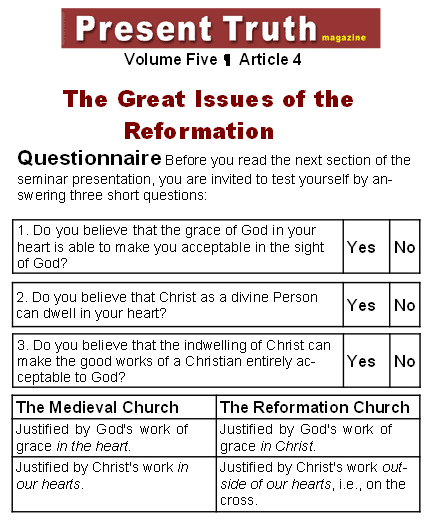 Reformed theology, or if you will, Calvinism, is not a theological debate; it is a philosophical debate concerning the question of how we interpret reality itself. This is a question of whether or not man can comprehend reality, and the structuring of society accordingly. Throughout history, this debate has always ended up in an arena where life and death are determined. This is not a theological debate this is a debate that determines what kind of world we will be living in. Nietzsche was right in regard to a “Christian” nomenclature of Reformed thought; it holds to the idea that truth and morals are objective and unattainable while in this subjective world.
paul
Excerpt: TANC Volume 2
 “In pondering how to best describe John Calvin’s historic inhumanity, one wonders which particular trees best describe the forest.”
Calvinism’s Parasitic Deception: How the Puritans Hijacked the Great Awakening
The writing of The Truth About New Calvinism—Volume 2 is in full throttle. From time to time, I would like to share some things that I am stumbling upon as I define my research of the past three years.
Many thanks to those who have helped me define the direction of volumes two and three. Volume 2 is guaranteed to be understandable. This is the unveiling of Calvinism’s fundamental detriment to Christianity and humanity in general. It doesn’t matter whether you understand the doctrine or not; volume 2 will trace and define the logic that formed the doctrine. From there, the assumption that the ideology is dressed up in Bible verses to look, sound, and feel biblical is a correct one. Volume 2 is for the layman, volume 3 will be an in-depth theological evaluation for those who want it. Once the ideology that formed the doctrine is understood in volume 2, volume 3 may be easier to understand.
If it can be confirmed that the Reformers used the Bible to sell an ideology, and it can, and they did, what they came up with is fairly irrelevant. Not only that, volume 2 will examine the fruits of the doctrine which is also telling. In order to sell the ideology, the Reformers proffered a theological treatise from the Bible. Volume 3 will demonstrate why that doesn’t even hold water.
One character trait of New Calvinism is to exploit the overall lack of education concerning its history, ideology, doctrine, and character. New Calvinism, the authentic Reformed article, is looking for a result based on covert assimilation. The result that is sought is CONTROL. This control is sought through justification by faith alone which is a doctrine that is literally justification alone because it eliminates sanctification. Stated in layman’s terms: it emphasizes the work of God while deemphasizing anything the Christian does in salvation or post-salvation. This is done by out of sight, out of mind. If you only teach justification (salvation) to the exclusion of sanctification (the Christian life), the masses will eventually live according to the Reformed version of justification alone. The Reformers were masters at redefining the terms and teaching sanctification in a justification way.
This leads to the Reformed practice of infiltrating religious movements throughout history as a stowaway and then taking over the movement. The prime example is the Great Awakening (1730s – 1790s). The Great Awakening was a pushback against Reformed ideology, not the result of it. The Pilgrims created the need for the Great Awakening. The Pilgrims, a soft idiom for “Calvinistic Puritan political refugees,” brought European tyrannical polity with them. The motif that the Pilgrims came to America for religious freed is patently false—they came to establish their own vision of a church state. To this point:
Throughout the colonial period, and even in the early years of the independent United States, most colonies or states had established churches—churches legally recognized as the official state church. Different colonies privileged different Christian sects, for example, Congregationalism (the descendent of Puritanism) was the official state church for Massachusetts, Connecticut, and New Hampshire; and Anglicanism was the established faith in most colonies, including Virginia, South Carolina, and Georgia. Along with official recognition came special privileges, like financial support from public taxation. Before the Great Awakening, colonial Americans harbored no expectation that there should be any separation between church and state.[1]
In reality, there are NO religious movements that could be considered legitimate revivals post apostolic church until the Great Awakening which was ignited by the Age of Enlightenment. The Enlightenment was predicated on the ideas of all men being created equal by God, and mankind’s ability to solve problems through reason. This resonated with colonials and slaves alike that were under European tyranny:
Joseph Tracy, the minister, historian, and preacher who gave this religious phenomenon its name in his influential 1842 book The Great Awakening, saw the First Great Awakening as a precursor to the American Revolution. The evangelical movement of the 1740s played a key role in the development of democratic thought, as well as the belief of the free press and the belief that information should be shared and completely unbiased and uncontrolled. [2]
Enlightenment ideas were completely contrary to Reformed thought as exemplified by the Westminster Confession.[3] Most of the Westminster Divines were Puritans. Colonial Puritans believed in slavery according to their extreme European caste mentality, and executed doctrinal detractors. Contra Enlightenment ideas that ignited the Great Awakening can be seen in the present-day New Calvinist movement; for instance, an article written by New Calvinist James MacDonald bearing the title, “Congregational Government is From Satan.”
Nevertheless, Reformed hacks like Jonathan Edwards infiltrated the Great Awakening, and to a large extent hijacked it. The Great Awakening was a revolt against the organized institutional church state, and was a gargantuan human mass of people searching out new ideas. Hence, the thousands who showed up to hear Reformed teachers during that time were not necessarily enthralled by the supposed gatekeepers of the Awakening, but were flocking to hear anyone who had an idea. Edwards et al proceeded to connect the movement to the Reformers of old who were the ones directly responsible for the tyranny that the colonials were experiencing in the first place.
Moreover, the colonial Puritans wasted no time in trying to infiltrate the American Revolution, its founding declarations, and constitution. James Madison fought the infiltration tooth and nail with his Memorial and Remonstrance Against Religious Assessments.
Unfortunately, the colonial Puritans did succeed in identifying Reformation thought with the Great Awakening. The many denominations and groups that were created by the Awakening usually, and unwittingly, identified themselves as Protestants. As a result, the primary Reformed institutions of learning[4] were built with money from the children of the Great Awakening who were really the product of Benjamin Franklin’s contra ideology. Incredibly, and undoubtedly the zenith of historical misrepresentation, those of Reformed thought who hijacked the Great Awakening have been credited with the Abolitionist movement. The Abolitionist movement was nothing more or less than an Enlightenment idea, while the Puritans were the first to bring slaves to the shores of America (ironically, slaves brought many cultic beliefs with them that in part incited the Salem witch trials).[5] The Enlightenment era was directly responsible for the massive conversion of slaves to Christianity shortly after the signing of the Declaration of Independence. The ideas of freedom and reason ignited colonial revivalism, not the contra idealism of the Reformation. Franklin was an abolitionist while he was governor of Pennsylvania, and the epicenter of revivalism among the slave population was Philadelphia.
This form of parasitic deception and covert assimilation is a Reformed hallmark. Those of Reformed idealism, historically, do not build anything. The Pilgrims were utterly inept in fending for themselves in the new world. They latch on to what is alive and feed off of it. Their very institution is a historical Ponzi scheme. A contemporary example is the home church movement in America. Because of the fundamentals that came out of the Great Awakening, the American church remained fundamentally Reformed in its overemphasis on justification because sanctification infers human ability. Therefore, per the usual outcome, a mass exodus from the institutional church began in circa 2000. This resulted in the home church movement. According to the Reformed mode of operation, New Calvinism hijacked that movement as well, primarily for self-preservation. This is the motivation for flock groups and “churches” like Apex. However, they are not purely home churches, and are connected to a central institution in order to maintain control.
A proper understanding of church history is the key. Until then, Reformation thought will continue to suck the life blood out of anything that lives in Western church culture.
Endnotes
1. Shmoop Editorial Team. “Religion in The American Revolution” Shmoop.com. Shmoop University, Inc., 11 Nov. 2008. Web. 30 Oct. 2013.
2. Wikipedia.org: Great Awakening.
3. Paul Dohse: Inseparable: The Reformation’s Principles of Persecution and its Gospel; Paul’s Passing Thoughts .com, August 31, 2013.
4. Columbia University (King’s College, 1754, Anglican), Brown University (Rhode Island College, 1764, Baptist), Rutgers (Queens College, 1766, Dutch Reformed), and Dartmouth College (1769, Congregationalist).
5. 1619: Slavery begins in the colonies, as twenty Africans are brought by a Dutch ship to Jamestown for sale as indentured servants. 1664: Maryland makes lifelong servitude for black slaves legally mandatory. Similar laws are later passed in New York, New Jersey, the Carolinas and Virginia. 1667: The Virginia House of Burgesses passes a law that binds blacks to servitude, even if they convert to Christianity.

 Paul's Passing Thoughts
leave a comment