My Reply to Linda: Yes, I Am a Christian, But Not Sure You Are
 I am presently in the process of eliminating my personal Face Book account. A ministry account will be maintained for the TANC blog, Paul’s Passing Thoughts .com, and overseen by Pearl the PPT moderator. I recommend people befriend that account if they want to stay connected to our ministry.
The reason is simple: I no longer have patience for the evangelical regurgitation of orthodox talking points. Protestants don’t own their own faith that they have seen in the Bible with their own study. What they think they see and understand is what Protestant academics have told them, including the idea that they have authority to tell them what to believe. So, what is wrong with church? Church is wrong with church because it is predicated on a false gospel. That’s right, the Protestant Reformation was a false reformation founded on a false gospel. And this is why Dr. James White and others have refused to debate me publicly; the Protestant gospel as stated in its orthodoxy is the biblical definition of a lost person…under law as opposed to under grace.
Martin Luther and John Calvin et al proffered a gospel that is under law, but that is supposedly OK because Jesus keeps/kept the law for us and that obedience is imputed to our Christian status. This is a perpetual covering of sin, or sometimes referred to as “atonement,” but not an ENDING of sin that requires no further justification. Hence, we must “preach the gospel to ourselves every day” to “keep ourselves in the love of God” (CJ Mahaney) etc. White and others know that this is a simple matter of theological math, and do not intend to address it until enough people catch on. The only case they can make presently is for a historical-redemptive interpretation of Scripture that interprets every verse as a justification verse. Sanctification is defined as progressive justification via Protestant talking points.
So, while in the process of eliminating my personal Face Book account, I noticed a comment to me by a “Linda.” It follows:
“Are you a Christian Paul? And secondly do you believe that the Bible is the inspired Word of God? That would be my two questions for you. Romans says, ‘There is none righteous, no not one.’ That includes you and me. This doesn’t mean that we never do a kind act or good deed. It means that we don’t and can’t do enough of them to be declared ‘RIGHTEOUS’ by God. We could never do enough good deeds and kind acts to get us into heaven. Therefore we need the righteousness of Christ imputed unto us in order to go to heaven. God imputes this kind of righteousness to those who believe and accept HIS son Jesus and his shed blood as atonement for their sins and their UNrighteousness. We are part of God’s family by adoption. Nothing can make us righteous enough to go to heaven. The righteousness that is applied to our never dying soul can only come from Christ. The ‘part and parcel’ of our own being is puny compared with what God demands. In one place in scripture our puny ‘part and parcel’ is described as ‘filthy rags.’ So our own human effort at righteousness is from our flesh. Our flesh is not saved from sin and unrighteousness. Only our soul is. We are not capable of learning and loving enough to be declared righteous enough for heaven. We could learn and love enough to help another person with a kind act or good deed. But that does not fit our soul for heaven. I don’t understand your third question……’Christ imputing sin’ ????”
Her comment was in reply to previous comments made in regard to a post. She was replying to a comment I made regarding her initial comment. Her initial comment follows, and afterward my reply:
“I am a never dying soul whom Christ died and rose for, approved of by God because I have HIS righteousness. Just by learning and loving we are different. Better means ‘improved in some way.’ Not hard questions for me.”
“Linda, where does the Bible say you have the righteousness of Christ? That’s the first question. The second: Are we only approved of God because we ONLY have the righteousness of Christ and none of our own? What about the new birth? If we are literally born of God and now part of His lineage, would that not make us righteous? Do you mean to say that we have a righteousness LIKE Christ’s because we are a member of the same family, or ONLY His righteousness and none that is part and parcel with our own being? Are we truly righteous, or only declared righteous? Third question: was Christ’s role in salvation an imputation of sin AND righteousness, or just sin? On the one hand, you seem to state that we only have the righteousness of Christ, but on the other, you say we learn and love. How exactly do we learn and love if we ourselves are not righteous people? So, I am not trying to be a jerk here, I am simply resolute that Christians should have a clear definition of who they are. Yes, I know exactly what the Reformers believed about our identity, but I would like to see your clarification.”
This is the extreme Protestant cognitive dissonance resulting in the train wreck we call “church” that I no longer have patience for. People who are serious about following Christ need to take their true gospel and leave the institutional church for home fellowship networks. The institutional church is part and parcel with the authority that demands a denial of the obvious. Authority has replaced truth. Nevertheless, I do believe evangelicals will have to eventually address their under law gospel.
I will make this as simple as possible as I am weary of addressing it. Much, much, thanks to Andy Young who is helping to carry the water on this as well. Linda’s response is pretty much the Protestant gospel talking points that we hear often, and pregnant with cognitive dissonance. All in all, her answers to my questions are, “NO.” Please start by noting that. This is where we discuss another disservice the Reformers performed: adding chapters and verses to the Bible. This circumvents the need to read all of Scripture in context. You can form a theological argument by using John Immel’s pet peeve: Scripture stacking. Basically, Linda is using the same verses to argue for the same Protestant talking points that she has received from Protestant academics. As a result, if one examines her statements, the blatant contradictions are stunning.
Where to start? ALL of our works are filthy rags (Isiah 64:6), yet, we can do some stuff that is good? So, “all” doesn’t really mean “all”? Per the usual, Protestants profess a double false gospel because they don’t rightly understand the gospel taught by the father of the Reformation, Martin Luther. In fact, Luther taught that EVERY deed of man is evil, even those that appear good because man’s “good” deeds always have a flawed motive. Calvin taught the same. Hence, if one believes that we can do a good deed, that is “mortal sin” and cannot be forgiven by the church. But, if one believes that every work we do, even works that appear good, are actually evil, all of our sin can be forgiven by revisiting the same gospel that saved us, and that revisitation is only valid under the auspices and oversight of the clergy. This is Luther, this is Calvin, this is the Protestant gospel. I have documented this backwards and forwards as those who follow TANC Ministries know.
Now, for the Protestant part of this that Linda got right, and in fact a mainstay of Protestantism, but still a false gospel. Luther and Calvin orthodoxy already condemns her to hell, but they would agree with her making the law the standard for justification. Biblically, there is NO law in justification. The Bible testifies about justification, but law and justification are mutually exclusive. It doesn’t matter who keeps the law, there is no law in justification. What determines justification is the new birth. The law is strictly for love in the Christian life. Again, the law informs us about justification, and here is the information: law is not the standard for justification, the new birth is. The apostle Paul wrote the epistle of Galatians to make this very point. Again, I predict that folks are going to start catching on to this in the future and the who’s who of evangelicalism are going to have to make a defense; good luck to them as that attempt will be interesting. The Protestant under-law-gospel, also stated by Linda, has Christ fulfilling God’s “demands” in our stead when God’s only demand regarding justification is that we be born again.
In order to make the law the standard for justification, the Reformers resorted to Saint Augustine’s Neo-Platonism, which later became Gnosticism and wreaked havoc on the first century church. We see this in Linda’s talking points about “the flesh.” ALL of our works come from where? Right, the flesh which, like the Reformers, she deems as inherently evil. That’s Gnosticism. The Bible teaches that our bodies, or members, are “weak” not inherently evil. When the Bible speaks of the “desires of the flesh” and the “deeds of the flesh,” that speaks of when our members are used for sinful purposes. Obviously, if Linda would stop long enough to read her own Bible with her own understanding given to her by God, she would see that our body, or “flesh,” can also be used for holy purposes (Romans 12:1 among many other passages). And, what is more obvious than the fact that our bodies are declared to be the temple of God? Actually, a word study reveals that the Holy of Holies is being referred to.
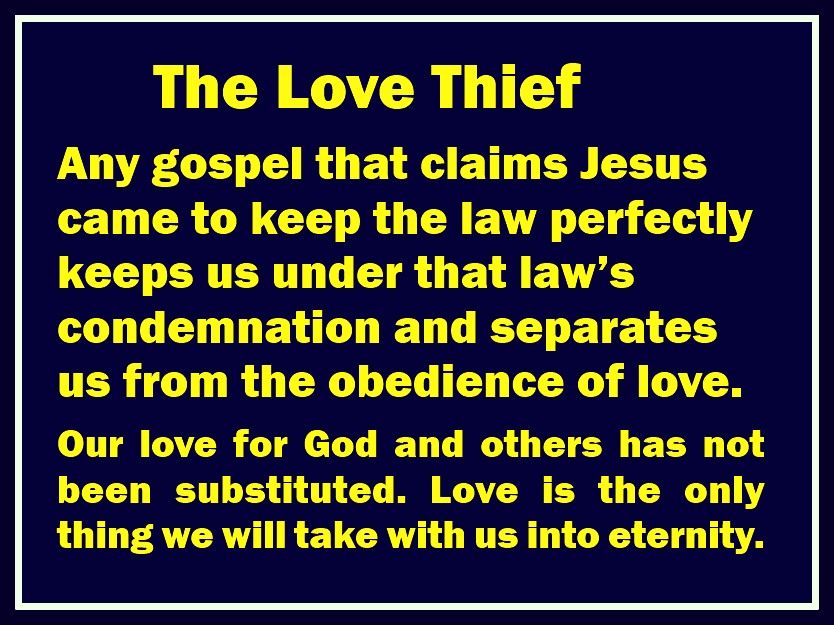
This brings us to Linda’s Protestant confusion in regard to the difference between salvation and redemption. The former is the saving of the soul, the latter is the saving of the mortal body which can be used for evil or good depending on which desires we are obeying. Christians, through the new birth, have the ability to obey the desires of the Spirit stated in the Bible and the ability to say “no” to evil desires that remain part of the body’s weakness and mortality. Because Christ ended the law through the new birth, sin has been stripped of its ability to enslave and condemn. If Christ obeys the law for us, we are still under it and enslaved to sin. The old us that died with Christ violated the whole law with every sin; the new us that was raised with Christ fulfills the whole law with one act of love. Christ didn’t come to obey the law for us—He came to END the law. Christ didn’t come to cover our sin—He came to END our sin.
A book could be written here, but time won’t allow it; nevertheless, let’s address Linda’s confusion, typical among Protestants, in regard to gift and reward. We cannot birth ourselves, but we can obtain the baptism of the Spirit by faith alone in “the promise” (see Galatians chapter 3). Once the gift is received, it is ours to utilize by loving God and others. Exercising the gift is not taking credit for the gift. The Bible states that God would be unjust to forget our good works and service to the saints (Hebrews 6:10). “Unjust”? Yes, because as those literally born of Him (1John chapter 3), and literally a part of His literal family, our reward is due us as siblings working for the Father. As a slave to the former master, we could only earn death wages—now we can earn true reward. Read the Parable of the Talents and see what the outcome is for those who fear and want to give God back only what was given and nothing more. It shows a fundamental misunderstanding of the new birth.
As a policy, I don’t judge the salvation of others. I believe that there are Protestants who are confused enough about Protestantism to be saved. So, yes Linda, I am saved, but I find your assurance that you are saved indicative of your confusion. Protestant orthodoxy CLEARLY states that the motor of sanctification moving justification forward is doubt of salvation because being under condemnation is part and parcel with being under law…the standard for justification according to Protestantism. In Calvin’s words, if “Christians” are not still under condemnation, what further need is there for Christ and His righteousness?
So Linda, I am saved, but I recommend that you start thinking for yourself. All of the Protestant academics you trust will not stand in your stead at the judgment. You will be standing there alone.
And you better have more than a covering with sin underneath it, you better be a literal child of God before Him.
paul
Good Works, Sin, and the Law
 “Tullian Tchividjian once said that his assurance, as far as he could have it, was based on the fact that he has never done a good work; that’s just good solid Protestant soteriology.”
“ Sin has a foe in both the lost and the saved…Child psychologists say their deepest challenges abide with children who have no conscience.”
Truth be known, most professing Christians are uncomfortable with the idea that salvation is a mere legal declaration by God based on a signed contract. According to the contract, we are declared legal by God if we denounce all self worth, declare all of our works and the works of others as “filthy rags,” and submit ourselves to “godly authority.” According to Luther and Calvin, we are in breach of contract if we think we can do a good work. And because of our supposed natural pertinacity to think we have some goodness within us, we can never be sure that we are upholding our end of the bargain. Tullian Tchividjian once said that his assurance, as far as he could have it, was based on the fact that he has never done a good work; that’s just good solid Protestant soteriology. Of course, this so-called gospel is couched in spiritual sounding terms like “covenant” and “grace” and “justification,” etc.
Most Christians are uncomfortable with what goes on in the institutional church, but what else is there? Protestantism, like all doctrines of tyranny, seeks to dumb down the masses they seek to control. Why? Because one of the major essences of sin is a desire to control. Collectivist doctrines and Sin have always walked closely together, and always will, be driven by low information. Protestants can make no sense of the world at all without paradox as a primary hermeneutic; and in fact, paradox is the primary hermeneutic of orthodoxy. Funny, if not so sad, would be the Protestant assertion that “walk by faith and not by sight” means that it is perfectly alright that life makes no sense at all. After all, we are “totally depraved,” and cannot really know anything except “Christ and Him crucified.”
The Catholic Church has never been shy about stating that information in the hands of the great unwashed is like handing a toddler a loaded gun, but Protestant academics skinned the cat a different way: knowledge about the fact that you can’t know anything is really, really deep, and shame on any saint that does not “study [this fact] to show yourself approved.” And, but of course there is work in the Christian life; as Tullian Tchividjian also said, seeking to see your depravity in a deeper and deeper way IS hard work! Again, because of our “natural” tendency to think we can do something good.
So, a knowledgeable Protestant will interpret the following event this way: a garage mechanic finds 10,000 dollars left in a car, and the former owner was unaware that her dead husband left it there to surprise her. He turned in the money to his manager; seemingly a good deed. But, this auto mechanic is going to hell because he thinks he did a good work. According to Luther and Calvin, believing you can do a good work is “mortal sin,” and the belief that one can fulfill any aspect of the law perfectly. Less knowledgeable Protestants are merely confused by these kinds of events because they, by design, have no real knowledge of biblical law/gospel.
First of all, we must begin with a very, very short philosophy lesson that dumbed-down Protestants don’t think they need. But, fact is, if you don’t have at least a basic knowledge of Gnosticism, you will be unable to understand little going on in the church today, if anything. However, I am going to make this very simple: holiness can dwell with weakness. The present creation, though fallen, is not inherently evil, but rather weak. Weakness does not equal evil. Let me demonstrate. Are the angels weaker than God? Yes, but are they also “holy”? Yes.
Our mortality makes us weak, and Sin abides in our mortal bodies, but Sin does not define mortality. We have the treasure of the new birth in clay (weak) vessels. Sin has a foe in both the lost and the saved. In the lost who are not born again, Sin’s foe is the law written upon the heart’s of every individual born into the world. The conscience is the judge that sits over this law and either accuses the individual or excuses them. Child psychologists say their deepest challenges abide with children who have no conscience. If the conscience (judge) has no law, there is no condemnation.
Hence, lack of a developed moral compass via teaching will generally determine the potency of a child’s conscience, and also determine one’s moral compass into adulthood. A judge without a law sits silently. We see this dynamic at work in the aforementioned article cited by the embedded link. Christ often noted that the law written on every person’s heart is a sort of thumbnail version of the more specific law that is the Bible. It is not uncommon for the secular “Golden Rule” to be biblically consistent. This is why the mechanic said he gave back the money; it’s the way he was raised (learned common decency that gives the conscience [judge] a law to work with), and he imagined how he would have felt if the money was his and he lost it (do unto others as you would have others do to you).
So did he do a good work? Yes, of course he did. He obeyed the law written on his heart by God. Will that good work save him? No, of course not. The conscience may temporarily reward him with good feelings, but that will not save him either. This is where we must segue into a little more philosophy. What is your perception of God? Is He an invisible aloof God that disdains everything material? Should we be amazed that He would even acknowledge our existence on any level? Or is He a God that makes Himself known and wishes to see all people saved? Does He actively push all to the precipice of salvation through the very design of His gospel? I think it is the latter, and this is where freewill comes into play: God creates a conscience and a law within us, but it is up to us to develop the conscience through choices. If parents understand this biblical dynamic, they have a clear choice in how they raise their children including the acceptance of contrary philosophies regarding the conscience.
So, God sought to further define what we will call the common heart law with the Old Covenant law, or the law of Moses. There are two laws being dealt with here, and Sin is against both laws. Therefore, the increase of law gives Sin more opportunity to condemn. Sin came into the world as an enemy of good, and its mode of operation is to incite rebellion for purposes of condemnation. Sin seeks the destruction of God’s creation on all counts. More law gives Sin more opportunity to condemn through sinful desires. Sin appeals to the individual through sinful desires, and those desires will prevail according to the strength of one’s developed conscience. Have no doubt: there is a warfare going on inside the unbeliever. Remember, the mechanic acknowledged that keeping the money was a desirable thought, but he knew that would be wrong, was not how he was raised, and wouldn’t be treating others the way he wants to be treated. Moreover, he probably knew his conscience would not allow him to enjoy the booty anyway.
The law is also good. The more law the better. The law is the standard for loving God and others. What if God ended the law’s ability to condemn and only made it useful for love? This would disarm Sin; if sin cannot condemn, it has no power, purpose, or incentive. This is where we talk a little bit about the gospel of Moses. The law can condemn leading to death, and it can love leading to life. As far as those born under the law, they can choose life or death, but ultimately, their end is death. They will suffer lesser death to the degree that they obey their consciences.
This is where the true gospel comes in according to the new birth. The law of Moses not only defines all sin leading to death, but it also defines all love leading to life. Until Christ came, all sin was imputed to the law as a possible indictment. The law held sin “captive” until “faith” came. Of course, the law could still be used to love as well. Christ’s primary gospel role was to die on the cross to pay the penalty of sin, and thereby ending it. Sin or the law? Both. Christ’s death ended the law’s ability to condemn. His death on the cross paves the way for the Spirit to baptize a believer in His death, and resurrect the believer in the same way He resurrected Christ. The new creature born of God cannot be condemned by the law, and therefore, Sin is stripped of its power. That is, IF the believer knows this. Sin can still make an appeal through desires, but the new birth counters that with NEW DESIRES infused by the new birth, specifically, a love for the law that did not previously exist. A believer can still experience the consequences of temporary death from disobedience and the fear thereof, but not the fear of eternal death because there is now no condemnation for those who are in Christ, viz, born into His literal family with God the Father.
So, yes, everyone does good works, but for the unsaved it is lesser death; for the believer it is more life. The unbeliever is still under the condemnation of the law, has an indifference to God’s law, and doesn’t see God’s law as the definition of love. This is why unbelievers often distort the meaning of the word, for one example among myriad, “I love you, but I am divorcing you.” This makes the unbeliever captive to sin. Depending on one’s upbringing, and consequently the strength of their conscience and good habits, their life will be commended by lesser death, but not more life.
In contrast, the born again believer is free from all eternal condemnation, thus stripping Sin of its power, is given a new-found love for the law and truth, and experiences life more abundantly unless he or she obeys sinful desires still present leading to death albeit temporary consequences.
BUT, if so-called believers are taught that they cannot obey the law “perfectly” (which is not the point to begin with) which is supposedly the standard for being truly justified, and thereby leading to a relaxing of the law, you can now easily understand why secular people often live better than church members: their lesser death looks better than lesser life. In other words, the lost world can obey their consciences better than “God’s people” can obey the Bible because they don’t believe they can.
Moreover, so-called saints can also see the law written on their hearts as equally futile because law is law either way—law can only condemn. This totally eliminates the concept of justice which is not absent from the law written on the hearts of all born into the world. This means that the world will have more of a concept of justice than the church. Sound familiar?
Justification is not a mere “legal declaration.” In fact, law has not one wit anything to do with justification. The law either condemns or loves depending on whether a person is saved or unsaved. For the true believer, the law is for love—not justification. The belief that Christ keeps the law for us, because all are unable, accomplishes nothing because the law cannot justify—it can only love.
paul
The Protestant Twisting of 1John, Part 4 – A Clarification: Gospel and Obedience
 Originally published April 20, 2015
Listen to audio or download audio file.
Welcome to Blogtalk Radio False Reformation this is your host Paul M. Dohse Sr. Tonight, part 4 of “The Protestant Twisting of 1John: A Clarification.” If you would like to add to our lesson or ask a question, call (347) 855-8317. Remember to turn your PC volume down to prevent feedback. Per the usual, we will check in with Susan towards the end of the show and listen to her perspective.
If you would like to comment on our subject tonight, you can also email me at paul@ttanc.com. That’s Tom, Tony, Alice, Nancy, cat, paul@ttanc.com. I have my email monitor right here and can add your thoughts to the lesson without need for you to call in.
Initially, I wanted to just address 1John 1:9 in a thorough way to debunk this whole Protestant idea that we keep ourselves saved by returning to the same gospel that saved us. And, the way we reutilize the same gospel that saved us is a continued repentance for “present sin.” It’s this whole idea that Jesus died for our past sins, but we must ask forgiveness for known present sin in order to keep ourselves saved. When we do that, it’s a reapplication of Jesus’ death for present sin. Hence, 1John 1:9.
But it doesn’t stop there in Protestant soteriology. They then concern themselves with the question of true righteousness. If our sins are forgiven, that keeps us out of hell, but it doesn’t make us truly righteous. What to do? So here is what they came up with: Jesus came to die for our forgiveness, past and present IF we return to the same gospel that saved us by faith alone, but He also came to keep the law perfectly so that His perfect obedience could be imputed to “Christian” life. The Reformed call this “double imputation.”
And it turns the true biblical gospel completely upside down. First, it makes the law the standard for justification. There is no law in justification, we are justified APART from the law. Why would Christ obey the law for us when justification is apart from the law? Then what is the standard for righteousness? NOT the law, but rather God’s righteousness. What’s that? For one, and primarily, it’s the new birth. For us, the standard of righteousness is being a child of God. Being the offspring of God is what makes us righteous. Kinship, not law.
Secondly, we are not justified by the law, no matter who keeps it—who keeps it is not the point, the law itself is the point, because there is no law that can give life. Only the new birth gives life (Galatians 3:21).
Thirdly, double imputation is obviously a covering for sin with the righteousness of Christ and not an ENDING of sin. Our sins are not “taken away” they are only covered. “Christianity” is about living a life of faith only to maintain a covering for sin. Therefore, we are not the ones really obeying, and therefore, we are not the ones performing love either.
And boy does this notion land us right where we are at in 1John. I have invested so much in the untwisting of 1John 1:9 in this series, that I thought, “I might as well finish the book out and make it our 1John commentary.” And so it is.
This is our theses: the new birth creates us anew into people who love the truth, and therefore practice oblove. That’s a new word that I made up. What is the definition of oblove? It’s the combination of the words “love” and “obedience.” Biblically, you cannot separate these two words, they are synonymous. The law is the Bible, and it is a book of condemnation to the unsaved and a beloved love manual for those born again. This is also why our sins are not covered, they are taken away (1John 3:5). Christ came to take away sin, not cover it.
You know, many go to church and sing the hymns, and many listen to Christian radio and raise their hands in praise while stopped at red lights, but a lot of that good Protestant music is just really bad theology that imperils the soul and stops far short of inciting the curiosity of the unsaved. One example is a beautiful song by Steve Camp titled, “He Covers Me.” But again, the premise of the song is that our sins are covered and not ended.
You know, there is a quiet revolution going on in Christianity. Christian husbands are beginning to stand up and assume their rightful role as spiritual leaders. This necessarily means leaving the institutional church which deliberately seeks to emasculate the men among us. One thing that I hear back is that fathers are beginning to stand silent and not sing traditional songs that are deviations from the truth. Good for them. I even hear back that their children ask, “Daddy, why aren’t you singing?” And they tell them why. Undoubtedly, children and wives will get way more out of these types of examples rather than 365 different versions of the same gospel that saved us.
“Why is it that all we ever hear about in the church is the gospel?” Because we have to keep returning to the same gospel that saved us to keep ourselves saved, and by the way, the only place that this continued atonement is valid is in the institutional church. Sure, Protestants will deny salvation by church membership; they will rather become indignant and state that salvation is only found in the gospel. However, the fact remains that they also believe that authority to preach the gospel is vested in the institutional church.
If our sins are only covered, the focus of the Christian life is to keep ourselves covered, not obedience because now obedience is defined by law-keeping. We have been trained mentally to think of obedience as something demanded by the law. This makes the law a co-life-giver with God. At least in one regard, the idea of one God connects with this idea. There is only one life-giver (Galatians 3:10-21).
I strongly suspect that when the Bible talks about God being one, it in no way includes the context of the Trinity. It’s interesting to note that in context of Galatians 3:10-21, the point is that the law is not a coequal with God—there is only one God.
1John 3:1 – See what kind of love the Father has given to us, that we should be called children of God; and so we are. The reason why the world does not know us is that it did not know him. 2 Beloved, we are God’s children now, and what we will be has not yet appeared; but we know that when he appears we shall be like him, because we shall see him as he is. 3 And everyone who thus hopes in him purifies himself as he is pure.
4 Everyone who makes a practice of sinning also practices lawlessness; sin is lawlessness. 5 You know that he appeared in order to take away sins, and in him there is no sin. 6 No one who abides in him keeps on sinning; no one who keeps on sinning has either seen him or known him. 7 Little children, let no one deceive you. Whoever practices righteousness is righteous, as he is righteous. 8 Whoever makes a practice of sinning is of the devil, for the devil has been sinning from the beginning. The reason the Son of God appeared was to destroy the works of the devil. 9 No one born of God makes a practice of sinning, for God’s seed abides in him, and he cannot keep on sinning because he has been born of God. 10 By this it is evident who are the children of God, and who are the children of the devil: whoever does not practice righteousness is not of God, nor is the one who does not love his brother.
11 For this is the message that you have heard from the beginning, that we should love one another. 12 We should not be like Cain, who was of the evil one and murdered his brother. And why did he murder him? Because his own deeds were evil and his brother’s righteous. 13 Do not be surprised, brothers, that the world hates you. 14 We know that we have passed out of death into life, because we love the brothers. Whoever does not love abides in death. 15 Everyone who hates his brother is a murderer, and you know that no murderer has eternal life abiding in him.
16 By this we know love, that he laid down his life for us, and we ought to lay down our lives for the brothers. 17 But if anyone has the world’s goods and sees his brother in need, yet closes his heart against him, how does God’s love abide in him? 18 Little children, let us not love in word or talk but in deed and in truth.
19 By this we shall know that we are of the truth and reassure our heart before him; 20 for whenever our heart condemns us, God is greater than our heart, and he knows everything. 21 Beloved, if our heart does not condemn us, we have confidence before God; 22 and whatever we ask we receive from him, because we keep his commandments and do what pleases him. 23 And this is his commandment, that we believe in the name of his Son Jesus Christ and love one another, just as he has commanded us. 24 Whoever keeps his commandments abides in God, and God in him. And by this we know that he abides in us, by the Spirit whom he has given us.
The law is not the standard for justification; it is the standard for our love, obedience, and submission. If there is a standard for justification at all, it would simply be defined by the new birth. We are justified by virtue of being in God’s family. The first man was a created being. God did not decide to save man by restoring a covenant of works, or restoring man’s image created in the likeness of God, or to restore paradise lost. He decided to save man by making him His literal family. The gospel isn’t about restoring things; it’s about making all things new. This defines you as pure, albeit in mortality. Nevertheless, being born of God in mortality results in the inevitable morphing into more and more purity:
See what kind of love the Father has given to us, that we should be called children of God; and so we are. The reason why the world does not know us is that it did not know him. 2 Beloved, we are God’s children now, and what we will be has not yet appeared; but we know that when he appears we shall be like him, because we shall see him as he is. 3 And everyone who thus hopes in him purifies himself as he is pure.
Let’s ask an interpretive question here. What did Jesus mean when He told John the Baptist that His baptism by John would fulfill all righteousness? I think it fulfilled all righteousness by representing the literal new birth, or Spirit baptism. Though we still reside in mortal bodies, the decision to be saved is a decision to follow Christ in baptism, or a decision to be born again. That’s the gospel. That’s what the gospel is.
Romans 6:1 – What shall we say then? Are we to continue in sin that grace may abound? 2 By no means! How can we who died to sin still live in it? 3 Do you not know that all of us who have been baptized into Christ Jesus were baptized into his death? 4 We were buried therefore with him by baptism into death, in order that, just as Christ was raised from the dead by the glory of the Father, we too might walk in newness of life.
5 For if we have been united with him in a death like his, we shall certainly be united with him in a resurrection like his. 6 We know that our old self was crucified with him in order that the body of sin might be brought to nothing, so that we would no longer be enslaved to sin. 7 For one who has died has been set free from sin. 8 Now if we have died with Christ, we believe that we will also live with him. 9 We know that Christ, being raised from the dead, will never die again; death no longer has dominion over him. 10 For the death he died he died to sin, once for all, but the life he lives he lives to God. 11 So you also must consider yourselves dead to sin and alive to God in Christ Jesus.
12 Let not sin therefore reign in your mortal body, to make you obey its passions. 13 Do not present your members to sin as instruments for unrighteousness, but present yourselves to God as those who have been brought from death to life, and your members to God as instruments for righteousness. 14 For sin will have no dominion over you, since you are not under law but under grace.
The more you study the apostle John, the more you will see the apostle Paul. Romans 6 is key here. The perfection of the law is not the standard for righteousness, passing from life to death is the standard. Though we still sin, we are dead to sin. Being deemed righteous in our present state is defined by a reversal of slavery leading to a new direction in life. Romans 6 explains, as we shall see, 1John 3. The literal new birth, in essence reverses slavery (Romans 6:20). This also debunks the whole Reformed total depravity song and dance. Before the baptism of the Spirit that comes by believing on Christ, the unregenerate are free to do good, but enslaved to the law of sin and death (Romans 8:2).
Being under the curse of the law is both a forensic statement and a state of being. It is true, while under law, a perfect keeping of the law is demanded. But this is key: when it gets right down to it, unbelievers are indifferent to the Bible or the law of God. And remember, the law and the Bible are the same thing. Man is capable of doing good, and in fact does do good, but because he/she has no love for God’s truth, and in fact are indifferent to it, life decisions lead to many-faceted forms of death, and ultimately, eternal death. Unbelievers that live according to conscience will suffer a lesser punishment in this life and the life to come.
Believers can in fact make life and death decisions, but are inclined towards obeying the law because of the new birth. Clearly, the Bible states that there is a reversal of slavery. The believer is enslaved to righteousness, but unfortunately free to sin. But according to Paul, a believer can stupidly enslave themselves to certain sins by obeying the desire that the sin produces. The believer is no longer enslaved to sin, but can be ignorant of this fact. And keep in mind, Protestantism is predicated on the idea that we are still enslaved to sin as believers which goes part and parcel with still being under the law and law continuing to be the standard for justification.
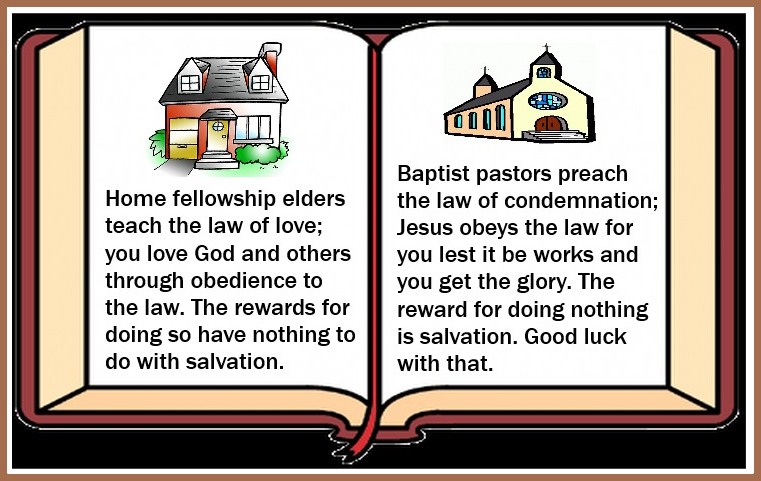
Listen, here is why the home fellowship movement is going to eventually take off: the alternative is Protestantism which defines the believer according to how the Bible defines an unbeliever. Eventually, people are going to figure out that they have been proudly proclaiming themselves as unregenerate in the name of Christ.
Lastly, this is defined by the fact that believers have the freedom to present their bodies as living sacrifices, or in other words, present their members for holy purposes that please God. The body is not inherently evil because it is part of the material world. Whether saved or unsaved, the body can be used for good purposes. However, in the case of an unbeliever, good behavior doesn’t lead to life more abundantly, it just leads to lesser punishment and a more bearable eternal state. For the unbeliever, good behavior merely leads to less death. For the believer, obedient love leads to more life.
Now with all of this in mind, let’s read further in 1John Chapter 3:
4 Everyone who makes a practice of sinning also practices lawlessness; sin is lawlessness. 5 You know that he appeared in order to take away sins, and in him there is no sin. 6 No one who abides in him keeps on sinning; no one who keeps on sinning has either seen him or known him. 7 Little children, let no one deceive you. Whoever practices righteousness is righteous, as he is righteous. 8 Whoever makes a practice of sinning is of the devil, for the devil has been sinning from the beginning. The reason the Son of God appeared was to destroy the works of the devil. 9 No one born of God makes a practice of sinning, for God’s seed abides in him, and he cannot keep on sinning because he has been born of God. 10 By this it is evident who are the children of God, and who are the children of the devil: whoever does not practice righteousness is not of God, nor is the one who does not love his brother.
John wrote what he wrote in 1John 3 because of what Paul wrote in Romans 6—it’s saying the same thing. Obeying the law isn’t the issue, a “commitment” to obey the law isn’t the issue, the reality of the new birth is the issue.
1Corinthians 15:1- Now I would remind you, brothers, of the gospel I preached to you, which you received, in which you stand, 2 and by which you are being saved, if you hold fast to the word I preached to you—unless you believed in vain.
3For I delivered to you as of first importance what I also received: that Christ died for our sins in accordance with the Scriptures, 4 that he was buried, that he was raised on the third day in accordance with the Scriptures, 5 and that he appeared to Cephas, then to the twelve. 6 Then he appeared to more than five hundred brothers at one time, most of whom are still alive, though some have fallen asleep.
This is, as Paul called it, the gospel of “first importance” or literally “the gospel of first order of importance.” There is way more behind this than a mental ascent to the facts of the gospel. You have to believe that this first happened to Christ in order to believe that it really happened to you spiritually. Repentance is a change of mind in regard to many things concerning your life and the life of Christ.
By the way, there was an evangelical movement for a while that emphasized the new birth. It peaked in the 70’s and was considered to be the most egregious of all false gospels. The Australian Forum, the think tank that gave birth to the present-day return to authentic Reformed soteriology, actually published an article titled, “The False Gospel of the New Birth.”
John continues in chapter 3 to explain one of the characteristics of being born again, love. But let me insert this, and this is VERY important: the characteristics of the new birth are framed in what the Bible refers to as “abiding.” If God’s seed “abides in” us (1John 3:9), other things also abide in us: the fact that we abide in Him also; the truth abides in us; we know the truth; we love the truth; we love fellow Christians; we do not practice sin, but rather practice righteousness as a life direction and pattern; we love God’s law; we submit to need; we obey; we seek to please God; we have a hunger for learning more of God’s word, and many more can be listed.
Let’s read more of John 3 with this in mind:
11 For this is the message that you have heard from the beginning, that we should love one another. 12 We should not be like Cain, who was of the evil one and murdered his brother. And why did he murder him? Because his own deeds were evil and his brother’s righteous. 13 Do not be surprised, brothers, that the world hates you. 14 We know that we have passed out of death into life, because we love the brothers. Whoever does not love abides in death. 15 Everyone who hates his brother is a murderer, and you know that no murderer has eternal life abiding in him.
16 By this we know love, that he laid down his life for us, and we ought to lay down our lives for the brothers. 17 But if anyone has the world’s goods and sees his brother in need, yet closes his heart against him, how does God’s love abide in him? 18 Little children, let us not love in word or talk but in deed and in truth.
See, the order in which John discusses these things is in no wise disconnected. We need to start thinking about “obedience” in reference to love and the new birth. Really, the Christian life is about love. But listen, any love that flows from you starts with a love for truth. Also, please take note of a more biblical definition of love: love is a submission to need—that’s love. When the Scriptures tell women to submit to their husbands, that’s just another way of telling wives to love their husbands. When the Bible tells men to love their wives, it’s simply telling men to submit to their needs. Look at 1John 3:17 again. How does benevolence get parachuted into that body of text out of nowhere? John goes from discussing murder to meeting financial need; it seems like he is all over the map, but not really.
Lastly, working out the new birth with love leads to assurance.
19 By this we shall know that we are of the truth and reassure our heart before him; 20 for whenever our heart condemns us, God is greater than our heart, and he knows everything. 21 Beloved, if our heart does not condemn us, we have confidence before God; 22 and whatever we ask we receive from him, because we keep his commandments and do what pleases him. 23 And this is his commandment, that we believe in the name of his Son Jesus Christ and love one another, just as he has commanded us. 24 Whoever keeps his commandments abides in God, and God in him. And by this we know that he abides in us, by the Spirit whom he has given us.
Assurance of salvation comes through working out our new birth in fear and trembling. Assurance of salvation is grounded in the ending of the law because the old us died with Christ resulting in no condemnation, while our new relationship to the law leads us in love and life. Now listen, even a casual student of the Bible can begin to hang Bible verses all over this framework.
Next week, we will build on this as we go into chapter 4—let’s go to the phones.

 Paul's Passing Thoughts
3 comments