The Source of Phobias
 I have rubbed shoulders recently with folks who have a phobia thing going on. In one particular case, the person presently employed by a relative of mine would not ordinarily be able to hold down a job.
This is another area where Christians show how confused they are. On the one hand, they get all glassy-eyed and proclaim the simplicity of God’s word, how we should read it as “little children.” But you mark my words: on the other hand, they will proclaim my biblical explanation for phobias here, “Too simplistic.”
The source of ALL fear, according to the Bible, is being under law as opposed to being under grace. I find it hard to believe that if the primary source of fear is gone, that the extreme expressions of it are possible.
According to the Bible, being under law, and specifically its condemnation, is the antithesis of LOVE. Throughout the Bible, fear and love are set in contrast to each other—polar opposites.
To those under law, the Bible is condemnation; to those under grace, the Bible is the discipleship of love. One is a law that continually warns of the wrath to come, the other is instruction regarding love.
This is why Paul said that the sting of death is sin, and the power of sin is the law. Ironically, many denominations keep their followers under law. This is why it is more than possible that professing Christians will suffer from these phobias which is also the case with the aforementioned acquaintance. I also find it curious that said person is of a denomination that emphasizes law. Hence, the person’s known faithful Bible reading will only make the fear worse because of a skewed view of law/gospel.
I am also convinced of this: God’s word states that you are under law regardless of who keeps it; under law is under law. The law must be ENDED for condemnation or you are still under its power. You must be put to death so you are no longer under it, and raised to life so that you may serve the law of love freely. Still being under law with the idea that someone keeps it for you is antithetical to the new birth. You must know that you can no longer be condemned. You are not merely protected from condemnation—condemnation no longer exists.
And therefore, fear can only exist if you allow it for it cannot live without condemnation.
paul
The Key to Revival: Stop Saying “Sins of the Flesh”. The Flesh is NOT Sinful
Protestantism wasn’t born of Gnosticism; it was born of Neo-Platonism which became Gnosticism. Most Protestants would deny that they are Gnostics, but because the fruit doesn’t fall far from the tree, they often embrace ideology that is Gnostic. In other words, they are functioning Gnostics.
The prime example is the whole “sins of the flesh” Christian mantra. That’s not a biblical idea, and is essentially Gnostic.
A primary tenet of Gnosticism is Either/Or epistemology. If you pay attention to the words used in this Sunday’s sermon, more than likely, you will notice that everything is either/or with no middle ground. I realize that the Bible does contain sentences that refer to the “desires of the flesh” and “sins of the flesh,” but that refers to when the flesh, the bodily members, are used for sinful purposes. Please note that the Bible also states that we can use our members for holy purposes as well.
Furthermore, the Bible even states that as believers, our bodies are the temples of God. Moreover, a more careful examination reveals that the reference to “temple” in regard to our bodies actually refers to the Holy of Holies. If you think you can presently hear Calvin and Luther rolling and screaming in their graves in response to that assertion—the problem is not in your cranium set.
If you are actually free to present your body as a living sacrifice to God in the Holy of Holies, what do you need the vast Protestant industrial complex for? You don’t.
The flesh is NOT sinful, according to the Bible; it is “weak.” The idea that weakness is part and parcel with the evil material world is a Gnostic presupposition. For example, the holy angels are weaker than God, no?
Pastors, do you want revival? Stop telling your parishioners that they are “sinners saved by grace.” They are not sinners; they are literally a nation of holy priests.
“But we still sin.”
If you just said that, you are not fit for the ministry—you don’t even understand Biblical Law/Gospel 101.
Get with the program. You will never have revival with a bunch of sinners—that would seem evident. Grow up in Christ, and stop listening to men. You are like my adorable grandson, Blaine, who is 4 years old. He is a great listener and repeats everything he hears.
That’s just adorable, but when grown men who dare to call themselves pastors do the same thing—not so much.
paul
A Definitive Biblical Statement on Law and Gospel for Home Fellowships
TANC Ministries, 2015
Whatever form of Protestantism you are talking about, and Calvinism in particular, its Achilles’ heel is the law. Protestantism cannot pass the true gospel test because of its position on law, and this is not hard to understand.
Andy Young, an associate of TANC ministries, said something in last year’s 2014 conference that is probably true for the most part: “The law is for sanctification.” Right, because the law is in no wise for justification. We are justified apart from the law (Romans 3:21) and “apart” means exactly that. The fact that the law will judge people in the end is a separate issue altogether.
The apostle Paul makes all of this easy to understand in Galatians chapter 3. But first, let’s use that same chapter to establish what we mean by the word “law.” The word is used interchangeably with many other words, including “gospel”, to refer to the Bible. So, Andy was merely saying that the Bible is for sanctification, or in other words, Christian living. Andy was talking in context of sanctification for the Bible has no stake in justification, and again, the fact that the Bible will judge people in the end is another issue. Yes, the Bible defines justification (Rom 3:21, Gal 4:21); yes, the Bible testifies to the truths regarding justification, but the law does not justify.
Note the following from Galatians 3:
21 Is the law then contrary to the promises of God? Certainly not! For if a law had been given that could give life, then righteousness would indeed be by the law. 22 But the Scripture imprisoned everything under sin, so that the promise by faith in Jesus Christ might be given to those who believe.
Notice that Paul uses the word “law” and “Scripture” interchangeably. The law, “holy writ,” “the word,” “the gospel,” “the Scriptures,” “the law and the prophets,” etc. are all terms that refer to the Bible which is a full orbed statement by God regarding Himself, mankind, and reality. Statements like this: “We are not bound by the law, or else we’d have to live under every aspect of the law including not wearing blended fabrics and not eating shrimp and bacon” reveal a fundamental ignorance in regard to what the law is.
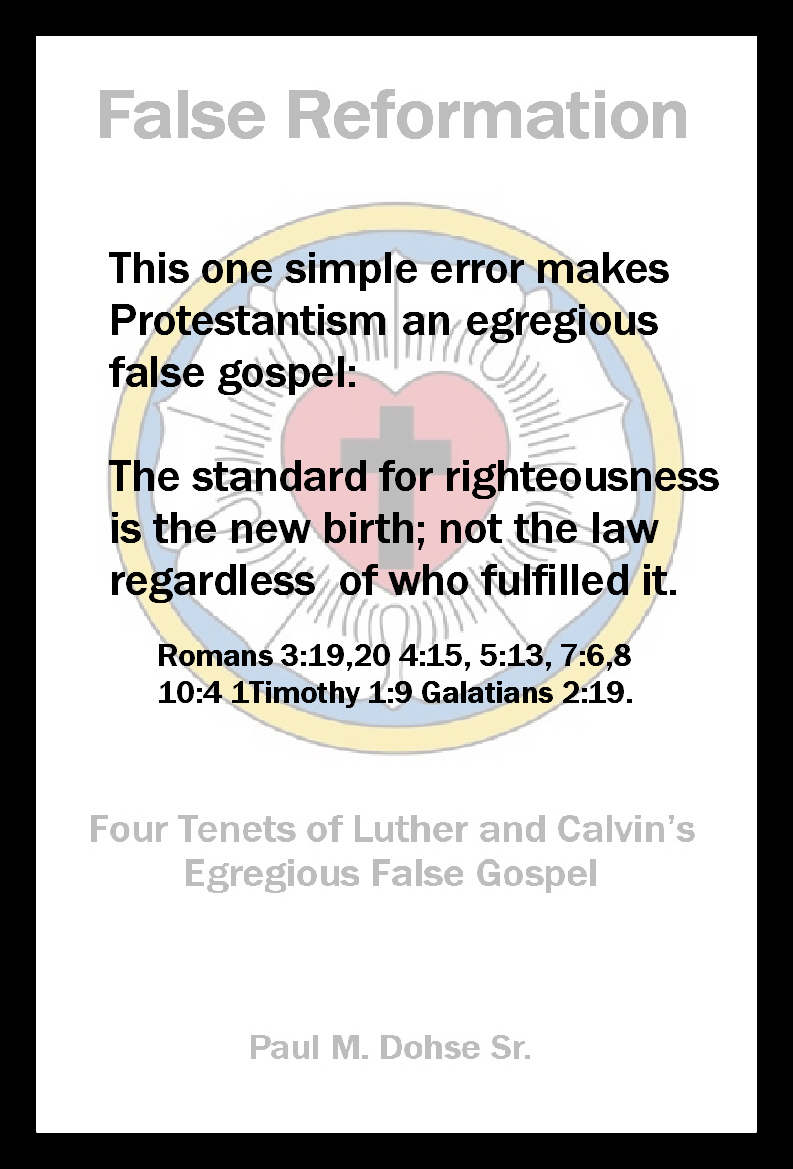
Protestantism falls on this one basic principle: law is the standard for righteousness. This makes the salvific work of Christ two-fold: He died to pay the penalty for our sins, and came to fulfill the law for us in order to make us righteous. That’s gross heresy. That’s an egregious false gospel. Hence, you have two kinds of Protestants: one camp that understands the position and professes it, and the other camp who also confesses it, but has not thought out the ramifications. This includes Baptists, Methodists, and many others. Baptists parted ways with the Reformers on baptism, but have never repented of making the law justification’s standard.
Yes, Jesus said that He came to fulfill the law and to not end it, but then we have the apostle Paul writing that Christ in fact did come to end the law, so does the Bible contradict itself? By no means.
Here is the problem: by design, Protestants don’t interpret the Bible in context of sanctification and justification, and again, that is by design. Why? Because Protestantism is founded on the idea that sanctification is merely the progression of justification. This also goes hand in glove with the idea that the law is justification’s standard. Hence, the law must continue to be fulfilled perfectly to keep the saints justified. This results in the confused theological train wreck we call Protestantism.
When the law must be continually fulfilled perfectly as a standard for justification, the law cannot be used for love because now you have fused love and justification together. This is why churches lack love; the maintaining of justification and love are confused. In the Bible, love is absolutely synonymous with obedience. Unfortunately, Protestantism makes obedience a justification issue. Obedience is not a justification issue—it’s a love issue. That’s why there is so much love-bombing in your churches; true love is stifled because it is confused with justification. The vacuum is then filled with empty words and programs. People are in bondage to the law in Jesus’ name and their pain is medicated by praise bands, personality cults, and the splendor of institutional temples.
The fulfillment of the law in Jesus’ name is a huge problem—there is no law in justification regardless of who keeps it. Who keeps it is not the issue, the law is the issue. Here is the theses of Paul’s argument in Galatians 3: Only God can give life through faith alone in the promise. What is the promise? It was a promise made to Abraham and Christ that Israel and the Gentiles would be blessed with eternal life, and that Christ would be resurrected by the power of the Holy Spirit in order to make that possible:
Galatians 3:15 – To give a human example, brothers: even with a man-made covenant, no one annuls it or adds to it once it has been ratified. 16 Now the promises were made to Abraham and to his offspring. It does not say, “And to offsprings,” referring to many, but referring to one, “And to your offspring,” who is Christ. 17 This is what I mean: the law, which came 430 years afterward, does not annul a covenant previously ratified by God, so as to make the promise void. 18 For if the inheritance comes by the law, it no longer comes by promise; but God gave it to Abraham by a promise.
So in other words, if Christ came to also fulfill the law, the Promise is fulfilled by law, and not God’s promise made to Abraham. By the way, this term, “the promise” is a major biblical term referring to the gospel. In regard to justification, Christ came for one reason: to end the curse of the law:
Galatians 3:10 – For all who rely on works of the law are under a curse; for it is written, “Cursed be everyone who does not abide by all things written in the Book of the Law, and do them.” 11 Now it is evident that no one is justified before God by the law, for “The righteous shall live by faith.” 12 But the law is not of faith, rather “The one who does them shall live by them.” 13 Christ redeemed us from the curse of the law by becoming a curse for us—for it is written, “Cursed is everyone who is hanged on a tree”— 14 so that in Christ Jesus the blessing of Abraham might come to the Gentiles, so that we might receive the promised Spirit through faith.
If we still rely on the works of the law, we are under a curse; again, it doesn’t matter who keeps it. Paul spent most of his ministry trying to hammer this point home. Here, he makes it clear that the law was not part of the original promise, and once a covenant has been ratified, nothing can change it. If Christ fulfilled the law in our stead, that is clearly an addition to the original covenant of promise—that’s Paul’s specific point.
But now Protestants once again protest that the key is a perfect fulfillment of the law which only curses those who cannot keep it perfectly. Christ’s perfect obedience to the law is then imputed to us. In light of this chapter in Galatians, this position is fraught with problems. Clearly, it’s still an addition to the original covenant. Also key is who the promise is made to; ie., the descendants of Abraham which include the Gentiles, and Christ Himself. Paul emphasizes that there is only ONE seed (verse 16). Why?
“Seed” is key. The Greek word refers to offspring. Christ was part of Abraham’s lineage, and is only ONE seed—there is not more than one seed. Christ died to end the curse of the law by dying to pay the penalty of sin, and then waited (in a manner of speaking) in the grave for the promise that was also made to Him: “the promised Spirit.” The Spirit raised Christ from the grave:
Romans 8:11 – If the Spirit of him who raised Jesus from the dead dwells in you, he who raised Christ Jesus from the dead will also give life to your mortal bodies through his Spirit who dwells in you.
Ephesians 1:19 – and what is the immeasurable greatness of his power toward us who believe, according to the working of his great might 20 that he worked in Christ when he raised him from the dead and seated him at his right hand in the heavenly places,…
The promised Spirit is major here. This is the new birth. This promise of the Spirit accomplished three universe-shaking objectives: it enabled mankind to follow Christ in literal death and resurrection, baptized Jews and Gentiles into one body, or family of God, cancelled judgement and condemnation, and set God’s children free to aggressively love.
The idea that Christ fulfilled the law in order to satisfy justification usurps the Spirit’s role in the promise. God elected the means of salvation, Christ died, and the Spirit baptizes. God initiated salvation, Christ paid the penalty for sin, and the Spirit regenerates. We are not justified by the law, we are justified by the new birth:
Romans 4:20 – No distrust made him waver concerning the promise of God, but he grew strong in his faith as he gave glory to God, 21 fully convinced that God was able to do what he had promised. 22 That is why his faith was “counted to him as righteousness.” 23 But the words “it was counted to him” were not written for his sake alone, 24 but for ours also. It will be counted to us who believe in him who raised from the dead Jesus our Lord, 25 who was delivered up for our trespasses and raised for our justification. (ESV 2001).
Galatians 3:1 – O thoughtless Galatians, who did bewitch you, not to obey the truth — before whose eyes Jesus Christ was described before among you crucified?
2 this only do I wish to learn from you — by works of law the Spirit did ye receive, or by the hearing of faith? 3 so thoughtless are ye! having begun in the Spirit, now in the flesh do ye end? (YLT).
Notice the idea of completion reflected by the Greek and properly translated by the YLT. We don’t receive the Spirit and His work on the installment plan when we believe; the new birth is a complete work. Hence, the new birth, or the Spirit’s baptism is what makes us righteous or justified, not the law.
Again, God set forth the plan of salvation: Christ died to end the law, and the Spirit regenerates us and helps us in our progression of holiness. We are born of the Spirit and resurrected as holy babies born of God, and grow up in holiness (1Peter 2:2). The baptism of the Spirit is therefore twofold:
Romans 6:1 – What shall we say then? Are we to continue in sin that grace may abound? 2 By no means! How can we who died to sin still live in it? 3 Do you not know that all of us who have been baptized into Christ Jesus were baptized into his death? 4 We were buried therefore with him by baptism into death, in order that, just as Christ was raised from the dead by the glory of the Father, we too might walk in newness of life.
5 For if we have been united with him in a death like his, we shall certainly be united with him in a resurrection like his. 6 We know that our old self was crucified with him in order that the body of sin might be brought to nothing, so that we would no longer be enslaved to sin. 7 For one who has died has been set free from sin. 8 Now if we have died with Christ, we believe that we will also live with him. 9 We know that Christ, being raised from the dead, will never die again; death no longer has dominion over him. 10 For the death he died he died to sin, once for all, but the life he lives he lives to God. 11 So you also must consider yourselves dead to sin and alive to God in Christ Jesus.
Romans 7:1 – Or do you not know, brothers—for I am speaking to those who know the law—that the law is binding on a person only as long as he lives? 2 For a married woman is bound by law to her husband while he lives, but if her husband dies she is released from the law of marriage. 3 Accordingly, she will be called an adulteress if she lives with another man while her husband is alive. But if her husband dies, she is free from that law, and if she marries another man she is not an adulteress.
4 Likewise, my brothers, you also have died to the law through the body of Christ, so that you may belong to another, to him who has been raised from the dead, in order that we may bear fruit for God. 5 For while we were living in the flesh, our sinful passions, aroused by the law, were at work in our members to bear fruit for death. 6 But now we are released from the law, having died to that which held us captive, so that we serve in the new way of the Spirit and not in the old way of the written code.
Colossians 2:8 – See to it that no one takes you captive by philosophy and empty deceit, according to human tradition, according to the elemental spirits[a] of the world, and not according to Christ. 9 For in him the whole fullness of deity dwells bodily, 10 and you have been filled in him, who is the head of all rule and authority. 11 In him also you were circumcised with a circumcision made without hands, by putting off the body of the flesh, by the circumcision of Christ, 12 having been buried with him in baptism, in which you were also raised with him through faith in the powerful working of God, who raised him from the dead. 13 And you, who were dead in your trespasses and the uncircumcision of your flesh, God made alive together with him, having forgiven us all our trespasses, 14 by canceling the record of debt that stood against us with its legal demands. This he set aside, nailing it to the cross. 15 He disarmed the rulers and authorities and put them to open shame, by triumphing over them in him.
Why would Christ fulfil the law and then die to end it? Why would Christ’s perfect obedience to law be imputed to us when it is no longer valid? Why would Christ fulfil the law for those who die with Him and are no longer under that law? Why would Christ fulfil a law that has nothing to say to us? (Romans 3:19). When Paul states, “For all who rely on works of the law are under a curse” (verse 10), that means any works of the law period, not just what we perform, but any works of the law period. The covenant of promise WAS NOT RATIFIED BY THE LAW THAT CAME 430 YEARS LATER. What could possibly be more evident? If Jesus kept the law perfectly as part of the gospel, that still ratifies the original covenant of promise.
But all of this is not even Paul’s primary argument. His primary argument is that only the Spirit can give life. His argument is that only the resurrection of the new birth gives life. If the law has any part in justification, then the law can give life and there is more than one seed. Consequently, only God can give life and now there is a co-life-giver. That’s Paul’s argument exactly.
11 Now it is evident that no one is justified before God by the law, for “The righteous shall live by faith.” 12 But the law is not of faith, rather “The one who does them shall live by them.”
Life, justification, faith alone in the promise, and the new birth are all mutually inclusive while the law and justification are mutually exclusive—that’s exactly what the apostle Paul is saying.
Also, if law has anything to do with justification at all, we inherit eternal life by being born again into God’s family by the fulfillment of the law and NOT promise:
18 For if the inheritance comes by the law, it no longer comes by promise; but God gave it to Abraham by a promise.
Someone may argue, “But Jesus keeps the law perfectly!” So what of it? It’s still inheritance by the law and not promise. Again, and again, the original covenant was not ratified by Jesus’ perfect law-keeping. Here is what we must come to grips with: Protestantism is predicated on a juvenile perception of law and gospel.
16 Now the promises were made to Abraham and to his offspring. It does not say, “And to offsprings,” referring to many, but referring to one, “And to your offspring,” who is Christ.
20 Now an intermediary implies more than one, but God is one.
21 Is the law then contrary to the promises of God? Certainly not! For if a law had been given that could give life, then righteousness would indeed be by the law.
As an aside while on the subject of covenants: this whole idea of Jesus fulfilling the law plugs into the ever popular Covenant theology. This is the idea that Christ came to obey the law perfectly in order to restore the original and supposed covenant of works with Adam. But the Covenant of Promise was not made with Adam, it was made with Abraham. Compounding this glaring error is the citation of Genesis 3:15 to make a connection between Adam’s disobedience and Christ’s obedience to the law. But in that verse, it is the serpent that is being addressed and not Adam. Usually, when you make a covenant with someone, as with Abraham, it’s made with the person you are talking to. In essence, it claims that God made a covenant with the serpent.
Regardless of all of the splendor and glory affiliated with religious academia, it is found wanting in embarrassing proportions. The laity must stop listening to these people and start reading the Bible for themselves.
But with all of this said, “Why then the law?”(verse 19). However, which law is Paul referring to when he presents this anticipated question in verse 19? There are two laws: one known as, “the written code” (Colossians 2:14), “the law of sin and death” (Romans 8:2), “the law of sin” (Romans 7:23), simply “the law” in many places, “the letter” (2Cor 3:6), “ministry of death” (2Cor 3:7), “ministry of condemnation” (2Cor 3:9), “the record of debt” (Col 2:14), and “the first covenant” (Hebrews 8;13).
The second is known as: “the law of the Spirit of life” (Romans 8:2), “the law of my mind” (Romans 7:23), “the law of liberty” (James 1:25), “the law of Christ” (Galatians 6:2), and because love fulfills the whole law (Romans 13:8-10), it can be rightly called “the law of love.”
In verse 19, Paul is referring to the first law. It only condemns and judges, but that’s not its only function by far.
19 Why then the law? It was added because of transgressions, until the offspring should come to whom the promise had been made, and it was put in place through angels by an intermediary. 20 Now an intermediary implies more than one, but God is one.
21 Is the law then contrary to the promises of God? Certainly not! For if a law had been given that could give life, then righteousness would indeed be by the law. 22 But the Scripture imprisoned everything under sin, so that the promise by faith in Jesus Christ might be given to those who believe.
23 Now before faith came, we were held captive under the law, imprisoned until the coming faith would be revealed. 24 So then, the law was our guardian until Christ came, in order that we might be justified by faith. 25 But now that faith has come, we are no longer under a guardian, 26 for in Christ Jesus you are all sons of God, through faith. 27 For as many of you as were baptized into Christ have put on Christ. 28 There is neither Jew nor Greek, there is neither slave nor free, there is no male and female, for you are all one in Christ Jesus. 29 And if you are Christ’s, then you are Abraham’s offspring, heirs according to promise.
What’s this saying? First, it’s saying that the first law has no function for believers after Christ died on the cross to END the law. And Christ did come to end the law of sin and death. Christ didn’t come to merely cover sin with His own righteousness, He came to end sin by ending the law (Romans 3:19,20, 4:15, 5:13, 7:6,8, 10:4, 1Tim 1:9, Gal 2:19).
Secondly, the first law covered believers until Christ died on the cross. The first law was an atonement for sin; all of the sins of Old Testament believers were imputed to that law, and then it was ended by Christ. The person who believes on Christ dies in baptism, and is no longer under the law that he/she sinned against (Romans 7:1ff). This would also include believers who were deceased at the time.
In regard to Old Testament believers that were dead during the time of Christ’s ministry on earth, Old Testament believers were captive under the law until Christ died to end the law. Therefore, they were in Sheol/Abraham’s bosom/Paradise/Hades. When Christ died, He went there and preached to the captives and took the thief on the cross with Him. When the Spirit resurrected Him, He also resurrected those in Sheol and set the captives free. They and their sins were held captive by the law until Christ died to end it. Remember, King David said, “For you will not abandon my soul to Sheol, or let your holy one see corruption” (Psalm 16:10). As a testimony, Christ sent many of them to walk around Jerusalem. Texts that help sum up all of these points are Ephesians 4:7-10 which also references Psalm 68:18, Luke 16:22, Matthew 27:51-53, and Colossians 2:13-15.
Thirdly, the first law still has a function in the scheme of things. The old covenant of the law is passing away, but is not ended for the unbelieving. “Under grace” did not end “under law” (Romans 6:14). The first law still holds sin captive because all sin is against the law (1John 3:4). Yes, for those who don’t repent, the law will judge them in the end. To the degree that they violate the law, they will be punished eternally.
But there is a sense in which the first law also serves a purpose of covering as it formally did for those under grace. When a person is saved and born again, they die and are no longer culpable to the law—the law is also ended for them at that time. Their sins are taken away and cast as far as the east is from the west. Again, Christ did not come to cover sin, he came to take sin away. The first law is grace in waiting. All sin is imputed to it, and it stands ready to be ended for each and every person who chooses to follow Christ in death and resurrection.
Now, what about the other law—the law of the Spirit of life? Let there be no doubt, there is a law that is under grace. It is the law of love. We have been released from the condemnation of the first law, and are now free to aggressively serve the law of Christ:
Romans 7:4 – Likewise, my brothers, you also have died to the law through the body of Christ, so that you may belong to another, to him who has been raised from the dead, in order that we may bear fruit for God.
In the same way that one sin formally violated the whole law (James 2:10), one act of love fulfills the law of Christ (Gal 5:14, Rom 13:10). Love covers a multitude of sin (1Peter 4:8). We are sanctified with the word of truth (John 17:17). The Christian life is faith WORKING through the obedience of love (Gal 5:6), and love is synonymous with obedience (John 14:15).
If a professing Christian is not truly bearing fruit for God as an expression of true love for truth, God, and others, he/she has a flawed view of the law’s relationship to the gospel.
What is sapping the power of Christianity in our day is misguided fear. When the ending of sin is confused with the idea of covering, excessive introspection ensues for fear that we are not living by a convoluted Protestant system of faith-alone works so that the perfect obedience of Christ will continue to be imputed to our Christian life.
In contrast, there is no longer any condemnation for those in Christ and fear has to do with judgement (Rom 8:30, 1Jn 4:16-19). Those mature in love cast away fear. They are free from the condemnation of the law and free to serve Christ in aggressive love.
Who will deny that the overwhelming preoccupation of Protestants is sin and not love while any appearance of good works are held suspect? Where there is not freedom to love without fearful introspection, love will not thrive.
Protestantism: So Many Flavors, but It’s All Ice Cream
 Protestantism has many different denominations and interpretations of the Bible, and let me explain why that’s the case. Protestantism was founded on the idea that the law of God has a single dimension. That’s the foundation, and that fleshes itself out in one way or the other across all denominational lines.
For purposes of keeping this simple, we will focus on how this applies according to what is in vogue presently: the law can only condemn; the law can only provoke us to sin; the law demands perfection or all bets are off; the standard for being justified is perfect law-keeping.
What to do about law? That fundamental question is what divides all sects of Protestantism. It is what drives all the bickering between Calvinists, Arminians, free grace (Zane Hodges), and the anti-lordship salvation crowd which is mostly made up of the free grace crowd
This is why Protestants can’t seem to get it together on Christian living. Trying to make a single dimension law work in the Christian life causes all kinds of confusion. Staying in the same vein of simplicity, let’s use Romans 8:2 in an attempt to understand the problem:
Romans 8:2 – For the law of the Spirit of life has set you free in Christ Jesus from the law of sin and death.
That’s two different relationships to the same law. To the born again believer, the Spirit uses the law to sanctify the believer (John 17:17). To walk in the Spirit is to learn and obey the word of God which is life. This is a colaboring with the Spirit in the truest sense.
To the unbeliever, the law can only condemn, and sin within uses the law to provoke the unbeliever to sin. To the unbeliever, the law can only bring death. Hence, “the law of sin and death.”
In what way does the law set us free to “serve another”? When we believe its testimony, it sets us free from being condemned by it, and frees us to obey it as a way of loving God and others. This isn’t a difficult concept: if we listen to wisdom we live; if we reject wisdom we die, but it’s the same wisdom.
Again, for purposes of making a simple point in this post, I am not going into how this all fits together with the believer being truly righteous, and able to please God through obedience while falling short of perfection. You aren’t going to understand any of that till you get this basic point anyway.
The following prompted this post: I stumbled upon an anti-lordship salvation kind of guy named Jack Smack who believes Calvinists, Arminians, and proponents of lordship salvation are all going to hell. Again, this all boils down to differences in how you get the square peg of a single dimension law into the round hole of Christian living and the gospel. Note what he states in the video:
Now what is Lordship salvation? It’s the idea that you have to live a certain way, you have to prove you are saved by your works. You got to obey God; you got to repent of your sins, and it’s all of this jargon. And there’s a lot, there’s a few other things they say: the lot of them will tell you, you know, you can’t live any way you want to and all this, well, they’re trying to control you. They’re trying to put you under the law. They’re doing exactly what these Jews were doing. It says, “why compest thou the Gentiles to live as do the Jews?” Okay…
15 We who are Jews by nature, and not sinners of the Gentiles,
16 Knowing that a man is not justified by the works of the law, but by the faith of Jesus Christ, even we have believed in Jesus Christ, that we might be justified by the faith of Christ, and not by the works of the law: for by the works of the law shall no flesh be justified. 17 But if, while we seek to be justified by Christ, we ourselves also are found sinners, is therefore Christ the minister of sin? God forbid.
Now look at this: Lordship Salvation, they’re people trying to get you to sin – they want you to sin! They teach lawless, that lewd antinomianism, because if you get down to it, they’re trying to put you back under a law. And all the law can do is cause you to sin.
18 For if I build again the things which I destroyed, I make myself a transgressor.
So actually, in all reality, ironically, a Lordship Salvationist claims like they don’t want people to keep on sinning, but the reality of what they teach, it’s going to make you go on sinning, according to that verse. So yes, Lordship Salvation proponents are antinomian. Regardless of whether or not they will admit this, the bible says they are. Any time you try to put somebody under a law, you are making them into a bigger sinner PERIOD.
19 For I through the law am dead to the law, that I might live unto God.
So, it’s all I have. Lordship Salvation makes you into a bigger sinner because you’re imposing laws on people that they just can’t obey on their own, and um…that’s exactly what these people are doing. So I , you know, believe in, I teach Free Grace. I teach that we’re justified freely by His grace through the redemption that is in Christ Jesus.
Now you have to understand Free Grace, or you cannot serve God; and you cannot, you know, obey God. You have to understand what’s been done on your behalf: Jesus Christ died for your sins. He was buried and rose again. He gives eternal life as a free gift. So, on the basis of that, we should want to serve God and to live right. And that’s what I teach. People that are teaching law, lordship, they’re the antinomians because the reality of what they teach leads to uh..transgression.
In the Bible, there are only two kinds of people: under law (lost), and under grace (saved). But what is missed in Protestantism is that being under grace doesn’t exclude being under law, it’s just not the law of sin and death. The law informs us as to what people need to do to be free from being condemned by the law, resulting in being free to use the law for loving God and others. If we want to know what to do in order to not die for lack of wisdom, we go and ask Lady Wisdom, right?
When we are saved by believing the law’s testimony about Christ, we are set free from its condemnation in a one time, completed transformation from death to life. We are now free to serve the law unto life more abundantly. Freedom from the law of condemnation is a gift, but obedience to the law as a born again believer yields rewards in the present life and the life to come. Hence, “For I through the law am dead to the law, that I might live unto God.” But living to God doesn’t exclude the law; Matthew 4:4 couldn’t be clearer on that.
Nevertheless, notice how Smack states that the relationship of the law of sin and death remains the same for the believer. This keeps believers “under law,” which is the very definition of a lost person. He states that a demand for Christians to obey the law only causes them to sin more! Woe! But frankly, this take on law is the same problem with Protestantism in general across the board.
The obvious question becomes: how do I obey the law as a Christian in a way that won’t cause me to sin more or condemn me? Of course, this has caused much confusion among Protestants. The remedy is usually a confusing system of some sort that imputes the perfect obedience of Jesus to our life in the same way His righteousness was imputed to us by faith alone. These systems range from outright denial of the law in the Christians life to a “relaxing of the law.”
Here is what Christians need to come to grips with: the two uses of the law in Romans 8:2. That is the key.
paul

 Paul's Passing Thoughts
leave a comment