The Saving God, Tears of Joy, and the Gospel of Freewill
 “They are purchased slaves remaining under the dominion of their present master by their own choice.”
John Immel makes one particular statement at every TANC conference each year: Calvinism is the most disastrous body of doctrine ever perpetrated on mankind. He speaks primarily from a societal viewpoint, I speak primarily from a theological viewpoint, and Susan speaks primarily from a life experience viewpoint. That’s how our roles in the TANC endeavor operate. We now have Andy as well who represents a grammatical life application of the theological ramifications, and to a point, the societal implications as well. If you don’t attend the conferences—you are missing out.
But back to John. The yearly statement which is now a tradition is unlike many traditions, in that one’s understanding of the statement grows every year. So, when John makes that statement, there is a marked, deeper refection than the year prior.
When I initially received Christ, the music of the gospel made me cry. Then I became acquainted with the only thing one can be acquainted with in the institutional church: orthodoxy. When orthodoxy became synonymous with truth in my mind, that’s the day the music died. Think what you may of John Immel, but his first series of talks at TANC 2012 introduced me to a unique challenge: orthodoxy as intermediate truth, and church polity as a soft term for the fusion of faith and force. That challenge led me on a journey that has resulted in the enablement to hear the sweet music of the gospel once again.
A combination of circumstances, including my marriage to Susan, enabled me to say to God, “No more listening to men, help me to take these words in Romans at face value. You are not a God of confusion, what is Paul plainly saying?” Pray tell: how do we make two laws, plainly stated as such, two realms? Answer: orthodoxy.
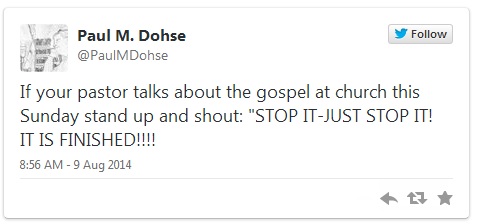
The music is back. My sins are not merely covered, they are ended. My salvation has no judgment. There is no law to be found. There is no condemnation. All I can see now in regard to condemnation is our loving Lord hanging on that cross in unimaginable suffering saying, “It is finished.” We are untouchable. Nothing can separate us from the love of God. Christ came to end the law of sin and death for those who believe, and set them free to obey the law of the Spirit of life without fear of condemnation.
When one stops listening to experts and really believes that God rewards those who seek Him, a particular God emerges from the truth: a God who predetermined a means for reconciliation, and pronounced it irrevocable, an irrevocable calling that will stand till all things are new. It’s called, “hope.” It is knowing that a good ending is predetermined. No one can take it from us. We also see a God that seeks man in his weakness and sin, shoving him to the precipice of His kingdom, but stopping short of making the decision for him. Certainly, when Adam sinned, he did not immediately seek God out for a solution—he hid. But God sought him out and reasoned with him, and so it goes in history.
God ordained the means of salvation; put His law on every man’s heart with an internal judge; sent His son to die, and thereby drawing all men to Him; sent the Holy Spirit to convict the world of sin; imputes all sin to the law of sin and death that has already been ended and awaits those who want to be free of sin’s condemnation; and mandates His kingdom citizens to implore all to join God’s kingdom as well. “TURN AWAY! TURN AWAY! WHY WILL YOU DIE?” Moreover, Christ did not come to condemn the world, but to save it. Hell was not created for man, but for the kingdom of darkness. Consider…
And when Jesus saw that he answered wisely, he said to him, “You are not far from the kingdom of God.”
Note that an unregenerate person can have wisdom. Note that they are drawn to the kingdom’s door. The unregenerate can know truth. The unregenerate can be persuaded. They have the law written on their hearts. They have an internal convicter, an outside convicter, the love of a Savior, the witness of love among His followers, and the testimony of creation.
We are told that God does all of this, but is just sporting with man, for in the final analysis, it is His choice alone. God is within His right, because of His righteousness, to send all to hell. Yet, in contrast, the Bible states that His righteousness is manifested by supplying a way of salvation. Christ didn’t come to obey the law perfectly to display the righteousness of God. Men were declared righteous apart from the law well before the first coming of Christ. Supplying a way to be reconciled with man put His righteousness on display. Christ did not come to condemn, and God desires that all men would be saved and come to the knowledge of the truth. God takes no pleasure in the death of the wicked.
At the 2008 T4G pastors’ conference, John MacArthur Jr. took opportunity to announce to the Reformed community that he was one of them in the truest sense. He asserted that total inability has always been the dominate teaching of the church from the very beginning. This, of course, is an outright, blatant lie and an attempt to rewrite church history. Free will was the position of many church fathers and theologians of the post apostolic church. But either orthodoxy can be bad and we need neither.
There will be weeping in eternal hell because they will know they had a choice; they “neglected the great salvation.” They said “no” in the face of a God who bankrupted heaven to call them. They will not be weeping because they had no choice. To believe that you have no choice is a choice.
The strongest indictment against predestination of individuals is the source itself, the Reformers…of the Catholic Church. Calvin, in league with the Eastern transcendental meditation that Reformed theology is predicated on, believed that there are three classes of elect: the non-elect; the partially elected; and those given the gift of perseverance. Yes, Calvin taught that some people are temporarily illumined, but God, apparently in conjunction with what He has predetermined, takes away their election and condemns them to a greater damnation. Only those “given the gift of perseverance” are the truly elected. This coincides with Eastern religion and the idea that some are hopelessly enslaved to the shadow material world (and enslaved to empirical reason) while some are partially able to see beyond the material. The third class is completely free from interpreting reality in the shadowy material world.
Because of the kinship that the Reformers had with Eastern mysticism, they were hard pressed to explain how Christ came to earth as a man in the flesh. I have received reports from some in Reformed churches that pastors are teaching the following: Christ did not have the same kind of flesh that we have. This should be of no surprise if you understand the true roots of the Reformation. Martin Luther taught that Christ came as a man to supply an epistemological gateway of understanding into the invisible. He equated ALL works with the material world, and insisted that Christ came to replace all works with suffering. Hence, Luther defined the essence of the Christian life as an endeavor to escape the material world through suffering and a deeper knowledge of Christ’s suffering in life and on the cross. The kinship to Eastern thought here is evident. This led to the cross being the paramount icon of Christianity.
The point here is that part and parcel with these ancient and Eastern ideas from the cradle of civilization is the concept of predeterminism. Predeterminism dominates Eastern thought and is very prevalent in Islam. Yet, in the same message at T4G 2008, MacArthur propagated the well-traveled idea among the Reformed that predetermism is unique to the Reformation. This is a blatant aberration from true history; to the contrary, predetermist ideology saturates human history and has been the fabric of the vast majority of religious and secular movements throughout history.
What has always been rare, and unique to the point of extinction is the idea that man is able. America is unique in history because it is founded on the insane idea that man is able to govern himself. This so grates against the mentality that has dominated world history that America is despised regardless of the steroidal goodness produced by her. In reality, the world lusts to see the American experiment fail, and this by no means excludes the present-day Neo-Calvinist movement. The Reformers, past and present, have sold their package well: the idea that freewill is the common mentality of humanity is perhaps the greatest myth that has ever been propagated upon mankind.
How can a loving God send people to an eternal hell? He doesn’t. They choose to go to a place that was never created for them, but rather for the Devil and his angels. They choose between two kingdoms.
Sin was “found” in Lucifer, either because God was complicit in the creation of sin, or because freewill is a righteous element of His creation power. But if freewill existed before man’s fall, and obviously it did, nothing in Scripture indicates that freewill no longer exists.
I understand that isolated Bible verses seem to propagate predeterminism, but that doesn’t equal plenary determinism, nor are ignorant Protestants qualified to draw conclusions from orthodoxy. The jury is still out because the fruits are from a poisonous tree. To what degree does God intervene and predetermine, and how much does the historic predeterminism running in the background reflect on certain statements in the Bible? For instance, God talking to the disciples in parables so that others could not understand…
“See, that’s because He didn’t elect the others that were listening.”
Then why any fear of them understanding something? Jesus was pushing back against the Gnosticism of that day which propagated the idea that religious leaders only had saving knowledge. He spoke in parables in front of them, and then reveled the meaning of the parables to His disciples later. This was a direct, in-your-face push-back to the Gnosticism of that day, and taught the disciples to stop taking the religious leaders of their day seriously. We would do well to follow that lesson in our own day.
But in the final analysis, this post points to our freedom in Christ. Christ died to purchase all men from the slavery of sin that rules the kingdom of darkness. They are under a law that condemns them, but also protects them in case one day they would follow Christ. The heavy load of law breaking on their shoulders is a law that has been ended if they would only believe in Christ. They are purchased slaves remaining under the dominion of their present master by their own choice. They are also written in a book of life from which God does not desire to blot them out.
If we are in Christ we are free indeed. We are free from condemnation. We must not only tell the world that they serve the master of sin, its king, and its kingdom, but that they have been purchased by the king of glory. They are slaves by choice. This is where Calvinism must claim limited atonement; the idea that Christ only purchased the chosen with His death. The idea that Christ purchased all men from the slavery of sin brings much question upon the idea of individual election. Yet,
But false prophets also arose among the people, just as there will be false teachers among you, who will secretly bring in destructive heresies, even denying the Master who bought them, bringing upon themselves swift destruction.
God prepared the means of salvation and predetermined that the application of it would be undeterred. Mankind is convicted in regard to sin and the judgment to come from within and without. Within by conscience, a judge that administers the law written on their hearts, and without by the Holy Spirit. Christ came to save the world, not condemn it, and to draw all men to Himself. He seeks after all men, initially writes them in the Book of Life, and has purchased them from the master of this world. Even the law that condemns them imprisons their sin until faith comes. It is a law that leads them to Christ, but will indeed condemn them if they do not repent. He also calls on His church to implore all men to be “reconciled to God.”
He does everything but make the choice for us. This is far more compelling than the worn-out un-novel idea of determinism used by every sect and band of religious gypsies that have ever come down the pike. It sets us free from confusion and compels us to glorify God by sharing our life of joy that is able to love God and please Him. It rejoices in the freedom of loving God by loving others without fear of condemnation.
Calvinists only rob us of our freedom in Christ to love by warning us that such zeal could be a mere attempt at self-righteousness. But we know that righteousness is a finished work, and we will not submit ourselves again to the fear of condemnation…
…for there is no fear in love.
paul
14 Basic Fundamentals of the True Gospel

1. Justification
Used synonymously with “righteousness.” It is the declaration and imputation of righteousness to the believer. This is the very righteousness of God. This is also the salvation of the soul. God NEVER declares anyone righteous unless He makes them righteous. This is not a position only, the person is actually made righteous.
2. The New Birth
Normally, sanctification would be discussed next, but it is important to understand how we are truly righteous—yet we still fall short of God’s standards in this life. The new birth takes place in time when we believe, and is a spiritual reality which lacks the experiential evidence we would expect, yet the Bible is explicit about what takes place. Our old spiritual self dies a literal death “with Christ,” and we are born again with an incorruptible seed. This is pictured in water baptism. We are new creatures. We do NOT have two natures, we only have one nature.
3. Flesh
It is the human body. It is not inherently evil, what God created that was good originally became weak in the fall, like creation, but is not inherently evil. This is why we are actually righteous, but fall short of God’s glory: “The spirit is willing, but the flesh is weak.”
4. Sin
Sin was found in Lucifer, an angel created by God. It is described in the Bible as a master. Sin masters those who are not saved, but is hindered by the conscience God created in every being. God also wrote His character traits on the hearts of all people because we are born in His image. Unbelievers are not completely mastered by sin because they are born in God’s image. Unfortunately, unbelievers often confuse the image of God with their own righteousness.
When a believer sins, it is a violation of the Bible, but is considered to be sin against God and His family, directly or indirectly, by bringing shame on God’s name. For the unbeliever, violation of the law leads to eternal condemnation while sin for the believer can lead to chastisement and loss of reward.
5. Sanctification
It means to be set apart for God’s purposes. The gospel is really a call to kingdom living. Escape from eternal judgment is a positive by-product. See Andy Young’s TANC 2014 sessions on sanctification.
6. Kingdom
The earth is presently ruled by Satan. It is the kingdom of darkness. God’s kingdom is NOT on earth nor is the earth being gradually transformed from one kingdom realm to another via the collective Christocentric psyche of the church. We are ambassadors of God’s heavenly kingdom. Christ will return, destroy Satan’s kingdom, and set up His own. Christians are to make as many disciples as possible until that day. The church has no task in bringing forth God’s kingdom on earth. We display the will of the kingdom, and call people to it, but have NO task in bringing it to earth.
7. Hell
Hell was not created for man, but for Satan and the demons who were never offered salvation. A loving God sends no one to hell, people merely choose what kingdom they want to belong to. The gospel is a call to escape the earthly kingdom and its slavery to sin, and be transformed into God’s kingdom of light.
8. The Bible
“Law,” “scripture,” “holy writ,” “the law and the prophets,” “the word,” “the law,” etc., are all interchangeable terms for the closed canon of scripture. The Bible is God’s law and wisdom for life and godliness. It is also a full-orbed metaphysical treatise. It defines reality.
9. The Law of Sin and Death
It’s the Bible’s relationship to unbelievers. It describes how the unbeliever will be judged in the last day for every violation of conscience.
10. The Law of the Spirit of Life
It describes the believer’s relationship to the Bible. The transformed heart of the believer now desires to obey God, is no longer enslaved to sin, and cannot be condemned by the law. The Bible is a manual for our kingdom citizenship.
11. Judgment
There are two: one of condemnation for those who chose the kingdom of darkness, known as the Great White Throne Judgment, and a separate one for eternal rewards known as the Bema Judgment.
12. Redemption
This is the other salvation. It is the redemption of the body at resurrection. This salvation is often confused with justification, or the salvation of the soul.
13. Justice
Justice is of paramount importance to God and He is angered when it is not practiced by people whether lost or saved. Fairness matters to God.
14. Rest
The Christian life is NOT a rest. John Calvin believed sanctification is the New Testament version of the Old Testament Sabbath rest. Because Protestantism only sees ONE application of the law, to judge/condemn, Christians must supposedly rest while Jesus fulfills the law for us.
Unwittingly, this defines Christians as “under law.” Who keeps the law is irrelevant, it can’t give life, and it can’t justify. Protestants must wrongly assert this because they reject the two applications of the law and make it strictly for condemnation only. In contrast, Christians can use the law lawfully because it can no longer condemn them. In Protestantism, the condemnation of the law is not removed for the Christian.
The Potter’s House: Law and Grace; Romans Chapter 4
 Originally published January 2, 2013
We now come to chapter four in our study of Romans. Thus far, Paul has emphasized that all men, whether Jew or Gentile, are saved by faith alone. This salvation is a revelation of God’s righteousness, and is imputed to us when we believe in Jesus Christ. We have learned that the gospel is the full counsel of God which of course includes the death burial, and resurrection of Christ. We have learned that Paul was very concerned with a spiritual caste system that would render the Gentiles as second-class citizens in the church. Though the church is uniquely Jewish, God shows no partiality in regard to race and gives the various gifts of salvation to all men freely.
What we have in the book of Romans is a radical dichotomy between justification and sanctification; or said another way, salvation and its imputed righteousness set against the Christian life as kingdom citizens living on earth as aliens and ambassadors. However, there is NO dichotomy between law and gospel. Why? Because both are the full counsel of God. In the Bible, “law,” “truth,” “gospel,” “Scriptures,” “holy writ,” “the law and the prophets,” and other terms are used interchangeably to speak of the closed canon of God’s full counsel for life and godliness. Christ as well as Paul made it absolutely clear: man lives by every word that proceeds from God and ALL Scripture is profitable to make the servant of God complete in every good work.
Now listen: though the life application of some Scripture changes with time and circumstances, it still remains that all Scripture informs us in regard to our walk with God in the way we pray, think, and act. We do not stone rebellious children in our day. Nay, when we have a rebellious teen in the church, we do not gather the congregation together and stone him/her to death. With that said, does the fact that God at one time instructed the Jews to do so inform us in regard to many applications for teen rebellion in our day? Absolutely. Oh my, the contemporary applications in our day are almost endless. Not only that, Old Testament ritual and symbolism offers a built-in protective hermeneutic for the Scriptures as a whole. What do I mean by that? Well, you can mess with words, but symbolism is very difficult to mess with. If it’s a lampstand, it’s hard to change that to a Honda Civic. Right?
Paul delves into a paramount truth for Christians in the book of Romans: The relationship of the law to the unsaved verses the saved. And here it is: the lost are UNDER the law, and the saved are UNDER grace, but informed by the law. Let me repeat that: the lost are UNDER the law, and the saved are UNDER grace, but informed by the law. And we can see this right in the same neighborhood of the text that we are in.
Romans 3:21—But now the righteousness of God has been manifested apart from the law, although the Law and the Prophets bear witness to it—
That verse pretty much says it all. We are justified apart from the law, and as we will see, Paul means totally apart from the law. But we are informed by it. Paul states in Romans 3:28:
For we hold that one is justified by faith apart from works of the law.
Now note what he states after a few verses following in Romans 4:3,
For what does the Scripture say?
Paul strives to make the point in this letter that law is not even on the radar screen in regard to justification. And this is extremely important to know in our day for many teach that law is on the justification radar screen and therefore Christ must keep the law for us in order to maintain our justification. Not so, there is no law to keep in regard to justification—a righteousness APART from the law, the very righteousness of God has been imputed to our account in full. Paul even writes (and this is very radical) that Christians are sinless in regard to justification because there is no law in justification to judge us:
Romans 7:1—Or do you not know, brothers—for I am speaking to those who know the law—that the law is binding on a person only as long as he lives?
Romans 7:6—But now we are released from the law, having died to that which held us captive….(v.8) Apart from the law, sin lies dead.
Now, the law can judge our sin in our Christian life, but that can’t touch the fact that we are “washed.” Therefore, in sanctification, we only need to wash our feet to maintain a healthy family relationship with our Father God and Brother, the Lord Jesus Christ. Turn with me and let’s look at this in John 13:1-11:
Now before the Feast of the Passover, when Jesus knew that his hour had come to depart out of this world to the Father, having loved his own who were in the world, he loved them to the end. 2 During supper, when the devil had already put it into the heart of Judas Iscariot, Simon’s son, to betray him, 3 Jesus, knowing that the Father had given all things into his hands, and that he had come from God and was going back to God, 4 rose from supper. He laid aside his outer garments, and taking a towel, tied it around his waist. 5 Then he poured water into a basin and began to wash the disciples’ feet and to wipe them with the towel that was wrapped around him. 6 He came to Simon Peter, who said to him, “Lord, do you wash my feet?” 7 Jesus answered him, “What I am doing you do not understand now, but afterward you will understand.” 8 Peter said to him, “You shall never wash my feet.” Jesus answered him, “If I do not wash you, you have no share with me.” 9 Simon Peter said to him, “Lord, not my feet only but also my hands and my head!” 10 Jesus said to him, “The one who has bathed does not need to wash, except for his feet, but is completely clean. And you are clean, but not every one of you.” 11 For he knew who was to betray him; that was why he said, “Not all of you are clean.”
Clearly, “washing” refers to salvation, and differs from needing the lesser washing of the feet. The example is set against the unregenerate betrayer among them. Note that Jesus said that even though we needed to wash our feet, we are still “completely clean.” My, my, what a strong contrast to much of the teachings in our day; i.e., the idea of “deep repentance” that is the same repentance that saved us and keeps us saved—as long as we are in a Reformed church where such forgiveness is available. (more…)


 Paul's Passing Thoughts
2 comments