Let’s be Honest: Does God Really Want Christians to “Live by the Gospel” Every Day?
 “The application of the gospel in regard to the saints is clearly stated here. It is a ministry of reconciliation that we preach to the world, not to ourselves. We are already reconciled. This would seem evident.”
It was maybe a year ago in Fort Wayne, Indiana. I showed up for morning service to find a huge cross assembled at the altar with a couple of hundred white ribbons draped across the horizontals. At the beginning of the service, red ribbons were passed out to all those in attendance. The message was on Isaiah 1:18;
“Come now, and let us reason together,” says the LORD, “though your sins are as scarlet, they will be as white as snow; though they are red like crimson, they will be like wool.”
As the pastor preached a gospel-centered message on “Though Your Sins are as Scarlet,” everyone was holding those red ribbons, a great reflective tool while listening to the message. At the end of the message, everyone went up front and exchanged their red ribbon for a white ribbon, laying their red ribbon on the cross and taking a white ribbon. The sight of hundreds of people doing that was very moving. As we then held our white ribbons, he closed.
Till this day, I still have that white ribbon in my Bible. Though I had already decided I was going to start visiting other churches, and I knew where the message was coming from in the whole scheme of that particular church’s doctrine (gospel sanctification), I was extremely glad for the message. Why? Because I love the gospel and grieve the fact that the mantle of its splendor often fades as I wade through the milieu of life.
How could I not be continually exhilarated by this unfathomable sacrifice? The message left me with an awesome feeling. I felt very close to the Lord and was full of joy. When I stopped for gas on the way home, did the clerk not see the very joy of the gospel on my face? In such a state is one not ready and willing to serve the Lord with joy and without a moment of hesitation? Who then would dare say that we should not continually dwell on the message of the gospel?!
Well, among many: Christ, the apostle Paul, the apostle Peter, and the Hebrew writer. I’m right there with you, having that experience makes you feel pretty darn spiritual. Who wouldn’t want that every day? That day I was glad for the reminder of what Christ had done for me, but the apostle’s question should always be before us: “What does the Scripture say?”
Hang on as you read the following run-on sentence, it’s a long one:
Of course to some the following argument is dead on arrival because every verse in the Bible is about the gospel and you have to see all Scripture through that prism and therefore everything must come out gospel and by the way that should be great news for me because if I find the gospel in every verse I can have the same experience I had that day in Fort Wayne and obey the Lord without effort and with joy so what’s my stinking problem and why am I writing this essay?
Does the “Gospel” Need the Truth?
…….because I love something more than my own experience; even the one of that day in regard to the gospel, the truth (2 Thessalonians 2:10).
One day Peter experienced the glory of God through Christ and went on to say that we have a “more sure” testimony. Namely, the word of God (2 Peter 1:16-21). I must pause here to make a point before I move on to answer the primary question of the title and some closing comments about the gospel. All of the contemporary mantras speaking of worshiping Christ as a person with the gospel being synonymous with his personhood, rather than through objective truth, is an affront to our Holy God. Why? Because all knowledge of Him goes through what He says, period! To bypass what He says specifically and objectively for a subjective worship of his “personhood” via an eisegetical interpretation of the Scriptures, is grave error. Christ had a run-in with a person who should be the poster child for subjective worship. He threw a bucket of cold water on her worship of Him, right there in front of everybody:
“As Jesus was saying these things, a woman in the crowd called out, ‘Blessed is the mother who gave you birth and nursed you.’ He replied, ‘Blessed rather are those who hear the word of God and obey it’” (Luke 11:27,28).
When it came to the worship of Christ as a person, He pointed the woman right back to what He says, and insisted that it be obeyed. That’s where the blessings are (“Blessed rather are those who hear the word of God and obey it”). All roads go through what God says about Himself, and many in our day should take caution as to whether presuppositions of any sort have usurped that process. Besides, in obedience to His word is where blessings reside (James 1:25 also).
Does True Worship Need Instruction?
In Psalm 138:2, King David says the following:
“I will bow down toward your holy temple and will praise your name for your love and your faithfulness, for you have exalted above all things your name and your word.”
God is well aware of how majestic He is and doesn’t need us to remind Him of it. Our worship of Him is in “spirit and truth” (John 4:23). All of the talk about “gazing” on His glory “through the gospel” is all well and good, but it had better be an objective gazing and studious thinking on His truth with application accordingly. So says God Himself. King David received good life lessons in regard to this as recorded in chapters 7-12 of 2 Samuel. David’s propensity for subjective worship caused him trouble more than once. As a matter of fact, many today would say that his desires were “properly oriented.” Nobody possessed a stronger desire to worship God than King David and this was often expressed through singing, dancing and exalted praise. But in chapter seven, David went to Nathan and complained that God lived in a tent while he lived in a cedar house. Basically, he was looking for Nathan’s approval and got it. Later in the same day, God came to Nathan and said the following:
“Go and tell my servant David, “This is what the LORD says: Are you the one to build me a house to dwell in? I have not dwelt in a house from the day I brought the Israelites up out of Egypt to this day. I have been moving from place to place with a tent as my dwelling. Wherever I have moved with all the Israelites, did I ever say to any of their rulers whom I commanded to shepherd my people Israel, ‘Why have you not built me a house of cedar?’”
There is only one way God could ask such a rhetorical question of David using the history of Israel; He was referring to the written revelation available at that time. In essence, He was saying this: “David, where do you find it in Scripture that I want a house built for myself?”
In the following verses, we have God reminding David of where He brought him from and where he is going to take his descendants (also known as the Davidic Covenant), all without David’s help. David’s subjective love for God was steeped in arrogance. When it’s not based on truth, our own flesh will most certainly fill the void.
David gets the message and begins his responsive prayer with the following in 2 Samuel 7:18:
“Who am I, O Sovereign LORD, and what is my family, that you have brought me this far?”
Subjective love usually leads to arrogance and sometimes worse. Let me share what God said was at the heart of David’s murderous adultery with Bathsheba:
“Why did you despise the word [emphasis mine] of the LORD by doing what is evil in his eyes? You struck down Uriah the Hittite with the sword and took his wife to be your own. You killed him with the sword of the Ammonites” (2 Samuel 12:9).
God knew David did not despise Him personally, but a lack of attention to the word (what God says) led to sin against God Himself. The constant mantra we hear today, “Christ is a person and not a precept” (or the negative synonyms they choose to make a point: “rules, do’s and dont’s,” etc. etc.), is a subjective mentality that will lead to arrogance or worse.
Where would one even stop to comprehensively compile all there is in Scripture to further this point? In 1 Samuel, chapter 15, every indication points to the fact that King Saul’s attempt to worship God had good intentions except for one thing:
“But Samuel replied: ‘Does the LORD delight in burnt offerings and sacrifices as much as in obeying the voice [emphasis mine] of the LORD? To obey is better than sacrifice, and to heed is better than the fat of rams’”
Of course the Lord delights in our worship. But what did Samuel say God delights in more? It’s not His personhood, It’s the following of His voice: “My sheep listen to my voice; I know them, and they follow me” (John 10:27).
What is the Gospel, and Do We Really Live by It Every Day?
The word means “good news.” There is much talk concerning a definition of the gospel. Every time I turn around in Reformed circles you read or hear that question. My missionary son-in-law says it’s because Reformed theologians spend all their time torturing simplicity instead of sharing the gospel they are always researching and debating. He may have a point. However, the question itself has always confounded me because the good news seems to be expressed in a many faceted way (in the Bible) while being one central truth. Basically, my answer is the following: “The gospel is the good news concerning how God reconciled man to Himself.” How God did that and why He decided to is kind of a long story. Study all the various presentations of the gospel in the Bible; they are far from cookie cutter. I am going to use one biblical definition by the apostle Paul in regard to the gospel being called “reconciliation.” It is from 2 Corinthians 5:18-21;
“All this is from God, who reconciled us to himself through Christ and gave us the ministry of reconciliation: that God was reconciling the world to himself in Christ, not counting men’s sins against them. And he has committed to us the message of reconciliation. We are therefore Christ’s ambassadors, as though God were making his appeal through us. We implore you on Christ’s behalf: Be reconciled to God.”
The gospel’s relationship to the saints is clearly stated here. It is a ministry of reconciliation that we preach to the world, not to ourselves. Obviously, we are already reconciled. We are not ambassadors to our own country, but rather ambassadors to the world. This would seem evident. Also, “good news” implies something not heard before. You know, the “news” part. It seems somewhat oxymoronic for daily use in regard to Christians.
Were Christ and the Apostles Poor Communicators?
“Then Jesus came to them and said, ‘All authority in heaven and on earth has been given to me. Therefore go and make disciples of all nations, baptizing them in the name of the Father and of the Son and of the Holy Spirit, and teaching them to obey everything I have commanded you. And surely I am with you always, to the very end of the age’” (Matthew 28:19,20).
This is our Lord’s mandate to the church. Making disciples and baptizing them is the ministry of reconciliation. “Teaching them to observe all that I have commanded” is obviously our role in the sanctification process. If living by the gospel every day is our paramount role in the sanctification process, how could this passage be constructed or worded in this way? Certainly, for Christ to instruct obedience to all that He commanded, implies a variety of information as opposed to the single good news of the gospel. Why would Christ not rather say, “Teaching them to observe the gospel”? If Christ wanted the gospel observed every day, why would He not simply state that accordingly? Also, if Christ “is the gospel” and the gospel is He, why did He command baptism in the name of all three? If all of Scripture is about Christ and His gospel, here is a grand opportunity to drive that point home. Furthermore, if we are to live by the gospel every day, why not baptize everyday as well? Why not? It’s a New Testament picture of the gospel. If all of Scripture is about the gospel, what verse would exclude this notion? (Mark my words, this will soon be coming to a church near you).
Furthermore, John chapter 13 (note verses 9 and 10 specifically) contains the account of Christ washing Peter’s feet. Peter at first declines until Jesus tells him to agree in order to have a relationship with Him. Peter then tells Christ to wash his whole body. In return, Christ tells Peter that he who has bathed, only needs to have his feet washed. All the major Bible commentators agree that this refers to the salvation / sanctification relationship in regard to forgiveness of sins. Why would Christ use that example if we need the full effect of the gospel every day?
Was Peter a Poor Communicator?
If we are to live by the gospel every day, Peter did not get the memo in the worst way. 2Peter 1: 3-17 encompasses a teaching Peter thought was most important before his departure from this world (see verses 14 and 15) and it wasn’t the gospel. What was that message? The message was a call to diligently add eight practices to the foundation of our faith (see verses 5-8). Peter then says adding these virtues to our faith results in assurance of salvation:
“Therefore, my brothers, be all the more eager to make your calling and election sure. For if you do these things, you will never fall” (verse 10).
To the contrary, proponents of living by the gospel everyday teach that assurance comes from “preaching the gospel to ourselves every day.” That is clearly contrary to what Peter said.
In verse 3, Peter says that God’s power has given us all things that pertain to life and godliness. Why wouldn’t he rather say that God’s power has given us all things that pertain to the gospel? Or better yet, why would he not say that we have all things that we need for life and godliness through the gospel? In verses 12-15, Peter expresses his concern that they may forget to diligently add these qualities after he was gone. This is an unreasonable disconnect if in fact the paramount role of the believer is to live by the gospel every day. It just doesn’t make sense!
Was Paul a Poor Communicator?
In 1Corinthians 3:10-15, Paul says that we build upon the foundation of Christ. He even says that we will be judged by Christ according to how we build. Therefore, living by the gospel (and Christ being the gospel according to advocates of GS) daily would then be a rebuilding of the foundation every day. It turns Paul’s metaphor completely upside down.
Furthermore, in Romans 15:20, Paul makes it clear that the gospel is a “foundation,” and said he would not go where Christ had already been named because that would be building on the foundation of others.
Was the Hebrew Writer a Poor Communicator?
“We have much to say about this, but it is hard to explain because you are slow to learn. In fact, though by this time you ought to be teachers, you need someone to teach you the elementary truths of God’s word all over again. You need milk, not solid food! Anyone who lives on milk, being still an infant, is not acquainted with the teaching about righteousness. But solid food is for the mature, who by constant use have trained themselves to distinguish good from evil. Therefore let us leave the elementary teachings about Christ and go on to maturity, not laying again the foundation of repentance from acts that lead to death, and of faith in God, instruction about baptisms, the laying on of hands, the resurrection of the dead, and eternal judgment. And God permitting, we will do so.” (Hebrews 5:11- 6:3).
The Hebrew writer says that spiritual immaturity is the result of not putting God’s word into practice, not a failure to live by the gospel every day. Again, somebody didn’t get the memo. Also, even though 6:2 most certainly refers to Old Testament practices, a reference to doctrines of Christ in 6:1 is irrefutable. Therefore, it seems to be in direct contradiction to a living daily by the gospel approach. An exclusive, daily focus on the glorious, but foundational gospel, is antithetical to what the Hebrew writer is prescribing.
I contend that I am in good company here. Jay Adams uses this same argument from Hebrews 5:11-6:2 (as I do) to refute Biblical Sonship (pages 38-41 “Biblical Sonship,” Timeless Texts 1999). Biblical Sonship, like gospel sanctification, advocates an everyday living by the gospel:
“Certainly all of us may frequently look back to the time when we became sons and rejoice in the fact, but there is no directive to do so for growth, or even of an example of this practice, in the New Testament. And surely there is nothing to support the ritual act of repeatedly doing so as a technique of growth! Something so prominent as the prime practice in the Sonship movement ought to have a corresponding prominent place in the Bible. The true reminder of the good news about Jesus’ death for our sins is the one that He left for us to observe, the Lord’s supper (‘Do this in remembrance of Me’).” ( Jay Adams, page 41, “Biblical Sonship,” Timeless Texts 1999).
Living By the Gospel.
We should most certainly live out the gospel each day by being faithful to our call as ministers to the “ministry of reconciliation.” However, we are ambassadors to the world, not ourselves. Sure, in some respects, we mirror the gospel with our lives every day. We should forgive like Christ forgave us. We should sacrifice self as Christ did, and daily. We also still repent and do so daily. But it is clear that we are to continue to build on our faith from the word of God. Gospel Sanctification is a nebulous concept that focuses on subjective worship and disregards the plain sense of biblical mandates.
At the beginning of this essay, I supplied a good look into the mentality of Gospel Sanctification; every sermon, every Bible lesson, and every daily reading of the Bible should focus on the gospel. In doing so, we are changed from glory to glory, supposedly. Experiential sermons like the one I attended in Fort Wayne sells the theory well, as does John Piper’s emphasis on “exultation” during his sermons. Basically, it makes everything about what God did, instead of what God says. Buyer beware, God has not only exalted His name above all, but His word as well (again, Psalms 138:2).
paul
An Allusion to Inclusion and “Spiritual Formation”
“In other words, their definition of the new birth is the living Christ being formed within spiritually dead believers.”
A reader alluded to the ecumenical aspect of New Calvinism based on the core doctrine of Gospel Sanctification, or COG (the centrality of the objective gospel) or COGUS (the centrality of the objective gospel outside of us). If you believe in COG, you’re in the tribe, and anything else, including things like snake handling, are fair game (“secondary issues”):
And I am picking up on something else with these guys after reading over at an SBC Reformed blog and other Reformed blogs: If you are deemed to have correct doctrine concerning this, you can get by with just about anything. It is one reason they totally ignore the antics of Driscoll and Mahaney. See, they have correct doctrine and that is more important than what they do. But one would think that correct doctrine would bring about doing the right things at some point.
Not by them, because they deny the new birth. And they clearly teach that we are still totally depraved. So, what is their version of spiritual growth? They do have one that would ordinary appear orthodox if you start throwing excerpts around. This is the weakest link in the near complete picture we have of the New Calvinist theological system and its life application. It’s called “spiritual formation.” Notice that many elders in Reformed churches are being referred to as “elder over spiritual formation.”
Basically, instead of us growing spiritually as persons (which would be supposedly “infusing grace into us and reversing justification and sanctification” [John Piper et al ]), The works of Christ are “formed within us” as we meditate on the gospel. “We have this treasure in earthen vessels,” right? In other words, their definition of the new birth is the living Christ being formed within spiritually dead believers. This is a constant theme throughout the book “How People Change” written by Powlison Kool-Aid drinkers Paul David Tripp and Timothy Lane.
This is bringing this ministry into a deep study of the postmodern Spiritual Contemplationism movement. There are many ministries out there that have been griping for some time that the likes of Mark Driscoll and Tim Keller are guilty of this. Of course, New Calvinism has enjoyed incremental criticism for years without a vetting of the full picture of who they really are. The second volume of TTANC will complete this part of the puzzle. They believe the new birth is a formation of Christ within spiritually dead believers via Gospel Contemplationism.
Incredibly, John MacArthur Jr. criticized the postmodern view of interpreting Scripture as a meta-narrative in “Truth War” while enthusiastically supporting New Calvinists that hold to that same view. The shameful embracing of New Calvinism by Grace to You ministries will be addressed in volume two as well.
paul
The Issue of New Calvinism May Be Simple to Understand After All
It has happened more than once until the lightbulb went on a couple of days ago. Susan and I often eat in the same booth at a local restaurant where I proposed to her and where she said, “yes.” In our discussions there on New Calvinism, she often gets a perplexing look on her face and asks questions that seem to indicate that she doesn’t get it. Then the light went on, and I said, “Honey, this point here, they really believe this stuff!”
Yes, often, we don’t connect the dots that lead to understanding because we reject the idea that intelligent people would really believe certain elements of a doctrine. I think that is what gives New Calvinism its cover in many cases. I stayed at Clearcreek Chapel for at least five years after knowing something wasn’t right because I was in denial. “Did he really just say that? Well, I don’t think he meant that exactly, he probably meant to say, you fill in the blank.”
Folks wonder why I constantly engage myself in debating mindless, Kool-Aid drinking New Calvinists. The answer is simple; the linguistic exercise creates avenues in my mind that help me better articulate the doctrine. Has the most simplistic formula for understanding this doctrine been right in front of me for months now? Though the calling card for New Calvinism is “the objective gospel outside of us,” I don’t think that my mind would let me connect the dots that these guys believe that the objective gospel is still “completely” outside of us in salvation. And “completely” is their word, not mine.
Now, when I say “gospel,” think, “justification.” Remember, New Calvinists, like their SDA ancestors, interpret everything through justification. Hence, sanctification can’t be separate, it must be a manifestation of justification in some way. Orthodoxy believes justification makes sanctification possible, New Calvinists (those who know what they believe and are functioning on more than soundbites) believe sanctification is justification in growing form. But justification can’t grow, it is a legal declaration that was accomplished once, and for all those the Father gives to the Son.
When we are saved (because we were justified before the earth was even created), something else happens: “You must be born again.” Justification makes this possible, or better said: it determines it will happen, but the new birth is not justification. At this point, New Calvinists cry, “foul!” And, “You are infusing grace (think, “justification”) into us, and inside of us, making a work inside of us the ground of our justification!”
Ok, what’s going on here? Well, at issue is our ability to participate in our own spiritual growth. Because they view everything through justification like their momma, Ellen White, we can’t be enabled to participate in justification. BUT WE AREN’T BEING ENABLED TO PARTICIPATE IN JUSTIFICATION, JUSTIFICATION IS A COMPLETED WORK.
We are born again, and we are not only declared righteous, we are righteous because we are “new creatures” and, “Behold, all things are new.” Us minus this body we are in, does equal perfection, and we long for the day that Jesus Christ will deliver us from it. But our efforts in sanctification are not an effort to participate in being justified, that’s impossible, we were justified not only before we were born, but before the earth was even created! But New Calvinists refuse to separate the two, and insist that an inside enablement is an enablement to participate in justification. Let me repeat that: “But New Calvinists refuse to separate the two, and insist that an inside enablement is an enablement to participate in justification.” Which wouldn’t be a good thing.
Therefore, according to New Calvinists (those who know what they really believe, and aren’t mere followers), if we are enabled to participate in justification, that is infusing the righteousness of grace within us—that is making us righteous for the purposes of maintaining justification, or a “righteous standing before God.” Hence, all righteousness that justifies must be OUTSIDE OF US. And since sanctification is “justification in action,” that active justification has to be fueled by a righteousness that is outside of us lest we be participants in justification. BUT WE CAN’T PARTICIPATE IN JUSTIIFCATION—IT’S A FINISHED WORK!
Also, all righteous works have to be apart from us and are the exclusive works of Christ. Let me repeat that: “….all righteous works have to be apart from us and are the exclusive works of Christ.” Because all righteous works are intrinsically connected to the gospel, or justification, all righteousness points back to justification.
New Calvinists believe that this was the crux of the Reformation. Rome infused righteousness within the believer—they infused the righteous works of Christ within the believer. No, Rome was guilty of the exact same thing that New Calvinists are guilty of, believing that justification has to be maintained through sanctification. The major difference is the following: Rome said that was obtained by ritual and their traditions from an infallible pope. New Calvinists say no to that, but yes to Jesus performing sanctification on our behalf and without our participation. Then they have made that issue “semper reformanda.” But both are guilty of the same thing, fusing justification and sanctification. When you do that, there can only be two results: works salvation (according to ritual and tradition), or let go and let God, or outright sanctified antinomianism (“Oh yes, the law is very, very important, but we can’t keep it, Jesus keeps it for us).
Now, let me pause here and cite some quotations:
Author: What do you think the unique theological findings of the Forum were in light of history? Robert Brinsmead: “Definitely the centrality and all sufficiency of the objective gospel understood as an historical rather than an experiential event, something wholly objective rather than subjective – an outside of me event and the efficacy of an outside-of-me righteousness.”
When the ground of justification moves from Christ outside of us to the work of Christ inside of us, the gospel (and the human soul) is imperiled. It is an upside down gospel
~John Piper
Thus, it will inevitably lead not to self-examination that leads us to despair of ourselves and seek Christ alone outside of us, but to a labyrinth of self-absorption.
~ Michael Horton
So what does this objective Gospel look like? Most importantly, it is outside of us.
~ Tullian Tchividjian
The blessings of the gospel come to us from outside of us and down to us.
~ John Fonville
If we happen to say No to one self-destructive behavior, our self-absorption will merely express itself in another, perhaps less obvious, form of self-destruction. Jesus sympathizes with our weaknesses. He was tempted in all ways as we are, yet without sin. We need help from outside ourselves—and he helps.
~ David Powlison
The saving action of God took place “outside of me” in the finished work of Jesus Christ.
~Robert Brinsmead (Australian Forum)
It robs Christ of His glory by putting the Spirit’s work in the believer above and therefore against what Christ has done for the believer in His doing and dying.
~ Geoffrey Paxton (Australian Forum)
But to whom are we introducing people to, Christ or to ourselves? Is the “Good News” no longer Christ’s doing and dying, but our own “Spirit-filled” life?
~ Michael Horton
And the new-birth-oriented “Jesus-in-my-heart” gospel of evangelicals has destroyed the Old Testament just as effectively as has nineteenth-century liberalism. (footnoted to Paxton’s article with above quote).
~ Graeme Goldsworthy (Australian Forum)
In it [Goldsworthy’s lecture at Southern] it gave one of the clearest statements of why the Reformation was needed and what the problem was in the way the Roman Catholic church had conceived of the gospel….I would add that this “upside down” gospel has not gone away—neither from Catholicism nor from Protestants.
~ John Piper
Geoffrey Paxton convinced Robert Brinsmead that the SDA fusion of justification and sanctification via our participation was not the ticket (works salvation). Instead, they devised a fusion of the two that was not “justification by works.” But the base error is the same, and the brilliant John Piper cartel has bought into it hook, line, and sinker.
But how does it all work in “real life.”
So how is this all packaged to appear orthodox? That is what we refer to as “Gospel Sanctification.”
What is Gospel Sanctification?
First, let’s look at a traditional view of sanctification. The Scriptures make it clear that there is nothing we can do to save ourselves, it is a work of God alone. But once we are born again we are new creatures set apart and enabled by God to dependently work with him in the sanctification process. Sanctification is the spiritual growth process that takes place until God brings us home. Most evangelicals would agree with that definition. However, proponents of gospel sanctification would say: “No, no, no, God alone saved us but now you say we can work for our sanctification? No we can’t, that’s bunk. The gospel saved us and it also must sanctify us, both are a work of God alone. We are saved by the gospel and sanctified by the gospel.” Hence the term gospel sanctification. As Jerry Bridges often says: “We must preach the gospel to ourselves every day.” Therefore, we are saved by the gospel and must live by the gospel every day (there is some element of truth to this; for instance, everyday repentance likens somewhat to our original repentance at salvation, but in fact, is not exactly the same [Jn 13:10]). The next logical question is: how does that apply to our everyday walk with God? As a friend of mine often says, “Put feet on that.” Well, think salvation. The main key to gospel sanctification is that you couldn’t do anything to be saved and you therefore cannot do anything to be sanctified. Dana L. Stoddard, in his treatise on gospel sanctification in the Journal Of Biblical Counseling entitled “The Daily Christian Life,” put it this way:
“It is by virtue of Christ’s perfect life, death on the cross and resurrection-plus nothing-that we are justified (made and declared right with God) and sanctified (set apart, kept, and viewed as right in the Lord’s eyes by virtue of his obedience). Christ is our holiness. Christ is our sanctification.”
Therefore, according to Stoddard in this article which is an excellent representation of the gospel-driven life, both justification and sanctification are brought about by the life and death of Christ “plus nothing.” Stoddard further drives this point home by quoting John Murray who calls this view definitive sanctification (sanctification by virtue of the indicative alone): “Being made and declared holy is a definitive act of God alone in Christ” (emphasis mine). Therefore, gospel sanctification by virtue of its definition alone is necessarily a passive approach to sanctification. It seeks to synthesize justification and sanctification as much as possible making everything a total work of God alone. Is it biblical? And if it isn’t, what are the ramifications?
But first, let me say that proponents of gospel sanctification would be very quick to answer a charge of let go and let God. Gospel sanctification does have a practical application. But again, it is necessarily limited by its passive definition and attempts to make sanctification as monergistic as justification (or otherwise as passive as possible). In other words, our contribution to the sanctification process is limited and narrow. Paul David Tripp, a propagator of gospel sanctification, even refers to biblical thinking as a “technique that is not sufficient for real change.” For all practical purposes, he says in one of his books that 2 Corinthians 10:4-6 is unbiblical:
“But this approach again omits the person and work of Christ as Savior, Instead, it reduces our relationship to Christ to think his thoughts and act the way Jesus would act” (How People Change pg. 27).
When you warn readers that even our own efforts to change our thinking to the mind of Christ is a work that eclipses the person and work of Christ, that is excessively passive. Also, note that the crux of the matter in Tripp’s mind is “omitting the person and work of Christ as Savior” (emphasis mine). This is a very defining statement in regard to gospel sanctification; we cannot exclude Christ as Savior from the sanctification process. Any effort on our part, even an attempt to align our thinking with the mind of Christ is to exclude the person of Christ from the sanctification process. Proponents of gospel sanctification make no distinction between justification and sanctification; both are monergistic and obtained by the gospel. Of course, this approach would be a really hard sell to Christians at large if there was no real-life application. So then, what are the primary working dynamics of gospel sanctification, if any? In other words, is there a practical application? As one person asked me, “So what are we supposed to do?” (GS proponents often say that very question is indicative of a grave spiritual problem).
Deep Repentance
Remember, think gospel. What did you have to do to get saved? Believe and repent. The sanctification process is then no different. Daily repentance is the primary thrust of gospel sanctification because it is the lowest common denominator of passivity that proponents can come up with. Remember, we are dealing with a narrow concept, so whatever elements they have must be greatly embellished. So, we have deep repentance as opposed to regular everyday biblical repentance. This is a process in which the heart is emptied of any desire that exceeds our desire for Christ. This can be done through our recognition of daily sin but not stopping there, we must determine what desire led to the sin (good luck).
Theology of the Heart
This is the process that is used to determine the sinful desires of the heart (see “How People Change,” chapter 6). It involves a knowledge of how the heart supposedly works in the milieu of life and often explained through visual charts. Besides outward sin and response to circumstances, desires can be evaluated by asking ourselves “X-ray questions.” Paul Tripp supplies a list of thirty-four with two or three phrases in each that ask additional questions in each separate question on page 163 of “HPC” for a total of about 100. The most popular one that you will hear often is: “What did you want?” Imagining possible future circumstances of life and thinking about how we might respond while asking ourselves the right X-Ray questions is yet another way to determine desires of the heart that cause sin. We empty our heart of idols that distort our desires by confessing them daily, and then Christ fills our hearts with himself resulting in an effortless flow of obedience. Supposedly.
Belief and Identity
Once we have emptied our heart of idols, we then “rest and feed” on the living Christ who then fills our heart with Himself, replacing the idols of the heart (idols that create desires that exceed a desire for Christ, “HPC” pg. 28). We also focus and learn about who we are, and what we have in Christ to fill the void left by the eradication of sinful desires / idols effected by deep repentance.
New Obedience
The result of this process is new obedience. Or as Tripp explains it in “HPC”: “New and Surprising Fruit” (chap. 14). Or as others explain it, obedience is always a “mere natural flow” (The Imperative Command is Grounded in the Indicative Event, “Vossed World” blog). In other words, we are walking along and holy fruit just starts popping up everywhere without any effort and to our surprise. However, Philippians 2:8 says Christ was obedient to the cross. Now go to Matthew 26:36-46 and read about the struggle Christ experienced as he faced the cross. Hebrews 12:3,4 says: “Consider him who endured such opposition from sinful men, so that you will not grow weary and lose heart. In your struggle against sin, you have not yet resisted to the point of shedding your blood” (emphasis added).
Nevertheless, according to proponents of gospel sanctification, Christ died to pay the penalty for our sins and justify us before God, but also lived an obedient life in order to obey for us as well (remember what Stoddard said about us being justified and sanctified by the “life” and “death” of Christ with His active obedience being imputed to us, not just righteousness). To accept anything less is to exclude the person of Christ from the gospel, so they say. Some call this belief monergistic substitutionary sanctification. Christ was not only a substitute for the penalty of sin; but was also, and presently is, a substitution for all our works in sanctification as well.
Joy
So how do we know when we are obeying God in our own efforts or when it is the work of Christ through us? Easy, our obedience is accompanied by joy and all willingness, that’s how we know according to proponents of the gospel-driven life. Joyless obedience is always in our own efforts and not pleasing to God. Please do not misunderstand me, I realize there is much obedience in the life of a believer accompanied by joy and complete willingness, but sometimes that joy comes as a result of the obedience at a later time. Knowing this often helps us to endure accordingly: “Let us fix our eyes on Jesus, the author and perfecter of our faith, who for the joy set before him endured the cross, scorning its shame, and sat down at the right hand of the throne of God” (Heb 12:2). Here I must pause and interject a very important note: Paul Tripp is the guru who has articulated the supposed practical application of the gospel- driven life via “How People Change.”
John Piper is the guru who has articulated the experience of gospel sanctification via Christian hedonism and other such writings. Much of the theory in regard to how the gospel-driven life is experienced is through the writings of John Piper.
What does that look like?
This is a gospel sanctification (GS) buzz question / mantra that replaces “how do we do that?” How, is now the wrong question to ask because it indicates there is actually something we can do to participate in the sanctification process, a crime worthy of death. If you doubt the wide spread influence GS has today, take note of how often you here that phrase. Even the terminology must be changed to discourage some kind of effort on our part in the sanctification process that might imply some verb to follow.
The GS Hermeneutic
But what about all of those pesky Bible verses that seem to contradict gospel sanctification’s passive approach? Like say for instance, 1 Corinthians 9:27; ”No, I beat my body and make it my slave so that after I have preached to others, I myself will not be disqualified for the prize.” No problem. GS has its own process for interpreting the Bible through the lens of a gospel perspective so everything comes out redemptive. It’s called the redemptive-historical hermeneutic, or the Christocentric hermeneutic, or the cross-centered hermeneutic; so you have the theology of GS doing the interpretation.
GS Characteristics
Gospel sanctification is well suited for American culture. It’s new, It’s easy, and claims to have a low failure rate. It also has a strong intimidation factor. To speak against GS is to be against Christ and his gospel. To be against GS is to propagate the “legalism” of self-discipline and hard work in the sanctification process. Worse yet, if you believe that obedience is an exercise of the will to please God, you are supposedly engaging in works salvation. First of all, any Christian knows that we cannot please God apart from His life giving Spirit, but neither are we merely potted plants in the process:
“We sent Timothy, who is our brother and God’s fellow worker in spreading the gospel of Christ, to strengthen and encourage you in your faith” (1 Thess 3:2, emphasis mine. Some translations: “coworker”). “Do your best to present yourself to God as one approved, a workman who does not need to be ashamed and who correctly handles the word of truth” (2 Tim 2:15, emphasis mine).
GS is destructive error for the following reasons:
It takes away from the word of God in regard to elements of biblical sanctification.
Our resources and guiding truth concerning sanctification in the Bible are many faceted and numerous. GS is a narrow approach that excludes or ignores key truths of sanctification such as satanic strategy and our battle with the flesh. According to GS proponents, these kinds of considerations, and many others distract us from “owning our own sin.” They say that the flesh is not our problem, the heart is the problem, the flesh is a realm (I expand on this in the other essays). As only one example among many, most GS teachers do not see Satan as being in the loop of spiritual warfare, regardless of clear warnings from the Scriptures. This is no trite matter.
The following quote concerns John Piper’s Christian Hedonism which is the articulation of how gospel sanctification is experienced. But, the same concerns expressed by Dr. Masters below can also be applied to gospel sanctification as a whole. Gospel sanctification applies, and confines sanctification to the same elements of justification which are much fewer; namely, by faith alone.
“But Dr Piper’s formula for its use undoubtedly alters the understanding of sanctification long held by believers in the Reformation tradition, because it elevates one Christian duty above all others.
Delighting in God, we repeat, is made the organizing principle for every other spiritual experience and duty. It becomes the key formula for all spiritual vigor and development. Every other Christian duty is thought to depend on how well we obey this central duty of delighting in the Lord. The entire Christian life is simplified to rest upon a single quest, which is bound to distort one’s perception of the Christian life and how it must be lived. Whatever the strengths of Dr Piper’s ministry, and there are many, his attempt to oversimplify biblical sanctification is doomed to failure because the biblical method for sanctification and spiritual advance consists of a number of strands or pathways of action, and all must receive individual attention. As soon as you substitute a single ‘big idea’ or organizing principle, and bundle all the strands into one, you alter God’s design and method. Vital aspects of Truth and conduct will go by the board to receive little or no attention.”
It denies specific biblical instruction.
GS denies that the Bible includes specific instruction. The hit list of GS includes: living by lists; do’s and don’ts; put off and put on; biblical thinking; discipline; and a traditional view of obedience among many others. Yet 2 Timothy 3:16 says: “All Scripture is God-breathed and is useful for teaching, rebuking, correcting and training in righteousness.”
It redefines obedience and the gospel.
It makes obedience in the sanctification process synonymous with works salvation. Therefore, it redefines Christ as a Lord that does not require obedience, and in fact, rejects it. Is it therefore a half gospel that presents Christ as Savior only? Yes.
It redefines spiritual warfare.
This can best be summarized by a statement I make in another essay contained in this book:
“Tripp’s battleground location would suggest a totally different form of warfare as opposed to warfare with sin that abides in the flesh. For one thing, warfare with the flesh is much more defined as opposed to the subjective nature of what the Bible calls the heart. As a matter of fact, Jeremiah suggested that we cannot know the heart to begin with. These are two separate paths of sanctification. Saints would do well to choose their path carefully.
The Church for the most part defines spiritual warfare as Scripture describes it, a warfare between our regenerate heart and the flesh. Disciplines that feed our spirit God’s pure milk and deprive the flesh of provisions is not merely an outside warfare verses an inside warfare, it is the biblical prescription.”
It robs Christians of assurance of salvation.
Throughout Scripture, striving in obedience to the word of God is said to result in assurance of salvation. Most notably, 2 Peter 1:5-11. This is a far cry from the prescription for assurance by Jerry Bridges who counsels us to have assurance via “preaching the gospel to ourselves every day.”
CONCLUSION
It boils down to this: when we are saved, and born again, is God’s righteousness imparted to us? And if it is—is that working for justification? I believe orthodoxy answers that second question with an unequivocal NO!
paul
More Clarification on Second Review of TTANC
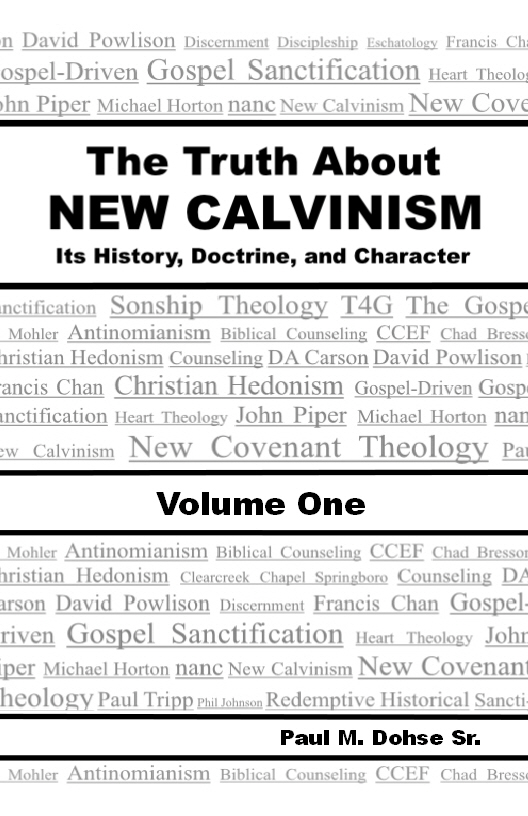 Randy Seiver has posted several responses to my response regarding his review of “The Truth About New Calvinism.” But the following is the bottom line:
He is a self-proclaimed contemporary New Covenant theologian with a Th.M from Westminster Theological Seminary and a student of church history. He also knew men who were involved in the early part of the movement. After all of his rhetoric about my “muddled” thinking, contrived theories about the connections between New Covenant theology and New Calvinism, and historical dots not being connected, he confirmed his belief that the centrality of the objective gospel is the true gospel!
The centrality of the objective gospel outside of us is the magnum opus of the Australian Forum which is what drives New Calvinism. Seiver’s quote concerning COG could be added to the list of quotes on page 94 of the book. Brinsmead clearly stated to me that COG was a “unique finding” by the Forum in light of church history.
This is a simple thing; his review furthers the case made in the book.
paul
Question on The 95 Thesis Against New Calvinism
So I am trying to figure out # 23-24 & 27 (a couple of others too). Could you explain in further detail? Number 27 particularly seems to contradict James 2:10-11
Scott,
James is talking about those who willfully disobey certain parts of the law but perceive themselves as those who uphold God’s law. In this case, showing socioeconomic partiality. They didn’t take the law seriously in regard to that sin. Murder isn’t optional, but favoritism is a “little” sin that is no big deal. Such sin in their minds was a footnote in God’s law. The Pharisees had a particular problem with this, seeing outward behavior as what mattered, but thoughts of the mind didn’t. Then on top of that, they redefined God’s law to make it easier to obey even in the outward arena. The Bible states specifically that they were anti-law both inwardly and outwardly.
Christians are born again. If we weren’t in this flesh, we could keep the law perfectly. And guess what? For salvation purposes, it doesn’t matter because we are not under the law for justification, we are under the law for kingdom living. This is where New Calvinists miss the boat via SDA theology. When you fuse justification and sanctification, the law remains a standard for justification WITHIN sanctification. Let me repeat that: “When you fuse justification and sanctification, the law remains a standard for justification WITHIN sanctification.” Paxton convinced Brinsmead that COOPERATION/COLABORING with God to MAINTAIN JUSTIFICATION was not the ticket. So how could the law be presented to God in sanctification perfectly? That’s when they founded the think tank named “The Australian Forum.”
To develop a consistent theological system that answered this question was the stated goal of the Forum, and the result was “the centrality of the objective gospel.” And shazaam! They discovered in the process that COG was the very crux of the Reformation, and had been lost to an evangelical “subjective gospel.” This also was a perfect fit for Paxton and Brinsmead’s shared disdain for Charismatic theology. Of course, the primary tenet of the doctrine has paved the way for their inclusion which would undoubtedly make both of them cringe. So, what was the formula for their dilemma? How can perfection be presented in sanctification? They developed an orthodox sounding theology that supposedly answered that question and such is the core doctrine of New Calvinism.
Now my point: You can see why New Calvinists want to interpret James that way; “See, see, Christians can’t obey the law perfectly (which is the standard for justification, but we have already been declared righteous), and if you disobey at one point, you are guilty of disobeying the whole law.” But hello, in regard to justification, we CANNOT be declared guilty for anything! Our obedience to the law for kingdom living is a whole separate issue. This is why Piper et al are constantly talking about how we can unwittingly make “sanctification the ground for our justification.” EVERYTHING IS CONNECTED TO JUSTIFICATION. Really, Jay Adams nailed this whole problem back in 1999. He has been harping for thirteen years that the crux of this problem is “the fusion of justification and sanctification.”
paul

 Paul's Passing Thoughts
11 comments