The T4G’s False Gospel

“….so, a supposed concern for an illegitimate new birth is clearly not the concern, they reject the new birth all together as significant to sanctification.”
If one goes to the Together For Gospel Sanctification (T4GS) infosite: t4g.org, they can observe the New Calvinist coalition’s official statement concerning the gospel. It reads as follows:
The Gospel
The Gospel is the joyous declaration that God is redeeming the world through Christ (Matt 1:21; Luke 1:68; Eph 1:7; Col 1:20), and that He calls everyone everywhere to repent from sin and trust Jesus Christ for salvation (Mark 1:15; Acts 2:38; 17:30).
Each of us has sinned against God (Rom 3:23), breaking his law and rebelling against his rule, and the penalty for our sin is death and hell (Rom 6:23). But because He loves us, God sent his Son Jesus (John 3:16; Eph 2:4; 1 John 4:10) to live for his people’s sake the perfect, obedient life God requires (Rom 8:4; 1 Cor 1:30; Heb 4:15) and to die in their place for their sin (Isa 53:5; Mat 20:28; 26:28; Mark 10:45; 14:24; Luke 22:20; John 11:50-51; Rom 3:24-25; 4:25; 1 Cor 15:3; 2 Cor 5:21; Eph 5:2; Heb 10:14; 1 Pet 3:18). On the third day, He rose bodily from the grave (Mat 28:6) and now reigns in heaven (Luke 22:69; 24:51; Heb 8:1), offering forgiveness (Eph 1:7), righteousness (Rom 5:19), resurrection (Rom 8:11), and eternal blessedness in God’s presence (Rev 22:4) to everyone who repents of sin and trusts solely in Him for salvation.
Looks pretty orthodox, but the devil is in the details. Literally. I have no specific beef with all of the statement and its Scripture citings, EXCEPT the sentence fragment that makes it a blatant false gospel:
….God sent his Son Jesus (John 3:16; Eph 2:4; 1 John 4:10) to live for his people’s sake the perfect, obedient life God requires (Rom 8:4; 1 Cor 1:30; Heb 4:15)….
Double Imputation and “Legal Fiction”
That’s not orthodoxy. First, God doesn’t require a perfect life for salvation, he requires a perfect sacrifice. And if he required a perfect life, we would all be toast, which is the very straw man New Calvinists use for their false gospel. Hang with me here. This is the belief that God’s part in salvation, justification, has to be maintained in real life in order to “stand in the judgment.” When we believe in the works of Christ for salvation, we are declared righteous and forgiven of past sins, but that REALITY must be sustained and confirmed in the future judgment by God. If not, supposedly, the declaration is “forensic/legal fiction.” This is all right out of Seventh-day Adventism and the faulty premise that drives 90% of all other false gospels.
Said another way, the law must be perfectly obeyed to establish God’s legal declaration as being true. And the declaration must be confirmed as being true at the judgment. This is works salvation. Somebody has to work to prove the declaration true. New Calvinists then say, “EXACTLY! That is what we are trying to say! Unless it is a reality, God’s declaration is a farce!” Or, “legal fiction.” We are declared righteous, but really we aren’t. Obviously, the best of us break the law daily. Before I get into true orthodoxy, let me tell you what their solution is and where they got it.
Their solution is a complex formula that enables believers to continually offer the perfect works of Christ to the Father in order to maintain the true reality of justification. This is the very definition of FAITH according to New Calvinists. “The just shall live by faith.” Right? Even in sanctification, we must “trust in the saving works of Christ” and not “our own.” Right? Let me pause/interject here for a moment and answer that: no. We don’t trust in the saving works of Christ for sanctification; we trust in His POWER for sanctification. We trust in His gifts for sanctification. We trust in His promises for sanctification. Huge difference! We are already totally saved; nothing or nobody has to maintain our salvation via perfect obedience to the law—it is a finished work, but sanctification isn’t.
However, if sanctification is seen as that which completes justification, as New Calvinists do, perfection would be required, and of course, practically speaking, we can’t foot that bill, someone else must do it for us. Hence, New Calvinists have a formula for offering the perfect works of Christ by faith in sanctification to make the legal declaration true.
What is it? Well, how were we saved? Same way. That way, the same faith in the same gospel that saved us, also sanctifies us. Sound familiar? What’s good for the justification, is also good for the sanctification. Yes, we do something in sanctification, but it is a formula of faith and not works. It is offering the perfect works of Christ to the Father by faith, and not our own. That’s why Christ supposedly had to live a perfect life for our justification—so his obedience can be offered up in place of our own by faith alone.
Where did they get this formula? They got it from Progressive Adventism. I substantiate this in The Truth About New Calvinism. The following is an example from Progressive Adventism’s theological journal, Present Truth Magazine. This quote will also add understanding /clarification to what I am posting as well:
We say again, Only those are justified who bring to God a life of perfect obedience to the law of God. This is what faith does—it brings to God the obedience of Jesus Christ. By faith the law is fulfilled and the sinner is justified (Present Truth: vol.7 art.2 part2).
Of course, there are some variations among New Calvinists concerning the formula, but some elements seem to be pretty consistent. The idea that can be seen in the aforementioned fragment that is the crux of this post alludes to one—the idea that Christ’s perfect obedience was imputed to us for obedience in sanctification. If Christ’s perfect obedience was imputed to our sanctification, that makes the perfect obedience required by the law a reality for us because we offer Christ’s obedience by faith, and the legal declaration is therefore found true. But you say, “Yes Paul, but we are the ones specifically declared righteous.” And they would say, “Yes, but that has to be seen in its gospel context—we are righteous IN CHRIST, he is our sanctification.” Sound familiar?
The New Birth Becomes a Problem
Secondly, if Christ is our sanctification in the sense of completely fulfilling sanctification in our stead because it must be done perfectly in order for the legal declaration of justification to be found true, our “ENABLEMENT” for valid participation in sanctification becomes a huge problem because we cannot participate perfectly as required to make the forensic declaration true. Ie., something must be done with the new birth. Therefore, New Calvinists subtly deny it. PPT has written extensively on how New Calvinists reject the new birth and I will not recite it here, but primarily, they don’t reject it out of hand, but relegate it to a subjective/inferior sphere while emphasizing the objective truth of the gospel. They often warn of “eclipsing Christ” with an overemphasis on the “subjective new birth.” Yet, Christ said: “You must be born again.”
In fact, John Piper plainly states that recognition of the new birth “infuses grace” into the believer and “reverses the relationship of sanctification and justification” making “sanctification the basis of our justification.” Piper believes that even a view of Christ working within us (ie., only a partial view of the new birth) is an “upside down Gospel” (Desiring God blog, June 25, 2009: Goldsworthy on Why the Reformation Was Necessary). You say, “Yes Paul, but he was talking about people who believe that Christ works within us to help us keep ourselves justified.” That’s exactly my point: Piper, as well as all New Calvinists, believe that anything we do in sanctification is an attempt to do that because the two are connected for the purpose of sanctification completing justification. Therefore, believing that Christ does a work within us can subjectively lead us to an effort to maintain our justification. The only safe bet is the objective works of Christ completely outside of us. Hence, the following quotes from many contemporary New Calvinists:
When the ground of justification moves from Christ outside of us to the work of Christ inside of us, the gospel (and the human soul) is imperiled. It is an upside down gospel
~John Piper
Thus, it will inevitably lead not to self-examination that leads us to despair of ourselves and seek Christ alone outside of us, but to a labyrinth of self-absorption.
~ Michael Horton
So what does this objective Gospel look like? Most importantly, it is outside of us.
~ Tullian Tchividjian
The blessings of the gospel come to us from outside of us and down to us.
~ John Fonville
If we happen to say No to one self-destructive behavior, our self-absorption will merely express itself in another, perhaps less obvious, form of self-destruction. Jesus sympathizes with our weaknesses. He was tempted in all ways as we are, yet without sin. We need help from outside ourselves—and he helps.
~ David Powlison
Now, observe carefully: again, one could argue that New Calvinists are talking about people who think we can maintain justification with the help of Jesus inside of us. Specifically, a new birth/regeneration that enables us to maintain our just standing until the judgment. So, they could say they don’t object to the new birth per se, but only a new birth that is for purposes of maintaining our just standing before God.
But they ALSO believe in the fusion of justification and sanctification. They believe that sanctification must necessarily finish justification, so anything done in sanctification must be done according to perfection (see note 1). This can be illustrated from the above quotes. As can be clearly seen by the Tchividjian and Fonville quotes, and to a lesser degree in the other two, they believe that the power of the gospel for sanctification STILL comes from outside of believers. Remember, all of these men think the same gospel that saved us also sanctifies us (see note 2); so, a supposed concern for an illegitimate new birth is clearly not the concern, they reject the new birth all together as significant to sanctification.
New Calvinists vary on how this fleshes out; I will touch on it lightly. Some believe that the Spirit’s work is done in a heavenly realm, and the “flesh” speaks of a worldly, sinful realm. Both realms exert a pressure on us, and at any given moment, we “yield” to one or the other. This is not considered works by us, but rather a passive yielding. But the key is that it still remains faithful to everything remaining outside of us.
Yet another approach, and the most popular, is the idea that we are spiritually dead and full of idols that replace God. These idols are exhibited through desires that we have. When we find these idols and repent of them, it empties our heart and the void is filled by Christ which results in a manifestation of good works. This is a “filling of Christ” rather than a filling of the Holy Spirit. The eradication of the idols that creates the void is called “deep repentance.” The works that result from the filling of Christ are called “new obedience.”
Though Christ does the works in us, our role is a completely outward focus on the gospel, so it remains faithful to the primary formula. This also remains true to the salvation model; we are sanctified the same way we were justified—by faith and repentance only. The works are not ours, but those wrought by Christ (new obedience). This formula is articulated in the book, How People Change, written by Paul David Tripp and based on David Powlison’s Dynamics of Biblical Change.
Of course, when you consider all of this, it’s obvious that the law has to be dealt with in some way. The Scriptures are a primary concern in regard to believers participating in God’s work. Therefore, the Scriptures need to be relegated to something other than a means for believers to participate in sanctification. PPT has posted many articles concerning this and I will not stop here to elaborate, but the New Calvinist approach to the Scriptures is necessarily antinomian.
Let’s now look at the Scripture citations by T4GS that supposedly affirm the idea that Christ lived a perfect life to impute His perfect obedience to our sanctification because such perfection is required to maintain justification and the validity of the legal declaration:
Romans 8:4
in order that the righteous requirement of the law might be fully met in us, who do not live according to the flesh but according to the Spirit.
What does this verse have to do with Jesus living a perfect life in our place for sanctification? The subject of the verse is the believer. The verses before and after do not speak of an imputation of obedience from the perfect life lived by Christ. Nevertheless, New Calvinists use this verse to teach that a utilization of Christ’s learn and do formula (Matthew 7:24-27) is living “according to the flesh” (or the flesh realm), and living by the Spirit is through Gospel Contemplationism.
1 Corinthians 1:30
It is because of him that you are in Christ Jesus, who has become for us wisdom from God—that is, our righteousness, holiness and redemption.
The subject of this verse is God the Father, not a perfect life live by Christ of which his obedience was imputed to us. The subject of Christ’s incarnate life appears nowhere in this verse.
Hebrews 4:15
For we do not have a high priest who is unable to empathize with our weaknesses, but we have one who has been tempted in every way, just as we are—yet he did not sin.
Again, this verse does not speak directly to an imputed obedience by Christ—it speaks to his empathy for us and the fact that He has experienced what we experience firsthand, but without sin.
So when all of this is considered, what makes New Calvinism a false gospel?
First, it skews what becoming a Christian is (via the initial gospel presentation). It’s the good news of salvation ONLY, and not the good news of kingdom citizenship. Prime examples are the “five word” and “one sentence” gospel presentations that exclude any reference to a commitment in recognizing Christ as Lord in kingdom living (see note 3).
Second, it skews the true meaning of repentance in the gospel message. The repentance is not ours; it was imputed to us by Christ’s perfect life. Therefore, this presentation presents the gospel as salvation by faith alone [ok so far], but then goes on and presents kingdom living by faith alone as well. That’s a half gospel. It is a gospel that requires faith alone for BOTH justification and sanctification. John 13:8-10 makes it clear that repentance in sanctification is not the same as repentance for justification. One is for the washing of the whole body, and the other is daily forgiveness for how we fail in kingdom living.
Third, it makes our righteous life part of the atonement. Hence, works in kingdom living is synonymous with works for justification. Therefore, the supposed believer enters into a one-sided relationship with Christ. And it makes living out sanctification a virtual walking through a minefield. Because the two are fused, what we do in sanctification can effect our justification.
Fourth, it skews Trinitarian involvement in salvation, even though we baptize in the name of all three. If the perfect obedience of Christ is imputed to our sanctification, the generative work of the Holy Spirit is not needed.
Fifth, It plainly denies the significance of the new birth, regardless of Jesus stating: “You must be born again.”
Sixth, it clearly devalues the Scriptures in regard to instruction and obedience, since obedience has already been imputed to us.
Seventh, for a true believer, it will rob him of assurance as a result of endeavoring to live out sanctification by faith alone (see 2Peter, ch.1).
Eighth, it skews the truth about what really justifies us. Clearly, the T4GS statement says that we are justified by the many acts of Christ in His perfect life being imputed to us. This is in brazen contradiction to Romans 5:18 and Hebrews 10:14.
Ninth, it implies a future judgment for Christians to determine their righteous standing. Christians will stand in no such judgment, and this inflicts a fearful and false duty upon the Christian to not take action in sanctification that could affect justification.
Tenth, it skews the use of the full armor of God in sanctification, hinders our love for Christ in obedience, and Robs the Father of His due glory through our lack of obedient acts that are supposedly already accomplished by someone else.
Notes
[1] “Christ has already done the imperatives on our behalf because we couldn’t. When I can’t do any given imperative perfectly (failing miserably), I rest in the One who has. Christ’s imputed active obedience is never far from the indicative-imperative rhythm of the Pauline ethic” (Pastor Chad Bresson: The Gospel Coalition blog, Imperatives-Indicatives =Impossibilities, May 3, 2010, online source: http://goo.gl/ttdZR).
[2] “I once assumed the gospel was simply what non-Christians must believe in order to be saved, while afterward we advance to deeper theological waters. But I’ve come to realize that the gospel isn’t the first step in a stairway of truths, but more like the hub in a wheel of truth. As Tim Keller explains it, the gospel isn’t simply the ABCs of Christianity, but the A-through-Z. In other words, once God rescues sinners, his plan isn’t to steer them beyond the gospel, but to move them more deeply into it (Tullian Tchividjian: The Everyday Gospel).
[3] CJ Mahaney states on page 20 of The Cross Centered Life that “Christ died for our sins” should define every part of who we are. In The Gospel in 6 Minutes video, John Piper states the following: “What’s the gospel? I’ll put it in a sentence. The Gospel is the news that Jesus Christ, the Righteous One, died for our sins and rose again, eternally triumphant over all his enemies, so that there is now no condemnation for those who believe, but only everlasting joy. That’s the gospel.”
Some Comments Just Have to be Posted
|
Submitted on 2012/02/03 at 3:31 pm
From the New Calvinist Bible, Matthew 21:28-32: Jesus asked the men who had come to test him, “But what do you think? A man had three sons, and he came to the second son and said, ‘Son, go, work today in my vineyard.’ He answered and said, ‘I will not,’ but afterward he regretted it and went. Then he came to the third son and said likewise. And he answered and said, ‘I go, sir,’ but he did not go. Which did the will of his father, the second son or the third son?” One of the really smart men listening to Jesus said to him, “The third son. While it is true that the second son repented and went to the vineyard, he obviously never understood the graceful message the father intended to convey to him. Sadly, the second son spent his life trying to please his father by working hard and following what the father had commanded. The third son, on the other hand, understood that the father never really expected obedience to his commands. The third son realized that, despite all the knowledge the father had revealed to him and all the resources he had been given by the father to do the work in the vineyard, he was in fact totally deficient of all ability to tend the vineyard as the father had commanded. The third son had learned from his teachers that the father almost always meant just the opposite of what he said to his sons, especially when the father said something that sounded like a command. Moreover, the third son trusted that the father’s first son, who had died years earlier, had already done all the work necessary for the vineyard to thrive. Again, that’s what the third son’s teachers had taught in class, and the third son felt at peace with their teaching. Importantly, the third son’s teachers had instructed that, in order to never feel compelled to go and work in the vineyard, the third son should remind himself daily of the good news that the father didn’t mean what he commanded and that the deceased first son had already done all the work. Note 1: The original manuscripts explicitly mention only two sons. However, the Editors interpreted the penumbras of the best original manuscripts and found there were actually three sons. These penumbras were found to exist throughout the best original manuscripts whenever the text included imperative statements. Note 2: Original manuscripts contain a warning by Jesus in verses 31b and 32. This warning has been omitted by the Editors because all such warnings impart fear and obedience to commandments, which are Old Testament concepts that were carried over into some of the New Testament writings inadvertently. |
Classic New Calvinist Double Speak: Tchividjian; Christians Are Not Totally Depraved, But they are Totally Depraved
 Again, as I am getting further and further behind schedule because New Calvinist heretics continue to herald outrageous error while cowardly HIV’s (highly respected leaders with international visibility) remain silent, I have to stop in the middle of a project to address something that I stumbled across while doing research. Apparently, questions about New Calvinism’s total depravity of the saints are causing enough stir to demand some answers. So Tullian Tchividjian (hereafter: TT) wrote a response on his blog.
As he sat down to write his response, a little mouse overheard him talking to himself and reported the following to me after running all the way up here from Florida:
“Hmmmm, how ate-up in the brains are my beloved Kool-aid drinking followers? Should I just plainly admit it, or use doublespeak? I don’t think they are quite ready for the whole truth yet, so I will use doublespeak. Now let me see, how can I say that we are totally depraved, while saying at the same time that we aren’t? Hmmmmm.”
Does the mouse story seem farfetched? So what? Christians will believe anything these days—why can’t I have some fun? TT’s treatise on how we are totally depraved, but not totally depraved, can be read here. First, TT gets us warmed up with a traditional view of what totally depravity is, and isn’t. Ie., it doesn’t mean we are all as evil as we could be because of God’s restraints. TT spends the first half of the post on that, and cites five Bible references.
After assenting to the fact that we are born again (and keep in mind that the New Calvinist definition of the new birth is NOT orthodox), he states the following:
But once God regenerates us by his Spirit, draws us to himself, unites us to Christ, raises us from the dead, and grants us status as adopted sons and daughters, is there any sense in which we can speak of Christian’s being totally depraved?
Yes.
I, by no means, am going to stop here and write a book on what New Calvinists really believe about the new birth, but notice in his statement that he stops short of a description of new creaturehood. The apostle Paul said of the new birth:
2 Corinthians 5:17
Wherefore if any man is in Christ, he is a new creature: the old things are passed away; behold, they are become new.
One might also note that TT conveniently leaves out the fact that the old man died with Christ’s death which means the power of sin over us is broken:
What shall we say, then? Shall we go on sinning so that grace may increase? 2 By no means! We are those who have died to sin; how can we live in it any longer? 3 Or don’t you know that all of us who were baptized into Christ Jesus were baptized into his death? 4 We were therefore buried with him through baptism into death in order that, just as Christ was raised from the dead through the glory of the Father, we too may live a new life. 5 For if we have been united with him in a death like his, we will certainly also be united with him in a resurrection like his. 6 For we know that our old self was crucified with him so that the body ruled by sin might be done away with, that we should no longer be slaves to sin— 7 because anyone who has died has been set free from sin (Romans 6:1-7).
TT then continues to build on his thesis:
Theologians speak of total depravity, not only in terms of “total inability” to come to God on our own because we’re spiritually dead, but also in terms of sin’s effect: sin corrupts us in the “totality” of our being. Our minds are affected by sin. Our hearts are affected by sin. Our wills are affected by sin. Our bodies are affected by sin. This is at the heart of Paul’s internal struggle that he articulates in Romans 7: “For I do not do what I want, but I do the very thing I hate.”
Note what he is stating here carefully—words mean things: because we are still affected by sin in our mortal bodies, or because it is still there—there is still a “total inability” to come to God in the same way that there was before we were saved. In other words, and for all practical purposes, sanctification is a continual coming to Christ by faith. TT relates this further by writing in the same post:
Paul’s testimony demonstrates that even after God saves us, there is no part of us that becomes sin free–we remain sinful and imperfect in all of our capacities, in the “totality” of our being. Even after God saves us, our thoughts, words, motives, deeds, and affections need the constant cleansing of Christ’s blood and the forgiveness that comes our way for free.
No it’s different. Sin’s relationship to us as believers is not the same as when we were unbelievers—it’s present, but its power over us is broken. TT at the very least deemphasizes that, and for the most part denies it. But the smoking gun here is the fact that TT reveals a theological flaw in New Calvinist thinking that repentance unto salvation and repentance in sanctification are the same. This reflects their belief that the relationship to sin and its power over us is the same as it was when we were unregenerate. Again, words mean things—what does the “blood” refer to? It refers to our justification, or Christ’s death on the cross for our “washing” (1Cor.6:11). But we don’t need that kind of washing/forgiveness anymore; we only need forgiveness for sin in sanctification that disrupts our relationship to the Father as adopted sons (John 13:9-11).
TT then elaborates on how New Calvinism fleshes out in an unbiblical fusion of sanctification and justification:
The reason this is so important is because we will always be suspicious of grace (“yes grace, but…”) until we realize our desperate need for it. Our dire need for God’s grace doesn’t get smaller after God saves us–in one sense, it actually gets bigger. Christian growth, says the Apostle Peter, is always “growth into grace”, not away from it. Many Christians think that becoming sanctified means that we become stronger and stronger, more and more competent.
And,
The truth is, however, that Christian growth and progress involves coming to the realization of just how weak and incompetent we continue to be and how strong and competent Jesus continues to be for us. Spiritual maturity is not marked by our growing, independent fitness. Rather, it’s marked by our growing dependence on Christ’s fitness for us. Because we are daily sinners, we need God’s daily distributions of free grace that come our way as a result of Christ’s finished work. Christian growth involves believing and embracing the fact that, even as a Christian, you’re worse than you think you are but that God’s grace toward you in Christ is much bigger than you could ever imagine.
In other words, total depravity is a good thing because the more we realize how sinful we are, the smaller we get and the bigger the cross and our need for it becomes. This can be illustrated by the following chart published by a New Calvinist organization:
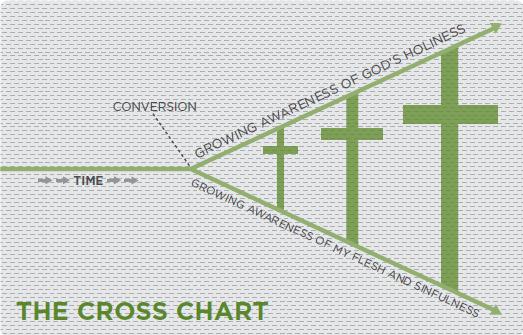
Basically, this is indicative of the New Calvinist gospel that makes much of sin so that Jesus is magnified. It is the antithesis of the true gospel.
TT concludes:
Because of total depravity, you and I were desperate for God’s grace before we were saved. Because of total depravity, you and I remain desperate for God’s grace even after we’re saved.
Thankfully, though our sin reaches far, God’s grace reaches infinitely farther.
Conclusion? We are still totally depraved. And what is really the difference between this and the apostle’s literary gasp concerning the amplification of sin so grace can abound?
In my book, nothing.
paul
Two Roads to Hell Named “Gospel”
It happened again on Facebook. A twenty- something professing Christian posting casual information about cohabitation with a boyfriend/girlfriend. What struck me about it was the following: as in other cases that I have seen and heard about, the shameless normality in which the information is shared.
Why is this the norm of our day? Answer: the gospel. The gospel means “good news,” and since the Fifties there has been two primary gospels preached in America and both are great news to most people. The first gospel (from the 50’s to the 90’s) emphasized the importance of believing that Christ died for our sins, and if you believed that, you were going to heaven. Obeying the ten commandments was a nice thing to do for Jesus, but optional. Even if you later denied Christ and the gospel, you were still saved, and keeping the law was optional. After all, we aren’t saved by the law, so how important could it be? Just in case you think that’s a generalization, consider these quotes from the book, “Eternal Security” written by evangelical superstar Charles Stanley:
PAGE 6 “As long as I have an ongoing role in the salvation process, my natural tendency will be to focus on my behavior rather than on Christ.”
PAGE 7 “People who are constantly examining their spiritual condition tend to fall into the trap of legalism.”
PAGE 200 “But isn’t it true that people who believe they must maintain some kind of good works in order to stay saved are trusting in themselves for their eternal security?”
PAGE 195 “Placing the responsibility for maintaining salvation on the believer is adding works to grace. Salvation would no longer be a gift. It would be a trade – our faithfulness for His faithfulness.”
PAGE 7 “Show me a believer who is caught up in trying to maintain God’s acceptance through good works, and I will show you a fragile saint. My experience has been that these are the people who on the surface appear to be completely sold out to personal holiness and purity but who suddenly disappear. It is not unusual for these well-meaning types to end up in a lifestyle completely opposite of what they once stood for.”
PAGE 93 “Even if a believer for all practical purposes becomes an unbeliever, his salvation is not in jeopardy.”
PAGE 72 “The Bible clearly teaches that God’s love for His people is of such magnitude that even those who walk away from the faith have not the slightest chance of slipping from His hand.”
PAGE 93 “Christ will not deny an unbelieving Christian his or her salvation because to do so would be to deny Himself. Why? Faithful or not, every person who has at any time had saving faith is a permanent part of the body of Christ.”
PAGE 104 “In Christ, the requirements of God’s holiness have been completely fulfilled!”
PAGE 63 “According to Jesus, what must a person do to keep from being judged for sin? Must he stop doing something? Must he promise to stop doing something? Must he have never done something? The answer is so simple that many stumble all over it without ever seeing it. All Jesus requires is that the individual “believe in” Him.”
Then more good news came in the latter Nineties. The first gospel didn’t emphasize the law enough, but the second gospel places very strong emphasis on the law. But the news is still good; Jesus obeys the law for us! In fact, it was part of the atonement; His perfect obedience was imputed to our sanctification! Moreover, even the relaxed approach to the law in the first gospel was legalism! So relax, be happy, live in peace with thy girlfriend. As one of the propagators of this second gospel has said,
The irony, of course, is that it’s only when we stop obsessing over our own need to be holy and focus instead on the beauty of Christ’s holiness that we actually become more holy! Not to mention, we start to become a lot easier to live with! Will someone please keep reminding me of this? (Tullian Tchividjian, Accountability Groups: The Tyranny of Do More, Try Harder).
And trust me, everyone is getting the message.
Besides, why bother with keeping the law? After all, as second gospel guru Paul David Tripp has stated in regard to Christians, “When you are dead you can’t do anything” (p. 64, How People Change 2006). Likewise, CJ Mahaney: “We [who is “we”?] are [present tense] enemies of God. We are God ignoring. We are God defying. We hate God” (2009 Resolved Conference).
Hence, compare the following quotes from these second gospel gurus to those of Stanley:
Francis Chan: “To change our hearts, what we value, what we risk, how we act, we don’t need more guilt or more rules, we just need to be in love with God. Because when you’re wildly in love with someone, it changes everything.”
DA Carson: “In this broken world, it is not easy to promote holiness without succumbing to mere moralism; it is not easy to fight worldliness without giving in to a life that is constrained by mere rules.”
John Piper: “So the key to living the Christian life – the key to bearing fruit for God – the key to a Christ-exalting life of love and sacrifice – is to die to the law and be joined not to a list of rules, but to a Person, to the risen Christ. The pathway to love is the path of a personal, Spirit-dependent, all-satisfying relationship with the risen Christ, not the resolve to keep the commandments.”
Tullian Tchividjian: “A taste of wild grace is the best catalyst for real work in our lives: not guilt, not fear, not another list of rules.”
These two gospels are two roads to hell. Why? Because both gospels restrict saving faith / belief to limited knowledge of the true gospel. Both limit saving faith to what Jesus did to make our entry into the kingdom possible, and not its purpose. “Jesus died for our sins, just believe that.” No, there is more. Jesus died for the purpose of setting us apart. The biblical word is “sanctification”:
Or do you not know that wrongdoers will not inherit the kingdom of God? Do not be deceived: Neither the sexually immoral nor idolaters nor adulterers nor men who have sex with men 10 nor thieves nor the greedy nor drunkards nor slanderers nor swindlers will inherit the kingdom of God. 11 And that is what some of you were. But you were washed, you were sanctified, you were justified in the name of the Lord Jesus Christ and by the Spirit of our God (1Corinthians 6:9-11).
But we ought always to thank God for you, brothers and sisters loved by the Lord, because God chose you as firstfruits to be saved through the sanctifying work of the Spirit and through belief in the truth (2Thess. 2:13).
In other words, the Spirit’s purpose is to set us apart, and Christ died for our sins to make that possible, resulting in us being declared righteous by the Father. Any gospel that excludes that purpose thereof is a half gospel:
It is God’s will that you should be sanctified: that you should avoid sexual immorality (1Thess.4:3).
The one who does what is sinful is of the devil, because the devil has been sinning from the beginning. The reason the Son of God appeared was to destroy the devil’s work (1John 3:8).
Therefore, the “new convert” supposes that Jesus only died to save us, and “enters the kingdom” indifferent to one of the primary reasons Christ died for us—to set us apart from the rest of the world unto the Father as a peculiar people. Hence, Facebook. Yea, flaunt thy supposed “festival of freedom.” After all, he only died to save us. Supposedly. For the true Christian beholding the heart of Christ and his purpose of setting us apart unto the Father, and His willingness to leave Heaven and obey the cruel cross—I beg you to tell me—how can being like the world be like business as usual? Furthermore, how can any man claiming to be a bishop of God tell us not to “obsess” over our holiness? It is the very essence of being a saint. It is what we signed up for. According to Mark G. Cambron, D.D. in Bible Doctrines:
Again we emphasis that the words “holiness,” “sanctification,” and “saint” all come from the same word meaning “set apart,” “separation.” The word “sanctify” in Exodus 13:2, and the word ‘holiness” in Psalm 29:2, and the word “saints” of Psalm 34:9 are the same word. The word “sanctify” of John 17:17, and the word “saint” of Philippians 1:1, and the word ‘holiness” of Hebrews 12:10 are all from the same word.
The call of the true gospel is a call to believe in the works of Christ and a commitment to be set apart according to His will. It is a call to embrace Him as Savior and Lord. It is most certainly an obsession with truth and holiness. It recognizes that being born again is to be set apart by the Spirit. Christ went to the cross to see this happen in His children, resulting in the destruction of the devil’s work. How it must grieve the Holy Spirit and Christ when we not only do the world’s bidding, but report it to others in casual fashion.
And because of this, should not the wording of the gospel be of major concern when we present it? How is it that the gurus of the second gospel proudly herald a five word gospel: “Christ died for our sins”? And then even go as far as to say that we live by that as well! How is it that John Piper presents the gospel in “one sentence,” excludes sanctification, and then says, “that’s the gospel”?
It is not the gospel. It is a half gospel. Both of these gospels breed an indifference for one of the primary reasons Christ went to the cross—sanctification. And by the way, the word of God is the standard for what that separation is and the knowledge to obtain it. It is not just law, it is every word that comes from the mouth of God that we live by (Matthew 4:4).
paul
How Kinky Does it Have to Get? Stuart Scott et al Don’t Care
 I have never been much for getting into the more bizarre aspects of New Calvinism, but we know that errant theology leads to life getting stranger and stranger. This post is about well-known Christians and their determination to associate with bizarre sects of New Calvinism. Without a doubt, the best example is my old stomping grounds, Clearcreek Chapel in Springboro, Ohio.
Clearcreek is still a training center for the National Association of Nouthetic Counselers and is on NANC’s national referral list. The Chapel is frequented by guest speakers such as Robert Jones, Paul David Tripp, Stuart Scott, and Lou Priolo. Apparently, Martha Peace has an ongoing teaching arrangement with Clearcreek as well. PPT has sent most of these folks letters asking them to not grant Clearcreek credibility in this way, but to no avail. Scott’s basic response was, “Not my problem.”
So, what doesn’t matter to these folks? Primarily, it doesn’t matter that one of Clearcreek Chapel’s staff elders (over adult education) is Chad Bresson, a former Christian radio personality. Bresson is one of the charter members of the Earth Stove Society which is a fringe group that promotes New Covenant Theology. Bresson authors the blog, Vossed World which is dedicated to the Bible Theology of Geerhardus Vos.
Vos has a cult following from this group. Literally. NCT fringe groups lead yearly pilgrimages to Vos’ gravesite in Pennsylvania to pay homage to Vos. Bresson led such a pilgrimage last year that was nothing short of a worship service. Bresson himself stood before Vos’ headstone and wept while reading from books written by Vos. Shockingly, Bresson posted the affair on his Facebook page and the information was forwarded to PPT.

“Standing in the midst of the obvious decay that is the hallmark of the already, speaks of the inbreaking ‘not yet’ through lumped throat and wet eyes.”
Just last week, I had the following encounter with an advocate of NCT and acquaintance of Bresson’s in the PPT comment section of a post:
My dear anti-Pneumian friend, we are heading there in a few weeks for our winter Pilgrimage . . . we will be sure to light a prayer candle or two for you at his shrine as we offer up prayers on our special new covenant Rosary to our beloved patron Saint Geerhardus. May he grant to you out of his treasury of grace to be spared some time in purgatory. Until then, walk in the power of the Spirit and be filled with the joy and wonder of the Gospel!
Jack,
I would be inclined to think you are kidding, but I know Bresson all too well, so, I think you are serious about this. If Vos shows up, take good notes and I will let you write a guest piece here.
Also troubling is Bresson’s outright denial of a literal, instructive approach to Scripture. Bresson believes the Holy Spirit only illumines the word when it is approached as a gospel narrative for purposes of Gospel Contemplationism. Any use of the Bible for instructive purposes is to use the Bible in the same way that the Pharisees used the Torah (Vossed World blog: “The Word of God is a Person,” 7/17/2008 archives). As the foremost respected theologian at Clearcreek Chapel, the idea that every single verse in the Bible must be read as concerning Christ and the gospel can be seen in the following post by another Chapel teacher: Clearcreek Chapel Biblical Theological Study Center blog: “Interpreting the Unfolding Drama the Way Jesus Did,” student archives 2/19/2011, by Max Strange. Online source: http://clearcreekbtsc.blogspot.com).
The Clearcreek elders are so bent on not implementing instruction in counseling that on at least one occasion, according to a former counselee I talked to, they will draw pictures of the person’s life on a piece of paper and illustrate were the counselee is located in the picture. I witnessed a testimony firsthand in which a Clearcreek elder said a marriage was miraculously transformed before his eyes by merely showing forth the gospel from the Scriptures in the first counseling session. When I confronted the elders about it, the response was, “Oh, that’s just Dan.”
Even by NANC standards, the fact that NANC associates with them and refers people there who have deep problems is unconscionable.
Another example is New Calvinist Mark Driscoll who has been a keynote speaker at such events like CCEF’s 2009 national conference at the behest of David Powlison. The following video in which he claims to see visions is self-explanatory:
Truly, New Calvinists like John Piper and CJ Mahaney must get together and giggle about what they can actually get away with. The following video documents their strange “The Scream of the Damned” concoction. This actually took place at the 2009 resolved conference sponsored by John MacArthur’s church. The fact that Grace Community Church would host such nonsense speaks for itself. Following are quotes concerning the message and then the 2009 resolved promo trailer:
CJ spoke of our Savior’s cry, “My God, my God, why have you forsaken Me?” And though I have contemplated that amazing cry often, never did it hit me as hard as in CJ’s message, when he referred to it as “the scream of the Damned.”
Then there was break and music and announcements, and John Piper stood up to bring his message. Several of us had prayed in a back room that God would anoint John, and pick right up where He left off in the previous message, and wow, did He. John referred repeatedly to the “scream of the Damned,” and then moved into Romans 8.
A flood of tears came as God preached the message to me yet again. That Deity would be Damned. That the God who is called upon righteously by the saints and angels in heaven to damn people, and called upon habitually by unbelievers flippantly and unrighteously to damn people, would in fact damn his Son, would (from the Son’s willingness to drink the cup) damn himself…for us. That it could be said of the Beloved One, “God damned Him,” and that He screamed the scream of the Damned….it was too much for me. It is too much for me this moment. And in the ages to come it will continue to be too much for me.
~ Randy Acorn
Everything exists to magnify the worth of the scream of the damned. That’s the point of the universe. What we will do forever in heaven is magnify the worth of the scream of the damned. Calvary will not be forgotten. It is the most-horrible, most sinful, most agonizing event that ever was – it will be the center of heaven forever. Hell exists, cross exists, sin exists, heaven exists, you exist, universe exists, in order to magnify the worth of the scream of the damned. What is the apex of the revelation of the grace of God? And the answer is the scream of the damned on the cross.
~ John Piper from his sermon on “The Screamed of the Damned.”

 Paul's Passing Thoughts
22 comments