Calvinism and the Problem with Perfection
 Originally published November 7, 2013
Augustine, Luther, and Calvin were first and foremost Platonists. They integrated the Bible with Platonism. Plato’s theory of forms posits the idea of two worlds; the mutable material world of illusion where reality can only be partially known, and another world where the immutable objective true forms exist. This material world is a shadow world; everything is shadows of the true forms. Therefore, man can only interpret and experience this world subjectively. The tendency is to interpret reality by observing the shadows. To the degree that mankind thinks the material world is reality according to the five senses, subjectivity and chaos will abound.
Therefore, Plato’s ethic was to improve the subjective experience of this life by accessing the true forms through ideas and mathematics—things that transcend the five senses (he believed math was an unchangeable rule and therefore not part of the shadow world). He believed that those who have the capability and willingness to bring more understanding of the objective into the subjective to be an elite minority. These were Plato’s philosopher kings whom he thought should rule society in order to decrease chaos as much as possible. Without philosopher kings, the world would be awash in a sea of subjectivity, everyone living by their own subjective presuppositions based on the shadows of this world. Hence, the arch enemy of the Platonic ideal is individualism.
Plato’s world of true objective forms was his trinity of the true, good, and beautiful. Experiencing the pure form of goodness in this world is impossible—only a shadow of good can be experienced subjectively. Plato’s social engineering has a doctrine, and to the degree that doctrine is applied, a higher quality of subjective existence occurs.
The Reformers put a slightly different twist on this construct. There is no doctrine to apply, only an orthodoxy that focuses on seeing and experiencing. Their version of Plato’s philosopher kings are pastors who possess the power of the keys. Orthodoxy is mediated truth determined by “Divines,” and passed down to the masses for the purpose of experiencing the objective power of the gospel subjectively. The Reformers made the true forms “the gospel,” and reality itself the gospel, ie., the work and personhood of Jesus Christ in particular.
Therefore, in the same way Plato envisioned a society that experiences the power of the true forms subjectively through ideas and immutable disciplines like mathematics, the Reformers sought a heightened subjective experience through a deeper and deeper knowledge of their own true, good, and beautiful—the gospel. And more specifically, instead of the gateway of understanding being reason, ideas, and immutable disciplines, they made the gospel itself the interpretive prism. So: life, history, the Bible, ie., everything, is a tool for experiencing true reality (the gospel) in a higher quality subjectivity. The Bible and all life events are a gospel hermeneutic. Salvation itself is the interpretive prism. All of reality is about redemption. Salvation itself is the universal hermeneutic.
But both constructs have this in common: Pure goodness and perfection cannot exist objectively in the material world. This is where Calvinism and Platonism kiss. The Bible only agrees with this if it is a “gospel narrative.” But if it is God’s full orbed philosophical statement to all men to be interpreted grammatically and exegetically, contradictions abound. To wit, if man possesses goodness and the ability to interpret reality objectively, Platonism and its Reformed children are found wanting. If Reformation orthodoxy is not evaluated biblically with the very theses of its own orthodoxy as a hermeneutic, even more wantonness is found.
The Apostles rejected Platonism because they believed goodness and perfection could indeed be found in this material world. There is no question of the quality of goodness inside of man that enables mankind to interpret reality objectively, the quantity of goodness notwithstanding. In contrast, a dominate theme in the Calvin Institutes is the idea that no person lost or saved can perform a good work. Like Plato’s geometric hermeneutics, the Reformers believed the Law lends understanding to man’s inability to do good because eternal perfection is the standard. The best of man’s works are tainted with sin to some degree, and therefore imperfect. Even if man could perform one perfect work, one sin makes mankind a violator of the whole law. The Reformers were adamant that no person could do any good work whether saved or lost.
Why all the fuss over this point? Why was Calvin dogmatic about this idea to the point of annoyance? Because he was first and foremost a Platonist. The idea that a pure form of good could be found within mankind was metaphysical heresy. Because such contradicts every page of the Bible, the Reformers’ Platonist theology was made the hermeneutic as well. Instead of the interpretation method producing the theology, they made the theology the method of interpretation. If all of reality is redemptive, it must be interpreted the same way.
For the Platonist, the coming of Jesus Christ in the flesh poses a huge problem. He is the truth. He came to the material world in a material body. Platonism became Gnosticism and wreaked havoc on the 1st century church. Notice how the first sentences of 1John are a direct pushback against the Gnosticism of that day:
1John 1:1 – That which was from the beginning, which we have heard, which we have seen with our eyes, which we looked upon and have touched with our hands, concerning the word of life— 2 the life was made manifest, and we have seen it, and testify to it and proclaim to you the eternal life, which was with the Father and was made manifest to us— 3 that which we have seen and heard we proclaim also to you, so that you too may have fellowship with us; and indeed our fellowship is with the Father and with his Son Jesus Christ. 4 And we are writing these things so that our joy may be complete.
Christ is the true, good, and beautiful, and He was touched, felt, seen, heard, and understood. Game over. This is the paramount melding of Plato’s two worlds resulting in a plenary decimation of his philosophy. Nevertheless, Calvin et al got around that by keeping mankind in a subjective realm while making the material world a gospel hermeneutic. Reality still cannot be understood unless it is interpreted by the gospel—everything else is shadows.
Martin Luther took Plato’s two worlds and made them two stories: our own subjective story, a self “glory story” that leads to a labyrinth of subjectivism, or the “cross story” which is the objective gospel. Luther made Plato’s two worlds two stories, but still, they are two realms: one objective and one subjective. In the final analysis mankind is still incompetent, and void of any good whether saved or lost.
Whether the Reformed gospel or Platonism, the infusion of objective goodness is the heresy. Man cannot have any righteousness in and of himself, whether lost or saved. The pushback against this idea can be seen throughout the New Testament. A few examples follow:
1John 2:4 – Whoever says “I know him” but does not keep his commandments is a liar, and the truth is not in him, 5 but whoever keeps his word, in him truly the love of God is perfected.
1John 2:20 – But you have been anointed by the Holy One, and you all have knowledge.21 I write to you, not because you do not know the truth, but because you know it, and because no lie is of the truth.
1John 2:26 – I write these things to you about those who are trying to deceive you. 27 But the anointing that you received from him abides in you, and you have no need that anyone should teach you. But as his anointing teaches you about everything, and is true, and is no lie—just as it has taught you, abide in him.
1John 2:29 – If you know that he is righteous, you may be sure that everyone who practices righteousness has been born of him.
1John 3:2 – Beloved, we are God’s children now, and what we will be has not yet appeared; but we know that when he appears[a] we shall be like him, because we shall see him as he is. 3 And everyone who thus hopes in him purifies himself as he is pure. 4 Everyone who makes a practice of sinning also practices lawlessness; sin is lawlessness. 5 You know that he appeared in order to take away sins, and in him there is no sin. 6 No one who abides in him keeps on sinning; no one who keeps on sinning has either seen him or known him. 7 Little children, let no one deceive you. Whoever practices righteousness is righteous, as he is righteous.
Romans 15:14 – I myself am satisfied about you, my brothers, that you yourselves are full of goodness, filled with all knowledge and able to instruct one another.
Christians can know goodness, and perform righteousness objectively. This speaks to the quality of the righteousness when it is performed—it is perfect and acceptable to God. We are not limited to a mere subjective experience in regard to righteousness. When we are resurrected, the quantity thereafter will be 100%, but our present righteousness is acceptable to God when it is performed by us. If it is accepted by God, it is perfect.
Even the unregenerate know good, and can perform it. The works of the law are written on their hearts, and their consciences either accuse or excuse them (Romans 2:12-15). Though enslaved to unrighteousness, they are free to perform righteousness (Romans 6:20). The very goodness of God can be understood from observing creation as well (Romans 1:20).
The only way the Reformers can make all goodness outside of man is to make the Bible a salvation hermeneutic. It is the only way they could integrate the Bible with their Platonist philosophy.
paul
The Nature of God
 I believe incredibly exciting times await God’s people as they break free from the Protestant Orthodoxy Dark Ages. The key will be the realization that God wrote the Bible for the average individual. We have an example of this regarding the nature of God; a subject thought to be too deep for the average disciple.
Our only head is Christ who teaches all, and the idea of being taught assumes the ability to understand. God’s people need to simply let the words in the Bible say what they plainly say, and we are individually responsible for doing so. One must free their minds from the tyranny of orthodoxy and journey into the Bible with their own God-given mind, and they will be responsible to God alone for doing so.
What then does the Bible teach us about God’s nature? The Bible states that God is love:
Beloved, let us love one another, for love is from God, and whoever loves has been born of God and knows God. Anyone who does not love does not know God, because God is love.
So we have come to know and to believe the love that God has for us. God is love, and whoever abides in love abides in God, and God abides in him.
Obtaining God’s Love
Protestant orthodoxy has a peculiar teaching known as the “vital union.” According to Reformed tradition, we maintain this vital union of “Christ in us and us in Christ” by “preaching the gospel to ourselves.” This is done by searching for sin in our lives so that we can return to the cross for forgiveness resulting in increased salvation. The following chart publicized by several Reformed organizations illustrates the process:
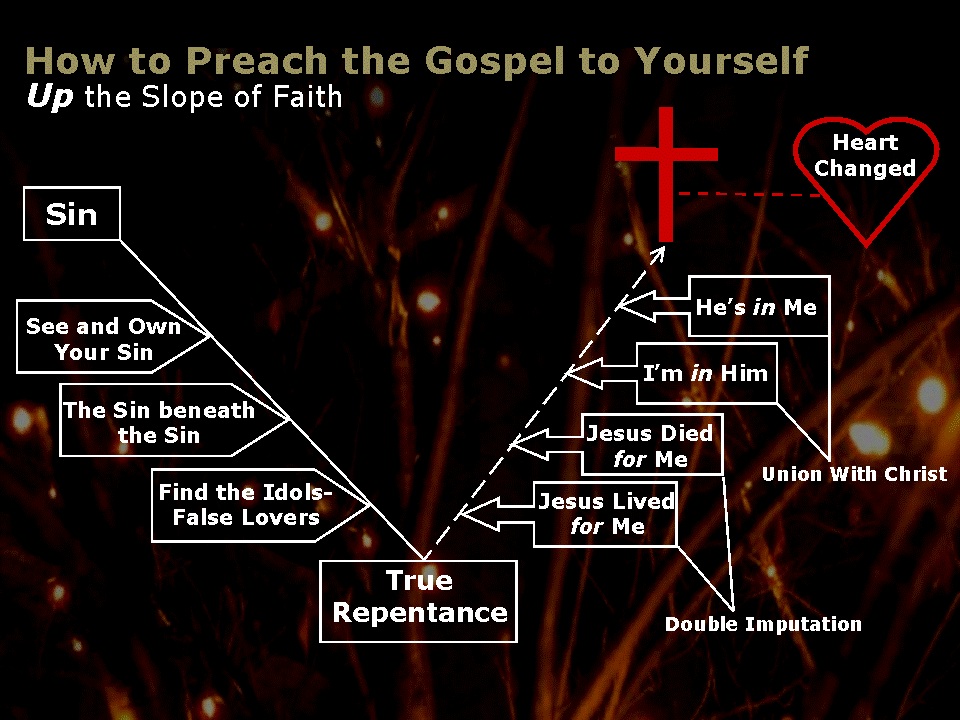
In case you think this is a “biblical” process for best results in growing as a disciple expressed in the illustration by “Heart Changed,” think again as illustrated by another chart published by several Reformed organizations as well:

In this chart, what is growing? Us, or our “salvation”? Many Reformed teachers in our day are fond of telling us how to “keep ourselves in the love of God” by “preaching the gospel to ourselves every day.” In fact, if we change, the following chart from the same camp shows the consequences:

…our salvation gets smaller! In contrast, we obtain God’s love once, and for all time, by believing in His Son, and experience assurance of that love but walking according to our new being.
Little children, let us not love in word or talk but in deed and in truth. By this we shall know that we are of the truth and reassure our heart before him…
But according to Protestant orthodoxy, if we make every effort to love God and others instead making every effort to find more and more sin in our lives, the gospel effect in our lives is diminished.
The Nature of God
How we obtain the love of God as prescribed by Protestant orthodoxy flows from its tenets regarding the nature of God. Primarily, God is defined as sovereign. Rather than sovereignty being an aspect of God’s nature, it is made to be the primary organizing principle—not love. This is an important distinction for those who take part in the exodus from Protestant darkness; will God’s nature be defined by a grammatical and exegetical interpretation of Scripture, or an interpretation based on orthodoxy?
Clearly, the Bible states that God is love. So, how does the Bible define love? Let’s see:
1Corinthians 13:1 – If I speak in the tongues of men and of angels, but have not love, I am a noisy gong or a clanging cymbal. 2 And if I have prophetic powers, and understand all mysteries and all knowledge, and if I have all faith, so as to remove mountains, but have not love, I am nothing. 3 If I give away all I have, and if I deliver up my body to be burned, but have not love, I gain nothing.
4 Love is patient and kind; love does not envy or boast; it is not arrogant 5 or rude. It does not insist on its own way; it is not irritable or resentful; 6 it does not rejoice at wrongdoing, but rejoices with the truth. 7 Love bears all things, believes all things, hopes all things, endures all things.
8 Love never ends. As for prophecies, they will pass away; as for tongues, they will cease; as for knowledge, it will pass away. 9 For we know in part and we prophesy in part, 10 but when the perfect comes, the partial will pass away. 11 When I was a child, I spoke like a child, I thought like a child, I reasoned like a child. When I became a man, I gave up childish ways. 12 For now we see in a mirror dimly, but then face to face. Now I know in part; then I shall know fully, even as I have been fully known.
13 So now faith, hope, and love abide, these three; but the greatest of these is love.
The so-called Reformed gospel of sovereignty calls for the total inability of man to love God even after their definition of conversion. One well known Reformed theologian wrote a book titled One Way Love. This staple Protestant belief is defined in the doctrine of double imputation which calls for the imputation of Christ’s alien righteousness to be imputed to our lives apart from anything we do other than preaching the gospel to ourselves. Much is made of living the Christian life by faith alone in order to maintain our “just standing.”
What it boils down to is God creating evil for His own glory. Whether you consider the teachings of Martin Luther or John Calvin, the founding fathers of Protestantism, this is an irrefutable fact. Luther taught that God created mankind with a passive will; in other words, a will that can only act if acted upon from an outside source. This testifies to God’s nature as defined by sovereignty. Hence, certain people are predetermined to suffer for eternity. In regard to this, John Calvin stated,
[God] arranges all things by his sovereign counsel, in such a way that individuals are born, who are doomed from the womb to certain death, and are to glorify him by their destruction.
~Institutes 3.23.6
I again ask how is it that the fall of Adam involves so many nations with their infant children in eternal death without remedy, unless it so seemed meet to God?…The decree, I admit, is dreadful; and yet it is impossible to deny that God foreknew what the end of man was to be before he made him, and foreknew, because he had so ordained by his decree.
~Institutes 3.23.7
This is contrary to love which is the true nature of God, being “kind,” and “Love does no wrong to a neighbor; therefore love is the fulfilling of the law.” The Reformed even make it a point to say that God did no wrong by creating man in an evil state because the end cause is God’s glory. If God brings good out of something evil, in the final analysis it is good because the end is good. It is also said that God created evil to make good better. However, that still does not dispose of the kindness issue. Love CANNOT be unkind to ANYONE.
Furthermore, it does not seek its own way, and you can insert “its own glory” in that list as well. Moreover, love does not rejoice in evil for any outcome, and always rejoices in truth and not the temporary demise of truth for some kind of better outcome. That notion is absurd.
In the final analysis, one of God’s attributes is sovereignty, but sovereignty is not the organizing principle of his nature because his nature is love.
paul
The Magnum Opus of the Reformation: Martin Luther’s Heidelberg Disputation; Part 5
Connecting the Dots: Tullian Tchividjian and Luther’s Theologian of the Cross
Listen to audio or download audio file.
That’s pastor Tullian Tchividjian…
…welcome truth lovers to Blog Talk radio .com/False Reformation, this is your host Paul M. Dohse Sr. Tonight, part 5 of “The Magnum Opus of the Reformation: Martin Luther’s Heidelberg Disputation.”
Greetings from the Potters House and TANC ministries where we are always eager to serve all of your heterodox needs. Our teaching catalog can be found at tancpublishing.com.
If you would like to add to our lesson or ask a question, call (347) 855-8317. Remember to turn your PC volume down to prevent feedback.
Per the usual, we will check in with Susan towards the end of the show and listen to her perspective.
Remember, you may remain anonymous. When I say, “This is your host; you are on the air, what’s your comment or question”—just start talking.
If you would like to comment on our subject tonight, you can also email me at paul@ttanc.com. That’s Tom, Tony, Alice, Nancy, cat, paul@ttanc.com. I have my email monitor right here and can add your thoughts to the lesson without need for you to call in. You can post a question as well.
At the beginning of tonight’s program, you heard an excerpt from a sermon via pastor Tullian. It is an example of what drives other Reformed leaders nuts, but they can complain all they want to, pastor Tullian is a Luther purest. His resignation last week from Coral Ridge Presbyterian Church brought me to remembrance in regard to what an excellent example he is of Martin Luther’s application of the Heidelberg Disputation in our day. So, tonight, this is an interlude of sorts that we are going to use to solidify what we have learned to this point.
Tullian lends credence to two accusations that the Reformed fear most: the charge of progressive justification, and antinomianism. I don’t know exactly why, but these are the two accusations that set a fire under their rumps, and along with it, a flood of cognitive dissonance. Yes, we are going to examine the arguments used to refute the charge of antinomianism and progressive justification, and as we will see, the arguments are so pitiful they would be deemed ridiculous by an adolescent which should be telling.
But first, I want to unpack the opening excerpt as a segue into the program tonight. Short excerpt, but packed with Luther’s foundational theology. In that short statement, we see the Reformed doctrines of mortification and vivification, Luther’s Theology of the Cross, deep repentance, double imputation, and total depravity.
Tullian stated first that we, as Christians, don’t merely need help with our walk, but we need to be raised from the dead. Let me pause here for a moment. What we are about to discuss are facts about the Reformation and Protestant soteriology in general that Protestants don’t understand. Fact: 98% of professing Calvinists really have no idea what Calvin believed, taught, and propagated. This is why the New Calvinism movement creates so much division between so-called Old Calvinists and New Calvinists; when the original article was rediscovered, by a Seventh-Day Adventist by the way, present-day Calvinists believed it was a false gospel. I was one of them. I set out to expose the New Calvinists and discovered they are the real Calvinists. I also discovered the fact that the Reformation is the biggest hoax ever perpetrated on mankind. The facts are irrefutable. So, is there hope? Of course there is; stop listening to men, turn on the light switch of the brain God gave you for a purpose, and read the gospels, the book of Acts, and Romans for yourself. Read those books, think for yourself, and just let the words say what they say. When the meaning isn’t apparent, don’t immediately run to a book full of someone else’s thoughts, what we call a “Commentary,” do your own independent research.
Why would Tullian say that Christians continue to be raised from the dead? That’s right out of theses 16-18 of the Heidelberg Disputation (HD). As I have stated before, the HD which came about 6 months after the 95 Theses is the foundational document of the Reformation, and then Calvin articulated and expanded Luther’s foundation in the Calvin Institutes. This progressive justification component of dying and rebirthing ourselves into heaven came to be known as mortification and vivification in the Calvin institutes. This brings us to Tullian’s mention of “Christians” being confessors, or the doctrine of deep repentance; that is the mortification component of mortification and vivification. By continually seeing our sinfulness in a deeper and deeper way, and being brought to the point of despair, or what Luther called “death at hand,” we then experience resurrection, or a revisitation of the joy of our salvation. Reformed scholars such as Michael Horton call this, “reliving our original baptism.” Listen, New Calvinist mantras like “We must preach the gospel to ourselves every day” do not come from nowhere. This is the source. We get to heaven by perpetually revisiting the same gospel that saved us. Those of you familiar with this ministry are worn out from me citing Michael Horton and Paul Washer on this, so let me change things up a little by quoting a guy that commented on a Tullian article posted on Justin Taylor’s blog over at TGC (The Gospel Coalition).
It’s not that complicated: the ground of all Christian obedience is the faithfulness of Jesus Christ. Justification occurs EACH time a believer confesses and receives forgiveness for his sins. The pattern of justification is illustrated by Paul in Romans 4. Abraham believes in the God who justifies the ungodly (in this case gentile Abraham), David is forgiven for his adultery and murder. God’s condemnation for sin has reached into history at the cross, glorification has reached into history at conversion where believers experience a foretaste of glory. Neither Old or New Covenant obedience require moral perfection, they both require obedience of faith….so, having been justified from faithfulness we have peace with God!
Indeed it is not complicated. “Faithfulness” to “confession” continually re-justifies us. And, as a result, we experience resurrection/joy/vivification. The confession is mortification/deep repentance/death at hand, the rising from the dead that Tullian is talking about is vivification and re-justification. Tullian’s emphasis on us being no different from unbelievers is based on the following idea: the ONLY difference between the saved and unsaved is the saved start getting saved by confessional faith alone resulting in perpetual re-salvation. Then, at the final judgement, we find out who lived by faith alone well enough to be saved and who didn’t. That’s authentic Protestantism in a nutshell, and the facts supporting this reality are irrefutable. And of course, it’s an in-your-face denial of the new birth as defined biblically in 1John 3 and many other places.
This also speaks to total depravity. Throughout the short excerpt Tullian pounds home the fact of moral equivalency, or the idea that one sinner is not any worse than any other. This comes from justification being defined and based on the law. This is major in the HD, but Calvin articulates this Reformation tenet in 3.14.9,10 of the Calvin Institutes. If you break the law on one point, you are guilty of breaking all of the law. “But Paul, isn’t that what James said in James 2:10?” No, that’s not what James was talking about. James wasn’t proffering a justification based on law as its standard. That concept is really the Achilles’ heel of Reformation soteriology. James was pushing back against the idea that some tradition of some sort replaces the law of love. Only love can fulfill the law. James was pushing back against the idea that justification’s standard is the law. No, there is NO law in justification; law and justification are mutually exclusive. In essence, what James was stating follows:
You can’t live by some orthodoxy devised by men and then live anyway you want to. Whatever your tradition is, it doesn’t fulfill the law. If your justification is based on the law, you break all of the law when you break it at any given point. Only love according to the law fulfills the law. The apostle Paul called this “faith working through love” in his letter to the Galatians. The standard for justification is what? Right, the new birth, NOT law! What is the official Reformed position on justification’s standard? Right, the law. This idea is what Paul spent his whole ministry refuting—this very idea that turns the gospel completely upside down! Clearly, the Reformers redefined justification by replacing its new birth premise with the law. Again, this concept of law/gospel was Paul’s number one nemesis.
This leads us to the question of how we are justified when we are supposedly justified anew. Tullian speaks of this in the excerpt when he alludes to what Jesus has done for us, not anything we do. In the excerpt, he thanks God that the gospel is not about anything we do, but rather only what Jesus has done for us. This is the Reformed doctrine of Christ for us, or, Christ 100% for us, or…double imputation. This is a huge Reformed mainstay.
What is it? This is the idea that Christ not only came to die for our sins once and for all on the cross, but that He also came to live a perfect life for the fulfilling of the law so that His obedience/righteousness can be imputed to us in vivification. Every time we confess, or according to Luther, “accuse ourselves,” or “visit the gospel afresh” (Michael Horton), the righteousness of Christ obtained by His perfect obedience to the law is imputed to us. Hence, every time we “visit the gospel afresh,” His propitiation and righteousness are both reapplied. This is the exact problem Paul addressed at Galatia. He argued that if the law was the standard for justification, that life is not given by the promise, but by law. He also argued that if law justifies us—there is a law that can give life while only God can give life. Making law the standard for justification is making the law a fourth member of the Trinity. That’s pretty much Paul’s argument.
In contrast, we are forgiven because the old us is dead, and no longer under the law. Look at Romans 7; one who has died is NOT under the law or its jurisdiction. This is why Christ died once: to end the law via us following Him in death. The new us is resurrected with Christ by the Spirit and able to fulfill the law through loving God and others. If perfect law-keeping, even by Christ, is the standard for justification rather than our death and resurrection through the new birth, it is impossible for us to love God and others—Christ must love for us; our love must be substituted by Christ’s love. And that in fact is the meaning of “Christ 100% for us.” Yes, Christ loves for us along with anything else that would be meritorious before God and the “righteous demands of the law.” Consequently, you often see these Reformed written motifs about sinners coming to the law with nothing in their hands but the obedience of Christ. That puts the law on a throne sitting beside the Father and the Son as a co-life-giver. That’s heresy in the extreme and a blatant denial of the new birth.
In concluding on this point, we now come Tullian’s mentioned disdain for “theologians of glory.” What’s that? That’s right out of the HD. It’s the counterpart, or one piece of the two-fold metaphysical theme of the document. The more I learn about this stuff, the more I am annoyed by Protestants who think they know what they are talking about, and we will soon be discussing one of them.
Luther divided the interpretation of all reality into two categories: the cross story and the glory story. Luther saw all of reality as a metaphysical narrative written by God with the cross being the primary epistemology; not only the cross, but the suffering of the cross in particular. Luther believed all wisdom is hidden in suffering. Luther, in keeping with Augustine’s Neo-Platonist worldview, demanded that all invisible things be interpreted through the suffering of the cross. Said Luther in theses 19:
That person does not deserve to be called a theologian who looks upon the »invisible« things of God as though they were clearly »perceptible in those things which have actually happened«
Thesis 20: He deserves to be called a theologian, however, who comprehends the visible and manifest things of God seen through suffering and the cross.
The manifest and visible things of God are placed in opposition to the invisible, namely, his human nature, weakness, foolishness. The Apostle in 1 Cor. 1:25 calls them the weakness and folly of God. Because men misused the knowledge of God through works, God wished again to be recognized in suffering, and to condemn »wisdom concerning invisible things« by means of »wisdom concerning visible things«, so that those who did not honor God as manifested in his works should honor him as he is hidden in his suffering.
Thesis 21: This is clear: He who does not know Christ does not know God hidden in suffering. Therefore he prefers ,works to suffering, glory to the cross, strength to weakness, wisdom to folly, and, in general, good to evil. These are the people whom the apostle calls »enemies of the cross of Christ« (Phil. 3:18), for they hate the cross and suffering and love works and the glory of works. Thus they call the good of the cross evil and the evil of a deed good. God can be found only in suffering and the cross, as has already been said Therefore the friends of the cross say that the cross is good and works are evil, for through the cross works are dethroned and the »old Adam«, who is especially edified by works, is crucified. It is impossible for a person not to be puffed up by his »good works« unless he has first been deflated and destroyed by suffering and evil until he knows that he is worthless and that his works are not his but God’s.
Thesis 22: That wisdom which sees the invisible things of God in works as perceived by man is completely puffed up, blinded, and hardened.
This has already been said. Because men do not know the cross and hate it, they necessarily love the opposite, namely, wisdom, glory, power, and so on. Therefore they become increasingly blinded and hardened by such love, for desire cannot be satisfied by the acquisition of those things which it desires. Just as the love of money grows in proportion to the increase of the money itself, so the dropsy of the soul becomes thirstier the more it drinks, as the poet says: »The more water they drink, the more they thirst for it.« The same thought is expressed in Eccles. 1:8: »The eye is not satisfied with seeing, nor the ear filled with hearing.« This holds true of all desires.
Thesis 24: He, however, who has emptied himself (cf. Phil. 2:7) through suffering no longer does works but knows that God works and does all things in him. For this reason, whether God does works or not, it is all the same to him. He neither boasts if he does good works, nor is he disturbed if God does not do good works through him. He knows that it is sufficient if he suffers and is brought low by the cross in order to be annihilated all the more. It is this that Christ says in John 3:7, »You must be born anew.« To be born anew, one must consequently first die and then be raised up with the Son of Man. To die, I say, means to feel death at hand.
Luther’s worldview calls for the condemnation of anything that can be perceived by the five senses, and that would of course include any work by mankind, in exchange for the work of faith that seeks death at hand by self-condemnation and the incessant confession of our own sin. All or any good work performed by us must be disavowed. This is the only work of faith that a Christian is to do; deep repentance that results in vivification. This is Luther’s definition of the new birth. Our only task is deep repentance resulting in only experiencing works that God may, or may not perform according to His own will. It is interesting what I am learning from Susan and her research on Jonathan Edwards. He believed that saving faith is a sixth sense that is able to perceive the works of God. That fits with what we are discussing here. Faith only confesses and then experiences the work of Christ following.
Any notion that man, saved or unsaved, can do anything at all that has merit with God is the glory story propagated by theologians of glory; this is what Tullian was referring to specifically in that sentence, no more—no less.
Before we move on, let me say this: to me, the more I study all of this, the more I am incredulous that congregations are forcing these guys caught with their hands in the cookie jar to resign. Why? It plainly shows the disconnect between the average Protestant’s understanding of their own faith and what their leaders teach. It’s totally inconsistent with the doctrine. “They sinned, well duh, so what?”
However, this is not always the case. Tullian has a close friend, also a pastor, who pretty much was fairly impious in broad daylight and never had to resign. In fact, he was the subject of a whole chapter in a book titled Sin Boldly: A Field Guide for Grace by Cathleen Falsani. This is where we segue into our second part. As I said, the two accusations that the Reformed camp is sensitive about are progressive justification and antinomianism. And especially in the area of antinomianism, the denial is beyond cognitive dissonance. It’s just borderline childish.
Let’s start by asking where Cathleen Falsani got the title for her book. “Sin Boldly,” do you know where she got that? It’s a quote by Martin Luther. Here is the whole quote from his letter to Philipp Melanchthon:
God does not save those who are only imaginary sinners. Be a sinner, and let your sins be strong (sin boldly), but let your trust in Christ be stronger, and rejoice in Christ who is the victor over sin, death, and the world.
Here, we see plainly that Luther saw salvation as ongoing for condemning sin. God does not save imaginary sinners. What is the tense there? That is answered in the next sentence: “Be a sinner.” So obviously, it’s a present continuous idea; it’s progressive. And if condemning sin is present continuous, obviously salvation must be present continuous as well. You must continually deem yourself a sinner in need of salvation. Be a sinner, or else you are denying that you need salvation.
Nevertheless, the arguments we hear against the idea that Protestantism is progressive justification sound like this from John MacArthur Jr.: “Justification and sanctification cannot be separated, but are distinct.” So, the two are distinct because one is progressive and the other is not, but yet, they are not separate. This is an attempt to answer the accusation that Reformed soteriology fuses justification and sanctification together which would of course be progressive justification. MacArthur attempts to deny that Protestantism fuses the two together by stating that the two are “distinct.” But this is like saying that a cat is never separate from its catness, but distinct from its catness when it progresses by walking. A cat is never separate from its catness, but distinct when it is walking; the argument is ridiculous.
In an article I wrote on PPT titled The Gospel According to John MacArthur’s Reformation Myth, I deconstruct MacArthur’s position on this in agonizing detail. Along Reformed lines, he states that justification is solely a forensic declaration that doesn’t change the individual. He then makes a distinction between Catholicism and Protestantism. The former infuses righteousness into the individual, and according to MacArthur, that is the fusion of justification and sanctification together resulting in progressive justification. In contrast, Protestantism disavows this infusion and replaces it with the imputation of Christ’s righteousness and obedience to the believer for sanctification, or Christian living if you will. So yes, justification and sanctification are not separate, but distinct in the fact that one declares us justified while the other is the manifestation of Christ’s righteousness. They can’t be separate because both are a predication on a single dimension of the law, ie., it’s for condemnation only and can only be fulfilled by Christ in our stead.
I am not going to get into the Protestant misrepresentation of Catholicism, suffice to say for now that it is also progressive justification based on Aristotelian philosophy instead of Platonism, but both are progressive justification. However, we can pause here to define the word “antinomianism” according to the Reformed: it is the absence of law as the standard for justification. In other words, that makes me an antinomian according to them. This is in contrast to the true definition of antinomianism from the Bible: the absence of the law for faith working through love. In other words, the use of the law for love is denied. In addition, the biblical dual perspective on the law is refuted and replaced with a single perspective on the law—condemnation instead of the Spirits twofold use of the law: to convict the world of sin and the judgement to come, and for sanctifying the saints. True antinomianism circumvents the law for sanctification and deprives the saints of their calling to love God and others.
If law is the standard for justification, a perfect keeping of it must be maintained by double imputation which calls on the “believer” to use it for gospel contemplation only rather than using it to love God and others. All obedience points to justification instead of love. This is why Christ said that in the latter days the love of many will wax cold, because of an increase of “anomia” which is “antinomianism” according to the English.
It’s ironic, the Reformed camp recently had a hissy fit over a statement made by Joel Osteen’s wife during one of their services at Lakewood Church—the largest Protestant church in America boasting some 25,000 members. Apparently, she stated that we should not obey God to please God, but should obey God to please ourselves. Pray tell, a single focus on deep repentance to keep ourselves saved through double imputation is better? At least Osteen is propagating a many faceted obedience that might lobe some love at somebody. Moreover, isn’t a single focus on sin for purposes of joyful vivification, in fact, delighting in evil? Sure it is.
As some of you know, I got into a little back and forth on Twitter this week with Janet Mefferd. It started with me pushing back against her assertion in a recent article that Tullian isn’t an antinomian. My contention centered on a tweet by Tullian that read…

Where does that come from? That comes right out of the HD, and if you are keeping up with this series, you see this plainly. Because Tullian sees all of his works as mortal sin, even stopping the blind grandmother from walking out into traffic, all of his sin is therefore venial and can be forgiven by perpetually revisiting the gospel. Mefferd replied with the same old worn out Reformed responses. I am particularly amused by the classic one I call the cat hermeneutic. If Calvin writes in the Institutes that he saw a cat run across the road, Calvin doesn’t necessarily mean that he saw a cat run across the road. You see, you must read the whole corpus of his writing to really know for certain that he intended to say that he saw a cat run across the road. Really? Am I here right now?
Look, I could make the point very well tonight that Mefferd, like most Protestants, is completely clueless. But I think I will close with another angle. Tonight, I have picked this apart from a doctrinal standpoint, but we must remember that Jesus liked to give folks a really simple rule of thumb while they are in the process of learning the doctrine. Here it is: “By their fruits you will know them.” Yes, I am simply going to close with a comment that was posted on PPT today, and then we will go to the phones:
Sean, and others, do any of you know what Janet Mefferd’s background is? Specifically, what is her education? She obviously does not know that Luther advocated the use of state-sponsored violence, torture and murder against the Mennonites and other Anabaptists, that Luther was an anti-Semite, and had horrible demeaning attitudes towards women. On the latter, here are some quotes:
“The word and works of God is quite clear, that women were made either to be wives or prostitutes.”
Martin Luther, Works 12.94
“Men have broad and large chests, and small narrow hips, and more understanding than women, who have but small and narrow breasts, and broad hips, to the end they should remain at home, sit still, keep house, and bear and bring up children.”
Martin Luther, Table Talk
“Even though they grow weary and wear themselves out with child-bearing, it does not matter; let them go on bearing children till they die, that is what they are there for.”
Martin Luther, Works 20.84
“God created Adam master and lord of living creatures, but Eve spoilt all, when she persuaded him to set himself above God’s will. ‘Tis you women, with your tricks and artifices, that lead men into error.”
“We may well lie with what seems to be a woman of flesh and blood, and yet all the time it is only a devil in the shape of a woman.”
“No gown worse becomes a woman than the desire to be wise.”
I could go on and quote his anti-semitic statements too. Oh, and Martin Luther despised reason. Here are some quotes:
“Reason is the Devil’s greatest whore; by nature and manner of being she is a noxious whore; she is a prostitute, the Devil’s appointed whore; whore eaten by scab and leprosy who ought to be trodden under foot and destroyed, she and her wisdom … Throw dung in her face to make her ugly. She is and she ought to be drowned in baptism… She would deserve, the wretch, to be banished to the filthiest place in the house, to the closets.”
Martin Luther, Erlangen Edition v. 16, pp. 142-148
“Reason is the Devil’s greatest whore; by nature and manner of being she is a noxious whore; she is a prostitute, the Devil’s appointed whore; whore eaten by scab and leprosy who ought to be trodden under foot and destroyed, she and her wisdom … Throw dung in her face to make her ugly. She is and she ought to be drowned in baptism… She would deserve, the wretch, to be banished to the filthiest place in the house, to the closets.”
Martin Luther, Erlangen Edition v. 16, pp. 142-148
“There is on earth among all dangers no more dangerous thing than a richly endowed and adroit reason… Reason must be deluded, blinded, and destroyed.”
Martin Luther, quoted by Walter Kaufmann, The Faith of a Heretic, (Garden City, NY, Doubleday, 1963), p. 75
Also, Luther was an advocate of drinking alcohol in excessive amounts. I could go on, but Luther’s quotes make me ill and nauseous. Obviously, Janet Mefferd has studied Christian history well.
______________________
Visit “The Oligarchy White Paper” for additional perspective.
John Calvin: Mankind Fallen BEFORE the Fall
Originally published December 22, 2013
For some time I have heard teachings coming from Calvinists that seem to insinuate that man was fallen before the fall. A popular teaching in the Patriarchy movement is the idea that Adam sinned before Eve bought into the idea that she needed a mediator between her and God. In fact, the need for mediation between man and God before the fall is very prevalent in Calvin’s writings. Francos Wendal, in his work, Calvin: Origins and Development of His Religious Thoughts (Presses Universitaires Defrance 1950) states the following on page 216:
“Indeed, for any contact to be established between the most holy God and sinful man, it was necessary for God to come right down to man, since man would never, of his own strength, have been able to raise himself up to God. ‘The majesty of God is too high,’ said Calvin, ‘For us to say that mortal men could attain to it, seeing that they can do no more than crawl over the earth like little worms,’*
“That, of course. Is the state of man since the Fall. But Calvin had no very high opinion of humanity even before the original sin. It is not so surprising therefore, that he could write:
‘Even If man had remained in his integrity, still his condition was too base for him to attain to God. How much less could he have raised himself so far, after having been plunged by his ruin into death and hell, after staining himself with so many defilements nay, even stinking in his corruption and all overwhelmed with misery?’** [The Calvin Institutes 2.12.1: Henry Beveridge translation varies slightly]”
The more Calvin is studied, the more it is realized that he sought to upend every element of truth in the Bible. The root of this is Calvin’s Platonist underpinnings that of course would have to see a problem with man before the fall because of his material essence.
Again, in regard to the pastorate of our day, who knew what and when? And in regard to those who didn’t know, why not?
paul
Endnotes
* Inst., 2.6.4. Among numerous similar passages, the Course upon Hosea, Opp. 42, 264: “Deum a nobis quaeri non posse, nisi in mediatore Ghristo. . . . Nisi Christus se medium nobis offerat qua via possemus ad Deum accedere?” Or again, the sermon on I Ephesians 1.1-3: “Without this Mediator, it is certain that we are all foreclosed [by God] and the majesty of God ought to make the hairs of our head stand on end.” Opp.9 51, 256.
Does Protestantism Require Church Membership for Salvation?
It most certainly does, but the reason church membership is required by the Protestant faith is far more scandalous than that one symptom. We will start with the core gospel of the Protestant religion, and then see how required membership in the local church is efficacious to its gospel.
How “Christians” that are far removed from the original Protestant tradition function is no defense for its official Reformed gospel. Protestants can’t have it both ways though they try. They excuse what Luther and Calvin taught because not all Protestants function by every jot and tittle. But on the other hand, they deem other religions as false based on their original statement of faith. Obviously, no Protestant will give a Buddhist a pass for one second because, “Not all Buddhists believe the exact same things that Buddha believed.”
By and large, the problem is that most Protestants really don’t know what the Protestant gospel is, and when they are confronted, they choose to defend their investment in it for whatever reason. At least one reason follows: investing in the truth is hard work. Protestantism, like many other religions, propagates the farming-out of their faith to the experts. Of course, that is very ill advised.
First, we will look at a summary of the Protestant gospel, and then establish the summary with specific citations. The core principle is progressive justification. This is the idea that salvation is a process and not a onetime passing from death to life. This fact about Protestantism surprises many Protestants. Many tout “once saved always saved,” but that’s not what the Reformers taught at all. They taught that the justified state was a progression from definitive justification to final justification, and the process in the middle is subjective justification. The process in the middle is really progressive justification, but many Reformed scholars deny that in the face of insurmountable evidence. In fact, the title of chapter 14 in book 3 of the Calvin Institutes is, “The Beginning of Justification. In What Sense Progressive.” In other words, justification is present continuance; it’s not a onetime finished event.
As we will see, the institutional church established by the church at Rome circa 4th century is deemed as God’s institution that oversees the progression of justification for God’s people. Unless you are a member of a local church, your salvation cannot progress from point A to point B. Remember, the Reformation did not really seek to replace the “Mother Church,” but rather sought to reform it. Luther, Calvin, nor their mentor St. Augustine ever officially left the Catholic Church. Luther and Calvin had a dying devotion to Augustine until the end who is an official Doctor of Grace in the Catholic Church until this day.
Foundational to Protestantism is the idea that Christ’s death served two purposes for sin: an unconditional forgiveness of past sin, and a conditional forgiveness for “present sin” and future sin. The condition for receiving forgiveness for “present” and future sin was membership in the local church signified and confirmed by water baptism. They didn’t teach baptismal regeneration directly, but taught that forgiveness of present and future sin can only be received in the church, and only water baptism made someone a true member of the church:
“Wherefore, our initiation into the fellowship of the church is, by the symbol of ablution, to teach us that we have no admission into the family of God, unless by his goodness our impurities are previously washed away” (The Calvin Institutes: 4.1.20).
“Nor by remission of sins does the Lord only once for all elect and admit us into the Church, but by the same means he preserves and defends us in it. For what would it avail us to receive a pardon of which we were afterwards to have no use? That the mercy of the Lord would be vain and delusive if only granted once, all the godly can bear witness; for there is none who is not conscious, during his whole life, of many infirmities which stand in need of divine mercy. And truly it is not without cause that the Lord promises this gift specially to his own household, nor in vain that he orders the same message of reconciliation to be daily delivered to them” (The Calvin Institutes: 4.1.21).
“To impart this blessing to us, the keys have been given to the Church (Mt. 16:19; 18:18). For when Christ gave the command to the apostles, and conferred the power of forgiving sins, he not merely intended that they should loose the sins of those who should be converted from impiety to the faith of Christ; but, moreover, that they should perpetually perform this office among believers” (The Calvin Institutes: 4.1.22).
“Secondly, This benefit is so peculiar to the Church, that we cannot enjoy it unless we continue in the communion of the Church. Thirdly, It is dispensed to us by the ministers and pastors of the Church, either in the preaching of the Gospel or the administration of the Sacraments, and herein is especially manifested the power of the keys, which the Lord has bestowed on the company of the faithful. Accordingly, let each of us consider it to be his duty to seek forgiveness of sins only where the Lord has placed it. Of the public reconciliation which relates to discipline, we shall speak at the proper place” (Ibid).
“…by new sins we continually separate ourselves, as far as we can, from the grace of God… Thus it is, that all the saints have need of the daily forgiveness of sins; for this alone keeps us in the family of God” (John Calvin: Commentaries on the Catholic Epistles; The Calvin Translation Society 1855. Editor: John Owen, p. 165 ¶4).
“. . . forgiveness of sins is not a matter of a passing work or action, but comes from baptism which is of perpetual duration, until we arise from the dead” (Luther’s Works: American ed.; Philadelphia: Muhlenberg Press; St. Louis: Concordia, 1955, vol. 34, p. 163).
“. . . Forgiveness of sins is not a matter of a passing work or action, but of perpetual duration. For the forgiveness of sins begins in baptism and remains with us all the way to death, until we arise from the dead, and leads us into life eternal. So we live continually under the remission of sins. Christ. is truly and constantly the liberator from our sins, is called our Savior, and saves us by taking away our sins. If, however, he saves us always and continually, then we are constantly sinners” (Ibid, p.164).
“For the forgiveness of sins is a continuing divine work, until we die. Sin does not cease. Accordingly, Christ saves us perpetually” (Ibid., p.190).
“Daily we sin, daily we are continually justified, just as a doctor is forced to heal sickness day by day until it is cured” (Ibid., p.191).
Hence, notice that there is no distinction made between sins committed as unbelievers and sins committed as believers. Sin is sin and needs a perpetual forgiveness in order for the “believer” to remain justified. The only difference is unconditional forgiveness (sin committed as an unbeliever) and conditional forgiveness, i.e., you can only receive forgiveness as a member of the local church.
Also note the shocking assertion, usually attributed to Catholic priests, that pastors/elders have the authority to grant forgiveness for present and future sin.
paul

 Paul's Passing Thoughts
1 comment