
Shame On You John MacArthur!
 Once a rabid respecter of John MacArthur, I now have absolutely no respect for him. I am keeping some of his books in my library for reference purposes, but that’s about it. And as one who actively promoted financing/support for Christians to attend his college, I now consider him a danger to the wellbeing of Christianity in general. I have watched his decline (due to bad company with the likes of mega-heretic John Piper) for some time, but his willingness to support and associate with CJ Mahaney reveals the true heart of John MacArthur Jr.
I am almost finished reading “Blight In The Vineyard” by John Immel, and I’m looking forward to writing a review on it, and I’m taking this review very seriously as I believe this book is one of the most relevant books of our day. I have made the book required reading for all in the Dohse household. Immel, among the other hefty services rendered to the church in said book, provides Cliff Notes (in a manner of speaking) for SGM Wikileaks.
I have gone to Wikileaks and read, primarily because Reformed despots say it is gossip to do so (and thereby doing my duty), but have really been unable to ascertain any great evil on the part of CJ Mahaney because of the massiveness of the documents. Well, Immel clears that all up by pointing out a few atrocities and the page numbers. The only one I had to see follows: the transcript of a recorded conversation between CJ Mahaney and SGM cofounder Larry Tomczak. CJ Mahaney, according to the transcript by anybody’s measure, is trying to blackmail Tomczak who left SGM for doctrinal reasons (Calvinism).
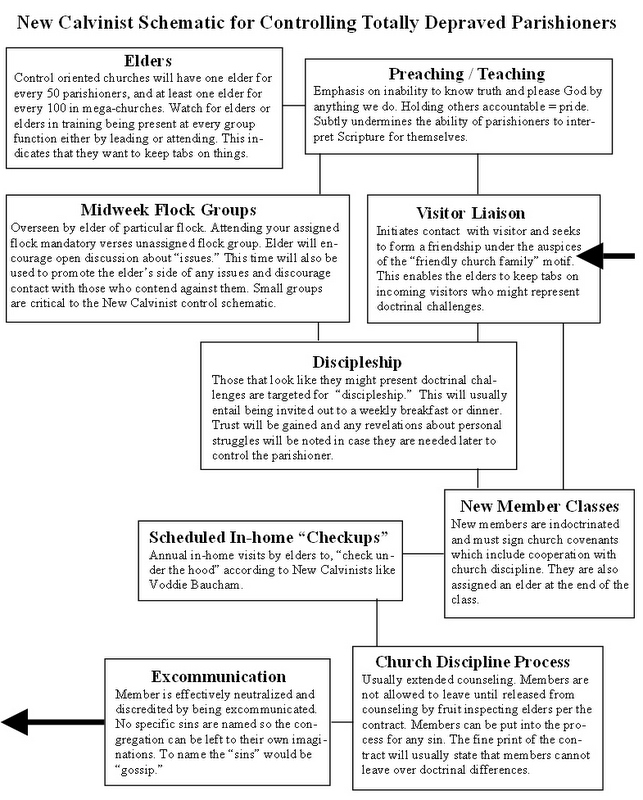
Ok, look, what happened to Tomczac plays out over, and over, and over again in churches daily because of the new resurgence of Geneva style true-blue Calvinism. Aka, New Calvinism. As Charles Spurgeon once said, “Calvinism is the Gospel.” Therefore, as CJ said to Larry, “Doctrine is an unacceptable reason for leaving P.D.I” (People of Destiny International—later renamed SGM). If I only had a nickel for every time we see this played out here at TANK/PPT. It goes like this:
- The elders are informed someone is leaving for doctrinal issues.
- They are immediately confronted with “unrepentant, longstanding sin” in their lives. Like Calvin, they believe (out of necessity for control) that ANY sin is fodder for church discipline.
- They are placed in a church discipline “process” that includes counseling. When you have shown forth “fruits meet for repentance” as judged by fruit inspecting elders, you are released from the counseling (ie., you convert to Gospel Sanctification).
- If you try to leave the church without being released from “counseling,” the assembly is told that you are jumping ship in the middle of the Matthew 18 process. The congregation usually assumes the victim was confronted with an issue or dispute, and left before the offended party could come back with witnesses. The anti-gospel (synonymous with anti-Calvinism per Spurgeon) individual is then excommunicated which totally discredits him/her from blowing the whistle or challenging the doctrine of God’s anointed.
Apparently, in Tomczak’s case, that wasn’t going to fly, so CJ threatened to reveal sins committed by Tomczak’s (at the time a minor) son. Tomczak’s wife, who was on the line, called Mahaney out in regard to the fact that it was pure, unadulterated blackmail. Also consider that the son had confessed the sin and was granted forgiveness thereof. Unbelievably, when CJ is reminded of that, he tells the Tomcsaks that he wouldn’t have promised to keep the forgiven sins confidential if he knew at the time that they were going to leave for doctrinal reasons.
Immel also points out (according to Wikileaks documents) that Mahaney and SGM cronies had their attorneys review a proposal for revealing the sin/sins publically. Their attorneys strongly advised against it because Georgia law protects the rights of minors in such cases. But in a brilliant observation, Immel asks what would have happened if the church and the state of Georgia were the same! (as propagated by the Reformers for the necessary control of the totally depraved zombie sheep). Game over. Tomcsak submits or SGM reveals the information.
And this is the crux. Because Reformed leaders of the John Calvin Geneva Theocracy club cannot evoke the state to enforce their authority (not yet, anyway), they all stick together. MacArthur, Dever, Mohler, Piper et al, see a huge lack of respect in the church for the authority that they think they should have among God’s people. How they choose to save the totally depraved zombie sheep from themselves is none of our business. They have no time to be concerned with the necessary fallout that accompanies the John Calvin gospel of the enlightened ones leading the totally depraved through the fabricated spiritual minefield they call sanctification.
This explains why the cries of abused sheep fall on the deaf ears of other leaders, time, and time again. I have become convinced of this unequivocally. Nevertheless, and while one also wonders what else might be in the Wikileaks documents, MacArthur’s willingness to associate with CJ Mahaney is deplorable. But this is who John MacArthur really is. My God fearing grandmother said it well, and often: “Birds of the feather flock together.”
paul
Reformed Theology = All Righteousness REMAINING Completely Outside of Us
“If the Platonist monster is hiding in the church’s big closet, there is no priesthood of believers and pastors/elders are the enlightened ones who must tell us who to marry, what to eat, and what to wear. They must also do whatever it takes to protect the totally depraved zombie sheep from themselves. And look around, we are almost there right now. The mega-church is behaving like Rome and Geneva’s theocracy more and more every day.”
“So now we have this core element of all righteousness remaining outside of the believer. Where do we go from here? What about the new birth? What’s ‘new’ about us if all righteousness remains outside of us?”
“Though New Calvinist elders talk of the new birth and Christ being ‘in’ us, you must understand they’re using earthly language that the totally depraved zombie sheep can understand. They do not believe Christ works in us (which can be clearly seen from the aforementioned Piper quote), or that we are born again enabled people.”
This post will demonstrate that Reformation theology called for grace/righteousness to remain completely outside of us. In fact, Reformation theology even rejects the idea that Jesus is doing ALL of the work IN US as Christians. The Reformers, primarily Luther and Calvin, taught that the primary difference between Romanism and true Christianity was this whole idea that Jesus did a sanctifying work INSIDE of us verses a sanctifying work OUTSIDE of us. They decried the former as an “infused grace” that enabled us to partake in the finishing or participation of our justification. Problem is, that’s why it is important that justification and sanctification are seen as being separate. Justification is a finished work, and sanctification doesn’t finish justification. Once that is established, the conversation gets interesting: “Where do we go from there?”
This Reformation concept and everything it leads to, also leads to a social death at various points in history. Other forms of Reformation theology sanctified by spiritual common sense carry the Reformation motif forward, while the pure Reformation gospel dies out. Jay Adams is a good example of a Sanctified Calvinist. But from time to time, a resurgence of the pure Reformation gospel comes about via rediscovery, and that is exactly what is going on with the New Calvinist Movement. Hence, Sanctified Calvinists are not the original article—that’s why so many of them oppose “New Calvinism.”
But why does the original article die a social death? Primarily because of the basic philosophy that led to the doctrine. Plato was a religious philosopher. He believed that man cannot know reality, and lives in a world that is a shadow of truth. He also believed that there are people who can endeavor to know truth and become enlightened, but in doing so, cannot be enslaved to what their senses can understand according to physical matter. Truth is something completely outside of the human realm. He then asserted that the enlightened needed to rule the unenlightened, and that the purpose of government should aid the philosopher king in controlling the unenlightened masses to protect them from themselves. Augustine was greatly influenced by these teachings, and Augustine’s development of these ideas were passed on to Luther and Calvin.
This is really no big secret if one does some research and stops listening to what others tell them. Plato was the father of Gnosticism, which embellishes the “practical application” of Reformed theology in its purest form. Hence, the spiritual tyranny that comes out of this philosophy causes it to be rejected socially from time to time. In other words, the fallout from the resurgence begins to manifest itself; or, the chickens come home to roost. That part dies out, while Calvinism by name, primarily (supposedly) representing the sovereignty of God issue (its sanctifying element) continues to live on until the next rediscovery movement. The New Calvinist Movement is now shining a light on what Calvin really believed. The Calvin Institutes are a brilliant systemizing of Augustinian theology, but Sanctified Calvinists don’t hold to the whole package which explains contradictions in their soteriology and eschatology.
But on the other hand, a need develops in the remaining theological systems that fuse justification and sanctification together. Since sanctification is said to finish justification, how can a person be found truly righteous at the one, final judgment? In theological systems where the two are separate; this isn’t a problem, we are declared righteous and our living in sanctification will show that, but has no bearing on the declaration and our guaranteed glorification. However, if the two are fused, that is, justification and sanctification, we must not only be positionally righteous, but must indeed be perfect in order for God’s declaration not to be “legal fiction.” So, the question becomes: “How can we be truly perfect in order to stand in the judgment?” In the theological system that separates justification and sanctification, the answer is: “I don’t have to be found righteous at a future judgment because I will not stand at any such judgment. I have already been declared righteous, and would be perfect if I wasn’t still in this mortal body. But in reality, I am a born again holy one hindered by this mortal, sinful flesh.”
This doesn’t bode well in the Platonist mindset, for now we have a whole race of enlightened ones who are capable of knowing truth on their own (and as I note in The Truth About New Calvinism, this denotes the idea that the law of God can be used to please Him and to live an abundant sanctified life with the help of the Spirit). Not only that, it makes us participants in the “Golden Chain of Salvation”; ie, we are “ENABLED” to participate in the finishing of our salvation/justification. This is a problem because the results are still imperfect, and thus God’s declaration is still “legal fiction.” If your mindset is that salvation is a continuous chain that links justification to glorification with sanctification being the middle links (an exact illustration used by John Piper), then the work must be all of God in order for it to be sufficient for us to stand in the future judgment. “Infused grace” only enables us enough to be dangerous and makes us participants in an imperfect endeavor which would make God a liar at the final judgment.
But nevertheless, it is what it is and gives rise to a reintroduction/need of purest Reformed theology: since Christians function in the “Golden Chain of Salvation,” we must find a way to be in the sanctification links while making our perfection true reality. How is this done? Theological systems of all stripes that fuse justification and sanctification together are left to languish in this question on their own until the collective peacelessness of the people cry out for another way. An infused enablement (in the justification endeavor) and pseudo perfectionism doesn’t fill the bill.
This exact scenario gave rise to the present-day New Calvinist Movement. One of the languishing theological systems that views sanctification as the completer of justification is Seventh-Day Adventism. Since 1884, this movement, trapped in the context of the Golden Chain of Salvation, has struggled to answer the question of how one stands righteous in the judgment. In 1970, a SDA theologian named Robert Brinsmead blew the lid off of the whole debate. In The Truth About New Calvinism, I cite the writings of someone who was involved with Brinsmead’s movement at that time:
In 1971, Brinsmead scheduled a flurry of summer institutes to bring us his latest emphasis. There was more excitement than usual; the latest round of tapes had prepared us for something big. Bob had been studying the Reformation doctrine of justification by faith, comparing it to Roman Catholic doctrines. Reading Luther, he saw that justification is not just a means to the end of perfect sanctification. When we are justified by faith, not only does God impute Christ’s righteousness to us but we also possess Christ Himself—all His righteousness and all His perfection. Eternity flows from that fact….
“And those whom he predestined he also called, and those whom he called he also justified, and those whom he justified he also glorified” (Rom. 8:30).
The same ones he justified he also glorified. We began to realize we had inserted extra steps into Paul’s chain of salvation: sanctification and a final atonement brought about by blotting out sins. Those added steps, in fact, were the heart of the Awakening message—but we had ignored the heart of the real gospel: being justified by faith, we ‘rejoice in hope of the glory of God.’ Our righteousness is in heaven, said Brinsmead:
“The righteousness by which we become just in God’s sight, remain just in His sight and will one day be sealed as forever just in His sight, is an outside righteousness. It is not on earth, but only in heaven…only in Jesus Christ.”
True sanctification looks away from self and flows from the finished, objective work of Christ…. For many Christians, the glory of the crucified Christ is not their focus; instead they seek internal experiences that eclipse the cross. The Awakening rightly opposed the subjective, human-centered emphasis found among some groups within Christianity. Wrongly, they reacted with a cerebral, spiritless gospel. Brinsmead strongly opposed the Charismatic movement’s emphasis on experiences as a return to the theology of Rome. However, going to another extreme, Present Truth magazine decried “the false gospel of the new birth,” and offered a new birth that was merely a corporate, objective blessing, not an individual experience. (pp. 33, 34).
This concept that Brinsmead claimed he got directly from the Reformers launched the Awakening Movement and turned the SDA completely upside down. Because of the supposed fact that the true Reformation gospel of justification by faith alone had been all but lost in evangelical circles, Brinsmead, along with two Anglican theologians formed the Australian Forum think tank to systematize the theology into a contemporary understanding. And they were dead right: what they developed was in fact the true Reformation gospel; righteousness and grace remains completely outside of the believer—justification cannot be completed by an infused ability to participate in the completion of justification because our participation results in falling short of perfection. This rediscovery was perhaps the most significant rediscovery movement since Colonial Calvinism, and a book written by one of the Australian Forum 4, Geoffrey Paxton (“The Shaking of Adventism”), would lend merit to that idea. An illustration from the Forum’s theological journal captures the essence of the doctrine:
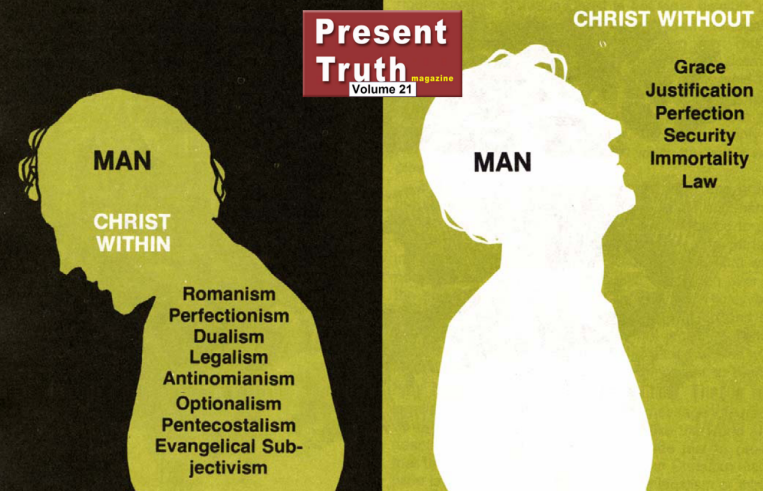
Freeze that thought. Don’t try to connect the dots yet. It is what it is. No righteousness can be inside of us (meaning Christians). In fact, Christ doesn’t even really do a work inside of us either. Yes, I know they use that terminology from time to time, but that’s not what they mean. It is critical that we establish that fact right now, and then we will build understanding. Let’s first demonstrate that one of the primary figures of the New Calvinist movement, John Piper, believes this exactly, and also believes that it was the crux of the Reformation. Piper wrote an article about a series of lectures that one of the Australian 4 conducted at Southern Seminary in Louisville, KY. The following is from my book, The Truth About New Calvinism:
In March, 2008, Graeme Goldsworthy of the Forum delivered a lecture at Southern Baptist Theological Seminary entitled Biblical Theology and its Pastoral Application. Part of the thesis concerned why the Reformation was needed. The purpose of Goldsworthy’s lecture was affirmed by pastor John Piper in an article he wrote on his Desiring God blog on June 25, 2009 entitled Goldsworthy on Why the Reformation Was Necessary. The lecture, and Piper’s response shows an uncanny kinship between the Forum and New Calvinism. Examples in the present Christian landscape are myriad , but this particular combination shows agreement on all of the Forum’s major, and unique tenets….In the aforementioned article concerning Goldsworthy’s lecture at Southern, Piper agrees that the original Reformation sought to correct the reversal of sanctification and justification:
This meant the reversal of the relationship of sanctification to justification. Infused grace, beginning with baptismal regeneration, internalized the Gospel and made sanctification the basis of justification. This is an upside down Gospel….When the ground of justification moves from Christ outside of us to the work of Christ inside of us, the gospel (and the human soul) is imperiled. It is an upside down gospel.
Note his words carefully. At issue is any kind of infusion of grace into the sanctification process. In case you think he is talking about wayward Catholicism, here is what he adds to these thoughts:
In it [Goldsworthy’s lecture at Southern] it gave one of the clearest statements of why the Reformation was needed and what the problem was in the way the Roman Catholic church had conceived of the gospel….I would add that this ‘upside down’ gospel has not gone away—neither from Catholicism nor from Protestants (pp. 41-43).
So whether or not the belief is infused grace for the new birth or some abhorrent variation of evangelicalism is not the point; the point is the infusion of grace within the believer for sanctification or any other reason. To do that is to supposedly make us a part of our own justification. But how in the world would this work in real life? This seemingly leaves us without any spiritual arms or legs—virtual paraplegics in a spiritual sense. How can a feasible role be introduced while staying faithful to Platonist ideal?
Enter Reformed theology. But before I do, let me reiterate that this everything good outside of us ideal is the calling card of the New Calvinist Movement and what they understand to be the crux of the Reformation. The following are several quotes from key figures in the New Calvinist movement. Keep in mind that these statements are in regard to Christians:
The blessings of the gospel come to us from outside of us and down to us.
~ John Fonville
We need help from outside ourselves—and he helps.
~ David Powlison
So what does this objective Gospel look like? Most importantly, it is outside of us.
~ Reblogged by Tullian Tchividjian
Thus, it will inevitably lead not to self-examination that leads us to despair of ourselves and seek Christ alone outside of us, but to a labyrinth of self-absorption.
~ Michael Horton
When the ground of justification moves from Christ outside of us to the work of Christ inside of us, the gospel (and the human soul) is imperiled. It is an upside down gospel
~John Piper
And from my interview with Robert Brinsmead:
Author: What do you think the unique theological findings of the Forum were in light of history? Robert Brinsmead: “Definitely the centrality and all sufficiency of the objective gospel understood as an historical rather than an experiential event, something wholly objective rather than subjective – an outside of me event and the efficacy of an outside-of-me righteousness.”
Brinsmead’s last statement is a powerful description of this doctrine: “…something wholly objective rather than subjective – an outside of me event and the efficacy of an outside-of-me righteousness.”
All righteousness being outside of the believer is in my estimation where the line is drawn in the sand between Reformed theology and the rest of Christianity—not the election/free will debate per se. If the argument is there, then at least debate it in regard to the born again Christian having no real spiritual life, and no free will. Let’s start there, and leave the free will to choose God in salvation fight for another day. If the Platonist monster is hiding in the church’s big closet, there is no priesthood of believers and pastors/elders are the enlightened ones who must tell us who to marry, what to eat, and what to wear. They must also do whatever it takes to protect the totally depraved zombie sheep from themselves. And look around, we are almost there right now. The mega-church is behaving like Rome and Geneva’s theocracy more and more every day.
Sure, when you corner them, they are going to deny this, but there is simply too much circumstantial evidence/theology to back this claim. How can the total depravity of the saints not add up to this “efficacy of an outside-of-me righteousness”? You say, “Now Paul, where have any of these guys said that we are ‘totally depraved’? Look, I am not going to play word games here. If Isaiah 64:6 applies to born again believers, as many in Reformed circles contend, then the accusation is fair and apt for illustration purposes. Besides, many are now using that term specifically to describe Christians. Moreover, Calvin himself stated the following:
There can be no doubt that Paul, when he treats of the Justification of man, confines himself to the one point—how man may ascertain that God is propitious to him? Here he does not remind us of a quality infused into us; on the contrary, making no mention of works, he tells us that righteousness must be sought without us; otherwise that certainty of faith, which he everywhere so strongly urges, could never stand; still less could there be ground for the contrast between the righteousness of faith and works which he draws in the tenth chapter to the Romans….( (From Kenneth A. Strand, ed., Reform Essentials of Luther and Calvin: A Source Collection [Ann Arbor: Braun-Brumfield, 1971], pp.219-222).
Please think about this: it is a debate concerning our very identity as Christians. If we don’t even know who and what we are: God help us. This total inability and all righteousness being outside of us profoundly effects the following hallmark elements of the Christian faith:
- The new birth.
- Use of the law in sanctification.
- The very definition of the gospel itself.
- The relationship and authority of elders to the saints.
- The relationship and authority of the church to the saints.
- The authority of the Word in relationship to saints/elders.
- The proper use of God’s word in counseling.
- The proper use of God’s word for preaching.
- The difference between justification and sanctification.
- The roles of justification and sanctification in the life of the saint.
- The difference between repentance for salvation and sanctification.
- The very definition of biblical obedience.
- Eschatological truth.
- Future judgment of mankind.
And frankly, the present-day church is showing symptoms of misunderstanding in these areas that approaches fallout in the realm of biblical proportions.
So now we have this core element of all righteousness remaining outside of the believer. Where do we go from here? What about the new birth? What’s “new” about us if all righteousness remains outside of us? Here is where Platonism, and its twin sibling, Gnosticism, partner with Reformed theology, at least the Plato—Augustine—Luther—Calvin strain. We don’t change; we are merely transported into a different realm (darkness/light) where we can determine which realm we manifest by what we contemplate or meditate on. New Calvinists have even developed a way to determine how that is experienced: John Piper’s Christian Hedonism. The Scriptures then serve the following primary purposes:
- A contemplation tool for the totally depraved zombie saints.
- A polity structure guide for Reformed elders.
- A book for preaching the gospel to the totally depraved.
- It makes Reformed elders the experts on seeing Christ in every verse of the Bible, and therefore relegating believers to a pope-like reliance on Reformed elders.
In speaking of the Bible’s function in the scheme of things, I am getting a little ahead of myself. Since all righteousness remains outside of the believer, the “practical application” of this theology is the continual resaving of the saint; or, a continual manifestation of a grace completely outside of us. The Bible then becomes the tool for doing that. Reading the Bible for learning and doing is strongly discouraged. Everything in the Bible is to show forth grace. The imperatives show us what we can’t do, but what Christ has done for us. It also shows us how other totally depraved zombie sheep have experienced grace manifestations throughout redemptive history. In the latest rediscovery movement (New Calvinism), this Platonist, metaphysical approach is not hard to see. Two of the most popular New Calvinist websites have Gnostic themes: “Between Two Worlds,” and “Between Two Spheres.” The number one tenet of New Covenant Theology (New Calvinism’s approach to law/gospel), as described by the Earth Stove Society (a NCT think tank) is:
New Covenant Theology insists on the priority of Jesus Christ over all things, including history, revelation, and redemption. New Covenant Theology presumes a Christocentricity to the understanding and meaning of all reality [ALL reality?].
Though New Calvinist elders talk of the new birth and Christ being “in” us, you must understand they’re using earthly language that the totally depraved zombie sheep can understand. They do not believe Christ works in us (which can be clearly seen from the aforementioned Piper quote), or that we are born again enabled people. Hence, they need to keep us away from the truth of the new birth in ways that can be understood by us. One may also note the lack of teaching on the new birth altogether in New Calvinist churches. Their only alternative is to come right out and say that we really don’t perform any works, but rather manifest works already accomplished by Christ from another realm. Good luck with that; the adolescent Sunday school gang will not even buy that when stated forthrightly.
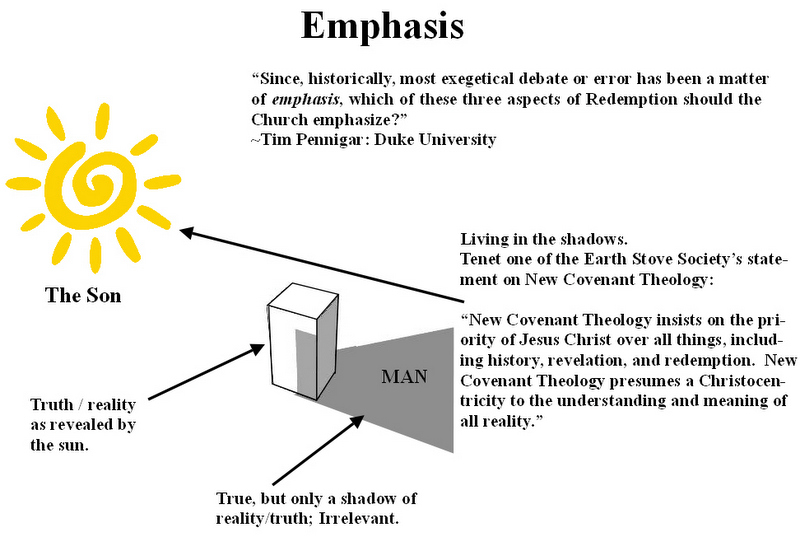
So what do they teach? Answer: “EMPHASIS” as the only relevant truth. This is blatant Platonism. Plato taught that what we experience on Earth (what the senses can detect) are shadows of truth. Sure, shadows are real, but they aren’t truth/reality. Likewise, there is a sense in which the Holy Spirit does a work in us, but it’s not really relevant to the blazing truth of the objective gospel which deals with the works of Christ, and not subjective works by us via help from the Holy Spirit. Anything short of focusing on the “Sun” eclipses the Son and causes us to focus on the shadows of lesser, irrelevant truth. This is a primary theme of Rick Holland’s book, “Uneclipsing the Son.” The Australian Forum (the aforementioned rediscovery movement) published an article entitled “The False Gospel of the New Birth” which was based on the Platonist concept of emphasis (shadows verses what the sun revealed about the objects casting the shadows). This concept can be seen by them in quotes from the article, but also echoed by contemporary New Calvinists:
It robs Christ of His glory by putting the Spirit’s work in the believer above and therefore against what Christ has done for the believer in His doing and dying.
~ Geoffrey Paxton (Australian Forum)
But to whom are we introducing people to, Christ or to ourselves? Is the “Good News” no longer Christ’s doing and dying, but our own “Spirit-filled” life?
~ Michael Horton
And the new-birth-oriented “Jesus-in-my-heart” gospel of evangelicals has destroyed the Old Testament just as effectively as has nineteenth-century liberalism. (footnoted to Paxton’s article with above quote).
~ Graeme Goldsworthy (Australian Forum)
Did an overzealous attempt to give God all of the glory for all works create the fusion of Justification and sanctification with a need for Gnosticism to be the “practical application”? Or did Platonism create the theology which dealt redeemed mankind from the sanctification process? Hard to say, but it is clear that this is what the Augustinian line of Reformers believed. And for all practical purposes is a perpetual justification and daily resaving by faith alone to maintain a just standing before God. From the archives of the Australian Forum:
The present continuous nature of justification was the genius of Luther’s emphasis. In
“The Disputation Concerning Justification” (1536). He says:
. . . forgiveness of sins is not a matter of a passing work or action, but comes from baptism which is of perpetual duration, until we arise from the dead. — Luther’s Works(American ed.; Philadelphia: Muhlenberg Press; St. Louis: concordia, 1955), vol. 34, p. 163.
. . . Forgiveness of sins is not a matter of a passing work or action, but of perpetual duration. For the forgiveness of sins begins in baptism and remains with us all the way to death, until we arise from the dead, and leads us into life eternal. So we live continually under the remission of sins. Christ. is truly and constantly the liberator from our sins, is called our Savior, and saves us by taking away our sins. If, however, he saves us always and continually, then we are constantly sinners. — Ibid., p.164.
On no condition is sin a passing phase, but we are justified daily by the unmerited forgiveness of sins and by the justification of God’s mercy. Sin remains, then, perpetually in this life, until the hour of the last judgment comes and then at last we shall be made perfectly righteous. — Ibid., p.167.
For the forgiveness of sins is a continuing divine work, until we die. Sin does not cease. Accordingly, Christ saves us perpetually. —Ibid., p.190.
Daily we sin, daily we are continually justified, just as a doctor is forced to heal sickness day by day until it is cured. — Ibid., p.191.
This quote can be added by Calvin as well:
Christ cannot be torn into parts, so these two which we perceive in him together and conjointly are inseparable—namely, righteousness and sanctification. Whomever, therefore, God receives into grace, on them he at the same time bestows the spirit of adoption [Romans 8:15], by whose power he remakes them to his own image. . . Yet Scripture, even though it joins them, still lists them separately in order that God’s manifold grace may better appear to us. — John Calvin, Institutes of the Christian Religion (Philadelphia: The Westminster Press, 1960), Bk. 3, chap. 11, sec. 6).
Another way to think of this is: we are sanctified the same way we are saved—by faith and repentance only. Salvation and sanctification are both completely monergistic. As New Calvinists say, “The same gospel that saves you also sanctifies you,” and “We must preach the gospel to ourselves every day.” Hundreds of years later, the doctrine and its Gnostic applications are not even ambiguous.
paul

 Paul's Passing Thoughts
1 comment