TANC 2015: Paul Dohse Session 1 – Introduction to Biblicism
Session 1: Introduction to Biblicism
Who do we think we are? Why would Western culture be immune from populous deception? In fact, history, even recent history reveals the dangers of collective logic whether by tradition or some sort of neo-movement. Moreover, examples of bad fruit coming from collective logic can be taken from the best of what Western culture has to offer.
There is one constant that shapes culture; change occurs as a result of bad fruit. The collective pain threshold begins to surpass the threshold of life value. Society then becomes split into two types of people: those with new ideas and those willing to listen.
Tyranny has always been a foolish endeavor by virtue of God’s design of things. The reason is simple: the people always outnumber the rulers, and the rulers need people to have a government, and you can only kill so many people. This is why controlling the way people think is so important; this taps into the human resource without killing the donor.
From the cradle of society, caste was the norm. Unfortunately, the consensus had always been that bad fruit had nothing to do with the system, but only those running it. The American experiment was the first successful challenge to collectivism. The definition of the words and the understanding of them are a matter of life and death on a massive scale. For example, “individualism” does not exclude cooperation and organization for the common good, but rather, asks who will determine what the common good is and how one reaches that conclusion. The assumption that individualism leads to societal chaos has in fact produced chaos in incomprehensible proportions.
Once again, history is repeating itself in many ways, but the particular aspect that TANC focuses on is Protestantism. Once again, fruit demands reevaluation because of the threshold of pain. But this time of historical reevaluation is utterly unique because it is post American Revolution. For the first time in over 500 years, Protestantism faces a reevaluation without the force of state at its disposal.
Nevertheless, Protestantism has done its job well. It yet has no fear of replacement because those who have given up on it believe there is no alternative. Hence, its utter failure has produced no competitors. The Nones and the Dones are just that, none and done. Yet, lest Protestantism would break from protocol and show mercy to its detractors, the Nones and the Dones are declared damned to hell on their way out to the wilderness of hopelessness because being a member in good standing in the institutional church is synonymous with loving Christ and being a legitimate part of His body.
We at TANC reject such an arrogant notion with extreme prejudice, and believe we understand a legitimate alternative—a return to the assembly of Christ and its priesthood of believers. A return to individual gifts, not spiritual collectivism; fellowship, not membership; leadership, not dictatorship; organization, not institutionalization; not many masters, but only one; a body, not a corporation, and finally, freedom of conscience. Individual saints with one word, one Lord, and one body. It’s a body, not a spiritual caste system, and we have but one mediator—the Lord Jesus Christ.
Biblicism
The alternative to Protestant orthodoxy is Biblicism. What is it? Let’s begin with a definition from Wikipedia. This is by far the best definition of Biblicism that I have ever found, and unfortunately listed under an alternative name for Biblicism, “Biblical Literalism.” And, as rightfully noted by Wikipedia, often used as a pejorative. Don’t you know, any Biblicist that has read Matthew 5:30 has cut off his right hand or feels guilty that he hasn’t. Let’s examine the definition:
Alternatively, the term can refer to the historical-grammatical method, a hermeneutic technique that strives to uncover the meaning of the text by taking into account not just the grammatical words, but also the syntactical aspects, the cultural and historical background, and the literary genre. It emphasizes the referential aspect of the words in the text without denying the relevance of literary aspects, genre, or figures of speech within the text (e.g., parable, allegory, simile, or metaphor).
Let me add that Biblicism starts with literalism and the plain sense of the text first, and then utilizes the elements of the historical-grammatical methods as needed to make the rendering consistent with the rest of Scripture. As one person has said, “When the plain sense of Scripture makes common sense, seek no other sense.” Let me also add that Biblicists would normally be impressed with a method of interpretation known as Occam’s razor. Again, we are indebted to Wiki for a definition:
…a problem-solving principle devised by William of Ockham (c. 1287–1347). It states that among competing hypotheses, the one with the fewest assumptions should be selected. Other, more complicated solutions may ultimately prove correct, but—in the absence of certainty—the fewer assumptions that are made, the better.
In context of the lay person, learning is a jigsaw puzzle. I want to use this example of a jigsaw puzzle that is a map of Xenia, Ohio. Let’s say the map, to the degree that it is fitted together, represents knowledge of Xenia. Until the puzzle is completely fitted together with all of the pieces, what do we do with the pieces that we can’t get to fit into the map presently? Answer: we lay those pieces aside for the time being. Dear layman, you don’t need the scholars. In fact, please remember that we live in the Information Age. Study to show yourself approved as a “workman.”
As a parenthesis regarding interpretation, let me offer all the proof you need to know that every verse of Scripture must be interpreted in context of justification or sanctification; Christians, throughout the New Testament, are referred to as “workman.” If justification is not a finished work, the fact that we are participants in it is unavoidable, either by direct participation or intentional non-participation. Intentional non-participation is doing something. If justification is not a finished work, invariably, religious formulas for work works and faith alone works emerge. The problem here is evident: if you can lose your salvation, what do you have to do, or not do, in order to keep it?
The Dirty Little Secret
What we are talking about here is deductive/inductive study of the Bible that begins with the presupposition that man is able to reason. Here is where we must stop and state a huge historical fact in this matter that is irrefutable. Historically, there have only been two schools of thought on Bible interpretation: the historical-grammatical method, and the historical-redemptive method.
But please, if you don’t take anything else away from this first session, please know the dirty little secret in all of this: these are ALSO two different ways of interpreting reality itself. Listen: the Protestant Reformers started first with their interpretation of reality, and then extrapolated that method onto the Bible as well.
If you have been following our TANC series on the first and foundational doctrinal statement of the Reformation, the Heidelberg Disputation, you know that Martin Luther laid the foundations in that document for the historical-redemptive method of interpreting reality and consequently the Bible as well. Luther believed that all of reality is a redemptive metaphysical narrative written by God. Look out the window right now. See that car driving down the street? The only reason that just happened is because God wrote it into the script of the metaphysical narrative, what many of the Reformed call the “divine drama.” Reality is nothing but a story written by God.
Hence, salvation is only an ability to perceive or “see” the story. The unregenerate are defined by those who think they have ANY measure of freewill. To have freewill is the ability to write your own reality. Luther’s assessment of freewill is therefore called “the glory story of man.” Either one confesses that God wrote the story of history and reality, or man is foolishly trying to write his own reality.
Luther received this idea primarily from Saint Augustine and Saint Gregory, established the Protestant Reformation with its premise, and John Calvin later articulated its supposed life application in the Calvin Institutes of the Christian Religion. It called for a repeat of our spiritual baptism throughout the Christian life by progressively seeing/perceiving two things: the depravity of man and the holiness of God. Plunging the depths of our sinfulness supposedly brings about humbleness and self-death resulting in a resurrection of joy regarding our original salvation. Therefore, the joy of our salvation is progressively increased throughout our Christian lives regardless of circumstance. In fact, tragedy only facilitates our ability to see our depravity and the judgement that we deserve. Tragedy is merely a part of God’s prewritten gospel narrative.
Consequently, Spirit baptism is not a onetime event, but is repeated throughout our Christian life. The Bible has one purpose and one purpose only: to aid the “believer” in continually revisiting salvation and the perpetual revisiting of Spirit baptism. This is an official Protestant doctrine called mortification and vivification. Several Protestant organizations use the chart below to illustrate this doctrine and the historical-redemptive use of the Bible:
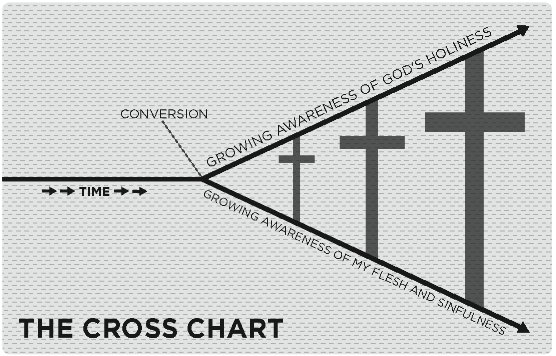
Therefore, God uses circumstances and the Bible to help us in the downward trajectory illustrated by this chart. A contrary perspective on reality is illustrated by another chart widely published by Protestant organizations:
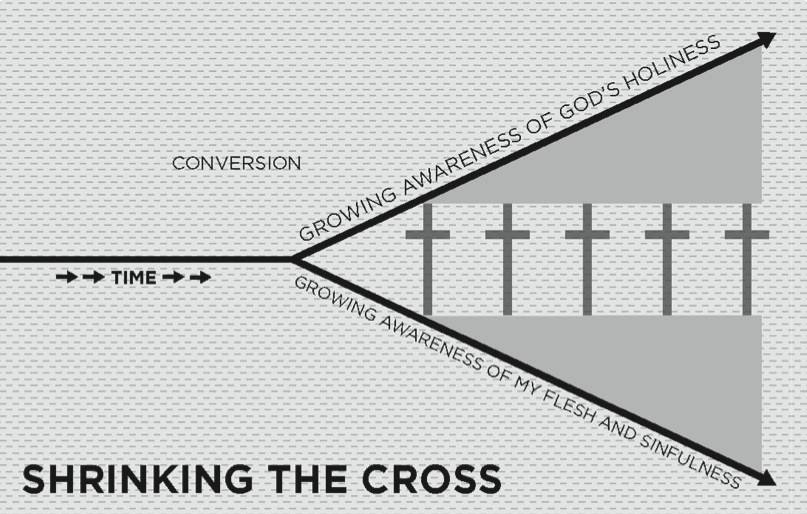
What is behind the popularity of this worldview? Simply, an ability to live a carefree life without fear of unknown circumstances (with the only exception being your eternal destiny). We all know that investing in life can set us up for enhanced disappointments and suffering. This is a worldview that completely separates us from the responsibilities of life and its suffering. Don’t worry, be happy, it’s a just a divine video tape anyway, and what will be, will be. If one of your loved ones dies tragically, don’t sweat it, it’s just part of God’s divine drama prewritten before the foundation of the earth. Besides, God is using this to make the gospel bigger and you smaller. Listen, even Protestants who don’t get this function according to the same worldview: “It’s God’s will.” “I didn’t do it! God did it!” “We are all just sinners saved by grace.” All of these Protestant truisms fit the downward trajectory of the above cross chart.
As far as Biblicism, there is a huge pushback against it. A focal point of the pushback is a book written by Protestant turned Catholic Prof. Christian Smith titled, The Bible Made Impossible: Why Biblicism is Not a Truly Evangelical Reading of Scripture. I must credit the Christian Research Institute with the following review of the book which is endorsed by many evangelical heavyweights such as Rachel Held Evans, and will help us further define Biblicism:
Smith asserts that biblicism is the constellation of ten different assumptions or beliefs: (1) The words of the Bible are identical with God’s words written inerrantly in human language. (2) The Bible represents the totality of God’s will for humanity. (3) The divine will for all issues relevant to Christian life is contained in the Bible. (4) Any reasonable person can correctly understand the plain meaning of the text. (5) The way to understand the Bible is to look at the obvious, literal sense. (6) The Bible can be understood without reliance on creeds, confessions, or historic church traditions. (7) The Bible possesses internal harmony and consistency. (8) The Bible is universally applicable for all Christians. (9) All matters of Christian belief and practice can be learned through inductive Bible study. (10) The Bible is a kind of handbook or textbook for Christian faith and practice.
While some evangelicals may downplay or deny some of these points, Smith suggests as long as you hold to some of these points, you are still a biblicist (pp. 4–5).
Before we address these points for a clearer understanding of what Biblicism is, it shouldn’t surprise us that the only alternative in the book is the Christocentric hermeneutic which is the same thing as the historical-redemptive hermeneutic. It sees the gospel or Jesus in every verse of the Bible as a result of interpreting reality itself through the suffering of the cross. It should be noted that this hermeneutic is crossing over into Catholicism as well.
(1) The words of the Bible are identical with God’s words written inerrantly in human language.
A Biblicist believes no such thing. God used fallible humans to write the Bible over 1600 years in many different languages. Because Christ warned that there would be serious consequences for tampering with God’s word, we can assume many have in fact tampered with it.
The key follows: the Bible is God’s statement on being including metaphysics, epistemology, ethics, and politics. The Bible is not without error in the transmission of these truths, but none of the truths are lost due to God’s oversight and assistance. Included is the way that the Bible was written, or its overall structure of checks and balances. As the “workman” studies to show himself approved, God’s principles become more and more apparent.
(2) The Bible represents the totality of God’s will for humanity.
This point is vague, but one assumes it speaks to the accusation that Biblicists believe the Bible speaks to every detail of life like how to fix our cars etc. While the notion is absurd, the Bible does tell us what kind of car-fixer we should be—not the details of a how-to-manual. The Bible is a manual for how we should love God and others, so while it does not give specific instructions on how to fix our wife’s Toyota, it does convey a principle of love that would prevent us from taking shortcuts on safety issues in order to save money. If it’s our wife’s car, we don’t repair the brake lines with duct tape, etc.
(3) The divine will for all issues relevant to Christian life is contained in the Bible.
This is true, and the reason for the contention is evident: the sole purpose of the Bible should be to show us how wicked we are, not instruction on loving God and others.
(4) Any reasonable person can correctly understand the plain meaning of the text.
True, with the exclusion of the straw man argument that the meaning in every text is always “plain.” The Bible states that individual study is required, and acknowledges that obtaining understanding can be difficult work.
(5) The way to understand the Bible is to look at the obvious, literal sense.
This is true as the primary organizing principle, but gain, the straw man is the assertion that Biblicists believe this is true of every verse.
(6) The Bible can be understood without reliance on creeds, confessions, or historic church traditions.
This is absolutely true because Biblicism rejects spiritual caste systems of all kinds. Teachers are a help, they are a gift to the church for purposes of equipping, NOT an office. But when it gets right down to it, in context of the apostle John addressing the Gnosticism that was wreaking havoc on the 1st century church, he stated, “You have no need for anyone to teach you.” Biblicism is predicated on collective individualism, not group-think overseen by an elite class of those who supposedly possess the “gnosis.”
(7) The Bible possesses internal harmony and consistency.
Absolutely. Again, the complexities of the Bible are used to argue against human reason as a valid epistemology for reasons of selling a redemptive interpretation of all reality.
(8) The Bible is universally applicable for all Christians.
Sure it is. Loving God and others pertains to principles that are universal.
(9) All matters of Christian belief and practice can be learned through inductive Bible study.
In regard to loving God and others, absolutely.
Note the continual distinction being made between love and law. There is a specific reason for that which we will see more of later.
(10) The Bible is a kind of handbook or textbook for Christian faith and practice.
The word “practice” factors in huge here. As previously noted, Protestantism defines salvation as an ability to see/perceive/experience APART from practice. Therefore, the Christocentric approach to interpretation of reality, and consequently the Bible as well, will reject any practice by man to be of any value to God. Therefore, the sole purpose of the Bible is to aid mankind is seeing that all righteousness is an alien righteousness completely outside of man.
So, this is an introduction to Biblicism. In the next session, we will look at the Biblicist gospel, its evaluation of law/gospel, the nature of God, the nature of man, evangelism, and the nature of sin. In the fourth session, we will examine Protestantism and the extreme contrast that it presents. I will conclude this first session with a few more principles of interpretation:
Deuteronomy 29:29 – The secret things belong to the Lord our God, but the things that are revealed belong to us and to our children forever, that we may do all the words of this law.
Deuteronomy 30:11 – For this commandment that I command you today is not too hard for you, neither is it far off. 12 It is not in heaven, that you should say, ‘Who will ascend to heaven for us and bring it to us, that we may hear it and do it?’ 13 Neither is it beyond the sea, that you should say, ‘Who will go over the sea for us and bring it to us, that we may hear it and do it?’ 14 But the word is very near you. It is in your mouth and in your heart, so that you can do it.
Two basic interpretative principles can be drawn from these verses. First, some things we cannot know, but what we can know we are responsible for. Second, we have no need for interpretive mediators between us and God. There is only ONE mediator between God and man—Christ.
Calvinism and the Problem with Perfection
 Originally published November 7, 2013
Augustine, Luther, and Calvin were first and foremost Platonists. They integrated the Bible with Platonism. Plato’s theory of forms posits the idea of two worlds; the mutable material world of illusion where reality can only be partially known, and another world where the immutable objective true forms exist. This material world is a shadow world; everything is shadows of the true forms. Therefore, man can only interpret and experience this world subjectively. The tendency is to interpret reality by observing the shadows. To the degree that mankind thinks the material world is reality according to the five senses, subjectivity and chaos will abound.
Therefore, Plato’s ethic was to improve the subjective experience of this life by accessing the true forms through ideas and mathematics—things that transcend the five senses (he believed math was an unchangeable rule and therefore not part of the shadow world). He believed that those who have the capability and willingness to bring more understanding of the objective into the subjective to be an elite minority. These were Plato’s philosopher kings whom he thought should rule society in order to decrease chaos as much as possible. Without philosopher kings, the world would be awash in a sea of subjectivity, everyone living by their own subjective presuppositions based on the shadows of this world. Hence, the arch enemy of the Platonic ideal is individualism.
Plato’s world of true objective forms was his trinity of the true, good, and beautiful. Experiencing the pure form of goodness in this world is impossible—only a shadow of good can be experienced subjectively. Plato’s social engineering has a doctrine, and to the degree that doctrine is applied, a higher quality of subjective existence occurs.
The Reformers put a slightly different twist on this construct. There is no doctrine to apply, only an orthodoxy that focuses on seeing and experiencing. Their version of Plato’s philosopher kings are pastors who possess the power of the keys. Orthodoxy is mediated truth determined by “Divines,” and passed down to the masses for the purpose of experiencing the objective power of the gospel subjectively. The Reformers made the true forms “the gospel,” and reality itself the gospel, ie., the work and personhood of Jesus Christ in particular.
Therefore, in the same way Plato envisioned a society that experiences the power of the true forms subjectively through ideas and immutable disciplines like mathematics, the Reformers sought a heightened subjective experience through a deeper and deeper knowledge of their own true, good, and beautiful—the gospel. And more specifically, instead of the gateway of understanding being reason, ideas, and immutable disciplines, they made the gospel itself the interpretive prism. So: life, history, the Bible, ie., everything, is a tool for experiencing true reality (the gospel) in a higher quality subjectivity. The Bible and all life events are a gospel hermeneutic. Salvation itself is the interpretive prism. All of reality is about redemption. Salvation itself is the universal hermeneutic.
But both constructs have this in common: Pure goodness and perfection cannot exist objectively in the material world. This is where Calvinism and Platonism kiss. The Bible only agrees with this if it is a “gospel narrative.” But if it is God’s full orbed philosophical statement to all men to be interpreted grammatically and exegetically, contradictions abound. To wit, if man possesses goodness and the ability to interpret reality objectively, Platonism and its Reformed children are found wanting. If Reformation orthodoxy is not evaluated biblically with the very theses of its own orthodoxy as a hermeneutic, even more wantonness is found.
The Apostles rejected Platonism because they believed goodness and perfection could indeed be found in this material world. There is no question of the quality of goodness inside of man that enables mankind to interpret reality objectively, the quantity of goodness notwithstanding. In contrast, a dominate theme in the Calvin Institutes is the idea that no person lost or saved can perform a good work. Like Plato’s geometric hermeneutics, the Reformers believed the Law lends understanding to man’s inability to do good because eternal perfection is the standard. The best of man’s works are tainted with sin to some degree, and therefore imperfect. Even if man could perform one perfect work, one sin makes mankind a violator of the whole law. The Reformers were adamant that no person could do any good work whether saved or lost.
Why all the fuss over this point? Why was Calvin dogmatic about this idea to the point of annoyance? Because he was first and foremost a Platonist. The idea that a pure form of good could be found within mankind was metaphysical heresy. Because such contradicts every page of the Bible, the Reformers’ Platonist theology was made the hermeneutic as well. Instead of the interpretation method producing the theology, they made the theology the method of interpretation. If all of reality is redemptive, it must be interpreted the same way.
For the Platonist, the coming of Jesus Christ in the flesh poses a huge problem. He is the truth. He came to the material world in a material body. Platonism became Gnosticism and wreaked havoc on the 1st century church. Notice how the first sentences of 1John are a direct pushback against the Gnosticism of that day:
1John 1:1 – That which was from the beginning, which we have heard, which we have seen with our eyes, which we looked upon and have touched with our hands, concerning the word of life— 2 the life was made manifest, and we have seen it, and testify to it and proclaim to you the eternal life, which was with the Father and was made manifest to us— 3 that which we have seen and heard we proclaim also to you, so that you too may have fellowship with us; and indeed our fellowship is with the Father and with his Son Jesus Christ. 4 And we are writing these things so that our joy may be complete.
Christ is the true, good, and beautiful, and He was touched, felt, seen, heard, and understood. Game over. This is the paramount melding of Plato’s two worlds resulting in a plenary decimation of his philosophy. Nevertheless, Calvin et al got around that by keeping mankind in a subjective realm while making the material world a gospel hermeneutic. Reality still cannot be understood unless it is interpreted by the gospel—everything else is shadows.
Martin Luther took Plato’s two worlds and made them two stories: our own subjective story, a self “glory story” that leads to a labyrinth of subjectivism, or the “cross story” which is the objective gospel. Luther made Plato’s two worlds two stories, but still, they are two realms: one objective and one subjective. In the final analysis mankind is still incompetent, and void of any good whether saved or lost.
Whether the Reformed gospel or Platonism, the infusion of objective goodness is the heresy. Man cannot have any righteousness in and of himself, whether lost or saved. The pushback against this idea can be seen throughout the New Testament. A few examples follow:
1John 2:4 – Whoever says “I know him” but does not keep his commandments is a liar, and the truth is not in him, 5 but whoever keeps his word, in him truly the love of God is perfected.
1John 2:20 – But you have been anointed by the Holy One, and you all have knowledge.21 I write to you, not because you do not know the truth, but because you know it, and because no lie is of the truth.
1John 2:26 – I write these things to you about those who are trying to deceive you. 27 But the anointing that you received from him abides in you, and you have no need that anyone should teach you. But as his anointing teaches you about everything, and is true, and is no lie—just as it has taught you, abide in him.
1John 2:29 – If you know that he is righteous, you may be sure that everyone who practices righteousness has been born of him.
1John 3:2 – Beloved, we are God’s children now, and what we will be has not yet appeared; but we know that when he appears[a] we shall be like him, because we shall see him as he is. 3 And everyone who thus hopes in him purifies himself as he is pure. 4 Everyone who makes a practice of sinning also practices lawlessness; sin is lawlessness. 5 You know that he appeared in order to take away sins, and in him there is no sin. 6 No one who abides in him keeps on sinning; no one who keeps on sinning has either seen him or known him. 7 Little children, let no one deceive you. Whoever practices righteousness is righteous, as he is righteous.
Romans 15:14 – I myself am satisfied about you, my brothers, that you yourselves are full of goodness, filled with all knowledge and able to instruct one another.
Christians can know goodness, and perform righteousness objectively. This speaks to the quality of the righteousness when it is performed—it is perfect and acceptable to God. We are not limited to a mere subjective experience in regard to righteousness. When we are resurrected, the quantity thereafter will be 100%, but our present righteousness is acceptable to God when it is performed by us. If it is accepted by God, it is perfect.
Even the unregenerate know good, and can perform it. The works of the law are written on their hearts, and their consciences either accuse or excuse them (Romans 2:12-15). Though enslaved to unrighteousness, they are free to perform righteousness (Romans 6:20). The very goodness of God can be understood from observing creation as well (Romans 1:20).
The only way the Reformers can make all goodness outside of man is to make the Bible a salvation hermeneutic. It is the only way they could integrate the Bible with their Platonist philosophy.
paul
The Protestant Road to Salvation; Gaining Salvation with More and More Salvation by Using the Bible to be Brought Down to Hell
 The Heidelberg Disputation Series: Theses 15-18.
Listen to audio or download audio file.
Welcome truth lovers to Blog Talk radio.com/False Reformation, this is your host Paul Dohse. Tonight, part 10 of “The Magnum Opus of the Reformation: Martin Luther’s Heidelberg Disputation, Thesis 15 ff. The Protestant Road to Salvation; Gaining Salvation with More Salvation by Using the Bible to be Brought Down to Hell
Greetings from the Potters House and TANC ministries where we are always eager to serve all of your heterodox needs. Our teaching catalog can be found at tancpublishing.com.
If you would like to add to our lesson or ask a question, call (347) 855-8317. Remember to turn your PC volume down to prevent feedback. If you choose to use Skype to listen to the show, my advice is to just dial direct from your Skype account without using any of the Blogtalk links. 347-855-8317.
Per the usual, we will check in with Susan towards the end of the show and listen to her perspective.
Remember, you may remain anonymous. When I say, “This is your host; you are on the air, what’s your comment or question”—just start talking.
If you would like to comment on our subject tonight, you can also email me at paul@ttanc.com. That’s paul@Tom, Tony, Alice, Nancy, cat.com. I have my email monitor right here and can add your thoughts to the lesson without need for you to call in. You can post a question as well.
Tonight, we continue in our sentence by sentence evaluation of the HD (Heidelberg Disputation) starting with thesis 15. Yes, tonight, we really get into the meat of the Protestant gospel, and it ain’t pretty.
Due to the fact that I can’t decide where to stick this with a fork first tonight, let’s begin by reading the 15th thesis:
Thesis 15: Nor could free will remain in a state of innocence, much less do good, in an active capacity, but only in its passive capacity (subiectiva potentia).
The Master of the Sentences (Peter Lombard), quoting Augustine, states, »By these testimonies it is obviously demonstrated that man received a righteous nature and a good will when he was created, and also the help by means of which he could prevail. Otherwise it would appear as though he had not fallen because of his own fault.« He speaks of the active capacity (potentia activa), which is obviously contrary to Augustine’s opinion in his book ›Concerning Reprimand and Grace‹ (De Correptione et Gratia), where the latter puts it in this way: »He received the ability to act, if he so willed, but he did not have the will by means of which he could act.« By »ability to act« he understands the original capacity (potentia subiectiva), and by »will by means of which he could,« the active capacity (potentia activa).
The second part (of the thesis), however, is sufficiently clear from the same reference to the Master.
We discussed the two primary elements of Martin Luther’s bondage of the will in part 7. They are active will and passive will. Man has no active will, his will is passive. It’s like water; it just sits there until it is acted upon by something from the outside. In Luther’s bondage of the will construct, man is dead as a passive being. We normally think of death as a termination of life, but according to Luther, death is a realm where works can be performed, but they are dead works.
As often pontificated by the Reformed, their favorite illustration in regard to this is the resurrection of Lazarus in John 11. Supposedly, this is illustrative of sanctification (the Christian life). From there, the Reformed put metaphysical feet on it in various and sundry philosophical ways, but the major premise is the same.
A caution when studying Reformed ideology/philosophy: separate the major premises from the various applications or you will drive yourself nuts. The major premises such as the total inability of mankind are consistent, but the so-called life applications are not. Let me give an example.
Some of the Reformed believe that man is not active in any regard as far as the will. Everything that happens is because God acted upon man. Others believe man has a free will to do dead works in the material realm, but all manifestations of good works are the result of God acting upon man’s passive will. So, one view sees all human events as a result of God’s active will while others see the distinction in only good or evil acts. Man is passive in regard to good works, but has an active will in regard to all things evil.
Hence, it’s fine to go about your business and live life as it comes just so you believe that everything you do is evil. That qualifies you to be forgiven on Sunday. In the other application, you have no active will at all, but ALL things are preordained by God for His glory. Your goal is only to SEE and EXPERIENCE what God is doing. In the final analysis, these varying applications are not going to cause much of a rift in Reformed circles; the tie that binds is the total inability of man.
But here is another tie that binds: the idea that God created evil for His own glory. Most Protestants think that Protestants believe that Adam and Eve were sinless/holy/pure before the fall and they are just dead wrong in that idea, no pun intended. Authentic Protestant soteriology holds to the idea that Adam and Eve were created with passive wills as clearly stated by Luther in the thesis at hand. Either they had a propensity to do evil and God acted to prevent it until the appointed time, or God actively incited their fall as well.
It can be demonstrated clearly that the creation of evil by God is a Reformed mainstay, but the various philosophical applications make it possible for the Reformed to play all kinds of metaphysical shell games in order to keep people confused and controlled.
As stated before, the Reformation was first and foremost about philosophy and NOT theology. Clearly, the Reformation was about the integration of Dualism with the Bible. One aspect of Dualism insists that nothing can exist without a counterpart to define it. Without darkness, there can be no light, etc. When we get to thesis 28, we will see that Luther’s counterpart to love is evil. Since God is love, the only logical conclusion, other than the fact that Jonathan Edwards and many others have stated it directly, is that God Himself cannot exist without evil because He is the defining counterpart. Some suggest that God existed, but for all practical purposes was nonexistent until He created evil. This is nothing new. This is a resurgence of the exact same Platonist/Neo-Platonist/Gnostic doctrines that plagued the first century church. Take note of what James was pushing back against in that day:
James 1:13 – Let no one say when he is tempted, “I am being tempted by God,” for God cannot be tempted with evil, and he himself tempts no one. 14 But each person is tempted when he is lured and enticed by his own desire. 15 Then desire when it has conceived gives birth to sin, and sin when it is fully grown brings forth death.
16 Do not be deceived, my beloved brothers. 17 Every good gift and every perfect gift is from above, coming down from the Father of lights with whom there is no variation or shadow due to change. 18 Of his own will he brought us forth by the word of truth, that we should be a kind of firstfruits of his creatures.
Of course, the Reformed deny that they teach such things; specifically, that God created evil for His own glory, and dance around the fact with their shell-game communication skills. An example is the following excerpt from an article written by John MacArthur:
Evil originates not from God but from the fallen creature. I agree with John Calvin, who wrote,
. . . the Lord had declared that “everything that he had made . . . was exceedingly good” [Gen. 1:31]. Whence, then comes this wickedness to man, that he should fall away from his God? Lest we should think it comes from creation, God had put His stamp of approval on what had come forth from himself. By his own evil intention, then, man corrupted the pure nature he had received from the Lord; and by his fall drew all his posterity with him into destruction. Accordingly, we should contemplate the evident cause of condemnation in the corrupt nature of humanity-which is closer to us-rather than seek a hidden and utterly incomprehensible cause in God’s predestination. [Institutes, 3:23:8]
~ Is God Responsible for Evil? Grace to You catalogue #A189.
Ok, so it originates from the creature and not God as if that has nothing to do with how God created man. The only alternative is the idea that God created man in His holy image, and with a free will, but don’t hold your breath and wait for them to ever agree to that.
Note Calvin’s language very carefully. It wasn’t one, then another individual deceived by the serpent; it was a propensity inherent in the kind. Also, in the same section of 3.23.8, Calvin attributes the fall to God’s predestination for His glory. It is unclear if Calvin would have agreed with Luther’s bondage of the will via man’s passive will, but Calvin clearly believed that man was created with a level of integrity that could not obtain full fellowship with god even if man had not fallen:
Even If man had remained in his integrity, still his condition was too base for him to attain to God. How much less could he have raised himself so far, after having been plunged by his ruin into death and hell, after staining himself with so many defilements nay, even stinking in his corruption and all overwhelmed with misery?
~The Calvin Institutes 2.12.1. Henry Beveridge translation varies slightly.
Shockingly, the Henry Beveridge translation has it that man’s condition was too base to attain to God “without a Mediator” note capital “M.” Clearly, Calvin is saying that man needed a mediator before the fall.
Thesis 16: The person who believes that he can obtain grace by doing what is in him adds sin to sin so that he becomes doubly guilty.
On the basis of what has been said, the following is clear: While a person is doing what is in him, he sins and seeks himself in everything. But if he should suppose that through sin he would become worthy of or prepared for grace, he would add haughty arrogance to his sin and not believe that sin is sin and evil is evil, which is an exceedingly great sin. As Jer. 2:13 says, »For my people have committed two evils: they have forsaken me, the fountain of living waters, and hewed out cisterns for themselves, broken cisterns, that can hold no water,« that is, through sin they are far from me and yet they presume to do good by their own ability.
Now you ask: What then shall we do? Shall we go our way with indifference because we can do nothing but sin? I would reply: By no means. But, having heard this, fall down and pray for grace and place your hope in Christ in whom is our salvation, life, and resurrection. For this reason we are so instructed-for this reason the law makes us aware of sin so that, having recognized our sin, we may seek and receive grace. Thus God »gives grace to the humble« (1 Pet. 5:5), and »whoever humbles himself will be exalted« (Matt. 23:12). The law humbles, grace exalts. The law effects fear and wrath, grace effects hope and mercy. Through the law comes knowledge of sin (Rom. 3:20), through knowledge of sin, however, comes humility, and through humility grace is acquired. Thus an action which is alien to God’s nature (opus alienum dei) results in a deed belonging to his very nature (opus proprium): he makes a person a sinner so that he may make him righteous.
This thesis is a good summary of the Reformation gospel. Man remains unchanged accept for the ability to see how evil he is and his continued need for the same gospel that saved him. Any notion that there is anything in man that could choose God is double sin and hewing out cisterns for himself that cannot hold water.
Also assumed in the rhetoric is efficacious good works to maintain the law as a standard for justification.
Luther then states what “saved” sinning lost people are to do since they can do nothing but sin. One is to focus on their sin as a way to see a continued need for salvation resulting in more grace…for salvation and continued justification. Instead of being indifferent to sin, embrace it as a means of seeing your need for continued “grace,” herein a more nuanced word than outright “justification” or “salvation.” Again, this nuancing of words incessant with the Reformed began right here in the HD. Following is a contemporary example:
In the following video trailer from the 2011 Resolved Conference, Al Mohler states that the only purpose of the law in the life of a believer is to show us our ongoing need for salvation. Of course, he doesn’t word it that way. He states that believers have an ongoing need for Christ (which no Christian would refute), but note carefully: he is speaking in context of our initial salvation. So, instead of saying plainly that Christians need to be continually saved, or continually justified, he replaces that wording with “Christ.” However, again, the context is clearly salvation. He is saying that we need Christ in the same way that we needed Him for salvation.
Mohler is also saying that the law has the same relationship/purpose to unbelievers as it does believers: to show us our need for Christ. So, obviously, this is in contrast to any ability on the part of the believer to keep it. All the law can do is show NEED. Need for what? Well, what’s the context? Mohler also presents an either/or choice in regard to the law: it either shows us our need for Christ (again, what need specifically?), or we are using it to “rescue ourselves from sin.” Hmmm, what does it mean to “rescue ourselves from sin”? I believe Mohler deliberately uses the word “rescue” instead of “save” in order to add nuance to his point. “Rescue” is less direct, and could refer to a believer trying to overcome sin on his own. This is the same reason he replaces “salvation” with “Christ” in his prior point. It’s deliberate deception. Excluded is any mentioning that the law can be used by the believer to please God and glorify Him in all we do by “observing all that I have commanded.”
~Paul’s Passing Thoughts.com: Why Al Mohler is a Heretic; April 10, 2012
Thesis 17: Nor does speaking in this manner give cause for despair, but for arousing the desire to humble oneself and seek the grace of Christ.
This is clear from what has been said, for, according to the gospel, the kingdom of heaven is given to children and the humble (Mark 10:14,16), and Christ loves them. They cannot be humble who do not recognize that they are damnable whose sin smells to high heaven. Sin is recognized only through the law. It is apparent that not despair, but rather hope, is preached when we are told that we are sinners. Such preaching concerning sin is a preparation for grace, or it is rather the recognition of sin and faith in such preaching. Yearning for grace wells up when recognition of sin has arisen. A sick person seeks the physician when he recognizes the seriousness of his illness. Therefore one does not give cause for despair or death by telling a sick person about the danger of his illness, but, in effect, one urges him to seek a medical cure. To say that we are nothing and constantly sin when we do the best we can does not mean that we cause people to despair (unless we are fools); rather, we make them concerned about the grace of our Lord Jesus Christ.
Ok, so not much commentary needed here—this is pretty plain. As believers we are still sick, and hey, telling someone that they need a doctor continually is not bad news, but good news. All of the Christian life is seeking to be concerned about “grace.” Again, that means salvation. As we have discussed many times before, “grace” is a biblical word that has broad meaning including, for the most part, “help.” Though Luther calls any assertion that this would instill despair in people “foolish,” historical facts beg to differ.
Thesis 18: It is certain that man must utterly despair of his own ability before he is prepared to receive the grace of Christ.
The law wills that man despair of his own ability, for it »leads him into hell« and »makes him a poor man« and shows him that he is a sinner in all his works, as the Apostle does in Rom. 2 and 3:9, where he says, »I have already charged that all men are under the power of sin.« However, he who acts simply in accordance with his ability and believes that he is thereby doing something good does not seem worthless to himself, nor does he despair of his own strength. Indeed, he is so presumptuous that he strives for grace in reliance on his own strength.
Here we have it again. The sole use of the Bible is to show us our worthlessness so as to be brought down to hell in order to prepare ourselves to receive more salvation/justification. As Dr. Michael Horton has said, the sole Purpose of the Bible is to “drive us to despair of self-righteousness.” This is, of course, the mortification part of the Reformed doctrine of mortification and vivification.
With that, let’s go to the phones.
Dee Parsons of Wartburg Watch: The Personification of Everything Wrong with Church
 When Paul’s Passing Thoughts .com was started in 2009, the goal was to find out why church turned on me with a vengeance despite my best efforts. Second to that was the question, “What now, where does one go from the point of diagnosing the problem?” You have to properly diagnose the problem before you can fix it.
This article will not wear you out with points leading up to a final conclusion; I will begin by stating what I have found. Church produces the fruit of its ideology. What is wrong with church? Answer: church is what’s wrong with church. Christ’s mandate to his followers was never intended to look anything like church. The solution is to depart from church and pursue Christ’s mandate to His followers. You can’t fix church. There is nothing there that is salvageable.
Let me back up a tad because this post is not the least bit personal, but seeks to sharpen the objectives of TANC Ministries. This is some information that I have not shared before. PPT was primarily a blog for the express purpose of sharing my research. My focus was research. I had to know why—how could dozens of pastors stand by and watch Clearcreek Chapel do to my family what they did?
Clearly, obviously, from a literal interpretive standpoint in regard to the Bible, what they were doing was dead wrong and unbiblical. During the episode, I was even under the counsel of a church that was part of the same fellowship of churches that Clearcreek Chapel belongs to. The pastor, the late Rick Wilson, was a former associate pastor at CCC. The present pastor of the church, Paul Craig, was an elder at the time and according to Wilson found the situation, “unsettling.” Grace Covenant (Beavercreek, Ohio) was obviously stuck in the middle, and was also the recipient of a significant exodus of people from CCC at the time. Though I was clearly under church discipline at CCC, I was allowed to attend Grace Covenant on a regular basis. I even thought about applying for membership which would have forced the Grace Covenant elders into making a judgment regarding the veracity of CCC discipline. I should have; watching that play out would have been priceless.
Eventually, Wilson instructed me to go back and play along in order to get my wife back, but I had already tried that for four months. During that time, I was subjected to cult-like break sessions conducted by CCC elder and Psychiatrist Dr. Devon Berry. The CCC elders knew that I had overcome serious depression in the past, and it was obvious they thought they could use Berry and the circumstances they were bringing to bear in my life to drive me into debilitating despair. It was very apparent to me at the time: that is what they were trying to do.
I want to stop right here and thank God publically for something right now—I want to give Him the glory. At the time, I was working out of town and laid in bed at night before going to work the next day…in perfect peace. My favorite time of the day during that time period was bedtime. Why? I laid there in the quiet darkness, not really thinking about anything except how peaceful it was. I was doing nothing but laying there soaking up the peacefulness. Do I have any theories regarding this experience? One: I had begun a long journey in search for the truth. God is with one on such journeys. That’s my best shot at answering that question. By all reasoning, I should have been a basket case.
Let’s now pause here for some simple clarification. It all boiled down to two things:
AUTHORITY, and how I interpreted reality versus how they interpreted reality.
I have discovered something in my research—research enables you to come to a point more and more where you can explain complex problems in simple terms. In the 2500 + articles I have written on Reformed ideology, you can see the focus move from the what to the why. My first book articulated the what and how it contradicted a grammatical interpretation of reality, though I didn’t understand the latter dynamic. My second book articulated the contemporary history of the Neo-Calvinism movement and added some more data about grammatical contradictions.
My third book and subsequent booklets articulate the grammatical contradictions in regard to soteriology. They also describe the dynamics between the Old Calvinism/New Calvinism question and how the interpretation of reality drives that debate.
Including time spent prior to PPT, eight years later, I can now put all of this in simple terms. It boils down to AUTHORITY vested in the interpretation of reality.
And, the established credential thereof known as “orthodoxy.” What is the premise of orthodoxy? Nothing more or less than the claims of men that people choose to believe. You can put any number of things in place of “naked” in regard to the following question posed by God, “Who told you that you are_____?” Be very, very, very wary of what men say God told you. And that’s orthodoxy. And the place we go to get certified in orthodoxy is called “seminary.” In case you haven’t noticed, God isn’t the dean or an adjunct professor in any of these schools.
 Here is something else that should be evident: you, and only you alone will answer to God. Therefore, pick your orthodoxy well. There are no attorneys in God’s court save Christ, “hear ye Him.” “God has spoken to us in these last days through His Son”, not a horde of academics.
So, what do we have in the recent dust-up between PPT and Wartburg Watch? Be advised, I am not going to rehash all of the gory details. Dee Parsons is right and I am wrong because she has college degrees, and holds to orthodoxy. Paul Dohse does not have college degrees, and does not hold to orthodoxy. Paul Dohse holds to a grammatical interpretation of realty, and therefore asks, “How can those who proclaim themselves ‘wicked’ lay claim to salvation?”
Be sure of this: NOTHING has changed since Christ ministered on earth. The primary pushback against Christ was clearly the orthodoxy of the day. Christ deliberately avoided the lauded academia of that day. I just don’t know what is more obvious. In addition, he had to personally reeducate the apostle Paul who was the only religious academic that He used for foundational purposes.
I am weary of documenting the steroidal cognitive dissonance that takes place over at Wartburg and their e-church hosted by the Barney Fife of pastors, Wade Burleson. Regardless of his credentials, from a standpoint of interpreting reality grammatically, his theological snafus are just plain embarrassing. For example, you can’t make the point that a biblical author was teaching something based on the analysis of a word that didn’t exist in the first century. This all takes place in the face of common sense for the same reason I experienced what I experienced at CCC:
AUTHORITY vested in a particular interpretation of reality.
Because one is credentialed in knowing how to lead those who cannot know reality, one should have authority over you for your own good and the common good of people in general.
In varying degrees, CHURCH, established in the 4th century by St. Augustine et al, is the expression of this primary root, and the fruit doesn’t fall far from the tree. Chaos and drama will continue in the church with no solution in sight because of its foundational presuppositions concerning the interpretation of reality and the authority vested in its epistemology.
This ministry’s series on the Heidelberg Disputation focuses on the following fact: at issue with the Reformation was a debate about the interpretation of reality. Of course that spoke to how the Bible is interpreted, but the issue started with how reality itself is to be interpreted. Let me give you the thumbnail:
Words don’t necessarily mean things.
By and large, there are two kinds of Protestants roaming about, Calvinists and functioning Calvinists. Susan and I often have conversations with people who hate Calvinism, but verbally espouse Calvinism unawares constantly. We don’t even address the particulars anymore because we know a complete reeducation is needed. This is what we are attempting to do with the HD series. This series reexamines the roots of the poisonous tree.
This is why Dee Parsons, in the recent dust-up, insinuated that I am mentally ill. What is the definition of a person who does not properly perceive reality? Hence, the CCC elders involved a Psychiatrist in my situation because they honestly believe I am mentally ill because I interpret reality grammatically. Reformed scholars such as Geerhardus Vos have stated such openly. Pastor Russ Kennedy told me I was “mad” and begged me to allow them to “shepherd” me. I believe the guy honestly meant well and still does. Unfortunately, as the saying goes, the road to hell is paved with good intentions.

By the way, I am not talking about grammatical interpretation that leads to a redemptive outcome. I am talking about the interpretation of reality beginning with exegetical presuppositions in the purest sense. I realize Reformed scholars interpret a verse literally when it can serve a redemptive historical outcome…
…that doesn’t make you a proponent of interpreting reality grammatically.
One of the accusations that flowed from the recent dust-up was that TANC Ministries is merely developing its own orthodoxy. Not so. Orthodoxy fundamentally interprets reality according to Martin Luther’s Heidelberg Disputation which was expanded upon by John Calvin’s Institutes of the Christian Religion. Seminary degrees guarantee that individuals will not do independent research that will reveal the real tenants of orthodoxy:
- It is a metaphysical redemptive narrative that interprets all reality through a dualism of good and evil.
- It demands the fusion of faith and force for the common good of mankind.
- It is predicated on spiritual caste that adds additional mediators between God and man other than Christ.
- All of reality progresses as predetermined by manifestations of good completely outside of man.
Dee Parsons’ response to me that “I don’t believe what you say I believe” is most likely due to her ignorance regarding the true sum and substance of the same Reformed orthodoxy that she promotes. Perhaps. While claiming to be an advocate for the spiritually abused, she picks and chooses from orthodoxy what she wants to acknowledge.
The Westminster Confession is just wonderful, but its call to control the free press and execute those who are heterodox is due to the authors being “men of the time.” Of course, their politics and ethics had nothing to do with their ideology. Perish the thought, and no, American Jurisprudence isn’t the only difference between Calvin’s Geneva and the present-day church. It’s absurd to think Dee Parsons would actually have you committed to a mental institution because she thinks you are mentally ill. It’s absurd to think Mark Driscoll would really put you in a wood chipper just because he said that’s what ought to be done. It’s absurd to think James MacDonald would catapult you into the next county, and to your certain death just because he said he wishes he could.
Church is a place where professional clergy interpret reality in a completely different way than most parishioners. Congregants follow the dictates of church leaders while being clueless in regard to their interpretation of reality. They are given elements to follow while being totally unaware as to what those elements are based on. Hence, chaos and confusion reign. Duggar-like drama is paraded before the world constantly like an out-of-control stampede of rats. Yet, that isn’t the madness; the madness is suggesting that we rethink how church is done. After all, Catholicism and Protestantism have had only 1500 + years to get it right. Not only that, the Neo-Calvinist movement has been in total control of the church for at least ten years. Growing steadily since its conceptual resurgence in 1970, discernment/spiritual abuse blogs exploded in 2009 when the movement shifted into 4th gear. Starting in 2008, a historical phenomenon of mediation organizations to keep churches out of court exploded onto the scene as well.
With all of this considered, I think I have heard the best assessment of Wartburg Watch yet:
Subconsciously or consciously, Dee uses her blog as a means to leverage her desire for a seat at the American church’s authoritarian table. Period. Whether this was an initial objective of her blog or merely a pitfall of unforeseen success, who knows? But the reality is obvious:
Dee creates better soldiers, not better souls. And the irony is thus that the “victims” who frequent her site often become the very image of that which they initially despised: manipulative self-appointed God-proxies who claim that the only legitimate doctrinal discussions are with those whom already concede their reformed hermeneutic (Muff Potter, anyone?).
My point is that the cognitive dissonance, the categorical rejection of reason as a yard stick for measuring reality (the efficacy of existence), makes contending with her an almost perfect waste of time.
So what’s the solution? I believe the solution is an utter rejection of orthodoxy and church as we know it. The immense ramifications of that is not the issue—truth is the issue. The church has had its chance to make a case for hope, and has not measured up.
I believe the task ahead is daunting, but will supply a freedom and joy beyond our wildest imaginations. It is a call for Christians to submit themselves to the one mediator Jesus Christ. It is a call for Christians to stop listening to men, and “hear ye Him.” Orthodoxy has NO authority, ALL authority has been given to Christ and no one else.
Past this, God’s people must gather together for mutual encouragement and edification in the ways prescribed by the Bible and not the traditions of men.
When is the misery and suffering produced by orthodoxy enough to make us question everything?
That time is well past.
paul
The Magnum Opus of the Reformation: Martin Luther’s Heidelberg Disputation; Part 2
 Listen to the lesson or download audio file.
Welcome truth lovers to Blog Talk radio .com/False Reformation, this is your host Paul M. Dohse Sr. Tonight, part 2 of “The Magnum Opus of the Reformation: Martin Luther’s Heidelberg Disputation.”
Greetings from the Potters House and TANC ministries where we are always eager to serve all of your heterodox needs. Our teaching catalogue can be found at tancpublishing.com.
If you would like to add to our lesson or ask a question, call (347) 855-8317. Remember to turn your PC volume down to prevent feedback.
Per the usual, we will check in with Susan towards the end of the show and listen to her perspective.
Remember, you may remain anonymous. When I say, “This is your host; you are on the air, what’s your comment or question—just start talking.
If you would like to comment on our subject tonight, you can also email me at paul@ttanc.com. That’s Tom, Tony, Alice, Nancy, cat, paul@ttanc.com. I have my email monitor right here and can add your thoughts to the lesson without need for you to call in. You can post a question as well.
Last week we did pretty well; we began with an introduction and completed the first two theses. Tonight, we begin with thesis 3.
Thesis 3: Although the works of man always seem attractive and good, they are nevertheless likely to be mortal sins.
Human works appear attractive outwardly, but within they are filthy, as Christ says concerning the Pharisees in Matt. 23:27. For they appear to the doer and others good and beautiful, yet God does not judge according to appearances but searches »the minds and hearts« (Ps. 7:9). For without grace and faith it is impossible to have a pure heart. Acts 15:9: »He cleansed their hearts by faith.«
The thesis is proven in the following way: If the works of righteous men are sins, as Thesis 7 of this disputation states, this is much more the case concerning the works of those who are not righteous. But the just speak in behalf of their works in the following way: »Do not enter into judgment with thy servant, Lord, for no man living is righteous before thee« (Ps. 143:2). The Apostle speaks likewise in Gal. 3:10, »All who rely on the works of the law are under the curse.« But the works of men are the works of the law, and the curse will not be placed upon venial sins. Therefore they are mortal sins. In the third place, Rom. 2:21 states, »You who teach others not to steal, do you steal?« St. Augustine interprets this to mean that men are thieves according to their guilty consciences even if they publicly judge or reprimand other thieves.
In this third thesis, Luther declares ALL works of men evil. That includes the works of believers as well. Again, we come to a paramount tenet of the Reformation; total depravity does not only pertain to mankind in general, but also the saints. Even though the works of men appear “good and beautiful” (eerily similar to Plato’s trinity of the good, true, and beautiful), they are evil:
If the works of righteous men are sins, as Thesis 7 of this disputation states, this is much more the case concerning the works of those who are not righteous.
By the way, this is synonymous with the Calvin Institutes 3.14.9-11. Luther hints in this thesis in regard to why all the works of men can be deemed wicked: they are under the law, and no man can keep the law perfectly:
But the works of men are the works of the law…
This is another way of saying that Christians remain under the law just like unbelievers, and since no person can keep the law perfectly, all bets are off. The Calvin Institutes 3.14.10 is an in-depth articulation of this idea. This is amazing because it’s right here where Reformed soteriology falls completely apart and turns the whole Bible upside down. Right here, you are looking at it. It’s the idea that Christians cannot perform a good work because they are still under the law and the law demands perfect obedience.
Also, amazingly, all of the major tenets of the Reformation gospel are in this one thesis. Let’s begin with Luther’s heart theology that actually laid the foundation for the contemporary biblical counseling movement; at least what came out of Westminster’s CCEF. An illustration can be seen below.
Luther cites Matthew 23:27 and Psalms 7:9 to make the point that the outward works of men are meaningless and God looks upon the heart. In this theology, the “heart” is the seat of faith. Even though the believer can do no good work; the believer’s heart (or faith) can be pure. What Luther proffers as we move along is a purity totally disconnected from works, and purity (faith) that is strictly an ability to perceive, and depending on the Reformed camp, experience the works of God completely separate from anything man does. If we pay close attention, we see these ideas in this third thesis.
For without grace and faith it is impossible to have a pure heart.
We must continue to remember that what Luther is saying about the heart is completely disconnected from man’s ability to do a good work. Why? Because everything man does is under the law and no man can keep the law perfectly. Again…
But the works of men are the works of the law…
Everything man does whether lost or saved is under the law, and since no man can keep the law perfectly; all of his works are condemned. The next part is very important:
Acts 15:9: »He cleansed their hearts by faith.«
The heart is cleansed by faith alone, and as we will see further along in our study, Luther believed that these cleansings needed to be repeated for ongoing present sin. But a little bit of thinking will reveal it here as well. If we are still under the law, we continue to sin against the law which necessarily demands a repurification. Especially since this sin is “mortal sin.” However,
But the works of men are the works of the law, and the curse will not be placed upon venial sins. Therefore they are mortal sins.
It boils down to this: if one thinks they performed a good work or are able to perform a good work, that’s mortal (subject to death) sin. But a faith that separates itself from works is venial (forgivable) sin which must be continually sought to receive ongoing cleansing. Luther elaborates on this more in the latter theses, but note how he uses Psalm 143:2 in this regard:
»Do not enter into judgment with thy servant, Lord, for no man living is righteous before thee«
To not completely depend on faith alone, and thinking that you can do a good work is being under the curse of the law:
Gal. 3:10, »All who rely on the works of the law are under the curse.« But the works of men are the works of the law, and the curse will not be placed upon venial sins.
So there is no middle ground; one either depends totally on faith or on works. The belief that one can do a good work is tantamount to being cursed.
This third thesis is the very heart of the Reformation: no man can do a good work, and to believe that is pure faith apart from any good works. Again, faith and good works are separated. Now you know why Luther didn’t like the book of James. The premise for this is the supposed fact that believers remain under law which is a glaring contradiction to Scripture. The “heart” is the seat of pure faith apart from any works; faith and works are mutually exclusive throughout the life of the “believer.”
Thesis 4: Although the works of God are always unattractive and appear evil, they are nevertheless really eternal merits.
That the works of God are unattractive is clear from what is said in Isa. 53:2, »He had no form of comeliness«, and in 1 Sam. 2:6, »The Lord kills and brings to life; he brings down to Sheol and raises up.« This is understood to mean that the Lord humbles and frightens us by means of the law and the sight of our sins so that we seem in the eyes of men, as in our own, as nothing, foolish, and wicked, for we are in truth that. Insofar as we acknowledge and confess this, there is »no form or beauty« in us, but our life is hidden in God (i.e. in the bare confidence in his mercy), finding in ourselves nothing but sin, foolishness, death, and hell, according to that verse of the Apostle in 2 Cor. 6:9-10, »As sorrowful, yet always rejoicing; as dying, and behold we live.« And that it is which Isa. 28:21 calls the »alien work« of God »that he may do his work« (that is, he humbles us thoroughly, making us despair, so that he may exalt us in his mercy, giving us hope), just as Hab. 3:2 states, »In wrath remember mercy.« Such a man therefore is displeased with all his works; he sees no beauty, but only his depravity. Indeed, he also does those things which appear foolish and disgusting to others.
This depravity, however, comes into being in us either when God punishes us or when we accuse ourselves, as 1 Cor. 11:31 says, »If we judged ourselves truly, we should not be judged by the Lord«. Deut. 32:36 also states, »The Lord will vindicate his people and have compassion on his servants.« In this way, consequently, the unattractive works which God does in us, that is, those which are humble and devout, are really eternal, for humility and fear of God are our entire merit.
Here we have the Reformed mainstay doctrine of mortification and vivification. This is a major Reformed soteriological doctrine along with double imputation and the vital union. But in regard to M&V, here it is folks—right here. This is probably where this doctrine is first introduced.
But first, let’s look at the Reformation’s single perspective on the law also in this thesis. Luther makes it clear that the supposed sole purpose of the law is to bring man down into despair because of his total depravity:
This is understood to mean that the Lord humbles and frightens us by means of the law and the sight of our sins so that we seem in the eyes of men, as in our own, as nothing, foolish, and wicked, for we are in truth that. Insofar as we acknowledge and confess this, there is »no form or beauty« in us, but our life is hidden in God (i.e. in the bare confidence in his mercy), finding in ourselves nothing but sin, foolishness, death, and hell, according to that verse of the Apostle in 2 Cor. 6:9-10, »As sorrowful, yet always rejoicing; as dying, and behold we live.« And that it is which Isa. 28:21 calls the »alien work« of God »that he may do his work« (that is, he humbles us thoroughly, making us despair, so that he may exalt us in his mercy, giving us hope), just as Hab. 3:2 states, »In wrath remember mercy.« Such a man therefore is displeased with all his works; he sees no beauty, but only his depravity. Indeed, he also does those things which appear foolish and disgusting to others.
Once we use the law, and God uses circumstances to bring us into despair, that is the mortification part, God brings about vivification, or exaltation. As you can see, Luther uses 2Corithians 6:9,10 to make the case for that. This suffering is actually the good works of God as opposed to the evil works that look good to man; ie., good works done by men whether saved or unsaved. Later in this disputation Luther will define that as the story of man, or the glory story, viz, good and beautiful works done by man, versus the cross story, viz, the works of God that look unattractive. As we will see further along, this is Luther’s very definition of the new birth. The Christian life is a perpetual death (mortification) and resurrection (vivification) cycle that continually repeats itself experientially from despair to joy.
This is also the basis of John Piper’s Christian Hedonism doctrine. Joy must be part of the salvation experience because it is the upside of the perpetual new birth experience that keeps salvation moving forward by faith alone. If you only experience despair, that’s a half gospel. Many are confused by John Piper’s Christian Hedonism doctrine until they understand M&V, then it all makes perfect sense why joy must be part of the salvation experience. Contemporary Reformers state it this way:
Progressive sanctification has two parts: mortification and vivification, ‘both of which happen to us by participation in Christ,’ as Calvin notes….Subjectively experiencing this definitive reality signified and sealed to us in our baptism requires a daily dying and rising. That is what the Reformers meant by sanctification as a living out of our baptism….and this conversion yields lifelong mortification and vivification ‘again and again.’ Yet it is critical to remind ourselves that in this daily human act of turning, we are always turning not only from sin but toward Christ rather than toward our own experience or piety (Michael Horton: The Christian Faith; mortification and vivification, pp. 661-663 [Calvin Inst. 3.3.2-9]).
At conversion, a person begins to see God and himself as never before. This greater revelation of God’s holiness and righteousness leads to a greater revelation of self, which, in return, results in a repentance or brokenness over sin. Nevertheless, the believer is not left in despair, or he is also afforded a greater revelation of the grace of God in the face of Christ, which leads to joy unspeakable. This cycle simply repeats itself throughout the Christian life. As the years pass, the Christian sees more of God and more of self, resulting in a greater and deeper brokenness. Yet, all the while, the Christian’s joy grows in equal measure because he is privy to greater and greater revelations of the love, grace, and mercy of God in the person and work of Christ. Not only this, but a greater interchange occurs in that the Christian learns to rest less and less in his own performance and more and more in the perfect work of Christ. Thus, his joy is not only increased, but it also becomes more consistent and stable. He has left off putting confidence in the flesh, which is idolatry, and is resting in the virtue and merits of Christ, which is true Christian piety (Paul Washer: The Gospel Call and True Conversion; Part 1, Chapter 1, heading – The Essential Characteristics Of Genuine Repentance, subheading – Continuing and Deepening Work of Repentance).
Now, the next thesis is fairly interesting. In the fifth thesis, Luther distinguishes between crimes and mortal sins.
Thesis 5; The works of men are thus not mortal sins (we speak of works which are apparently good), as though they were crimes.
For crimes are such acts which can also be condemned before men, such as adultery, theft, homicide, slander, etc. Mortal sins, on the other hand, are those which seem good yet are essentially fruits of a bad root and a bad tree. Augustine states this in the fourth book of ›Against Julian‹ (Contra Julianum).
This is pretty straight forward. Criminal acts are NOT classified as mortal sins. Criminal acts are works that are condemned among men while mortal sins are the good works of man that are really “fruit of a bad tree.” Those of orthodoxy must deny that man does any good work at all that is not condemned by God. The belief that any man can do any kind of meritorious work falls under sin that will not be forgiven. This means that Reformed persons in the know would seek daily forgiveness for every, and all acts performed by them. It pretty much boils down to this quotation cited by a theological journal:
The flesh, or sinful nature of the believer is no different from that of the unbeliever. “The regenerate man is no whit different in substance from what He was before his regeneration.” — Bavinck [Reformed philosopher Herman Bavink] (Present Truth: Sanctification-Its Mainspring Volume 16 Article 13).
At this point it is fairly easy to draw a watershed conclusion in all of this: the lynchpin idea of the Reformation was that salvation can only be obtained and maintained with a righteousness not our own, but also the exclusion of righteous acts performed by us. At this point, there is only one way forward: a mystical manifestation of works performed by deity; Martin Luther’s Alien Righteousness. This necessarily demanded and still demands a discussion of a philosophical ideology to make manifestation and realm birthing feasible. The Heidelberg Disputation not only does that, but articulates the theoretical life application and how these manifestations are experiences in reality. Luther was very concise in that regard while anticipating future objections.
Thesis 6: The works of God (we speak of those which he does through man) are thus not merits, as though they were sinless.
In Eccles. 7:20, we read, »Surely there is not a righteous man on earth who does good and never sins.« In this connection, however, some people say that the righteous man indeed sins, but not when he does good. They may be refuted in the following manner: If that is what this verse wants to say, why waste so many words? Or does the Holy Spirit like to indulge in loquacious and foolish babble? For this meaning would then be adequately expressed by the following: »There is not a righteous man on earth who does not sin.« Why does he add »who does good,« as if another person were righteous who did evil? For no one except a righteous man does good. Where, however, he speaks of sins outside the realm of good works he speaks thus (Prov. 24:16), »The righteous man falls seven times a day.« Here he does not say: A righteous man falls seven times a day when he does good. This is a comparison: If someone cuts with a rusty and rough hatchet, even though the worker is a good craftsman, the hatchet leaves bad, jagged, and ugly gashes. So it is when God works through us.
Luther’s rusty and rough hatchet is an interesting metaphysical illustration. Notice carefully who the “’good’ craftsman” is. That can’t be us, right? Right, we are the rusty and rough hatchet. A hatchet, like all other tools, is a completely passive instrument. It has no life of its own. It only does what the craftsman does with it. Like one Reformed teacher said to me, “The Christian life is done to us not by us.”
Also, the hatchet doesn’t get any credit for the work, but only the good craftsman using the axe. This is Luther’s cardinal point of the thesis. This is a strict metaphysical dichotomy of good and evil with man defining evil and God defining good (The Calvin Institutes 1.1.1.). All manifestations of good on earth must come from above, and no good can be in man or come out of man.
Of course, this makes God the creator of rusty and rough hatchets; ie., sin and evil, but remember, as Luther stated, the good work of the craftsman only appears to be evil to us, right?
Although there is no room in this series to unravel every Scripture text that Luther twisted for his own purposes, I will speak to his use of Ecclesiastes 7:20 to make his point. All that verse is really saying is that man needs wisdom because he is not sinless and is prone to erroneous ways and death without wisdom. It’s not saying that no man does any good work. The idea in the text as noted by translations like NASB follows: no man does only good exclusively.
A thought before we go to the phones for you who are aware of our ministry’s dustup this week with the Wartburg Watch. Some folks from over there came over to PPT claiming that we have no orthodoxed credentials; therefore, apparently, our views are not relevant. Well, two things: if this is not orthodoxy, what is? And secondly, how can people claim to be advocates for the abused when they hold to this doctrine? They are either blowhards that don’t even understand what they are talking about, or they do understand. Which is it? Let’s go to the phones.

 Paul's Passing Thoughts
leave a comment