Apparently, I am Fed-up With All the Whining About Symptoms of Calvinism
 Apparently, I begin the New Year completely fed-up with all of the whining about the symptoms of Calvinism which is a false gospel. Christians seem to be oblivious to the fact that ill behavior flows from bad ideas. The blogosphere is saturated with incessant whining about the spiritual abuse and tyranny foisted on the American church by Calvinism, but yet, they refuse to address the core of the problem. Hence, many blogs have become little more than the National Inquirer adorned in Bible verses.
But though annoying, there is a reason for it: we are Protestants. Our foundation is Calvin and Luther who believed that Christians remain totally depraved and ignorant. Therefore, present-day Christianity in this country is predicated on the idea that we must be led by a sanctified pre-ordained academia. Like Catholicism? Absolutely, because the Reformers maintained Rome’s metaphysical presuppositions; especially in regard to mankind, and only changed their doctrine which strives for the exact same goal: CONTROL.
That’s why we have such a comfortable relationship with St. Augustine and the fact that our Protestant founding fathers were his followers. This is why we whine about spiritual abuse but continue to give these guys our money:
Ya, they’re bad guys, but we need them. I mean, look what David did, but he was God’s anointed. Israel needed him.
And why do we continually whine about symptoms while giving them our money when their philosophy and doctrine is clearly anti-God and anti-Bible? Because: we do not deem ourselves capable of speaking to their doctrinal error. We are not qualified. We could falsely accuse them because we have supposedly not been preordained to see Christocentric reality the way they do. God gave them metaphysical eyes that we don’t have. And if we step out and teach with the authority of the word, and without their permission, we may be found naked by them. Our hidden “ignorance” may be exposed. Reformed despots have worked for 510 years to develop this unspoken bondage.
So, we know our place and only speak to the behavior. We are exactly like the slaves in the South during the Civil War who were powerless to do anything but complain about the abuse. Or so they thought. Others questioned that assumption and sought solutions. The results speak for themselves. America now has a two-term black President. Christians should take note of that. Like him or love him, Obama is solution oriented. And any Christian who likes to speak their mind probably benefits from the Civil Rights Movement because the hangman’s noose differs little from the burning stake stoked with green wood for those who dared to understand Scripture apart from Reformed elders. The abuse we see today is Reformed Light tamed by the U.S. Constitution.
Look, rat on the behavior—keep doing that, but when are folks going to start blogging about the philosophy and the doctrine?
When they think they have the authority and capability to do so.
Well, touché. Yes, I know about the behavior, but what about the fact that these guys believe that we are resaved every day and that we can only receive daily forgiveness that maintains our justification in their churches? Heeeellllloooooo.
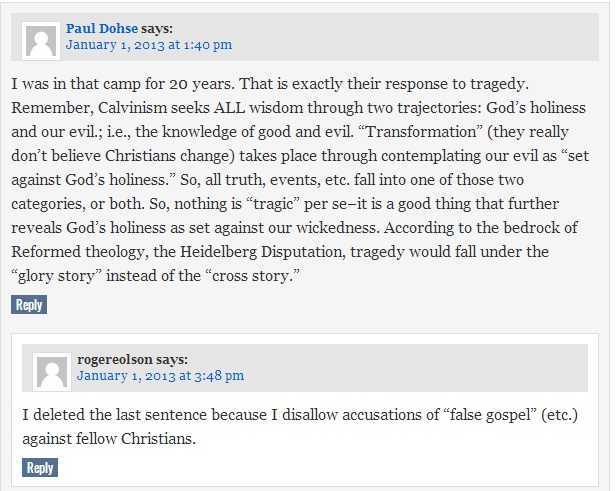
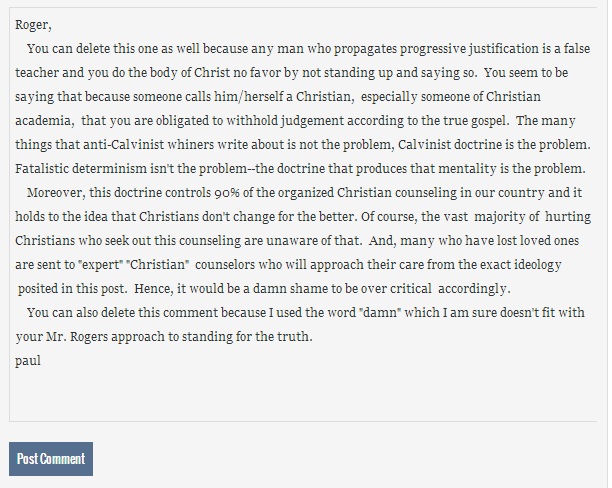
I posted a comment on a blog and the response from the author hit a nerve and prompted this post (here). My response was so knee-jerk that I stopped and pondered why I responded in that way. Hence, the title of this post. I’m clearly exasperated. But I let the comment stand.
Stop whining and study to show thyself approved. And then blog about it. Until the doctrine is dealt with, we will continue to be slaves to heretics rather than the Chief Shepherd.
paul

The SBC is Being Completely Trashed by Authentic Calvinism

“Six months after Luther’s 95 Thesis launched the Reformation, he put doctrinal feet on the Reformation with his Heidelberg Disputation. It is a complete dressing down of any idea that the Christian has worth in the eyes of God. It defines love itself as something that ONLY seeks what has NO value to the seeker. Luther considered the idea that Christians could please God in sanctification—anathema. By feeding on God’s love (salvation) alone and thereby affirming our worthlessness, we pave a safe road to eternal life.”
“If Christians grow in sanctification—the Reformation metaphysical construct falls. That’s why it’s efficacious to Reformed theology that you are a dead man walking. That is why it is important that everything is done by Christ for us.”
“Reformation Light and its wimpy sanctification has the SBC on its deathbed. Now authentic Reformation doctrine is presiding over the SBC in the persona of Dr. Kevorkian.”
Friends of PPT have been sending me some great links lately. I wish I could personally thank all of you, but I am really swamped right now. I click on all of them for general perusal, and one ended up getting me into a fray over at SBC Voices. I am a Southern Baptist, but really don’t rub shoulders with that crowd much since Susan and I do church at home and are extremely busy with this ministry and writing.
The fray yesterday was a real eye-opener in regard to how authentic Calvinism has infected the Convention. These are mean people folks. PPT continues to annoy as we learn better ways to articulate authentic Calvinism to the average Christian. Though perpetual re-salvation (progressive justification) is a description that is somewhat oversimplified, it’s an idea that most Christians can grasp and is an attention-getter. After all, the need to preach the gospel to ourselves everyday must have something behind it.
Something is changing. I don’t know how much this ministry has to do with it, but those who know something isn’t right, but can’t articulate it, are beginning to. The wolverine is being tied down and examined, and when that happens it’s not pretty. In one scathing review of me personally and the newly published False Reformation, a Reformed pastor stated the following:
My concern is not for those who have theological understanding; they will be able to see through Paul’s erroneous reasoning right away. My concern is for those who have so little biblical and theological instruction as to be able to discern the errors in Mr. Dohse’s arguments.
Get the picture fellow Average Joe Christians? Reading Paul Dohse’s ideas is something that shouldn’t be done at home by the ignorant totally depraved masses. In fact, in the book, I quote Southern Seminary president Al Mohler:
The main means by which God saves his people from ignorance is the preaching and teaching of the word of God. That’s why a conference like this is so important. It’s not just because we think of the pastorate as a profession set alongside other professions so that we can gather together for a little professional encouragement to go out and be a little better at what we do.
No, we’re here because we believe that those who teach and preach the word of God are God-appointed agents to save God’s people from ignorance [1]. (p.8).
And trust me, the good ole’ boys over at SBC Voices get that message loud and clear. I lay the vast majority of SBC problems at the feet of the Reformation. Because the Reformation was predicated on anti-new birth, Reformed Light propagated wimpy sanctification (including inept theological instruction for parishioners) and an overemphasis on getting people saved rather than making disciples. Sanctification was devalued. It wasn’t deemed important. My wife Susan addressed this at last year’s conference, and her words should be well noted. The following is a conversation she had with her Christian father shortly after a funeral they attended:
“Mrs. Coleman said, At least, he was saved. Can a person be a little bit saved and still go to heaven?” I asked. “Honey, there are all kinds of opinions on whether Lovell was saved. And God has final say in the matter, not the preacher.” I have heard that phrase many times at funerals or when speaking of someone who died. “Well, at least he was saved.” So Lovell lived like the devil, but at least he had his fire insurance policy, made effective because he walked the aisle, said the sinner’s prayer, and was baptized in the Big Sandy River. But I will have to agree with my dad. Only God really knows if Lovell was genuinely saved or not and resting in the bosom of Abraham. At my funeral, I hope more will be said about me than “at least, she was saved.”
And….
I encourage you pastors, teachers, and parents to obey Scripture and teach the dreaded D word: doctrine. Deuteronomy 6:6-9, “The Lord spoke to Moses and to us, and you must commit yourself wholeheartedly to these commands that I am giving you today. Repeat them again and again to your children. Talk about them when you are at home and when you are away on a journey, when you are lying down, and when you are getting up again. Tie them to your hands as a reminder. Wear them on your forehead. Write them on the doorpost of your house and on your gates. It is vital to know and to teach doctrine as we all follow the great commission. Go and make disciples.
The latest resurgence of authentic Calvinism in the SBC is going to finish the job; Calvinism Light says, “sanctification is not important.” Authentic Calvinism says, “What the heck are you talking about??? There isn’t any such thing as sanctification at all!” Six months after Luther’s 95 Thesis launched the Reformation, he put doctrinal feet on the Reformation with his Heidelberg Disputation. It is a complete dressing down of any idea that the Christian has worth in the eyes of God. It defines love itself as something that ONLY seeks what has NO value to the seeker. Luther considered the idea that Christians could please God in sanctification—anathema. By feeding on God’s love (salvation) alone and thereby affirming our worthlessness, we pave a safe road to eternal life.
Look, authentic Calvinism in the form of the latest resurgence, New Calvinism, will do what it always does—it will die a social death. But not before it will leave the SBC in ruins. Reformation Light and its wimpy sanctification has the SBC on its deathbed. Now authentic Reformation doctrine is presiding over the SBC in the form of Dr. Kevorkian. We will go from weak sanctification to no sanctification while, in their own words, “feeding on justification” for what they deceptively call “progressive sanctification.” The two ideas presented in this paragraph can clearly be seen from a link that I was sent by a PPT friend just yesterday. The blog author is a New Calvinist heavyweight, and the candid information on his blog speaks to what I am saying here specifically. The name of the blog is, “Gospel Shaped Living: exploring the completeness of Christ for us.” In other words, we don’t change, the shape of our life does (or the realm), and Christ, via our faith alone, obeys “for us” in sanctification. That’s the only thing that can make our sanctification, “complete.”
But as I was informed yesterday by the Calvinist bubbas over at Voices, you can’t draw any conclusions from a title; ie, Calvin really wasn’t saying that justification is progressive when he entitled 3.14 “The Beginning of Justification. In What Sense Progressive.” And no, I didn’t forget a question mark in that title. I was also informed by another Reformed guru yesterday that when Calvin stated that Christ’s death has a perpetual efficacy for the church (Isnt: 3.14.11)—that Calvin didn’t mean “perpetual” in a perpetual way, per se. Good grief. But here is something interesting from the post that was sent to me from the aforementioned blog:
Let me be clear. I am grateful for the working of God to renew Gospel focus across so many denominations and churches. It was just not so 30 years ago. The Gospel was the entry message for the Christian life, and after that, it was all law. I preached that way for the first ten years of ministry, until God sent a messenger to correct me. Now it seems every day a new book is published applying the Gospel to another area of life!
Well, where did it go prior to “30 years ago”? Actually, the conception of the resurgence was in 1970 officially, compliments of the Seventh-Day Adventist Awakening Movement that in fact rediscovered the true Reformation gospel of EVERYTHING sola fide. A fact many in the Convention are not overly excited to discuss.
Also, note his outright admission that salvation as an “entry” only was a problem prior to the rediscovery, and if salvation is only a “entry”, everything after that is “law.” Obviously, salvation must continue in order for everything not to be about law. This also speaks to the Reformed idea that law continues to be the standard for justification after salvation, and salvation by faith alone must therefore continue in order for that not to be the case. This is a huge problem. And also note that it is the same gospel that saved us that is applied to “another area of life” rather than a many-faceted biblical wisdom of learn and do discipleship. Note that’s “law.” So, is applying the same gospel that saved us to every area of life complicated? Of course it is—that’s why you need them. Also note that “books” are being written that reveal more ways of doing this “30 years” later!
The New Calvinist construct that was derived from authentic Reformed doctrine is dualism. It is knowledge of God’s holiness as set against our sinfulness. It is the good old fashioned knowledge of good and evil introduced in the garden. If Christians grow in sanctification—the Reformation metaphysical construct falls. That’s why it’s efficacious to Reformed theology that you are a dead man walking. That is why it is important that everything is done by Christ for us. That’s why it is important to always search the heart for revealed sin that supposedly makes God bigger and us smaller. But with all false doctrines—they implode—they cave-in on themselves. This is because we are wired to eventually act on what we believe; logic will eventually act on its presuppositions. Hence, the author states the following in the same post:
What I read on one side of this debate is pretty much advocating an endless monitoring of the state of my heart. Am I resting in Christ’s work for me? Am I feeding on my justification?
This seems to be a new legalism, an internal one. It is getting the functional Gospel right in my heart. I dare not do anything until I do so.
“Oh my, I obeyed, but I did so with a trace of self-righteousness. I need to make sure that does not happen again!”
“Dear me, I sought to please God but there was some self-sufficiency in that obedience, and I must repent and try to get it right next time.”
This paralyzes people. I think it is contrary to the apostolic method.
Paul reminds people of the objective truth of the Gospel. Then he calls them to act upon it. He does not call them to endlessly work on making sure they are getting the function of the Gospel correct before they do anything.
Putting the last two ideas together, I can begin the day with words like these: “I believe my righteousness is in Christ and his work, and his work alone. Nothing can change that. God is at work in me too, to make me like his Son.” Then I go into the day. Perhaps I remind myself of these things along the way. But I live based on objective affirmation of faith, not the quality of my resting in Christ.
Basically, meditate on the gospel, and whatever Christ might decide to do is “objective confirmation.” Anything that is within us is subjective. That is why this doctrine is often referred to as the objective gospel completely outside of us. But at any rate, people are always going to do something based on what they believe, and in this case, as the author notes, the endeavor to become more and more aware of how wicked we are becomes a new legalism in, and of itself. This is the futility of false doctrine—it usually becomes what it so vehemently opposes. Though the author’s solution is just more Reformed cognitive dissonance, he touches on what I saw yesterday at Voices. On steroids.
The post I addressed is a short one:
“Take care, brothers, lest there be in any of you an evil, unbelieving heart, leading you to fall away from the living God” (Heb. 3:12).
Search your heart oh friend
Hear this stanza
Repent of your hidden sin
Bring to Justice the Adam Lanza within
The loudest statement made by Adam Lanza on December 14, 2012 was, “Jesus is not Lord!” Although he did not verbalize this statement, he emphatically affirmed it by murdering his mother at her home and 26 other people (6 adults and 20 young children) at Sandy Hook Elementary School in Newtown, Connecticut. Then he further rebelled against his Creator and Sustainer by taking his own life.
Search your heart oh friend
Hear this stanza
Repent of your hidden sin
Bring to Justice the Adam Lanza within
This rebellion against the rule and reign of Christ is taking place all around us as men, women, and children unashamedly sin against their Creator. The question is whether or not you and I have the same rebellious heart (although we may express our rebellion differently), that led Adam Lanza to commit this horrid act of rebellion against God and His Word.
Search your heart oh friend
Hear this stanza
Repent of your hidden sin
Bring to Justice the Adam Lanza within
The sad reality is that every time you and I sin, we rebel against the Lordship of Christ. The answer for such rebellion is that we must continually repent and affirm the gospel, pursuing holiness with all our might while pleading the blood of the King of kings and Lord of lords alone! In other words, we must continually bring the Adam Lanza within to Justice (God) by trusting in Christ, forever reminding ourselves that our sins have been judged in Christ. Therefore, although we are guilty of emphatically proclaiming “Jesus is not Lord,” on the cross God treated Christ as if He was the rebel so that the rebellious could go free! How will you respond? Will you bring to Justice the Adam Lanza within?
Search your heart oh friend
Hear this stanza
Repent of your hidden sin. . .
The obvious suggestion of this post would find agreement with authentic Reformed mentality—even totally depraved Christians still have a propensity to murder children in cold blood for no apparent reason. There is no difference between our sin and the sin of the unregenerate. This makes God look bigger, and us smaller. This is Reformed epistemology. Notice that we are to continually search for inner sins that we need to, “Bring to Justice.” This is perpetual justification. Obviously. The New Calvinists in the SBC teach this, but deny it when confronted—even in the face of the obvious. When confronted, they defied reality itself without even blushing:
What you propagate here is a New Calvinist progressive justification.
I’m advocating progressive sanctification, not progressive justification.
You say plainly that progressive sanctification is by the blood of Christ. So, are [you] not saying that the justifying blood is the source of our sanctification?
The justifying and sanctifying blood of Christ is the source of our sanctification. The Holy Spirit gradually conforms us to Christ.
Are you saying that the finished work of Christ is not the source of our sanctification?
YES JARED, that’s exactly what I am saying. How is a finished work the source of what’s progressive? This was Paul’s specific beef with the Galatians. Justification is not the source of sanctification–the two are separate. This was Dr. Jay E. Adams’ specific argument against the contemporary father of New Calvinism, Dr. John Miller (Sonship Theology) in his book, “Biblical Sonship: a Biblical Evaluation.”
Paul, I’m not saying that justification is the source of sanctification. You’re saying I’m saying this regardless what I say. Offer your position from Scripture. Tell us what the source is for sanctification.
The “blood” represents Christ’s death on the cross for our justification. We were justified by it. You said that we are both justified and sanctified by His blood: “Paul, It is by the blood of Christ that we are justified and sanctified.” How can you now say that–that’s not what you are saying? But to answer your question: the new birth now powers our progressive sanctification, NOT THE OTHER.
Paul, the blood represents Christ’s death on the cross for our justification AND sanctification. We live by faith in the Son of God (Gal. 2:20). We are ever dependent on His finished work. The list of Scripture can go on and on. I’m saying that the work of Christ is the source for both our justification and sanctification, not that our justification is the source of our sanctification.
Paul, my point is that the source is the same not that justification and sanctification are the same. We are progressively sanctified by pursuing holiness while possessing faith in Christ.
Once again, no one is saying that we are sanctified by our justification. We live by faith in the Son of God. We do not look within for our sanctification, we look to Christ alone….So, tell us what you believe is the source of our sanctification if not the work of Christ.
NOT His finished work on the cross, of course, He works in our sanctification through the Holy Spirit, but that DOES NOT = “preaching the cross to ourselves everyday” because we still need to be justified by it.
Paul, I don’t think you can separate the Holy Spirit’s work in our hearts from the work of Christ. No one I’ve seen is arguing that we must continually be justified. You’re building up and tearing down a strawman.
….you say in the post that Christian sin must be continually brought to justice by the blood. That’s not progressive justification? It also makes the law the present affirmation of our just standing when the Scriptures plainly say that we are justified apart from the law. Here is what you wrote: “In other words, we must continually bring the Adam Lanza within to Justice (God) by trusting in Christ…How will you respond? Will you bring to Justice the Adam Lanza within?” I mean, are you saying that you were not using “justice” in a justifying way? Please explain.
Paul, I meant it exactly as Heb. 3:12 describes. We must continually trust in Christ alone for our salvation, making our calling and election sure as we live by faith in the Son of God. We are justified by His blood at the moment we first believe, and if we have been justified, we will continue believing. We must indeed confess ourselves sins while enjoying His forgiveness, not for justification but sanctification. We bring our sins to Justice (God) forever acknowledging our sins have been judged in Christ. Once again, we live by faith in the Son of God. The same blood that justifies us also sanctifies us.
I’ve asked you repeatedly to explain your position. You do not believe Christ’s work is the source of our sanctification, so what is?
The new birth is the source of our sanctification, not the blood which you use to replace, “justification.” Your New Calvinist position is a continual offering of the works of Christ in sanctification by faith alone. Southern Baptists have never believed in sanctification by faith alone because the law is still a standard for our justification in sanctification.
Key is your statement: “We must continually trust in Christ alone for our salvation, making our calling and election sure as we live by faith in the Son of God.” That’s not how the Scriptures say we make our calling and election sure (SPEAKING OF ASSURANCE). It states that we are to ADD to our faith for that purpose–it’s not by faith in the works of Christ ALONE that we gain assurance.
It’s not keeping our own salvation by faith alone. Our faith is already KEPT. It’s leaving the foot of the cross and aggressively pursuing the fruits of righteousness.
[As an addendum, note: “We must continually trust in Christ alone for our salvation, making our calling and election sure as we live by faith in the Son of God.” We “must” and “continually”” live by faith.” As I argue often, there is NO must to keeping anything for our salvation—not even faith which we cannot lose once God has granted it to us as a gift].
Paul, so what does the Apostle Paul mean when he says, “I have been crucified with Christ. It is no longer I who live, but Christ who lives in me. And the life I now live in the flesh I live by faith in the Son of God, who loved me and gave himself for me” (Gal. 2:20)? All I’m advocating is that Christians live by faith in the Son of God. We pursue holiness, putting on the new man, while constantly possessing faith in the Son of God.
We are not sanctified by our works. Also, you can claim that Southern Baptists have “never” believed what I’m advocating, but I would argue that the majority believe like I do.
We gain assurance by looking at the Holy Spirit’s fruit in our lives. This truth CANNOT be separated from living by faith in the Son of God. You cannot separate the Spirit’s work from the Son’s work. Christ’s work is the basis of both our justification and our sanctification. We pursue holiness while possessing consistent faith in Christ. We cannot separate the two. You seem to be separating the two.
1. What did Paul mean in Galatians 2:20? A word for justification appears 6 times between verses 15 and 21. 3:1-3 makes it clear that the context is works salvation by attempting to earn justification through a work that is finished. Verse 3 means literally, “are you reaching your end (glorification) by effort.” This coincides with Romans 8:29, 30. Paul’s argument is that they are trying to work towards a goal that is already finished. When we were unsaved, we were in the flesh and under the law–now we are dead to the law and the life we live in the flesh is sustained by Christ because the flesh involves law. Our justified state is by faith alone, and we are dead to the law. But you make this apply to sanctification as well. “Sanctification” is a biblical word and appears nowhere in this text, but “justification” does no less than 6 times. The crux of Paul’s point is verse 21: “I do not nullify the grace of God, for if justification were through the law, then Christ died for no purpose.”
So then, if sanctification is in these verses, then we cannot make an effort to keep the law in sanctification. We are also dead to the law in sanctification in the same way we are in justification. Therefore, we are dead in sanctification in the same way we are in justification, and Christ must keep the law for us in sanctification. And granted–that is the New Calvinist doctrine.
2. “We are not sanctified by our works.” Yes we are. Paul said that God’s will was our sanctification, and then described it as “abstaining” from…. Our enabled efforts in sanctification by all means does sanctify us (a setting apart from the world), and our end judgment will be for rewards, not to judge “the ground of our justification.”
3. “Christ’s work is the basis of both our justification and our sanctification. We pursue holiness while possessing consistent faith in Christ. We cannot separate the two. You seem to be separating the two.”
Yes, absolutely, I am separating the two. As can be seen by your above statement, if the two are fused together, I must maintain my justification in the same way that I was saved. This makes faith a work for the purpose of keeping our salvation. This is why JC Ryle stated the following: “But the plain truth is, that men will persist in confounding two things that differ–that is, justification and sanctification….What God has divided let us not mingle and confuse.”
How many times do I have to say that no one is infusing justification and sanctification together. Ya’ll are reading your own presuppositions into these men and my article.
How can you say you don’t fuse the two together when you posited Galatians 2:20 to make your point about faith alone for sanctification? Though the text doesn’t speak of sanctification, you say that “the life I now live” speaks to sanctification while the context of the passage is clearly justification. How can this be Jared? Jared, you said that OUR sins needed to be sought out and justified by Christ in the present through the blood. That’s what you You said. Words mean things.
Paul, where did I say that our sins must be sought out and justified? I didn’t you say it; you won’t find it. I said that our sins must be brought to Justice (God), not justified. There’s a difference. Once again, you need to take the time to actually understand what people are arguing before you throw around words like “heretic.”
You may consider the obtuse contradictions following by the author of the post at Voices:
“The justifying and sanctifying blood of Christ is the source of our sanctification.” ≠ “Paul, I’m not saying that justification is the source of sanctification.”
“No one I’ve seen is arguing that we must continually be justified. You’re building up and tearing down a strawman.” ≠ “In other words, we must continually bring the Adam Lanza within to Justice (God) by trusting in Christ…How will you respond? Will you bring to Justice the Adam Lanza within?”
“We cannot separate the two. You seem to be separating the two.” ≠ “How many times do I have to say that no one is infusing justification and sanctification together. Ya’ll are reading your own presuppositions into these men and my article.”
“Paul, where did I say that our sins must be sought out and justified? I didn’t you say it; you won’t find it. I said that our sins must be brought to Justice (God), not justified. There’s a difference.” ≠
Repent of your hidden sin
Bring to Justice the Adam Lanza within
I have said it before and I will say it again: corresponding with these yo-yos is a total waste of time. I do it for educational and ministry purposes, but no resolution or unity will ever be accomplished by trying to reason with these people. Personally, I don’t even take them seriously anymore. God’s people need to come out from among them at all cost. That’s where all of this is going anyway.
Again, the movement will die a social death as it has five times prior to today after Calvin’s Geneva theocracy. The rise and fall of those movements will be documented in the second volume of The Truth About New Calvinism. But concerning the carnage that will be left behind before the next decline into insignificance; a pity. The goal of this ministry is to educate God’s people in hopes of accomplishing the following to whatever degree we can in our little corner of the universe: hastening its inevitable death, and preventing its return.
paul
Tchividjian’s Response: It’s Why They’re Called “Wolves in Sheep’s Clothing”
“Not only that, and don’t miss this, if sanctification ‘feeds on justification,’ and if justification is monergistic, and it most certainly is, then sanctification is also monergistic and not synergistic. So, regardless of Tchividjian’s synergistic-like jargon in regard to sanctification—we should know better.”
Let’s be honest, when the Bible warns us about wolves dressed up like sheep; deep down, we assume it’s a bad costume. But it’s not, and we should assume that we will have to diligently exercise the brain God gave us in order to make sure that “no one deceives you.”
Tullian Tchividjian, hereafter “Mr. T,” is once again answering to fellow Calvinists for his Reformed antinomian ways. Mr. T is a heretic, but he’s spot-on in regard to the Reformed doctrine that he teaches. Unfortunately, rather than calling out men who don’t get what Luther/Calvin really taught, Mr. T continues to hone and adjust his defense of what he teaches in an evangelical way. If he would just say, “Listen guys, I teach authentic Reformed doctrine. You guys call yourselves Calvinists and you don’t even understand his soteriology, so hang it on your beak,” I would come to Coral Ridge and wash his car for free. And as a bonus, I would serenade him with the Christian classic, “Friends.” Yes, let’s get all the Calvinists debating each other with citations from the Institutes and the Heidelberg Disputation. Hint: if you are in that debate; choose sides with Mr.T.
Mr. T’s conclusion to his latest defense makes my first point:
So, I’m all for effort, fighting sin, resisting temptation, mortification, working, activity, putting off, and putting on, as long as we understand that it is not our work for God, but God’s work for us, that has fully and finally set things right between God and sinners. Any talk of sanctification which gives the impression that our efforts secure more of God’s love, itself needs to be mortified. As Scott Clark has said, “We cannot use the doctrine of sanctification to renegotiate our acceptance with God.” We must always remind Christian’s that the good works which necessarily flow from faith are not part of a transaction with God–they are for others. The Reformation was launched by (and contained in) the idea that it’s not doing good works that make us right with God. Rather it’s the one to whom righteousness has been received that will do good works.
There’s so much more that can be said, but I hope this serves to clarify that my understanding of the Christian life is not “let go and let God” but “trust God and get going”–trust that, in Christ, God has settled all accounts between him and you and then “get going” in sacrificial service to your wife, your husband, your children, your friends, your enemies, your co-workers, your city, the world.
AMEN “BROTHER!” But….the devil is in the details—literally. Mr. T writes the following in his introduction:
Pertinent to any discussion regarding justification and sanctification is the question of effort. In my recent back and forth with Rick Phillips on the nature of sin and its ongoing effect on the Christian, some have assumed that when I say there is no part of Christians that are sin free, I’m also endorsing a “why-even-try”, effortless approach to the Christian life–that I’m overlooking or understating the importance of “sanctification.” I suspect that one of the reasons for this is owing to my passion to help people understand the inseparable relationship between justification and sanctification.
Though I understand why—“why-even-try” is between quotation marks, technically, in context, “sanctification” being so indicates a misnomer by the author. In fact, many in the Reformed tradition dismiss progressive sanctification altogether. Dana Stoddard refers to it as “definitive sanctification” which usually refers to the elective setting apart for salvation by the Holy Spirit when we were justified before the foundation of the Earth. As far as I can tell, the Reformation magnum opus, the Heidelberg Disputation, does not contain the word sanctification at all. But perhaps I am missing it somewhere. At any rate, a couple of other details are worth noting in Mr.T’s introduction.
He speaks of “the nature of sin and its ongoing effect on the Christian.” The idea that “when I say there is no part of Christians that are sin free.” Well, that just isn’t so. It’s solid Reformed theology, but it’s not true. 1John 3:9 states, “No one born of God makes a practice of sinning, for God’s seed abides in him, and he cannot keep on sinning because he has been born of God.” The apostle Paul adds to that by saying we delight in God’s law in our “inner being.” Furthermore, Paul stated that the power of sin to enslave us is broken; hence, “it is no longer I who do it, but sin that dwells within me.” To say that no part of the Christian born of God is untainted by sin is just not true.
Mr. T then states that justification and sanctification are “inseparable.” And….
As G. C. Berkouwer said, “The heart of sanctification is the life which feeds on justification.” So, I think it’s fair to say that sanctification is the justified life.
This is sanctification by justification, and suggests that the law still needs to be upheld to maintain our justification. That is not righteousness “apart from the law.” This is the Achilles heel of the Reformation gospel and I have written on this extensively. Not only that, and don’t miss this, if sanctification “feeds on justification,” and if justification is monergistic, and it most certainly is, then sanctification is also monergistic and not synergistic. So, regardless of Tchividjian’s synergism-like jargon in regard to sanctification—we should know better. Everything else is just window dressing. Impressive window dressing, but nothing more than window dressing just the same.
Furthermore, as Dr. Jay Adams aptly notes, this whole business of sanctification feeding on justification “misidentifies the source of sanctification.” Mr. T then begins to make his case with Luther’s concept of passive righteousness and active righteousness. Right. That’s from theses 27 of Luther’s Disputation and is classic Reformed theological gymnastics. The Disputation eradicates the participation of the Christian in sanctification so thoroughly that Luther suggests in theses 5 that people who do good works in public shouldn’t be brought up on criminal charges. I’m not kidding.
Moreover, Mr. T, in supposedly advocating hard work in sanctification, describes that work as a constant fight against our supposed totally depraved narcissism which constantly clamors to earn acceptance with God for justification:
Also, be aware of the fact that our hearts are like a “magnet” that is always drawing the horizontal (non-saving) plane towards the vertical–we are always burdening our love for others (which fulfills the law) with soteriological baggage. In other words, we see our good works as a way to keep things settled with God on the vertical plane instead of servicing our neighbor on the horizontal plane.
In other words, we should never serve anybody for the sole purpose of pleasing God. Pleasing God always means pleasing God for the sake of justification. This, my friends, is just one of many, many problems with fusing justification and sanctification together. The apostle Paul made it clear that pleasing God is the paramount goal of the Christian’s life.
Mr. T even suggests that efforts to keep the law as Christians will just inflame sin. This is true of unbelievers who are “under the law.” The law has a tendency to provoke them to sin. This also agrees with the Reformed idea that Christians are still “under the law” and therefore need the gospel every day:
This is also why it is important to fight sin and resist temptation. Sin and temptation is always self-centered. It is, as Augustine put it, “mankind turned in on himself.” Failing to believe that everything we need we already have in Christ, we engage in “sexual immorality, impurity, sensuality, idolatry, sorcery, enmity, strife, jealousy, fits of anger, rivalries, dissensions, divisions, envy, drunkenness, orgies, and things like these” (Galatians 5:19-21), desperately looking under every worldly rock and behind every worldly tree for something to make us happy, something to save us, something to set us free. The works of the flesh are the fruit of our self-salvation projects…. Real freedom in “the hour of temptation” happens only when the resources of the gospel smash any sense of need to secure for myself anything beyond what Christ has already secured for me. We, therefore, “preach the gospel to ourselves everyday” because we forget it everyday.
And, go figure, the cure is dedication to the….right, local church:
It is for these reasons that it is so important for us to exert effort to pray, read the Bible, sit under the preached Word, and partake of the sacraments. It’s in those places where God confronts our spiritual narcissism by reminding us that things between he and us are forever fixed. It’s at those “rendezvous points” where God reminds us that the debt has been paid, the ledger has been put away, and that everything we need, in Christ we already possess. This vertical declaration forever secures us and therefore sets us free to see the needs around us and work hard horizontally to meet those needs.
When justification and sanctification are fused together, sanctification becomes a tricky minefield that can blow-up our eternal security. This is obvious if you read all of the back and forth between Tchividjian and Kevin DeYoung, and now Phillips. But never fear, if you are faithful to the Reformed philosopher kings, all will be well. Just stay at the foot of the cross while the philosopher kings figure it all out. You will be safe feeding there.
Or will you?
paul
Ground Zero: Pope Gregory and New Calvinist Gospel Contemplationism
“Monks. That’s what we are missing here. Martin Luther. Ever heard of him? He was a monk.”
“In that Disputation, Luther postulates Pope Gregory’s take on the gospel which is the exact same calling card of present-day New Calvinism.”
“Powlison points to Pope Gregory and Augustine as the pioneers of biblical counseling using a ‘Christ-centered,’ ‘full gospel’ approach. And what was that approach?”
Let’s just take one contemporary example: a Presbyterian church that is now a mere shell of what it was; the remains of a war over the arrival of a New Calvinist pastor who exhibited outrageous behavior and leadership style. Today, some parishioners stand dumbfounded that the Presbytery took positive steps to keep said pastor in place.
As TANC, our newly formed think tank that researches Reformed theology continues to journey into church history for answers, the reasons for present-day tyranny in the church become clearer every day. First, it is driven by the gospel that founded the Reformation. Simply put, it is a gospel that does not believe that people change, but are rather called to contemplate the saving works of Christ in order for His righteousness to be manifested in one of two realms. Whether Baptist, Methodist, or whatever, this Reformed seed, the idea that people really don’t change is at the core of their function though they would deny it verbally. The Western church as a whole buys into this basic concept.
Secondly, the basic concept of spiritual elitists ruling over the totally depraved. You know, the they really can’t change crowd. The Reformation clarion call of total depravity—what’s our second clue if we need one? The spiritual is accessed through the chief contemplationists, and since they have the dope directly from God, they should rule over the totally depraved. Look, I have been a Baptist since 1983, and this is how it works. Again, we wouldn’t verbalize that, but to some degree it is true of all Western denominations because we are the children of the Protestant Reformation. What were we protesting? Naughty philosopher kings; past that, not much.
If we don’t change, the church doesn’t either. Think about that. And we wonder why things are a mess. Apparent growth in numbers is being driven by something else other than a true gospel. And the Reformers deny that while pontificating total depravity. It is testimony to the depth of which this Protestant construct has dumbed down the average parishioner; i.e., the totally depraved change. And nobody blinks. The assumption is that total depravity only pertains to the unregenerate, but that’s not the case according to the Reformed gospel and its time for people to start doing the math on that. The “Nones” and the massive exodus from the evangelical church is taking place for a reason.
I’m not ready to declare Pope Gregory the Great the father of the Reformation and present-day New Calvinism just yet, but recent discoveries reveal some things that should be fairly obvious. We aren’t stupid, just trusting, and that needs to end. Christians need to take advantage of the information age and start studying for themselves as the Christian academics of our day refuse to be forthcoming. They didn’t forget to mention that sola fide is also for sanctification. They didn’t forget to mention the total depravity of mankind AND the saints. They didn’t forget to mention that the new birth is a realm and not something that happens in us—it’s deliberate deception because the Reformed gospel is “scandalous.” The totally depraved are not “ready” for what the enlightened class of philosopher kings understand. By the way, many seminary students will testify to the fact that they are told as much by their seminary professors. Seminaries are where you go to be certified for the purpose of ruling over the totally depraved in order to, in Al Mohler’s words, “save them from ignorance.” Sorry, I prefer to let the Bible and Google save me from ignorance. Thank goodness for the Gutenberg press.
Monks. That’s what we are missing here. Martin Luther. Ever heard of him? He was a monk. What is the very premise of monkism? It’s the idea that the spiritual is obtained by contemplationism. And monkism is not unique to the Catholic Church—it is the link from the Catholic Church to the ancient concept of mystic dualism. Though it pans out in various different ways, it’s the idea that matter is evil and spirit is good. In other cases, it holds to the idea that both good and evil are necessary to understand true reality. Good defines evil, and evil defines good. The more you understand both, the more “balance” you have in the universe. Then there is the goal to birth the spiritual into the physical through meditation/contemplationism. Like I said, there are many takes on the basic approach.
Monks believe that the physical or world realm is a distraction from the spiritual realm. In some cases, they believe that all matter is merely a form of the perfect, or spiritual. Hence, monasteries. Traditionally, monasteries have been clearing houses for the dope from God through contemplationism. And since they have the dope, they should rule the totally depraved for their own good. In some spiritual caste systems, the monks rule directly, in others like the Catholic Church, the monks are the Scribes and Prophets for the rulers; i.e., the Popes.
The fact that monkism would be part and parcel to any doctrine formulated by Martin Luther is a no-brainer. Mysticism is simply going to be a significant factor, and so it is with Protestantism. This becomes more apparent when you consider the core four of the Protestant Reformation: Martin Luther, John Calvin, St. Augustine, and Pope Gregory the Great. Luther’s 95 Theses was a protest against naughty Popes, but he was completely onboard with the Catholic caste system. When his 95 Theses resulted in the unexpected societal eruption that took place, he presented a doctrinal disputation to the Augustinian Order in Heidelberg. And don’t miss this:
In that Disputation, Luther postulates Pope Gregory’s take on the gospel which is the exact same calling card of present-day New Calvinism. In theses 27 of his Disputation, Luther states the following:
Thus deeds of mercy are aroused by the works through which he has saved us, as St. Gregory says: »Every act of Christ is instruction for us, indeed, a stimulant.« If his action is in us it lives through faith, for it is exceedingly attractive according to the verse, »Draw me after you, let us make haste« (Song of Sol. 1:4) toward the fragrance »of your anointing oils« (Song of Sol. 1:3), that is, »your works.«
There could not be a more concise statement in regard to the New Calvinist gospel. Deeds in the Christian life come from the same acts in which Christ saved us. Secondly, they are not our acts, but the acts of Christ applied to our Christian lives by faith alone. Thirdly, when the works of Christ are applied to our Christian lives by faith alone, it will always be experienced by the exhilarating emotions of first love—this is the mark of Christ’s active obedience being manifested in the spiritual realm through the totally depraved. We “reflect” the works of Christ by faith alone. Even John MacArthur has bought into this nonsense, claiming that obedience to the Lord is “always sweet, never bitter.” Francis Chan states that it always “feels like love.” And of course, poke John Piper’s rhetoric anywhere and this same monkish mysticism comes oozing out.
Moreover, Luther states this same concept from many different angles in his Disputation, and theses 28 is clearly the premise for John Piper’s Christian Hedonism.
No wonder then that New Calvinists of our day sing the praises of Pope Gregory. Here is what heretic David Powlison stated in an interview with Mark Dever’s 9Marks ministry:
Caring for the soul, which we try [try?] to do in biblical counseling, is not new. Two of the great pioneers in church history would be Augustine and Gregory the Great. Even secular people will credit Augustine’s Confessions as pioneering the idea that there is an inner life. Augustine did an unsurpassed job of tearing apart the various ways in which people’s desires become disordered. Gregory wrote the earliest textbook on pastoral care. He pioneered diverse ways of dealing with a fearful person, a brash and impulsive person, an angry person, an overly passive person. He broke out these different struggles and sought to apply explicitly biblical, Christ-centered medicine—full of Christ, full of grace, full of gospel, and full of the hard call of God’s Word to the challenges of life.
Powlison points to Pope Gregory and Augustine as the pioneers of biblical counseling using a “Christ-centered,” “full gospel” approach. And what was that approach? It was primarily contemplationism and dualism. In fact, Gregory practically saw “doing” as a necessary evil. In Roland Paul Cox’s Masters dissertation, Gregory the Great and His Book Pastoral Care as a Counseling Theory, Cox states the following:
The overall theme in Gregory’s dichotomies is balance. It is possible that this comes from Gregory’s own struggles in balancing his desire for the contemplative life of a monk versus his reluctant, but active, service as ambassador to Constantinople and pope.“The Regula Pastoralis was in large part devoted to describing how to reconcile the two types of life. He came to the conclusion eventually that while the contemplative life was the better and more desirable of the two, the active life was unavoidable, and indeed necessary in order to serve one’s fellow man.…There could be no better exemplar of the two lives than Gregory himself, but he would have been less than human had he not from time to time mourned the fact that so much of his time must be given over to the active at the expense of the contemplative” [Jeffrey Richards, Consul of God : The Life and Times of Gregory the Great (London ; Boston: Routledge & Kegan Paul, 1980), 57.].
Powlison, in true Reformed tradition, invokes the either/or hermeneutic, or the either cross story or glory story hermeneutic of Luther’s Disputation by suggesting that any denial of this “Christ-Centered” approach is a wholesale denial of an “inner life.” In other words, suggesting that doing something should be emphasized as much as contemplationism is paramount to denying that there is an inner life. Such statements by Powlison are indicative of his utter lack of integrity.
In addition, Gregory’s penchant for mystic dualism is seen in the same dissertation:
Gregory’s view of health revolved around balance. In Pastoral Care 34 dichotomies are given. For each one Gregory discusses how either extreme is detrimental. The following are a few examples of Gregory’s dichotomies: poor/rich, joyful/sad, subject/superiors, wise/dull, impudent/timid, impatient/patient, kindly/envious, humble/haughty, obstinate/fickly, and gluttonous/abstemious. Further, Gregory explains how certain traits although they appear to be virtues are in reality a vice. For example, in describing the dichotomy of impatient and patient, Gregory says the following about the patient: “…those who are patient are to be admonished not to grieve in their hearts over what they suffer outwardly. A sacrifice of such great worth which they outwardly offer unimpaired, must not be spoilt by the infection of interior malice. Besides, while their sin of grieving is not observed by man, it is visible under the divine scrutiny, and will become the worse, in proportion as they claim a show of virtue in the sight of men. The patient must, therefore, be told to aim diligently at loving those whom they needs must put up with lest, if love does not wait on patient” [Pastoral Care: pp. 109, 110].
In other words, self-control is a vice. Unless cross-centered love is mystically applied according to Luther’s Disputation (theses 28), the latter evil of self-control is worse than the former sin of being offended since such offences serve to humble us (LHD theses 21).
What goes hand in metaphysical hand in all of this is good ole’ ancient spiritual caste tyranny. As Cox further observes,
Shortly after becoming pope, Gregory wrote Pastoral Care. In addition as pope, he reorganized the administration of the papal states, he maintained papal authority in the face of encroachments from the Patriarch of Constantinople, he established links with the Frankish Kingdoms, and most importantly (for these English writers), he sent a party of monks, led by Augustine, to convert the Anglo-Saxons.
Gregory was very influenced by the Rule of St. Benedict and Benedictine monks who came to Rome after the monastery that St. Benedict founded was burnt. In some letters, Gregory calls his work Pastoral Rule. “There is every reason to assume that Gregory in conceiving the plan for Liber Regulae Pastoralis [Pastoral Rule] intended to provide the secular clergy with a counterpart to this Regula [the Rule of St. Benedict].
….This culture of rulers and emperors also helps explain why Gregory saw Pastoral Care and Pastoral Rule as one in the same. By modern day standards, Gregory would be considered overly authoritarian.
A culture of “rulers and emperors” had precious little to do with it, but rather ancient spiritual caste systems that answered the supposed preordained call of God to control the totally depraved. With the sword if necessary. While many of these systems were based on mythology prior to the 6th century, Plato systematized the idea and gave it scientific dignity. But his trifold theory of soul consisting of king, soldier, and producer called for a sociological counterpart that was a mirror image to fit the need. Sir Karl Raimund Popper, considered the greatest philosopher of the 20th century, fingered Platonism as the primary catalyst for religious and secular tyranny in Western culture. And Plato’s mystic dualism (shadows and forms) added not just a little to the MO of the Reformers. According to church historian John Immel:
Calvin’s Institutes (1530) is the formal systematic institutionalization of Platonist/Augustinian syncretism that refined and conformed to Lutheran thinking and became the doctrinal blueprint for the Reformed Tradition [Blight in the Vineyard: Prestige Publishing 2011].
Christ promised us that He would build His Church and the gates of hell would not prevail against it. The idea that the Reformers rescued His church from the gates of the Roman Catholic Church is both laughable and the biggest hoax ever perpetrated on mankind. The idea that Christ needed, and continues to need the services of Plato’s philosopher kings is arrogance on steroids. Somewhere, God’s church moves forward. Let us shed the Reformed load that hinders and find our place in that true church.
paul
Reformed Questions in Response to “False Reformation”
 Paul,
Paul,
Just a few questions:
1. If you accept the idea that “flesh” and “spirit” refer to parts of regenerate believers rather than to spheres in which people live and by which we are controlled, where does sanctification take place, in the flesh or in the spirit? The same question applies in terms of “old man”/ “new man.” Which of those grows in sanctification?
Answer: This question reflects the fact that the Reformed crowd doesn’t openly discuss what they really believe about this issue, and I commend you accordingly. Authentic Reformed doctrine holds to the idea that the active obedience of Christ is manifested in the “Spirit realm” as a result of what we see in the Bible being imputed to us by faith alone in sanctification (see Luther’s Heidelberg Disputation, theses 27). We don’t change. The “Spirit realm” and the “flesh realm” are two forces that put pressure on us, and at any given time, we “yield” to one or the other. This is the position of the elders who are over the NANC training center in Springboro, Ohio according to an email I received from them when they thought I was onboard with their doctrine.
Of course, the take on this varies among those in the Reformed tradition. Another example would be the idea that we are still dead spiritually, and the living Christ within us is the one obeying. What is consistent is the idea that this obedience is experienced in a certain way: joy and a willing spirit (see LHD, theses 27); that’s how we know Jesus is doing it and not us. At any rate, the crux of Reformed theology is that all good works take place outside of the believer; i.e., Luther’s “alien righteousness” for not only justification, but for sanctification as well. Your question is at the very core of debates that took place between heretic Dr. Ed Welch of CCEF and the commendable Dr. Jay Adams.
Jay Adams oversees INS as he was pretty much run out of NANC and CCEF—largely due to the fact that NANC and CCEF are both bastions of evil. I find it utterly intolerable that thousands are sent to these organizations daily with the hope of change when these Reformed organizations in fact don’t believe that God changes them. There are no words for my loathing of such hideous deception while these organizations also take people’s hard-earned money to boot. And some don’t go along with these ideas, but they stand silent and therefore are just as guilty. And my “whole life” is contending against this? Perhaps, but better that than one’s whole life buying acceptance with silence. Moreover, people praise CJ Mahaney and co. for their tireless night and day service to the “gospel” which is really the work of the kingdom of darkness against the kingdom of light. A pity that I would counter that with my own life.
Unfortunately, Adams, who is much more advanced in patience than I am—associates with them, and in my estimation thereby causes confusion regarding the kind of counseling that will change people. Also, the possibility that the only biblical counseling organization left on the face of the earth that is not infected with Trippism and Powlisonism is also a major concern. Nevertheless, Adams and his associate, Donn Arms, are the only ones who have taken a stand against the heretical onslaught taking place in biblical counseling circles which is fraught with mindless followers, lackeys, lovers of filthy lucre, shameless cowards, and lying integrationists. The idea that these people care about any marriage or the well being of any saint is laughable.
But to answer your question completely, I believe the Scriptures are clear that the old self was put to death and no longer has the ability to enslave us to sin. The old self was “under the law” which means that the law provoked him to sin and a final judgment according to the law. As long as we are alive, our mortality has influence over us in regard to the old ways of being under the law, but the enslavement is broken. We are in fact born again, and have a regenerated “law of our mind.” Hence, “the spirit is willing, but the flesh is weak.” The warfare takes place inside of the believer between the law of his mind and the “law of sin.” The apostle makes it absolutely clear: this warfare takes place between my “inner being” and “in my members.” What is clearer? Unless the Bible is a Reformed gospel narrative that isn’t meant to inform our co-laboring with God in sanctification. But it is, because we are no longer “under” it for justification, but are informed by it for sanctification. Because the Reformers believe we are still under it, we must continue to live by the gospel that saved us from the law. We are still under it, but Jesus keeps it for us. How this is applied to the Christian life by the Reformers is outright Gnosticism to the core.
Furthermore, the “law of my mind” part of the believer that “delights in the law” in our “inner being” is what grows. Something in us is in fact growing: a host of passages that include 1Peter 2:1-3 make this certain. Really? Jesus isn’t really talking to us when he states, “Well done faithful servant”?
2. Do you believe sanctification occurs completely apart from faith? Do we have everything we need at the point of regeneration, so that further dependence on the Holy Spirit is no longer necessary? It sounds as if that is what you are saying.
Answer: Your question is framed within the confines of the Reformed either/or hermeneutic. Reality is either interpreted through the “glory story” or the “cross story.” This is the interpretive foundation of Reformed theology as stated in Luther’s HD. Because sanctification includes us, it must be by faith alone like salvation or it includes our glory as well. Therefore, where faith is, it must be by faith alone because faith is of God who will not share His glory with another. Therefore, if our doing is involved with sanctification, it must occur completely apart from faith. It must be the glory story, or the cross story. Reformed proponent Gerhard Forde states this in no uncertain terms.
Biblicists reject that metaphysical presupposition with prejudice. We stand with our beloved brother James, whom Luther rejected for obvious reasons, in saying that faith and works are together in sanctification while faith is alone in justification. Luther and his Reformed minions believe that grace is fused with works apart from our faith when it is faith in the works of Christ alone in sanctification (LHD theses 25).
Also, “Do we have everything we need at the point of regeneration, so that further dependence on the Holy Spirit is no longer necessary?” Again, we see Reformed metaphysics. If any part of our story is in the narrative, it’s semi-Pelagianism and not the cross story. This is a rather simple concept. All of the power that raised Christ from the dead is credited to our account in salvation. The Holy Spirit, our “HELPER” (ESV) “helps” us (that’s what a “helper” does, they “help”) in appropriating the blessings of salvation. He aids us (that’s what a “helper” does, he “aids”). And those blessings are appropriated “IN” (that’s a preposition) the DOING (James 1:25).
3. Do you believe Jesus’ actions are ever to be considered not only as instructional as a pattern for our obedience, but as motivation to imitate him?
Answer: As many have forcefully argued in several articles, especially Presbyterian Pastor Terry Johnson, God uses many different incentives to motivate us other than gratitude and meditating on the salvific works of Christ. This was also Adams’ primary contention against Sonship Theology.
4. Do you see any difference between God’s work in a believer that replaces his need to obey and God’s work in believers motivating them to obey?
Answer: The very question suggests a “need” to “replace (s)” the “need” of a believer to “obey” in sanctification? Of course, a clear distinction is not made regarding….in sanctification or justification? But, NO SUCH NEED EXISTS for sanctification. Our work in sanctification has NO bearing on our justification. The premise of the question is based on faulty Reformed presuppositions.
5. How do you see the Reformed doctrine as teaching that sanctification completes justification?
Answer: They call it a “CHAIN” (The golden chain of salvation-Romans 8:29,30). What’s a “chain”? What happens if you remove the middle links of a “chain” ? It’s not completed—this would seem apparent.
paul

 Paul's Passing Thoughts
2 comments